Mastering Sustainable Farming: Your End-to-End Crop Management Workflow Guide
Veröffentlicht: Aktualisiert: 04/16/2026
Inhaltsverzeichnis
- Introduction: The Necessity of End-to-End Crop Management
- Phase 1: Pre-Planting Intelligence - Laying the Foundation
- Phase 2: Seeding Success - From Order to Ground Zero
- Phase 3: Nurturing Growth - Soil Health and Nutrition Management
- Phase 4: Water Wisdom - Precision Irrigation Scheduling
- Phase 5: Execution and Documentation - Planting Day Protocols
- Phase 6: Monitoring the Environment - Pest and Health Tracking
- Phase 7: Predictive Power - Mid-Season Assessment and Adaptation
- Phase 8: Harvesting for Maximum Yield - Planning and Forecasting
- Integrating Technology: The Digital Backbone of Sustainable Farming
- Case Study Snapshot: Workflow in Action
- Challenges and Pitfalls to Avoid in Your Workflow
- Measuring Success: Key Metrics for Sustainable Farming
- The Future of Farm Management: Automation and AI
- Conclusion: Building a Resilient, Sustainable Farm System
- Resources & Links
TLDR: This guide introduces a comprehensive, step-by-step workflow template designed to streamline and optimize every aspect of your farming cycle-from initial data gathering (like field planting and soil testing) to final harvest forecasting. By following this structured process, you can ensure critical tasks (like seed ordering, fertilizer calculation, irrigation scheduling, pest monitoring, and treatment logging) are managed efficiently, leading to more consistent, sustainable, and successful yields with minimal guesswork.
Introduction: The Necessity of End-to-End Crop Management
In the face of increasing climate volatility, resource scarcity, and the growing global demand for sustainable food, traditional, reactive farming methods are no longer sufficient. Modern agriculture demands a shift from episodic decision-making to proactive, continuous management. A piecemeal approach-where soil testing happens in isolation, irrigation is scheduled without considering recent weather shifts, and pest management is only addressed after visible damage-leads to suboptimal yields, wasted resources, and increased environmental impact. True agricultural success today requires a holistic, interconnected system. An end-to-end crop management workflow acts as the central nervous system for the farm. It connects data points-from the initial soil composition to the final yield forecast-into one seamless, actionable pipeline. By integrating these various stages, farmers can ensure that every action, whether ordering seeds or adjusting irrigation, is informed by the entire lifecycle data set, moving farming from guesswork to precision science.
Phase 1: Pre-Planting Intelligence - Laying the Foundation
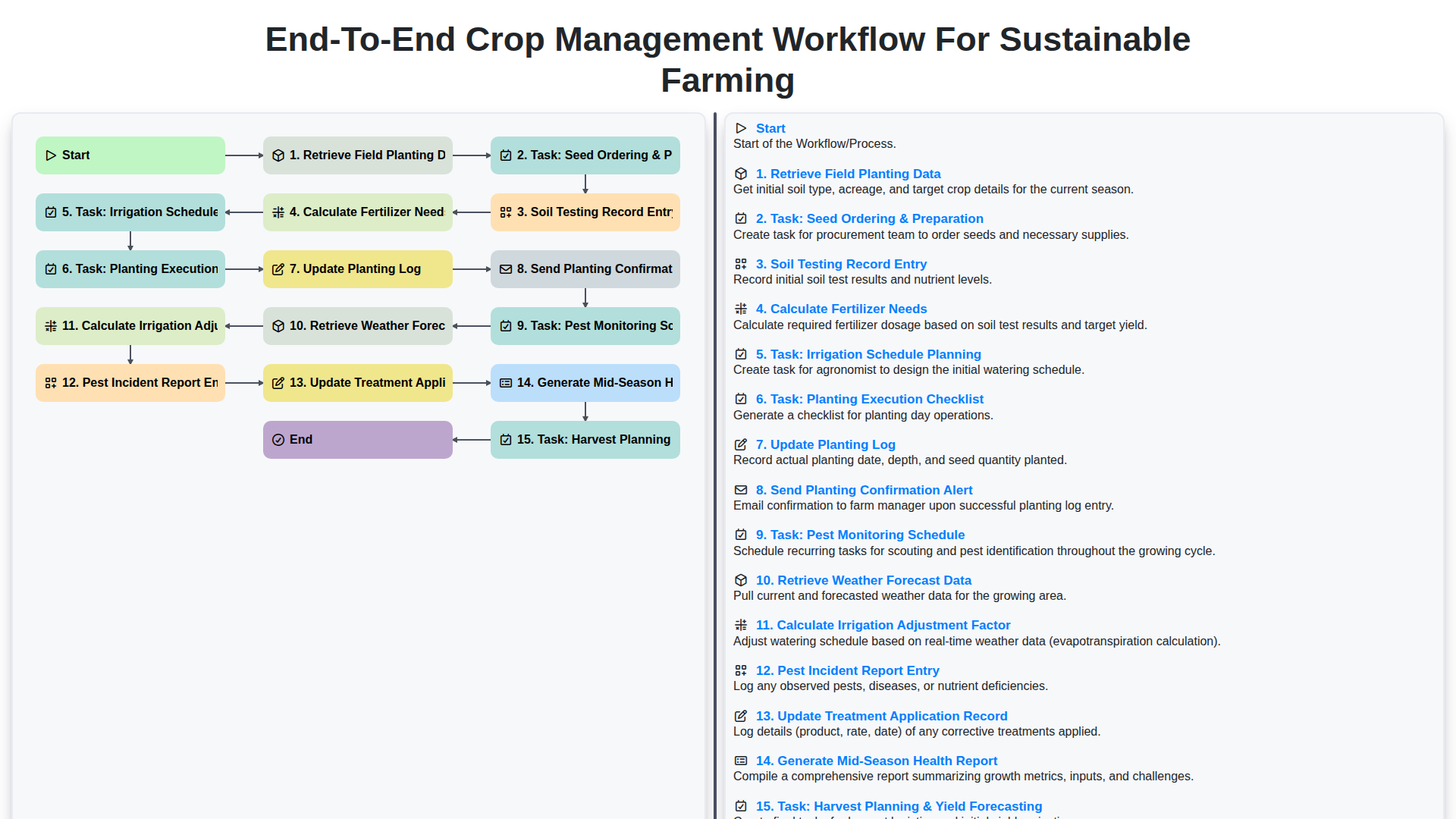
The journey to a bountiful harvest begins long before the first seed touches the soil. Our comprehensive workflow starts with Retrieving Field Planting Data, which serves as the foundational blueprint for the entire season. This initial step brings critical historical and location-specific information to the forefront. Next, we move into proactive resource management. We tackle the essential task of Seed Ordering & Preparation, ensuring that the right, high-quality seeds arrive precisely when needed. Concurrently, understanding the ground is paramount, so we mandate Soil Testing Record Entry to establish a baseline of nutrient availability. Armed with this data, the system can then Calculate Fertilizer Needs with pinpoint accuracy, minimizing waste and maximizing nutrient uptake. Following this, we look to water management by executing the Irrigation Schedule Planning task, setting the initial rhythm for the crop's hydration.
Phase 2: Seeding Success - From Order to Ground Zero
The journey to a bountiful harvest begins long before the seeds touch the soil. This crucial second phase, Seeding Success - From Order to Ground Zero, is where meticulous planning meets preparation. It starts with gathering all necessary intelligence, beginning with the Retrieve Field Planting Data. This initial dataset tells us what needs to be planted, where, and when. This data feeds directly into the Task: Seed Ordering & Preparation, ensuring the right, high-quality seeds are procured and properly stored. Simultaneously, deep understanding of the environment is key; we must Soil Testing Record Entry to establish a baseline nutritional profile. Armed with this knowledge, we can Calculate Fertilizer Needs precisely, optimizing input costs while maximizing plant vigor. Following this, thoughtful resource management dictates the Task: Irrigation Schedule Planning. As the weather forecast comes into play, we Retrieve Weather Forecast Data to predict changing needs, allowing us to Calculate Irrigation Adjustment Factor-a dynamic tweak to our initial schedule. Before the planting even occurs, the Task: Planting Execution Checklist ensures no critical step is missed, and once done, the Update Planting Log provides an immediate, accurate record. Finally, a Send Planting Confirmation Alert notifies all stakeholders that the groundwork is complete, setting the stage for growth.
Phase 3: Nurturing Growth - Soil Health and Nutrition Management
This phase is where the data gathered from initial soil analysis truly comes to life. By systematically integrating Soil Testing Record Entry, we move beyond mere data collection into actionable insights. The next critical step is to Calculate Fertilizer Needs, ensuring that every nutrient requirement is precisely matched to the crop's lifecycle stage and the soil's deficiency profile, promoting optimal nutrient uptake. This precision is vital for sustainability, minimizing waste. Following fertilization planning, the focus shifts to water management with Task: Irrigation Schedule Planning. This isn't a one-size-fits-all approach; it's an adaptive system that feeds into the next major data stream: retrieving the Weather Forecast Data. This allows us to Calculate Irrigation Adjustment Factor, dynamically modifying the schedule based on predicted rainfall or temperature shifts. Complementing water management is vigilance against threats. Through the Pest Monitoring Schedule, field staff systematically log observations, which feed directly into the Pest Incident Report Entry. Should an issue arise, the workflow mandates an Update Treatment Application Record, ensuring a transparent, compliant, and traceable record of all interventions. The culmination of this phase is the Generate Mid-Season Health Report, a comprehensive snapshot that dictates any necessary course corrections before moving into the final stretch.
Phase 4: Water Wisdom - Precision Irrigation Scheduling
Accurate water management is crucial for optimizing crop health and minimizing resource waste. This phase moves beyond simple watering schedules to integrate predictive science. We begin by Retrieving Weather Forecast Data. This feeds directly into calculating the Irrigation Adjustment Factor. Instead of relying on fixed timelines, the system dynamically adjusts water delivery based on predicted rainfall, temperature shifts, and evapotranspiration rates. This intelligence allows us to prevent both under-watering stress and costly over-watering waste. The result is a tailored, highly efficient Irrigation Schedule Planning that ensures your crops receive exactly the right amount of water, precisely when they need it most.
Phase 5: Execution and Documentation - Planting Day Protocols
This crucial phase transitions the planning data into actionable, on-the-ground procedures. The Planting Execution Checklist serves as the operational backbone, guiding teams through every step of planting, from machinery checks to final seed placement. This systematic approach ensures consistency and quality, minimizing human error on the most critical day. Following planting, the Update Planting Log is mandatory. This log documents the precise location, actual seed count, and planting depth for every section of the field, providing an immediate historical record. Crucially, a Send Planting Confirmation Alert is triggered upon completion. This alerts stakeholders (managers, agronomists, and the next-stage team) that the planting phase is complete and that the next set of tasks (like initiating initial irrigation or pest monitoring) can begin without delay.
Phase 6: Monitoring the Environment - Pest and Health Tracking
As the growing season progresses, proactive monitoring is crucial to ensure the health and vitality of your crop. This phase focuses heavily on tracking the environment and the plant's response to it. The process begins with establishing a dedicated Pest Monitoring Schedule, ensuring regular inspections across the fields. When any issues are identified, a detailed Pest Incident Report Entry is mandatory, documenting the pest, the affected area, and initial observations. Following diagnosis, the necessary interventions are logged through the Update Treatment Application Record, providing an auditable trail of every treatment applied. This continuous data stream culminates in the Generate Mid-Season Health Report, offering a comprehensive overview of the crop's overall condition, allowing farmers to pivot quickly if necessary.
Phase 7: Predictive Power - Mid-Season Assessment and Adaptation
This phase marks a crucial shift from reactive management to proactive decision-making. The Generate Mid-Season Health Report isn't just a data compilation; it's the core diagnostic tool of the sustainable farm. By synthesizing data collected throughout the previous stages-everything from initial soil nutrient levels to the success of early pest treatments-this report provides a holistic, actionable snapshot of the crop's current vigor. It flags potential nutrient deficiencies, areas showing early signs of stress (be it water-related or pest-related), and highlights variations in yield estimates compared to initial forecasts. This predictive analysis allows farmers to move beyond simply reacting to visible problems; they can anticipate them, making minor adjustments now that prevent major losses later, thereby maximizing resource efficiency and ensuring the sustainability of the final yield.
Phase 8: Harvesting for Maximum Yield - Planning and Forecasting
This final critical stage moves beyond mere maintenance and into strategic realization. Effective harvest planning is not just about knowing when to cut; it's about maximizing the return on all the previous efforts. We begin by Task: Harvest Planning & Yield Forecasting. This involves analyzing preliminary data gathered throughout the season-growth rates, historical yields for this specific plot, and current plant health markers-to create a precise harvest timeline. Based on this forecast, we can anticipate potential yields, allowing farmers to manage logistics, storage, and sales contracts proactively. This prediction feeds directly into efficient resource allocation for the harvest window.
Integrating Technology: The Digital Backbone of Sustainable Farming
This entire sequence of tasks-from initial planting data retrieval to final yield forecasting-is significantly optimized when supported by interconnected digital tools. A centralized farm management software or a specialized IoT platform acts as the 'digital backbone,' ensuring that data flows seamlessly from one step to the next. For instance, after the initial Seed Ordering & Preparation, the system can automatically prompt the user to Soil Testing Record Entry. Crucially, integrating real-time data streams, such as Weather Forecast Data, directly into the Irrigation Schedule Planning module allows the system to dynamically calculate the necessary Irrigation Adjustment Factor, preventing over- or under-watering before the farmer even steps into the field. Furthermore, by digitizing the Pest Incident Report Entry and linking it to the Update Treatment Application Record, the system builds an immutable, auditable history for every square meter of the field, which directly feeds into the accuracy of the Generate Mid-Season Health Report. This technological synergy moves farming from reactive decision-making to proactive, predictive management, which is the essence of true sustainability.
Case Study Snapshot: Workflow in Action
Consider a mid-sized farm managing corn across several fields. When the planting season approaches, the workflow kicks into gear. First, the system automatically pulls the Field Planting Data for all designated acres. Next, a team member uses the system to initiate the Seed Ordering & Preparation task, cross-referencing optimal seed types with the planting schedule. Simultaneously, the Soil Testing Record Entry is completed, providing crucial baseline nutrient data. This data feeds directly into the Calculate Fertilizer Needs module, which suggests precise NPK ratios for each field zone. Before planting, the Irrigation Schedule Planning task is run, setting preliminary watering dates. On planting day, the team follows the Planting Execution Checklist digitally, and upon completion, the Update Planting Log is instant. A Send Planting Confirmation Alert notifies management and external stakeholders. As the season progresses, the Pest Monitoring Schedule triggers weekly field checks. Crucially, the system integrates Weather Forecast Data, which feeds into the Calculate Irrigation Adjustment Factor, allowing for immediate changes to watering routines. When pests are identified, the Pest Incident Report Entry is logged, followed by the Update Treatment Application Record, ensuring regulatory compliance. Mid-season, the Generate Mid-Season Health Report provides a holistic view. Finally, as maturity nears, the Harvest Planning & Yield Forecasting task guides logistics, completing the cycle of optimized, data-driven farming.
Challenges and Pitfalls to Avoid in Your Workflow
Relying solely on manual tracking is a productivity killer and a breeding ground for errors. Transcribing data from paper records into digital systems introduces human error at every touchpoint. Furthermore, siloed data-where planting information lives in one spreadsheet, soil tests in another, and pest sightings on a notepad-makes a true, actionable overview nearly impossible. This forces farmers to spend critical time gathering data rather than acting on it. Another common pitfall is failing to integrate predictive analytics. Treating these workflow steps as a checklist rather than a dynamic, interconnected system means you are always one step behind the rapidly changing environment. For instance, failing to automatically link the Weather Forecast Data to the Irrigation Schedule Planning leaves you guessing, leading to over- or under-watering, which directly impacts yield. Finally, neglecting automated alerts means crucial decisions-like an immediate fungicide application after a confirmed pest outbreak-might be delayed until the problem escalates beyond manageable levels.
Measuring Success: Key Metrics for Sustainable Farming
Monitoring specific metrics is crucial for proving the impact and return on investment of your sustainable practices. Key indicators you should track include Yield Per Acre (YPA) adjusted for resource inputs, which measures efficiency rather than just raw output. Tracking Water Use Efficiency (WUE)-the amount of yield produced per unit of water consumed-is vital for water-stressed regions. Furthermore, monitoring Input Reduction Percentage (e.g., reduction in synthetic fertilizer or pesticide use year-over-year) directly quantifies your sustainability gains. Don't forget to track Soil Organic Matter (SOM) percentage increase and Water Quality Indicators (like runoff nutrient levels) to validate the ecological health of the land itself. These metrics allow you to move beyond simply doing sustainable practices to actively proving their success.
The Future of Farm Management: Automation and AI
The integration of automation and Artificial Intelligence (AI) is fundamentally reshaping farm management, transforming what was once a labor-intensive, reactive process into a proactive, data-driven science. Modern farm management systems are moving far beyond simple record-keeping; they are becoming intelligent decision-support engines. Automation handles the repetitive, time-consuming tasks-such as automatically logging field activities or sending timely alerts-freeing up farm managers to focus on high-level strategic thinking. AI, meanwhile, breathes predictive power into the system. By analyzing vast datasets-from historical yields and localized soil maps to real-time satellite imagery and complex weather models-AI can predict potential issues before they manifest. For example, instead of just recording a pest sighting, an AI can analyze patterns across multiple fields to predict an outbreak zone days in advance, suggesting optimized, targeted treatment plans rather than blanket applications. This synergy between robotic efficiency and cognitive prediction is the core of achieving truly sustainable, maximally productive farming in the 21st century.
Conclusion: Building a Resilient, Sustainable Farm System
By systematically implementing this end-to-end workflow, farms can move beyond reactive problem-solving to proactive, data-driven stewardship. This integrated approach ensures that every stage, from initial soil assessment to final harvest yield forecasting, is managed with precision and sustainability in mind. This structured methodology minimizes waste, optimizes resource allocation-be it water, fertilizer, or labor-and significantly reduces the environmental footprint of farming. Ultimately, adopting a cohesive workflow like this isn't just about efficiency; it's about cultivating resilience. It empowers farmers to adapt swiftly to changing climates, unpredictable pests, and fluctuating market demands, ensuring healthier yields, greater profitability, and a sustainable future for the land and community.
Resources & Links
- EPA - Sustainable Agriculture Resources : General guidelines and best practices for sustainable resource management in agriculture.
- Purdue Extension - Farming Resources : University-backed educational materials on various farming practices, soil science, and crop management.
- USDA - Farming Practices : Official government resources covering sustainable farming techniques and regulations.
- Sustainable Agriculture Research Hub : Articles and reports on modern, environmentally friendly agricultural methodologies.
- Advanced Irrigation Technology Insights : Industry resources focused on precision irrigation, sensors, and water conservation.
- AgriTech News & Reviews : Latest articles on farm technology, IoT, and farm management software.
- Scientific Deep Dives on Agri-Systems : In-depth articles providing scientific context to farming challenges and solutions.
Häufig gestellte Fragen
What is a sustainable farming workflow?
A sustainable farming workflow is a comprehensive, end-to-end management process that integrates ecological health with agricultural productivity. It involves continuous monitoring, resource optimization, and practices like crop rotation and integrated pest management to ensure long-term soil fertility and environmental stability.
What are the key stages included in an end-to-end crop management guide?
The essential stages include pre-planting preparation (soil testing and seed selection), planting, nutrient and water management, crop monitoring, pest and disease control, harvesting, and post-harvest storage/distribution.
How can technology help in mastering sustainable crop management?
Technology plays a vital role through the use of Precision Agriculture tools such as IoT sensors for soil moisture, drone imagery for crop health assessment, and data analytics for predictive modeling, all of which help minimize waste and optimize input usage.
What is the importance of soil health in this workflow?
Soil health is the foundation of sustainable farming. Maintaining high organic matter and microbial activity through practices like cover cropping and composting ensures nutrient availability, reduces the need for chemical fertilizers, and improves water retention.
How do I implement integrated pest management (IPM) within my workflow?
IPM involves a multi-layered approach: starting with biological controls and habitat manipulation to prevent pests, using physical barriers, and only resorting to targeted chemical pesticides as a last resort when economic thresholds are met.
War dieser Artikel hilfreich?
Demonstration der Managementlösung für die Landwirtschaft
Der Betrieb eines Bauernhofs oder eines landwirtschaftlichen Unternehmens ist komplex. ChecklistGuro's Work OS Plattform vereinfacht Ihre Abläufe, von der Anbauplanung und Bewässerungsmanagement bis hin zur Tierverfolgung und Ernteplanung. Erhöhen Sie die Effizienz, reduzieren Sie Abfall und steigern Sie die Erträge! Sehen Sie, wie ChecklistGuro Ihr landwirtschaftliches Unternehmen revolutionieren kann.
Verwandte Artikel
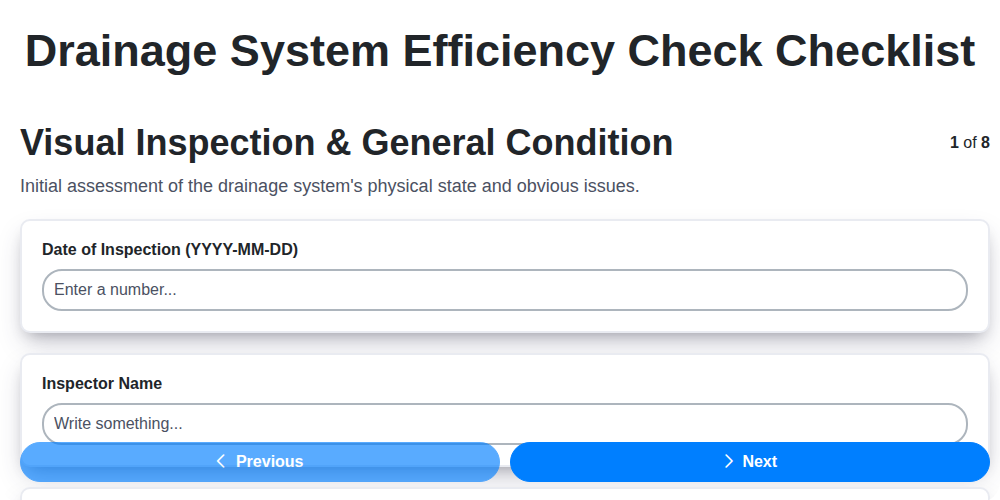
10 einfache Schritte zu einem gesunden Entwässerungssystem: Ihre Checklisten-Vorlage

Die tägliche Erntebeobachtung meistern: Ihre Checklisten-Vorlage für [Spezifische Feldfrüchte]
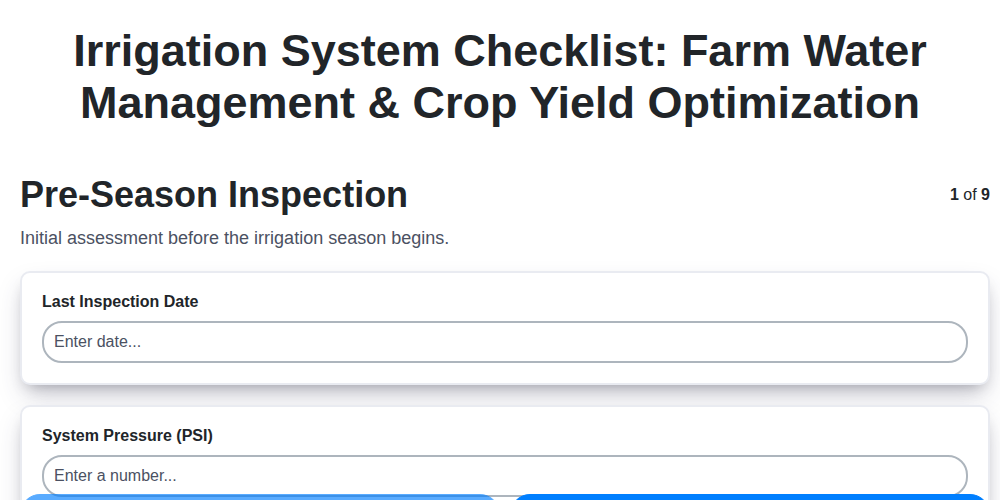
Bewässerungssystem-Checkliste: Farm-Wasserwirtschaft & Optimierung der Ernteerträge
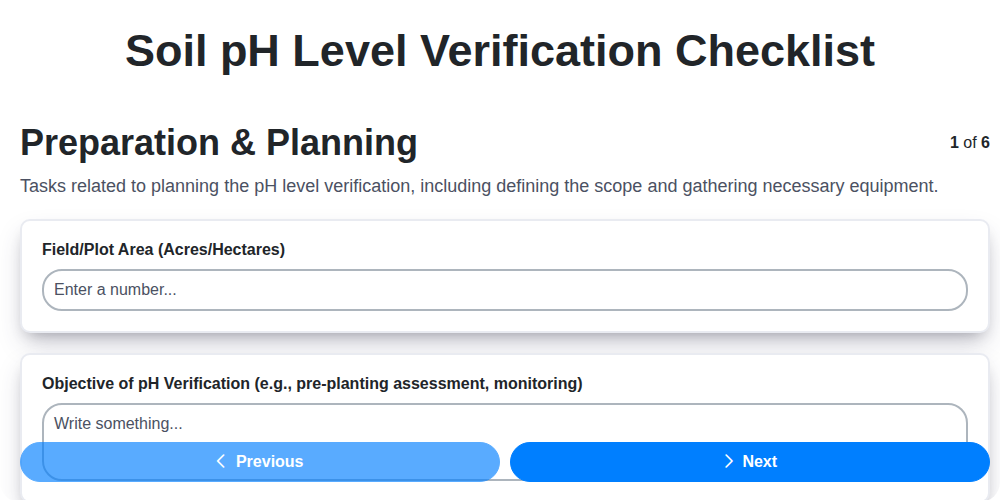
Entfesseln Sie das Potenzial Ihres Gartens: Eine Checkliste zur Überprüfung des pH-Werts des Bodens
PSA-Nutzungs-Checkliste: Ihr Leitfaden zur Sicherheit
Wasserabgabegenehmigung – Compliance-Checkliste (Vorlage)
Die ultimative Checklisten-Vorlage für GPS- und Präzisionslandwirtschaftskalibrierung
Prüfliste zur Analyse des Oberflächenabflusses
Gemeinsam schaffen wir das
Benötigen Sie Hilfe bei Checklisten?
Haben Sie eine Frage? Wir helfen Ihnen gerne. Bitte senden Sie uns Ihre Anfrage, und wir werden Ihnen umgehend antworten.