Maximize Your Shop's Output: The Ultimate 2026 Automotive Workshop Productivity & Technician Efficiency Checklist Template
Veröffentlicht: 30.10.2026 Aktualisiert: 31.10.2026
Inhaltsverzeichnis
- Introduction: The Future of Workshop Efficiency in 2026
- 1. Pre-Shift Preparation & Resource Readiness
- 2. Work Order & Job Assignment Management
- 3. Technician Tool & Equipment Utilization
- 4. Parts Availability & Workflow Integration
- 5. Workshop Bay Throughput & Cycle Time Optimization
- 6. Labor Time & Flat Rate Efficiency Tracking
- 7. Digital Documentation & Real-Time Reporting
- 8. Quality Control & Re-Work Prevention
- 9. Technician Training & Skill Development
- 10. End-of-Day Performance Review & Reporting
- Conclusion: Building a High-Performance Workshop Culture
- Resources & Links
TLDR: Streamline your automotive workshop for the future with this comprehensive 2026 productivity checklist. Learn how to optimize every stage of the repair process-from pre-shift preparation and intelligent job assignment to advanced digital reporting and quality control-to boost technician efficiency, reduce cycle times, and maximize shop profitability.
Introduction: The Future of Workshop Efficiency in 2026
As we approach 2026, the automotive aftermarket landscape is undergoing a seismic shift. The integration of electric vehicle (EV) maintenance, increasingly complex diagnostic software, and rising customer expectations for rapid turnaround times means that working hard is no longer enough to sustain a profitable garage. To remain competitive, workshop owners must transition from reactive management to proactive, data-driven orchestration.
The New Standard of Workshop Management
The margin for error in modern automotive repair is shrinking. In an era of rising overhead and labor shortages, productivity is no longer just about how many cars pass through your bays-it is about how effectively you manage the synchronization of tools, parts, talent, and technology.
The difference between a shop that struggles to break even and one that scales profitably lies in operational precision.
Moving Beyond the Busy Trap
Many service managers fall into the trap of equating a busy shop with a productive one. However, a shop can be overwhelmed with vehicles but still suffer from massive revenue leaks due to inefficient workflow, high rework rates, or poor parts integration.
To achieve true efficiency in 2026, you must focus on:
- Minimizing Idle Time: Reducing the gaps between job completion and the next assignment.
- Optimizing Technician Output: Ensuring your most skilled technicians are focused on high-complexity tasks while maximizing their billable hours.
- Eliminating Friction: Removing the small, repetitive delays-like waiting for parts or searching for tools-that aggregate into lost revenue.
How to Use This Checklist
The following checklist is designed as a high-level strategic audit for workshop owners, service managers, and shop foremen. It is not merely a list of tasks, but a framework for continuous improvement. By systematically reviewing each of these ten critical pillars, you can identify bottlenecks in your current workflow and implement a streamlined, tech-forward approach to automotive service delivery.
Whether you are managing a single-bay independent shop or a multi-location enterprise, this template will serve as your roadmap to maximizing throughput and maximizing your bottom line.
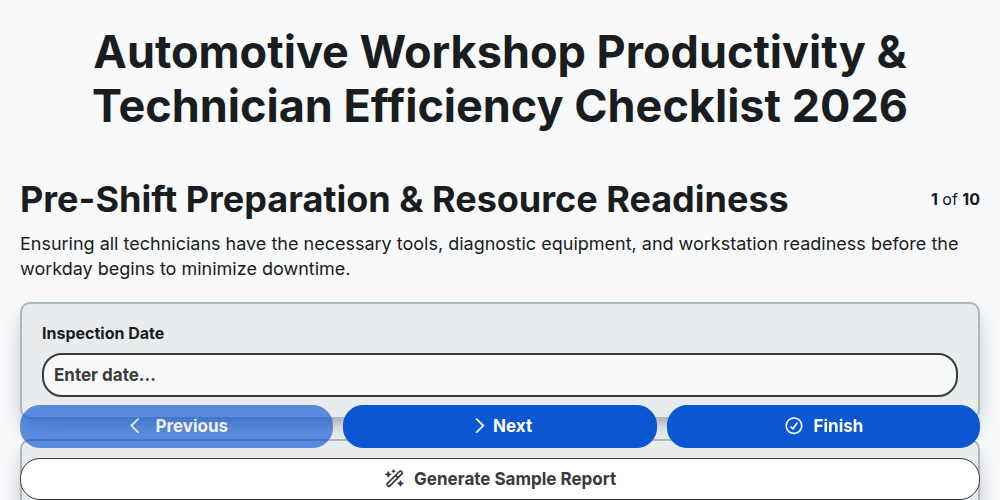
1. Pre-Shift Preparation & Resource Readiness
Setting the Stage for a High-Performance Day
Efficiency in an automotive workshop isn't born on the shop floor; it is engineered before the first engine even starts. The first hour of your shift dictates the trajectory of the next eight. To avoid the reactive mode trap-where technicians spend more time hunting for information than turning wrenches-your morning routine must be a disciplined sequence of preparation.
The Foundation of Workflow Continuity
A productive workshop operates on predictability. When technicians arrive to a chaotic environment, productivity plummets due to decision fatigue and administrative friction. Use this segment of the checklist to ensure every necessary element is in place before the first work order is assigned.
Critical Readiness Checkpoints:
- Station & Bay Audit: Ensure all service bays are clear of debris from the previous shift and that floor surfaces are clean and safe.
- Consumable Inventory Check: Verify that high-turnover items (shop towels, cleaners, lubricants, and basic fasteners) are replenished and within reach of the workstations.
- Digital Workspace Sync: Ensure all diagnostic tablets, shop management software (SMS) terminals, and communication devices are booted up, updated, and logged in.
- Daily Briefing Alignment: Conduct a 5-minute stand-up meeting to communicate the day's specific goals, high-priority vehicles, and any critical staffing shortages.
- Safety Perimeter Verification: Confirm that all lifting equipment, ventilation systems, and emergency eye-wash stations are fully operational and unobstructed.
The Goal: Eliminating Dead Time
The objective of pre-shift readiness is to eliminate Dead Time-the period between a technician starting their shift and actually performing billable work. By auditing your resources in advance, you transform the start of the day from a period of searching into a period of executing.
2. Work Order & Job Assignment Management
Optimizing the Workflow: Precision in Job Assignment
In 2026, the difference between a profitable workshop and a struggling one lies in how work is distributed. Effective job assignment management is no longer just about handing out papers; it is about strategic resource allocation. To maximize throughput, your management process must focus on matching the right task to the right skill set while minimizing dead time between jobs.
Strategic Technician Matching
The era of one size fits all assignments is over. Efficiency begins with analyzing the complexity of a work order against the specific competency of your technicians.
- Skill-Based Routing: Route heavy engine diagnostics and electrical complexities to your master technicians, while reserving routine maintenance (oil changes, brake pads, tire rotations) for junior techs or apprentices.
- Load Balancing: Monitor real-time technician capacity. Avoid overwhelming a high-performer while leaving another technician idle, which creates bottlenecks in the overall workshop flow.
Digital Work Order Lifecycle
A seamless workflow requires that a work order moves through the shop without manual friction.
- Digital Intake Integration: Ensure that customer concerns captured during the service drive are instantly visible to the technician on their digital tablet. This eliminates transcription errors and reduces re-reading time.
- Dynamic Priority Management: Implement a system where high-priority quick lane jobs can be interspersed with long-duration repairs without disrupting the workshop's rhythm.
- Real-Time Status Updates: Every technician should be able to update the status of a job (e.g., Waiting for Parts, In Progress, Pending QC) instantly. This transparency allows service advisors to provide accurate updates to customers, reducing unnecessary phone inquiries.
Minimizing The Gap
The greatest enemy of efficiency is the gap-the time between a job being completed and the next one starting.
- Pre-Assignment Planning: Use the hour before the shift starts to stage the next wave of work orders.
- Automated Notifications: Set up alerts that notify technicians the moment a vehicle is moved into their bay and the parts required are confirmed as ready.
3. Technician Tool & Equipment Utilization
Optimizing Asset Performance for Peak Output
In 2026, a technician's productivity is no longer measured solely by their manual dexterity, but by how effectively they leverage the advanced technology surrounding them. To minimize downtime and eliminate searching time, your workshop must move beyond basic tool ownership to a strategy of active asset management.
Maximizing Tool Accessibility and Maintenance
The goal is to ensure that every second a technician spends looking for a specialized wrench or a diagnostic scanner is a second of lost revenue.
- Standardized Tool Kits: Implement a standardized baseline of essential tools for every bay to reduce dependency on shared communal bins.
- Preventative Maintenance (PM) Schedules: Integrate a digital tracking system for shop equipment-such as lifts, compressors, and tire changers-to prevent unexpected breakdowns that halt production.
- Calibration Tracking: Use automated alerts to ensure all torque wrenches and precision diagnostic tools are calibrated according to manufacturer standards, preventing costly errors.
Leveraging Smart Diagnostic & Digital Integration
As vehicle complexity increases, the tool is often a software interface.
- Diagnostic Tablet Integration: Ensure all technicians have high-speed, seamless access to cloud-based diagnostic databases and OEM software.
- The Single Source of Truth Hardware: Equip bays with ruggedized tablets or integrated shop monitors so technicians can view schematics, wiring diagrams, and digital work orders without leaving the vehicle.
Inventory Control of Consumables
Efficiency dies in the small stuff. A technician shouldn't leave their bay to hunt for brake cleaner or shop rags.
- Point-of-Use Supply Systems: Implement organized, easy-access stations for high-turnover consumables (lubricants, fasteners, cleaning agents) within each workstation.
- Shadow Boarding & 5S Implementation: Adopt the 5S methodology (Sort, Set in order, Shine, Standardize, Sustain) for all shared specialty tools to ensure instant visual identification of missing or misplaced equipment.
4. Parts Availability & Workflow Integration
Eliminating the Wait Time Bottleneck
In a high-performance workshop, the greatest enemy of productivity isn't a slow technician-it's a stationary vehicle. Even the most skilled mechanic becomes a cost center when they are forced to wait for a single gasket or a sensor to arrive from the warehouse. To hit your 2026 efficiency targets, parts management must evolve from a reactive task to a proactive workflow component.
The Integration Imperative
True efficiency is achieved when the parts department and the service bays operate as a single, synchronized unit. In 2026, integration means moving away from the call-and-wait method toward a predictive model.
- Pre-Staging Strategy: For scheduled maintenance and known repairs, parts should be kitted and placed at the designated bay or technician station before the vehicle even enters the lift.
- Real-Time Inventory Sync: Ensure your DMS (Dealer Management System) provides real-time visibility. Technicians should be able to verify part availability via tablets without leaving their workstations.
- Automating the Requisition Loop: Implement digital triggers that notify the parts department the moment a technician identifies a needed component during inspection, reducing the lag between diagnosis and repair.
Optimizing the Supply Chain Workflow
Efficiency isn't just about having the part; it's about the speed of the internal logistics.
- Minimize Shop Floor Wandering: Every minute a technician spends walking to the parts counter is a minute of lost billable time. Optimize your shop layout to ensure high-frequency consumables are accessible within the workflow.
- The Backorder Protocol: Establish a standardized process for handling parts delays. If a part is delayed, the workshop controller should immediately reassign the technician to a different job to prevent dead time in the bay.
- Standardized Kit Accuracy: Implement a double-check system for kits to ensure that every necessary washer, sealant, or bolt is included. A missing $2 bolt can derail a $1,000 labor operation.
5. Workshop Bay Throughput & Cycle Time Optimization
Streamlining Flow: Maximizing Bay Utilization and Reducing Cycle Time
In the competitive landscape of 2026, the profitability of your workshop is no longer determined solely by how many cars you can fix, but by how quickly you can move them through your service bays. High-performing workshops focus on throughput-the rate at which vehicles enter, are serviced, and exit the shop-and cycle time-the total time a vehicle spends in your care.
To prevent bottlenecks and ensure your bays are never sitting idle, use this optimization checklist:
Strategies for Reducing Vehicle Downtime
- Identify and Eliminate Dead Time: Audit your workflow to find periods where a vehicle is occupying a bay but no actual repair work is being performed (e.g., waiting for parts, waiting for technician availability, or waiting for customer approval).
- Implement Staggered Starts: Avoid the morning bottleneck by staggering technician start times or specialized equipment availability, ensuring a continuous flow of work throughout the day rather than a single morning rush.
- Pre-Stage Workflows: Ensure that vehicles for the next scheduled appointment are pre-inspected or staged near the appropriate bay to minimize the time spent on vehicle movement and intake.
Optimizing Bay Turnover
- Standardize Bay Specialization: Consider designating specific bays for Quick Service (oil changes, brake inspections) versus Heavy Repair (engine/transmission work). This allows your high-speed technicians to maintain a rapid rhythm without being interrupted by long-duration projects.
- Monitor Bay Occupancy Metrics: Track how long a bay remains occupied by a single VIN. If a bay's cycle time is trending upward, investigate whether it is due to equipment failure, lack of technician availability, or inefficient parts delivery.
- The Clean Bay Protocol: Integrate a mandatory 5-minute reset period between jobs. A bay cluttered with leftover parts and debris from a previous repair is a primary driver of increased cycle time for the next technician.
Goal: The Seamless Transition
The ultimate goal of optimizing throughput is to transform your workshop from a series of disconnected repair events into a synchronized production line. When you minimize the time a vehicle spends waiting, you simultaneously increase your daily car count and your shop's total revenue.
6. Labor Time & Flat Rate Efficiency Tracking
Optimizing Your Shop's Most Valuable Asset: Labor & Efficiency
In 2026, managing a workshop is no longer just about how many cars pass through the door; it is about how much productive time is actually being captured. To maintain profitability in an era of rising overhead, you must move beyond busy-ness and focus on effective labor utilization.
Mastering the Metrics: Efficiency vs. Productivity
To drive growth, your management team must distinguish between these two critical KPIs:
- Productivity: The percentage of a technician's clocked hours that are spent on actual repair orders (wrench time).
- Efficiency: The ratio of the time it should take to complete a job (flat rate/book time) versus the actual time the technician spent performing it.
Strategies for High-Performance Tracking
1. Implementing Real-Time Flat Rate Monitoring
Waiting until the end of the week to review performance is a recipe for lost revenue. Utilize integrated Shop Management Systems (SMS) to track real-time progress against estimated labor times. If a technician is consistently trending below 100% efficiency on standard tasks, it provides an immediate signal for targeted intervention.
2. Identifying Lost Time Leakage
Efficiency isn't always about speed; it's about the elimination of friction. Use your tracking data to identify where technicians are losing time. Common culprits include:
- Waiting for parts delivery.
- Searching for specialized diagnostic tools.
- Excessive downtime caused by incomplete work orders.
- Administrative delays in job approvals.
3. Incentivizing Performance with Data
Use your efficiency data to build a transparent, merit-based incentive program. When technicians see a direct correlation between their efficiency ratings and their compensation, motivation increases. However, ensure your tracking software also monitors for rushing, which can lead to quality issues.
4. The Golden Ratio of Labor Utilization
Aim for a balanced workflow where technicians are neither overwhelmed (leading to burnout and errors) nor underutilized (leading to wasted overhead). By tracking labor time against your workshop's total capacity, you can predict future staffing needs and optimize your appointment scheduling to prevent gaps in the daily production schedule.
7. Digital Documentation & Real-Time Reporting
Embracing the Paperless Garage: Real-Time Data for Instant Decisions
In 2026, the era of checking the clipboard at the end of the day is officially over. To maintain a competitive edge, your workshop must transition from reactive management to proactive, data-driven leadership. Digital documentation is no longer a luxury; it is the backbone of a high-output service center.
Moving Beyond Paper Trails
The integration of cloud-based Workshop Management Systems (WMS) allows every technician to input data directly from tablets or mobile workstations. This eliminates the information lag that occurs when technicians manually write notes that must later be transcribed by service advisors.
Key digital milestones to track:
- Instant Status Updates: Transitioning a job from In Progress to Awaiting Parts or Ready for QC in real-time so the front office can manage customer expectations instantly.
- Digital Vehicle Health Checks (VHC): Using photos and videos attached to digital inspections to provide transparent, indisputable evidence to customers, which significantly boosts approval rates.
- Automated Digital Sign-offs: Ensuring all authorizations are timestamped and stored, protecting the shop against liability and disputes.
Leveraging Real-Time Reporting for Agility
The true power of digital documentation lies in the ability to generate live dashboards. Rather than waiting for a weekly summary, shop managers should be able to view Live Shop Loading at any moment.
Essential Metrics to Monitor via Digital Dashboards:
- Live Bay Occupancy: Identify instantly which bays are stagnant and which are moving through the workflow.
- Real-Time Labor Utilization: Monitor the gap between clocked hours and actual billable hours as they happen, allowing for mid-shift adjustments.
- Instant Bottleneck Detection: If a specific stage of the workflow (e.g., waiting for technician release) is accumulating digital piles, management can intervene before it impacts the entire day's schedule.
By digitizing your documentation, you aren't just saving paper; you are creating a transparent, high-velocity information stream that allows your management team to make surgical adjustments to productivity in real-time.
8. Quality Control & Re-Work Prevention
The Cost of Getting it Wrong Twice
In a high-efficiency workshop, re-work is the ultimate profit killer. When a vehicle returns to the bay because a bolt wasn't torqued or a diagnostic was missed, you aren't just losing labor time; you are losing bay availability, technician focus, and-most importantly-customer trust. In 2026, with rising parts costs and tighter margins, doing it right the first time is no longer a goal; it is a financial necessity.
Implementing a Multi-Stage Verification Process
To eliminate the cycle of re-work, your checklist must move beyond a simple check the oil mentality. Implement a structured verification system:
- The Technician Self-Check: Before a job is marked as complete, technicians must follow a standardized digital checklist specific to the repair type (e.g., brake service, engine timing, or electrical diagnostics).
- The Secondary Inspector Protocol: For high-complexity repairs, implement a peer-review or shop foreman sign-off. A fresh set of eyes can often catch the small oversight that the primary technician became blind to during a long shift.
- Standardized Road Testing: Ensure every vehicle undergoes a documented road test following specific parameters to verify performance under real-world driving conditions.
Leveraging Digital Verification Tools
Modern productivity relies on digital accountability. Use your Workshop Management System (WMS) to mandate photo/video evidence of completed repairs.
- Visual Proof: Requiring technicians to upload photos of new parts installed or cleaned components provides an indisputable digital paper trail.
- Automated Error Flags: Use digital checklists that prevent a work order from being closed until all critical safety must-checks are electronically timestamped and verified.
Root Cause Analysis (RCA)
A checklist is only effective if it leads to improvement. When a re-work event occurs, don't just fix the car-analyze the failure. Was it a lack of specialized tooling? Was it a training gap? Or was it a rushed job due to poor scheduling? By tracking the reason for every re-work, you can adjust your workflow to prevent the same mistake from happening in the next shift.
9. Technician Training & Skill Development
Future-Proofing Your Workforce: Beyond Basic Competency
In 2026, a technician's value is no longer measured solely by their ability to turn a wrench, but by their ability to navigate a complex ecosystem of software, sensors, and hybrid-electric architectures. As vehicle complexity accelerates, your checklist must move beyond maintenance training and into continuous competency evolution.
Closing the Skills Gap with Targeted Upskilling
The most significant drain on workshop productivity is the hesitation period-the time a technician spends stuck on a diagnostic problem because they lack familiarity with a new module or protocol. To minimize downtime, implement a structured training cadence:
- EV/HEV Specialization: As high-voltage vehicles become the workshop standard, ensure your team is certified in high-voltage safety and battery diagnostics to prevent workflow bottlenecks.
- Advanced Diagnostic Software Mastery: Training shouldn't just be on the vehicle, but on the tools. Ensure every technician is proficient in the latest ADAS calibration software and telemetry analysis tools.
- Soft Skills for Technical Leads: As your senior technicians move into supervisory roles, provide training in communication and workflow management to ensure the efficiency part of your checklist is maintained at the leadership level.
Implementing a Learning-as-a-Workflow Model
Don't treat training as an annual event that pulls technicians off the floor for days at a time. Instead, integrate micro-learning into your daily operations:
- The 15-Minute Morning Brief: Use part of your pre-shift meeting to review a single new diagnostic trick or a common error code found in the previous day's work orders.
- Digital Knowledge Base: Maintain a searchable, internal wiki of Shop Standard Operating Procedures (SOPs) and documented fixes for recurring complex issues.
- Cross-Training Rotation: Periodically rotate technicians through different bay specialties. A technician who understands both mechanical repair and electrical diagnostics is far more efficient at navigating complex, multi-system failures.
Measuring the ROI of Training
To ensure this step remains a productivity driver rather than a cost center, track the correlation between training milestones and Re-Work Prevention and Cycle Time. If training in advanced diagnostics leads to a measurable drop in diagnostic time on complex jobs, your investment is paying off.
10. End-of-Day Performance Review & Reporting
Closing the Loop: The Power of the Daily Debrief
The final hour of the workday is often the most undervalued period in a busy workshop. As technicians prepare to clock out, the temptation is to simply shut down and leave. However, the most productive shops in 2026 treat the end-of-day period as a critical data-collection phase that dictates the success of the following morning.
Effective end-of-day reporting isn't about micromanaging; it's about identifying bottlenecks before they become tomorrow's crises.
Key Components of an Effective End-of-Day Review
To ensure your workshop maintains a trajectory of continuous improvement, your daily closing routine should focus on these three pillars:
1. Daily KPI Snapshot Review the hard numbers from the day's operations. Compare your actual billable hours against the scheduled hours.
- Did we meet our target productivity percentage?
- What was the total revenue generated vs. the daily goal?
- How many vehicles were completed vs. how many were left in the bays?
2. The Pending & Progress Audit Before the shop floor is cleared, ensure every open work order has an updated status.
- Status Updates: Every vehicle currently in a bay must have a clear note regarding its current stage (e.g., Awaiting parts, Diagnostic complete, or Final testing).
- Tomorrow's Roadmap: Identify which jobs are scheduled to start first thing in the morning to ensure technicians can hit the ground running without waiting for service advisors.
3. Incident & Bottleneck Logging Use this time to document the why behind any deviations from the plan. If a technician's efficiency dropped, was it due to a broken lift, a delayed parts delivery, or an undocumented complication? Documenting these friction points allows management to implement long-term structural fixes rather than repeatedly fighting the same daily battles.
Pro-Tip for 2026: Automated Reporting
Leverage your Workshop Management Software (WMS) to automate this process. Instead of manual tallying, set up an automated End-of-Day Digest that emails the service manager a summary of productivity, parts delays, and completed job counts. This transforms the end-of-day review from a manual chore into a high-level strategic briefing.
Conclusion: Building a High-Performance Workshop Culture
Beyond the Checklist: Cultivating Continuous Improvement
Implementing this checklist is not a one-and-done task; it is the foundation of a high-performance culture. In the rapidly evolving automotive landscape of 2026, the difference between a struggling garage and a highly profitable workshop lies in the transition from reactive firefighting to proactive management.
Efficiency is rarely the result of a single heroic effort by a technician; rather, it is the byproduct of a frictionless system where tools are ready, parts are staged, and data is transparent. By systematically auditing your operations against these ten pillars, you are doing more than just tracking time-you are eliminating the hidden wastes that erode your profit margins.
Moving Toward Data-Driven Leadership
As you integrate these steps into your daily routine, keep these three principles in mind:
- Consistency Over Intensity: A perfectly organized shop is maintained through daily habits, not monthly clean-ups. Use the End-of-Day Performance Review to identify patterns, not just to point out mistakes.
- Empower Your Technicians: Efficiency shouldn't feel like surveillance. When you focus on Resource Readiness and Parts Availability, you are providing your team with the tools they need to succeed, which boosts morale and reduces burnout.
- Iterate Based on Results: Use the insights from your Digital Documentation to refine the checklist. If Cycle Times are lagging despite high Labor Efficiency, it's a sign that your bottleneck might lie in your Parts Workflow, not your technicians' speed.
The Path to 2026 and Beyond
The automotive industry is moving toward greater complexity with EVs, advanced ADAS, and integrated software diagnostics. The workshops that thrive will be those that treat productivity as a measurable science.
Start by picking two or three areas from this checklist where you see the most friction. Master them, stabilize them, and then move to the next. Your journey toward a leaner, more profitable, and highly efficient workshop begins with the first checkmark.
Resources & Links
- Auto Repair Estimating Software: Tools for managing labor time, parts pricing, and digital inspection workflows to improve shop accuracy.
- Shopmonkey Workshop Management: A cloud-based platform for managing work orders, technician productivity, and real-time shop communication.
- AutoZone Pro: Resources for parts availability and professional-grade components to minimize vehicle downtime.
- Service Consultants Association: Industry standards and best practices for service advisors to optimize customer workflow and communication.
- Automotive Service Association: Professional resources regarding workshop regulations, safety standards, and industry growth trends.
- Snap-on Tools: High-performance diagnostic tools and equipment essential for technician efficiency and precision.
- Denton Automotive: Advanced workshop equipment and diagnostic solutions to improve bay throughput and technical accuracy.
- Forbes Business Insights: General business management strategies applicable to scaling service-based operations and labor management.
- Lean Business Academy: Principles of Lean methodology applied to workshop workflow, waste reduction, and cycle time optimization.
- Entrepreneur Magazine: Leadership and management resources for building a high-performance workplace culture and team retention.
- OSHA Workshop Safety: Essential guidelines for maintaining a safe workshop environment to prevent downtime and employee injury.
- Automotive News: Latest industry trends, technological shifts, and market forecasts for the automotive aftermarket in 2026.
- McKinsey & Company: Deep dives into operational excellence, digital transformation, and productivity optimization strategies.
- Automotive Training Resources: Platforms focused on technician skill development, continuous learning, and modern vehicle technology training.
- Digital Communication Tools: Software solutions for real-time reporting and improving the customer-technician feedback loop.
Kommentare
Bisher gibt es keine Kommentare. Seien Sie der Erste, der einen hinzufügt!
Demonstration der Lösung für das Management der Automobilproduktion
Optimieren Sie Ihre Automobilproduktion! ChecklistGuro digitalisiert Arbeitsabläufe, von der Teileprüfung bis zum Endtest. Reduzieren Sie Fehler, steigern Sie die Effizienz und stellen Sie die Qualitätskonformität sicher. Erzielen Sie Ergebnisse mit unserer Work OS.
Verwandte Artikel
Automotive Customer Satisfaction: Your Follow-Up Checklist for Lasting Loyalty
The Ultimate Automotive Sales Prospect Follow-Up Checklist: Close More Deals

The Ultimate Vehicle Registration & Insurance Validation Checklist

Drive Sales Success: Your Automotive Sales Team Performance Tracking Checklist
The Ultimate Automotive Dealer Operations Checklist: A Comprehensive Guide
Die ultimative Vorlage für die Reifenprüfliste zu Druck und Zustand

Maximize Your Trade-In: The Automotive Appraisal Checklist You Need
Streamline Your Shop: The Ultimate Automotive Parts Ordering & Receiving Checklist
Benötigen Sie Hilfe bei Checklisten?
Haben Sie eine Frage? Wir helfen Ihnen gerne. Bitte senden Sie uns Ihre Anfrage, und wir werden Ihnen umgehend antworten.