Mastering the Future: The Ultimate ERP Supply Chain Visibility & Integration Checklist for 2026
Veröffentlicht: 30.10.2026 Aktualisiert: 31.10.2026
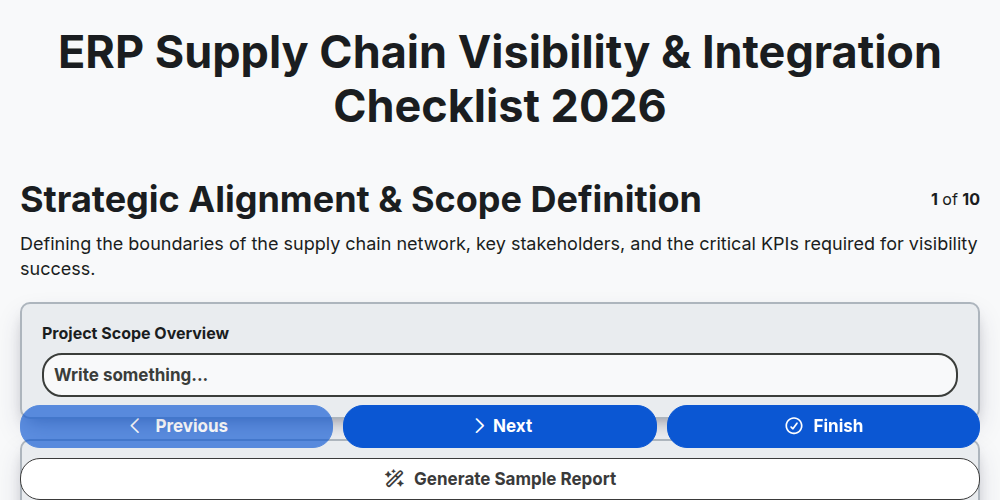
Inhaltsverzeichnis
- Introduction: Navigating the Complexity of 2026 Supply Chains
- Phase 1: Laying the Foundation: Strategic Alignment & Scope Definition
- Phase 2: Expanding the Network: Multi-Tier Supplier Integration
- Phase 3: Bridging the Digital Gap: Real-Time Data Connectivity & IoT Integration
- Phase 4: Achieving Precision: Inventory Visibility & Tracking Accuracy
- Phase 5: Optimizing Movement: Logistics & Distribution Monitoring
- Phase 6: Synchronizing the Flow: Demand Forecasting & Replenishment Sync
- Phase 7: Proactive Resilience: Risk Management & Exception Alerting
- Phase 8: The Single Source of Truth: Data Standardization & Master Data Integrity
- Phase 9: Driving Actionable Insights: Performance Analytics & Reporting
- Phase 10: Safeguarding the Ecosystem: Security, Compliance & Audit Trails
- Conclusion: Building a Future-Proof ERP Ecosystem
- Resources & Links
TLDR: As supply chains face increasing complexity, achieving end-to-end visibility requires more than just basic tracking. This checklist provides a strategic roadmap for 2026, covering critical pillars such as multi-tier supplier integration, IoT-driven real-time connectivity, AI-powered demand forecasting, and robust data integrity to ensure your ERP ecosystem is resilient, automated, and ready for the future of autonomous logistics.
Introduction: Navigating the Complexity of 2026 Supply Chains
Navigating the Complexity of 2026 Supply Chains
As we approach 2026, the global supply chain landscape has moved far beyond the era of simple track and trace capabilities. We have entered an age of hyper-complexity, characterized by geopolitical volatility, fragmented logistics networks, and a relentless demand for instantaneous information. In this environment, a disconnected ERP system isn't just an operational bottleneck-it is a critical business risk.
The era of reactive management is over. To remain competitive, modern enterprises are transitioning from mere data collection to active ecosystem orchestration. The goal is no longer just to see what is happening in your warehouse, but to predict what is happening three tiers deep in your supplier network before it impacts your bottom line.
The Shift Toward Total Visibility
The disconnect between siloed departments and fragmented data points is the primary driver of the visibility gap. When your ERP cannot communicate seamlessly with IoT sensors, logistics providers, or multi-tier suppliers, you are essentially flying blind. This lack of integration leads to the bullwhip effect, where minor fluctuations in demand trigger massive, costly inefficiencies upstream.
Why This Checklist Matters Now
The 2026 supply chain demands a unified digital thread. Achieving this requires more than just upgrading software; it requires a strategic overhaul of how data flows across your entire value chain. Whether you are managing global manufacturing, complex distribution, or highly sensitive raw material sourcing, your ERP must serve as a single source of truth that is:
- Predictive: Moving from what happened to what will happen.
- Integrated: Breaking down the walls between internal processes and external partners.
- Automated: Reducing manual intervention through real-time IoT and AI-driven insights.
The following checklist is designed to guide your digital transformation journey. It provides a strategic roadmap to ensure your ERP ecosystem is prepared to handle the scale, speed, and complexity of the 2026 marketplace. Use these steps to audit your current capabilities and identify the critical integration points necessary to build a resilient, transparent, and highly responsive supply chain.
Phase 1: Laying the Foundation: Strategic Alignment & Scope Definition
Defining the Blueprint for Success
Before a single line of code is integrated or a single sensor is deployed, the success of your ERP evolution depends on clarity of purpose. In the complex landscape of 2026, visibility is no longer just about seeing where a shipment is; it is about understanding how that shipment impacts your entire margin, carbon footprint, and customer satisfaction score.
To avoid the common pitfall of integration for integration's sake, your initial phase must focus on aligning your technological capabilities with your long-term business objectives.
Establishing Strategic Objectives
The first step is to move beyond operational firefighting and define high-level business goals. Ask your leadership team:
- Are we integrating to reduce operational costs, or to improve customer experience through faster delivery?
- Is the primary driver risk mitigation (resilience) or capital efficiency (lean inventory)?
- How will the success of this integration be measured in KPIs (e.g., reduction in stockouts, improved OTIF-On-Time In-Full-rates)?
Defining the Scope of Visibility
Visibility is a broad term that can lead to scope creep if not strictly defined. You must determine the boundaries of your integration project:
- Depth of Visibility: Are you looking only at Tier 1 suppliers, or is the project encompassing Tier 2 and Tier 3 visibility to mitigate deep-tier disruptions?
- Breadth of Integration: Which specific modules within the ERP ecosystem are being touched? Does this include procurement, warehousing, and outbound logistics, or is it a localized pilot for a specific product line?
- Data Granularity: Do you require real-time,-second-by-second updates, or is periodic batch processing sufficient for your decision-making needs?
Stakeholder Engagement & Resource Allocation
Integration is a cross-functional endeavor. This phase requires the active participation of:
- IT & Data Architects: To assess the compatibility of legacy systems with new cloud-native ERP modules.
- Supply Chain Operations: To ensure the digital workflows mirror physical reality.
- Procurement & Logistics Partners: To align on the technical standards required for external data sharing.
By treating this phase as the bedrock of your strategy, you ensure that your 2026 ERP roadmap is not just a technical upgrade, but a strategic engine for competitive advantage.
Phase 2: Expanding the Network: Multi-Tier Supplier Integration
Beyond Tier 1: Building a Transparent Ecosystem
In 2026, visibility is no longer defined by how well you know your direct suppliers. True supply chain resilience is found in the shadows of your network-the sub-suppliers, raw material providers, and logistics partners who exist deep within your Tier 2, Tier 3, and beyond layers.
To achieve true integration, your ERP strategy must move from a hub-and-spoke model to a fully interconnected web.
Breaking the Silos of Sub-Tier Uncertainty
The most significant disruptions in recent years have not originated with direct partners, but further up the stream. If a Tier 3 component manufacturer faces a localized shutdown, your ERP system should ideally alert you before your Tier 1 supplier even realizes there is a shortage.
To master this phase, your checklist must include:
- Automated Supplier Onboarding & Portal Integration: Transition away from manual email exchanges. Implement standardized EDI (Electronic Data Interchange) or API-led connectivity that allows sub-tier suppliers to feed essential status updates directly into your ERP ecosystem.
- Digital Mapping of the Extended Value Chain: Utilize your ERP's integration capabilities to create a digital twin of your entire supply network. You must be able to visualize the dependencies between your primary suppliers and their critical source points.
- Collaborative Capacity Planning: Move from reactive purchasing to proactive synchronization. Integration should allow for shared visibility, where suppliers can update their production capacities and lead times in real-time, allowing your ERP to automatically adjust procurement schedules.
- The N-Tier Data Standard: Ensure that the data coming from secondary and tertiary suppliers is translated into a format compatible with your Master Data Management (MDM) protocols. Without this, you risk polluting your core system with fragmented, unverified information.
The Goal: Proactive vs. Reactive Management
The objective of Multi-Tier Integration is to eliminate the blind spots that lead to sudden stockouts and emergency air freight costs. By extending your ERP's reach into the deeper layers of your supply chain, you transform your procurement department from a cost center into a strategic engine of resilience.
Phase 3: Bridging the Digital Gap: Real-Time Data Connectivity & IoT Integration
Moving Beyond Static Data: The Power of Live Connectivity
By 2026, periodic updates will no longer be an acceptable standard for supply chain management. To achieve true visibility, your ERP must evolve from a system of record into a system of action. This phase of the integration journey focuses on eliminating data latency by embedding live streams of information directly into your core business logic.
Integrating the Internet of Things (IoT) Ecosystem
The backbone of modern supply chain visibility lies in the seamless handshake between physical assets and digital workflows. Integration at this stage involves:
- Sensor-Driven Intelligence: Implementing IoT sensors across warehouses and transit fleets to feed real-time temperature, humidity, and vibration data directly into your ERP. This ensures that quality is monitored in real-time, not just at the point of arrival.
- Automated Asset Tracking: Utilizing RFID and BLE (Bluetooth Low Energy) integration to automate the movement of goods through the fulfillment center, reducing manual scanning errors and human intervention.
- Edge Computing Integration: Processing critical data at the source to ensure that time-sensitive alerts (such as a sudden breach in cold-chain integrity) are triggered instantly without waiting for cloud synchronization.
Achieving Continuous Data Fluidity
Connectivity is not just about hardware; it is about the architecture of your data pipelines. To master this phase, focus on:
API-First Integration Strategy
Moving away from legacy batch processing, a 2026-ready ERP relies on robust, high-frequency APIs. This allows your system to talk to third-party logistics (3PL) providers, carrier platforms, and even ocean freight trackers instantaneously.
Reducing the Visibility Gap
The goal of this integration phase is to close the window of uncertainty between when an event occurs in the physical world and when it is reflected in your ERP dashboard. When connectivity is mastered, your supply chain transitions from reactive (responding to what happened yesterday) to predictive (responding to what is happening right now).
Phase 4: Achieving Precision: Inventory Visibility & Tracking Accuracy
Achieving Precision: Inventory Visibility & Tracking Accuracy
As we move into 2026, the margin for error in inventory management has vanished. In an era of hyper-agile supply chains, knowing how much stock you have is no longer enough; you must know exactly where it is, its condition, and its exact movement status in real-time.
Achieving true visibility requires transitioning from reactive counting to proactive, automated precision. To ensure your ERP ecosystem is prepared for the complexities of 2026, use this sub-checklist to audit your inventory capabilities.
The Precision Audit Checklist
1. Real-Time Granularity and SKU-Level Tracking
The era of batch-level visibility is over. Your ERP integration must support granular tracking at the individual unit level.
- Serialized Tracking: Are you able to track unique identifiers (serial numbers) across the entire lifecycle?
- Batch & Lot Traceability: Can you perform an instantaneous track and trace in the event of a recall or quality issue?
- Status Automation: Does your system automatically update stock status (e.g., Available, Quarantined, In-Transit, Reserved) without manual intervention?
2. Automated Data Capture Integration
Manual data entry is the enemy of accuracy. Your 2026 strategy must prioritize the elimination of human error through automated hardware-to-ERP synchronization.
- RFID & Scanning Integration: Are your handheld scanners, RFID gates, and Automated Identification and Scanning (AIS) systems communicating directly with the ERP in milliseconds?
- Edge Computing Utilization: Is your system processing data at the point of capture to prevent latency in warehouse updates?
- Digital Twin Synchronization: Does your physical inventory movements trigger an immediate update to your digital inventory twin?
3. Shrinkage and Discrepancy Management
Visibility is meaningless if the data is untrustworthy. You must implement automated mechanisms to detect and reconcile discrepancies.
- Automated Cycle Counting: Have you replaced annual physical counts with continuous, AI-driven cycle counting protocols?
- Discrepancy Alerting: Does the ERP trigger an immediate Exception Alert when a physical scan does not match the expected digital record?
- Root Cause Integration: Is your system capable of linking inventory discrepancies to specific processes (e.g., a specific receiving dock or a particular shift) to identify patterns of loss?
4. Multi-Location Synchronization
In 2026, your inventory lives in a distributed network of DCs, 3PLs, and retail hubs.
- Unified Stock View: Can a user in one region see the available-to-promise (ATP) stock in a different geographical node instantly?
- Inter-Warehouse Transfer Automation: Does the ERP manage the visibility of inventory in motion between nodes, ensuring that stock is neither lost nor double-counted during transit?
Phase 5: Optimizing Movement: Logistics & Distribution Monitoring
Mastering In-Transit Visibility and Last-Mile Precision
As we approach 2026, the boundary between warehouse management and logistics management has effectively vanished. To achieve true supply chain visibility, your ERP cannot simply stop at the warehouse dock. The next phase of integration focuses on the movement of goods across the global landscape, ensuring that in-transit is no longer a black box of uncertainty.
Bridging the Gap Between ERP and TMS
True integration requires a seamless handshake between your ERP and your Transportation Management System (TMS). By 2026, the goal is to eliminate manual updates and fragmented tracking. Your checklist must ensure that every milestone-from carrier pickup to final delivery-is reflected in your ERP in real-time. This allows for automated updates to customer service modules and proactive adjustments to downstream production schedules.
Key Integration Objectives for 2026:
- End-to-End Milestone Tracking: Beyond simple GPS coordinates, your system should capture critical events such as customs clearance, port congestion delays, and cross-docking completions.
- Automated Carrier Communication: Implementing EDI (Electronic Data Interchange) or modern API-led connectivity to receive automated shipping notices (ASNs) and delivery confirmations.
- Dynamic Route Optimization Integration: Integrating real-time traffic, weather, and fuel data into your ERP to allow for automated rerouting and more accurate Estimated Time of Arrival (ETA) predictions.
- Last-Mile Visibility: For companies handling direct-to-consumer or distributed manufacturing, integrating last-mile delivery data is critical to maintaining the single version of truth regarding order fulfillment status.
Reducing the Buffer via Precision
The ultimate KPI for this phase is the reduction of safety lead time. When your ERP knows exactly where a shipment is-and can predict delays before they occur-you can reduce the excess inventory held to buffer against uncertainty. By mastering logistics monitoring, you transform your supply chain from a reactive cost center into a predictive, high-velocity competitive advantage.
Phase 6: Synchronizing the Flow: Demand Forecasting & Replenishment Sync
Achieving Predictive Equilibrium
In the landscape of 2026, reactive supply chain management is no longer an option; it is a liability. As volatility becomes the new baseline, the integration between your ERP and your supply chain must move beyond simple tracking to predictive synchronization.
The goal of this phase is to eliminate the bullwhip effect by ensuring that every signal of shifting consumer demand is instantly translated into precise replenishment actions across your entire network.
Bridging the Gap Between Forecast and Action
True integration in 2026 means breaking the silos between your sales forecasting modules and your procurement workflows. It is not enough to know what you think you will sell; your ERP must automatically calculate the ripple effect of those projections on raw material orders, production schedules, and inbound logistics.
Key Integration Milestones:
- Closed-Loop Demand Sensing: Integrating real-time market signals (social trends, weather patterns, and macroeconomic shifts) directly into your ERP's forecasting engine to adjust replenishment triggers dynamically.
- Automated Replenishment Logic: Moving away from static safety stocks toward AI-driven, dynamic reorder points that adjust based on real-time lead time variability and consumption velocity.
- Unified S&OP (Sales and Operations Planning) Synchronization: Ensuring that your demand plans are mathematically aligned with your supply capabilities, preventing both costly stockouts and capital-draining overstock.
- Automated Order Orchestration: Streamlining the transition from forecasted need to active purchase order, reducing manual intervention and human error in the procurement cycle.
The 2026 Standard: Proactive Replenishment
By mastering this phase, your ERP stops being a historical record of what happened and starts acting as a navigational tool that anticipates what will happen. The objective is a seamless loop where demand fluctuations trigger autonomous, intelligent, and optimized replenishment workflows.
Phase 7: Proactive Resilience: Risk Management & Exception Alerting
Navigating the Unpredictable: Building an Intelligent Alert Ecosystem
In the volatile landscape of 2026, visibility is no longer just about seeing what is happening; it is about knowing what will happen before it disrupts your operations. As supply chains become more interconnected, the margin for error shrinks. The final frontier of your ERP integration must move beyond reactive monitoring toward a state of proactive resilience.
To achieve true mastery, your integration strategy must prioritize the following two pillars:
Automated Exception Alerting
A seamless supply chain generates massive amounts of data, much of which is noise. The goal of your ERP integration is to filter this noise so that your team only focuses on what matters.
- Threshold-Based Triggers: Configure your system to trigger automatic alerts when key performance indicators (KPIs) deviate from the norm-such as a shipment delay exceeding 12 hours or a temperature fluctuation in a cold-chain container.
- Smart Notifications: Move away from alert fatigue by implementing intelligent routing. An inventory shortage alert should go directly to the procurement lead, while a logistics delay should be routed to the distribution manager and the customer service team simultaneously.
Integrated Risk Management
Risk management in 2026 requires a holistic view that bridges the gap between external disruptions and internal capabilities.
- Predictive Disruption Modeling: Use your integrated data to run what-if scenarios. If a primary port experiences a strike, can your ERP automatically recalculate the impact on downstream production schedules?
- End-to-End Traceability for Compliance: Ensure that risk management includes the ability to instantly trace components back to their origin. In the event of a quality issue or a regulatory change, your integrated system should allow for surgical precision in recalls or audits, minimizing both cost and reputational damage.
By integrating risk management directly into your ERP's core visibility layer, you transform your supply chain from a vulnerable chain of dependencies into a self-healing network capable of navigating the complexities of the modern global market.
Phase 8: The Single Source of Truth: Data Standardization & Master Data Integrity
The Foundation of Intelligence: Unified Data Architecture
In the era of AI-driven supply chains, your ERP system is only as powerful as the data fueling it. By 2026, the ability to achieve real-time visibility will no longer be a competitive advantage-it will be a baseline requirement. However, real-time visibility is impossible if your data is fragmented, inconsistent, or trapped in silos.
To achieve true integration, your focus must shift from merely collecting data to ensuring its absolute integrity and standardization across the entire ecosystem.
Eliminating Data Silos through Standardization
As supply chains become more complex and multi-tiered, the variety of data formats coming from different suppliers, logistics providers, and IoT sensors increases exponentially. Without a standardized data language, your ERP will struggle to perform meaningful cross-functional analysis.
- Unified Data Schemas: Implement standardized naming conventions and units of measure (UOM) across all integrated modules. A unit in your warehouse must mean the same thing to your supplier in Asia and your distributor in Europe.
- Global Product Identifiers: Leverage GS1 standards and advanced EPCIS (Electronic Product Code Information Services) to ensure every component is identifiable through every stage of the lifecycle.
- Interoperability Frameworks: Ensure that API integrations utilize standardized protocols (such as JSON or XML) that allow disparate legacy systems to communicate seamlessly with your central ERP.
Master Data Management (MDM): The Core of Decision-Making
Master Data Management is the practice of creating a single, authoritative version of truth for your most critical business entities: Products, Suppliers, Customers, and Locations.
Key Pillars of Data Integrity for 2026:
- The Golden Record Approach: Establish a centralized MDM strategy where every piece of master data has one unique, verified source. This prevents the duplicate vendor or ghost inventory issues that plague automated replenishment algorithms.
- Automated Data Cleansing: In 2026, manual data entry is a liability. Implement automated validation workflows that scrub incoming supplier data for errors, duplicates, or incomplete fields before it hits your production environment.
- Data Governance & Ownership: Define clear ownership for data attributes. Who is responsible for updating a supplier's lead time? Who approves a change in a product's weight or dimensions? Without clear governance, data decay is inevitable.
Why This Matters for Your 2026 Strategy
If your Master Data is corrupted, your advanced features-like predictive demand forecasting and autonomous replenishment-will fail. You cannot automate a process built on unreliable information. By prioritizing data standardization and integrity, you are not just cleaning up your database; you are building the high-octane fuel required for the next generation of autonomous supply chain orchestration.
Phase 9: Driving Actionable Insights: Performance Analytics & Reporting
From Raw Data to Strategic Intelligence
In the era of 2026, simply collecting data is no longer a competitive advantage; the advantage lies in how quickly you can transform that data into foresight. As your ERP ecosystem becomes more integrated, the sheer volume of information from IoT sensors, multi-tier suppliers, and logistics partners can become overwhelming. The final stage of your integration journey is about building a unified Single Source of Truth that moves your supply chain from a reactive posture to a predictive one.
The Shift from Descriptive to Prescriptive Analytics
To maximize your ERP investment, your reporting capabilities must evolve through three distinct layers:
- Descriptive Analytics (What happened?): Standardized dashboards that provide a real-time snapshot of current inventory levels, shipment statuses, and supplier performance.
- Diagnostic Analytics (Why did it happen?): The ability to drill down into integrated datasets to identify the root causes of bottlenecks, such as a specific delay in a Tier-2 supplier's production cycle.
- Predictive & Prescriptive Analytics (What will happen and how do we respond?): Leveraging AI-driven modules within your ERP to simulate what-if scenarios and automatically suggest replenishment adjustments before a stockout occurs.
Key Performance Indicators (KPIs) for the Integrated Era
Your reporting framework should focus on integrated metrics that bridge the gap between procurement, warehousing, and logistics:
- End-to-End Lead Time Variability: Measuring the gap between promised and actual arrival times across all integrated tiers.
- Perfect Order Rate: A holistic metric tracking orders that meet all requirements (on-time, complete, damage-free, and accurately documented).
- Supplier Risk Scorecards: Automated, real-time ratings based on the data flowing from your multi-tier integration.
- Inventory Velocity & Turnover: Real-time tracking of how quickly capital moves through your supply chain, synchronized with demand forecasting.
Democratizing Data Across the Value Chain
A truly integrated ERP setup breaks down departmental silos. Effective reporting in 2026 means providing customized, role-based visibility. While a warehouse manager needs granular SKU-level accuracy, your C-suite executives require high-level visibility into global margin impacts and total landed costs. By centralizing these analytics, you ensure that every decision-from the factory floor to the boardroom-is backed by the same high-integrity, real-time data.
Phase 10: Safeguarding the Ecosystem: Security, Compliance & Audit Trails
Fortifying the Digital Thread: Security, Compliance & Audit Trails
As supply chains become increasingly interconnected through real-time IoT data and multi-tier integrations, the attack surface for cyber threats expands exponentially. In 2026, visibility is a double-edged sword: while it provides unprecedented insight, it also creates new vulnerabilities. A single breach in a supplier's integrated node can cascade through your entire ERP ecosystem.
Establishing Robust Cybersecurity Protocols
To maintain a resilient supply chain, your integration strategy must move beyond simple firewalls. Focus on implementing:
- Zero-Trust Architecture: Ensure that every device, user, and API call-whether internal or from a third-party vendor-is continuously verified before gaining access to your ERP data.
- End-to-End Encryption: Secure data in transit between IoT sensors, logistics partners, and the central ERP to prevent man-in-the-middle attacks.
- Identity and Access Management (IAM): Utilize multi-factor authentication (MFA) and strict role-based access controls (RBAC) to ensure partners only see the specific data points necessary for their operations.
Automated Compliance & Regulatory Alignment
The regulatory landscape in 2026 is more complex than ever, with heightened scrutiny on ESG (Environmental, Social, and Governance) reporting and global trade sanctions. Your ERP integration must do more than just track movement; it must track legitimacy.
- Automated Regulatory Tracking: Leverage integrated modules that automatically update your system with changing customs regulations and trade compliance laws.
- ESG Traceability: Ensure your visibility tools can capture and validate sustainability metrics, such as carbon footprint data and ethical sourcing certificates, across all tiers of your supply chain.
The Immutable Audit Trail
In the event of a disruption, a product recall, or a compliance audit, good enough documentation is no longer sufficient. You need a granular, forensic-level record of every transaction and movement.
- Comprehensive Data Lineage: Maintain a digital paper trail that links raw material origin to the final delivery, ensuring that every touchpoint is timestamped and logged.
- Audit-Ready Reporting: Transition from manual, reactive auditing to proactive, continuous monitoring. Your ERP should be capable of generating instantaneous reports that demonstrate adherence to safety standards and contractual obligations.
By prioritizing security and compliance as core components of your integration checklist, you transform your supply chain from a vulnerable network of links into a secure, fortified ecosystem capable of withstanding the uncertainties of the modern global market.
Conclusion: Building a Future-Proof ERP Ecosystem
Navigating the Complexity of 2026 and Beyond
As we approach 2026, the boundary between supply chain management and digital ecosystem management has officially dissolved. The checklist outlined above is more than just a technical to-do list; it is a strategic blueprint for survival in an era defined by volatility, rapid automation, and hyper-connectivity.
The transition from reactive logistics to predictive, autonomous supply chains does not happen overnight. It requires a disciplined, phased approach to integration-starting with foundational data integrity and scaling toward advanced IoT and AI-driven orchestration.
From Visibility to Autonomy
The ultimate goal of implementing this checklist is to move your organization through three critical stages of maturity:
- Phase 1: Reactive Visibility: Knowing what happened after the disruption occurred.
- Phase 2: Proactive Monitoring: Detecting anomalies in real-time as they unfold across your multi-tier network.
- Phase 3: Predictive Orchestration: Using integrated data to automate replenishment and mitigate risks before they impact your bottom line.
A Call to Action for Supply Chain Leaders
As you begin auditing your current ERP capabilities against these 2026 standards, remember that integration is a journey, not a single deployment. Start by prioritizing Data Standardization and Strategic Alignment-without a clean, unified data foundation, even the most advanced IoT sensors will only provide faster incorrect information.
The companies that thrive in 2026 will be those that treat their ERP not as a static system of record, but as a dynamic engine of intelligence. Use this checklist to identify your gaps, bridge your siloes, and build a supply chain that is not only visible but truly resilient.
Resources & Links
- Gartner: Leading research and advisory services for supply chain technology trends and strategic IT planning.
- SAP: Industry leader in ERP solutions, providing insights into integrated supply chain management and digital cores.
- Oracle: Comprehensive resources on cloud ERP, logistics, and integrated business data management.
- McKinsey & Company: In-depth analysis on global supply chain resilience, digital transformation, and macro-economic trends.
- Supply Chain Brain: A premier source for news, trends, and educational resources regarding logistics and supply chain innovation.
- DHL: Global logistics expertise focusing on distribution monitoring, movement optimization, and smart warehousing.
- IBM: Insights into IoT integration, AI-driven demand forecasting, and blockchain for supply chain transparency.
- Forbes: Business perspectives on digital transformation and the impact of emerging technologies on global enterprises.
- Inbound Logistics: Specialized resources for logistics professionals focused on transportation, tracking, and visibility.
- Microsoft Dynamics 365: Information on integrating ERP with real-time data connectivity and cloud-based analytics.
- Deloitte: Expertise in supply chain risk management, compliance, and building resilient digital ecosystems.
- ISS World: Focus on the intersection of IoT and supply chain visibility for precision inventory tracking.
- Supply Chain Management Review: Academic and professional insights into master data integrity and operational excellence.
- Cisco: Technical resources regarding network security, IoT connectivity, and digital infrastructure.
- NVIDIA: Advanced computing and AI resources for predictive analytics and complex demand forecasting models.
- ISO (International Organization for Standardization): Essential standards for data security, compliance, and quality management within the supply chain.
Kommentare
Bisher gibt es keine Kommentare. Seien Sie der Erste, der einen hinzufügt!
Demonstration der ERP-Lösung (Unternehmensressourcenplanung)
Sind Sie überfordert von unverbundenen Systemen? ChecklistGuro bietet eine zentrale ERP-Lösung, die Ihre Geschäftsprozesse - Finanzen, Betrieb und mehr - miteinander verbindet, um die Transparenz und Kontrolle zu verbessern. Vereinfachen Sie Abläufe und steigern Sie die Effizienz.
Verwandte Artikel

Checkliste für die Überprüfung der Hygiene und Sicherheit in Restaurants
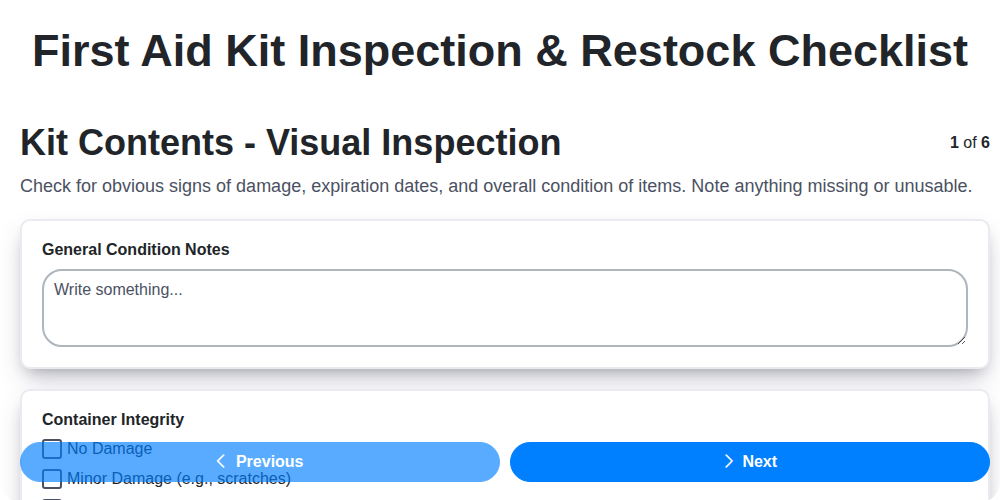
Erste-Hilfe-Kasten-Überprüfung & Nachbestückung: Ihre druckbare Checkliste Vorlage

Monatliche Erste-Hilfe-Raum-Überprüfung: Ihre Checklisten-Vorlage
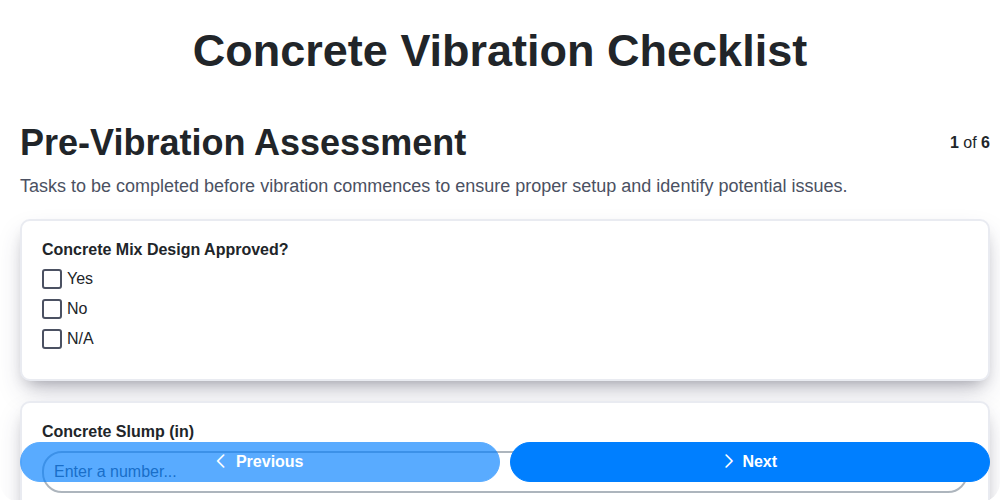
Die ultimative Vorlage zur Überprüfung der Betonverdichtung
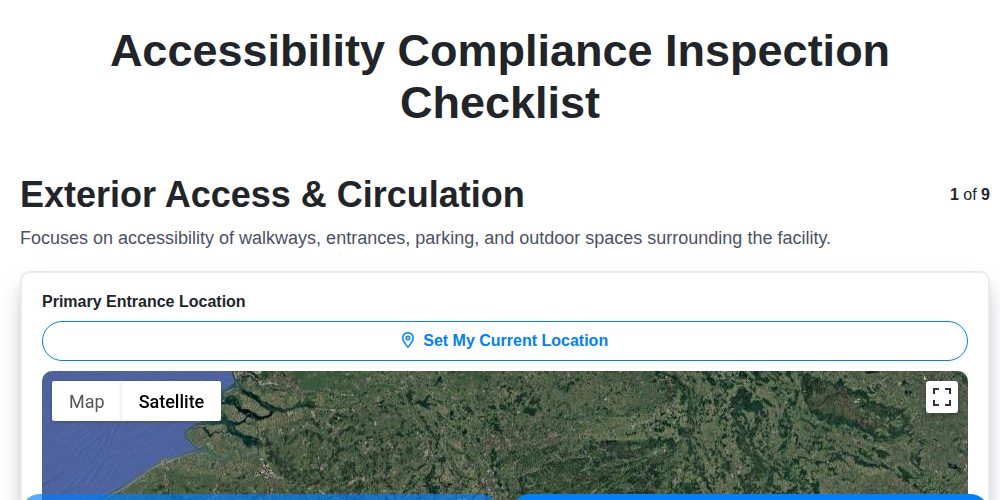
Vorlagen-Checkliste für die Überprüfung der Einhaltung von Barrierefreiheitsstandards
Entfesseln Sie das Potenzial Ihres Gartens: Eine Checkliste zur Überprüfung des pH-Werts des Bodens
Gehaltsabrechnungs-Überprüfungs-Checklisten-Vorlage: Ihr Leitfaden zur Genauigkeit

Lebensmittelsicherheit meistern: Ihre kostenlose HACCP-Überprüfungsliste
Benötigen Sie Hilfe bei Checklisten?
Haben Sie eine Frage? Wir helfen Ihnen gerne. Bitte senden Sie uns Ihre Anfrage, und wir werden Ihnen umgehend antworten.