The Ultimate 2026 Insurance Telematics Data Integration Checklist: A Comprehensive Guide for Seamless Implementation
Veröffentlicht: 28.10.2026 Aktualisiert: 29.10.2026
Inhaltsverzeichnis
- Introduction: The Evolution of Telematics in 2026
- Phase 1: Foundation and Hardware Reliability
- Hardware & IoT Connectivity Verification
- Data Accuracy & Sensor Calibration
- Phase 2: Data Pipeline and Stream Management
- Data Ingestion & Stream Integrity
- Edge Case & Connectivity Failure Protocol
- Phase 3: Processing, Engineering, and Storage
- Data Processing & Feature Engineering
- Storage & Big Data Management
- Phase 4: Integration and Ecosystem Connectivity
- API & Third-Party Integration Testing
- Phase 5: Security, Compliance, and Governance
- Data Privacy & GDPR/CCPA Compliance
- Phase 6: Intelligence, Visualization, and Monitoring
- Automated Trigger & Alert Verification
- Dashboard & Reporting Visualization
- Conclusion: Ensuring Long-Term Scalability
- Resources & Links
TLDR: Ensure your 2026 telematics deployment is flawless with this mission-critical integration checklist. Learn how to master everything from hardware connectivity and sensor calibration to advanced feature engineering, big data management, and strict GDPR/CCPA compliance to drive accurate, real-time, and actionable insurance insights.
Introduction: The Evolution of Telematics in 2026
The New Era of Data-Driven Underwriting
As we navigate through 2026, the landscape of the insurance industry has undergone a fundamental shift. We have moved far beyond simple GPS tracking and basic mileage monitoring. Today, the industry stands at the intersection of hyper-personalization and real-time risk assessment. Telematics is no longer just a value-add feature; it is the backbone of modern underwriting, claims automation, and customer engagement.
In an era where edge computing and 5G-Advanced connectivity are the industry standards, the complexity of managing telematics ecosystems has reached unprecedented levels. The promise of continuous underwriting relies entirely on the integrity of the data pipeline. A single failure in sensor calibration or a latency issue in data ingestion doesn't just result in a technical glitch-it leads to inaccurate risk profiles, fraudulent claims vulnerabilities, and compromised user trust.
Why a Robust Integration Checklist is Non-Negotiable
The sophistication of 2026-era IoT devices-incorporating computer vision, advanced accelerometers, and even environmental sensors-means that the volume and velocity of incoming data are higher than ever before. Integrating these disparate data streams into a cohesive, actionable insurance platform requires more than just a standard API connection. It requires a rigorous, end-to-end validation framework.
Whether you are an InsurTech startup scaling your infrastructure or an established carrier modernizing your legacy systems, the margin for error has disappeared. This checklist is designed to guide technical leads, product owners, and data engineers through the critical touchpoints of the integration lifecycle. By following these strategic pillars, you ensure that your telematics ecosystem is not only functional but resilient, compliant, and capable of delivering the predictive insights that define the future of insurance.
Phase 1: Foundation and Hardware Reliability
Establishing a Robust Infrastructure
Before a single byte of data reaches your analytics engine, the physical and connectivity layers must be impenetrable. In the 2026 landscape, where vehicle autonomy and hyper-connectivity are the norms, your integration success depends entirely on the integrity of the initial data capture.
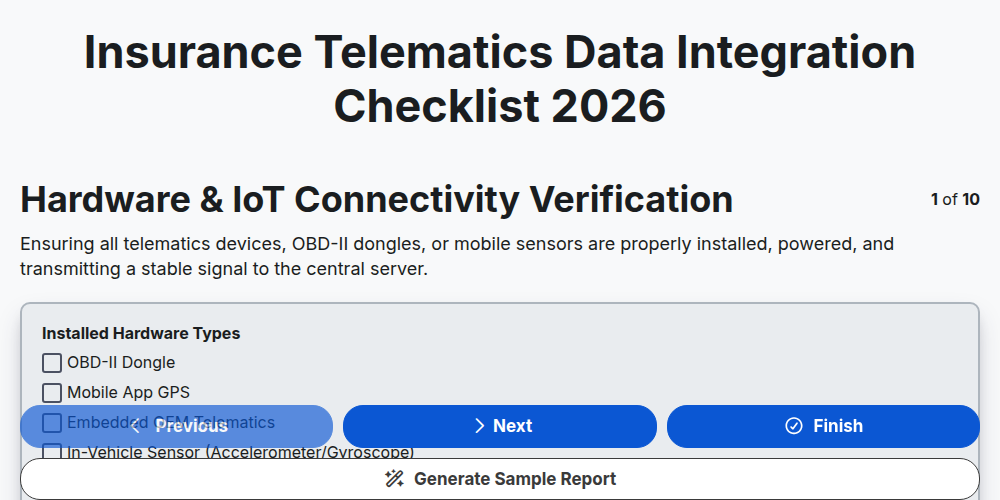
Hardware & IoT Connectivity Verification
The foundation of any telematics ecosystem is the physical hardware installed within the vehicle. You must ensure that every IoT device, whether an OEM-integrated module or an aftermarket OBD-II dongle, is communicating via stable, low-latency protocols.
- Signal Strength Validation: Test connectivity stability across varying cellular network densities (5G/6G handovers).
- Firmware Consistency: Ensure all hardware units are running the latest, standardized firmware to prevent fragmented data formats.
- Battery & Power Management: Verify that devices maintain consistent performance during vehicle ignition cycles and low-power states.
Data Accuracy & Sensor Calibration
Raw data is useless if it is misleading. High-fidelity risk assessment requires sensors that are precision-tuned to reflect real-world driving dynamics.
- Sensor Drift Monitoring: Implement automated checks to detect drift in accelerometers and gyroscopes that could lead to false braking or cornering alerts.
- GPS Precision Audits: Validate the accuracy of GNSS data, specifically looking for high-frequency error corrections in urban canyons where signal multipath interference is common.
- Environmental Normalization: Ensure sensors are calibrated to account for external variables like extreme temperature fluctuations or electromagnetic interference.
Edge Case & Connectivity Failure Protocol
In a mobile environment, disconnection is an inevitability, not an anomaly. A resilient integration strategy must define exactly what happens when the umbilidical cord to the cloud is severed.
- Store-and-Forward Logic: Verify that hardware possesses sufficient local buffer capacity to store telemetry data during dead zones and successfully upload it once connectivity is restored.
- Data Gap Reconstitution: Develop protocols to flag periods of missing data to prevent blind spots in the driver's risk profile.
- Failure Notification Triggers: Ensure the system proactively alerts engineers when a device stops heartbeat signals, preventing silent data loss.
Hardware & IoT Connectivity Verification
Ensuring the Foundation: Hardware & IoT Connectivity Verification
In the 2026 insurance landscape, the integrity of your telematics ecosystem is only as strong as the physical connection between the vehicle and your cloud infrastructure. Before a single byte of data can be analyzed for risk assessment, you must ensure that the edge is communicating flawlessly. This first step of the integration checklist focuses on the physical and signal-layer stability of your hardware deployment.
1. Device-to-Gateway Handshake Validation
The integration process must begin with a rigorous audit of the initial handshake protocols. You must verify that the On-Board Diagnostics (OBD-II) dongles, OEM-embedded modules, or mobile-based sensors are correctly identifying themselves to your network.
- Authentication Protocols: Ensure that unique device IDs are being correctly registered and that the handshake follows modern TLS (Transport Layer Security) standards to prevent spoofing.
- Signal Strength Monitoring: Test the reliability of the connection across varying signal strengths (2G/3G/4G/5G) to ensure that low-coverage areas do not lead to device de-registration.
2. Network Latency and Packet Loss Assessment
In telematics, timing is everything. A delay in transmitting a hard braking event can render the data useless for real-time driver coaching or accident reconstruction.
- Latency Benchmarking: Measure the round-trip time (RTT) from the moment a sensor detects an event to the moment it hits your ingestion engine.
- Packet Loss Testing: Simulate high-congestion environments to determine how your system handles dropped packets. Does the hardware have the buffering capability to re-transmit lost telemetry during intermittent connectivity?
3. Battery and Power Management Audits
For plug-in hardware, power stability is a critical variable.
- Voltage Fluctuation Resilience: Verify that the hardware remains operational and maintains data integrity during engine ignition, cranking, and low-voltage states (e.g., when the vehicle is off for extended periods).
- Energy Consumption Profiling: If using mobile-based telematics, evaluate the impact of the integration on the user's smartphone battery life to prevent app churn caused by excessive background drain.
4. Firmware Over-the-Air (FOTA) Readiness
As we move deeper into 2026, static hardware is a liability. Your integration checklist must confirm that the hardware supports seamless, secure, and automated firmware updates.
- Update Integrity: Test the ability to push patches without interrupting active data streams.
- Rollback Capability: Ensure that if a firmware update fails during the connectivity phase, the hardware can autonomously revert to the last stable version to prevent bricking the device in the field.
Data Accuracy & Sensor Calibration
Ensuring High-Fidelity Inputs: The Foundation of Telematics Reliability
In the ecosystem of telematics-driven insurance, the quality of your predictive models is only as good as the raw data feeding them. If your sensors are miscalibrated or reporting inconsistent values, even the most sophisticated machine learning algorithms will produce garbage in, garbage out results. As we move into 2026, where hyper-precise risk scoring is the industry standard, verifying data accuracy and sensor calibration is no longer a peripheral task-it is a core requirement for actuarial integrity.
Precision Calibration and Drift Detection
To ensure that every data point-from sudden deceleration to cornering G-forces-is actionable, your integration checklist must include rigorous calibration protocols.
- Sensor Zero-Point Calibration: Verify that all IoT modules and mobile device accelerometers are calibrated to a true zero state. Even a slight offset can lead to the cumulative miscalculation of trip distances or false triggers for hard-braking events.
- Latency-Adjusted Accuracy: In 2026, high-speed data streams require time-stamping accuracy that accounts for network latency. Ensure that sensor readings are synchronized with a universal time source (such as NTP) to prevent data drifting, where movement data and timestamps become decoupled.
- Regular Drift Monitoring: Implement automated checks to detect sensor drift-the gradual loss of accuracy due to hardware degradation or environmental changes. Your integration pipeline should flag sensors that deviate from established baseline patterns.
Validating Data Integrity Across the Payload
Beyond the physical sensor, you must validate the integrity of the data as it transitions from a hardware signal to a digital record.
Cross-Referencing Ground Truth
How do you know the data is correct? You must implement Ground Truth validation steps within your testing phase:
- Reference Benchmarking: Compare telematics outputs against known high-precision GPS/GNSS benchmarks during controlled test drives.
- Anomaly Detection for Outliers: Integrate automated filters to identify impossible physics-such as a vehicle accelerating from 0 to 100 mph in a single second. These are often not real driving behaviors but rather sensor glitches or packet errors.
- Consistency Audits: Cross-verify accelerometer data with gyroscope and GPS velocity data. If the accelerometer reports a high-G event but the GPS shows no change in velocity or direction, your system should trigger a calibration alert.
By treating sensor calibration as a continuous, automated part of your data integration lifecycle, you safeguard the reliability of your risk assessment models and maintain the trust of both underwriters and policyholders.
Phase 2: Data Pipeline and Stream Management
Ensuring Seamless Data Flow and Integrity
Once the hardware connectivity is established, the focus shifts from the physical device to the digital pipeline. In the 2026 insurance landscape, the volume of telemetry data is massive, and any latency or loss in the pipeline can lead to incorrect risk profiles and failed claims processing.
Data Ingestion & Stream Integrity
The backbone of any telematics ecosystem is its ability to ingest high-frequency data without bottlenecks. You must verify that your ingestion layer can handle sudden bursts of data-such as during peak driving hours-without dropping packets.
- Check for: End-to-end latency monitoring, buffer management during peak loads, and message deduplication to prevent ghost events in the driver's history.
Data Accuracy & Sensor Calibration
Data is only as valuable as its precision. Telematics relies on a delicate interplay between accelerometers, GPS, and gyroscopes. Integration is not complete until you have verified that the digital data reflects physical reality.
- Check for: Cross-referencing GPS timestamps with accelerometer logs, identifying sensor drift, and implementing automated validation checks to flag noisy or unrealistic data points.
Data Processing & Feature Engineering
Raw coordinates and G-force readings are useless to an underwriter without context. This stage involves transforming raw telemetry into actionable driving features, such as harsh braking frequency, cornering intensity, or speeding duration.
- Check for: Real-time processing efficiency, accuracy of the logic used to define events, and the seamless conversion of raw timestamps into localized, driver-friendly time zones.
Storage & Big Data Management
As your fleet or policyholder base grows, your storage architecture must scale horizontally. Efficient management prevents data swamps where historical information becomes unretrievable or too expensive to query.
- Check for: Tiered storage strategies (hot vs. cold storage), data lifecycle policies, and the ability to perform high-speed analytical queries on massive datasets without degrading system performance.
Data Ingestion & Stream Integrity
Ensuring Continuous Data Flow and Stream Stability
In the era of 2026's real-time ecosystem, the value of telematics lies not just in the collection of data, but in its continuous, uninterrupted delivery. Data Ingestion & Stream Integrity focus on the pipeline aspect of telematics-ensuring that once a signal leaves a vehicle or device, it moves through your architecture without loss, corruption, or latency.
Validating Ingestion Throughput and Latency
As vehicle fleets increase in density, your ingestion layer must handle massive spikes in concurrent connections. A successful integration requires:
- Load Testing Ingestion Endpoints: Verify that your message brokers (such as Kafka, Pulsar, or AWS Kinesis) can handle peak-hour bursts without backpressure or ingestion delays.
- Latency Monitoring: Establish strict KPIs for sensor-to-cloud latency. In high-stakes scenarios like accident detection, a delay of even a few seconds can render the data useless for real-time emergency response.
Maintaining Stream Integrity and Order
Telematics data is inherently sequential. If a hard braking event is recorded after a stopped event due to out-of-order processing, your risk models will yield inaccurate results.
- Sequence Verification: Implement checks to ensure that event timestamps are preserved and processed in the correct chronological order, even when data arrives via asynchronous pathways.
- Deduplication Logic: With modern IoT networks, at-least-once delivery is common, which can lead to duplicate packets. Your ingestion layer must include robust deduplication mechanisms to prevent skewed mileage or frequency counts.
- Schema Evolution Management: As firmware updates change the payload structure of IoT devices, your ingestion pipeline must be resilient. Use a Schema Registry to ensure that new data formats do not break downstream processing or result in dead letter queues.
Monitoring for Data Loss and Gaps
A silent failure in a data stream is often more dangerous than a total outage.
- Gap Detection Algorithms: Implement automated monitoring to detect periods of missing data from specific device IDs, which could indicate localized network outages or device malfunctions.
- Checksum and Payload Validation: Implement end-to-end integrity checks to ensure that the data packet received at the cloud gateway is bit-for-bit identical to the packet sent by the hardware.
Edge Case & Connectivity Failure Protocol
Navigating the Unpredictable: Implementing Robust Failure Protocols
In the evolving landscape of 2026's hyper-connected ecosystem, perfect connectivity is a myth. As vehicle ecosystems become more complex with 5G-Advanced and integrated smart city infrastructure, the true strength of a telematics integration lies not in how it performs during peak signal, but in how it behaves during a blackout.
To ensure your data pipeline remains resilient, your integration strategy must account for the inevitable gaps in cellular coverage and hardware malfunctions.
1. The Store-and-Forward Validation
In areas of low connectivity (tunnels, remote rural zones, or underground parking), devices must rely on local buffering. Your checklist must include rigorous testing of the Store-and-Forward mechanism:
- Buffer Overflow Management: What happens when the device's local memory reaches capacity during an extended outage?
- Timestamp Integrity: Ensuring that once connectivity is restored, the event time (when the crash occurred) is preserved rather than the ingestion time (when the data finally reached the server).
2. Handling Packet Loss and Data Fragmentation
Network latency and jitter can lead to fragmented data packets. Your protocol should define specific logic for:
- Reconstruction Logic: Automated procedures to reassemble fragmented GPS trajectories or sensor bursts.
- Sequence Verification: Detecting missing telemetry frames to prevent teleportation errors in vehicle movement visualization.
3. Hardware Malfunction & Sensor Drift Detection
Edge cases aren't just about signal loss; they are about erroneous data. A robust protocol must include automated flags for:
Sensor Frozen States: Detecting when a GPS or accelerometer provides constant, unchanging values that indicate a hardware hang.
Out-of-Bounds Logic: Implementing automated alerts when incoming data deviates from physical reality (e.g., a vehicle accelerating from 0 to 200 mph in one second).
4. The Recovery & Re-sync Workflow
Finally, define the Handshake Protocol for reconnection. When a device regains LTE/5G connectivity, the system must be able to handle a massive, sudden burst of catch-up data without crashing your ingestion engine. This requires pre-configured rate-limiting and prioritized processing queues to ensure real-time alerts are not delayed by the flood of historical buffered data.
Phase 3: Processing, Engineering, and Storage
Once the raw data streams are successfully ingested and verified for accuracy, the focus shifts from collection to transformation. In the 2026 insurance landscape, the value of telematics lies not in the volume of data collected, but in the intelligence extracted from it. This phase is where raw GPS coordinates and accelerometer readings are converted into actionable risk profiles and behavioral insights.
Data Processing & Feature Engineering
Raw telemetry data is often too granular and noisy to be useful for underwriting or claims processing in its native state. This step involves applying sophisticated algorithms to turn digital noise into driving intelligence.
- Signal Transformation: Converting raw accelerometer data into meaningful metrics such as G-force impact, rapid deceleration, or aggressive cornering.
- Behavioral Feature Extraction: Developing complex features like Driver Smoothness Index, Night Driving Frequency, or Speeding Duration per 100km.
- Real-time Enrichment: Augmenting GPS data with external environmental contexts, such as weather conditions, road types (highway vs. urban), and traffic density.
- Model Readiness: Ensuring that engineered features are formatted specifically for consumption by Machine Learning (ML) models used in real-time pricing adjustments.
Storage & Big Data Management
With the explosion of IoT connectivity, the sheer volume of telematics data can overwhelm legacy systems. A robust storage strategy is critical to maintaining both high performance and cost-efficiency.
- Tiered Storage Architecture: Implementing a Hot, Warm, and Cold storage strategy. Use high-performance databases for real-time monitoring (Hot), scalable distributed systems for recent history (Warm), and low-cost object storage for long-term archival and regulatory compliance (Cold).
- Scalability & Throughput: Ensuring the architecture can handle bursty data periods, such as high-traffic windows or mass-deployment events of new hardware.
- Data Partitioning: Organizing data by driver ID, region, or time-series intervals to optimize query speeds for claims investigators and actuaries.
- Data Lifecycle Management: Automating the deletion or anonymization of data in alignment with global privacy regulations to prevent data bloating.
Automated Trigger & Alert Verification
The ultimate goal of modern telematics integration is automation. This sub-phase ensures that the system doesn't just store data, but actively reacts to it.
- Threshold Validation: Rigorous testing of the logic that triggers Critical Event alerts (e.g., an impact detection exceeding a specific G-force threshold).
- Latency Auditing: Measuring the time elapsed from the moment a sensor detects an event to the moment a notification reaches the insurer's ecosystem.
- False Positive Reduction: Fine-tuning algorithms to distinguish between a genuine collision and a false alarm caused by a heavy pothole or sudden braking in heavy traffic.
- Notification Integrity: Verifying that triggers correctly initiate downstream workflows, such as automated SMS alerts to the policyholder or immediate claims creation in the CRM.
Data Processing & Feature Engineering
Transforming Raw Telemetry into Actionable Intelligence
Once the data stream is verified and stabilized, the focus shifts from mere collection to sophisticated transformation. In 2026, simply having access to raw GPS and accelerometer data is not enough; the true competitive advantage lies in how effectively you can convert high-frequency signals into meaningful driver behavior profiles. This stage of the integration process is where noise is filtered out and insights are engineered.
The Feature Engineering Pipeline
Effective telematics integration requires a robust pipeline capable of performing complex mathematical computations on moving windows of data. Your integration strategy should prioritize the following engineering milestones:
- Behavioral Feature Extraction: Beyond basic speed and location, your pipeline must derive complex metrics such as cornering intensity, rapid acceleration/deceleration patterns, and braking force. These are the core components used to build risk-based scoring models.
- Contextual Enrichment: Raw data lacks context. A high-speed maneuver on a highway is vastly different from the same maneuver in a school zone. Your engineering layer must integrate external datasets-such as weather conditions, road type, and traffic density-to contextualize the telemetry.
- Aggregation & Windowing Logic: Deciding on the granularity of your data is critical. You must implement logic that handles various time-series windows (e.g., trip-level, daily averages, and monthly trends) to ensure that both real-time monitoring and long-term risk assessment are both possible.
Refinement and Model Readiness
The ultimate goal of this stage is to ensure that the output of your integration pipeline is model-ready. This means the engineered features must be standardized, normalized, and formatted for immediate consumption by your underwriting algorithms and machine learning models.
If your feature engineering layer is too heavy, you risk latency in real-time scoring; if it is too light, your downstream models will struggle with inconsistent inputs. A successful 2026 implementation ensures a seamless flow from raw sensor telemetry to high-fidelity, predictive risk indicators.
Storage & Big Data Management
Scaling for the Future: Navigating Big Data Architectures
As telematics data volumes continue to explode in 2026, your storage strategy can no longer be an afterthought. With the influx of high-frequency sensor data, waypoints, and event-based triggers, the challenge lies in managing massive datasets without compromising retrieval speeds or ballooning operational costs.
Architecting for Hybrid Scalability
Effective integration requires a multi-tiered storage approach. To maintain high performance, implement a strategy that differentiates between hot, warm, and cold data:
- Hot Storage (Real-time Layer): Utilize in-memory databases or high-performance NoSQL clusters for immediate processing of active trip data. This layer is critical for instant driver feedback and real-time risk scoring.
- Warm Storage (Operational Layer): Store recent historical data (e.g., the last 30-90 days) in optimized columnar formats. This supports frequent queries for underwriting adjustments and recent behavior analysis.
- Cold Storage (Archival Layer): Move long-term historical data to low-cost object storage. While retrieval is slower, this is essential for long-term trend analysis, legal compliance, and training deep learning models.
Managing Data Gravity and Latency
In a 2026 ecosystem, data is often distributed across edge devices, cloud gateways, and regional data centers. To prevent data gravity from slowing down your analytics, your management strategy must focus on:
- Partitioning and Sharding: Implement intelligent partitioning based on time-series attributes and geographical regions to ensure queries don't have to scan entire datasets.
- Schema Evolution Management: As IoT sensors evolve, your storage layer must handle schema drift without breaking downstream pipelines. Ensure your Big Data framework supports robust metadata management.
- Cost-Performance Optimization: Implement automated lifecycle policies. In 2026, the cost of storing everything forever is unsustainable; automated movement of data from high-cost SSDs to low-cost cloud archives is a mandatory requirement for a healthy bottom line.
Phase 4: Integration and Ecosystem Connectivity
Ensuring Seamless Ecosystem Connectivity
In the 2026 insurance landscape, telematics data cannot exist in a vacuum. The true value of telematics lies in its ability to communicate with the broader InsurTech ecosystem-from claims management systems to real-time pricing engines. This phase focuses on bridging the gap between raw incoming data and the actionable intelligence required by your enterprise architecture.
API & Third-Party Integration Testing
Modern telematics platforms rely on a complex web of interconnected services. Integration testing is no longer just about checking if a connection exists; it is about ensuring end-to-end interoperability.
- Contract Testing: Ensure that all API schemas remain consistent when third-party vendors push updates.
- Latency Benchmarking: Measure the delay introduced when passing data through intermediary middleware or external risk-scoring engines.
- End-to-End Workflow Validation: Verify that a hard braking event recorded by a sensor correctly triggers a notification in the claims module and updates the policyholder's risk profile in the CRM.
Automated Trigger & Alert Verification
The heartbeat of usage-based insurance (UBI) is the automated alert. If a high-risk event is detected, the system must respond instantaneously and accurately.
- Logic Validation: Test the accuracy of automated triggers (e.g., Is a speed threshold of 80mph correctly triggering a high-risk flag?).
- Latency of Alerts: Ensure that critical alerts reach the decisioning engine within the required sub-second window.
- Notification Loops: Verify that downstream automated actions-such as personalized driver feedback or premium adjustments-are triggered without manual intervention.
Edge Case & Connectivity Failure Protocol
Connectivity is never 100% guaranteed. As vehicles move through tunnels, remote areas, or dead zones, your integration must be resilient to data gaps.
- Reconnection Resilience: Test the system's ability to handle burst uploads when a device regains signal after a period of offline operation.
- Packet Loss Protocols: Define how the system should behave when data packets are corrupted or incomplete.
- Fallback Mechanisms: Establish clear protocols for when integration points fail, ensuring that the system can revert to baseline risk models until real-time data streams are restored.
API & Third-Party Integration Testing
Ensuring Seamless Ecosystem Connectivity
In the 2026 insurance landscape, telematics data does not exist in a vacuum. To derive true value from sensor inputs, your integration layer must communicate flawlessly with a vast ecosystem of external partners, including vehicle manufacturer APIs, smart city infrastructure, and claims management platforms. Testing these connections is not just about checking if a signal is sent, but ensuring the entire automated workflow remains unbroken.
Validating Third-Party Ecosystem Interoperability
As the Internet of Things (IoT) expands, your system must ingest data from diverse sources-from OEM (Original Equipment Manufacturer) cloud services to specialized weather and road condition APIs. Your testing protocol must include:
- Contract Testing: Implement automated contract tests to ensure that any changes in a third-party API schema do not break your ingestion pipelines.
- Payload Validation: Verify that data received from external vendors adheres strictly to the expected formats (JSON, Protobuf, etc.) and that all required metadata fields are present.
- Latency & Throughput Assessment: Simulate high-traffic scenarios to ensure that third-party data streams do not create bottlenecks in your real-time processing engine.
End-to-End Workflow Authentication
Integration testing must extend beyond the initial handshake. You must validate the entire lifecycle of a data packet as it moves through your ecosystem.
Authentication and Security Handshakes
With the rise of decentralized identity, testing must ensure that OAuth2, OpenID Connect, or newer mTLS (mutual TLS) protocols are functioning correctly across all integrated endpoints. A failure in the authentication layer during a third-party call can lead to significant gaps in driver behavior visibility.
Error Handling and Fallback Mechanisms
What happens when a partner API goes offline? Your testing suite must intentionally inject failures to verify:
- Retry Logic: Does the system implement exponential backoff without overwhelming the source?
- Circuit Breaker Patterns: Does your integration layer gracefully trip to prevent a single failing third-party service from cascading into a total system outage?
- Data Buffering: In the event of an integration blackout, is there a secondary mechanism to cache and re-sync the missing telemetry data once connectivity is restored?
Phase 5: Security, Compliance, and Governance
Ensuring Trust and Compliance in the Age of Big Data
As telematics data becomes the backbone of personalized insurance premiums, the focus shifts from mere data collection to the rigorous governance of that data. In 2026, a data integration pipeline is only as strong as its security framework and its ability to withstand regulatory scrutiny.
Data Privacy & GDPR/CCPA Compliance
In an era of heightened consumer awareness, privacy is no longer a feature-it is a prerequisite. Your integration checklist must prioritize Privacy by Design. This involves implementing robust anonymization and pseudonymization techniques at the point of ingestion. Ensure your pipeline can handle complex Right to be Forgotten requests and provides transparent data lineage, allowing you to prove exactly how and where a specific data point was processed to satisfy GDPR and CCPA/CPRA audits.
Edge Case & Connectivity Failure Protocol
Real-world connectivity is never perfect. A resilient integration strategy must account for dark periods-intervals where GPS or cellular signals are lost due to tunnels, remote areas, or hardware malfunctions. Your integration framework must include automated protocols for:
- Data Buffering: Managing local storage on the IoT device during offline periods.
- Reconciliation Logic: Intelligent merging of delayed data packets once connectivity is restored to prevent teleportation errors in vehicle movement logs.
- Conflict Resolution: Determining which data source (e.g., onboard sensor vs. smartphone GPS) takes precedence during high-latency events.
Automated Trigger & Alert Verification
The true value of telematics lies in actionable insights. However, an integration is a failure if a high-G force event or a sudden braking maneuver fails to trigger a notification to the underwriting engine.
- End-to-End Latency Testing: Regularly audit the time elapsed from the physical event to the dashboard alert.
- False Positive Mitigation: Implement validation layers to ensure environmental noise (such as a phone falling off a mount) is not misclassified as a collision event.
- Threshold Integrity: Periodically verify that the business logic governing alerts remains synchronized across all microservices.
Data Privacy & GDPR/CCPA Compliance
Prioritizing Privacy by Design in a High-Data Environment
As we navigate the landscape of 2026, the integration of telematics data is no longer just a technical challenge-it is a significant legal and ethical responsibility. With the increasing sophistication of IoT sensors, the volume of Personally Identifiable Information (PII) being collected is unprecedented. To avoid catastrophic regulatory penalties and maintain policyholder trust, compliance must be embedded into the integration architecture from day one.
Navigating the Global Regulatory Landscape
In 2026, the boundaries of data sovereignty are more complex than ever. Your integration checklist must account for a patchwork of evolving regulations, specifically:
- GDPR (General Data Protection Regulation): For any operations touching EU citizens, ensuring the Right to be Forgotten and Data Portability within your telematics pipeline is non-negotiable.
- CCPA/CPRA (California Consumer Privacy Act): Managing strict Do Not Sell or Share My Personal Information requests requires granular control over how telematics data flows between your ecosystem and third-party partners.
- Localized Data Residency Laws: As more regions implement strict data localization requirements, your integration strategy must verify that data is processed and stored within the legally mandated jurisdictions.
Key Compliance Checkpoints for Integration Engineers
1. Data Minimization and Purpose Limitation
Before a single byte is ingested, verify that your integration pipeline is designed for Data Minimization. Are you collecting high-frequency GPS coordinates when velocity and acceleration are sufficient for the risk model? Every extra data point increases your liability. Ensure that the integration logic filters out unnecessary sensitive attributes at the ingestion layer.
2. Pseudonymization and Anonymization Protocols
At the point of entry, implement robust pseudonymization techniques. The goal is to decouple the telematics payload (speed, braking, cornering) from the driver's identity (name, address, VIN) as early as possible in the stream. This ensures that even in the event of a breach, the breached data cannot be easily attributed to a specific individual without access to a separate, highly secured decryption key.
3. Consent Management Integration
Your data pipeline must be consent-aware. The integration layer should include a real-time check against a centralized Consent Management Platform (CMP). If a user withdraws consent via your mobile app, the ingestion engine must be capable of immediately halting the processing of that specific user's telemetry stream to prevent shadow data collection.
4. End-to-End Encryption and Audit Trails
Encryption is the baseline, but 2026 standards demand End-to-End Encryption (E2EE) from the edge device to the cloud. Furthermore, maintain an immutable audit log of every entity that accesses the telematics data. If a third-party API requests access to a driver's braking patterns, that access must be logged, timestamped, and traceable for regulatory audits.
Phase 6: Intelligence, Visualization, and Monitoring
Transforming Raw Data into Actionable Insights
Once your data pipeline is robust and your compliance frameworks are airtight, the focus shifts from data movement to data intelligence. This final phase is where the true value of telematics-risk assessment, personalized pricing, and driver coaching-is realized.
Data Processing and Feature Engineering
Raw telemetry is virtually useless without context. In this stage, we move beyond simple GPS coordinates and speed metrics to create high-value features.
- Signal Transformation: Converting raw accelerometer data into meaningful events like hard braking, rapid acceleration, or aggressive cornering.
- Contextual Enrichment: Layering external datasets (weather conditions, road types, time of day) onto the telematics stream to differentiate between a hard brake due to an obstacle versus a routine stop.
- Predictive Modeling Preparation: Ensuring that the engineered features are structured specifically to feed your machine learning models for real-time risk scoring.
Storage and Big Data Management
As your fleet or policyholder base grows, your data volume will scale exponentially.
- Scalable Architectures: Implementing distributed storage solutions (such as Data Lakes or Lakehouses) that can handle unstructured IoT streams.
- Lifecycle Management: Establishing tiered storage strategies-keeping hot data readily available for real-time alerts while moving historical data to cold storage to manage costs.
- Query Performance Optimization: Ensuring that large-scale analytical queries do not suffer from latency, even as petabytes of data accumulate.
Automated Trigger and Alert Verification
The Real-Time promise of telematics relies entirely on the reliability of your notification engine.
- Latency Testing: Verifying that critical alerts (e.g., a high-impact crash event) reach the claims or emergency response team within seconds.
- Logic Validation: Rigorous testing of the business rules that trigger notifications to ensure zero false positives, which can lead to alert fatigue among underwriters and customers.
Dashboard and Reporting Visualization
The final link in the chain is the human interface. Data must be digestible for both engineers and business stakeholders.
- Operational Dashboards: Real-time views for fleet managers and claims adjusters to monitor active incidents.
- Customer-Facing Interfaces: Intuitive, high-performance mobile interfaces for policyholders to view their Driver Score and understand their behaviors.
- Executive Analytics: High-level reporting for leadership to track loss ratios, portfolio risk shifts, and the overall ROI of the telematics program.
Edge Case and Connectivity Failure Protocol
In a 2026 landscape, a disconnected device is your greatest vulnerability.
- Resilience Planning: Developing protocols for when a device loses cellular coverage or enters a dead zone.
- Data Re-syncing Logic: Ensuring that once connectivity is restored, the device can upload cached buffered data without creating duplicates or corrupting the time-series sequence.
- System Self-Healing: Implementing automated checks to detect sensor malfunctions or hardware tampering before they impact the integrity of the entire dataset.
Automated Trigger & Alert Verification
Ensuring Real-Time Responsiveness through Automated Verification
In the high-stakes world of telematics-based insurance, the value of your data lies in its ability to drive immediate action. An integration project is only as successful as its ability to turn raw sensor inputs into actionable business intelligence. If a sudden braking event or a high-speed cornering maneuver occurs, the system must trigger the appropriate notification or risk-scoring update without delay.
Validating the Logic Chain
The core of this verification step is ensuring that the Event $\rightarrow$ Processing $\rightarrow$ Alert pipeline is unbroken. You must move beyond simple connectivity testing to functional logic verification. This involves simulating specific driving behaviors to ensure the backend engine correctly identifies threshold breaches.
Key Verification Components:
- Threshold Accuracy Testing: Verify that alerts are triggered precisely when predefined parameters (e.g., G-force, speed, or rapid acceleration) are met. Testing must include near-miss scenarios to ensure that the system doesn't suffer from false negatives or excessive noise.
- Latency Benchmarking: In 2026, near real-time is the industry standard. You must measure the end-to-end latency from the moment a sensor detects an anomaly to the moment the alert reaches the end-user or the underwriting dashboard.
- Notification Delivery Integrity: Test the multi-channel delivery of alerts. Whether it is a push notification to a policyholder's smartphone, an SMS to a fleet manager, or a high-priority flag in a claims professional's queue, each channel must be audited for delivery success rates.
- Concurrency & Stress Testing: Automated triggers must function reliably even during peak periods-such as extreme weather events-when data ingestion volumes spike across your entire user base.
The Role of Automated Regression Testing
To maintain the integrity of your integration as you update models or ingest new hardware types, implement an automated regression suite. This suite should replay historical golden datasets (previously verified driving patterns) through your new integration layers to ensure that recent code changes haven't inadvertently suppressed critical safety alerts or altered the logic of your risk assessment triggers.
Dashboard & Reporting Visualization
Turning Raw Data into Actionable Intelligence
The final and most critical stage of the integration lifecycle is ensuring that the complex streams of telemetry data are translated into intuitive, high-impact visual narratives. Data integration is meaningless if it remains trapped in a database; its true value lies in its ability to drive underwriting decisions, risk assessment, and customer engagement through clear, real-time visualization.
Visualizing the Driver Profile
In 2026, a dashboard must go beyond simple scatter plots. Your visualization layer should offer a multi-dimensional view of driver behavior, integrating various telemetry signals into a unified Risk Score interface. Effective dashboards should include:
- Behavioral Heatmaps: Mapping high-risk events (hard braking, rapid acceleration) against geographic coordinates.
- Trend Analysis Overlays: Comparing current driving patterns against historical baselines to detect sudden shifts in risk profiles.
- Segmented Fleet Views: The ability to toggle between individual driver profiles and aggregated fleet-wide performance metrics.
Real-Time Monitoring & Latency Management
As we move toward near-instantaneous insurance adjustments, your reporting tools must demonstrate low-latency updates. The visualization layer must be tested for its ability to reflect live data streams without overwhelming the UI.
- Interactive Drill-Downs: Users should be able to click on a high-level anomaly and instantly descend into the specific sensor readings (G-force, velocity, or GPS deviation) that triggered the alert.
- Alert Cohesion: Ensuring that visual indicators (such as red-flag notifications) are synchronized with the underlying data processing engine to prevent stale information from misleading underwriters.
Stakeholder-Specific Interfaces
A successful integration provides tailored views for different user personas:
- For Underwriters: High-density, technical views focusing on statistical significance and loss-ratio correlations.
- For Claims Adjusters: Simplified, event-centric views that highlight the precise mechanics of an accident reconstruction.
- For Policyholders: User-friendly, gamified mobile interfaces that provide Driver Scores and actionable coaching tips to encourage safer driving habits.
Performance & Scalability Testing
Finally, ensure your visualization layer is stress-tested against the massive datasets generated by 2026-era IoT sensors. Large-scale data rendering can cause browser lag or mobile app crashes. Your checklist must include verification that the dashboard maintains high frame rates and responsiveness even when querying massive, multi-terabyte datasets across complex time-series ranges.
Conclusion: Ensuring Long-Term Scalability
Future-Proofing Your Telematics Ecosystem
As we move into 2026, the window for competitive advantage in the insurance industry is no longer defined by the mere collection of data, but by the integrity and agility of the pipelines that transport it. Implementing a telematics integration is not a one-time deployment; it is the establishment of a living ecosystem that must evolve alongside advancing IoT capabilities and tightening global regulations.
Moving Beyond Implementation to Optimization
Successfully navigating the checklist provided above ensures that your initial launch is stable, but true market leadership requires a commitment to continuous optimization. A robust integration framework allows your organization to:
- Scale Without Friction: By prioritizing Storage & Big Data Management and API Integration Testing, you ensure that as your policyholder base grows, your infrastructure expands without incurring prohibitive latency or manual overhead.
- Drive Predictive Accuracy: Continuous Sensor Calibration and Feature Engineering enable the transition from reactive claims processing to proactive risk mitigation, turning raw telemetry into actionable underwriting intelligence.
- Maintain Trust through Compliance: In an era of heightened scrutiny, treating Privacy & GDPR/CCPA Compliance as a foundational pillar-rather than an afterthought-is the only way to maintain the brand loyalty necessary for long-term retention.
The Path Forward
The complexity of modern telematics-characterized by edge computing, 5G connectivity, and massive data volumes-demands a disciplined approach to integration. By treating this checklist as a standard operating procedure rather than a mere launch guide, insurance providers can transform fragmented data streams into a unified, high-fidelity engine for innovation.
The goal is simple: build a system that is resilient to connectivity failures, transparent in its data processing, and, most importantly, capable of delivering the hyper-personalized insurance experiences that the 2026 consumer expects.
Resources & Links
- GSMA: Global organization representing the interests of mobile operators, essential for understanding 5G and IoT connectivity standards in telematics.
- ISO (International Organization for Standardization): Reference for critical data quality, sensor calibration standards, and international security protocols.
- Cloudflare: Resources on edge computing, data stream security, and protecting API endpoints from DDoS attacks.
- AWS (Amazon Web Services): Industry-standard documentation for scalable data ingestion, IoT Core, and big data storage solutions.
- MongoDB: Insights into handling unstructured and semi-structured telematics data using NoSQL databases.
- Apache Software Foundation: Essential tools for data pipeline management, including Apache Kafka for real-time stream processing.
- NVIDIA: Leading-edge technology for edge AI and processing complex sensor data for predictive analytics.
- GDPR.eu: Comprehensive guide to European data protection regulations and privacy compliance requirements.
- OECD: Global insights into digital economy trends, privacy frameworks, and data governance policies.
- Tableau: Advanced data visualization techniques for creating actionable insurance dashboards and risk reports.
- Snowflake: Cloud-based data warehousing solutions for managing massive datasets generated by IoT devices.
- Splunk: Tools for real-time monitoring, log analysis, and automated alerting in complex data ecosystems.
- Conformiq: Best practices for model-based testing, vital for verifying API and third-party integration integrity.
- Postman: The industry standard for API development, testing, and documenting ecosystem connectivity.
- IETF: Technical standards for internet protocols, crucial for ensuring seamless device-to-cloud communication.
- NVIDIA AI: Information on implementing deep learning models for advanced feature engineering and driver behavior analysis.
- TechCrunch: Stay updated on the latest trends in InsurTech and the evolving landscape of connected vehicle technology.
- Forbes Technology Council: High-level strategic insights into the digital transformation of the insurance industry.
Kommentare
Bisher gibt es keine Kommentare. Seien Sie der Erste, der einen hinzufügt!
Demonstration der Managementlösung für das Versicherungswesen
Das Management von Policen, Schäden und Compliance in der Versicherungsbranche ist komplex. ChecklistGuro's Work OS Plattform optimiert Ihre Abläufe, von der Risikobewertung und Vertragsverlängerung bis zur Schadensbearbeitung und Berichterstattung. Steigern Sie die Effizienz, reduzieren Sie Fehler und verbessern Sie die Kundenzufriedenheit. Entdecken Sie, wie ChecklistGuro Ihr Versicherungsunternehmen verändern kann!
Verwandte Artikel
Die ultimative Checkliste zur Untersuchung von Versicherungsansprüchen: Ein Schritt-für-Schritt-Leitfaden
Snow Removal Readiness Checklist for Property Managers: Be Prepared This Winter
The Ultimate Farm Record Keeping Checklist: Stay Organized and Compliant

HOA Compliance Checklist for Rental Properties: A Landlord's Guide
The Ultimate Property Acquisition Due Diligence Checklist: A Step-by-Step Guide
Mastering the Policyholder Journey: Your Insurance Experience Survey Checklist
Emergency Preparedness Checklist for Rental Properties: A Landlord's Guide
Property Insurance Review Checklist for Real Estate Managers
Benötigen Sie Hilfe bei Checklisten?
Haben Sie eine Frage? Wir helfen Ihnen gerne. Bitte senden Sie uns Ihre Anfrage, und wir werden Ihnen umgehend antworten.