Mastering the Future: The Ultimate Supply Chain Demand Sensing & Forecasting Checklist 2026
Veröffentlicht: 28.10.2026 Aktualisiert: 29.10.2026
Inhaltsverzeichnis
- Introduction: The Shift from Reactive to Predictive Supply Chains
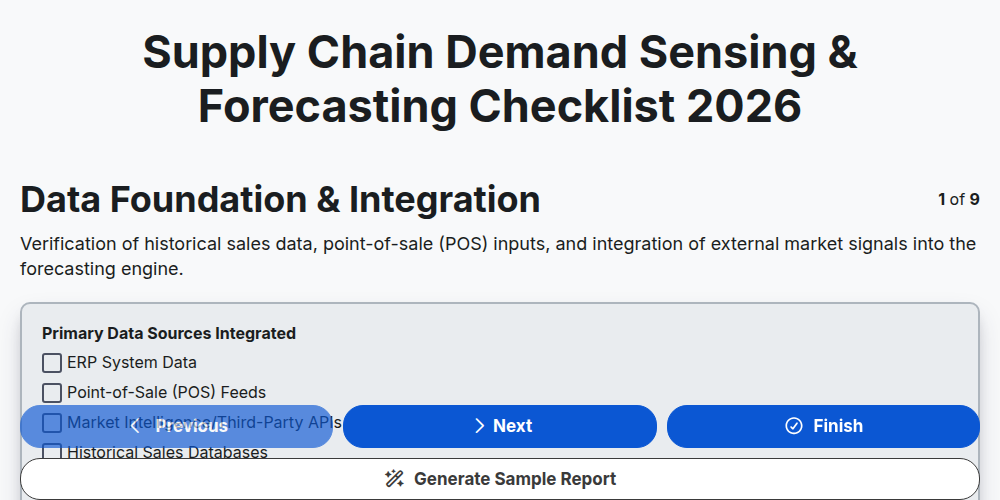
- 1. Building the Bedrock: Data Foundation & Integration
- 2. Capturing the Pulse: Demand Signal Identification
- 3. Ensuring Reliability: Forecasting Model Validation
- 4. Breaking Silos: Collaborative Planning & S&OP Alignment
- 5. Preparing for the Unpredictable: Demand Uncertainty & Risk Assessment
- 6. Measuring Success: Forecast Accuracy & Error Analysis
- 7. Bridging the Gap: Inventory & Buffer Strategy Alignment
- 8. Future-Proofing Operations: Technology & Automation Audit
- 9. The Feedback Loop: Post-Forecast Review & Continuous Improvement
- Conclusion: Navigating the 2026 Supply Chain Landscape
- Resources & Links
TLDR: Prepare your supply chain for the complexities of 2026 with this comprehensive guide. This checklist provides a strategic roadmap to mastering demand sensing and forecasting, covering everything from building a robust data foundation and integrating real-time demand signals to leveraging advanced automation, managing risk, and aligning inventory strategies with S&OP processes to drive accuracy and resilience.
Introduction: The Shift from Reactive to Predictive Supply Chains
The Era of Volatility Demands a New Paradigm
For decades, supply chain management relied on historical averages and seasonal trends to predict the future. But as we approach 2026, the rear-view mirror approach to forecasting is no longer just inefficient-it is a liability. We are operating in an era defined by permancrisis: rapid geopolitical shifts, extreme climate volatility, and consumer behavior that changes in the span of a single viral social media trend.
Beyond Traditional Forecasting
The traditional distinction between forecasting (predicting what might happen based on the past) and demand sensing (identifying what is happening right now) is dissolving. In the modern landscape, the most resilient organizations are moving away from reactive planning and toward predictive orchestration.
To stay competitive, companies must transition from a mindset of guessing to a mindset of sensing. This requires more than just better math; it requires a fundamental integration of real-time data, advanced AI, and cross-functional synergy.
Why 2026 is the Turning Point
As we enter 2026, the gap between leaders and laggards is widening. The emergence of autonomous agents, edge computing, and hyper-localized data streams means that the window for manual intervention is closing. The goal is no longer just to reduce error rates, but to build a living supply chain capable of self-correction.
The following checklist is designed to serve as your strategic roadmap. It is not merely a list of technical requirements, but a blueprint for building a highly responsive, digitally-native ecosystem that anticipates disruption before it hits your bottom line.
1. Building the Bedrock: Data Foundation & Integration
The Era of Data-Driven Resilience
As we approach 2026, the margin for error in supply chain management has evaporated. The gut feeling era of forecasting is officially dead, replaced by a landscape where real-time visibility and data integrity are the primary drivers of competitive advantage. Before you can implement the most advanced AI-driven sensing models, you must ensure that your underlying data architecture is robust, clean, and unified.
Establishing a Single Version of Truth
The most sophisticated forecasting algorithm is useless if it is fed dirty or siloed data. To achieve true demand sensing, your integration layer must bridge the gap between disparate organizational silos. This step is about moving away from fragmented spreadsheets and toward a unified data ecosystem.
Key Implementation Priorities:
- Breaking Down Data Silos: Ensure seamless integration between ERP, CRM, and external market intelligence feeds. Your forecasting models must have direct access to real-time point-of-sale (POS) data, much more than just historical shipments.
- Data Hygiene and Standardization: Implement automated cleaning protocols. In 2026, garbage in, garbage out is an even more expensive reality. Standardizing master data across different regions and product hierarchies is non-negotiable.
- Latency Reduction: Demand sensing requires near-real-time inputs. Audit your data pipelines to identify bottlenecks that cause delays between a market event occurring and that event being reflected in your forecasting engine.
- Integration of Unstructured Data: Prepare your foundation to ingest non-traditional inputs, such as social sentiment, weather patterns, and macroeconomic indicators, which are becoming critical components of modern sensing models.
The Goal: High-Fidelity Inputs
By focusing on a rigorous Data Foundation & Integration phase, you are not just organizing numbers; you are creating the high-fidelity environment required for predictive analytics to function. A resilient forecast begins with a foundation that is integrated, automated, and, above all, trustworthy.
2. Capturing the Pulse: Demand Signal Identification
Deciphering the Noise: Identifying High-Fidelity Signals
In the 2026 landscape, traditional historical sales data is no longer sufficient. To achieve true demand sensing, your organization must move beyond looking in the rearview mirror and start analyzing the real-time currents that shape future demand. The goal of this phase is to distinguish between noise (random volatility) and signals (predictive drivers).
Mapping Internal and External Data Streams
To build a robust sensing capability, you must audit and categorize your incoming data streams into three critical layers:
- Transactional Signals (The Foundation): This includes real-time Point-of-Sale (POS) data, e-commerce clickstream patterns, and recent order fulfillment rates.
- Market & Macro Signals (The Context): Identifying external drivers such as shifts in consumer sentiment, inflationary indices, and even localized weather patterns that influence seasonal purchasing behaviors.
- Upstream & Downstream Signals (The Ecosystem): Integrating distributor inventory levels, manufacturer lead-time fluctuations, and even social media trends that act as early warning indicators for demand spikes.
Evaluating Signal Relevancy and Latency
Not all data is created equal. A common pitfall in modern forecasting is data drowning-collecting massive amounts of information without the ability to act on it. As you build your checklist, evaluate every signal against two criteria:
- Latency: How quickly does this signal reach your system? For demand sensing to work, the window between a consumer action and your system's visibility must be minimized.
- Correlation Strength: Does this signal have a statistically significant relationship with your product demand? Use machine learning-driven correlation analysis to prune irrelevant data points that merely add computational complexity without improving accuracy.
Identifying Leading vs. Lagging Indicators
A sophisticated 2026 strategy focuses heavily on Leading Indicators. While a stockout is a lagging indicator (it tells you what went wrong), increasing cart abandonment rates or rising search volumes for specific product attributes are leading indicators (they tell you what will happen). Your checklist must ensure that your forecasting models are weighted toward these predictive, forward-looking signals to enable proactive rather than reactive supply chain management.
3. Ensuring Reliability: Forecasting Model Validation
Moving Beyond Static Models: The Art of Validation
In the 2026 supply chain landscape, a forecasting model is only as valuable as its proven ability to handle real-time volatility. As we move away from traditional historical averaging toward high-frequency demand sensing, the set it and forget it approach to modeling is a recipe for catastrophic stockouts or massive overstocks. Validation is the rigorous process of ensuring your algorithms are not just mathematically sound, but operationally resilient.
Stress-Testing Against Black Swan Scenarios
It is no longer enough to validate a model based on how well it performed last quarter. To achieve true resilience, your validation framework must include back-testing against historical periods of extreme disruption (e.g., sudden geopolitical shifts or logistics bottlenecks).
Ask your data science teams:
- How does the model react to sudden-onset volatility?
- Does the model over-correct (the bullwhip effect) when a single anomalous signal enters the system?
Quantitative Accuracy Metrics
While Mean Absolute Percentage Error (MAPE) remains a staple, 2026 demand sensing requires a more nuanced toolkit. Your validation process must incorporate:
- Weighted MAPE (wMAPE): To ensure that errors in high-margin or high-volume SKUs are prioritized over low-value items.
- Bias Tracking: Identifying if your model has a persistent tendency to over-forecast or under-forecast, which can lead to systematic inventory bloat.
- Forecast Value Add (FVA): A critical metric to determine if your complex AI/ML models are actually performing better than a simple moving average. If the complexity isn't adding accuracy, it's just adding noise.
Feature Importance & Drift Detection
As external variables-such as weather patterns, social media trends, and macroeconomic indicators-are integrated into your demand signals, Model Drift becomes a significant risk.
- Feature Attribution: Periodically audit which inputs are driving the forecast. If a previously critical signal (like a specific promotional metric) loses its predictive power, the model must be recalibrated.
- Concept Drift Monitoring: Implement automated alerts that trigger when the statistical properties of your target variable change, signaling that your current model architecture may be becoming obsolete.
The Human-in-the-Loop Verification
Validation is not purely an algorithmic task. The final step of this stage is the Expert Overlay Check. This involves comparing model outputs against the qualitative insights of regional planners and sales leaders. A model may be statistically accurate but operationally blind to an upcoming strategic promotion or a known competitor move. Validation is complete only when the math aligns with the market reality.
4. Breaking Silos: Collaborative Planning & S&OP Alignment
Bridging the Gap Between Insight and Execution
In the landscape of 2026, a forecast is only as valuable as the organization's ability to act upon it. Even the most sophisticated AI-driven demand sensing models will fail if they exist in a vacuum. The true power of demand sensing is realized when high-frequency signals are integrated into a unified, cross-functional decision-making framework.
To move beyond mere prediction and toward true synchronization, your checklist must focus on breaking down the traditional silos between Sales, Marketing, Finance, and Operations.
Synchronizing the Single Version of the Truth
The primary goal of S&OP (Sales and Operations Planning) alignment is to ensure that every department is working from the same set of numbers. In an era of rapid market volatility, data drift between departments is a critical risk. Your alignment strategy should include:
- Cross-Functional Consensus Building: Establishing a formal cadence where demand signals from the field (Sales) are reconciled with supply capabilities (Operations) and financial constraints (Finance).
- Integrated Business Planning (IBP) Maturity: Moving beyond traditional S&OP by incorporating the financial implications of demand fluctuations into the forecasting loop.
- Unified KPI Frameworks: Ensuring that the definition of accuracy and service level is standardized across the organization to prevent conflicting departmental goals.
Integrating the Demand-to-Supply Loop
Strategic alignment in 2026 requires more than just monthly meetings; it requires a real-time feedback loop. Use the following checkpoints to audit your alignment maturity:
- Marketing & Promotion Integration: Are promotional calendars and trade spend plans automatically ingested into the demand sensing engine to prevent artificial spikes in perceived organic demand?
- Feedback Loops from the Frontline: Do field sales and customer service teams have a structured mechanism to feed qualitative market intelligence back into the quantitative models?
- Scenario-Based Decision Making: Does your S&OP process include what-if simulations? Alignment is not just about agreeing on one number, but about pre-approving response plans for various demand scenarios.
By treating S&OP alignment as a continuous integration process rather than a periodic event, you transform your supply chain from a reactive cost center into a proactive, agile competitive advantage.
5. Preparing for the Unpredictable: Demand Uncertainty & Risk Assessment
Navigating Volatility in a High-Variance Era
In 2026, the era of predictable supply chains is officially over. As global markets face heightened geopolitical shifts, climate-driven disruptions, and rapid-fire consumer sentiment changes, a forecast is only as good as its ability to account for what might go wrong.
Effective demand sensing is no longer just about tracking trends; it is about stress-testing your assumptions against a landscape of constant volatility.
Mapping the Known Unknowns
To master demand uncertainty, your checklist must move beyond historical averages and begin integrating what-if scenarios. This stage of the audit focuses on identifying the drivers of variance that fall outside of standard seasonal patterns.
- Identify External Risk Drivers: Audit your ability to ingest non-traditional data-such as weather patterns, port congestion indices, and macroeconomic indicators-into your forecasting models.
- Scenario Modeling Capabilities: Evaluate whether your current systems can run multi-scenario simulations (e.g., What happens to our regional demand if a primary shipping lane is blocked for 14 days?).
- Sensitivity Analysis: Determine how sensitive your high-margin SKUs are to sudden shifts in consumer behavior or supply constraints.
Building Resilience Through Probabilistic Forecasting
The transition from deterministic (single-number) forecasting to probabilistic forecasting is a hallmark of a mature 2026 supply chain. Instead of asking, How much will we sell? your framework should ask, What is the probability of demand exceeding our current capacity?
Stress-Testing the Supply-Demand Gap
Risk assessment is incomplete without evaluating the friction points where demand volatility meets supply limitations.
- Lead Time Variability: Assess how fluctuations in supplier lead times impact your ability to respond to sudden demand spikes.
- The Black Swan Buffer: Review your contingency protocols for low-probability, high-impact events. Do you have a pre-defined trigger mechanism that moves the organization from standard forecasting to emergency replenishment mode?
By integrating rigorous risk assessment into your sensing process, you transform your supply chain from a reactive entity into a resilient, proactive powerhouse capable of navigating the complexities of the 2026 landscape.
6. Measuring Success: Forecast Accuracy & Error Analysis
Quantifying Precision: Moving Beyond Averages
In the 2026 supply chain landscape, simply knowing your error rate is no longer enough; you must understand the nature of your errors. To achieve true demand sensing maturity, your analysis must shift from retrospective reporting to diagnostic intelligence.
Beyond the MAPE: Advanced Error Metrics
While Mean Absolute Percentage Error (MAPE) remains a standard, relying on it exclusively can mask significant operational risks. To master your forecast, your checklist must include a multi-dimensional approach to error analysis:
- WAPE (Weighted Mean Absolute Error): Essential for understanding error in the context of volume, ensuring that a 10% error on a high-value SKU carries more weight than a 10% error on a low-volume item.
- Bias Tracking: Are you consistently over-forecasting (leading to bloated working capital) or under-forecasting (leading to lost sales and stockouts)? Identifying persistent directional bias is critical for tuning your sensing models.
- RMSE (Root Mean Square Error): Use this to penalize large, outlier errors. In a modern supply chain, a single massive forecasting miss can disrupt an entire downstream network; RMSE helps you identify these black swan forecasting failures.
Root Cause Categorization
A metric without a why is just a number. As part of your 2026 audit, implement a structured process for categorizing error drivers. Every significant deviation should be tagged under one of the following:
- Signal Noise: Was the error caused by a transient market anomaly or a genuine shift in consumer behavior?
- Data Integrity Issues: Did a failure in upstream data integration lead to an incorrect input?
- Execution Error: Was the forecast correct, but the replenishment or S&OP alignment failed to act on it?
- Model Drift: Is your predictive algorithm losing relevance due to changing seasonal patterns?
The Feedback Loop: From Analysis to Action
The ultimate goal of error analysis is to feed insights back into your Demand Signal Identification and Forecasting Model Validation steps.
Effective organizations use error analysis as a trigger for automated model retraining. If your error exceeds a predefined threshold for three consecutive periods, it should trigger an automatic audit of your demand signals. This transforms error analysis from a post-mortem autopsy into a proactive engine for continuous improvement.
7. Bridging the Gap: Inventory & Buffer Strategy Alignment
Synchronizing Forecasts with Physical Reality
A high-precision forecast is meaningless if your inventory strategy is stuck in a reactive, legacy mindset. In 2026, the set and forget approach to safety stock is a recipe for obsolescence or stockouts. To truly master demand sensing, you must ensure that the insights generated by your predictive models are directly translated into actionable inventory positioning.
Closing the Loop Between Prediction and Placement
The goal of demand sensing is to reduce the lag between a market shift and your supply chain's response. However, this requires more than just accurate numbers; it requires an alignment of your buffer strategies with the volatility detected by your new models.
- Dynamic Safety Stock Calibration: As demand sensing identifies new patterns of volatility, your safety stock levels must automatically adjust. If your sensing engine detects increased noise in a specific region, your inventory parameters should reflect that heightened risk in real-time.
- Decoupling Point Optimization: Use your forecast insights to determine where to hold inventory. Should you hold raw materials (upstream) to maintain flexibility, or finished goods (downstream) to ensure immediate fulfillment? Your 2026 strategy should use demand signals to strategically place buffers closer to the point of consumption.
Managing the Cost of Uncertainty
Every forecast carries an error margin. The maturity of your supply chain is defined by how you manage the gap between your forecasted demand and actual demand.
- Service Level vs. Working Capital: Use your error analysis to conduct a cost-benefit audit. Are you over-buffering low-margin items due to an inability to sense demand accurately? Conversely, are your high-margin, high-volatility items under-protected?
- The Buffer Right-Sizing Audit: Periodically review whether your physical inventory levels align with the precision of your forecasting models. If your forecasting accuracy improves, your buffer requirements should decrease, freeing up much-needed working capital.
By integrating your inventory strategy with your sensing capabilities, you transform your supply chain from a reactive cost center into a proactive, competitive engine capable of navigating the complexities of the 2026 landscape.
8. Future-Proofing Operations: Technology & Automation Audit
Navigating the Autonomous Era
As we approach 2026, the distinction between using software and leveraging intelligence has become the defining line between market leaders and laggards. A technology audit is no longer just about checking if your ERP is functional; it is about evaluating the cognitive capacity of your digital ecosystem.
Evaluating the Intelligence Layer
To ensure your forecasting capabilities are truly sensing rather than just reacting, evaluate your stack against these three critical dimensions:
- AI & Machine Learning Maturity: Move beyond basic regression models. Assess whether your tools can handle unstructured data (social trends, weather, geopolitical shifts) and whether they offer Explainable AI (XAI). Your team must be able to understand why a model predicted a spike, not just see the number.
- Integration Latency: In a 2026 supply chain, real-time is the only acceptable standard. Audit your data pipelines to identify bottlenecks. If there is a lag between a point-of-sale (POS) transaction and your forecasting engine, your demand sensing is actually just demand lagging.
- Edge Computing & IoT Connectivity: Evaluate how much data is being captured at the source. Are your sensors in warehouses and transit hubs feeding directly into your forecasting models, or is manual data entry creating a visibility gap?
Beyond Implementation: The Automation Maturity Model
Don't just ask if a process is automated-ask if it is autonomous.
- Level 1: Manual/Digitalized: Data is collected digitally but requires human intervention to generate forecasts.
- Level 2: Assisted: Systems suggest adjustments, but planners must approve every change.
- Level 3: Autonomous: The system detects a signal, updates the forecast, and triggers an automated replenishment alert with minimal human oversight.
The Human-Machine Interface (HMI)
The final component of your audit must be the user experience. As models become more complex, the risk of black box syndrome increases. Ensure your technology provides intuitive visualizations and decision-support dashboards that empower planners to intervene effectively when anomalies occur.
The 2026 Goal: Your technology stack should act as a continuous feedback loop, where automation handles the routine, leaving your human talent to focus on high-level strategic decision-making.
9. The Feedback Loop: Post-Forecast Review & Continuous Improvement
Closing the Loop: Turning Retrospectives into Resilience
A forecast is never truly finished-it is a living hypothesis that must be constantly tested against reality. In the era of 2026's hyper-volatile markets, the ability to close the loop between your predictions and actual outcomes is what separates industry leaders from those caught in a cycle of reactive firefighting.
The final stage of your checklist isn't about the next prediction; it is about auditing the integrity of your entire decision-making engine.
The Anatomy of a High-Performance Review
To move beyond simple error tracking, your post-forecast review must focus on three critical dimensions:
- Root Cause Analysis (RCA) of Bias: Don't just ask how much you missed the target by; ask why. Was the error driven by an external black swan event, an uncaptured promotional signal, or a failure in data integration? Distinguishing between structural bias (systemic errors) and random noise (unpredictable variance) is essential for refining your models.
- Model Decay Detection: Algorithms and machine learning models can suffer from drift as consumer behaviors shift. Periodic reviews allow you to identify when a previously high-performing model is losing its predictive power, signaling the need for retraining or feature updates.
- Process Agility Assessment: Use this stage to evaluate your S&OP synchronization. Did the demand signal reach the procurement and logistics teams in time to trigger an adjustment? If the data was accurate but the action was too slow, your bottleneck isn't your forecast-it's your organizational latency.
Cultivating a Culture of Continuous Improvement
Continuous improvement is not a periodic task; it is a cultural imperative. By institutionalizing a learning loop, you transform every forecast error from a failure into a strategic asset.
Key Actions for your 2026 Roadmap:
- Automated Alerting: Implement triggers that automatically initiate a deep-dive review when forecast error exceeds pre-defined thresholds.
- Knowledge Institutionalization: Document the lessons learned from major disruptions in a centralized repository to ensure that insights are not lost during personnel transitions.
- Iterative Refinement: Use the outputs of your error analysis to directly update the parameters in your Data Foundation & Integration and Demand Signal Identification steps.
By treating the post-forecast review as the engine of evolution, you ensure that your supply chain doesn't just react to the future-it anticipates it.
Conclusion: Navigating the 2026 Supply Chain Landscape
As we approach 2026, the margin for error in supply chain management is shrinking. The era of reactive planning is officially over; the era of anticipatory intelligence has arrived. The volatility we have grown accustomed to-from geopolitical shifts to rapid-fire consumer trend changes-demands more than just better math; it demands a fundamental shift in how we integrate data, technology, and human intuition.
The Strategic Imperative
Implementing this checklist is not a one-time project, but rather a commitment to a continuous cycle of evolution. By systematically addressing everything from your Data Foundation to Post-Forecast Continuous Improvement, you are building a resilient framework capable of absorbing shocks rather than shattering under them.
In 2026, the winners in the supply chain arena will not be those with the largest inventories, but those with the highest signal-to-noise ratio. The ability to distinguish a fleeting market fad from a structural shift in demand will be the ultimate competitive advantage.
Key Takeaways for your 2026 Roadmap:
- Prioritize Integration over Isolation: A forecast is only as strong as the weakest data silo. Ensure your demand signals are connected to your execution capabilities.
- Embrace the Hybrid Model: While automation and AI are non-negotiable, the Human-in-the-loop element remains critical for interpreting the why behind the what.
- Shift from Accuracy to Agility: While minimizing error is vital, building a strategy that allows for rapid re-calibration when error inevitably occurs is what ensures true business continuity.
As you move forward, use this checklist as your North Star. Use it to audit your current capabilities, identify critical gaps, and ultimately, to transform your supply chain from a cost center into a powerful engine of strategic growth.
Resources & Links
- Gartner Supply Chain Practice: Industry-leading research and insights on supply chain trends, predictive analytics, and strategic technology implementation.
- ASCM (Association for Supply Chain Management): The global leader in supply chain professional development, providing frameworks for S&OP and demand planning best practices.
- McKinsey & Company - Operations Practice: Deep dives into digital transformation and the shift toward autonomous, predictive supply chain operations.
- Supply Chain Brain: A leading news source for logistics and supply chain professionals covering demand sensing and technological innovations.
- Forbes - Supply Chain Insights: High-level strategic perspectives on how global economic shifts impact demand forecasting and risk management.
- SAP Integrated Business Planning (IBP): Resources on advanced demand sensing technologies and integrated business planning software solutions.
- Oracle Supply Chain Management: Information on cloud-based tools for demand management, forecasting, and end-to-end visibility.
- Blue Yonder: Focus on AI-driven demand forecasting and the implementation of machine learning in supply chain planning.
- Dell Technologies - Supply Chain Innovation: Insights into how IoT and edge computing contribute to real-time demand signal identification.
- Supply Chain Management Review: Detailed articles on breaking down organizational silos and achieving S&OP excellence.
- edX - Supply Chain Analytics Courses: Educational resources for mastering the mathematical foundations of forecast accuracy and error analysis.
- MIT Center for Transportation & Logistics: Academic research on demand uncertainty, risk assessment, and complex supply chain networks.
- IBM Supply Chain Intelligence: Focus on the role of AI and blockchain in creating a transparent and resilient data foundation.
- Siskon - Demand Planning Excellence: Resources regarding the alignment of inventory buffer strategies with demand volatility.
- Numerical Forecasting Tools: Technical documentation and logic behind demand sensing and predictive modeling algorithms.
- PMI (Project Management Institute): Frameworks for managing the continuous improvement loop and post-forecast review processes.
Kommentare
Bisher gibt es keine Kommentare. Seien Sie der Erste, der einen hinzufügt!
Demonstration der SCM-Lösung (Lieferkettenmanagement)
Haben Sie Probleme mit Unterbrechungen in der Lieferkette und mangelnder Transparenz? ChecklistGuro bietet eine zentrale SCM-Lösung, die Ihre Lieferanten, Hersteller und Distributoren miteinander verbindet, um die Zusammenarbeit und Kontrolle zu verbessern. Vereinfachen Sie Abläufe und steigern Sie die Effizienz.
Verwandte Artikel
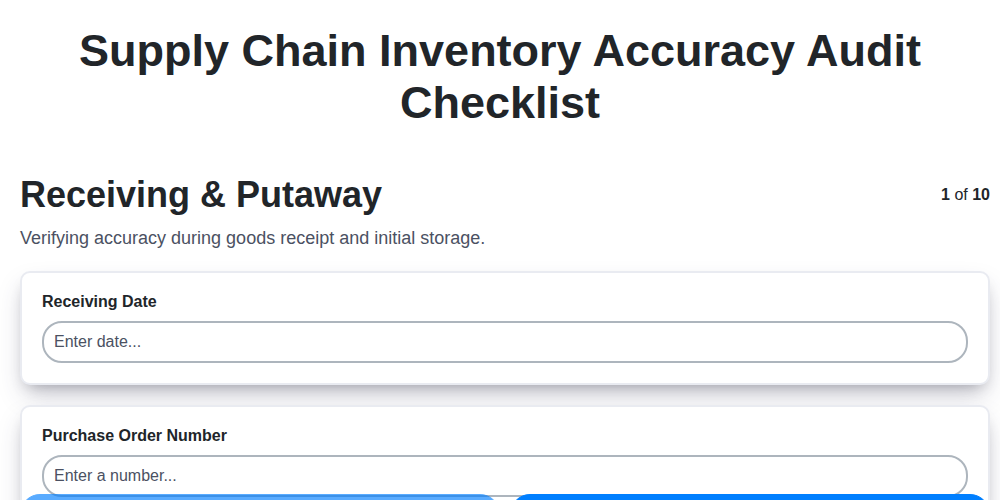
The Ultimate Supply Chain Inventory Accuracy Audit Checklist: A Step-by-Step Guide
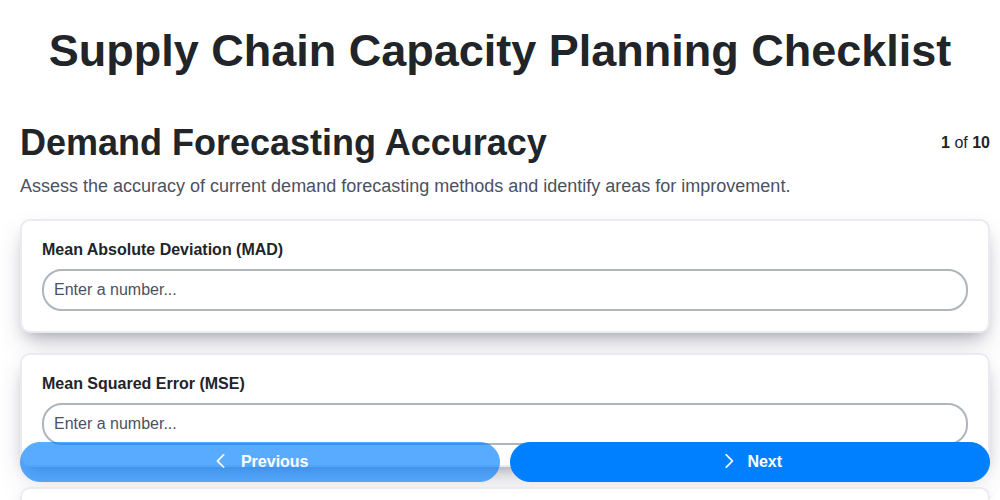
Supply Chain Capacity Planning Checklist: Ensure Readiness for Peak Demand
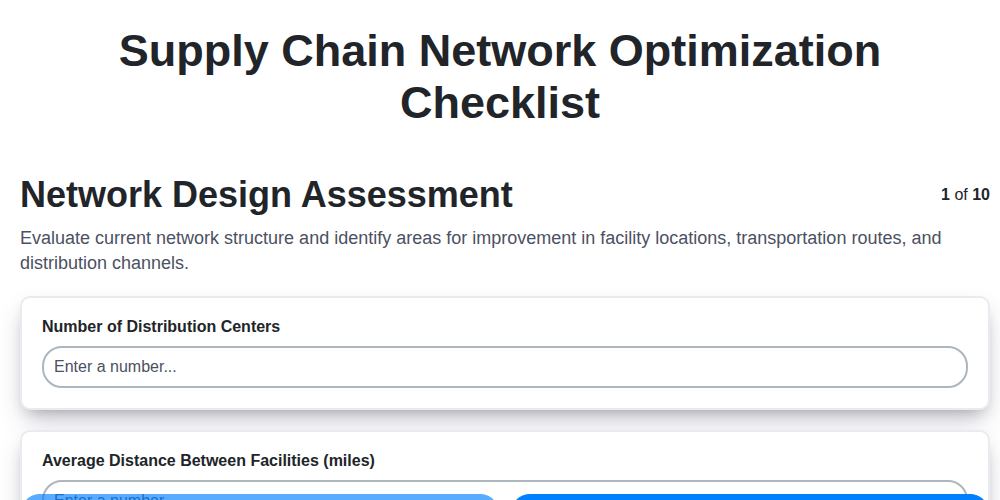
Die ultimative Checkliste zur Optimierung Ihrer Lieferkettennetzwerke: Ein Schritt-für-Schritt-Leitfaden
Supply Chain Risk Assessment Checklist: Your Guide to Resilience
Navigating Sustainability: Your Supply Chain Compliance Checklist

Top 10 SAP Logistics Business Network (LBN) Alternatives for 2025

Fortify Your Supply Chain: The Ultimate Resilience Assessment Checklist
Navigating Global Trade: Your Essential Import/Export Compliance Checklist
Benötigen Sie Hilfe bei Checklisten?
Haben Sie eine Frage? Wir helfen Ihnen gerne. Bitte senden Sie uns Ihre Anfrage, und wir werden Ihnen umgehend antworten.