Packaging and Labeling Workflow for Manufacturing: A Step-by-Step Guide
Publicado: 03/30/2026 Actualizado: 03/31/2026
Índice
- Introduction: The Critical Role of Packaging and Labeling
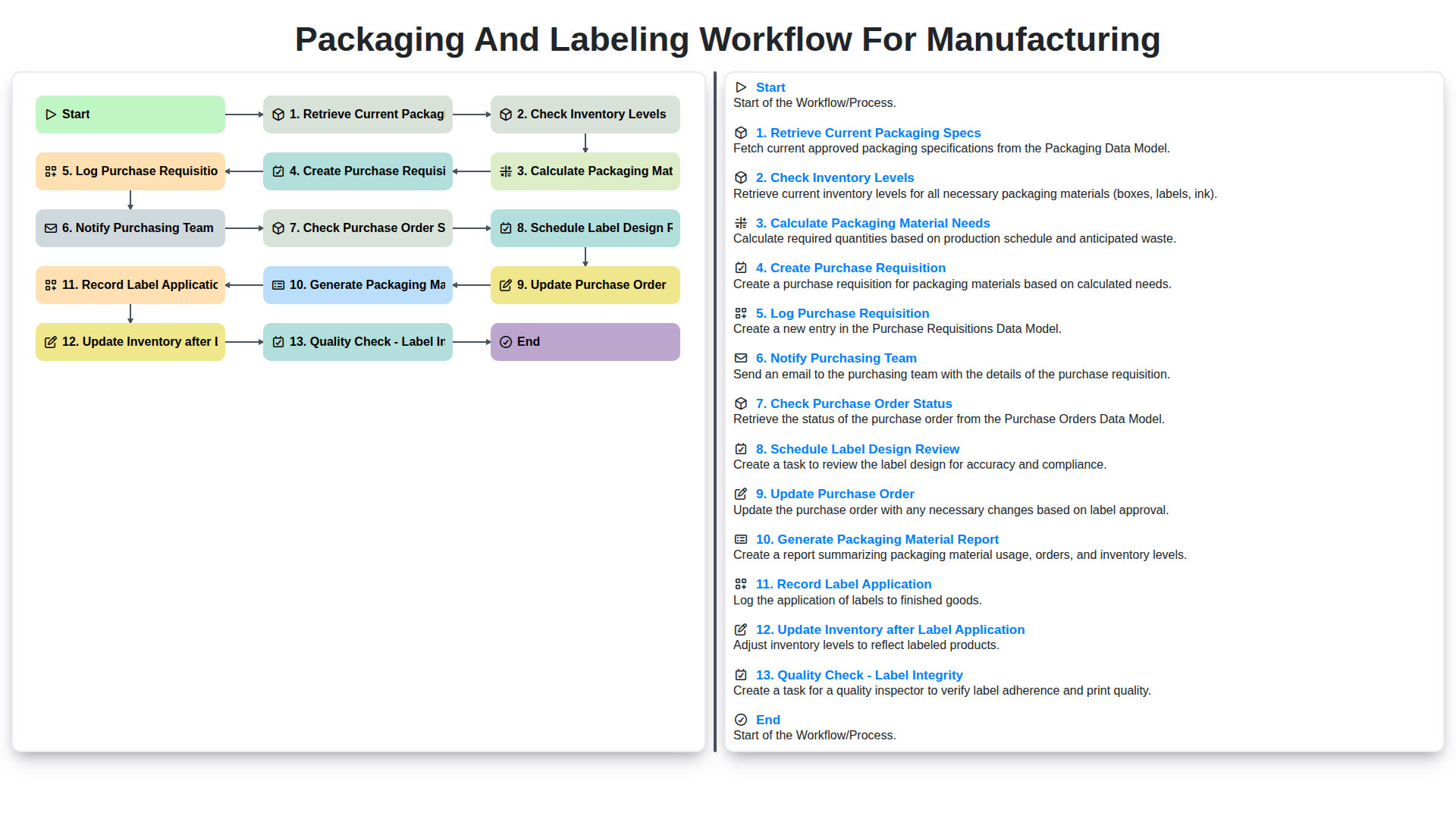
- 1. Retrieving Current Packaging Specifications
- 2. Assessing Current Inventory Levels
- 3. Calculating Packaging Material Needs: A Detailed Approach
- 4. Creating and Logging a Purchase Requisition
- 5. Notifying the Purchasing Team for Expedited Action
- 6. Monitoring Purchase Order Status: Keeping Track
- 7. Updating the Purchase Order: Amendments and Adjustments
- 8. Label Design Review: Ensuring Accuracy and Compliance
- 9. Generating a Packaging Material Report: Data for Decision-Making
- 10. Record Label Application: Maintaining Traceability
- 11. Updating Inventory After Label Application: Real-Time Visibility
- 12. Quality Check: Label Integrity and Adherence to Standards
- Conclusion: Streamlining Your Packaging and Labeling Workflow
- Resources & Links
TLDR: Ensure consistent and accurate packaging and labeling in your manufacturing process with this step-by-step workflow! From verifying specs and calculating material needs to quality checks and inventory updates, this guide streamlines the process, reduces errors, and keeps your production running smoothly.
Introduction: The Critical Role of Packaging and Labeling
Packaging and labeling are far more than just aesthetics in manufacturing. They's a crucial intersection of branding, product protection, regulatory compliance, and operational efficiency. Effective packaging safeguards your product throughout the supply chain, minimizing damage and ensuring freshness. Accurate and compliant labeling provides vital information to consumers and fulfills legal requirements. A breakdown in either area can lead to costly recalls, damaged reputations, and ultimately, lost revenue. This blog post will explore a robust workflow designed to streamline the entire packaging and labeling process, ensuring accuracy, minimizing waste, and maximizing efficiency. Understanding and optimizing this workflow is essential for manufacturers of all sizes striving for operational excellence.
1. Retrieving Current Packaging Specifications
Before any packaging material is ordered or labels are designed, ensuring you have the absolute latest packaging specifications is paramount. These specs dictate everything from dimensions and materials to printing requirements and regulatory compliance. Outdated specs lead to wasted materials, production delays, and potential product recalls - a costly and damaging scenario.
Where do you find these specs? They typically reside in a centralized document management system, product database, or engineering drawings. Key information to retrieve includes:
- Package Dimensions: Length, width, height, and wall thickness.
- Material Types: Corrugated cardboard grade, plastic resin, film gauge, etc.
- Printing Requirements: Colors, inks, resolutions, barcode placement, and any mandatory markings.
- Regulatory Compliance: Details on labeling requirements, legal disclaimers, and certifications.
Establish a clear protocol for accessing and verifying these specs. This might involve designated personnel, version control procedures, and mandatory approval steps to guarantee accuracy. Always confirm the revision date and obtain confirmation from the relevant engineering or product development team before proceeding to the next step.
2. Assessing Current Inventory Levels
Before any packaging material can be ordered, a thorough assessment of current inventory levels is crucial. This step prevents overstocking (tying up capital and risking obsolescence) and understocking (leading to production delays and lost sales). We don't just look at the quantity; we also consider expiry dates (for materials like adhesives or inks) and condition of the existing stock.
Our system automatically pulls data from our warehouse management system (WMS) to provide a real-time view of packaging materials, including boxes, labels, tape, void fill, and any custom packaging components. This information is then compared against the anticipated demand based on the current production schedule. Any discrepancies immediately trigger a review - is the demand truly accurate, or does a problem in forecasting need addressing? A proactive approach to inventory assessment isn't just about knowing how much we have; it's about understanding what we need for the upcoming production runs and identifying potential risks.
3. Calculating Packaging Material Needs: A Detailed Approach
Accurately calculating your packaging material needs is critical to avoiding costly shortages or excess inventory. This isn't just about looking at production volume; it's about a granular understanding of your packaging requirements. Here's a breakdown of a detailed approach:
1. Bill of Materials (BOM) Review: Start by meticulously reviewing your Bill of Materials. This document should clearly outline every packaging component required for each product - boxes, inserts, labels, shrink wrap, pallets, etc. Don't overlook seemingly minor items.
2. Production Forecast & Volume: Integrate your production forecast. How many units are you producing, and over what timeframe? This is your primary driver.
3. Package Size & Configuration: Consider package variations. Do you offer different sizes or configurations of the same product? Each variation will require a different set of packaging materials. Factor in those differences.
4. Wastage Factor: Account for wastage. Packaging materials inevitably get damaged or lost during handling. A typical wastage factor is between 2-5%, but this can vary depending on your handling processes and material fragility. Higher-value materials might warrant a lower wastage factor.
5. Label Considerations: Labels introduce complexity. Factor in label sizes, printing requirements (single-color vs. full-color), and quantities needed per product. Don't forget to include blank label stock for future needs or emergency reprints.
6. Buffer Stock: Finally, add a small buffer stock to account for unexpected demand spikes or supplier delays. This provides a safety net and prevents production halts. A buffer of 5-10% is generally recommended.
Formula Example:
- Material Need = (Production Volume x BOM Material Quantity) + (Wastage Factor x (Production Volume x BOM Material Quantity)) + Buffer Stock
By implementing this detailed approach, you can significantly improve the accuracy of your packaging material needs calculations, leading to a more efficient and cost-effective manufacturing process.
4. Creating and Logging a Purchase Requisition
Once your packaging material needs are calculated (as detailed in the previous step), the next crucial step is formally requesting those materials. This is done by creating a Purchase Requisition (PR). The PR essentially acts as an internal request to your purchasing team, outlining the specific materials, quantities, and any relevant specifications.
Creating the PR:
- Use a Standardized Form: Your company likely has a standard PR form, either paper-based or within your ERP/MRP system. Using this ensures consistency and accuracy.
- Detailed Information: Fill out all required fields meticulously. This includes:
- Material Name & Description (referencing the calculated needs)
- Quantity Required
- Supplier (if known - pre-approved suppliers are preferred)
- Delivery Date (based on production schedule)
- Cost Center/Account Codes (for budget allocation)
- Any specific quality requirements or certifications.
- Attach Supporting Documentation: Include the Packaging Material Needs report (generated previously) as an attachment to clearly justify the request.
Logging the PR:
- PR Number Assignment: The system (or designated personnel) will assign a unique PR number for tracking purposes. This is critical for referencing the request later.
- Digital or Physical Record: Ensure the PR is properly logged within your system. This often involves uploading a digital copy or filing a physical copy in an organized location.
- Workflow Initiation: Logging the PR typically initiates the workflow, routing it to the appropriate personnel for approval (often a supervisor or production manager).
5. Notifying the Purchasing Team for Expedited Action
Once a Purchase Requisition has been logged and approved, it's crucial to promptly notify the Purchasing Team. This isn't just about keeping them in the loop; it's about potentially expediting the process. Depending on your production schedule and anticipated demand, packaging materials might need to be sourced urgently. Clearly communicate the requisition details, including the urgency level and any deadlines related to production. Utilize your company's established communication channels - whether that's an email template, a specific messaging platform, or a task management system - to ensure the notification is tracked and doesn't get lost. Including the Purchase Requisition number in the notification provides easy reference and allows the Purchasing Team to quickly access all relevant information. Proactive communication minimizes potential delays and keeps your production on track.
6. Monitoring Purchase Order Status: Keeping Track
Keeping a close eye on your Purchase Order (PO) status is absolutely critical for maintaining a smooth packaging and labeling workflow. Delays in receiving packaging materials can halt production, leading to costly downtime and missed deadlines. Don't rely solely on periodic inquiries; proactive monitoring is key.
Here's what proactive monitoring entails:
- Automated Alerts: Implement a system that provides automated alerts when the PO status changes - whether it's approved, shipped, or experiencing delays. Many ERP and purchasing software solutions offer this functionality.
- Regular Checks: Even with automated alerts, schedule regular (daily or every other day) manual checks of the PO status in your supplier's portal or through direct communication.
- Communication is Key: Build a strong relationship with your purchasing team and suppliers. Open communication allows you to address potential issues early. Don't hesitate to inquire about estimated delivery dates and any potential roadblocks.
- Record Keeping: Maintain a log of all PO status updates and communication regarding the order. This provides a clear audit trail and helps identify recurring issues with specific suppliers.
- Exception Handling: Establish a clear procedure for handling PO exceptions, such as delayed shipments or changes in quantity. This might involve contacting the supplier, expediting shipping, or adjusting production schedules.
7. Updating the Purchase Order: Amendments and Adjustments
Once a Purchase Requisition is approved and a Purchase Order (PO) is created, the workflow doesn't end there. Manufacturing realities often necessitate adjustments. This section details how to handle those amendments and ensure your packaging material supply remains accurate.
Why Updates Happen: Unexpected demand surges, supplier pricing fluctuations, material substitutions due to scarcity, or even minor design changes can all trigger the need to update a PO. Ignoring these changes can lead to production delays, cost overruns, and potentially compromised product labeling.
How to Update the PO: The process for amending a PO varies depending on your ERP system and supplier relationship. Generally, the process involves:
- Identifying the Need: Someone - typically in Production, Procurement, or Quality - identifies the reason for the change. Document this reason thoroughly.
- Initiating a Change Request: Depending on your system, this might be a formal request within your ERP, a simple email, or a phone call. Clearly state the PO number, the items needing modification (quantity, price, delivery date, etc.), and the justification for the change.
- Supplier Communication: Contact the supplier and get their agreement to the proposed changes. Obtain a revised quote if the price is affected.
- Internal Approval: Depending on your company's approval matrix, the updated PO might require approval from different stakeholders (e.g., Production Manager, Finance).
- PO Amendment Creation: Formally create an amendment within your ERP system, documenting the original PO number, the changes made, and the supplier's acceptance.
- Updating Records: Ensure all relevant records, including the Purchase Requisition and any related packaging material reports, are updated to reflect the amended PO.
Best Practices:
- Change Control Process: Implement a formal change control process to manage PO amendments.
- Communication is Key: Keep all stakeholders informed of PO changes.
- Documentation: Thoroughly document all changes and approvals.
- Regular Review: Periodically review open POs to identify potential issues and ensure accuracy.
8. Label Design Review: Ensuring Accuracy and Compliance
The label isn't just about aesthetics; it's a critical communication tool and a legal requirement. This review stage is where accuracy and compliance are paramount. A dedicated team (often including representatives from marketing, regulatory affairs, and production) meticulously examines the label design against current regulations, product specifications, and branding guidelines.
Key areas of focus include verifying all required information is present (ingredients, warnings, usage instructions, etc.), ensuring font sizes are legible, validating barcode accuracy, and confirming adherence to any mandatory language requirements. This isn't just a visual check - it's a detailed validation process.
Any discrepancies or potential issues identified during this review are documented and relayed back to the design team for correction. The revised design then undergoes another round of review to ensure the changes address the initial concerns and maintain overall label integrity. This iterative process helps prevent costly errors, recalls, and potential legal repercussions down the line.
9. Generating a Packaging Material Report: Data for Decision-Making
A comprehensive packaging material report isn't just a formality; it's a vital tool for optimizing your manufacturing process and minimizing costs. This report consolidates data gathered throughout the entire workflow - from initial specifications to actual usage - providing valuable insights.
What should be included? At a minimum, your report should detail:
- Material Type & Quantity Used: Track the precise amount of each packaging material (boxes, tape, labels, void fill, etc.) consumed within a specific timeframe (e.g., weekly, monthly, quarterly).
- Order History: Include details of purchase orders placed, quantities ordered, and actual deliveries received.
- Waste/Scrap Rate: This is critical for identifying inefficiencies. Document instances of damaged materials, over-application, or incorrect usage.
- Cost Analysis: Break down material costs per unit produced. This helps pinpoint areas where alternative, more cost-effective packaging options might be available.
- Trend Analysis: Visually represent usage patterns over time. Identifying rising consumption rates allows for proactive adjustments to material purchasing or process improvements.
Analyzing this data empowers you to make informed decisions regarding supplier negotiations, inventory management, and potentially, a shift to more sustainable or cost-effective packaging alternatives. Regular review of this report is crucial for continuous improvement and operational efficiency within your manufacturing workflow.
10. Record Label Application: Maintaining Traceability
Accurate record-keeping during label application is paramount for traceability and accountability within your manufacturing process. This isn't just about confirming labels were applied; it's about creating an auditable trail. Your system should capture key details for each application, including:
- Product ID/Batch Number: Essential for linking the labeled product back to its origin and production data.
- Label Version/Design: Documenting the specific label design used ensures consistency and allows for identification of any potential issues related to a particular label version.
- Application Date & Time: This provides a timeline for tracking the labeling process.
- Operator ID: Identifying the individual who applied the label adds another layer of accountability.
- Quantity Labeled: The number of units labeled at that specific time.
- Any Anomalies/Observations: A space to note any issues encountered during application, like misprints or alignment problems.
This data should be integrated directly into your overall workflow system. Consider using barcode or QR code scanning to automate data entry, minimizing errors and maximizing efficiency. This detailed record allows for quick recall of specific production runs, facilitates root cause analysis if issues arise, and strengthens your overall quality control program.
11. Updating Inventory After Label Application: Real-Time Visibility
Once labels are successfully applied to the product, the final critical step is updating the inventory system. This isn't just about deducting the labeled product from available stock; it's about ensuring real-time visibility across your operations.
Why is this so important? Accurate inventory records directly impact order fulfillment accuracy, prevent stockouts, and provide a clear picture of product flow. Manual updates are prone to errors and delays, leading to discrepancies and potential disruptions.
Ideally, your labeling system should be integrated with your ERP or inventory management software. This automated process instantly reflects the updated inventory levels - providing immediate visibility to sales, production, and management. Even with manual systems, rigorous procedures are essential. Clearly define who is responsible for updating the records, the exact data to be entered, and the verification process to minimize errors.
Consider these best practices:
- Batch Updates: If dealing with large quantities, update in batches to avoid system overload.
- Double-Check: Implement a double-check system where a second person verifies the updated numbers.
- Automated Alerts: Set up automated alerts when inventory levels reach pre-defined thresholds, allowing for proactive replenishment.
- Traceability: Ensure your inventory updates are linked to the original batch number and labeling run for full traceability.
Accurate and timely inventory updates after label application aren't just about numbers; they're about maintaining control, efficiency, and confidence in your manufacturing process.
12. Quality Check: Label Integrity and Adherence to Standards
This final step in the packaging and labeling workflow is paramount to ensuring product safety, regulatory compliance, and brand consistency. A robust quality check focuses specifically on label integrity and adherence to established standards. This isn't just a visual inspection; it's a process designed to identify potential issues before product reaches the consumer.
Here's what's typically included in a thorough label integrity check:
- Legibility and Accuracy: Verify all text, barcodes, and QR codes are clear, accurate, and easily readable. Errors here can lead to recalls and incorrect product usage.
- Adhesive Performance: Assess the label's adhesion to the packaging. Is it secure and unlikely to peel or lift during handling and storage?
- Material Integrity: Check for any defects in the label material itself - wrinkles, tears, discoloration, or printing flaws.
- Compliance Verification: Confirm the label accurately reflects all required information dictated by regulations (e.g., nutritional information, warnings, ingredients). This includes proper placement and size.
- Color and Branding Consistency: Ensure colors match approved brand guidelines. Subtle variations can damage brand recognition.
- Dimensional Accuracy: Verify the label's dimensions are correct and properly aligned with the packaging.
- Resistance to Environmental Factors: Consider testing label durability against common environmental factors like moisture, temperature variations, and UV exposure (depending on the product and its intended storage conditions).
Detailed records of the quality check, including any deviations found and corrective actions taken, should be meticulously maintained. This data provides valuable insights for continuous improvement within the packaging and labeling process.
Conclusion: Streamlining Your Packaging and Labeling Workflow
Ultimately, a well-defined packaging and labeling workflow isn't just about ticking boxes - it's about ensuring product integrity, minimizing waste, and optimizing efficiency across your manufacturing process. By implementing the steps outlined above, from initial specifications to final quality checks, you can significantly reduce errors, prevent costly delays, and improve overall operational performance. Embracing automation and digital tools to manage these steps further enhances the benefits, allowing for real-time visibility, improved collaboration, and a proactive approach to potential issues. Investing in a robust packaging and labeling workflow isn't just a best practice; it's a strategic investment in your brand's reputation and bottom line.
Resources & Links
- Packaging Industry: A comprehensive resource for the packaging industry, offering news, trends, and insights related to packaging materials, technologies, and processes. Helpful for understanding current market conditions and best practices.
- Label & Labeling: A leading publication covering the label and packaging industry. Provides technical articles, case studies, and industry news relevant to label design, materials, and application.
- Packaging World: Offers in-depth articles, technical reports, and industry news focused on packaging machinery, materials, and design. Useful for understanding automation and efficiency improvements.
- GS1: Provides global standards for supply chain visibility and product identification, including barcodes and RFID. Essential for traceability and regulatory compliance, especially relevant to 'Record Label Application' and 'Quality Check' sections.
- U.S. Food and Drug Administration (FDA): Provides regulations and guidance for packaging and labeling of various products, crucial for compliance, especially in food, pharmaceutical, and cosmetic manufacturing. Relevant to 'Label Design Review' and 'Quality Check'.
- National Institute of Standards and Technology (NIST): Offers standards and best practices related to metrology and quality control, potentially relevant to precise measurements and consistency in packaging processes.
- International Organization for Standardization (ISO): Provides a wide range of international standards applicable to manufacturing processes, including quality management (ISO 9001) and environmental management (ISO 14001), which can influence packaging choices and workflows.
- Thomasnet: A directory of industrial suppliers, useful for researching packaging material vendors and potential suppliers for purchase requisitions and order updates.
- Supply Chain Dive: Provides insights and news on supply chain management, including procurement and inventory control - valuable for understanding the broader context of the packaging and labeling workflow.
Preguntas frecuentes
What is the purpose of a standardized packaging and labeling workflow?
A standardized workflow ensures product safety, regulatory compliance, brand consistency, and operational efficiency by reducing errors and minimizing waste during the manufacturing process.
What are the key stages in a typical packaging workflow?
The workflow generally includes several stages: primary packaging, secondary packaging, labeling application, quality inspection, and final palletizing/distribution preparation.
Why is quality control critical during the labeling process?
Quality control prevents costly recalls and regulatory penalties by ensuring that labels contain accurate ingredients, correct barcodes, legible expiration dates, and comply with all legal requirements.
How can manufacturers reduce errors in the packaging line?
Manufacturers can reduce errors by implementing automated labeling systems, utilizing vision inspection technology, conducting regular staff training, and performing frequent mid-process audits.
What role does automation play in modern packaging and labeling?
Automation increases throughput, improves precision in label placement, reduces reliance on manual labor, and ensures high-speed consistency that is difficult to achieve with manual processes.
What are some common challenges in packaging and labeling workflows?
Common challenges include equipment downtime, label misalignment, supply chain delays for packaging materials, and keeping up with changing global regulatory standards.
¿Te resultó útil este artículo?
Demostración de la solución de gestión de la fabricación
¡Deje de lidiar con papeleo y sistemas desconectados! Nuestra solución aporta claridad y control a su proceso de producción. Desde procedimientos operativos estándar (SOP) y mantenimiento de equipos hasta control de calidad y seguimiento de inventario, simplificamos cada paso.
Artículos relacionados
Plantilla de lista de verificación Kaizen: Su camino hacia la mejora continua

Machine Safety Audit Checklist: Your Guide to a Safer Manufacturing Workplace
Mastering Supplier Performance: Your Free Supplier Scorecard Checklist Template
Tu plantilla definitiva de lista de verificación de RCM: Una guía paso a paso

Plantilla de verificación LPA: Su guía para auditorías de procesos por capas

Tu plantilla definitiva de control de aislamiento energético (LOTO)

Your Ultimate FSC 22000 Checklist Template
Plantilla de Lista de Verificación para Inspección de Control de Calidad: Prevenir Defectos y Mejorar los Procesos de Fabricación
Podemos hacerlo juntos
¿Necesita ayuda con las listas de verificación?
¿Tienes alguna pregunta? Estamos aquí para ayudarte. Envía tu consulta y te responderemos a la brevedad.