The Ultimate 2026 Audit Checklist: Mastering Public Transport Driver Fatigue Management & Shift Compliance
Publicado: 28/10/2026 Actualizado: 29/10/2026
Índice
- Introduction: The Critical Importance of Fatigue Management in 2026
- 1. Driver Schedule & Rostering Compliance: Ensuring Regulatory Alignment
- 2. Pre-Shift Driver Health & Readiness Assessment: The First Line of Defense
- 3. Duty Break & Rest Period Monitoring: Verifying Compliance with Mandatory Downtime
- 4. Leveraging Fatigue Detection Technology & Monitoring Systems
- 5. Post-Shift Recovery & Logbook Accuracy: Validating the Cycle of Rest
- 6. Training, Education & Fatigue Awareness: Building a Safety-First Culture
- 7. Incident & Near-Miss Fatigue Correlation: Data-Driven Risk Analysis
- 8. Emergency Fatigue Intervention Protocols: Rapid Response Strategies
- Conclusion: Sustaining Long-Term Compliance and Passenger Safety
- Resources & Links
TLDR: Stay ahead of 2026 safety standards with our comprehensive audit checklist designed to ensure full compliance in public transport operations. Learn how to systematically evaluate everything from rostering accuracy and pre-shift health assessments to the integration of advanced fatigue detection technology and emergency intervention protocols to mitigate risks and ensure driver safety.
Introduction: The Critical Importance of Fatigue Management in 2026
In the rapidly evolving landscape of 2026 urban mobility, the stakes for public transport operators have never been higher. As we integrate more automated systems, electric fleets, and hyper-connected transit networks, the human element remains the most critical variable in operational safety. As transit networks grow in complexity, the margin for error shrinks, making the management of driver fatigue no longer just a regulatory obligation, but a cornerstone of public trust and operational resilience.
The Evolving Landscape of Transit Safety
As we navigate 2026, the industry is facing a dual challenge: the integration of sophisticated AI-driven monitoring technologies and a heightened regulatory focus on physiological wellness. Fatigue management is no longer a set and forget policy found in an employee handbook; it is a dynamic, real-time discipline. An audit is not merely a search for non-compliance-it is a proactive diagnostic tool designed to identify the subtle precursors to fatigue before they manifest as on-duty incidents.
Why an Audit is Mandatory for 2026 Compliance
With the implementation of stricter fatigue-related legislation and the rise of real-time telematics, reactive management is officially obsolete. A comprehensive audit allows operators to move beyond simple hour-counting and toward a holistic view of driver wellness.
Assessing the Three Pillars of Safety:
- Regulatory Adherence: Ensuring that every shift, rotation, and break aligns with the latest-standardized labor laws and transit safety mandates.
- Technological Integration: Verifying that your fatigue detection sensors, biometric monitoring, and smart-log systems are functioning as intended and providing actionable data.
- Human-Centric Culture: Moving beyond the dashboard to evaluate the efficacy of your training programs, emergency protocols, and the actual physiological readiness of your workforce.
The following checklist serves as your strategic roadmap. By systematically auditing these eight critical domains, you ensure that your organization doesn't just meet the standards of 2026, but sets them.
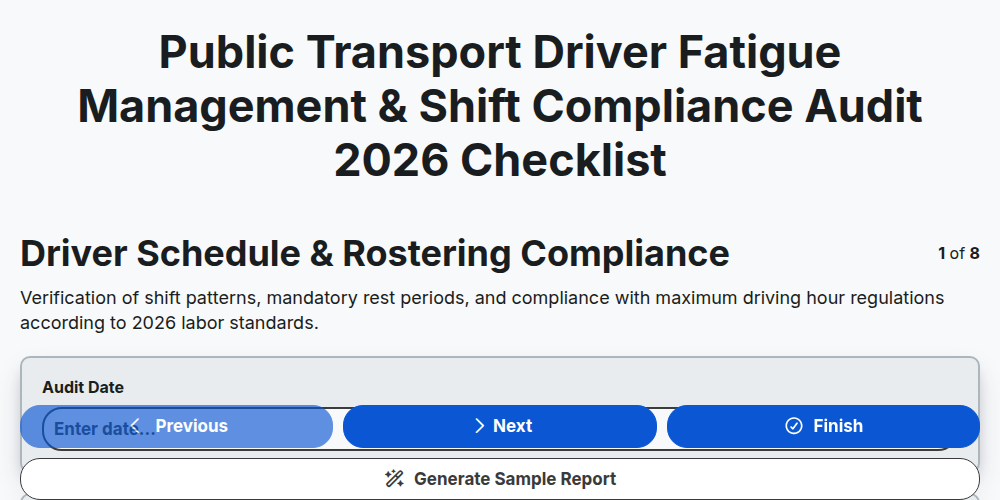
1. Driver Schedule & Rostering Compliance: Ensuring Regulatory Alignment
Navigating the Complexity of Modern Rostering
As we approach 2026, the regulatory landscape for public transport operators is becoming increasingly stringent. Compliance is no longer just about meeting minimum legal requirements; it is about proactive risk mitigation. The foundation of any robust fatigue management strategy lies in the precision of your scheduling. An audit of your driver schedules and rostering must ensure that every shift is designed with physiological safety in mind, rather than just operational convenience.
Key Audit Focus Areas
To ensure your rostering practices are audit-ready and compliant with the latest 2026 safety standards, your assessment should focus on the following pillars:
1. Adherence to Legal Driving Limits and Work Windows The first step in your audit is verifying that all rosters strictly adhere to statutory driving hour limits. This includes a granular review of:
- Maximum Driving Duration: Ensuring no driver exceeds the maximum allowable continuous driving time without a mandated break.
- Spreadover Compliance: Verifying that the total duration from the start of the first shift to the end of the last shift does not breach regulatory windows.
- Shift Inter-arrival Times: Confirming that the gap between the end of one shift and the commencement of the next meets the minimum rest requirements.
2. The Biological Clock Audit: Circadian Rhythm Alignment Modern compliance goes beyond simple hours; it involves assessing how rosters impact human biology. An effective audit must examine:
- Shift Rotation Patterns: Evaluating whether your rotation patterns (e.g., forward-rotating vs. backward-rotating) minimize circadian disruption.
- Night Shift Distribution: Analyzing the frequency and duration of nocturnal shifts to prevent the cumulative fatigue effect.
- Transition Period Analysis: Checking if there is sufficient time for physiological readjustment when drivers transition between day and night rosters.
3. Gap Analysis: Scheduled vs. Actual Duty A critical failure point in many audits is the discrepancy between the planned roster and the actual duty performed. Your checklist must include a reconciliation process:
- Unplanned Overtime Tracking: Identifying patterns where operational demands (traffic, vehicle breakdowns, or delays) are forcing drivers into non-compliant, extended shifts.
- Break Erosion Monitoring: Detecting instances where scheduled rest periods are being shortened by late-running trips or operational pressure.
Audit Pro-Tip for 2026
Don't just audit the paper roster; audit the live telemetry. Use data from your Vehicle Tracking Systems (VTS) to cross-reference scheduled break times against actual stationary periods. If the data shows a trend of rolling breaks that are shorter than the rostered duration, your compliance is at risk.
2. Pre-Shift Driver Health & Readiness Assessment: The First Line of Defense
Ensuring Readiness Before the Key Turns
A successful fatigue management strategy doesn't begin when the vehicle leaves the depot; it begins long before the engine starts. As we approach 2026, the industry standard for compliance has shifted from reactive monitoring to proactive prevention. The pre-shift assessment is your most critical opportunity to intercept fatigue-related risks before they enter the public transit network.
Beyond the Surface: Key Assessment Components
To pass a modern compliance audit, your pre-shift protocols must move beyond a simple Are you feeling okay? conversation. An effective assessment framework should evaluate three core dimensions of driver readiness:
- Physiological Indicators: Implementing standardized self-reporting tools that track sleep quality, recent sleep duration, and any underlying physical discomfort that could impair reaction times.
- Cognitive Alertness Verification: Utilizing quick, non-intrusive cognitive baseline tests to ensure drivers are mentally sharp and capable of managing complex route navigation and passenger interactions.
- Environmental & Lifestyle Check-ins: Evaluating external stressors-such as recent changes in personal circumstances or extended periods of high-intensity shifts-that may compromise a driver's ability to maintain focus.
Implementing Standardized Compliance Checks
For an audit to be successful, these assessments must be documented, repeatable, and objective. An auditor will look for evidence that your health and readiness checks are integrated into your daily operational workflow, rather than being treated as a mere formality.
The Role of Digital Self-Reporting
By 2026, the integration of mobile-based health declarations will be a hallmark of high-performing transit agencies. Providing drivers with a digital interface to log their readiness score prior to their shift allows for real-time data collection, enabling dispatchers to identify patterns of fatigue across the fleet and intervene before a driver even reaches their vehicle.
3. Duty Break & Rest Period Monitoring: Verifying Compliance with Mandatory Downtime
Ensuring Mandatory Downtime is Non-Negotiable
In the 2026 regulatory landscape, monitoring duty breaks and rest periods is no longer just about checking boxes-it is about verifying the biological necessity of recovery. An audit in this category must move beyond verifying that a break was taken and instead focus on the quality and continuity of that downtime.
Key Audit Verifications
To ensure your operations are fully compliant and prioritizing driver safety, your audit should scrutinize the following areas:
Verification of Consecutive Rest Intervals It is not enough to ensure a driver stopped for 30 minutes; auditors must verify that these breaks meet the minimum continuous duration required by local transport regulations. Check for fragmented breaks that may satisfy the clock but fail to provide restorative sleep.
The Split-Shift Recovery Audit With the increasing complexity of modern transit schedules, split shifts are common. The audit must confirm that the period between the end of the first duty segment and the start of the second provides sufficient physiological recovery time to prevent cumulative fatigue.
Compliance with Inter-Shift Minimums A critical audit point is the measurement of the quiet period between the end of one work day and the commencement of the next. We recommend auditing for a standardized minimum buffer to ensure drivers are not returning to the wheel with a sleep deficit.
Audit Checklist Items for Compliance Officers
| Audit Task | Compliance Metric | Evidence Required |
|---|---|---|
| Break Duration Check | Are all breaks equal to or greater than the legal minimum? | Digital Tachograph/Logbook timestamps |
| Break Continuity | Are breaks uninterrupted by operational duties? | GPS movement data vs. Scheduled break time |
| Post-Shift Buffer | Does the time between shifts meet the 11-hour (or local equivalent) rule? | Roster logs and driver clock-out data |
| Unauthorized Extensions | Are drivers exceeding maximum continuous driving limits? | Telematics and route completion logs |
Moving from Reactive to Proactive Monitoring
In 2026, the most advanced audits utilize Automated Break Verification. Rather than manually reviewing paper logs, auditors should be leveraging real-time telematics to flag micro-violations-shortly truncated breaks that, while seemingly minor, contribute to the long-term degradation of driver alertness and increase the risk of fatigue-related incidents.
4. Leveraging Fatigue Detection Technology & Monitoring Systems
Integrating the Next Generation of Real-Time Oversight
As we move into 2026, passive monitoring is no longer sufficient for high-standard public transport operations. To achieve true compliance, your audit must evaluate how effectively your fleet utilizes active, real-time fatigue detection technology. It is no longer enough to simply check if a system is installed; you must audit its integration into your operational response framework.
Evaluating AI-Driven Driver Monitoring Systems (DMS)
The core of a modern fatigue audit lies in assessing the efficacy of in-cab AI technology. When reviewing your technological landscape, focus on the following:
- Biometric & Eye-Tracking Accuracy: Are your systems capable of detecting micro-sleeps, eyelid closure frequency, and gaze deviation in varying light conditions (day vs. night shifts)?
- Alert Latency: Audit the time gap between a detected fatigue event and the trigger of an in-cab alert. In a high-speed transit environment, even a three-second delay can be the difference between a safe stop and a collision.
- False Positive Management: High rates of false alarms lead to alarm fatigue among drivers, causing them to ignore or disable critical safety features. Your audit should examine the calibration frequency of these sensors.
Analyzing Telematics & Behavioral Analytics
Beyond the driver's immediate physical state, the audit must look at the data layers provided by vehicle telematics.
- Erratic Maneuver Correlation: Evaluate how your software correlates sudden braking, lane drifting, or erratic steering with identified fatigue periods.
- Predictive Analytics Integration: Is your technology providing predictive rather than reactive data? Modern 2026 standards require systems that can flag a driver's declining performance trend before a fatigue event occurs.
Data Integrity and the Digital Audit Trail
A critical component of shift compliance is the accessibility of the data generated by these systems. Your audit must confirm that:
- Data is Centralized: Fatigue alerts are immediately accessible to dispatch and safety managers.
- Immutable Logging: The technological records are tamper-proof, ensuring that post-incident investigations are based on unalterable physiological data.
- Feedback Loops: There is a documented process for using technological insights to refine rosters and driver training programs.
5. Post-Shift Recovery & Logbook Accuracy: Validating the Cycle of Rest
Ensuring the Full Circle of Compliance
A fatigue management audit does not end when the engine is turned off; it ends when the driver is truly recovered and the documentation reflects that rest. The post-shift phase is the critical buffer zone that determines whether a driver enters their next shift rejuvenated or already in a state of cumulative sleep debt.
Auditing the Accuracy of Digital and Manual Logs
In 2026, with the integration of advanced telematics, logbook accuracy is no longer just about checking timestamps-it is about verifying data integrity. An effective audit must examine:
- Discrepancy Analysis: Comparing GPS-tracked vehicle movement against driver-recorded break times to identify hidden working hours or unauthorized late finishes.
- Data Consistency: Ensuring that end-of-shift logs align perfectly with automated tachograph or digital tachograph (DTCO) records.
- Error Reporting Patterns: Identifying if certain shifts or routes consistently produce errors in log entries, which may indicate rushed transitions or excessive pressure to complete routes.
Verifying Post-Shift Recovery Windows
Compliance is not just about the hours worked, but the hours not worked. The audit must scrutinize the Recovery Gap-the period between the end of one shift and the start of the next.
- The Cumulative Fatigue Check: Reviewing patterns of back-to-back shifts to ensure that the minimum required rest periods are not being eroded by overtime or operational delays.
- Validation of Rest Quality: Evaluating whether the roster allows for sufficient uninterrupted time, free from operational communications (such as shift change briefings or radio check-ins) that can mentally prevent true physiological recovery.
Closing the Loop on Operational Integrity
By auditing post-shift data, management can move from reactive monitoring to predictive prevention. High accuracy in post-shift documentation serves as the primary evidence that your fatigue management system is functioning as a closed, safe, and sustainable loop.
6. Training, Education & Fatigue Awareness: Building a Safety-First Culture
Moving Beyond Compliance: Cultivating a Proactive Safety Mindset
In 2026, fatigue management can no longer be viewed solely as a reactive box-ticking exercise. While sensors and logs provide the data, the true backbone of a zero-fatigue environment is a workforce that is educated, self-aware, and psychologically empowered to prioritize safety over schedule adherence.
An audit of your training and education protocols should look beyond whether a manual was distributed. You must evaluate the efficacy of how fatigue-related risks are communicated and understood across all levels of the organization.
Evaluating Training Efficacy and Content Relevance
To ensure your training programs are robust enough to meet modern regulatory standards, your audit should focus on the following key areas:
- Evidence-Based Curriculum: Does your training include the latest science on circadian rhythms, sleep hygiene, and the physiological impacts of micro-sleeps?
- Scenario-Based Learning: Are drivers trained using realistic simulations of high-risk situations, such as managing the 3:00 AM slump or recognizing the early physical cues of fatigue in themselves and colleagues?
- Frequency and Refresh Cycles: Is training treated as a continuous loop rather than a one-time induction? Audits should verify regular intervals for refresher courses and updates on new fatigue-detection technologies.
Promoting a Speak-Up Culture
The most advanced monitoring technology in the world will fail if a driver feels pressured to ignore their own exhaustion to meet a deadline. A critical component of your 2026 compliance audit is assessing the psychological safety of your operational culture.
Key Audit Questions for Cultural Assessment:
- Fatigue Reporting Non-Punitive Frameworks: Is there a documented, transparent process for drivers to report fatigue without fear of disciplinary action or roster penalties?
- Peer-to-Peer Accountability: Do your training modules empower drivers to intervene when they observe a colleague showing signs of impairment or extreme exhaustion?
- Leadership Engagement: Are shift supervisors and management actively participating in fatigue awareness workshops, demonstrating that safety is a shared organizational value?
By auditing your training and education programs through this lens, you transition from merely monitoring fatigue to actively preventing it through an informed and vigilant workforce.
7. Incident & Near-Miss Fatigue Correlation: Data-Driven Risk Analysis
Bridging the Gap Between Data and Driver Safety
In a 2026 compliance landscape, looking at fatigue in isolation is no longer sufficient. To truly master fatigue management, your audit must move beyond reactive monitoring and toward predictive correlation. This step involves the critical task of cross-referencing your fatigue detection data with your incident and near-miss reports to identify hidden patterns.
Turning Incidents into Insights
An audit of your incident logs should not merely record what happened, but under what physiological conditions it occurred. By overlaying fatigue detection alerts (from in-cab sensors or wearable tech) with near-miss data, you can uncover high-risk trends that manual logs might miss.
Key Audit Focus Areas:
- Pattern Recognition: Are near-misses clustering around specific times of day, specific routes, or specific shift transitions?
- The Silent Fatigue Gap: Identifying incidents that occurred even when fatigue sensors did not trigger. This helps determine if your current technology thresholds are sensitive enough to detect micro-sleeps or cognitive decline.
- Environmental Variables: Correlating fatigue-related incidents with external factors like night-time driving, extreme weather, or heavy traffic periods to refine your roster complexity.
Moving Toward Predictive Compliance
The goal of this correlation phase is to transition from detecting fatigue to predicting it. By analyzing the frequency of near-misses alongside driver alertness scores, your organization can implement preemptive roster adjustments before a fatigue-related incident ever reaches the level of a formal accident.
In 2026, a compliant fleet is one that uses its incident history as a roadmap for preventative scheduling.
8. Emergency Fatigue Intervention Protocols: Rapid Response Strategies
When Safety is Compromised: The Last Line of Defense
While the primary goal of a fatigue management system is prevention, even the most robust scheduling and monitoring systems cannot eliminate 100% of risk. The final, and perhaps most critical, component of your 2026 compliance audit is evaluating your Emergency Fatigue Intervention Protocols. This section of the audit focuses on how your organization responds when a driver is identified as being in an immediate state of impairment.
Evaluating Immediate Intervention Triggers
An effective audit must determine if your protocols provide clear, unambiguous stop-work triggers. When a driver or a monitoring system flags a high-risk fatigue event, the response must be instantaneous and standardized.
- The Zero-Tolerance Threshold: Does your policy clearly define the point at which a driver must be pulled from service? There should be no ambiguity between feeling tired and demonstrating signs of fatigue-induced impairment.
- Communication Loops: In an emergency fatigue event, how is the information cascaded? Audit the speed and accuracy of communication between the driver, dispatch, and depot management.
Rapid Response & Re-Routing Procedures
In a public transport environment, an intervention doesn't just affect one driver; it affects entire networks, passenger schedules, and secondary routes.
- Relief Driver Deployment: Evaluate the readiness of your standby or reserve fleet. If a driver is pulled from service due to fatigue, how quickly can a compliant, rested replacement be deployed to maintain service continuity?
- Vehicle Recovery Protocols: Are there clear instructions for the safe handover of a vehicle? The audit should check if protocols exist to ensure a vehicle is not left in an unsafe state or a vulnerable location during an emergency swap.
Post-Intervention Debriefing and Root Cause Analysis
An emergency intervention is not just a logistical hurdle; it is a diagnostic signal that a failure occurred in the preceding layers of your fatigue management system.
- The No-Blame Review Culture: Ensure your protocols encourage transparent reporting. The goal of the intervention audit is to identify whether the fatigue was a result of a systemic scheduling error, a failure in technology, or an unforeseen external factor.
- Corrective Action Integration: How quickly does the data from an emergency intervention feed back into your Driver Schedule & Rostering Compliance? A truly compliant 2026 system uses every near-miss and emergency intervention to recalibrate future rosters and preventative measures.
Conclusion: Sustaining Long-Term Compliance and Passenger Safety
Beyond the Checklist: Building a Culture of Vigilance
An audit is more than just a periodic inspection of logs and schedules; it is a vital diagnostic tool for the health of your entire transport network. As we approach 2026, the complexity of urban mobility and the integration of new fatigue-detection technologies mean that compliance can no longer be viewed as a check-the-box exercise. True excellence in fatigue management lies in the transition from reactive monitoring to proactive prevention.
Moving from Compliance to Culture
The most robust digital monitoring systems and the most precise rostering algorithms are only as effective as the human culture supporting them. A truly successful audit should reveal a workplace where:
- Drivers feel empowered to report fatigue without fear of retribution.
- Supervisors prioritize safety over strict adherence to arrival times.
- Data-driven insights are used to refine training rather than simply to assign blame.
The Future-Proof Strategy
To maintain a competitive and safe advantage in 2026, organizations must treat this checklist as a living document. As fatigue detection technologies evolve and new labor regulations emerge, your audit processes must evolve alongside them.
By rigorously applying these eight pillars-from pre-shift assessments to post-shift recovery-you are doing more than avoiding regulatory penalties. You are reinforcing the fundamental promise of public transport: the safe, reliable, and efficient movement of every passenger, every single trip.
Final Audit Summary Checklist for Management
| Focus Area | Key Audit Objective |
|---|---|
| Operational Integrity | Ensure rosters and breaks strictly adhere to legal mandates. |
| Technological Synergy | Verify that fatigue sensors and AI monitoring are integrated and functional. |
| Human-Centric Safety | Validate that training, awareness, and intervention protocols are deeply embedded in driver behavior. |
Resources & Links
- OSHA (Occupational Safety and Health Administration): The primary authority for workplace safety regulations, providing guidelines on fatigue-related hazards and driver safety standards.
- U.S. Department of Transportation: Official regulatory information regarding transport safety, compliance, and federal mandates for driver hours of service.
- European Commission - Transport: Essential resources for understanding international standards in driver rest periods and tachograph regulations.
- NHTSA (National Highway Traffic Safety Administration): Comprehensive data and research on the impact of driver fatigue on road safety and crash prevention.
- National Safety Council: Non-profit organization providing data-driven insights into preventing injuries and deaths related to fatigue and distracted driving.
- International Electrotechnical Commission: Technical standards for fatigue detection technologies and sensor-based monitoring systems used in modern vehicles.
- CDC - Centers for Disease Control and Prevention: Scientific research on the biological effects of sleep deprivation and the physiological impact of shift work on human performance.
- ISO (International Organization for Standardization): Global standards for occupational health and safety management systems (ISO 450 Mutually Assured Safety protocols).
- SAE International: Engineering standards for developing advanced driver-assistance systems (ADAS) and fatigue monitoring hardware.
- International Labour Organization: Global guidelines on working hours, labor rights, and the importance of adequate rest periods for transport workers.
- NIST (National Institute of Standards and Technology): Advanced research into the accuracy of biometric sensors and data logging technology for compliance auditing.
- World Health Organization: Global health perspectives on sleep hygiene and the long-term health risks associated with chronic circadian rhythm disruption.
- FMCSA (Federal Motor Carrier Safety Administration): Specific regulations regarding Hours of Service (HOS) and the implementation of Electronic Logging Devices (ELD).
- SafetyCulture: Digital tools and templates for conducting safety audits, checklists, and managing workforce compliance.
- American Institute of Aeronautics and Astronautics (AIAA) - Human Factors: High-level research on human factors engineering and the cognitive load of operating complex transport machinery.
- International Society for Cognitive Research: Resources on how fatigue affects decision-making, reaction times, and cognitive awareness in high-stakes environments.
¿Te resultó útil este artículo?
Comentarios
Aún no hay comentarios. ¡Sé el primero en añadir uno!
Demostración de la Solución de Gestión del Transporte Público
¡Optimice las operaciones del transporte público y mejore la experiencia de los pasajeros! ChecklistGuro optimiza la planificación de rutas, el mantenimiento de vehículos y la elaboración de informes de incidentes. Mejore la eficiencia, la seguridad y la fiabilidad. Administre todo con nuestro Work OS.
Artículos relacionados
Auditoría de Emergencia en el Depósito de Trenes: Tu Plantilla de Lista de Verificación para la Seguridad
Dominando el Agollamiento: Lista de Verificación para la Evaluación de Condiciones de Congestión en el Transporte Público
Mantener Nuestros Autobuses Limpios: Lista de Verificación para Auditorías de Calidad del Aire
La Guía Definitiva para la Auditoría de Rutas de Autobús: Una Plantilla para el Éxito del Transporte Público
Manteniendo el Transporte Urbano en Marcha: Tu Plantilla de Lista de Verificación para el Mantenimiento de Tranvías
Mantener las Ruedas Girando de Forma Segura: Su Plantilla de Lista de Verificación de Seguridad para el Depósito de Autobuses
Dominar la seguridad ATP: Su plantilla de verificación de inspecciones de tren
Lista de verificación para inspección de seguridad en el depósito de trenes: Su guía para una instalación más segura.
¿Necesita ayuda con las listas de verificación?
¿Tienes alguna pregunta? Estamos aquí para ayudarte. Envía tu consulta y te responderemos a la brevedad.