The Ultimate Retail Store Markdown & Clearance Implementation Checklist 2026: A Step-by-Step Guide to Maximizing Profitability
Publicado: 28/10/2026 Actualizado: 29/10/2026
Índice
- Introduction: Why a Strategic Markdown Strategy is Vital for 2026
- Phase 1: Pre-Implementation Strategy & Approval
- Phase 2: Inventory Identification & Sorting
- Phase 3: Ensuring Pricing & Tagging Accuracy
- Phase 4: Strategic Merchandising & Floor Placement
- Phase 5: Impactful Signage & Promotional Communication
- Phase 6: Syncing Your POS System & Software Updates
- Phase 7: Staff Briefing & Training for Success
- Phase 8: Loss Prevention & Security Monitoring Protocols
- Phase 9: Post-Implementation Review & Performance Audit
- Conclusion: Turning Clearance into a Revenue Driver
- Resources & Links
TLDR: Master your 2026 clearance season with our comprehensive implementation checklist. Learn how to strategically identify slow-moving stock, ensure pricing accuracy, and optimize floor merchandising to drive foot traffic, minimize shrinkage, and maximize profitability through a structured, step-by-step execution plan.
Introduction: Why a Strategic Markdown Strategy is Vital for 2026
Navigating the New Era of Retail Efficiency
As we approach 2026, the retail landscape is more dynamic than ever. With shifting consumer behaviors, hyper-competitive e-commerce integration, and more sophisticated supply chain pressures, the traditional slash prices and hope for the best approach to clearance is no longer viable. In today's market, a markdown is not just a discount; it is a precise financial lever used to optimize inventory turnover, free up precious warehouse space, and maintain healthy cash flow.
The High Cost of Poor Clearance Execution
Implementing a clearance sale without a structured plan is a recipe for margin erosion and operational chaos. When markdowns are executed haphazardly, retailers face three critical risks:
- Margin Bleed: Indiscriminate discounting can devalue your brand and eat into the profits of your full-price core collections.
- Operational Friction: Inaccurate pricing and disorganized floor layouts lead to customer frustration, long checkout lines, and increased labor costs.
- Inventory Stagnation: Failure to identify the right products for clearance can lead to dead stock that occupies high-value real estate, preventing newer, higher-margin seasonal arrivals from taking center stage.
Precision Over Panic: The 2026 Approach
In 2026, a successful markdown strategy requires a symbiotic blend of data-driven decision-making and flawless physical execution. The goal is to transition inventory from slow-moving to sold while maintaining a seamless shopping experience.
This guide provides a comprehensive, step-by-step checklist designed to help retail managers move through every phase of the process-from the initial strategic approval to the final post-mortem audit. By following this structured framework, you can ensure that your clearance events drive liquidity and excitement rather than confusion and loss.
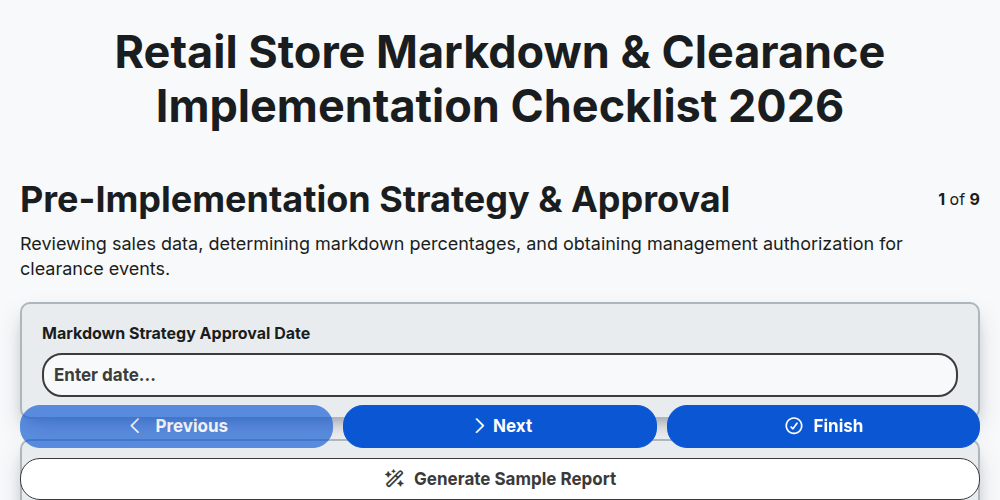
Phase 1: Pre-Implementation Strategy & Approval
Setting the Foundation for Success
Before a single price tag is changed or a clearance rack is rolled out, the success of your markdown strategy depends entirely on the groundwork laid during the planning phase. In 2026, with more volatile consumer trends and hyper-competitive digital landscapes, winging it with markdowns can lead to eroded margins and messy inventory.
A structured pre-implementation phase ensures that your clearance event is a strategic move to boost liquidity rather than a desperate attempt to clear clutter.
Defining Objectives and KPIs
The first step is to move beyond the idea of simply clearing space. You must define exactly what this markdown event aims to achieve. Are you trying to:
- Free up working capital for incoming seasonal collections?
- Increase foot traffic during a traditionally slow period?
- Improve inventory turnover ratios to optimize warehouse capacity?
By setting specific Key Performance Indicators (KPIs)-such as a target sell-through rate or a specific margin floor-you create a benchmark to measure the event's ultimate success.
Budgeting and Margin Protection
Markdowns are an investment in inventory health, but they must be controlled. During this phase, leadership must determine the depth of the discounts.
- Tiered Discounting Strategy: Will you use a progressive model (e.g., 20% off, then 40%, then 70%)?
- Margin Floor Analysis: At what point does a markdown become a loss-leader that outweighs the benefit of the sale?
Stakeholder Alignment and Final Approval
A clearance event impacts every department, from logistics to finance. Before moving to execution, ensure all key stakeholders have reviewed the proposed strategy.
The Approval Checklist
Before moving to the next phase, ensure you have documented approval on the following:
- The Markdown Schedule: Exact start and end dates for the event.
- The Discount Matrix: Clear instructions on which categories receive which percentage of discount.
- The Communication Plan: How the sale will be communicated to both loyal customers and the general public.
- Resource Allocation: Confirmation of additional labor or budget needed for merchandising and signage.
Phase 2: Inventory Identification & Sorting
Analyzing the Stock: Precision in Selection
Once your strategy is approved, the success of your clearance event hinges on how effectively you curate your markdown list. This phase is not just about removing old items; it is about strategic liquidation that clears space for new, high-margin arrivals without devaluing your brand.
Categorizing Your Inventory
To avoid a chaotic clearance floor, you must categorize your stock into specific liquidation tiers. Not every slow-moving item deserves the same discount level. Evaluate your inventory using the following criteria:
- End-of-Season Core Items: Seasonal goods that are no longer relevant to the upcoming quarter (e.g., winter coats in late February).
- Damaged or Imperfect Goods: Items with minor packaging defects or cosmetic flaws that can be moved via a clearance bin strategy.
- Slow-Moving SKUs: Products with low turnover rates that are tying up vital working capital.
- Discontinued Lines: Products that will not be replenished due to supplier changes or rebranding.
The Sorting Process: The Keep, Mark, or Remove Method
To maintain efficiency, your team should physically or digitally sort inventory into three distinct buckets:
- The Keep List: High-demand items that remain at full price. Protect these from being accidentally mislabeled.
- The Markdown List: Items slated for tiered discounts (e.g., 25%, 50%, or 70% off). These require precise tracking to ensure the math aligns with your margin goals.
- The Exit List: Items that are too costly to discount and should be removed from the floor entirely via vendor returns, donations, or bulk liquidation.
Data-Driven Decision Making
In 2026, sorting should not be done by gut feeling alone. Utilize your Inventory Management System (IMS) to run Ageing Reports. Focus heavily on the Days Sales of Inventory (DSI) metric. Any item exceeding your predetermined threshold of days on shelf should be flagged for immediate sorting. This data-centric approach ensures you are clearing the right stock to optimize your cash flow for the upcoming season.
Phase 3: Ensuring Pricing & Tagging Accuracy
Precision in Pricing: The Foundation of a Successful Sale
In the world of retail, a clearance event is only as successful as its execution. Even the most enticing discount loses its power if the price on the tag doesn't match the price at the register. Errors in pricing during a markdown phase don't just lead to customer frustration; they lead to margin erosion and potential legal compliance issues.
To ensure a seamless transition, your team must focus on the following pillars of accuracy:
The Verification Workflow
Before a single new sticker hits the shelf, implement a double-check system. A blind audit approach-where a second team member verifies a random sample of newly marked items against the master markdown list-is the gold standard for 2026 retail operations.
- Cross-Reference Master Files: Ensure that every SKU, UPC, and department code matches the approved markdown spreadsheet exactly.
- Validate Unit of Measure: For items sold by weight, pack, or quantity, verify that the discount applies correctly to the individual unit.
Error-Proofing the Tagging Process
Manual errors are the primary enemy of clearance efficiency. As you transition inventory, use these tactical checkpoints:
- Scannability Check: Ensure that new clearance stickers or overlays do not obscure the original barcode. If the original barcode is unreadable, the item must be re-barcoded to prevent mismatched item errors at checkout.
- The Old vs. New Audit: Ensure that old price tags are either completely removed or clearly overlaid. Leaving two visible prices is a recipe for customer disputes and price matching headaches at the POS.
- Date-Stamp Integrity: If your markdown strategy involves tiered discounts (e.g., 30% off this week, 50% off next week), ensure that the implementation date is clearly documented to prevent premature discounting.
Managing Exceptions and Special Cases
Not all items follow the standard rule. Your checklist must account for:
- Bundled Items: Ensure that Buy One, Get One or Clearance Bundles have specific, unique identifiers.
- Damaged/Open-Box Goods: If certain clearance items are marked down due to packaging damage, ensure the as-is status is reflected in both the physical tag and the digital system.
- Gift Card/Loyalty Exclusions: Clearly mark items that are excluded from further promotional stacking to manage customer expectations immediately.
Phase 4: Strategic Merchandising & Floor Placement
Optimizing the Floor for High-Velocity Sales
Once your clearance items are identified and priced, the next critical step is deciding where they live in your store. In 2026, successful clearance management is no longer about dumping old stock in a corner; it is about strategic placement that drives foot traffic and stimulates impulse buys without devaluing your core collection.
Strategic Zoning and Flow
Effective placement requires a balance between visibility and protection of your full-price inventory. Consider these three primary placement strategies:
- The Power Perimeter: Utilize high-traffic zones near the entrance or end-caps to feature Loss Leaders-items with deep discounts that entice customers into the store.
- The Destination Zone: Create a dedicated clearance section at the rear of the store. This forces customers to navigate through your full-price seasonal collections to reach the deals, increasing the opportunity for unplanned full-price purchases.
- Impulse Anchors: Place smaller, low-cost clearance items near the checkout lanes to capture last-minute additions to the basket.
The Clean Clearance Standard
One of the biggest mistakes in retail is allowing clearance sections to become disorganized. A messy clearance rack signals abandoned stock rather than value.
- Maintain Size Integrity: Ensure items are organized by size or category. A customer searching for a specific size who finds a disorganized pile will likely walk away.
- Avoid Overcrowding: Limit the number of items per hanger or shelf. If the density is too high, the perceived value of the product drops.
- Visual Consistency: Use standardized bins or branded clearance fixtures to distinguish these items from your premium collections while maintaining a cohesive store aesthetic.
Leveraging Seasonal Transitions
As you move through 2026, your placement strategy must evolve with the calendar. As seasonal transitions approach, use Transition Displays that bridge the gap between the departing season and the incoming one. This prevents dead zones on your sales floor and ensures that as old stock moves out, the new, high-margin inventory is already positioned to take its place.
Phase 5: Impactful Signage & Promotional Communication
Communicating Value: The Art of Strategic Signage
In 2026, clearance isn't just about lowering prices; it is about creating a sense of urgency and excitement. If your customers don't realize there is a sale happening-or if they can't easily find the discounted items-your markdown strategy will fail regardless of how deep the discounts are.
Effective communication bridges the gap between inventory sitting in the back and liquidated stock moving through the registers.
1. High-Visibility Hierarchy
Your signage should follow a clear visual hierarchy to guide the customer journey:
- Store-Wide Announcements: Use window clings and entrance decals to announce a Clearance Event or End of Season Sale. This stops foot traffic before they even enter.
- Departmental Callouts: Use hanging signs or aisle markers to direct shoppers to specific zones (e.g., Footwear Clearance or Electronics Markdown).
- Item-Level Details: Ensure every individual markdown item has clear, legible pricing that reflects the new discount.
2. The Psychology of The Reveal
The way you present a discount can change the perceived value. In 2026, simple Sale signs are no longer enough. Consider these high-conversion tactics:
- Percentage vs. Dollar Off: Test which resonates more with your specific demographic. Does 50% Off drive more impulse buys than $10 Off?
- Urgency Triggers: Incorporate time-sensitive language such as Last Chance, While Supplies Last, or Final Markdowns.
- Color Coding: Use consistent, high-contrast colors (like bright reds, yellows, or neons) for all clearance signage to differentiate new arrivals from clearance at a glance.
3. Multi-Channel Synchronization
Your in-store signage must match your digital footprint. A common mistake is running an in-store clearance that isn't reflected in your social media or email marketing.
- Omnichannel Consistency: Ensure that the Clearance banners on your website or app mirror the physical signage in your retail locations.
- Digital Integration: Use QR codes on physical clearance tags that lead customers to a More Deals landing page on your mobile site, turning a single-item find into a larger basket size.
4. Maintaining Visual Integrity
Avoid Signage Fatigue. If a store is cluttered with overlapping, torn, or poorly placed stickers, it creates a sense of chaos rather than opportunity. Ensure all promotional materials are:
- Uniform: All signs should follow your brand's updated 2026 aesthetic guidelines.
- Clean: Remove old, outdated promotional materials from previous seasons to ensure the new clearance message is the primary focus.
Phase 6: Syncing Your POS System & Software Updates
Ensuring Digital Accuracy in a Digital-First Retail Era
In 2026, a clearance event is only as successful as your backend data. With the rise of omnichannel retailing, a pricing error isn't just a mistake on a physical shelf-it's a potential disaster for your e-commerce site, mobile app, and BOPIS (Buy Online, Pick Up In-Store) workflows. If your physical markdown doesn't sync perfectly with your digital inventory, you risk selling ghost stock or undercharging for high-value items.
Synchronizing the Omnichannel Ecosystem
The core objective of this phase is to ensure that the moment a price change is applied to a physical tag, the update propagates across every digital touchpoint.
- Real-Time Database Updates: Verify that your Markdown/Clearance logic is pushed to your central ERP (Enterprise Resource Planning) system. This ensures that your web store reflects the same clearance pricing as your brick-and-mortar location.
- Inventory Reconciliation: Use this phase to run a dry run of your stock levels. Ensure that the quantities marked for clearance in your system match the physical counts identified during the sorting phase.
- Automated Trigger Verification: If your software is set to trigger automatic discount intervals (e.g., Take an extra 20% off this week), double-check the scheduling logic to prevent unexpected price drops.
Avoiding the Double Discount Trap
One of the most common pitfalls in modern retail is the accidental stacking of clearance prices with existing promotional codes or loyalty rewards.
Testing the Checkout Workflow
Before the doors open for the clearance event, your technical team must perform rigorous testing at the Point of Sale (POS).
- Scan Accuracy Test: Pick random items from the clearance section and scan them. Does the discounted price appear immediately, or is there a lag?
- Coupon & Loyalty Integration: Test how clearance items interact with existing digital coupons or loyalty points. Ensure that stacking rules are functioning according to your 2026 promotional strategy.
- Refund & Exchange Logic: Update your system rules to define how clearance items are handled for returns. Does the system allow a full-price refund, or is it restricted to store credit?
By treating your software update as a critical operational step rather than an afterthought, you protect your margins and maintain the customer trust essential for a successful clearance season.
Phase 7: Staff Briefing & Training for Success
Empowering Your Team to Execute with Precision
A clearance event is only as successful as the team executing it on the floor. Even the most strategic pricing plan will fail if your associates are confused about which items are discounted, how to handle customer inquiries, or how to process complex transactions. In 2026, with the increasing complexity of omnichannel retail, your staff must be prepared to manage both in-store and click-and-collect clearance stock seamlessly.
Key Training Pillars for the Markdown Period
To ensure a smooth transition, your training program should focus on these three critical areas:
- Product Knowledge & Discount Depth: Every team member should be able to instantly identify which categories fall under the Clearance umbrella and exactly what the discount percentages are. Ambiguity leads to customer frustration and lost trust.
- New Pricing Protocols: If your markdown strategy involves multi-buy offers or tiered discounts (e.g., Buy 2, Get 1 Free), ensure your staff is proficient in calculating these at the register to avoid long queues and errors.
- Customer Service Excellence During High Traffic: Clearance events often bring a surge in foot traffic and higher-than-usual-density shopping. Train your team on managing crowd flow, maintaining organized aisles, and handling the inevitable price dispute with professionalism.
The Service Recovery Mindset
The 2026 retail landscape demands a proactive approach to service. Use this phase to train staff on Service Recovery-how to assist customers when a clearance item is out of stock or when a misplaced price tag causes confusion. When staff members are empowered with the right answers and a positive attitude, a potentially chaotic sale turns into a high-conversion shopping experience.
Phase 8: Loss Prevention & Security Monitoring Protocols
Safeguarding Your Margins During High-Traffic Sales Events
When you implement a massive markdown or clearance event, you aren't just changing price tags; you are fundamentally altering the shopping environment. High-volume discount periods naturally attract a different demographic of shoppers and increase the shrink risk. To ensure that your increased sales velocity doesn't lead to a net loss in margin, you must implement rigorous security protocols.
Strengthening Physical Security Measures
Clearance sections often lead to crowded aisles and disorganized shelves, creating blind spots for staff.
- Enhanced Floor Sweeps: Increase the frequency of zone checks by floor associates. Ensure that high-value clearance items remain visible and are not being hidden in corners of the store.
- High-Shrink Item Surveillance: Identify specific clearance items that are prone to theft (e.g., small electronics, designer accessories, or premium cosmetics) and ensure they are placed within direct line-of-sight of cameras or near the checkout lanes.
- EAS (Electronic Article Surveillance) Reinforcement: Double-check that all discounted items retain their security tags. A common error during rapid re-tagging is forgetting to reactivate the security sensor.
Managing Hidden Inventory Loss
Loss prevention in 2026 isn't just about preventing shoplifting; it's about preventing administrative errors and internal shrinkage.
- Audit the Re-Tagging Process: Conduct random spot checks to ensure the price on the physical tag matches the price programmed into the POS. Discrepancies here lead to sweethearting or accidental undercharging.
- Monitoring High-Volume Returns: Clearance events often trigger a surge in returns. Ensure your return policy is strictly enforced to prevent return fraud, where customers attempt to return used items under the guise of a clearance purchase.
- Staff Awareness & Internal Controls: Train team members to recognize signs of organized retail crime (ORC) patterns, which often spike during promotional periods. Ensure that backroom access remains restricted during the chaos of floor resets.
Phase 9: Post-Implementation Review & Performance Audit
Measuring Success: The Post-Implementation Review & Performance Audit
The markdown process doesn't end once the last clearance sticker is applied. To truly master your inventory lifecycle in 2026, you must transition from execution to evaluation. The final phase of your implementation is the most critical for long-term profitability, as it turns a one-time clearance event into a data-driven strategy for future seasonal planning.
Analyzing the Data: The Quantitative Review
Once the clearance period concludes, gather your sales reports to evaluate the effectiveness of your pricing strategy. Ask yourself the following key questions:
- Sell-Through Rate: Did the markdown percentage trigger the expected volume of sales, or was the discount too shallow to move the stock?
- Margin Erosion Analysis: Did the increased volume compensate for the reduction in unit margin? Calculate your net profitability to ensure the clearance didn't cost more in lost margin than it gained in liquidity.
- Inventory Turn Velocity: Compare the movement speed of marked-down items against full-price counterparts to gauge the impulse impact of your pricing.
Operational Post-Mortem: The Qualitative Review
Beyond the numbers, assess the operational friction encountered during the rollout. Use this time to identify bottlenecks in your workflow:
- Execution Accuracy: Review any discrepancies found between the intended markdown plan and the actual pricing found on the floor.
- Staff Feedback Loop: Hold a brief debrief with your floor team. They are the first to notice if signage was difficult to hang, if certain zones were overlooked, or if customers expressed confusion regarding the sale terms.
- System Integrity Check: Confirm that all clearance items were properly cleared from the POS and that no ghost inventory remains in your digital records.
Refining the 2027 Strategy
The ultimate goal of a post-implementation audit is continuous improvement. Document every mistake and every win in a Markdown Playbook. If a specific category performed poorly despite deep discounts, use this insight to adjust your future procurement and replenishment cycles.
By treating every clearance event as a learning laboratory, you ensure that your 2026 strategy becomes the foundation for an even more efficient, profitable, and streamlined 2027.
Conclusion: Turning Clearance into a Revenue Driver
Mastering the Art of the Markdown
Executing a clearance strategy is more than just slapping red stickers on old stock; it is a strategic maneuver designed to optimize inventory health and free up capital for the upcoming season. As we move into 2026, the margin for error in retail is slimmer than ever. A disorganized markdown event doesn't just hurt your bottom line-it can erode your brand value and confuse your loyal customers.
By following this comprehensive checklist, you transition from reactive discounting to proactive inventory management. You ensure that every step-from the initial strategic approval to the final post-implementation audit-is executed with precision.
Key Takeaways for Success
To ensure your 2026 clearance season is a success, keep these three pillars in mind:
- Precision Over Panic: Never implement deep discounts without first verifying your Pricing & Tagging Accuracy. An error in the POS system or a misplaced tag can lead to massive margin erosion or customer frustration.
- Communication is Critical: Your frontline staff are your greatest asset. A well-trained team that understands the why behind the markdown can turn a clearance shopper into a repeat customer through effective upselling and product knowledge.
- Data-Driven Refinement: The process doesn't end when the sale does. Use the Post-Implementation Review to analyze what worked and what didn't. This data is the blueprint for your next seasonal transition.
Final Thoughts
A well-executed clearance event should feel like an opportunity for the customer, not a liquidation of a failing business. When you balance strategic inventory sorting with high-impact merchandising and rigorous loss prevention, you create a high-energy shopping environment that drives foot traffic and accelerates turnover.
Prepare your team, audit your systems, and use this checklist to turn your end-of-season clearance into your most profitable period of the year.
Resources & Links
- Shopify Retail Blog: Comprehensive guides on inventory management, pricing strategies, and modern retail trends.
- Manic: Manic
- BigCommerce Resource Center: Insights into e-commerce integration and omnichannel pricing synchronization.
- Forbes Business: Global economic trends and retail market analysis for strategic planning.
- McKinsey & Company: High-level retail strategy, consumer behavior reports, and profitability frameworks.
- Retail Dive: Daily news and deep dives into retail operations, technology, and supply chain shifts.
- National Retail Federation (NRF): The industry standard for retail news, security protocols, and loss prevention best practices.
- Zendesk Retail Blog: Resources on customer communication and managing expectations during sales and promotions.
- Square Retail: Technical guides on POS system updates, inventory tracking, and digital tagging.
- Adweek: Expert advice on impactful signage, visual merchandising, and promotional marketing.
- The Business of Fashion: In-depth analysis of inventory lifecycle and the economics of seasonal markdowns.
- Deloitte Retail Insights: Data-driven approaches to post-implementation performance audits and profitability.
- CBT Retail Consulting: Specialized resources on loss prevention, security monitoring, and shrinkage control.
- BigPortal Inventory Management: Tools and tutorials for inventory identification, sorting, and SKU management.
- HubSpot Marketing: Strategies for creating promotional campaigns that drive foot traffic during clearance events.
- Retail Training Resources: Best practices for staff briefing, onboarding, and operational training for sales teams.
- Entrepreneur Magazine: Small business strategies for maximizing revenue through seasonal inventory turnover.
¿Te resultó útil este artículo?
Comentarios
Aún no hay comentarios. ¡Sé el primero en añadir uno!
Demostración de la Solución de Gestión de Comercio Minorista
¡Aumente la eficiencia en el comercio minorista! ChecklistGuro simplifica las operaciones de la tienda, la gestión del inventario y la capacitación de los empleados. Mejore la experiencia del cliente y maximice la rentabilidad. Administre todo con nuestro Work OS.
Artículos relacionados
Seasonal Mulch & Gravel Checklist Template: Stay Stocked & Ready
Plantilla de verificación para inspección de ascensores y escaleras mecánicas: Su guía para la seguridad y el cumplimiento.
Plantilla de lista de verificación para la inspección diaria del área de dispensación de recetas

Plantilla de verificación semanal de gestión y reciclaje de residuos.
Keep Your Storefront Sparkling: Your Daily & Weekly Cleaning Checklist Template
Tu guía definitiva de paisajismo y mantenimiento de jardines: Plantillas semanales y mensuales
Plantilla de Lista de Verificación Mensual de Organización y Seguridad del Almacén
Plantilla de lista de verificación para la inspección diaria de vitrinas de lácteos
¿Necesita ayuda con las listas de verificación?
¿Tienes alguna pregunta? Estamos aquí para ayudarte. Envía tu consulta y te responderemos a la brevedad.