The Ultimate 2026 Carrier Performance & SLA Compliance Audit Checklist: A Comprehensive Template for Logistics Excellence
Publié: 28/10/2026 Mis à jour: 29/10/2026
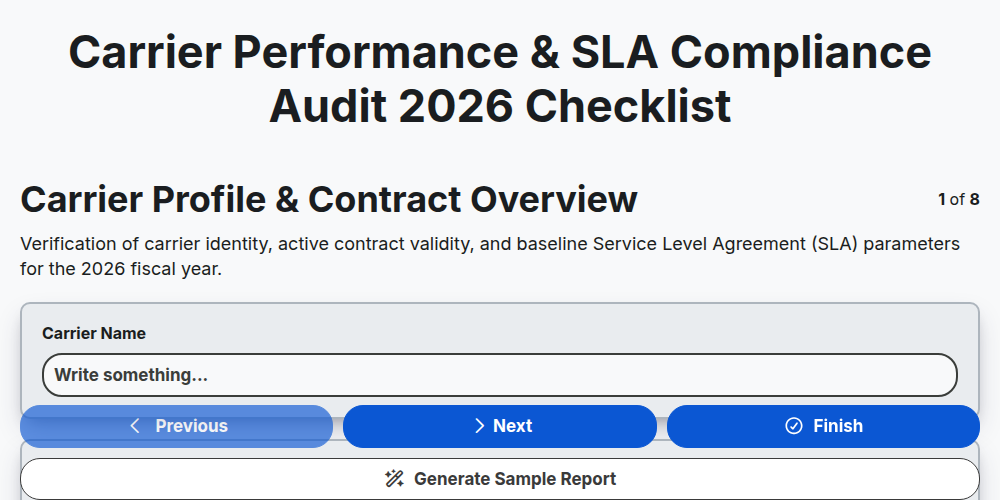
Table des matières
- Introduction: Why Auditing Carrier Performance is Critical in 2026
- Phase 1: Establishing the Baseline: Carrier Profile & Contract Overview
- Phase 2: Measuring Reliability: On-Time Performance Metrics
- Phase 3: Verifying Compliance: Documentation & Regulatory Accuracy
- Phase 4: Quality Control: Cargo Integrity & Damage Assessment
- Phase 5: Evaluating Responsiveness: Communication & Incident Management
- Phase 6: Financial Integrity: Cost Management & Billing Accuracy
- Phase 7: Asset Reliability: Equipment & Fleet Standards
- Phase 8: Risk Mitigation: Safety & Regulatory Compliance
- Synthesizing Results: How to Use Audit Data for Carrier Negotiations
- Conclusion: Continuous Improvement Through Regular Auditing
- Resources & Links
TLDR: Ensure your supply chain remains resilient and cost-effective in 2026 with our definitive audit checklist. This guide provides a structured framework for evaluating carrier performance across eight critical pillars-from on-time delivery and documentation accuracy to safety compliance and billing precision-helping logistics professionals mitigate risk, optimize costs, and enforce strict SLA compliance.
Introduction: Why Auditing Carrier Performance is Critical in 2026
Navigating the New Era of Logistics Complexity
As we enter 2026, the global supply chain landscape has reached a level of sophistication and volatility never seen before. The era of set it and forget it carrier management is officially over. With the integration of advanced AI-driven routing, increasing regulatory pressures regarding carbon footprints, and the heightened demand for real-time transparency, your logistics network is only as strong as its weakest link.
In this hyper-connected ecosystem, relying on a carrier's word is no longer a viable strategy. Service Level Agreement (SLA) compliance is no longer just a contractual obligation; it is the bedrock of your operational continuity.
The High Stakes of the 2026 Supply Chain
The consequences of overlooked carrier performance are more severe than ever. A single failure in on-time delivery or a lapse in documentation accuracy can trigger a catastrophic domino effect, leading to:
- Eroded Customer Trust: In an age of instant gratification, even minor delays can lead to permanent loss of brand loyalty.
- Exploding Operational Costs: Inefficiencies in carrier performance translate directly to increased detention fees, rerouting expenses, and administrative overhead.
- Compliance & Regulatory Risk: With tightening global standards on cargo safety and environmental impact, a carrier's failure to comply is your failure to comply.
Beyond the Surface: Moving Toward Proactive Auditing
A traditional audit often focuses solely on the what-did the shipment arrive? However, a high-performing 202rove audit must focus on the how.
An effective audit framework allows you to move from reactive troubleshooting (fixing problems after they occur) to predictive management (identifying patterns of failure before they impact your bottom line). By implementing a rigorous, structured checklist, you transform your carrier relationships from mere vendor transactions into strategic partnerships built on measurable accountability.
The following checklist is designed to help you deep-dive into every facet of your carrier's operations, ensuring that your logistics network is resilient, compliant, and optimized for the challenges of 2026 and beyond.
Phase 1: Establishing the Baseline: Carrier Profile & Contract Overview
Setting the Foundation for Accountability
Before diving into the granular metrics of operational performance, an effective audit must begin with a rigorous verification of the fundamental relationship between your organization and your carrier. An audit is only as strong as the baseline against which it measures success. Without a clear understanding of the rules of engagement defined in your 2026 service agreements, it is impossible to determine if a failure is a breach of contract or merely a deviation from an unstated expectation.
Revalidating the Core Agreement
The first step in this phase is to ensure that the data you are analyzing aligns with the current, active version of your Master Service Agreement (MSA) or Service Level Agreement (SLA). In the rapidly evolving logistics landscape of 2026, many-year-old contracts often fail to account for new regulatory requirements or updated technology integrations.
Your audit should begin by verifying:
- Contract Validity and Scope: Confirming that the carrier is operating under an active, unexpired agreement and that the services being audited fall within the defined scope of work.
- Defined KPIs and Thresholds: Re-confirming the specific, measurable targets (e.g., 98% on-time delivery) that are currently being used as the benchmark for success.
- Service Level Definitions: Ensuring that both parties are using identical definitions for critical terms-such as what constitutes a late delivery or an acceptable window for communication.
Updating Carrier Profiles
A carrier's operational capacity can shift significantly over a fiscal year. This stage of the audit requires a snapshot verification of the carrier's current operational footprint.
Key Audit Verifications:
- Entity & Authority Verification: Ensuring all legal names, tax IDs, and operating authorities (e.g., MC/DOT numbers) are current and match the documentation on file.
- Capacity & Resource Alignment: Assessing whether the carrier's current fleet size and network reach still align with your current volume requirements and strategic growth plans for 2026.
- Contact Matrix Accuracy: Updating the escalation matrix to ensure that the personnel responsible for incident management and billing are correctly identified and reachable.
By completing this phase, you transition from a vague sense of how things are going to a structured, data-driven auditing process rooted in contractual reality.
Phase 2: Measuring Reliability: On-Time Performance Metrics
Quantifying Reliability through Data-Driven KPIs
In the 2026 logistics landscape, on-time is no longer a vague goal-it is a precise metric that dictates your entire supply chain's stability. As delivery windows shrink and customer expectations for real-time transparency intensify, auditing your carriers' adherence to Service Level Agreements (SLAs) regarding timing is the most critical component of your performance review.
To move beyond anecdotal feedback and into actionable intelligence, your audit must scrutinize the following key performance indicators:
1. On-Time Delivery (OTD) Rate
This is the cornerstone of carrier reliability. Do not simply look at the final delivery date; instead, audit the percentage of shipments that arrived within the specific window promised in the contract.
- The Audit Focus: Compare the Scheduled Delivery Time against the Actual Delivery Time across your entire historical dataset for the audit period.
2. On-Time Pickup (OTP) Consistency
A delay at the origin creates a domino effect that disrupts downstream warehousing and downstream distribution.
- The Audit Focus: Identify patterns of late starts. Is the carrier struggling with driver availability or inefficient routing? Frequent pickup delays are often a leading indicator of upcoming capacity issues.
3. Transit Time Variability
Consistency is often more valuable than raw speed. A carrier that always takes 4 days is easier to manage than a carrier that fluctuates between 2 and 6 days.
- The Audit Focus: Calculate the standard deviation in transit times for specific lanes. High variability indicates a lack of control over their sub-contracted networks or unpredictable routing processes.
4. Appointment Adherence & Dwell Time
The audit must extend to the warehouse floor. Even if a truck arrives on the correct day, failure to meet specific appointment windows leads to costly detention fees and labor inefficiencies.
- The Audit Focus: Analyze Arrival vs. Appointment logs. Are carriers consistently missing dock windows? Are you being billed for excessive detention time caused by carrier-side delays?
5. Milestone Transparency & Real-Time Updates
In 2026, a delivery is only considered on time if the data matches the physical reality.
- The Audit Focus: Evaluate the accuracy of EDI/API status updates. Does the carrier's digital tracking match the actual movement of goods? Audit the frequency of ghost updates-where a shipment appears stationary in the system despite being in motion.
Phase 3: Verifying Compliance: Documentation & Regulatory Accuracy
Ensuring Regulatory Integrity and Paperwork Precision
In the complex regulatory landscape of 2026, a carrier's ability to move freight is only as strong as their ability to prove they are compliant. During this phase of the audit, you are moving beyond-the-surface metrics to examine the paper trail that protects your company from legal liability and operational disruptions.
The Audit Focus: Beyond the Bill of Lading
Verification in this phase is not merely about checking boxes; it is about ensuring that every document supporting a shipment is accurate, up-to-date, and legally binding. Inconsistencies in documentation are often the root cause of payment delays, customs hold-ups, and insurance denials.
Key Audit Components
Certificate of Insurance (COI) Validation
Coverage Limits: Verify that all active carriers meet the minimum liability and cargo insurance requirements outlined in your 2026 master service agreements.
Expiration Tracking: Ensure no certificates have lapsed. An expired COI renders your entire supply chain vulnerable to massive financial exposure.
Additional Insured Endorsements: Confirm that your organization is correctly named as an additional insured where contractually required.
Regulatory & Permit Verifications
Carrier Authority Status: Re-verify active FMCSA (or relevant regional authority) operating authority to ensure no sudden suspensions or deactivations have occurred.
Permit Accuracy: For specialized or cross-border freight, audit the validity of overweight, oversize, or hazmat-specific permits.
Environmental Compliance: In 2026, with increasing scrutiny on green logistics, verify that carriers are maintaining necessary documentation regarding emissions standards and carbon reporting compliance.
Data Integrity & Documentation Accuracy
Proof of Delivery (POD) Consistency: Cross-reference digital PODs against the original Bill of Lading (BOL) to ensure timestamps, signatures, and cargo descriptions match perfectly.
Signature Authenticity: Check for any patterns of irregular or illegible signatures that might indicate fraudulent reporting or unauthorized hand-offs.
Manifest Accuracy: Audit the alignment between physical cargo manifests and the digital data entered into your Transportation Management System (TMS) to prevent discrepancies during customs or roadside inspections.
Pro-Tip for 2026 Auditors
Leverage automated OCR (Optical Character Recognition) tools to scan documentation. The goal is to identify discrepancies between the physical document and the digital record in real-time, rather than discovering errors weeks after the shipment has been closed.
Phase 4: Quality Control: Cargo Integrity & Damage Assessment
Ensuring the Standard: Assessing Cargo Integrity & Damage Assessment
While timely delivery and paperwork accuracy are critical, the ultimate measure of a carrier's value lies in the physical condition of the goods upon arrival. In 2026's increasingly automated and high-velocity supply chain, even a minor increase in damage rates can lead to catastrophic downstream costs, including returns, customer dissatisfaction, and inventory shrinkage.
As part of your audit, this phase focuses on verifying that your carriers are not just moving goods, but protecting your assets.
Key Audit Focus Areas
To conduct a thorough assessment, your audit should evaluate the following sub-metrics:
- Damage Rate Frequency (DRF): Analyze the percentage of shipments arriving with visible or internal damage. Compare this against your established baseline and industry benchmarks to identify trends of negligence.
- Claims Processing Efficiency: It is not enough to identify damage; you must audit how the carrier handles the aftermath. Evaluate the time elapsed from damage discovery to claim resolution and the transparency of their investigation process.
- Load Securing & Stowage Protocols: Review physical inspection reports or photos to ensure that cargo was properly braced, blocked, and secured. This includes checking for appropriate use of dunnage, airbags, and straps to prevent shifting during transit.
- Temperature & Environment Maintenance (For Cold Chain): For temperature-sensitive freight, audit the integrity of the thermal envelope. Review continuous temperature logs to identify any excursions or deviations from the required setpoints during the journey.
Audit Checklist Items
Use the following points to verify compliance during your 2026 audit cycle:
- Verification of Inspection Logs: Do drivers/carriers perform and document pre- and post-trip inspections of the cargo?
- Claims-to-Shipment Ratio: Is the volume of cargo claims staying within the agreed-upon SLA threshold?
- Root Cause Analysis (RCA) Quality: When damage occurs, does the carrier provide a detailed RCA, or do they simply issue a generic unavoidable excuse?
- Packaging Compliance: Is the carrier reporting instances where improper shipper packaging (not carrier error) is contributing to damage rates?
- Sensor & IoT Data Integration: If using telematics, does the carrier's data align with your onboard impact and temperature sensors?
Pro-Tip for 2026 Audits
In the current landscape, hidden damage (damage discovered only after unpacking) is a rising cost driver. Use this audit phase to transition from merely checking for external box damage to reviewing sensor-based impact data. Carriers who can provide high-resolution data regarding sudden deceleration or heavy vibrations are significantly more valuable in a high-value goods environment.
Phase 5: Evaluating Responsiveness: Communication & Incident Management
Mastering the Feedback Loop: Communication & Incident Management
In the modern, high-velocity supply chain of 2026, a carrier's ability to move goods is only as valuable as their ability to move information. An audit of communication and incident management is not merely about checking if emails were sent; it is about evaluating the agility, transparency, and reliability of the carrier's communication infrastructure during critical disruptions.
To ensure your service level agreements (SLAs) are more than just paperwork, use the following sub-criteria to audit your carrier's responsiveness:
1. Real-Time Visibility & Digital Integration
In 2026, checking in should not require a phone call. Evaluate how effectively the carrier utilizes EDI (Electronic Data Interchange) or API integrations to provide real-time updates.
- Proactive Alerting: Does the carrier notify you of delays before the missed window occurs, or are you discovering issues only after the deadline has passed?
- Single Source of Truth: Is the carrier's data seamlessly integrated with your TMS (Transportation Management System) to prevent data silos?
- Milestone Accuracy: Are digital status updates (e.g., Arrived at Port, Out for Delivery) reflecting actual physical movements in real-time?
2. Incident Escalation & Resolution Protocols
When disruptions occur-whether due to weather, port congestion, or labor shortages-the speed of the resolution is paramount.
- Escalation Matrix Adherence: Does the carrier follow the predefined hierarchy for reporting critical incidents?
- Response Time Benchmarks: Are Urgent or Critical notifications being acknowledged within the SLA-mandable timeframe (e.g., <30 minutes)?
- Root Cause Analysis (RCA) Quality: After an incident, does the carrier provide a detailed, actionable RCA that identifies not just what happened, but how they will prevent recurrence?
3. Crisis Communication Continuity
A resilient logistics strategy requires a carrier that remains communicative even when infrastructure fails.
- Redundancy Channels: Does the carrier have secondary communication protocols (e.g., mobile apps, SMS, or satellite tracking) if primary digital networks fail?
- Stakeholder Management: Does the carrier take responsibility for notifying downstream partners (warehouses, receivers, and end customers) during a delay, or does that burden fall on your team?
4. Documentation Trail & Auditability
Communication must be documented to be verifiable.
- Audit Trail Integrity: Is there a clear, timestamped record of all critical communications regarding deviations from the original shipment plan?
- Dispute Transparency: How transparent is the carrier's communication during the claims and billing dispute process?
Phase 6: Financial Integrity: Cost Management & Billing Accuracy
Auditing the Bottom Line: Beyond the Invoice
In 2026, logistics cost management has moved far beyond simply verifying that the amount on the invoice matches the quote. With the increasing complexity of dynamic fuel surcharges, accessorial fees, and real-time spot market fluctuations, your audit must focus on the granular accuracy of every line item to prevent margin creep.
The goal of this phase is to ensure that what was contractually agreed upon in your Service Level Agreements (SLAs) is exactly what is being executed in your general ledger.
Key Audit Objectives
1. Rate Accuracy & Contractual Alignment
Verify that all-in rates, including base freight charges, align strictly with your 2026 master service agreements (MSAs).
- Base Rate Validation: Cross-reference recent invoices against current contract tariffs to identify overcharges.
- Accessorial Audit: Scrutinize hidden fees such as detention, demurrage, lumper fees, and residential delivery surcharges. Are these being applied according to agreed-upon triggers, or are they being used as unauthorized revenue drivers?
- Surcharge Verification: Audit fuel surcharge (FSC) calculations to ensure they follow the specific index and frequency outlined in your contract.
2. Invoice Discrepancy & Dispute Resolution
A high volume of disputes is often a symptom of poor communication or broken processes. Use this audit to measure the efficiency of your dispute workflow.
- Dispute Cycle Time: Measure the time elapsed from the identification of an incorrect charge to the final resolution/credit.
- Root Cause Analysis: Categorize frequent discrepancies. Is the error stemming from carrier clerical errors, inaccurate weight/dimension reporting (DIM weight), or failures in your internal receiving documentation?
- Credit Memo Tracking: Ensure all approved credits and adjustments are being applied to active accounts and not lost in administrative lag.
3. Ancillary Service & Accessorial Compliance
In an era of automated freight auditing, even small errors in dimensioning or weight reporting can lead to massive cumulative costs.
- Weight & DIM Verification: Audit a sample of shipments where discrepancies were noted between carrier-reported weight and warehouse-recorded weight.
- Lumper & Handling Verification: For shipments involving third-party handling, ensure all supporting documentation (receipts/signatures) is present and that charges are not being duplicated.
4. Audit Workflow Automation
As we move deeper into 2026, manual auditing is no longer scalable.
- Digital Audit Trail: Evaluate whether your current Freight Audit and Payment (FAP) systems are effectively capturing the data needed for real-time visibility.
- Data Integrity: Ensure that the data flowing from your TMS (Transportation Management System) into your ERP (Enterprise Resource Planning) is seamless and error-free, preventing ghost liabilities from accumulating in your budget.
Phase 7: Asset Reliability: Equipment & Fleet Standards
Ensuring Operational Continuity through Asset Excellence
A carrier's ability to meet SLAs is fundamentally tied to the physical state of their fleet. Even the most efficient routing and skilled drivers cannot compensate for mechanical failures or substandard equipment. In 2026, with the increasing integration of IoT and real-time telematics, auditing equipment standards has moved beyond a visual inspection to a deep dive into technical reliability and maintenance intelligence.
Key Audit Objectives
The goal of this phase is to verify that the equipment utilized in your supply chain meets the predefined safety, hygiene, and functional requirements necessary to protect your cargo and prevent transit delays.
Critical Inspection Areas
1. Maintenance Program Verification
Don't just check if the trucks are running; audit the rigor of the maintenance lifecycle.
- Preventative Maintenance (PM) Records: Review documentation to ensure all vehicles are adhering to scheduled service intervals.
- Telematics & Sensor Health: Verify that onboard diagnostic systems and temperature sensors (for reefer units) are calibrated and operational.
- Tire & Brake Integrity: Audit reports related to high-wear components that directly impact road safety and downtime risk.
2. Trailer & Container Condition Assessment
The vessel of your cargo must be structurally sound and clean.
- Structural Integrity: Check for holes, compromised seals, or floor damage that could lead to cargo contamination.
- Sanitation & Hygiene Standards: For food-grade or pharmaceutical logistics, audit the cleaning logs and ensure zero cross-contamination protocols are being followed.
- Refrigeration (Reefer) Validation: For temperature-sensitive lanes, audit the temperature stability logs and the functionality of backup power units.
3. Modernization & Technology Integration
As we move through 2026, the age of a fleet is a proxy for risk.
- Fleet Age Compliance: Ensure the carrier's fleet composition aligns with your company's risk appetite (e.g., newer models typically correlate with lower breakdown rates).
- ELD & GPS Accuracy: Confirm that Electronic Logging Devices (ELD) and GPS tracking are functioning seamlessly to ensure real-time visibility and compliance with Hours of Service (HOS) regulations.
4. Load Securing & Ancillary Equipment
- Tarp & Strapping Integrity: Evaluate the condition of load-securing materials to prevent shifting or environmental exposure.
- Specialized Equipment Readiness: If your contract requires air-ride suspension, lift gates, or specialized docking equipment, verify that these specific assets are audited and functional.
Phase 8: Risk Mitigation: Safety & Regulatory Compliance
Ensuring Operational Continuity through Rigorous Safety Auditing
In the 2026 logistics landscape, safety is no longer just a regulatory requirement-it is a critical component of supply chain resilience. As global regulations evolve and autonomous/connected vehicle technologies become more integrated into fleets, your audit must move beyond simple paperwork checks to evaluate real-time risk mitigation capabilities.
Regulatory Adherence & Compliance Documentation
The foundation of a safe carrier partnership lies in their ability to maintain up-to-date legal standing. During this phase of the audit, verify the following:
- FMCSA/Regulatory Standing: Confirm active authority and review the carrier's safety rating for any recent downgrades or critical violations.
- Driver Qualification Files (DQF): Ensure all drivers possess valid, class-appropriate licenses and that medical certificates are current and unexpired.
- Permit & Insurance Verification: Validate that all necessary operating permits (e.g., IRP, IFTA) are active and that insurance coverage limits meet or exceed your specific contractual requirements.
Safety Management Systems (SMS) & Technology Integration
As we move deeper into 2026, manual oversight is insufficient. We recommend auditing the digital frameworks carriers use to prevent incidents before they occur:
- Telematics & ELD Monitoring: Evaluate how the carrier utilizes Electronic Logging Devices (ELD) to monitor Hours of Service (HOS) and prevent driver fatigue.
- Driver Behavior Analytics: Assess the carrier's use of in-cab technology to track high-risk behaviors such as harsh braking, rapid acceleration, and speeding.
- Incident Response Protocols: Review the documented Chain of Command for accidents. How quickly is the carrier able to notify your team, and what are their immediate containment steps?
Environmental, Social, and Governance (ESG) Safety Standards
Modern auditing requires looking at the broader impact of carrier operations.
- Sustainability Compliance: Check for adherence to emerging carbon emission standards and the integration of low-emission or electric vehicles within their fleet.
- Training & Continuous Education: Audit the carrier's internal training programs. Are drivers being trained on new cargo-securing technologies and defensive driving techniques specific to 2026 road conditions?
Risk Mitigation Checklist Summary
| Audit Item | Verification Method | Criticality |
|---|---|---|
| Driver License/Medical Validity | Document Review | High |
| Insurance Certificate Expiry | Automated Tracking/Email | High |
| HOS/ELD Compliance Data | Digital Log Sampling | Medium |
| Safety Rating/CSA Scores | Public Record/FMCSA Search | High |
| Cargo Securing Protocol Audit | Physical/Photo Inspection | Medium |
Synthesizing Results: How to Use Audit Data for Carrier Negotiations
Transforming Raw Data into Strategic Leverage
An audit is only as valuable as the actions taken after the final report is filed. Collecting data on on-time performance, billing accuracy, and cargo integrity is a massive undertaking, but the true ROI of your 2026 audit lies in how you translate these metrics into a strategic roadmap for your supply chain.
The data gathered from your compliance audit should serve as the foundation for your upcoming quarterly business reviews (QBRs) and annual contract renegotiations. Rather than approaching carriers with vague complaints, you can now enter the room with undeniable, empirical evidence.
Leveraging Performance Metrics for Contract Renegotiation
When reviewing your findings, categorize your results into three strategic buckets to determine your next move:
- The Reward Bucket (High Compliance): For carriers meeting or exceeding all SLAs, use the audit data to justify long-term contract extensions or increased volume allocations. Positive reinforcement secures your priority status in a competitive market.
- The Remediation Bucket (Inconsistent Performance): For carriers with gaps in documentation or communication, use the specific failures identified in the audit to trigger Corrective Action Plans (CAPs). This is your opportunity to demand improved processes without immediately terminating the relationship.
- The Exit Bucket (Critical Non-Compliance): For carriers failing in safety, cargo integrity, or cost management, the audit provides the necessary paper trail to justify a transition to new partners. This mitigates the risk of sudden disruptions by ensuring your decisions are backed by documented history.
From Reactive Troubleshooting to Proactive Partnership
Beyond simple negotiation, use the audit to shift the relationship from a transactional model to a collaborative one.
Implementing Data-Driven Incentives
If the audit reveals high performance in specialized areas-such as superior equipment standards-consider restructuring your rate cards to reward these premium services. This incentivizes your most reliable carriers to maintain high standards.
Identifying Systematic Supply Chain Gaps
Sometimes, the audit reveals that carrier failure is actually a symptom of internal process flaws. For example, if the audit shows high incident rates due to poor communication, the issue may lie in your internal dispatch or documentation workflow rather than the carrier's performance. Use the audit to bridge the gap between your internal operations and your external partners, creating a seamless, high-performance ecosystem for 2026 and beyond.
Conclusion: Continuous Improvement Through Regular Auditing
Turning Audits into Strategic Advantages
An audit should never be viewed as a mere policing exercise or a simple box-ticking task. Instead, view the 2026 Carrier Performance & SLA Compliance Audit as a strategic diagnostic tool designed to uncover hidden inefficiencies and strengthen your supply chain resilience. In an era of increasing global volatility, the difference between a functional supply chain and a competitive one lies in the ability to identify, analyze, and rectify deviations before they escalate into systemic failures.
Moving Beyond Compliance to Partnership
The true value of this checklist lies in the transition from reactive troubleshooting to proactive partnership. When you use these metrics to hold carriers accountable, you aren't just looking for errors; you are creating a feedback loop that fosters continuous improvement.
- For the Carrier: The audit provides a roadmap for where they can improve service levels to retain your business.
- For the Shipper: The audit provides the data-driven leverage needed to negotiate more favorable contracts, optimize costs, and mitigate risk.
Strategies for Long-Term Success
To ensure that your auditing process drives lasting excellence, consider these three implementation pillars:
- Data-Driven Decision Making: Ensure your audit results are fed directly into your quarterly business reviews (QBRs). Data without action is just noise. Use the trends found in On-Time Performance and Cost Management to drive your next round of negotiations.
- Automated Monitoring: As we move further into 2026, manual spreadsheets are no longer sufficient. Integrate your audit checklist into your TMS (Transportation Management System) to move toward real-time compliance monitoring rather than retrospective analysis.
- Collaborative Remediation: When discrepancies are found in Safety or Cargo Integrity, work with your carriers to develop Corrective Action Plans (CAPs). A successful audit doesn't just identify a problem-it facilitates the solution.
By systematically applying this checklist, you are doing more than just monitoring compliance; you are building a robust, transparent, and high-performing logistics ecosystem capable of navigating the complexities of the modern global market.
Resources & Links
- Supply Chain Brain: Leading industry news and analysis for supply chain professionals, perfect for staying updated on 2026 logistics trends.
- CargoWise: A global leader in logistics software, providing insights into digital transformation and automated compliance tracking.
- Material Handling & Logistics: Expert resources on warehouse management, distribution, and maintaining high standards in carrier equipment and fleet reliability.
- FreightWaves: Real-time data and news on freight market dynamics, essential for understanding the context of on-time performance metrics.
- FMCSA (Federal Motor Carrier Safety Administration): The primary regulatory body for tracking carrier safety ratings and regulatory compliance standards.
- Gartner Supply Chain: High-level strategic insights and research for developing long-term carrier negotiation and risk mitigation frameworks.
- Inbound Logistics: Comprehensive industry magazine covering logistics management, procurement, and carrier relationship strategies.
- ShipBob: Excellent resources for understanding e-commerce fulfillment, cargo integrity, and damage assessment protocols.
- Logistics Management: In-depth articles on supply chain optimization, cost management, and billing accuracy audits.
- Supply Chain Dive: Daily news and deep dives into supply chain operations, including incident management and communication effectiveness.
- ASCM (Association for Supply Chain Management): The professional standard for supply chain excellence, offering frameworks for continuous improvement and auditing.
- DHL Logistics Insights: Global perspective on logistics trends, useful for benchmarking carrier performance against global standards.
- TradeLens (Digital Ecosystems): Insights into blockchain and digital documentation for verifying regulatory accuracy and documentation compliance.
- International Supply Chain Management: Focuses on global trade complexities, vital for the 'Establishing the Baseline' and 'Contract Overview' phase.
- Supply Chain Quarterly: Analytical content focused on the financial and strategic aspects of carrier management and cost-saving audits.
Commentaires
Aucun commentaire n'a été publié pour le moment. Soyez le premier à en ajouter un !
Démonstration de la solution de gestion de la logistique
Fatigué des retards d'expédition, des colis perdus et des itinéraires inefficaces ? La plateforme Work OS de ChecklistGuro rationalise l'ensemble de vos opérations logistiques, de la gestion des entrepôts et de l'exécution des commandes à l'optimisation des itinéraires et au suivi des livraisons. Obtenez une visibilité en temps réel, réduisez les coûts et améliorez la satisfaction client. Découvrez comment ChecklistGuro peut transformer votre entreprise de logistique !
Articles connexes
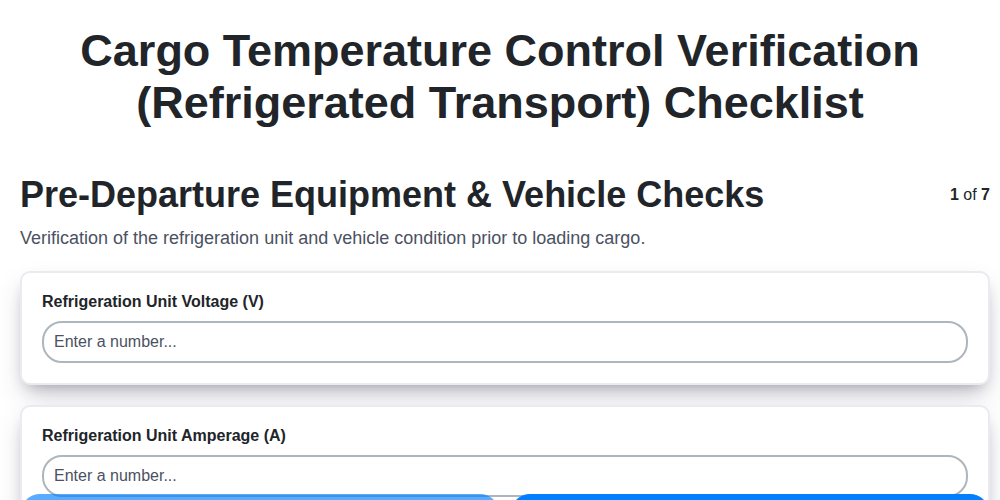
The Ultimate Refrigerated Cargo Temperature Control Checklist Template
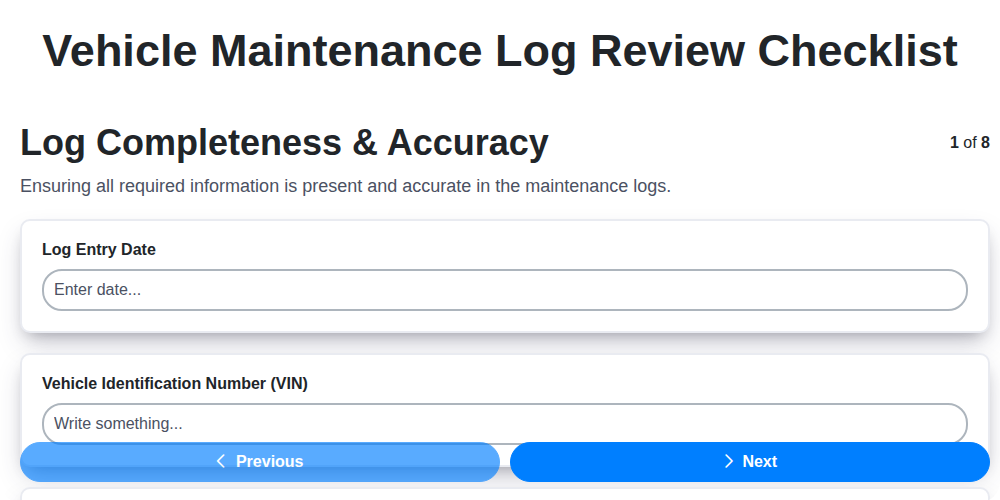
Mastering Your Fleet: A Vehicle Maintenance Log Review Template
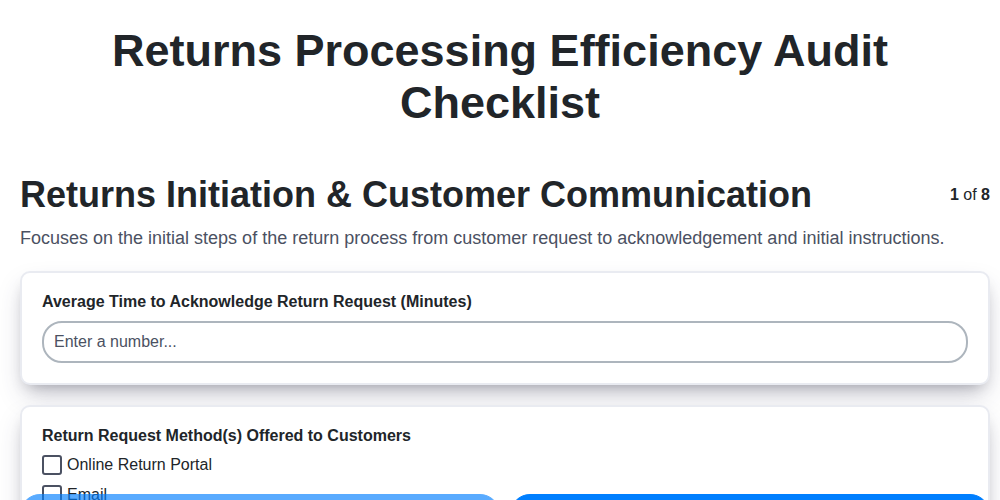
Master Your Returns: The Ultimate Returns Processing Efficiency Audit Checklist
Data Privacy Policy Compliance: Your Essential Checklist Template
Delivery Confirmation Audit: Your Checklist Template for Process Excellence
Votre modèle de liste de contrôle d'inspection et d'entretien des palettes.
Fuel Efficiency Monitoring: Your Checklist Template for Savings
Supply Chain Risk Assessment: Your Essential Checklist Template
Besoin d'aide avec les listes de contrôle?
Vous avez une question ? Nous sommes là pour vous aider. Veuillez soumettre votre demande et nous vous répondrons rapidement.