The Ultimate 2026 Farm Product Traceability and Food Safety Checklist: A Complete Template for Producers
Publié: 30/10/2026 Mis à jour: 31/10/2026
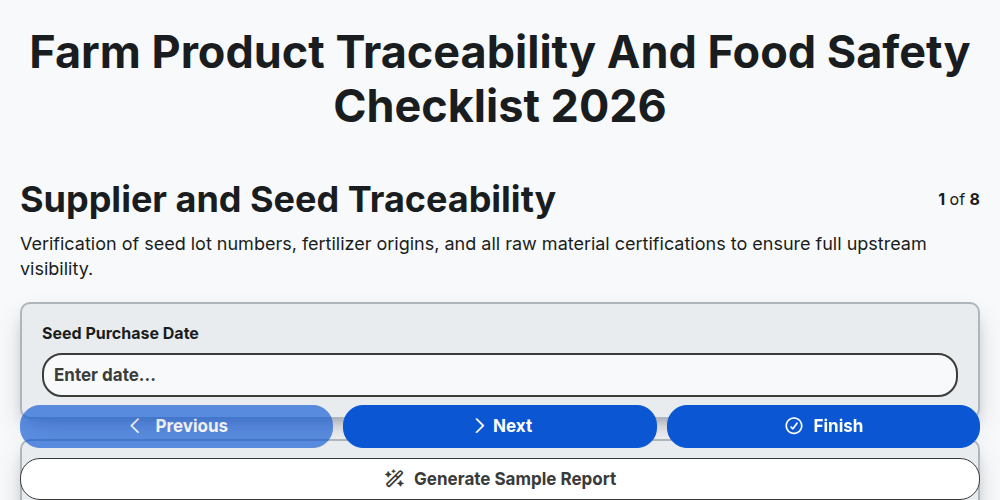
Table des matières
- Introduction: Navigating the 2026 Landscape of Food Safety Compliance
- The Importance of End-to-End Traceability in Modern Agriculture
- Phase 1: Upstream Integrity - Supplier and Seed Traceability
- Phase 2: Field Management - Harvest and Collection Records
- Phase 3: Moving the Crop - Post-Harvest Handling and Transport
- Phase 4: Preserving Quality - Storage Environment and Hygiene
- Phase 5: Market Readiness - Packaging and Labeling Compliance
- Phase 6: Maintaining Standards - Sanitation and Cleaning Schedules
- Phase 7: Human Element - Worker Hygiene and Training Records
- Phase 8: Risk Management - Food Safety Incident and Recall Preparedness
- Digital Transformation: Implementing Tech-Driven Tracking Systems
- Conclusion: Building a Culture of Continuous Compliance
- Resources & Links
TLDR: Stay ahead of 2026 regulatory standards with this comprehensive guide to farm-to-fork safety. This checklist provides a step-by-step template for managing everything from seed traceability and harvest records to post-harvest logistics, sanitation protocols, and recall preparedness to ensure total compliance and consumer trust.
Introduction: Navigating the 2026 Landscape of Food Safety Compliance
As we approach 2026, the global food supply chain is undergoing a profound transformation. The era of reactive food safety is officially over; we have entered the era of proactive traceability. Driven by more stringent international regulations, the rapid integration of digital monitoring technologies, and heightened consumer demand for transparency, the margin for error in agricultural production has never been slimmer.
The New Standard of Accountability
For modern producers, traceability is no longer just a regulatory hurdle-it is a fundamental pillar of brand integrity. Today's consumers and retailers are demanding more than just a natural label; they want to see the digital paper trail that connects the final product on their plate back to the specific seed planted in the soil.
In 2026, a single gap in your documentation can lead to more than just a failed audit. It can lead to catastrophic brand damage, costly product withdrawals, and a loss of trust that takes years to rebuild.
Why a Systematic Checklist is Your Best Defense
Compliance is not a one-time event; it is a continuous cycle of monitoring, documenting, and improving. Whether you are managing a small-scale organic farm or a large-scale industrial operation, the complexity of modern supply chains requires a standardized approach to risk management.
The checklist provided in this guide is designed to help you bridge the gap between field operations and regulatory requirements. By systematically addressing every stage of the lifecycle-from supplier verification to post-harvest logistics-you are doing more than just checking boxes. You are building a robust food safety management system (FSMS) that protects your workers, your customers, and your livelihood.
What This Guide Covers
This comprehensive template serves as a blueprint for your 2026 compliance strategy. We will walk through the critical control points of your production cycle, including:
- Upstream Integrity: Ensuring your inputs (seeds and suppliers) are verified.
- Operational Precision: Mastering harvest, handling, and storage protocols.
- Logistical Transparency: Maintaining the cold chain and transport integrity.
- Crisis Readiness: Developing the muscle memory needed for effective recall management.
By implementing these steps, you transition from simply following rules to leading the industry in safety and transparency.
The Importance of End-to-End Traceability in Modern Agriculture
Why Traceability is No Longer Optional
In the modern agricultural landscape, traceability has evolved from a best practice into a fundamental requirement for market access and consumer trust. As we move into 2026, the global food supply chain is becoming increasingly complex, driven by rapid technological integration, tightening international regulations, and a heightened-than-ever demand for transparency.
For producers, end-to-end traceability means being able to track every single ingredient or raw material from its point of origin-the very seed planted in the soil-all the way to the final consumer's plate. This farm-to-fork visibility is the backbone of a resilient food system.
Mitigating Risk and Protecting Brand Reputation
The primary driver for rigorous traceability is risk management. When a food safety issue arises, the ability to pinpoint the exact batch, field, or time of harvest can mean the difference between a surgical, localized withdrawal and a catastrophic, brand-destroying mass recall.
In an era where social media can spread news of contamination in seconds, having a robust, data-driven tracking system allows producers to act with precision. By identifying the specific scope of a potential hazard, you protect not only the health of your customers but also the economic viability of your entire operation.
Meeting Regulatory and Retailer Demands
The regulatory landscape in 2026 is more demanding than ever. Global food safety standards and local government mandates are increasingly requiring digital, real-time documentation of all agricultural processes. Retailers and large-scale distributors are also implementing stricter auditing protocols; they no longer simply ask if you are safe-they demand proof that your processes are verifiable.
Building Consumer Confidence through Transparency
Beyond compliance, traceability is a powerful marketing tool. Today's consumers are more informed and health-conscious than previous generations. They want to know where their food comes from, how it was grown, and whether the handling processes were hygienic.
By implementing a comprehensive traceability checklist, you aren't just checking off a box for auditors; you are building a narrative of quality and safety that fosters deep-seated loyalty with your customers. In a crowded marketplace, transparency is your greatest competitive advantage.
Phase 1: Upstream Integrity - Supplier and Seed Traceability
Ensuring Quality from the Very Beginning
Traceability doesn't start at the farm gate; it starts in the soil and the laboratory. In the 2026 regulatory landscape, the upstream portion of your supply chain is under more scrutiny than ever. To prevent contamination before a single seed is even planted, you must establish a rigorous verification process for every input entering your farm.
Establishing a Verified Supplier Database
The foundation of food safety is knowing exactly who you are doing business with. Your checklist should include:
- Supplier Certifications: Maintaining updated records of GlobalG.A.P., Organic, or other relevant third-party certifications for all fertilizer, pesticide, and seed providers.
- Approved Vendor List (AVL): A strictly maintained registry that ensures no materials are purchased from unvetted or unauthorized sources.
- Audit Trails for Inputs: The ability to trace specific batches of fertilizers or soil amendments back to their original manufacturer and lot numbers.
Seed Integrity and Genetic Traceability
Seeds are the blueprint of your crop. Any biological vulnerability or chemical residue introduced at this stage can compromise your entire harvest.
- Lot and Batch Tracking: Every seed packet must be logged with its specific lot number, germination rate, and variety.
- Pathogen Testing Records: Documentation proving that seeds have been screened for seed-borne pathogens (such as Salmonella or E. coli).
- Treatment Documentation: Detailed records of any seed coatings or chemical treatments applied during processing, ensuring these are compatible with your production standards and organic requirements.
Monitoring Soil and Water Inputs
Traceability extends to the mediums in which your crops grow.
- Water Source Verification: Regular testing logs for irrigation water quality to ensure no microbial contamination is being introduced to the field.
- Amendment Logs: Precise records of when, where, and in what quantity organic or inorganic amendments were applied, linked directly to specific field plots.
Phase 2: Field Management - Harvest and Collection Records
Ensuring Accuracy from the Field to the Bin
The moment of harvest is the most critical point in the traceability chain. Once a product is harvested, the link between the raw crop and the finished product begins to tighten. If your records at this stage are vague, the entire integrity of your food safety program is compromised.
To maintain compliance with 2026 food safety standards, your collection records must move beyond simple dates and quantities. You need to create a digital or physical paper trail that allows you to pinpoint exactly which plot or block a specific batch originated from.
Critical Data Points for Harvest Documentation
To pass an audit and ensure rapid response during a recall, every harvest entry should include the following details:
- Field/Block Identification: Precise mapping of the specific area where the crop was harvested.
- Date and Time of Harvest: Essential for tracking shelf-life and identifying potential heat-related spoilage windows.
- Batch/Lot Number Assignment: A unique identifier that follows the product from the field through to the consumer.
- Quantity Harvested: Total weight or volume, which helps in reconciling supply with post-harvest inventory.
- Harvest Personnel: Identification of the crew or individual responsible for the harvest to monitor for potential hygiene lapses.
Monitoring Environmental Conditions During Collection
Traceability isn't just about where the food came from, but how it was treated the moment it left the plant. Your records should also document:
- Ambient Temperature: Recording the temperature at the time of harvest to ensure crops were not exposed to heat stress.
- Equipment Inspection Logs: Verification that harvest bins, crates, and tools were clean and food-grade prior to use.
- Pre-harvest Interval (PHI) Verification: Documentation confirming that any necessary treatments or pesticides were applied within the legal safety window before picking commenced.
Best Practices for 2026 Compliance
As we move into 2026, manual logbooks are increasingly being replaced by real-time digital logging. Wherever possible, use mobile-integrated systems that allow field supervisors to input data instantly. This reduces human error, prevents retroactive logging (filling out logs at the end of the week), and ensures that your traceability data is available for immediate audit at a moment's notice.
Phase 3: Moving the Crop - Post-Harvest Handling and Transport
Once the harvest is complete, the chain of custody becomes even more critical. This phase is where the risk of cross-contamination and temperature abuse is highest. To maintain compliance with 2026 food safety standards, your documentation must prove that the product remained safe from the moment it left the field until it reached the distribution center.
Monitoring the Cold Chain and Transit Integrity
Traceability in transport is not just about knowing where the truck went, but how the environment was maintained during the journey.
1. Temperature Logs and Monitoring
If your product is perishable, you must maintain continuous temperature records.
- Pre-loading Checks: Verify that transport vehicles or containers are pre-cooled to the required temperature before loading.
- Transit Monitoring: Utilize automated data loggers or manual temperature checks at specific intervals during transit to identify any temperature spikes that could compromise food safety.
- Calibration Records: Ensure all thermometers and sensors used during transport are calibrated according to your farm's annual maintenance schedule.
2. Vehicle Cleanliness and Inspection
A clean vehicle is the first line of defense against cross-contamination.
- Pre-Loading Inspection: Document that the transport unit was inspected for debris, pests, odors, or chemical residues from previous loads.
- Segregation Protocols: Maintain records proving that raw agricultural products were never transported alongside chemicals, fertilizers, or untreated livestock.
Loading and Documentation Accuracy
The transition from the field to the truck is a high-risk data point. Errors here often lead to broken traceability links.
3. Load Manifests and Batch Assignment
Every shipment must be uniquely identifiable.
- Batch-to-Container Mapping: Your records must clearly link specific harvest batches/lots to specific vehicle IDs and driver names.
- Weight and Quantity Verification: Reconcile harvest records with loading weights to ensure no unidentified extra product has entered the supply chain.
4. Handling Procedures
- Physical Damage Assessment: Document any bruising or physical damage noted during loading. Compromised skin integrity in produce is a primary entry point for pathogens.
- Equipment Sanitation: Ensure that all bins, crates, and pallets used during the loading process have been cleaned and sanitized according to your established sanitation schedule.
Phase 4: Preserving Quality - Storage Environment and Hygiene
Maintaining the Cold Chain and Controlled Environments
Once your products have been harvested and transported, the battle for food safety moves into the storage phase. In 2026, regulatory scrutiny on temperature excursions and humidity fluctuations is higher than ever. It is no longer enough to simply keep it cool; you must prove that the environment remained stable from the moment the product arrived at the facility until it departed for distribution.
Temperature and Humidity Monitoring
Continuous monitoring is the backbone of modern storage safety. Your checklist should include:
- Automated Sensor Calibration: Ensure all digital thermometers and hygrometers are calibrated against traceable standards at least once a year.
- Real-Time Alert Systems: Verification that automated alerts (SMS or email) are active and functional in the event of a temperature deviation.
- Log Consistency: Maintaining uninterrupted temperature logs that capture data at regular intervals (ideally every 15-30 minutes) to identify micro-fluctuations that could compromise shelf life.
Facility Hygiene and Pest Control
Storage areas are high-risk zones for cross-contamination if not managed with precision.
- Sanitary Zoning: Clearly defined separation between raw incoming goods and processed or ready-to-ship products to prevent cross-contamination.
- Pest Management Documentation: Regular inspections and documented sightings/actions taken by certified pest control operators.
- Structural Integrity Checks: Routine inspections for cracks in floors, gaps in door seals, or leaks in the ceiling that could introduce moisture or pathogens.
Inventory Rotation and Airflow Management
Proper storage is as much about logistics as it is about temperature.
- FEFO Implementation: Transitioning from FIFO (First-In, First-Out) to FEFO (First-Expired, First-Out) to prioritize products based on remaining shelf life.
- Airflow Clearance: Ensuring that pallets and crates are not stacked against walls or directly on the floor, allowing for even cold air circulation around all surfaces of the product.
- Spill and Debris Management: A protocol for the immediate cleaning and sanitization of any broken packaging or organic matter to prevent the growth of molds and bacteria.
Phase 5: Market Readiness - Packaging and Labeling Compliance
Ensuring Regulatory Compliance and Consumer Trust
As your product moves toward the final stage of the supply chain, the focus shifts from the field to the package. In 2026, packaging is no longer just about containment; it is a critical vehicle for transparency. Compliance in this phase is what prevents costly market withdrawals and ensures your brand remains credible in a highly regulated landscape.
Essential Labeling Requirements
To avoid rejection at the retail or distribution level, every label must be audited for accuracy and completeness. Ensure your labeling process includes:
- Lot and Batch Coding: Every package must feature a unique identifier that links directly back to your harvest and collection records. This is the backbone of your traceability system.
- Accurate Product Identity: The common name of the product must be clearly stated, matching your official documentation.
- Origin Documentation: Clearly state the farm name, location, and country of origin to satisfy modern consumer demands for local and transparent sourcing.
- Allergen Declarations: If there is any risk of cross-contamination during packaging, all potential allergens must be prominently declared in compliance with current food safety standards.
- Net Weight and Unit Measurements: Verify that all weights are precise and meet international metrology standards.
Packaging Integrity and Material Safety
The physical barrier protecting your product is just as important as the information printed on it.
- Food-Grade Certification: Audit your packaging suppliers to ensure all plastics, films, and containers are certified food-safe and free from chemical migration risks.
- Tamper-Evident Features: Implement seals or indicators that allow both distributors and consumers to verify that the product has not been compromised during transit.
- Sustainability Compliance: As we move through 2026, ensure your packaging materials align with regional plastic reduction mandates and environmental regulations.
The Final Verification Step
Before any product leaves your facility, perform a Label Audit Check. Randomly sample finished packages and cross-reference the printed lot numbers with your digital harvest logs. If the numbers do not align perfectly, the batch must be quarantined immediately. Accurate labeling is your final line of defense against food safety incidents and the primary way to build lasting consumer confidence.
Phase 6: Maintaining Standards - Sanitation and Cleaning Schedules
Ensuring a Sterile Environment: Sanitation and Cleaning Protocols
Even the most robust traceability system will fail if the physical environment where food is handled is compromised by pathogens. As food safety regulations tighten heading into 2026, cleaning can no longer be a reactive task-it must be a documented, proactive, and verifiable process.
To ensure your farm meets global safety standards, your sanitation schedule must move beyond simple surface wiping and transition into a comprehensive Sanitation Standard Operating Procedure (SOP).
Establishing Your Cleaning Hierarchy
A successful sanitation program is built on a tiered approach to cleaning different areas of your operation:
- High-Contact Surfaces: Focus on tools, conveyor belts, crates, and knives that come into direct contact with produce. These require high-frequency disinfection.
- Secondary Equipment: Focus on processing machinery, weighing scales, and sorting bins.
- Environmental Surfaces: Focus on floors, walls, and drainage systems to prevent the buildup of biofilms and moisture-loving pathogens like Listeria.
The Four Pillars of an Effective Cleaning Schedule
To pass an audit in 2026, your sanitation records must demonstrate more than just cleanliness; they must prove consistency. Ensure your documentation covers these four pillars:
1. Frequency and Timing
Define exactly how often each task occurs. Is it after every harvest batch, daily at the end of a shift, or weekly for deep-cleans? Ambiguity in your schedule is a major red flag for inspectors.
2. The What and How (Chemical Concentration)
It is not enough to say you cleaned the equipment. Your logs must specify the cleaning agents used and, crucially, the concentration levels. For 2026 compliance, keep records of the titration tests or chemical mixing ratios to prove that your sanitizers are effective but not leaving harmful residues.
3. Verification and Monitoring
How do you know the cleaning was successful? Implementing a verification step-such as ATP bioluminescence testing or visual inspection logs signed by a supervisor-is essential for proving that your sanitation protocols are actually working.
4. Post-Sanitation Validation
Incorporate a Pre-Operational Inspection step into your checklist. Before any new harvest enters a cleaned area, a designated staff member must sign off that the area is free of debris, chemical residue, and organic matter.
Pro-Tip for 2026: Transition from paper logs to digital sanitation logs. Digital timestamps prevent back-dating logs and provide an unalterable audit trail that is much easier to present during unannounced food safety inspections.
Phase 7: Human Element - Worker Hygiene and Training Records
Ensuring Compliance Through People and Procedures
While technology and machinery play a massive role in modern traceability, the human element remains the most critical link in the food safety chain. Even the most advanced digital tracking system cannot compensate for a breakdown in basic sanitary practices or a lack of-trained personnel on the production floor.
In 2026, regulatory bodies are placing even greater emphasis on the competency and accountability of the workforce. To ensure your farm remains compliant and your products remain safe, your records must prove that every individual handling your product has been properly vetted and trained.
Essential Documentation for Personnel Management
To pass an audit and maintain a high standard of food safety, your records should encompass the following three pillars:
1. Hygiene and Health Monitoring
Traceability isn't just about where the seed came from; it's about the biological safety of the handling process. You must maintain rigorous logs that include:
- Health Screening Logs: Documentation of regular checks for foodborne illness symptoms among handlers.
- Handwashing Compliance Verifications: Periodic monitoring and logs confirming that handwashing protocols are being followed at critical control points.
- Personal Protective Equipment (PPE) Logs: Records showing that staff are using the required gloves, hairnets, and clean aprons to prevent physical and biological contamination.
2. Food Safety Training Logs
If an inspector asks, How do you know your team knows how to prevent cross-contamination? you must be able to provide written proof. Your training files should include:
- Onboarding Training Records: Evidence that every new hire has undergone basic food safety and Good Agricultural Practices (GAP) training before entering the production area.
- Refresher Course Documentation: Logs of annual or semi-annual training sessions focused on updated 2026 food safety standards.
- Specific Task Training: Detailed records of specialized training for high-risk tasks, such as handling sanitizing chemicals or managing post-harvest cooling processes.
3. Training Verification and Competency Testing
Simply attending a meeting is not enough. To meet modern traceability standards, you must demonstrate competency.
- Assessment Results: Keep copies of quizzes or practical skill assessments used to verify that employees actually understand the protocols they were taught.
- Corrective Action Records: If a worker is found to be out of compliance with hygiene standards, you must document the retraining session that occurred as a result of that incident.
Pro-Tip for 2026: Transitioning these paper-based training logs into a digital format is highly recommended. Digital signatures and timestamped training modules make it significantly easier to present real-time, unalterable evidence during unannounced food safety audits.
Phase 8: Risk Management - Food Safety Incident and Recall Preparedness
Staying Ahead of the Crisis: Proactive Recall Preparedness
In the modern agricultural landscape, a food safety incident is no longer a matter of if but when. As regulatory scrutiny intensifies in 2026, the ability to execute a rapid, surgical recall is what separates a manageable setback from a business-ending catastrophe. Traceability is your primary weapon in this fight; it allows you to pinpoint exactly which batches are affected, preventing the need for a broad, expensive, and reputation-damaging mass recall.
Developing Your Crisis Response Framework
To ensure your farm is prepared for the unexpected, your safety management system must include the following components:
1. The Recall Response Plan (RRP)
A formal, written document that outlines exactly what happens the moment a contamination or mislabeling issue is suspected. This plan should define:
- The Recall Team: A predefined group of individuals (e.g., Farm Manager, Quality Control Lead, Communications Officer) with specific roles and contact information.
- Traceability Triggers: Clear criteria for when a precautionary hold must be initiated versus a formal product recall.
- Communication Channels: A directory of stakeholders who must be notified immediately, including distributors, retailers, regulatory agencies, and local health authorities.
2. Mock Recall Drills
A plan is only as good as its last practice run. In 2026, auditors will look for documented evidence of Mock Recalls.
- Frequency: Conduct at least two mock recalls per year (one for forward traceability and one for backward traceability).
- The One-Hour Goal: Challenge your team to trace a specific lot number from the final package back to the original seed source and forward to all current distribution points within a narrow time window.
- Gap Analysis: Following every drill, document the lessons learned. Did a record go missing? Was a supplier contact outdated? Use these findings to refine your processes.
3. Rapid Information Retrieval
In a crisis, every minute counts. Your digital or physical record-keeping system must allow for instant retrieval of:
- Distribution Lists: Where did the specific lot go?
- Inventory Status: How much of the affected lot is still in your warehouse versus how much has already left the facility?
- Product Disposition: Records of any products that were destroyed or diverted during the incident.
4. Public and Stakeholder Communication
Prepare your templates in advance. Having pre-drafted communication templates for press releases, customer emails, and social media posts ensures that your message is transparent, professional, and calm, helping to maintain consumer trust even during a period of high uncertainty.
Digital Transformation: Implementing Tech-Driven Tracking Systems
Moving Beyond Paper: The Shift to Real-Time Data
As we approach 2026, the era of relying solely on handwritten logs and dusty filing cabinets is officially coming to an end. The increasing complexity of global supply chains and the heightened scrutiny from regulatory bodies mean that manual is no longer synonymous with reliable. To maintain a competitive edge and ensure total compliance, modern producers must transition toward digital-first tracking ecosystems.
The Rise of Integrated Traceability Platforms
The most significant advancement in the 2026 landscape is the integration of cloud-based traceability software. Unlike traditional spreadsheets, these platforms allow for real-time data entry at the point of origin.
When your Supplier and Seed Traceability is digitised, a single scan of a QR code can instantly reveal the entire lineage of a crop-from the specific batch of seed used to the chemical inputs applied during the growing season. This single source of truth eliminates the fragmentation that often leads to errors during audits.
Leveraging IoT and Sensor Technology
Digital transformation isn't just about replacing paper; it's about automating data collection through the Internet of Things (IoT). To truly master your Storage Environment and Hygiene, consider the following technological integrations:
- Automated Temperature Monitoring: IoT sensors in cold storage units that provide real-time alerts to mobile devices if temperatures drift outside of safety parameters.
- Smart Humidity Tracking: Continuous logging of moisture levels to prevent mold growth and ensure the integrity of post-harvest handling.
- GPS and Geofencing: Utilizing GPS tracking on transport vehicles to ensure Post-Harvest Handling and Transport protocols are met, providing a digital breadcrumb trail of the product's journey from farm to facility.
Data-Driven Compliance and Incident Response
The true value of a digital system is realized during a crisis. In the event of a food safety concern, a digitalized Food Safety Incident and Recall Preparedness strategy allows you to perform a surgical recall. Instead of withdrawing entire harvests, digital records enable you to identify only the specific affected lots, drastically reducing waste and protecting your brand reputation.
Bridging the Human-Digital Gap
While the technology is powerful, the backbone of your digital system remains your team. Digitizing Worker Hygiene and Training Records through mobile learning modules ensures that every staff member is updated on the latest protocols in real-time. By integrating digital checklists into daily workflows, you transform food safety from a periodic chore into a continuous, automated standard of excellence.
Conclusion: Building a Culture of Continuous Compliance
Moving Beyond a Checklist to a Culture of Safety
Completing a checklist is more than just a way to avoid penalties during an audit; it is about building a foundation of trust with your consumers and your supply chain partners. In the evolving regulatory landscape of 2026, traceability is no longer a nice-to-have feature-it is a fundamental requirement for market access and brand integrity.
From Compliance to Confidence
When you implement these protocols-from rigorous seed traceability to proactive recall preparedness-you are doing more than checking boxes. You are creating a transparent digital and physical paper trail that protects your farm when the unexpected happens. A robust traceability system ensures that if a food safety incident occurs, you can pinpoint the exact source, minimize the scope of a recall, and protect your reputation from widespread damage.
Continuous Improvement is Key
A checklist is a living document. As technology advances and global food safety standards evolve, your processes must evolve with them. We recommend the following three steps to ensure your checklist remains effective:
- Regular Audits: Don't wait for an official inspection. Conduct monthly mock recalls to test your documentation speed and accuracy.
- Iterative Training: Use your worker hygiene and training records to identify gaps. If errors occur in post-harvest handling, turn those errors into training opportunities.
- Digital Integration: As we move further into 2026, consider transitioning from paper logs to digital traceability software to reduce human error and provide real-time data visibility.
By integrating these eight pillars into your daily operations, you aren't just managing a farm; you are managing a high-standard food production system that is prepared for the future of global agriculture.
Resources & Links
- U.S. Food and Drug Administration (FDA): The primary regulatory body for food safety standards, FSMA regulations, and foodborne illness outbreak monitoring.
- USDA Food Safety and Inspection Service: Official resources for meat, poultry, and egg product inspection and food safety oversight.
- ISO (International Organization for Standardization): Access to global standards for food safety management systems (ISO 22000) and quality control.
- Global Food Safety Initiative (GFSI): A global platform that drives continuous improvement in food safety management through unified standards.
- IFR World: Industry news and technical insights regarding food safety, traceability, and global food regulations.
- FoodSafety.gov: A collaborative site from the US government providing consumer and producer guidance on preventing foodborne illness.
- European Commission Food Safety: Comprehensive information on EU-wide traceability requirements and the 'farm to fork' strategy.
- ASCE - Infrastructure & Supply Chain: Resources regarding the logistics and physical movement of goods within global supply chains.
- IBM Food Trust: Information on utilizing blockchain technology for end-to-end food traceability and transparency.
- SAP Agriculture: Insights into digital transformation and ERP solutions for managing farm-to-market data flows.
- FAO (Food and Agriculture Organization): Global perspectives on sustainable agriculture, food security, and international production standards.
- FDA CFSAN: The Center for Food Safety and Applied Nutrition, focusing on science-based regulatory activities.
- Science Business: Updates on the latest scientific research regarding food pathogens and preservation technologies.
- FoodNavigator: Global news on food manufacturing, processing, and the evolution of food safety technology.
- GS1 Global: The organization behind standardizing barcodes and identification systems used in food traceability.
- World Health Organization (WHO): Global guidelines on food safety risks and the impact of foodborne diseases on public health.
- AgriLink: Industry-specific resources for managing agricultural supply chains and farm management records.
Commentaires
Aucun commentaire n'a été publié pour le moment. Soyez le premier à en ajouter un !
Démonstration de la solution de gestion de la ferme
Développez votre ferme de manière plus intelligente et efficace ! ChecklistGiro rationalise la planification des cultures, la gestion des tâches et le suivi des ressources. Maximisez les rendements, réduisez les déchets et améliorez la rentabilité. Gérez tout cela grâce à notre plateforme Work OS.
Articles connexes
Unlock Higher Yields: Your Precision Agriculture Checklist Template
The Ultimate Farm Safety Inspection Report Checklist Template
Liste de contrôle du système d'irrigation : Gestion de l'eau agricole et optimisation des rendements des cultures

Livestock Health & Welfare Checklist: Your Farm Animal Care & Biosecurity Template
Crop Insurance Policy Review Checklist: A Farmer's Guide
Modèle de liste de contrôle pour la conformité aux permis de rejet d'eau
Le Guide Ultime de Vérification et d'Étalonnage pour GPS et Agriculture de Précision
Mapping the Threat: A Checklist for Proactive Pest & Disease Pressure Management
Besoin d'aide avec les listes de contrôle?
Vous avez une question ? Nous sommes là pour vous aider. Veuillez soumettre votre demande et nous vous répondrons rapidement.