The Ultimate HR Brand Identity & Employer Branding Checklist 2026: A Step-by-Step Template for Winning the War for Talent
Publié: 30/10/2026 Mis à jour: 31/10/2026
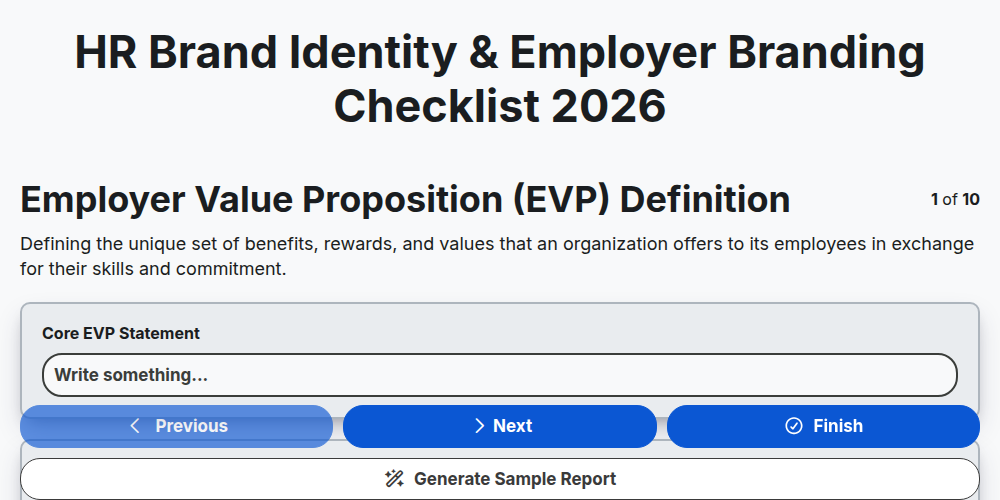
Table des matières
- Introduction: Why Employer Branding is Your Most Critical Asset in 2026
- Phase 1: Laying the Foundation - Employer Value Proposition (EVP) Definition
- Phase 2: Creating Visual Consistency - Visual Identity & Brand Alignment
- Phase 3: Optimizing Your Digital Storefront - Digital Presence & Career Page Audit
- Phase 4: Driving Inbound Talent - Candidate Attraction & Content Strategy
- Phase 5: Turning Employees into Ambassadors - Employee Advocacy Program Setup
- Phase 6: Auditing the User Journey - Candidate Experience Journey Mapping
- Phase 7: Amplifying Your Reach - Social Media & Recruitment Marketing Audit
- Phase 8: Protecting Your Image - Employer Brand Reputation Monitoring
- Phase 9: Bridging the Gap - Internal Brand Integration
- Phase 10: Measuring Success - KPIs & Brand Impact Measurement
- Conclusion: Future-Proofing Your Talent Strategy
- Resources & Links
TLDR: Future-proof your recruitment strategy with our comprehensive 2026 Employer Branding Checklist. Learn how to build a powerful talent magnet by refining your EVP, aligning visual identities, optimizing your digital presence, and leveraging employee advocacy to win the war for talent in an increasingly competitive landscape.
Introduction: Why Employer Branding is Your Most Critical Asset in 2026
In the rapidly evolving landscape of 2026, the war for talent has shifted. It is no longer enough to simply post an attractive job description and wait for applications. Today, top-tier talent-especially Gen Z and Gen Alpha-enters the job market as highly informed consumers of your corporate identity. They aren't just looking for a paycheck; they are looking for alignment in values, transparency in culture, and a digital presence that feels authentic.
The New Reality of Recruitment
The traditional recruitment model is dead. In an era defined by AI-driven sourcing, remote-first global workforces, and a heightened focus on DEI (Diversity, Equity, and Inclusion), your employer brand serves as your primary differentiator. If your internal culture and your external digital persona are out of sync, you aren't just losing candidates; you are actively damaging your market reputation.
Beyond the Logo: Branding as a Strategic Driver
Employer branding is often misunderstood as merely having a nice color palette or a catchy slogan. In reality, it is the holistic intersection of your HR Brand Identity (how you present your values and mission) and your Candidate Experience (how those values are felt during the hiring process).
A robust employer brand acts as a force multiplier for your HR team by:
- Reducing Cost-Per-Hire: Attracting organic, high-quality talent through a magnetic reputation.
- Increasing Retention: Aligning the right people with the right culture from day one.
- Building Trust: Creating a transparent glass box effect where your external promises match your internal reality.
How to Use This Checklist
The following checklist is designed to be your strategic roadmap for the upcoming year. It moves beyond the superficial, guiding you through deep-level structural shifts-from defining your core Employer Value Proposition (EVP) to implementing advanced KPI measurement frameworks.
Whether you are building an employer brand from scratch or auditing an existing identity to meet 2026's digital-first standards, use these steps to ensure your organization doesn't just compete for talent, but becomes the destination of choice.
Phase 1: Laying the Foundation - Employer Value Proposition (EVP) Definition
Defining Your Core: The Heart of Your Talent Magnet
Before you design a single social media graphic or update your careers page, you must define the why behind your organization. In the 2026 talent landscape, candidates are no longer just looking for a paycheck; they are looking for alignment in values, purpose, and culture. Your Employer Value Proposition (EVP) is the unique set of offerings, associations, and values that make your company the destination of choice for top-tier talent.
Without a clearly defined EVP, your employer branding efforts will lack consistency, leading to a fragmented identity that confuses potential applicants and fails to convert.
Identifying Your Unique Value Drivers
To build a robust EVP, you must look beyond generic perks like free coffee or flexible hours. You need to identify the intersection of what your company provides and what your ideal candidates crave. Start by analyzing:
- Compensation & Benefits: Beyond base salary, consider holistic wellness, mental health support, and long-term financial security.
- Career Growth & Development: How does your company foster upward mobility and continuous learning?
- Culture & Work Environment: Is your culture remote-first, collaborative, high-pressure, or mission-driven?
- Purpose & Impact: What real-world change does your work contribute to?
The Three-Pillar Research Approach
A successful EVP is not a top-down mandate from HR; it is a reflection of reality. To ensure authenticity, your definition process must involve three distinct perspectives:
- The Internal Reality (Employee Listening): Conduct surveys, focus groups, and stay interviews to understand why your current high-performers stay. What is the unspoken magic of your culture?
- The External Perception (Market Analysis): Audit how the talent market views you. Is there a gap between who you think you are and how the industry sees you?
- The Competitive Benchmarking: Analyze the EVPs of your direct competitors. Where can you differentiate? Where must you meet the industry standard to remain competitive?
Avoiding the Authenticity Gap
The most dangerous mistake in employer branding is promising an experience that your internal culture cannot deliver. In 2026, the authenticity gap-the space between your brand promise and the actual employee experience-is easily exposed via platforms like Glassdoor and LinkedIn.
Your goal in Phase 1 is to create a Truth-Based EVP: a promise that is aspirational enough to attract talent, yet grounded enough to be lived by every employee from Day 1.
Phase 2: Creating Visual Consistency - Visual Identity & Brand Alignment
Bringing the Brand to Life: Beyond Words and Values
Once you have defined your Employer Value Proposition (EVP), the next challenge is ensuring that your brand isn't just something people read, but something they recognize. In 2026, the distinction between a company's corporate brand and its employer brand must be seamless. Candidates are hyper-sensitive to brand dissonance-when a company's recruitment marketing promises a culture of innovation, but their visual assets look dated and stagnant.
To win the war for talent, your visual identity must act as a visual shorthand for your EVP.
Establishing a Unified Visual Language
Your employer brand should feel like a sibling to your corporate brand, not a stranger. While your corporate brand may focus on B2B stability or product excellence, your employer brand needs a visual layer that emphasizes people, culture, and purpose.
- Color Palette Consistency: Utilize your core brand colors but consider introducing secondary culture-centric palettes that evoke emotion (e.g., warmer tones for a community-focused culture or vibrant accents for a high-energy startup vibe).
- Typography and Tone: Ensure your recruitment communications use consistent typography. If your corporate brand is formal, your employer brand can be slightly more approachable, provided it maintains the same structural DNA.
- Iconography and Graphic Elements: Develop a set of custom icons or graphic motifs that can be used across job descriptions, LinkedIn banners, and onboarding decks to create a recognizable look and feel.
The Power of Authentic Imagery
In an era of AI-generated perfection, authenticity is your greatest competitive advantage. The stock photo trap is a significant risk to your brand credibility.
- Move Toward Realism: Replace generic, polished stock photos of people shaking hands with high-quality, candid photography of your actual team in their real working environments.
- Show, Don't Just Tell: If your EVP claims collaboration is our core, your visual assets must show real teams brainstorming, not isolated individuals staring at screens.
- Video as a Visual Anchor: In 2026, static images are no longer enough. Integrate short-form video assets-such as day in the life snippets-that use consistent filters, transitions, and framing to solidify your visual identity.
Auditing for Brand Alignment
Before moving to your digital presence, perform a quick alignment audit:
- The Consistency Check: Does a job post on LinkedIn feel like it belongs to the same company as your primary website?
- The Sentiment Check: Do your visuals evoke the emotions promised in your EVP?
- The Asset Inventory: Do you have a centralized Employer Brand Toolkit (logos, templates, approved imagery) available for recruiters and hiring managers to use?
Phase 3: Optimizing Your Digital Storefront - Digital Presence & Career Page Audit
Audit Your Digital Footprint: The Digital Presence & Career Page Audit
In 2026, your career site is no longer just a job board-it is your most powerful conversion tool. In an era of hyper-personalized candidate experiences, if your digital presence feels disconnected from your brand promise, top-tier talent will bounce before they even hit Apply.
To ensure your digital ecosystem is working for you rather than against you, use this audit checklist to evaluate your online visibility and usability.
1. The Career Page UX (User Experience) Audit
Your career page should feel like a seamless extension of your consumer brand, but with a recruitment-focused lens.
- Mobile-First Optimization: Does the page load instantly on mobile devices? In 2026, the majority of passive candidates are browsing via smartphones during micro-moments of downtime.
- Frictionless Application Flow: Count the number of clicks required to submit an application. If it exceeds three, you are losing talent. Are you offering One-Click application options (via LinkedIn or Google)?
- Information Hierarchy: Is your EVP (Employer Value Proposition) immediately visible above the fold? Candidates should understand why they should work for you within five seconds of landing on the page.
2. Content Relevance & Personalization
Generic descriptions are the enemy of conversion. Your digital presence must reflect the real-time reality of your company.
- Dynamic Job Descriptions: Move away from static, text-heavy lists. Are you using video snippets, team intros, or a day in the life elements within job postings?
- Diversity & Inclusion Visibility: Is your commitment to DEI visible through real imagery and data, or is it buried in a legal footer? Ensure your digital assets reflect a diverse workforce.
- Tech Stack Integration: Does your career page integrate smoothly with your ATS (Applicant Tracking System)? A broken link or a broken Apply button is a massive red flag for a candidate's perceived organizational competence.
3. The Searchability Check (SEO for Recruitment)
If talent can't find you, you don't exist. An audit must include how your brand appears in search engine results pages (SERPs).
- Keywords & Semantic Search: Are you optimizing your career pages for Human-centric keywords (e.g., Remote Software Engineer roles in [City] or Sustainable Tech Careers)?
- Schema Markup: Are you using structured data to ensure your job openings appear directly in Google for Jobs results?
- Consistency Check: Does the messaging on your LinkedIn Company Page, Glassdoor profile, and Career Site align perfectly? Discrepancies in tone or benefits descriptions create brand distrust.
Phase 4: Driving Inbound Talent - Candidate Attraction & Content Strategy
From Passive to Proactive: Building Your Content Engine
By 2026, the post and pray method of recruitment will be officially obsolete. In an era of AI-driven talent matching and hyper-saturated social feeds, your brand cannot simply exist; it must actively command attention. This phase of the checklist focuses on transitioning your employer brand from a static identity to a dynamic magnet that pulls high-quality candidates toward your organization.
Developing a Multi-Channel Content Strategy
To attract top-tier talent, you need a content ecosystem that speaks to different stages of the candidate journey. Your strategy should revolve around three core content pillars:
- Educational Content: Position your company as a thought leader by sharing insights into your industry, technological advancements, and professional development opportunities.
- Cultural Storytelling: Move beyond generic office photos. Use long-form articles, day-in-the-life videos, and deep dives into your company values to provide a window into your actual workplace reality.
- Transparency-Driven Content: Address the unspoken questions. Content regarding diversity initiatives, remote work policies, and career progression paths builds immediate trust with high-intent candidates.
Leveraging the Power of Short-Form Video and Micro-Moments
In 2026, attention spans are shorter than ever. Your content strategy must prioritize snackable media.
- Vertical Video Strategy: Utilize TikTok, Instagram Reels, and LinkedIn Video to showcase authentic, unpolished snippets of company culture.
- Employee Takeovers: Let your engineers, marketers, or designers run your social channels for a day. This authentic perspective carries more weight than any polished corporate advertisement.
Precision Targeting with Recruitment Marketing
Content is only effective if it reaches the right eyes. This step involves auditing how you distribute your brand story.
- Niche Community Engagement: Don't just broadcast on LinkedIn; identify where your specific talent pools hang out-whether it's specialized Discord servers, GitHub discussions, or industry-specific Slack communities.
- Paid Social Alignment: Ensure your paid recruitment campaigns are not just job ads, but brand experiences that lead back to your optimized career pages.
The Content Consistency Audit
Before moving to the next phase, ask yourself: Does the tone of our LinkedIn posts match the tone of our job descriptions? A disconnect between your creative marketing and your formal recruitment language creates brand friction, which can lead to candidate drop-off. Ensure your brand voice is unified, recognizable, and unmistakably yours across every digital touchpoint.
Phase 5: Turning Employees into Ambassadors - Employee Advocacy Program Setup
Scaling Authenticity Through Advocacy
By 2026, the era of corporate-only messaging is officially over. Modern candidates no longer trust polished, high-production brand videos as much as they trust the unfiltered perspectives of the people who actually work at your company. This phase of your checklist is about moving from a top-down communication model to a community-driven movement.
Building the Framework for Advocacy
Setting up an employee advocacy program isn't just about asking staff to share our LinkedIn posts. It requires a structured ecosystem that empowers your team to share their professional stories without feeling like unpaid marketing agents.
Your 2026 Checklist Items:
- Identify Your Internal Champions: Not every employee wants to be a creator. Identify those who are already naturally active on professional networks and provide them with the tools to amplify their reach.
- Provide Low-Friction Content Kits: Remove the barrier to entry. Create a repository of ready-to-share assets, including high-quality photography, pre-written captions (with room for personalization), and company news summaries.
- Develop a Share, Don't Just Post Guideline: Train your team on how to add value. Teach them how to pair company updates with their own professional insights, ensuring the content feels authentic rather than robotic.
- Implement an Incentive & Recognition Model: Reward participation through non-monetary means-such as featuring top advocates in company newsletters, providing professional development opportunities, or recognizing them in All-Hands meetings.
The Goal: The Humanized Employer Brand
The ultimate objective of this phase is to ensure that when a potential candidate searches for your company, they don't just see a sleek website-they see a living, breathing culture reflected through the eyes of your workforce. When your employees advocate for your brand, you aren't just recruiting; you are building a reputation of trust that no advertising budget can buy.
Phase 6: Auditing the User Journey - Candidate Experience Journey Mapping
Mapping the Path from First Impression to Final Offer
In 2026, a great employer brand is meaningless if the actual experience of interacting with your company is fragmented, slow, or confusing. Candidate Experience (CX) Journey Mapping is the process of stepping out of the recruiter's seat and into the shoes of a potential hire to identify every moment of truth where your brand promise meets reality.
To build a seamless recruitment engine, you must audit your talent pipeline through these four critical touchpoints:
1. The Discovery Phase: The First Contact Audit
Analyze how a candidate first encounters your brand. Is it through a LinkedIn ad, a Glassdoor review, or a referral?
- Check: Does the tone of your social media advertisements match the tone of your actual job descriptions?
- The Goal: Ensure brand consistency from the very first click.
2. The Application Phase: The Friction Test
The application process is often where the best talent is lost due to form fatigue.
- Check: Is your application mobile-responsive? Are you asking for redundant information (e.g., uploading a resume and then manually entering the same data)?
- The Goal: Minimize friction to prevent candidate drop-off.
3. The Assessment & Interview Phase: The Vibe Check
This is where your Employer Value Proposition (EVP) is tested. If you claim to be an innovative, fast-paced company, but your interview process is bogged down by weeks of silence and outdated manual scheduling, you are damaging your brand.
- Check: Are interviewers trained to act as brand ambassadors? Is the communication cadence consistent?
- The Goal: Align the interview reality with your stated company values.
4. The Decision & Onboarding Phase: The Handover
The journey doesn't end with an offer letter; it ends when the new hire is successfully integrated.
- Check: Does the excitement of the offer letter transition smoothly into a welcoming, organized Day 1?
- The Goal: Turn new hires into brand advocates from the moment they sign.
Pro-Tip for 2026: Use Mystery Shopping techniques. Periodically apply for your own open roles using a burner email to experience the automated communications and candidate portal firsthand. If the experience feels robotic or frustrating to you, it certainly will to your top-tier talent.
Phase 7: Amplifying Your Reach - Social Media & Recruitment Marketing Audit
Auditing Your Digital Footprint: Social Media & Recruitment Marketing
By 2026, the line between social media and recruitment has almost entirely disappeared. Candidates no longer just look at job boards; they consume your brand through short-form video, LinkedIn thought leadership, and even niche community forums. To ensure your employer brand isn't just visible, but persuasive, you must conduct a rigorous audit of your recruitment marketing ecosystem.
Evaluating Channel Relevance and Performance
A common mistake is attempting to be everywhere at once. This stage of the checklist is about precision, not volume.
- Platform Audit: Are you focusing your energy on the platforms where your target talent actually spends time? For Gen Z, this might mean a heavy emphasis on TikTok or Instagram; for executive leadership, it's LinkedIn.
- Content Consistency Check: Does the voice used in your recruitment ads match the voice found in your organic social posts? Discrepancies here create distrust and weaken your brand authority.
- Ad Spend Efficiency: Review your paid recruitment marketing campaigns. Are your sponsored posts driving high-quality traffic to your career site, or are they simply accumulating empty clicks that lead to high bounce rates?
Content Quality & Format Assessment
In 2026, static imagery is no longer enough. Your recruitment marketing must be dynamic and immersive.
- The Video Imperative: Audit your use of short-form video (Reels, Shorts, TikToks). Are you showcasing real employee stories, or is your content feeling overly polished and corporate?
- Employee-Led Content: Evaluate whether your marketing relies solely on company-run accounts or if you are empowering your team to share authentic behind-the-scenes glimpses.
- Message Resonance: Analyze your top-performing posts. Are they highlighting your EVP (Employer Value Proposition) effectively, or are they just announcing job openings? Great recruitment marketing sells the culture, not just the vacancy.
The Conversion Funnel Audit
Finally, look at the hand-off between your marketing and your recruitment process.
- Click-to-Apply Friction: Audit the journey from a social media ad to the actual application form. If a candidate clicks a beautiful Instagram story but hits a broken, non-mobile-friendly application portal, your marketing investment is wasted.
- Tracking and Attribution: Ensure you have the right UTM parameters and tracking pixels in place. You must be able to identify which specific social campaigns are producing your highest-quality hires to optimize your 2026 budget.
Phase 8: Protecting Your Image - Employer Brand Reputation Monitoring
Auditing the Feedback Loop: Reputation Management in the Digital Age
In 2026, your employer brand is no longer defined solely by what you say about your company, but by what your candidates and employees say when you aren't in the room. As talent becomes increasingly discerning, Reputation Monitoring acts as your brand's early warning system and your most vital tool for continuous improvement.
The Continuous Listening Strategy
Monitoring is not a one-time audit; it is a continuous loop of listening, analyzing, and responding. To maintain a competitive edge, your HR team must track sentiment across three critical layers:
- Public Review Platforms: Actively monitor sites like Glassdoor, Indeed, and specialized industry forums. In 2026, the speed of your response to a negative review is just as important as the review itself.
- Social Listening: Beyond official company channels, track mentions of your company culture and work environment on Reddit, LinkedIn, and niche professional communities.
- Internal Sentiment Analysis: Use pulse surveys and internal communication tools to catch cultural friction before it leaks into the public domain.
Turning Insights into Action
Data collection is useless without a roadmap for implementation. Use your monitoring findings to drive these three pillars of brand health:
- Crisis Mitigation: Develop a standardized protocol for addressing negative feedback. A transparent, empathetic, and solution-oriented response can actually strengthen trust with potential candidates.
- Gap Analysis: Compare your intended Employer Value Proposition (EVP) with the lived reality reported in reviews. If your brand promises radical flexibility but reviews mention micromanagement, you have identified a critical brand misalignment that requires immediate HR intervention.
- Success Story Amplification: Use positive sentiment as raw material for your content strategy. Highlighting authentic, positive employee experiences reinforces your brand's credibility and provides organic social proof.
The Goal: A Self-Sustaining Brand Ecosystem
The ultimate objective of reputation monitoring is to transition from reactive damage control to proactive brand cultivation. By closing the gap between perception and reality, you ensure that your employer brand remains resilient, authentic, and irresistible to top-tier talent.
Phase 9: Bridging the Gap - Internal Brand Integration
Bringing the Brand to Life: Making it Real for Your Current Team
An employer brand that only exists in your recruitment ads is nothing more than a hollow promise. In 2026, the divide between what we say (external brand) and what it's actually like (internal reality) is the number one killer of talent retention. If your employees don't live the values you promote on LinkedIn, your brand identity will collapse under the weight of negative Glassdoor reviews and high turnover.
Internal Brand Integration is the process of ensuring your Employee Value Proposition (EVP) is woven into the very fabric of your company culture.
Aligning Culture with Promise
To achieve true alignment, you must move beyond marketing jargon and look at the daily employee lifecycle. This involves:
- Values Activation: Translating abstract values (e.g., Innovation) into tangible behaviors that are recognized and rewarded during performance reviews.
- Leadership Modeling: Ensuring managers and executives act as the primary ambassadors of the brand identity. If your brand promises Work-Life Balance but leadership sends emails at midnight, the brand is broken.
- Onboarding Integration: The moment of truth occurs when a new hire joins. Your onboarding process should be a seamless extension of your external brand promise, reinforcing the culture from Day 1.
Internal Communication Strategies
Your internal communication channels should mirror the tone and visual identity of your external employer brand. Whether you use Slack, Microsoft Teams, or an internal intranet, the voice must be consistent.
The Feedback Loop: Closing the Circle
Integration is not a one-way street. It requires a continuous feedback loop where employee sentiment informs your external messaging. Use pulse surveys and stay interviews to ensure that the Brand Reality is evolving alongside your Brand Promise. When you successfully integrate the brand internally, your employees stop being just workers and start becoming your most powerful, organic marketing engine.
Phase 10: Measuring Success - KPIs & Brand Impact Measurement
Turning Data into Strategy: Measuring the ROI of Your Employer Brand
A brand is more than just a logo or a catchy slogan; it is a promise made to your current and future employees. To ensure your 2026 employer branding strategy is driving actual business value rather than just generating vanity metrics, you must implement a robust measurement framework.
In 2026, the distinction between a successful employer brand and a failed one lies in the ability to connect qualitative sentiment with quantitative data.
Establishing Your North Star Metrics
To evaluate the impact of your branding efforts, you must track a mix of top-of-funnel awareness and bottom-of-funnel conversion metrics. Focus on these three critical categories:
1. Recruitment Efficiency Metrics
- Cost-per-Hire (CPH): As your brand grows, your reliance on expensive third-party agencies should decrease. A strengthening brand should lead to a measurable drop in CPH.
- Time-to-Hire: A strong brand attracts ready-to-act candidates. Monitor if your talent pipeline is moving through the stages more fluidly.
- Source of Hire: Track the percentage of candidates coming from organic channels (career site, employee referrals, organic social) versus paid advertising.
2. Brand Awareness & Sentiment Metrics
- Career Site Traffic & Conversion Rate: Are visitors merely landing on your page, or are they clicking Apply Now? A high bounce rate on your career page is a sign of a brand-promise mismatch.
- Social Media Engagement Rate: Move beyond likes. Measure shares, comments, and meaningful interactions on your recruitment-focused content.
- Glassdoor/Indeed Sentiment Score: Monitor fluctuations in your company ratings and, more importantly, the sentiment of the qualitative reviews left by employees.
3. Retention & Internal Brand Health
- Employee Net Promoter Score (eNPS): This is the ultimate litmus test. Would your current employees recommend your company as a great place to work?
- Regrettable Turnover Rate: A strong employer brand should stabilize your core talent. An increase in turnover among high-performers often signals a disconnect between your external brand and internal reality.
The Continuous Feedback Loop
Measurement is not a year-end event; it is a continuous cycle. Use these KPIs to perform a quarterly Brand Gap Analysis. If your external marketing promises a culture of innovation but your internal eNPS shows frustration with bureaucracy, you have identified a critical Brand Gap that needs immediate tactical correction.
By treating your employer brand as a measurable product, you transform HR from a cost center into a strategic driver of organizational growth.
Conclusion: Future-Proofing Your Talent Strategy
Moving Beyond Recruitment to Brand Mastery
As we approach 2026, the distinction between a company that hires and an employer of choice has never been more profound. The checklist provided above is not merely a seasonal to-do list; it is a strategic blueprint for building a resilient, magnetic organizational identity.
In an era dominated by AI-driven recruitment and hyper-personalized candidate expectations, your employer brand is the only thing that cannot be automated. While algorithms can match skills to job descriptions, they cannot replicate the authentic human connection, the shared values, and the cultural resonance that a well-defined Employer Value Proposition (EVP) provides.
The Roadmap to Sustained Success
To successfully implement this checklist, remember that employer branding is an iterative cycle, not a one-time project. Success lies in the harmony between your internal reality and your external promise.
- Consistency is your greatest ally: Ensure that the promise made in your Candidate Attraction Strategy is the same reality experienced during Internal Brand Integration.
- Data-driven agility: Use your KPIs & Brand Impact Measurement to pivot. If your Candidate Experience Journey shows friction, use that data to refine your Visual Identity or Social Media Strategy.
- Empower your people: Your most powerful marketing tool isn't your career page-it is your employees. A robust Employee Advocacy Program turns your workforce into a global network of brand ambassadors.
Final Thought
The War for Talent in 2026 will not be won by the company with the largest advertising budget, but by the company with the most authentic, transparent, and employee-centric identity. By following these steps, you are doing more than just filling seats; you are building a legacy that attracts the innovators, the thinkers, and the leaders of tomorrow.
Start with one step, master it, and build your brand brick by brick.
Resources & Links
- SHRM (Society for Human Resource Management): The industry standard for HR professionals, providing research and best practices for talent acquisition and workplace culture.
- LinkedIn Talent Solutions: Essential platform for managing employer brand presence and executing recruitment marketing strategies.
- Glassdoor: Key resource for monitoring employer brand reputation and analyzing employee reviews and company ratings.
- Canva: A vital tool for HR teams to maintain visual consistency and create engaging brand assets for recruitment.
- HubSpot: Excellent resources for learning inbound marketing methodologies that can be applied to candidate attraction strategies.
- Indeed Hiring Lab: Provides deep insights into labor market trends and candidate behavior to help refine your EVP.
- Brandfolder: Digital asset management tools to help ensure brand alignment and visual consistency across all HR communications.
- Buffer: Useful for scheduling and managing social media presence to drive inbound talent through content strategy.
- Google Business Profile: Crucial for managing your local digital footprint and ensuring your employer brand appears correctly in search results.
- SurveyMonkey: A key tool for conducting internal brand audits and measuring employee sentiment for advocacy programs.
- Zendesk: Provides insights into customer journey mapping which can be adapted to auditing the candidate experience journey.
- Semrush: Useful for auditing your digital presence and understanding the search visibility of your career page.
- Sprout Social: Advanced social media listening tools for monitoring employer brand reputation and sentiment.
- Tableau: A powerful tool for visualizing KPIs and measuring the long-term impact of employer branding initiatives.
- Notion: An ideal workspace for documenting your brand guidelines and managing your employer branding checklist.
- Adweek: Great for staying updated on the latest trends in creative advertising and visual identity shifts.
- Forbes Human Resources Council: Provides high-level thought leadership on future-proofing talent strategies and navigating the war for talent.
Commentaires
Aucun commentaire n'a été publié pour le moment. Soyez le premier à en ajouter un !
Démonstration de la solution HRM - Gestion des ressources humaines
Simplifiez les processus RH et dynamisez votre équipe ! La solution HRM de ChecklistGiro rationalise l'intégration, la gestion de la performance et la conformité. Améliorez l'engagement des employés, réduisez la charge administrative et favorisez la croissance de l'organisation. Gérez tout cela grâce à notre plateforme Work OS.
Articles connexes
Independent Contractor Compliance Checklist Template for HR

HR's Guide to Workplace Safety: Your Compliance Checklist Template
The Ultimate Employee Exit Interview Checklist (HR Edition)
EEO Compliance Checklist Template for HR
The Ultimate HR Audit Checklist Template: Your Guide to Compliance

Paper vs ChecklistGuro in Human Resources Management

Your Guide to Employee Training Compliance: A Free Checklist for HR
Your Ultimate Employee Onboarding Checklist Template
Besoin d'aide avec les listes de contrôle?
Vous avez une question ? Nous sommes là pour vous aider. Veuillez soumettre votre demande et nous vous répondrons rapidement.