Mastering the Future of HR: The Ultimate 2026 HR Vendor Management & Procurement Checklist Template
Publié: 28.10.2026 Mis à jour: 29.10.2026
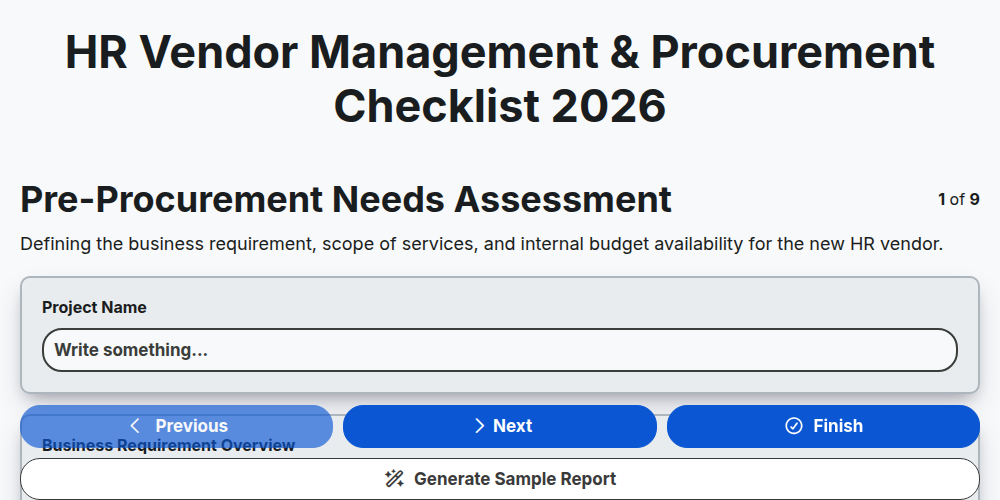
Table des matières
- Introduction: Navigating the Complex HR Tech Landscape in 2026
- Step 1: Pre-Procurement Needs Assessment - Defining Your Strategic Requirements
- Step 2: Vendor Identification & Sourcing - Finding the Right Partners in a Digital-First Era
- Step 3: Vendor Evaluation & Selection - Moving Beyond Feature Lists to Value-Driven Metrics
- Step 4: Compliance & Risk Due Diligence - Protecting Data Integrity and Regulatory Standing
- Step 5: Contract Negotiation & Legal Review - Securing Terms for Long-Term Success
- Step 6: Implementation & Integration Planning - Ensuring Seamless Tech Stack Synergy
- Step 7: Onboarding & Training - Maximizing User Adoption and ROI
- Step 8: Performance Monitoring & Audit - Continuous Evaluation of Service Level Agreements (SLAs)
- Step 9: Contract Renewal or Termination Protocol - Managing the End of the Lifecycle
- Conclusion: Building a Resilient HR Ecosystem for the Years Ahead
- Resources & Links
TLDR: Stay ahead of the curve in an evolving digital landscape with our comprehensive 2026 guide to HR vendor management. This checklist provides a step-by-step roadmap-from initial needs assessment and rigorous risk due diligence to seamless implementation and long-term performance auditing-ensuring your HR procurement process is efficient, compliant, and strategically aligned with future-ready business goals.
Introduction: Navigating the Complex HR Tech Landscape in 2026
As we move into 2026, the HR landscape is undergoing a seismic shift. The era of simple software-as-a-service is being replaced by an era of ecosystem integration. With the rapid maturation of Generative AI, the rise of hyper-personalized employee experiences, and increasingly stringent global data privacy regulations, the tools you choose today will define your organizational agility for years to come.
The New Era of HR Procurement
The complexity of the modern HR tech stack has never been higher. HR leaders are no longer just looking for a payroll provider or a Learning Management System (LMS); they are seeking integrated intelligence. Today's procurement process requires a delicate balance between pursuing cutting-edge innovation and maintaining rigorous operational stability.
In 2026, a single misstep in vendor selection-such as overlooking an AI ethics gap or failing to assess interoperability with your existing data lake-can lead to massive technical debt and compliance liabilities.
Why a Standardized Checklist is Your Best Defense
The stakes of vendor management have evolved beyond mere cost-saving. In an increasingly automated environment, your vendors are now extensions of your internal infrastructure. A flawed procurement process can result in:
- Data Silos: Fragmentation that prevents a single source of truth for people analytics.
- Compliance Vulnerabilities: Exposure to evolving global regulations like the EU AI Act.
- Integration Friction: Costly, manual workarounds that defeat the purpose of automation.
To mitigate these risks, HR professionals need more than just intuition; they need a repeatable, scalable, and rigorous framework. This checklist is designed to guide you through every stage of the vendor lifecycle-from the initial spark of a need to the final contract renewal-ensuring that your HR ecosystem remains robust, compliant, and future-ready.
Step 1: Pre-Procurement Needs Assessment - Defining Your Strategic Requirements
Setting the Foundation for Success
Before you begin browsing a marketplace of endless software solutions or service providers, you must first look inward. In the rapidly evolving HR landscape of 2026, the most common mistake is rushing into a procurement cycle based on trendiness rather than utility. A successful procurement journey begins with a deep understanding of your organization's specific gaps and future ambitions.
Identifying the Why Behind the Procurement
The first step is to move beyond simply identifying a problem and instead define the strategic objective. Are you seeking to automate manual workflows, enhance your employee experience, or bolster your data security posture?
Ask your stakeholders:
- What specific pain points are we solving? (e.g., high turnover, inefficient payroll, lack of diversity metrics).
- What are the desired outcomes? (e.g., a 15% reduction in time-to-hire or 100% compliance with new labor regulations).
- How does this align with our 2026-2027 business goals?
Defining Functional and Technical Requirements
Once the why is established, you must translate vague desires into concrete specifications. This involves gathering input from both HR practitioners and IT leaders to create a dual-layered requirement list:
- Functional Requirements: These are the must-have features for the HR team. If you are procuring an ATS, do you need AI-driven candidate matching? If it's a benefits platform, does it need to support decentralized, remote-first workforces?
- Technical Requirements: These are the must-have capabilities for your IT and Security teams. This includes API compatibility, SSO (Single Sign-On) capabilities, data residency requirements, and compatibility with your existing tech stack (e.g., ERP or HCM systems).
Budgeting and Resource Allocation
A needs assessment is incomplete without a reality check on resources. Determine your total cost of ownership (TCO), which includes not just the initial subscription or licensing fee, but also:
- Implementation and integration costs.
- Internal labor hours required for the project.
- Ongoing maintenance and training expenses.
- Potential hidden costs like data migration or premium support tiers.
Establishing the Procurement Timeline
Finally, define your window of opportunity. When is the go-live date? Working backward from your target implementation date will help you set realistic milestones for the subsequent stages of identification, evaluation, and legal review. By the end of this phase, you should have a formal Requirement Traceability Matrix (RTM) that will serve as your scoring rubric during the vendor selection process.
Step 2: Vendor Identification & Sourcing - Finding the Right Partners in a Digital-First Era
In 2026, sourcing is no longer just about finding a service provider; it is about identifying a strategic partner capable of integrating seamlessly into your automated ecosystem. As AI-driven ecosystems and decentralized workforces become the norm, your sourcing strategy must shift from reactive searching to proactive ecosystem mapping.
Expanding Your Search Horizon
The traditional request for quote approach is outdated. To build a resilient HR tech stack, you must look beyond standard industry leaders and explore specialized niche providers that offer high levels of interoperability.
- Leveraging AI-Powered Market Intelligence: Utilize AI sourcing tools to scan the global market for emerging HR tech startups. These tools can analyze patent filings, software reviews, and integration capabilities to identify vendors that are ahead of the curve in automation and predictive analytics.
- The Rise of Niche Ecosystems: Don't just look for all-in-one giants. In 2026, the most efficient HR departments often use a best-of-breed approach, sourcing specialized vendors for hyper-specific needs like neurodiversity support, AI-driven skill gap analysis, or carbon footprint tracking for remote work.
Defining the Sourcing Channels
To ensure a diverse and high-quality vendor pool, utilize a multi-channel sourcing strategy:
- Industry Ecosystem Maps: Analyze which vendors are already part of your existing software stack (e.g., your Payroll or LMS provider) to find compatible add-ons.
- Peer Networks & User Communities: Engage with HR professional communities to gain boots-on-the-ground insights into vendor reliability and real-world performance.
- Automated RFP (Request for Proposal) Distribution: Use automated platforms to distribute your requirements to a pre-vetted list of global suppliers, ensuring you receive standardized, comparable responses.
The 2026 Sourcing Criteria
When scouting for new partners, your initial screening should prioritize three emerging pillars:
1. API-First Architecture
In a digital-first era, a vendor is only as good as its ability to talk to your other tools. If a vendor lacks a robust, documented API or a standardized integration framework, they will create data silos that increase manual workload.
2. Scalability & Elasticity
As your organization grows or undergoes structural shifts (such as rapid expansion into new geographic territories), your vendors must be able to scale their service levels and compliance capabilities instantaneously without a total contract renegotiation.
3. ESG & Ethical AI Alignment
Sourcing in 2026 requires looking at the vendor's ethical footprint. Does the vendor use ethically sourced data to train their AI models? Do they demonstrate a commitment to sustainability? These factors are now critical to your company's overall ESG (Environmental, Social, and Governance) reporting.
Step 3: Vendor Evaluation & Selection - Moving Beyond Feature Lists to Value-Driven Metrics
In 2026, the feature war is officially over. With the explosion of generative AI and hyper-automation, almost every HR tech vendor can claim to offer smart automation and predictive analytics. If your evaluation process is still limited to checking boxes on a functional requirement spreadsheet, you are likely selecting for noise rather than value.
To stay competitive, your selection process must shift from functional capability to strategic compatibility.
Beyond the Feature List: The Three Pillars of Modern Selection
To ensure a vendor doesn't just work, but actually scales with your 2026 workforce strategy, evaluate candidates across these three critical dimensions:
1. Interoperability and Ecosystem Fit
In a fragmented tech landscape, a standalone tool is a liability. A vendor might have a brilliant standalone module, but if it cannot communicate via robust, real-time APIs with your existing HCM, payroll, or LMS, you are simply creating a new data silo.
- The Test: Ask for specific documentation on their API capabilities and their history of seamless integration with your current tech stack.
2. Data Intelligence and AI Integrity
As HR moves toward predictive workforce planning, the quality of a vendor's underlying logic is paramount. You are no longer just buying a dashboard; you are buying an engine of insight.
- The Test: Evaluate the Black Box. How does their AI reach its conclusions? Is the model trained on diverse datasets to prevent algorithmic bias? Can the insights be exported into your broader business intelligence tools?
3. Total Cost of Ownership (TCO) vs. Sticker Price
The initial subscription fee is often the least significant part of a vendor's long-term cost. In 2026, hidden costs like implementation fees, mandatory premium support tiers, data storage overages, and integration maintenance can bloat a budget by 40% within two years.
- The Test: Require a 36-month TCO projection that includes implementation, training, and anticipated scaling costs.
The Value-Driven Scoring Framework
Instead of a simple Yes/No checklist, implement a Weighted Scoring Model. Assign weights to your priorities based on your current HR roadmap. For example:
| Evaluation Criteria | Weight | Scoring (1-10) | Weighted Score |
|---|---|---|---|
| Strategic Alignment (Does it solve our 202-year goals?) | 35% | ||
| Technical Scalability (Can it handle our 2028 headcount?) | 25% | ||
| User Experience (UX/UI) (Will employees actually use it?) | 20% | ||
| Security & Compliance (Does it meet our global standards?) | 20% |
Pro-Tip for 2026: The Sandbox Requirement
Never finalize a selection based solely on a pre-recorded demo. Insist on a Proof of Concept (PoC) or a Sandbox environment using a subset of anonymized data. Seeing how the vendor handles your specific workflows and edge cases is the only way to validate the claims made during the sales cycle.
Step 4: Compliance & Risk Due Diligence - Protecting Data Integrity and Regulatory Standing
Securing the Ecosystem: Beyond the Surface Level
In the 2026 landscape, compliance is no longer a check-the-box activity; it is a strategic imperative. As HR departments increasingly rely on interconnected SaaS ecosystems and AI-driven tools, the surface area for potential data breaches and regulatory non-compliance has expanded exponentially.
During this stage of the procurement process, your goal is to move beyond reviewing a vendor's marketing promises and dive deep into their operational security and legal adherence.
The 2026 Compliance Audit Framework
To ensure your organization remains protected against the evolving landscape of global privacy laws (such as updated GDPR, CCPA, and emerging AI-specific regulations), your due diligence must cover these four critical pillars:
1. Data Privacy and Sovereignty
With the rise of decentralized workforces, knowing where data lives is paramount.
- Data Residency: Verify exactly which geographic regions your data will be stored in.
- Encryption Standards: Confirm that data is encrypted both at rest and in transit using industry-leading protocols.
- Privacy Impact Assessments (PIA): Require vendors to provide documentation on how they handle PII (Personally Identifiable Information) and their protocols for data anonymization.
2. AI Governance and Algorithmic Accountability
As HR tech becomes more autonomous, you must audit the black box.
- Bias Mitigation: Ask for documentation regarding how the vendor tests their algorithms for algorithmic bias to ensure compliance with emerging anti-discrimination laws.
- Explainability: Can the vendor explain how their AI reaches a specific decision (e.g., in candidate screening or performance scoring)?
- Model Transparency: Ensure the vendor has a clear policy on how much human oversight is integrated into their automated processes.
3. Cybersecurity Resilience
A vendor's weakness is your vulnerability. You must validate their technical defenses through:
- Third-Party Audits: Request recent SOC 2 Type II reports, ISO 27001 certifications, or equivalent independent security audits.
- Incident Response Plans: Evaluate their documented procedure for notifying your organization in the event of a breach. How quickly can they communicate?
- Vulnerability Management: Inquire about their regular penetration testing schedules and patch management lifecycles.
4. Regulatory and Legal Alignment
Ensure the vendor's operational model aligns with your industry-specific legal requirements.
- SDLC and Accessibility: For tools used by all employees, ensure compliance with WCAG 2.2 (or the latest standard) to prevent accessibility litigation.
- Financial Stability: Perform a high-level check of the vendor's financial health to ensure they won't undergo sudden insolvency, which could leave your critical HR processes stranded.
- Insurance Coverage: Verify that the vendor carries adequate Professional Liability and Cyber Liability insurance to cover potential damages.
Pro-Tip for 2026: Don't just collect certificates; ask for the Evidence of Implementation. A certificate shows they have a policy, but a recent audit report proves they are actually following it.
Step 5: Contract Negotiation & Legal Review - Securing Terms for Long-Term Success
By the time you reach the fifth stage of the procurement lifecycle, the honeymoon phase of vendor identification is over. Now, it is time to move from excitement to scrutiny. In the 2026 landscape-where data privacy laws are increasingly stringent and AI-driven automation is standard-this stage is where you protect your organization from unforeseen liabilities.
The goal of this phase is not just to agree on a price, but to ensure that every operational, technical, and legal contingency is accounted for before a single signature is applied.
Key Focus Areas for 2026 Negotiations
1. Data Privacy and AI Governance
In 2026, a standard privacy clause is no longer sufficient. As HR departments leverage more predictive analytics and automated decision-making tools, your contract must explicitly address:
- Algorithmic Transparency: If the vendor uses AI, do you have the right to audit the logic used in candidate screening or performance scoring?
- Data Sovereignty: Where exactly is the employee data being stored, and how does the vendor comply with evolving regional regulations (e.g., updated GDPR, CCPA, or local equivalents)?
- Data Breach Accountability: Define specific notification windows (e.g., within 24 hours) and clear-cut protocols for incident response.
2. Service Level Agreements (SLAs) with Teeth
A contract is only as good as its enforcement mechanism. Move beyond vague promises of high availability and define measurable benchmarks:
- Uptime and Latency: For critical HRIS or payroll platforms, what is the penalty for downtime during peak processing periods?
- Support Responsiveness: Define tiered response times based on the severity of the issue (e.g., P1 critical issues vs. P4 minor queries).
- Service Credits: Ensure there are clear financial repercussions or credits applied to your account if the vendor fails to meet agreed-upon KPIs.
3. The Exit Strategy Clause
One of the most overlooked aspects of procurement is planning for the end of the relationship. Avoid vendor lock-in by negotiating:
- Data Portability: Ensure the vendor is contractually obligated to return your data in a structured, machine-readable format upon termination.
- Transition Support: Define the level of assistance the vendor must provide during the hand-off to a new provider to ensure business continuity.
Legal Review: The Final Safeguard
Once the commercial terms are settled, the legal review serves as the final filter. Work closely with your legal counsel to ensure that the Master Service Agreement (MSA), Statement of Work (SOW), and Data Processing Agreement (DPA) are perfectly aligned.
Discrepancies between the sales promises made during the Vendor Evaluation stage and the actual legal fine print are where most HR projects fail. Ensure that every feature promised in the demo is reflected in the functional requirements of the SOW.
Step 6: Implementation & Integration Planning - Ensuring Seamless Tech Stack Synergy
Bridging the Gap Between Procurement and Operations
Once the contract is signed, the real work begins. The most common pitfall in HR procurement is treating the end of the deal as the beginning of the process. In the 2026 landscape, where AI-driven ecosystems and interconnected data layers are the standard, a failed implementation can lead to fragmented data silos and significant operational downtime.
Implementation planning is your roadmap to ensuring that your new vendor doesn't just exist in your budget, but actively enhances your HR tech stack.
Defining the Implementation Roadmap
Before any software is deployed or services are rendered, you must establish a clear timeline with defined milestones. This phase should include:
- Project Governance: Designating an internal Project Manager and a cross-functional steering committee (IT, HR, Finance, and Legal) to oversee the rollout.
- The Transition Timeline: Mapping out the Go-Live date and identifying critical path dependencies-tasks that must be completed before others can begin.
- Resource Allocation: Ensuring your HR team has the bandwidth to manage the migration without neglecting daily operations.
Achieving Technical Interoperability
In 2026, a standalone tool is a liability. Your new vendor must talk to your existing ecosystem. Your integration plan must prioritize:
- API & Data Mapping: Auditing how data will flow between the new vendor and your core HRIS (Human Resources Information System), Payroll, and LMS (Learning Management System).
- Data Migration Strategy: Developing a rigorous plan for extracting, cleaning, and importing legacy data to ensure accuracy and prevent garbage in, garbage out scenarios.
- Security & Permission Alignment: Working with IT to ensure that user access controls and Single Sign-On (SSO) protocols are seamlessly integrated with your existing cybersecurity framework.
Risk Mitigation During Rollout
The Integration Gap is where most productivity losses occur. To mitigate this, your checklist must include a UAT (User Acceptance Testing) phase. Before a full-scale launch, run a pilot program with a small, diverse group of super users to identify bugs, workflow friction, or UI/UX hurdles. By identifying these friction points in a controlled environment, you prevent costly large-scale disruptions.
Step 7: Onboarding & Training - Maximizing User Adoption and ROI
The true value of a new HR tool or service isn't realized at the moment of signing the contract; it is realized when your team actually uses it to drive business outcomes. In 2026, where the HR tech stack is more integrated and complex than ever, a plug-and-play mentality is a recipe for failure.
To ensure you capture the full ROI of your procurement efforts, your onboarding strategy must move beyond mere technical setup and focus on deep organizational integration.
Bridging the Gap Between Deployment and Adoption
Effective onboarding is the bridge between a functional software installation and a transformed HR process. To avoid the common pitfall of shelfware-expensive software that sits unused-your onboarding phase should focus on three critical pillars:
1. Technical Integration & Data Migration
Before users can interact with the tool, the backend must be seamless. This involves:
- Data Integrity Audits: Ensuring that legacy data migrated from old systems is clean, mapped correctly, and compliant with updated 2026 privacy standards.
- System Interoperability: Verifying that the new vendor's API or middleware is communicating correctly with your existing HCM, Payroll, and ERP ecosystems.
- Security Configuration: Finalizing Single Sign-On (SSO) protocols and multi-factor authentication (MFA) to ensure the deployment adheres to your IT security roadmap.
2. Structured User Training Programs
A one-size-fits-all webinar is no longer sufficient. Modern onboarding requires a segmented approach to training:
- The Admin Layer: Deep-dive technical training for HR Operations and IT specialists who will manage the backend, permissions, and configuration.
- The Manager Layer: Focused training for people leaders on how to leverage the tool for performance management, approvals, and team insights.
- The Employee Layer: High-level, intuitive training (often via micro-learning or in-app prompts) centered on self-service capabilities and user experience.
3. The Change Management Framework
The most significant barrier to new vendor success is often cultural, not technical. To drive adoption, you must manage the human side of the procurement:
- Communication Cascades: Pre-launch announcements that explain the why behind the change-highlighting how this new tool reduces manual workload or improves the employee experience.
- Super-User Networks: Identifying HR Champions within different departments who are trained early and can act as first-line support and advocates for their peers.
- Feedback Loops: Establishing a formal channel for users to report friction points during the first 90 days, allowing for rapid iterative adjustments to workflows.
Defining Success in the First 90 Days
Don't wait for the annual audit to see if the vendor is working. Set specific Adoption KPIs to monitor immediately following onboarding, such as:
- Login Frequency: Percentage of the workforce actively accessing the platform.
- Task Completion Rates: The speed and accuracy of core processes (e.g., time-off requests, onboarding tasks) within the new system.
- Support Ticket Volume: Monitoring if technical hurdles are decreasing over time, signaling a successful learning curve.
Step 8: Performance Monitoring & Audit - Continuous Evaluation of Service Level Agreements (SLAs)
Ensuring Long-Term Value Through Continuous Oversight
Securing a contract is only the beginning of the relationship. In the 2026 HR landscape-where automation, AI-driven decision-making, and real-time data are standard-a set it and forget it mentality is a significant business risk. To ensure your HR vendors continue to deliver the promised ROI, you must transition from implementation to rigorous, ongoing oversight.
Tracking Performance Against KPIs and SLAs
The foundation of effective monitoring lies in the measurable metrics established during the negotiation phase. Your audit process should focus on comparing actual vendor output against the defined Service Level Agreements (SLAs).
Key areas to monitor include:
- Uptime and System Reliability: For SaaS providers, is the platform meeting its 99.9% availability guarantee?
- Response and Resolution Times: For managed services, are support tickets being addressed within the agreed-upon windows?
- Data Accuracy and Integrity: Is the vendor's reporting consistent with your internal HRIS data?
- Compliance Adherence: Are security patches being applied, and is the vendor maintaining updated GDPR, CCPA, or industry-specific certifications?
The Role of Periodic Audits
While monthly KPI reviews catch operational hiccups, periodic deep-dive audits are essential to identify systemic issues. In 2026, these audits should not be limited to financial reconciliations; they must include security and data privacy audits to ensure the vendor's evolving tech stack hasn't introduced new vulnerabilities to your employee data.
Implementing a Feedback Loop
Effective vendor management is a two-way street. Establish a formal cadence for:
- Quarterly Business Reviews (QBRs): Meet with account managers to discuss not just what went wrong, but how the vendor can support your upcoming 2026-2027 strategic goals.
- Internal Stakeholder Surveys: Regularly poll your HR team (the end-users) to gauge usability, support quality, and feature effectiveness.
By treating performance monitoring as a continuous loop of assessment and adjustment, you transform vendor management from a reactive administrative task into a proactive strategic advantage.
Step 9: Contract Renewal or Termination Protocol - Managing the End of the Lifecycle
Ensuring Continuity and Strategic Exit Strategies
The final stage of the vendor management lifecycle is often the most overlooked, yet it is critical for maintaining organizational agility. In the rapidly evolving landscape of 2026, a contract should never be viewed as a set it and forget it agreement. Establishing a formal protocol for renewal or termination ensures that your HR technology stack remains modern, cost-effective, and aligned with your shifting workforce needs.
The Renewal Decision Framework
Before a contract reaches its expiration date, initiate a formal review process at least six months in advance. This period allows you to evaluate whether the current vendor still meets your evolving compliance, security, and functional requirements.
- Performance Audit Review: Analyze the data collected during the Performance Monitoring & Audit phase. Has the vendor met their SLAs (Service Level Agreements)?
- ROI Re-assessment: Calculate the total cost of ownership (TCO) against the value delivered. Are there newer, more efficient tools on the market that offer better integration capabilities?
- Internal Stakeholder Feedback: Gather input from the end-users (HR managers, IT, and employees) to identify any friction points in the current tool's usability.
Establishing a Termination Protocol
A professional exit strategy is just as important as a robust onboarding plan. In an era of heightened data privacy regulations, leaving a vendor requires a structured approach to mitigate operational and security risks.
- Data Portability and Extraction: Ensure your contract includes clear clauses regarding data ownership. You must have a documented plan for extracting all historical employee data, logs, and configurations in a usable, non-proprietary format.
- Data Destruction Verification: Upon termination, require a formal Certificate of Destruction from the vendor to ensure that all sensitive PII (Personally Identifiable Information) has been purged from their servers, meeting 2026 global compliance standards.
- Knowledge Transfer & Transition: If transitioning to a new provider, map out the hand-off period to prevent gaps in critical HR services, such as payroll processing or benefits administration.
- Service Discontinuation Checklist: Systematically revoke vendor access to internal networks, API integrations, and single sign-on (SSO) credentials to close any potential security loopholes.
By treating the end of the contract lifecycle as a strategic decision point rather than a mere administrative task, HR leaders can prevent vendor bloat and ensure their HR ecosystem remains lean, secure, and future-ready.
Conclusion: Building a Resilient HR Ecosystem for the Years Ahead
As we move toward 2026, the role of HR is shifting from traditional administrative oversight to strategic orchestration. The vendors you choose are no longer just service providers-they are integrated components of your digital ecosystem. A single failure in a payroll platform, an LMS, or a recruitment tool can disrupt your entire employee experience and compromise your company's data integrity.
The Strategic Advantage of Rigorous Procurement
Adopting this checklist is not about adding bureaucracy to your workflow; it is about building a defensive perimeter around your organization's most valuable asset: its people. By implementing a structured approach to pre-procurement assessments and rigorous risk due diligence, you transition from a reactive state of fixing broken tools to a proactive state of optimizing human capital.
Moving Beyond the Transactional
In the coming years, the most successful HR leaders will be those who view vendor management as a continuous lifecycle rather than a one-time event.
- Agility through Auditing: Regular performance monitoring ensures that your tech stack evolves alongside your workforce.
- Security as a Foundation: In an era of increasing cyber threats, your compliance and legal review processes are your primary line of defense.
- Seamless Integration: Successful implementation and onboarding planning ensure that new tools drive immediate productivity rather than causing friction.
Final Thought for HR Leaders
The complexity of the modern workplace demands a sophisticated approach to procurement. Use this checklist as your blueprint to ensure that every partnership you enter is scalable, secure, and strategically aligned with your long-term vision. As the landscape of work continues to transform, your ability to manage your vendor ecosystem with precision will be the ultimate differentiator in your organization's success.
Resources & Links
- SHRM (Society for Human Resource Management): The industry standard for HR professionals, providing critical updates on labor laws, compliance, and global HR trends.
- Gartner: Global research and advisory services providing deep insights into HR technology trends and procurement strategic frameworks.
- Forbes Business Council: Excellent for high-level perspectives on digital transformation and the future of workplace technology integration.
- McKinsey & Company: Strategic insights into organizational design and how automation is reshaping the HR value chain.
- Gartner IT Research: Essential for understanding the technical interoperability and API standards required for modern HR tech stacks.
- TechProcurement Insights: Resources focused on the nuances of software procurement, vendor selection, and SaaS management.
- ISO (International Organization for Standardization): The definitive source for information on data security standards (like ISO/IEC 27001) crucial for Step 4 compliance.
- ISACA: Specialized resources for IT governance, risk management, and auditing software vendors.
- ZDNet: Up-to-the-minute news on enterprise technology, cloud computing, and AI-driven software updates.
- Harvard Business Review: Thought leadership on managing vendor relationships and negotiating long-term strategic partnerships.
- Compliance Week: Detailed insights into regulatory landscapes, GDPR, and managing third-party risk in the supply chain.
- Atlassian: Useful for frameworks on project management and implementation workflows (Step 6).
- Salesforce (Trailhead): Learning resources for understanding how CRM and HR data integration impacts the wider enterprise ecosystem.
- Forrester Research: Market research and 'The Forrester Wave' reports which are vital for vendor identification and sourcing.
- Gartner Peer Insights: User-driven reviews of HR software to move beyond feature lists to real-world value metrics.
- PwC: Consulting insights on digital workforce transformation and the ROI of HR technology investments.
- EY (Ernst & Young): Focus on digital trust, cybersecurity, and managing the risks of vendor-driven data breaches.
Commentaires
Aucun commentaire n'a été publié pour le moment. Soyez le premier à en ajouter un !
Démonstration de la solution HRM - Gestion des ressources humaines
Simplifiez les processus RH et dynamisez votre équipe ! La solution HRM de ChecklistGiro rationalise l'intégration, la gestion de la performance et la conformité. Améliorez l'engagement des employés, réduisez la charge administrative et favorisez la croissance de l'organisation. Gérez tout cela grâce à notre plateforme Work OS.
Articles connexes
Independent Contractor Compliance Checklist Template for HR

HR's Guide to Workplace Safety: Your Compliance Checklist Template
The Ultimate Employee Exit Interview Checklist (HR Edition)
EEO Compliance Checklist Template for HR
The Ultimate HR Audit Checklist Template: Your Guide to Compliance

Paper vs ChecklistGuro in Human Resources Management

Your Guide to Employee Training Compliance: A Free Checklist for HR
Your Ultimate Employee Onboarding Checklist Template
Besoin d'aide avec les listes de contrôle?
Vous avez une question ? Nous sommes là pour vous aider. Veuillez soumettre votre demande et nous vous répondrons rapidement.