Optimized Production Order Management Workflow
Publié: 30/03/2026 Mis à jour: 31/03/2026
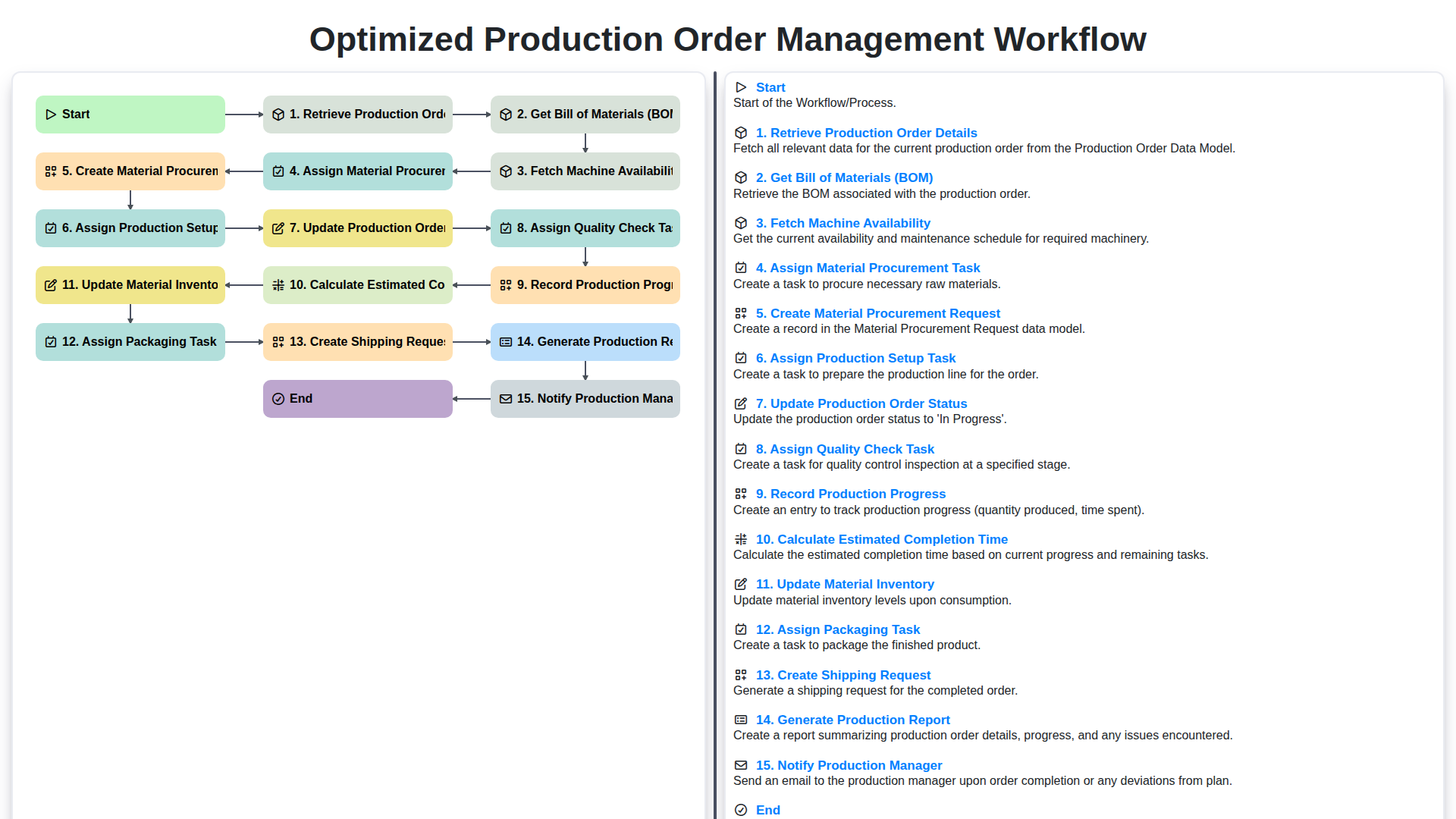
Table des matières
- Introduction: Why Optimize Your Production Order Management?
- Understanding the Current Production Order Landscape
- 1. Retrieve Production Order Details
- 2. Getting the Bill of Materials (BOM)
- 3. Assessing Machine Availability
- 4. Material Procurement: Assigning and Creating Requests
- 5. Production Setup: Preparing for Success
- 6. Tracking Progress and Estimating Completion
- 7. Inventory Management: Updating Material Levels
- 8. Packaging and Shipping: Getting Products Out the Door
- 9. Generating Comprehensive Production Reports
- 10. Keeping Stakeholders Informed: Notifications and Visibility
- Benefits of an Optimized Workflow
- Resources & Links
TLDR: Streamline your production process with this workflow! It covers everything from order details and material procurement to quality checks, packaging, and shipping - all while keeping your production manager in the loop and giving you a clear timeline for completion. Say goodbye to bottlenecks and hello to efficient production!
Introduction: Why Optimize Your Production Order Management?
In today's competitive manufacturing landscape, efficiency isn't just a goal-it's a necessity. A disjointed, manual production order management process can lead to costly delays, material shortages, quality issues, and ultimately, dissatisfied customers. Many manufacturers still rely on spreadsheets, email chains, and siloed systems, leading to bottlenecks and a lack of real-time visibility.
Optimizing your production order management workflow isn't just about streamlining tasks; it's about creating a responsive, agile manufacturing operation. A well-defined workflow minimizes errors, improves communication across teams, maximizes resource utilization, and ultimately drives profitability. This article dives into a streamlined workflow, demonstrating how each step contributes to a more efficient and profitable production process, helping you to transform your manufacturing operations from reactive to proactive. We'll explore a step-by-step approach to order management, designed to minimize bottlenecks and maximize output.
Understanding the Current Production Order Landscape
Many manufacturing businesses still rely on disjointed processes for managing production orders - a frustrating mix of spreadsheets, emails, and disparate software systems. This often leads to bottlenecks, delays, and a lack of real-time visibility. Imagine a scenario where a production order is approved, but the bill of materials isn't immediately accessible, leading to a delay in material procurement. Or consider the challenge of scheduling production when machine availability isn't accurately known, potentially disrupting the entire schedule. These inefficiencies can significantly impact delivery times, increase operational costs, and ultimately, affect customer satisfaction. A fragmented approach to production order management often masks underlying issues, making it difficult to identify areas for improvement and hindering the ability to proactively address potential problems. Ultimately, a lack of a streamlined workflow translates to lost time, increased costs, and reduced overall productivity.
1. Retrieve Production Order Details
The journey of any production order begins with a clear understanding of what needs to be produced and why. This initial step, retrieving production order details, is crucial for setting the stage for a smooth and efficient workflow. We pull information from the production order itself - details like the order number, customer requirements, quantity, due date, and any specific instructions or specifications. This data forms the foundation for all subsequent steps, ensuring everyone involved has a shared understanding of the task at hand. Inaccurate or missing information at this stage can create bottlenecks and errors down the line, so meticulous data capture is paramount. This often involves integration with order management systems and potentially manual verification depending on the complexity of the order.
2. Getting the Bill of Materials (BOM)
Once we've retrieved the production order details, the next critical step is to obtain the Bill of Materials (BOM). The BOM is the recipe for your product - it meticulously lists all the raw materials, components, and quantities required to manufacture one unit of the finished good. Without a precise and readily accessible BOM, production will be severely hampered, leading to delays, errors, and potential waste.
Our workflow automatically fetches the relevant BOM from our central database based on the production order's specified product. This eliminates manual searching and potential for human error associated with outdated or incorrect BOMs. The system not only provides a comprehensive list but also details any specific lot numbers, supplier information, or quality specifications associated with each component.
This automated BOM retrieval ensures that the production team has all the necessary information upfront, allowing them to accurately plan material procurement and avoid costly misunderstandings down the line. The system also flags any BOM revisions or updates, guaranteeing the production process aligns with the latest approved design.
3. Assessing Machine Availability
A critical bottleneck in any production order is machine downtime. Before assigning tasks and committing to a timeline, understanding machine availability is paramount. This isn't simply about knowing if a machine can run; it's about knowing its reliable operational capacity.
Our workflow includes a dedicated step to fetch machine availability data. This data typically encompasses:
- Scheduled Maintenance: Planned downtime for preventative maintenance, ensuring long-term machine health.
- Historical Performance: Analyzing past performance to identify recurring issues and predict potential downtime. Consider factors like Mean Time Between Failures (MTBF) and Mean Time To Repair (MTTR).
- Current Workload: Existing production orders already scheduled for specific machines significantly impact available time.
- Operator Availability: Even with a capable machine, a shortage of trained operators can create delays.
We leverage real-time data feeds from machine sensors (where available) and integrate with maintenance scheduling systems. This allows us to dynamically adjust production schedules and proactively address potential conflicts. Ignoring machine availability can lead to missed deadlines, increased costs due to expedited material orders, and frustrated production teams. Accurate assessment here is a foundational element for a smoothly running production order.
4. Material Procurement: Assigning and Creating Requests
Securing the necessary materials is critical to keeping your production orders on track. This phase of our optimized workflow focuses on ensuring timely material acquisition.
First, a Material Procurement Task is automatically assigned to a designated procurement specialist. This specialist reviews the detailed requirements outlined in the Production Order Details (obtained in the first step) and cross-references them with current inventory levels. Any shortfall is immediately flagged.
Next, a Material Procurement Request is created. This isn't a simple request; it's a structured document including:
- Specific Materials Needed: Clearly identifies each component and its quantity.
- Vendor Information: Pre-populated with preferred vendor details (based on historical performance and pricing agreements).
- Delivery Date Requirements: Aligned with the production schedule and factoring in lead times.
- Budgetary Approvals: Automatically routed for approval based on pre-defined spending limits.
This formalized request streamlines the procurement process, reduces errors, and provides a clear audit trail. The procurement specialist then manages the request, tracking progress and proactively addressing potential delays. The system automatically updates the Production Order with the status of the Material Procurement Request, ensuring everyone involved stays informed.
5. Production Setup: Preparing for Success
Before a single product rolls off the line, meticulous production setup is critical. This phase bridges the material procurement with actual production, ensuring everything is in place for a smooth and efficient run. Our workflow assigns a dedicated Production Setup Task, which encompasses several key actions. First, we verify that all procured materials received from the previous stage match the Bill of Materials (BOM) specifications. Discrepancies are immediately flagged and addressed to prevent costly delays later.
Next, the assigned team meticulously prepares the necessary machinery. This includes checking tooling, verifying calibration, and loading programs. We prioritize safety protocols during this stage, ensuring all equipment is operating correctly and following established guidelines. Finally, initial machine settings are confirmed based on the product specifications and planned production volume. This step reduces downtime and ensures the first few products closely meet quality standards, allowing for quick adjustments if needed. A well-executed production setup drastically minimizes errors and sets the stage for a successful production run.
6. Tracking Progress and Estimating Completion
Keeping a finger on the pulse of your production order is critical for meeting deadlines and maintaining efficiency. This stage focuses on real-time visibility and accurate forecasting.
Record Production Progress: As production moves forward, diligent recording of progress is paramount. This involves logging quantities produced, any issues encountered (downtime, defects, etc.), and the time spent on each stage. This data forms the basis for accurate completion time estimations and problem identification. Ideally, this should be tracked digitally, allowing for immediate data access and analysis.
Calculate Estimated Completion Time: Leveraging the recorded progress data, a dynamic Estimated Completion Time (ECT) is calculated. This isn't a static number; it adjusts based on current performance and any deviations from the initial plan. Factors like machine speed, material availability, and identified bottlenecks are all considered in this calculation. Automated systems often incorporate machine learning algorithms to improve the accuracy of ECT predictions over time. Regularly updating and communicating this ECT to relevant stakeholders keeps everyone informed and allows for proactive adjustments if necessary. This proactive approach minimizes potential delays and increases overall production reliability.
7. Inventory Management: Updating Material Levels
As production progresses, accurate inventory management is paramount to avoid bottlenecks and ensure timely order fulfillment. The Update Material Inventory step directly addresses this crucial aspect. This isn't just about subtracting consumed materials; it's about real-time visibility into stock levels.
Our system automatically deducts the quantity of materials used in each production run, based on the Bill of Materials (BOM) and the actual consumption recorded during the Record Production Progress step. This triggers an immediate update to the material inventory records.
Furthermore, this update is linked to the system's procurement capabilities. When material levels fall below pre-defined reorder points (configured within the system), automated procurement tasks can be triggered, ensuring a steady flow of materials and minimizing the risk of production delays. We also track material waste during production and factor that into the inventory adjustments, providing a more accurate reflection of actual material usage. This granular level of detail enables proactive inventory planning and helps optimize material purchasing strategies.
8. Packaging and Shipping: Getting Products Out the Door
Once production is complete and quality checks are satisfactory, it's time to focus on getting the finished goods out the door. This stage focuses on efficient packaging and shipping.
Packaging Task Assignment & Execution: We assign a dedicated packaging task, outlining specific requirements like protective wrapping, labeling according to customer specifications, and ensuring product integrity during transit. This task is tracked within the workflow to ensure timely completion.
Create Shipping Request: Following packaging, a shipping request is automatically generated. This request includes all necessary details: destination address, product list, weight, dimensions, and preferred shipping method. It is sent to the logistics team for action.
Shipping Method Selection & Carrier Assignment: The system considers factors such as delivery urgency, cost optimization, and carrier performance to suggest the optimal shipping method. This often involves integrating with shipping carrier APIs to obtain real-time rates and schedule pickups.
Tracking & Documentation: A unique tracking number is generated and associated with the shipping request. This allows for real-time tracking of the shipment's progress and provides visibility for both the company and the customer. All shipping documentation, including packing lists and customs forms (if applicable), are also generated and readily accessible.
Ultimately, this streamlined packaging and shipping workflow ensures orders are handled with care, delivered promptly, and tracked every step of the way, contributing to a positive customer experience and minimizing potential delays or errors.
9. Generating Comprehensive Production Reports
Data is only valuable if it's understood and acted upon. That's why generating comprehensive production reports is a critical final step in our optimized workflow. These reports aren't just about showing numbers; they're about revealing insights.
Our system automatically compiles data collected throughout the entire production process - from material procurement and machine utilization to quality checks and actual production time - into readily digestible reports. These reports include key performance indicators (KPIs) such as:
- Production Efficiency: Comparing planned versus actual output, highlighting areas for improvement.
- Material Usage: Tracking material consumption per order, identifying potential waste or over-ordering.
- Machine Downtime: Analyzing downtime causes and frequency to optimize maintenance schedules.
- Labor Productivity: Assessing the efficiency of the production team.
- Cost Analysis: Providing a breakdown of production costs per order, aiding in pricing and profitability decisions.
These reports are customizable, allowing users to filter data by date range, production order, machine, or other relevant parameters. They are accessible to relevant stakeholders, empowering them to make data-driven decisions, identify bottlenecks, and continuously refine production processes for maximum efficiency and profitability. Furthermore, historical report data allows for trend analysis and predictive modeling, proactively addressing potential issues before they impact production.
10. Keeping Stakeholders Informed: Notifications and Visibility
A streamlined production order management workflow isn't just about efficiency; it's about ensuring everyone involved is on the same page. That's why automated notifications and enhanced visibility are crucial elements. After the production process kicks off, the system should automatically notify the Production Manager regarding the order's initiation and subsequent status changes. This includes alerts for delays, material shortages, or quality concerns.
Beyond the manager, providing real-time access to production order status for relevant team members - procurement, quality control, and shipping - minimizes confusion and encourages proactive problem-solving. A centralized dashboard displaying order progress, potential roadblocks, and estimated completion times empowers everyone to contribute effectively and respond swiftly to any issues that arise. Ultimately, transparency and timely communication foster collaboration and boost overall production success.
Benefits of an Optimized Workflow
Implementing a streamlined production order management workflow, like the one we're outlining, delivers a wealth of benefits that impact efficiency, cost-effectiveness, and overall business performance. Let's break down what you can expect:
- Reduced Lead Times: By automating and sequencing tasks, bottlenecks are minimized, and production cycles are significantly shortened. This translates to faster order fulfillment and improved customer satisfaction.
- Lower Production Costs: Eliminating redundant steps, reducing errors, and optimizing resource utilization naturally lowers production costs. Proactive material procurement prevents costly rush orders and expediting fees.
- Improved Resource Utilization: Knowing machine availability upfront allows for optimal scheduling, maximizing machine uptime and minimizing idle time. Similarly, material procurement tasks are strategically assigned, avoiding shortages and overstocking.
- Enhanced Visibility & Control: A well-defined workflow provides complete transparency into the production process. You can track progress, identify potential issues early on, and make data-driven decisions to optimize performance.
- Reduced Errors & Rework: Automating tasks and incorporating quality checks at strategic points minimizes the likelihood of errors and reduces the need for costly rework.
- Increased Productivity: Empowering teams with clear responsibilities and streamlined processes leads to increased productivity and improved morale.
- Better Inventory Management: Precise material procurement and real-time inventory updates prevent stockouts and reduce the risk of obsolete inventory.
- Improved Communication & Collaboration: A unified workflow promotes clear communication and collaboration between departments, ensuring everyone is on the same page.
Resources & Links
- NetSuite: NetSuite offers a comprehensive ERP solution that often includes production order management capabilities. Their site offers information on manufacturing features and how they can streamline workflows.
- OEMConnect: OEMConnect focuses on connecting manufacturers with suppliers. This resource can be helpful for understanding material procurement and supply chain aspects of production order management.
- Aphex: Aphex specializes in manufacturing software and offers resources on shop floor control, production scheduling, and data collection - vital components of optimized workflows.
- Infor: Infor offers cloud-based manufacturing ERP software covering production planning, scheduling, and execution. Their site provides insights into modern manufacturing solutions.
- Microsoft Dynamics 365 Manufacturing: Microsoft Dynamics 365 offers manufacturing-specific modules within its broader ERP system. Useful for understanding how integrations and automation can be applied to production order management.
- IBM Manufacturing: IBM's manufacturing solutions and resources cover a wide range of topics, including automation, data analytics, and supply chain optimization - relevant for streamlining production orders.
- SAS Manufacturing Solutions: SAS provides data analytics and business intelligence tools. Understanding your production data is key to optimizing workflows; SAS can help with that.
- The Lean Enterprise Institute: Focusing on Lean Manufacturing principles can significantly optimize any production workflow. The Lean Enterprise Institute provides resources and training.
- APICS (ASCM): ASCM (formerly APICS) provides professional development and certifications in supply chain and operations management, including production planning and scheduling.
- Gartner: Gartner provides research and insights on technology vendors and trends in the manufacturing sector, assisting in informed decisions about software and solutions.
Questions fréquemment posées
What is an optimized production order management workflow?
An optimized production order management workflow is a streamlined process of planning, executing, and tracking manufacturing orders to ensure maximum efficiency, reduced waste, and timely delivery of goods.
What are the key benefits of optimizing production order workflows?
Key benefits include improved resource allocation, reduced lead times, minimized operational costs, enhanced real-time visibility into production status, and increased overall equipment effectiveness (OEE).
How does real-time data tracking impact order management?
Real-time data tracking allows managers to identify bottlenecks immediately, monitor machine performance, and make data-driven decisions to prevent delays before they impact the final delivery.
What role does automation play in an optimized workflow?
Automation reduces manual entry errors, accelerates the transition between production stages, and ensures that work orders are automatically updated and distributed to the relevant shop floor personnel.
What are the common bottlenecks in traditional production order management?
Common bottlenecks include manual scheduling conflicts, lack of communication between departments, inaccurate inventory levels, and delayed information regarding machine downtime or material shortages.
Commentaires
Aucun commentaire n'a été publié pour le moment. Soyez le premier à en ajouter un !
Démonstration de la solution de gestion de la production
Arrêtez de vous battre avec les paperasses et les systèmes fragmentés ! Notre solution apporte clarté et contrôle à votre processus de production. Des procédures opérationnelles standard (POS) et de la maintenance des équipements au contrôle qualité et au suivi des stocks, nous simplifions chaque étape.
Articles connexes
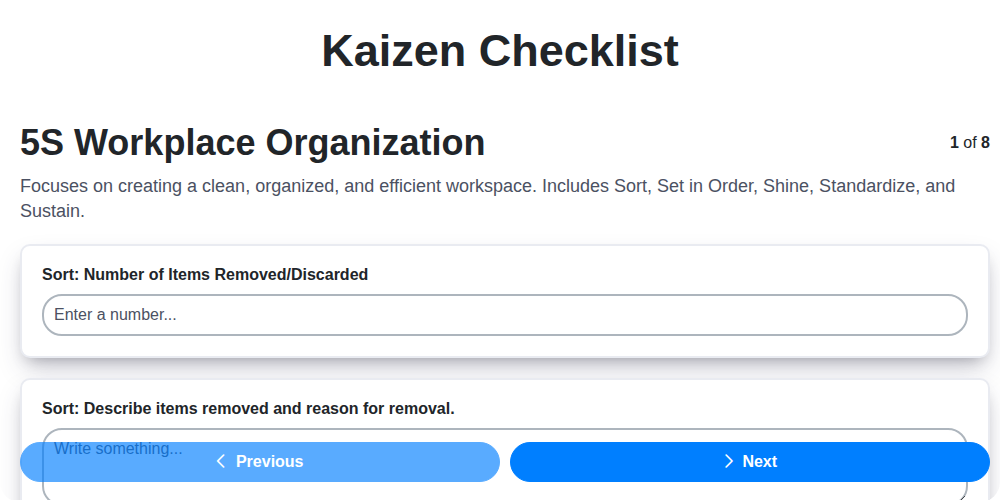
Modèle de liste de contrôle Kaizen : Votre parcours vers l’amélioration continue.

Machine Safety Audit Checklist: Your Guide to a Safer Manufacturing Workplace
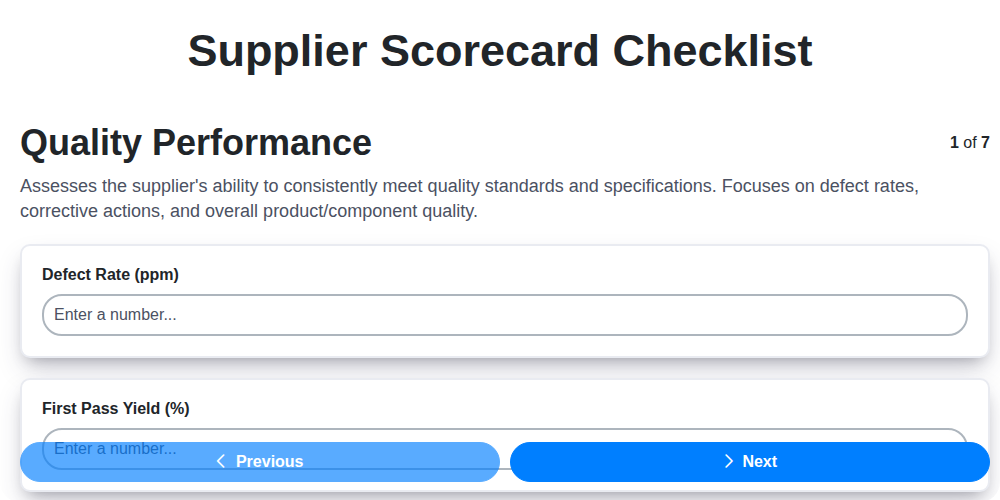
Mastering Supplier Performance: Your Free Supplier Scorecard Checklist Template
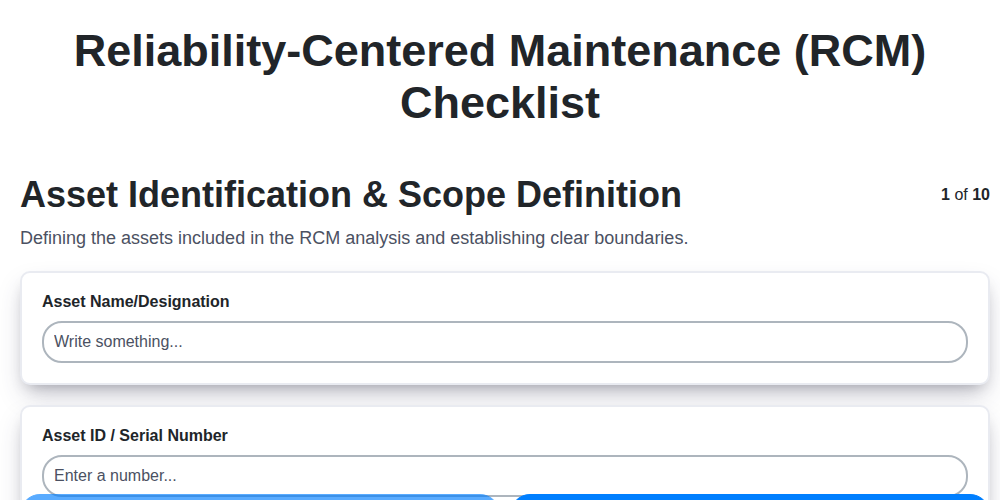
Votre modèle ultime de liste de contrôle RCM : Un guide étape par étape

Modèle de liste de contrôle LPA : Votre guide pour les audits de processus structurés

Votre modèle de liste de contrôle LOTO ultime

Your Ultimate FSC 22000 Checklist Template
Modèle de liste de contrôle d'inspection qualité : Prévenir les défauts et améliorer les processus de fabrication
Nous pouvons le faire ensemble
Besoin d'aide avec les listes de contrôle?
Vous avez une question ? Nous sommes là pour vous aider. Veuillez soumettre votre demande et nous vous répondrons rapidement.