Production Capacity Planning Workflow: A Step-by-Step Guide
Publié: 30/03/2026 Mis à jour: 31/03/2026
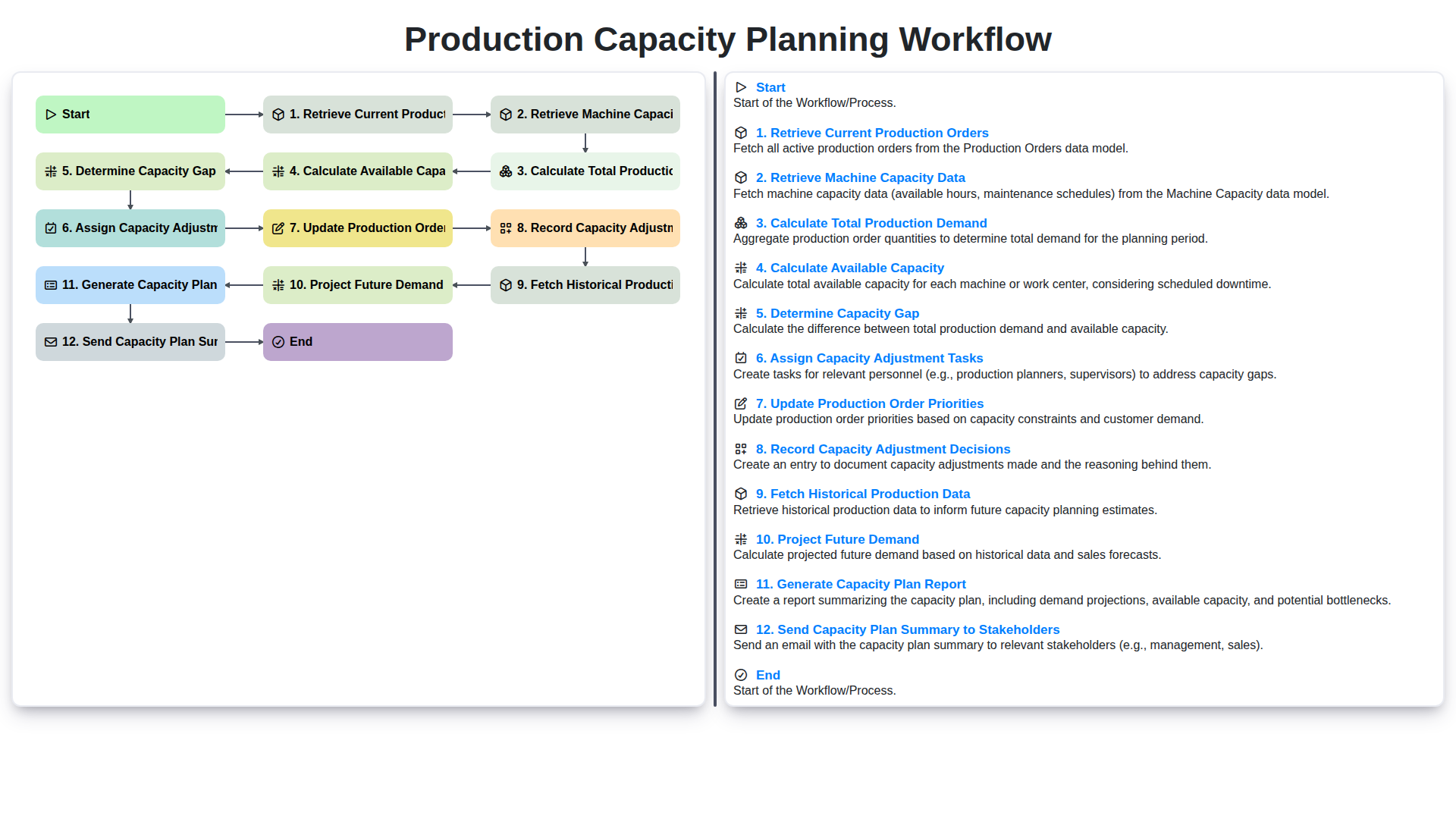
Table des matières
- Introduction: Why Capacity Planning Matters
- 1. Retrieve Current Production Orders
- 2. Gathering Machine Capacity Data
- 3. Calculating Total Production Demand
- 4. Assessing Available Capacity
- 5. Identifying the Capacity Gap
- 6. Assigning Capacity Adjustment Tasks
- 7. Prioritizing Production Orders
- 8. Documenting Capacity Adjustment Decisions
- 9. Analyzing Historical Production Data
- 10. Projecting Future Demand
- 11. Generating the Capacity Plan Report
- 12. Sharing the Capacity Plan Summary
- Conclusion: Optimizing Production with a Robust Workflow
- Resources & Links
TLDR: This workflow helps you proactively manage production by combining current orders, machine data, and historical trends to forecast future demand and ensure you have enough capacity. It involves calculating gaps, adjusting priorities, documenting decisions, and providing stakeholders with a clear plan to avoid bottlenecks and meet production goals.
Introduction: Why Capacity Planning Matters
Manufacturing thrives on a delicate balance. Meeting customer demand efficiently and profitably requires more than just skilled workers and quality materials - it demands a robust production capacity. Without proactive capacity planning, you risk missed deadlines, frustrated customers, increased costs, and potentially, lost business.
Capacity planning isn't just about knowing how much you can produce; it's about strategically aligning your production capabilities with anticipated demand. This involves a forward-looking assessment of resources - machines, labor, raw materials - and the ability to adjust them in response to changing market conditions. Failing to plan effectively can lead to bottlenecks, overtime expenses, and ultimately, an inability to capitalize on growth opportunities. This article outlines a comprehensive workflow for production capacity planning, ensuring you're prepared to meet the challenges and opportunities ahead.
1. Retrieve Current Production Orders
Understanding the foundation of any capacity plan begins with a clear picture of what's already committed. This first step involves retrieving all current production orders from your system. This isn't just about listing the orders; it's about gathering crucial details for each:
- Order ID: A unique identifier for tracking.
- Product Type: What is being produced?
- Quantity: How much of each product is needed?
- Due Date: When is the order due?
- Status: Is the order scheduled, in progress, or completed?
- Assigned Resources: Which machines and personnel are currently allocated to each order?
This data typically resides in your ERP (Enterprise Resource Planning) or MRP (Material Requirements Planning) system. Automation is key here. Direct integration between your capacity planning tool and these systems eliminates manual data entry, reducing errors and saving time. The more detail you can extract in this initial step, the more accurate your capacity planning will be.
2. Gathering Machine Capacity Data
Accurate capacity planning hinges on a clear understanding of what your machines can do. This isn't just about their theoretical maximum output; it's about their available capacity, considering real-world constraints. We need to move beyond just knowing a machine's rated speed.
Here's how we gather this critical data:
- Machine Profiles: Each machine should have a detailed profile outlining its operational parameters. This includes rated output per hour/shift, typical setup times, changeover times between different product types, and any known bottlenecks.
- Maintenance Schedules: Integrate planned maintenance schedules. Downtime for preventative maintenance directly impacts available capacity.
- Operator Skill Levels: Account for variations in output based on operator experience and skill. A less experienced operator will naturally take longer and produce less than a seasoned one.
- Material Availability: Even the fastest machine is useless without the materials it needs. We must consider potential material shortages and their impact on machine utilization.
- Data Sources: This data can come from several sources:
- Machine Monitoring Systems (MES): These systems provide real-time and historical performance data.
- Maintenance Logs: Provide insights into downtime and repair times.
- Operator Input: Experienced operators often have valuable insights into machine performance and potential limitations.
- Engineering Specifications: Provide baseline performance data.
- Regular Audits: It's crucial to regularly audit the accuracy of your machine profiles. Production processes evolve, equipment ages, and operator skills develop, requiring adjustments to the data.
By meticulously gathering and maintaining this data, we lay the foundation for a robust and reliable capacity plan.
3. Calculating Total Production Demand
Calculating total production demand is more than just summing up existing orders. It requires a holistic view of anticipated needs, incorporating both confirmed orders and projected future demand. Here's a breakdown of how we approach this crucial step:
- Consolidated Order Review: We begin by retrieving all current production orders from our system. This includes orders in various stages - pending approval, released, in-progress, and partially completed. Each order needs to be assessed for its quantity and expected completion date.
- Sales Forecast Integration: This is where future demand comes into play. We integrate our sales forecasts, which are typically generated by the sales and marketing teams, and adjust them based on market trends, seasonality, and any known promotions.
- Backlog Analysis: Analyzing our backlog - the difference between demand and available production capacity - gives us a clear understanding of current pressure points and anticipated future shortfalls.
- New Opportunity Assessment: We factor in potential new orders or projects that are still in the proposal stage, assigning a probability of acceptance based on current sales pipeline information.
- Demand Smoothing: We often apply smoothing techniques to the raw demand figures to minimize the impact of erratic fluctuations and provide a more stable basis for capacity planning. This may include moving averages or exponential smoothing methods.
The result is a comprehensive demand figure, broken down by product type and timeframe, providing a clear picture of what we need to produce.
4. Assessing Available Capacity
Calculating total production demand is only half the battle. Now, we need to understand how much we can actually produce. This is where assessing available capacity comes into play. It's a crucial step, as it identifies the gap between what's needed and what's achievable.
We start by retrieving machine capacity data - this includes details like maximum output per hour, scheduled maintenance downtimes, efficiency rates (accounting for factors like setup times and operator skill), and any current bottlenecks. This data isn't static; it needs to be regularly updated to reflect reality.
Next, we translate this raw machine data into a concrete measure of available capacity for each relevant timeframe - typically daily, weekly, and monthly. This calculation must consider factors like shift schedules, planned overtime, and the impact of any known constraints. For example, a machine's theoretical maximum output is useless if it's undergoing preventative maintenance for a significant portion of a week.
Finally, we need to consider resource constraints beyond just machines. This includes labor availability, raw material supply, and the capacity of supporting processes like quality control and packaging. If any of these resources are limiting, they need to be factored into the overall available capacity calculation. A machine might be capable of producing a lot, but if we don't have enough packaging, that capacity is effectively unused.
Accurate and up-to-date machine and resource data is absolutely vital for a realistic assessment of available capacity. Garbage in, garbage out applies here - if the data is flawed, the entire capacity planning process is compromised.
5. Identifying the Capacity Gap
The heart of effective capacity planning lies in pinpointing where you're falling short. This is where we calculate the Capacity Gap. It's a simple, yet crucial, comparison: Total Production Demand minus Available Capacity.
Let's break this down. Total Production Demand, as we established earlier, is the aggregate quantity of goods you need to produce, factoring in current orders, forecasted demand, and safety stock requirements. Available Capacity, on the other hand, represents the maximum output your machines and workforce can realistically achieve within a given timeframe.
When the resulting number is positive, you have a Capacity Gap - meaning demand exceeds your ability to fulfill it. A negative number signifies excess capacity, which, while seemingly good, can still indicate inefficiencies or potential missed opportunities.
Analyzing the magnitude of the Capacity Gap is vital. A small gap might be managed with minor adjustments, but a significant one signals a more pressing need for strategic action, whether that's overtime, additional shifts, capital investment, or process optimization. The data generated here directly informs the next steps in the workflow, ensuring you're addressing the most critical bottlenecks.
6. Assigning Capacity Adjustment Tasks
Once the capacity gap is determined, it's time to translate those findings into action. This isn't just about knowing what the problem is; it's about assigning clear, actionable tasks to the right people. This assignment isn't a blanket approach; it requires considering the nature of the gap and the expertise of your team.
Here's a breakdown of how to effectively assign capacity adjustment tasks:
- Categorize the Gap: Is the gap due to machine limitations, labor shortages, material delays, or a combination? This determines the type of task required.
- Identify Responsible Parties: Assign tasks to specific individuals or teams - maintenance for machine repairs, procurement for material acquisition, production supervisors for labor re-allocation, or engineers for process optimization.
- Define Clear Objectives & Deadlines: Each task should have a clearly defined objective (e.g., Reduce machine downtime by 15% by next Friday) and a realistic deadline. Vague requests lead to inaction.
- Prioritize Tasks: Use the urgency and impact of each task to prioritize work. High-impact, urgent tasks should be at the top of the list.
- Communicate Expectations: Ensure the assigned individuals understand the task's objective, priority, and expected outcome. Open communication is crucial for accountability.
- Provide Resources: Equip the team with the tools, information, and authority needed to successfully complete their assigned tasks. This could include access to data, budget approval, or collaboration with other departments.
Ultimately, effective task assignment fosters a sense of ownership and drives progress towards bridging the capacity gap and meeting production goals.
7. Prioritizing Production Orders
When a capacity gap emerges, simply throwing more resources at the problem isn't always the solution. Often, the most effective approach involves strategically prioritizing existing production orders. This isn't about arbitrarily favoring some orders over others; it's a data-driven process that considers factors like due dates, customer importance, order size, and potential penalties for late delivery.
Our prioritization workflow begins by assessing the criticality of each pending order. We use a weighted scoring system - for example, a high-priority customer might receive a higher score, while orders nearing their due dates are also heavily weighted. This scoring system helps us objectively rank orders within the queue.
Next, we examine the impact of delaying lower-priority orders. Can delays be communicated effectively to the customer? Are there contractual penalties associated with those delays? Understanding these ramifications allows us to make informed decisions that minimize overall risk.
Finally, we don't just shift priorities - we clearly communicate these changes to relevant teams, ensuring everyone understands the rationale behind the adjustments and their impact on timelines. This transparency is crucial for maintaining trust and ensuring a smooth production process.
8. Documenting Capacity Adjustment Decisions
A crucial, often overlooked, element of effective capacity planning is meticulous documentation. Every adjustment made to production orders, machine schedules, or personnel assignments should be clearly recorded. This isn't simply about creating a paper trail; it's about building a knowledge base for future planning and continuous improvement.
What should be documented? At a minimum, include:
- The Decision Itself: What specific adjustment was made? (e.g., Order #1234 shifted to next week, Machine A speed reduced by 10%).
- Rationale: Why was this adjustment necessary? (e.g., Machine breakdown, Unexpected surge in demand for product X, Supplier delay).
- Impact Assessment: What were the predicted and actual impacts of the adjustment? Consider factors like order fulfillment dates, customer satisfaction, and potential overtime costs.
- Decision-Maker: Who authorized the adjustment?
- Date and Time: When was the decision made and implemented?
- Supporting Data: Links to relevant data used in the decision (e.g., capacity reports, demand forecasts).
This documentation should reside in a centralized location accessible to the capacity planning team and relevant stakeholders. This can be a dedicated spreadsheet, a database, or an integrated system. By consistently documenting these decisions, you're creating a valuable resource to learn from past experiences, identify recurring bottlenecks, and refine your capacity planning process over time.
9. Analyzing Historical Production Data
Analyzing past performance is crucial for accurate future capacity planning. Historical production data provides a wealth of information about what has actually happened, not just what was planned. We need to dig deep here, looking beyond simple output figures.
Key areas to examine include:
- Production Volume Trends: Are there cyclical patterns, seasonal peaks, or long-term growth or decline trends in your production volume?
- Cycle Times: How have cycle times varied over time? Increases in cycle times can significantly impact capacity. Investigate the reasons behind these fluctuations - were they due to material shortages, machine downtime, or process inefficiencies?
- Downtime Analysis: Detailed records of machine downtime are invaluable. Identify recurring causes (e.g., specific machine failures, maintenance issues) and their impact on production capacity.
- Yield Rates: Track yield rates throughout the production process. Declining yields directly reduce output and necessitate adjustments to capacity.
- Order Fulfillment Performance: Analyze order fulfillment rates and lead times. These metrics highlight potential bottlenecks and inefficiencies that impact overall capacity.
- Root Cause Analysis: When significant deviations from planned production occur, conduct thorough root cause analyses to understand why and prevent recurrence.
By meticulously reviewing historical production data, we can identify patterns, anticipate potential challenges, and build a more robust and reliable capacity plan. Don't just look at what happened; strive to understand why it happened.
10. Projecting Future Demand
Accurately forecasting future demand is the bedrock of effective capacity planning. Without a realistic understanding of what's coming, your plan is essentially guesswork. We don't just look at what's currently on order; we need to anticipate what will be.
This involves several techniques, often used in combination. Historical data analysis is a crucial starting point. We examine past sales trends, seasonality, and any cyclical patterns. But relying solely on history is insufficient. We integrate market intelligence - considering factors like planned marketing campaigns, competitor activity, economic forecasts, and emerging trends.
Qualitative forecasting methods are also important. This incorporates expert opinions, sales team insights, and customer feedback. Think about planned product launches, potential disruptions in the supply chain, or shifts in customer preferences. We might use techniques like the Delphi method or market surveys to gather these valuable insights.
Finally, we leverage predictive analytics, utilizing statistical models and machine learning algorithms to identify patterns and generate forecasts based on multiple variables. These models can be refined and improved as more data becomes available, constantly enhancing the accuracy of our projections. The goal isn't perfect prediction (that's impossible!), but a well-informed estimate that allows us to proactively adjust our capacity.
11. Generating the Capacity Plan Report
The culmination of our workflow arrives with the generation of the Capacity Plan Report. This isn't just a collection of numbers; it's a dynamic document summarizing the entire planning process, highlighting key insights, and providing actionable recommendations.
The report incorporates data from every preceding step. You'll find a clear presentation of current production orders, machine capacity metrics, calculated demand, available capacity, identified gaps, and the adjustments made to address those gaps. Visualizations, such as graphs illustrating demand trends, capacity utilization, and the impact of adjustments, are critical for easy comprehension.
Crucially, the report should also include a section detailing the assumptions and methodologies used throughout the planning process. This promotes transparency and allows for informed review and refinement of the plan. Finally, the report should explicitly state the recommended actions for the production team and management, outlining priorities and potential risks. This transforms the plan from a theoretical exercise into a practical guide for operational success.
12. Sharing the Capacity Plan Summary
Sharing the finalized capacity plan isn't just about creating it - it's about ensuring everyone understands and buys into it. This step involves compiling a concise and visually appealing summary of the plan and distributing it to key stakeholders. This summary should highlight the overall production capacity, anticipated demand, any identified gaps, and the adjustments made to address those gaps.
Consider tailoring the summary based on the audience. Executives might need a high-level overview focused on key performance indicators (KPIs) and potential risks, while production managers require more detail on specific adjustments and task assignments. Using clear charts, graphs, and key metrics will significantly improve comprehension and foster alignment. A brief explanation of the assumptions used in the projections is also helpful for transparency. Regular, scheduled distribution (e.g., weekly or monthly) ensures ongoing awareness and allows for proactive discussion and adjustments as needed. Ultimately, this shared understanding strengthens collaboration and ultimately contributes to better production outcomes.
Conclusion: Optimizing Production with a Robust Workflow
Ultimately, a well-defined production capacity planning workflow isn't just about reacting to current demands - it's about proactively shaping your production to meet future needs and minimize disruptions. By integrating data retrieval, demand forecasting, capacity assessment, and stakeholder communication into a structured process, you build a system that's adaptable, transparent, and ultimately, more efficient. This empowers your team to make informed decisions, optimize resource allocation, and consistently deliver on commitments. Remember, continuous improvement is key - regularly review and refine your workflow based on historical data and evolving business needs to ensure it remains a valuable asset in your production planning strategy.
Resources & Links
- APICS (The Association for Supply Chain Management): A professional organization offering resources, certifications (like CPIM and CSCP), and education focused on supply chain management, including capacity planning. Great for understanding the theory and best practices.
- Gartner: A leading research and advisory company that offers insights into various technologies and processes, including manufacturing and capacity planning. Their reports can provide valuable market trends and expert perspectives (often require subscription).
- McKinsey & Company: A global management consulting firm. Their website often contains articles and reports on operational excellence and manufacturing strategies, which can offer high-level insights into capacity planning. (May require registration for some content).
- Oracle: A major provider of enterprise resource planning (ERP) software. Their site provides information on ERP systems and related modules, some of which directly support capacity planning. (Focus on solutions, but helpful for understanding functionality).
- SAP: Another leading provider of ERP software. Similar to Oracle, SAP's website details their solutions for production planning and capacity management.
- Microsoft: Microsoft offers tools and platforms that can be used for capacity planning, particularly with Excel for data analysis and Power BI for visualizations. Their website provides resources on these tools.
- Deloitte: A global professional services network providing consulting and advisory services related to manufacturing and supply chain optimization. They often publish thought leadership pieces relevant to capacity planning (may require registration).
- The Lean Enterprise Institute: Focuses on Lean principles and methodologies. Understanding Lean concepts can improve efficiency and contribute to better capacity utilization. Provides tools and resources for process improvement.
- Smartsheet: Offers a collaborative work management platform that can be used for tracking production orders, capacity data, and capacity adjustment tasks - a potential tool to implement the workflow described in the post.
- Tableau: A data visualization tool that can be used to create interactive dashboards for monitoring capacity utilization and projected demand. Useful for presenting the Capacity Plan Report effectively.
Questions fréquemment posées
What is production capacity planning?
Production capacity planning is the process of determining the production capacity needed by an organization to meet changing demands for its products. It involves assessing resources, equipment, labor, and time to ensure manufacturing goals can be met efficiently.
What are the key steps in a production capacity planning workflow?
A typical workflow includes: 1. Assessing current capacity, 2. Forecasting future demand, 3. Identifying gaps between capacity and demand, 4. Developing strategies to bridge gaps (such as hiring or upgrading equipment), and 5. Monitoring and adjusting the plan based on real-time performance.
Why is capacity planning important for manufacturing?
It is crucial for preventing bottlenecks, reducing operational costs, ensuring timely delivery to customers, and optimizing the use of labor and machinery to avoid both underutilization and overcapacity.
How can companies handle unexpected demand spikes during capacity planning?
Companies can manage spikes by maintaining a buffer capacity, implementing flexible shifts, utilizing outsourcing/subcontracting, or investing in scalable automation and cross-training employees.
What tools are commonly used for production capacity planning?
Commonly used tools include ERP (Enterprise Resource Planning) systems, APS (Advanced Planning and Scheduling) software, and data analytics tools that can track machine uptime, labor availability, and historical demand patterns.
Commentaires
Aucun commentaire n'a été publié pour le moment. Soyez le premier à en ajouter un !
Démonstration de la solution de gestion de la production
Arrêtez de vous battre avec les paperasses et les systèmes fragmentés ! Notre solution apporte clarté et contrôle à votre processus de production. Des procédures opérationnelles standard (POS) et de la maintenance des équipements au contrôle qualité et au suivi des stocks, nous simplifions chaque étape.
Articles connexes

Modèle de liste de contrôle Kaizen : Votre parcours vers l’amélioration continue.

Machine Safety Audit Checklist: Your Guide to a Safer Manufacturing Workplace
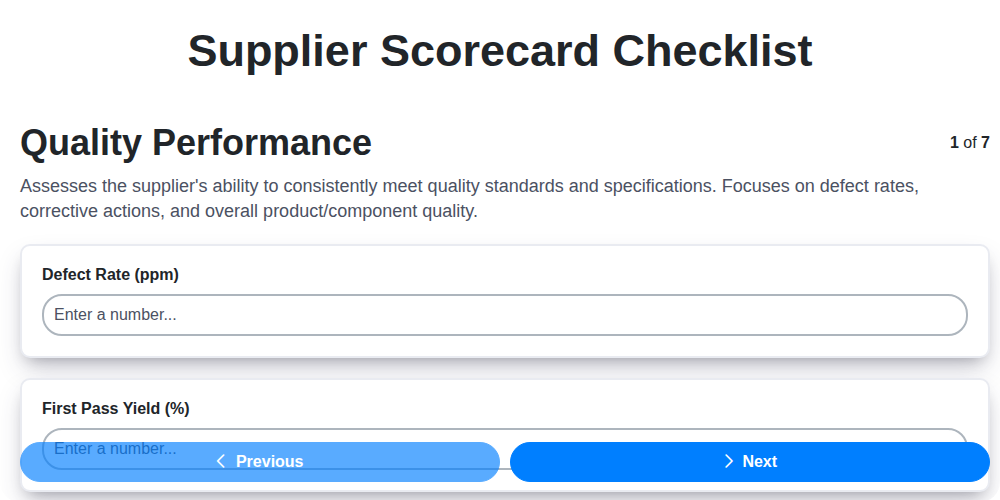
Mastering Supplier Performance: Your Free Supplier Scorecard Checklist Template
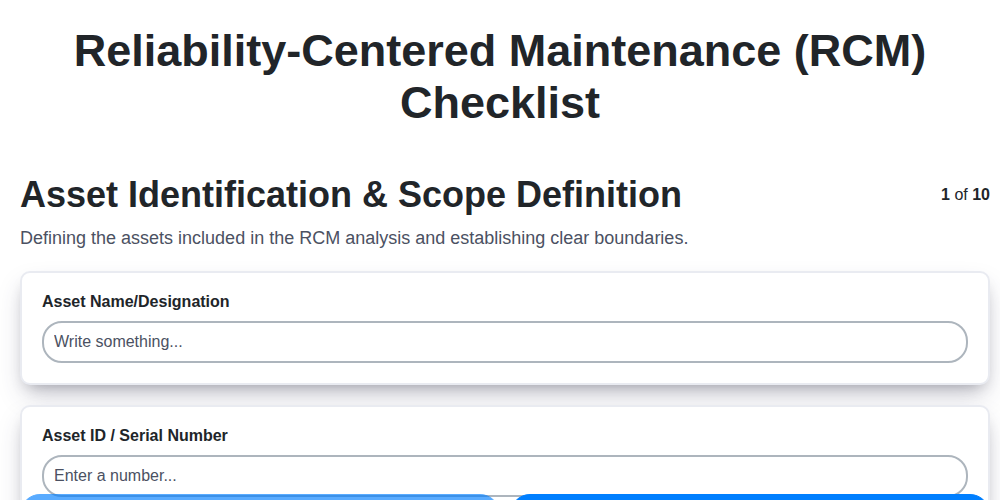
Votre modèle ultime de liste de contrôle RCM : Un guide étape par étape

Modèle de liste de contrôle LPA : Votre guide pour les audits de processus structurés

Votre modèle de liste de contrôle LOTO ultime

Your Ultimate FSC 22000 Checklist Template
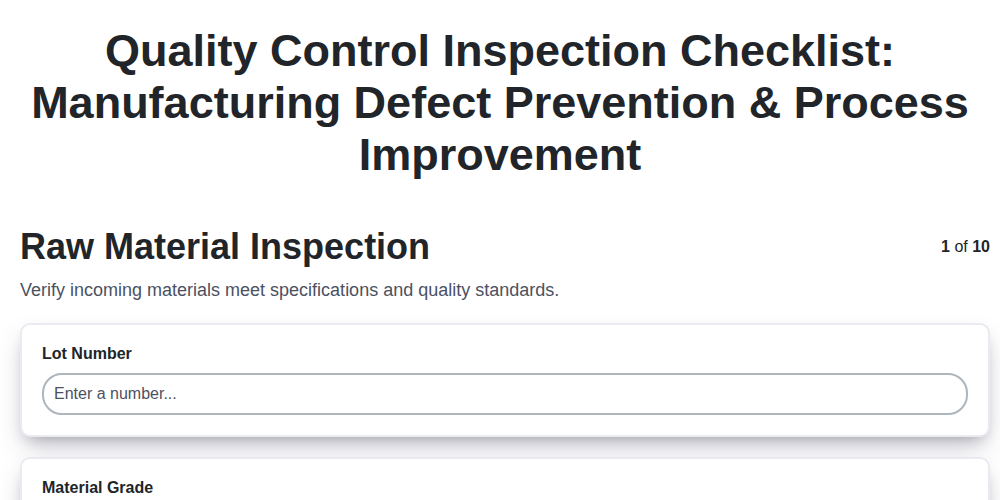
Modèle de liste de contrôle d'inspection qualité : Prévenir les défauts et améliorer les processus de fabrication
Nous pouvons le faire ensemble
Besoin d'aide avec les listes de contrôle?
Vous avez une question ? Nous sommes là pour vous aider. Veuillez soumettre votre demande et nous vous répondrons rapidement.