Mastering Water Treatment: The Ultimate Inspection Workflow for Optimized Process Management
Publié: Mis à jour: 04/16/2026
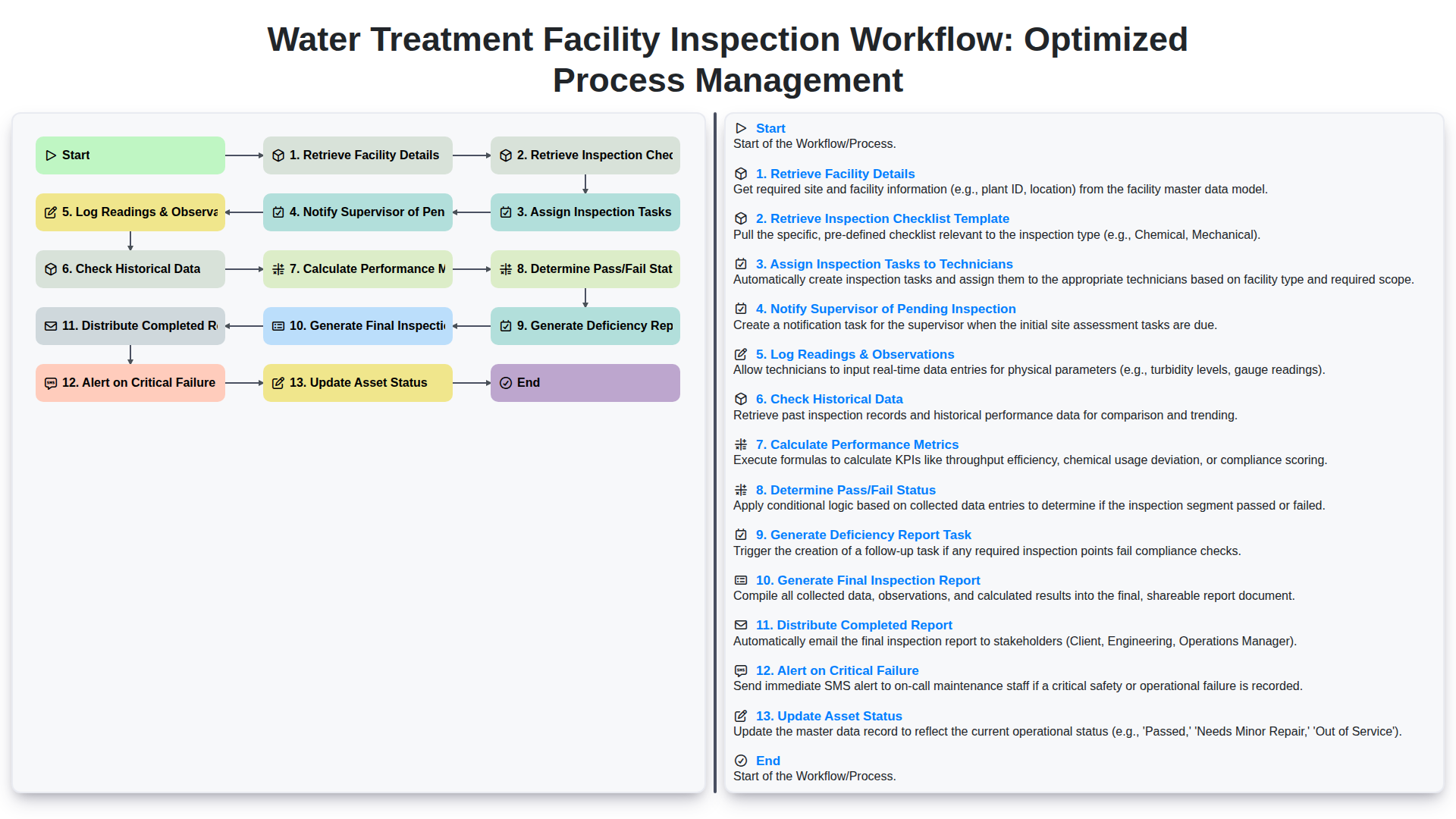
Table des matières
- Introduction: The Critical Role of Structured Inspections in Water Treatment
- Phase 1: Preparation and Initialization (Retrieving the Necessary Foundation)
- Streamlining Workload: Assigning Tasks Efficiently to Technicians
- Maintaining Oversight: Supervisor Notification for Pending Inspections
- Data Capture Excellence: Logging Readings and Observations at the Source
- Contextual Analysis: Leveraging Historical Data for Comparison
- Beyond Checking Boxes: Calculating Key Performance Metrics (KPIs)
- Decision Making: Determining Pass/Fail Status Accurately
- Addressing Issues: Generating Comprehensive Deficiency Reports
- The Final Output: Creating the Formal Inspection Report
- Closing the Loop: Distribution and Archiving of Completed Reports
- Proactive Safety: Instant Alerting on Critical Failures
- System Integrity: Updating the Live Asset Status Record
- Conclusion: Achieving Optimized Process Management Through Workflow Mastery
- Resources & Links
TLDR: This comprehensive workflow provides a step-by-step guide to streamline all aspects of water treatment facility inspections-from initial data retrieval and task assignment to final reporting and asset updates. By following these structured steps, you ensure consistent, thorough, and efficient process management, minimizing downtime and maximizing regulatory compliance.
Introduction: The Critical Role of Structured Inspections in Water Treatment
Water treatment facilities are the backbone of public health infrastructure, ensuring that the water we rely on for drinking and sanitation is safe and potable. The integrity of these facilities cannot be left to chance; routine, thorough inspections are not merely a suggestion-they are a critical operational necessity. These inspections serve as the primary mechanism for preventative maintenance, regulatory compliance, and ensuring the continuous delivery of high-quality water. Without a structured, repeatable, and efficient workflow, these vital inspections can quickly become manual, prone to human error, time-consuming, and difficult to audit. A streamlined process transforms what could be a disparate set of checklists and paperwork into a cohesive, intelligent management cycle, ensuring that compliance is maintained efficiently and that potential failures are caught before they impact the community.
Phase 1: Preparation and Initialization (Retrieving the Necessary Foundation)
The journey of a thorough water treatment facility inspection begins long before a single piece of equipment is physically examined. This initial phase, Preparation and Initialization, is about gathering and organizing the essential groundwork. The process kicks off with the Retrieve Facility Details step, ensuring that the inspection team has the most current and comprehensive profile of the site they are servicing-this includes operational history, layout maps, and owner contacts. Following this, the system automatically executes the Retrieve Inspection Checklist Template. This template is the backbone of the workflow; it guarantees consistency by providing a standardized set of questions, procedures, and required measurements tailored specifically to the facility's type and regulatory requirements. Once both the facility context and the checklist are secured, the next critical action is to Assign Inspection Tasks to Technicians. This step involves intelligently distributing the specific tasks derived from the checklist to the appropriate, qualified technicians, factoring in their location and expertise to ensure efficient coverage and accountability from the outset.
Streamlining Workload: Assigning Tasks Efficiently to Technicians
The crucial next step in the inspection lifecycle is ensuring that the right tasks reach the right people at the right time. This is where our system excels in Assign Inspection Tasks to Technicians. Instead of relying on manual assignment via emails or spreadsheets, the platform intelligently routes inspection checklists and specific tasks directly to the assigned technician's mobile device or portal. This automation eliminates delays caused by administrative overhead, ensures that technicians only see actionable items related to their assigned facility, and provides instant accountability. If a technician is out of the office or overloaded, the system offers built-in reassignment protocols, ensuring zero gaps in the inspection schedule and maintaining continuous oversight of critical infrastructure.
Maintaining Oversight: Supervisor Notification for Pending Inspections
The workflow's integration of supervisor notification is a crucial checkpoint for proactive oversight. As soon as the inspection tasks are assigned to technicians, the system automatically triggers a notification to the designated supervisor. This immediate alert informs the supervisor that an inspection is pending, providing visibility into operational status even before the data logging phase begins. This preemptive notification ensures that management is always aware of the inspection lifecycle, allowing them to allocate resources, anticipate potential bottlenecks, or intervene immediately if the scheduling or resource allocation suggests a delay. It transforms the supervision role from reactive (responding to problems) to proactive (managing the inspection timeline).
Data Capture Excellence: Logging Readings and Observations at the Source
Accurate and timely data capture is the backbone of any successful inspection process. Our workflow emphasizes logging readings and observations directly at the point of inspection. This means our technicians aren't just making estimates; they are capturing empirical data-everything from specific chemical levels read from onsite gauges to detailed notes about unusual odors or equipment wear. This process ensures that the raw, factual data is logged instantly, minimizing transcription errors and providing an immediate, comprehensive record that forms the foundation for all subsequent analysis.
Contextual Analysis: Leveraging Historical Data for Comparison
The true power of an optimized workflow lies not just in executing tasks sequentially, but in the ability to look backward. This is where the Check Historical Data step becomes a critical pivot point. By integrating historical performance data, the inspection process transcends a simple point-in-time audit; it becomes a powerful analytical tool. Comparing current readings and observations against past performance allows technicians and engineers to move beyond simply noting deviations and start understanding trends. Are elevated turbidity readings a one-off event, or do they signal a gradual decline in pre-treatment efficacy that warrants preventative action? Analyzing maintenance logs alongside current findings helps diagnose root causes, rather than just treating symptoms. This contextual layer ensures that decisions are not based on isolated data points, but on a comprehensive narrative of the facility's operational health over time.
Beyond Checking Boxes: Calculating Key Performance Metrics (KPIs)
Calculating Key Performance Metrics (KPIs) moves your inspection process from a mere compliance exercise to a powerful tool for predictive asset management. Instead of just noting that a component looks okay, these metrics quantify how well it is performing relative to industry standards and historical benchmarks. By crunching the data gathered during the field inspection, you can derive actionable insights. For instance, tracking the mean time between critical alerts, calculating the efficiency degradation rate of filtration units over the last quarter, or comparing current chemical consumption rates against optimized models provides immediate value. This quantitative analysis allows facility managers to shift from reactive repairs-fixing things after they break-to proactive maintenance scheduling, ensuring optimal uptime and significantly extending the lifespan of valuable infrastructure.
Decision Making: Determining Pass/Fail Status Accurately
The heart of any effective inspection workflow lies in its ability to make impartial, data-driven decisions. Our system streamlines this critical juncture through rigorous validation checks designed to accurately determine the pass/fail status. This step isn't merely a binary judgment; it's a calculated assessment based on accumulated evidence. By comparing the logged readings and detailed observations against the established standards within the inspection checklist template, the system automatically flags any parameter falling outside acceptable tolerance levels. Furthermore, integrating historical data comparison provides crucial context. A reading that might seem acceptable on its own could be flagged as a deviation if it represents a significant, unexpected trend compared to the asset's past performance. This methodical approach minimizes human error and ensures that the pass/fail status is robustly supported by the entirety of the inspection data recorded throughout the process.
Addressing Issues: Generating Comprehensive Deficiency Reports
This is where the process moves from simple documentation to actionable insights. Upon completion of the inspection, the next critical step is the Generate Deficiency Report Task. This isn't just about ticking boxes; it's about meticulously documenting every deviation, malfunction, or area requiring improvement. The system prompts technicians to log specific deficiencies linked directly to the checklist items that failed, providing detailed descriptions, severity levels, and photographic evidence if available. This comprehensive report serves as the foundation for corrective action.
The Final Output: Creating the Formal Inspection Report
The final, tangible output of this meticulous workflow is the formal Inspection Report. This document is more than just a compilation of data; it is a comprehensive narrative of the facility's operational health at a specific point in time. It begins with the initial facility details, providing immediate context for the reader. The body of the report is structured around the logged readings and observations, offering a clear, sequential account of what was inspected. Crucially integrated within this section are the pass/fail determinations, directly stemming from the calculated performance metrics. If deficiencies were noted, the dedicated Deficiency Report Task ensures these issues are clearly itemized, along with actionable recommendations. The workflow culminates in the generation of the final report, which packages all these elements-the raw data, the performance analysis, the pass/fail status, and the deficiencies-into one cohesive package. This report is then digitally distributed to all relevant stakeholders, ensuring accountability and immediate awareness. Furthermore, the system ensures that this final report automatically triggers the necessary alerts, whether for minor maintenance follow-ups or for critical failures that require immediate executive attention, solidifying the loop between inspection, reporting, and decisive action.
Closing the Loop: Distribution and Archiving of Completed Reports
The process doesn't end with the completion of the final report. A crucial final step in the workflow is ensuring the insights gathered are disseminated to the right stakeholders and securely archived for future reference. Distribution involves sharing the comprehensive, finalized inspection report with all relevant parties-facility management, engineering teams, and regulatory bodies-ensuring everyone has the most accurate and timely information for decision-making. Beyond mere sharing, this step often triggers automatic notifications, particularly for high-risk findings, ensuring immediate attention is paid where it's needed most. Following distribution, the report must be systematically archived within the central asset management system. This archival process is vital; it doesn't just store a document, but it populates the historical data record for that specific asset. This organized repository allows for trend analysis, performance benchmarking over time, and provides an unblemished audit trail, solidifying the loop and making the next inspection cycle more efficient and proactive.
Proactive Safety: Instant Alerting on Critical Failures
The workflow incorporates a crucial safety net through its instant alerting mechanism. This step is designed to provide immediate notification to relevant personnel the moment a critical failure is detected during the inspection process. By automating this alert, the system ensures that risks are addressed in real-time, significantly reducing response time and preventing potential safety hazards or major operational disruptions before they escalate.
System Integrity: Updating the Live Asset Status Record
This step is crucial for maintaining a real-time, accurate picture of the facility's operational health. Upon the successful completion of the inspection and subsequent analysis (including performance metrics and deficiency reporting), the system must immediately update the central asset status record. This single action propagates vital information across all linked departmental dashboards, alerting maintenance teams, management, and operations staff instantaneously to whether the asset is 'Operational,' 'Under Review,' or requires 'Immediate Attention.' This centralized update prevents downtime caused by delays in communication, ensuring that decision-makers are always acting on the most current data available.
Conclusion: Achieving Optimized Process Management Through Workflow Mastery
By systematically implementing this comprehensive inspection workflow, water treatment facilities can move beyond reactive maintenance toward a state of proactive, optimized process management. Each step, from the initial retrieval of facility details to the final distribution of the report, creates a seamless digital chain of custody and accountability. This structured approach minimizes human error, accelerates turnaround times, and ensures that critical insights-like performance metric calculations and immediate alerts on critical failures-are captured and acted upon without delay. Ultimately, mastering this workflow transforms an inspection from a mere checklist review into a powerful, data-driven tool for continuous operational excellence, significantly enhancing compliance, reducing downtime, and safeguarding public health.
Resources & Links
- International Water and Wastewater Quality Association (IWWQA) : A general resource for industry standards, best practices, and educational materials in water quality and treatment.
- American Water Works Association (AWWA) Resources : Provides technical papers, guidelines, and industry best practices specifically for water infrastructure management.
- Environmental Protection Agency (EPA) Water Treatment Guidelines : Official regulatory guidelines and technical documents from the governing body for water quality standards.
- General Workflow Automation Platforms : Articles on digital workflow management software, relevant for understanding modern process mapping and digital tools.
- Water Utility Technology & Operations Forums : Discussion boards and articles focused on the operational technology (OT) and management systems used in real-world water facilities.
Questions fréquemment posées
What is the primary goal of the water treatment inspection workflow described in the article?
The primary goal is to provide a standardized, systematic approach to inspecting water treatment facilities to ensure operational efficiency, regulatory compliance, and optimized process management.
Why is a structured inspection workflow important for water treatment facilities?
A structured workflow helps in early detection of equipment failure, prevents unplanned downtime, ensures consistent water quality, and optimizes the lifecycle of critical treatment components.
What are the key components of an effective water treatment inspection?
Key components include monitoring chemical dosage levels, checking filtration system integrity, assessing pump and motor performance, verifying sensor accuracy, and evaluating membrane health.
How does regular inspection contribute to cost savings in water treatment?
Regular inspections allow for predictive maintenance, which reduces the need for expensive emergency repairs and prevents large-scale system failures that can lead to significant operational costs.
What role does data logging play in the inspection workflow?
Data logging is crucial for tracking trends over time, identifying recurring issues, providing documented proof of compliance for regulators, and informing long-term maintenance strategies.
Cet article vous a-t-il été utile ?
Démonstration de la solution de gestion des audits et des inspections
Assurez la conformité et améliorez les performances ! ChecklistGuro rationalise la création, l'exécution et la génération de rapports d'audit/d'inspection. Réduisez les risques, améliorez la qualité et maintenez la cohérence. Gérez tout cela avec notre plateforme de gestion du travail.
Articles connexes
Restaurant Kitchen Safety Inspection Checklist Template
The Ultimate Brewery Equipment Sanitation & Safety Checklist Template
Modèle de liste de contrôle pour l'inspection des éoliennes : Votre guide complet
The Ultimate Apartment Building Maintenance Inspection Checklist Template
Your Essential Guide to a Manufacturing Quality Control Inspection Checklist
Le modèle ultime de liste de contrôle pour l'inspection des panneaux solaires
Votre modèle ultime de liste de contrôle pour l'inspection CVC
Le modèle de liste de contrôle ultime pour l'inspection des centres de données
Nous pouvons le faire ensemble
Besoin d'aide avec les listes de contrôle?
Vous avez une question ? Nous sommes là pour vous aider. Veuillez soumettre votre demande et nous vous répondrons rapidement.