Streamline Your Practice: The Ultimate Dental Treatment Planning & Consent Workflow Guide
Публикувано: Обновено: 04/16/2026
Съдържание
- Understanding the Critical Role of Dental Treatment Planning
- Step 1: From Initial Consultation to Data Gathering
- Step 2: Clinical Insights and Presenting Options
- Step 3: Drafting the Comprehensive Treatment Plan
- Step 4: Securing Patient Review and Agreement
- Step 5: Financial Clarity: Estimated Cost Calculation and Authorization
- Step 6: Communicating Care: Sending the Treatment Summary
- Step 7: Confirming the Path Forward: Next Steps via SMS
- Step 8: Finalizing Commitment: Consent Capture and Signatures
- Step 9: Beyond the Chair: Recall Scheduling and Reporting
- Step 10: The Power of Organization: Integrating Insurance Details
- Why Workflow Optimization Matters for Patient Experience
- Technology Solutions to Automate Your Workflow
- Measuring Success: Key Metrics for Your New Workflow
- Resources & Links
TLDR: This guide details a step-by-step workflow to guide your practice through dental treatment planning and consent, from initial consultation to post-visit follow-up. By systematically managing tasks like retrieving patient data, generating treatment options, calculating costs, submitting pre-authorizations, and capturing digital consent, you can significantly reduce administrative overhead, improve compliance, and create a seamless, positive experience for every patient.
Understanding the Critical Role of Dental Treatment Planning
Effective dental treatment planning is far more than just listing procedures; it's the cornerstone of a positive patient journey and the bedrock of clinical success. It represents the critical intersection where advanced clinical knowledge meets empathetic patient communication. A well-structured workflow ensures that the patient isn't overwhelmed by a barrage of medical jargon or presented with a confusing array of options. Instead, the process guides them smoothly from initial assessment to actionable agreement. This structured approach moves the focus from what is wrong to what can be done-creating a partnership between the dentist, the hygienist, and the patient. By systematizing the review, presentation of options, and subsequent agreement capture, practices can reduce patient anxiety, improve adherence rates, and ultimately enhance the overall perceived quality of care.
Step 1: From Initial Consultation to Data Gathering
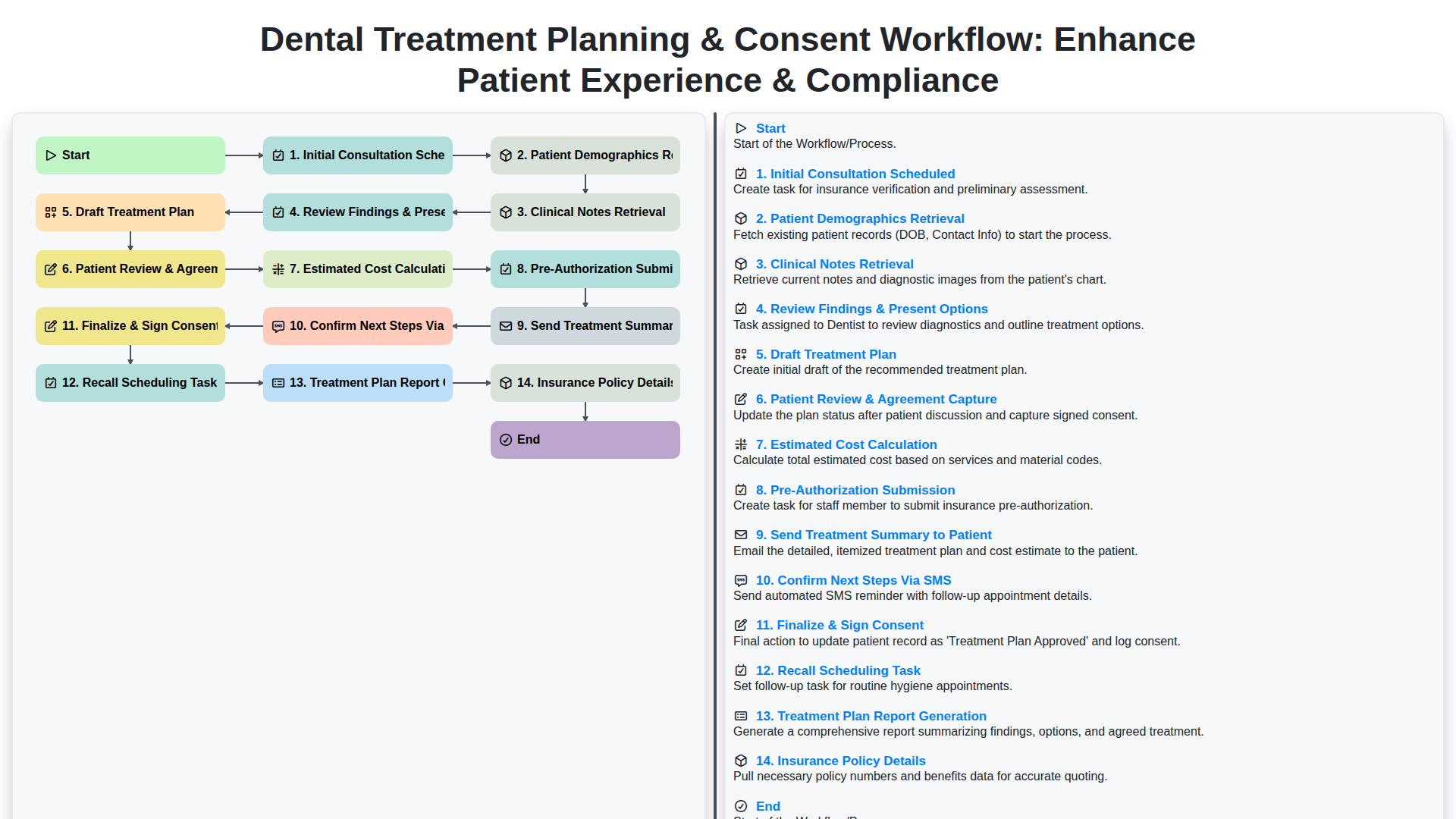
The journey to a comprehensive dental treatment plan begins with a crucial first step: the Initial Consultation. This appointment is more than just a check-up; it's the foundation of the entire patient experience. Immediately upon scheduling, the workflow kicks off with the Initial Consultation Scheduled trigger. Our system ensures that the right information is ready before the patient even walks through the door. Simultaneously, we begin the critical process of Patient Demographics Retrieval to ensure our records are accurate and up-to-date. Furthermore, the system facilitates the instant Clinical Notes Retrieval, gathering all relevant history-from previous dental visits to imaging reports-allowing the clinician to have a complete, 360-degree view of the patient's oral health profile from the outset.
Step 2: Clinical Insights and Presenting Options
This phase is where the magic happens-translating diagnostic information into a clear, actionable roadmap for the patient. After gathering all necessary clinical notes and imaging, the team must meticulously review all findings. The goal here isn't just to diagnose; it's to educate. Presenting options should be structured, empathetic, and patient-centric. Instead of overwhelming the patient with a list of procedures, categorize the needs: what is necessary for immediate function, what is recommended for long-term health, and what is optional for aesthetics. Utilize visual aids-diagrams, models, or even 3D renderings-to illustrate why a treatment is needed and what the desired outcome will look like. Crucially, this is a dialogue, not a monologue. Be prepared to discuss the alternatives, including watchful waiting and the implications of choosing no treatment. This structured presentation ensures the patient leaves the appointment not just informed, but truly understanding their choices.
Step 3: Drafting the Comprehensive Treatment Plan
This is where the clinical expertise meets actionable documentation. After thoroughly reviewing the initial findings and discussing viable pathways with the patient, the next crucial step is drafting the comprehensive treatment plan. This isn't just a list of procedures; it's a narrative document that synthesizes the patient's current condition, the recommended diagnostic steps, and the proposed treatment roadmap. The plan must be detailed enough for the patient to understand exactly what is recommended, yet structured enough for the clinical team to follow. It outlines specific procedures (e.g., root canal therapy on tooth #14, restorative crown placement), associated clinical goals (e.g., restore function, eliminate pain, improve aesthetics), and the anticipated order of operations. Accuracy and clarity are paramount here, as this document forms the factual basis for all subsequent discussions, cost estimates, and ultimately, the patient's agreement.
Step 4: Securing Patient Review and Agreement
This critical stage moves the process from clinical recommendation to patient commitment. When drafting the treatment plan, it's not enough to simply present the options; the patient needs to feel informed, empowered, and understood. Therefore, the workflow must incorporate a structured mechanism for patient review. This involves presenting the drafted plan-including recommended procedures, anticipated benefits, and potential alternatives-in clear, non-jargon language. It's paramount that the system facilitates a digital review period, allowing the patient to digest the information at their convenience. The digital capture of agreement is the goal here. This isn't just getting a signature; it's capturing explicit consent. The system should guide the necessary confirmations, ensuring that the patient acknowledges not only the scope of work but also the associated financial implications, which leads directly into the cost calculation phase.
Step 5: Financial Clarity: Estimated Cost Calculation and Authorization
This critical juncture bridges the clinical recommendation with the financial reality for the patient. Once the preliminary treatment plan is drafted, the next essential step is generating a transparent and accurate Estimated Cost Calculation. This process must aggregate the proposed procedures, materials, and associated fees into a single, easily understandable document. Simultaneously, the workflow triggers the necessary functions to handle Pre-Authorization Submission. The system should automatically pull the patient's insurance policy details and package this information with the treatment plan for submission to the carrier. Crucially, the resulting document presented to the patient must not only detail the services but must also clearly outline the estimated out-of-pocket responsibility, fostering trust and managing expectations upfront.
Step 6: Communicating Care: Sending the Treatment Summary
At this crucial stage, the detailed treatment plan needs to move beyond the clinical notes and become a clear, understandable communication tool for the patient. This is where the comprehensive Treatment Summary comes into play. It's not just a pile of technical jargon; it's the patient's roadmap to their oral health. The summary must translate the 'What' (the diagnosis) into the 'Why' (the recommended treatment) and the 'How' (the expected process). It should incorporate the initial findings and link directly to the proposed treatment options, making the decision process feel collaborative rather than prescriptive. This document serves as the anchor point for the subsequent discussion, ensuring that when the patient reviews the plan, they are looking at a single, authoritative source of information that they can take home and discuss with family members.
Step 7: Confirming the Path Forward: Next Steps via SMS
This crucial step bridges the gap between the finalized treatment plan and the actual appointment date. After the patient has reviewed, agreed to, and signed the consent, a prompt, automated SMS confirmation serves multiple vital functions. First, it acts as a tangible, immediate confirmation that the entire planning process has concluded positively. Second, it reinforces the commitment the patient made, keeping the next steps top-of-mind. The message should be warm, professional, and highly actionable. Beyond just saying, We look forward to seeing you, it must clearly outline what happens next-whether it's a reminder for the prep appointment, details about required documentation to bring, or the name/time of the clinician they should expect. This proactive communication drastically reduces no-show rates, minimizes pre-appointment anxiety for the patient, and establishes the dental practice as reliable and exceptionally organized.
Step 8: Finalizing Commitment: Consent Capture and Signatures
This critical juncture moves the planning from discussion to documented action. The system must facilitate a seamless capture of informed consent. This involves presenting the patient with the finalized, easy-to-read treatment plan summary, ensuring all proposed procedures, alternatives, risks, and anticipated benefits are clearly outlined. The workflow requires a dedicated step for the patient to review this information thoroughly. Digital signature capture is paramount here, offering a verifiable, time-stamped record of their agreement. For compliance, this signature needs to be securely linked not just to the treatment plan, but also to the date and context of the discussion, ensuring that the consent is fully informed. If any section of the plan requires additional clarification or the patient hesitates, the system should flag this for the practitioner to address before the final signature is obtained, preventing potential legal or clinical ambiguities down the line.
Step 9: Beyond the Chair: Recall Scheduling and Reporting
Once the treatment is successfully completed and the patient has signed the necessary consents, the workflow doesn't end at the point of payment. Step 9 is crucial for maintaining longitudinal patient care and maximizing practice revenue through proactive recall scheduling and comprehensive reporting. Automated recall scheduling ensures patients return for necessary preventive care (cleanings, checkups), which is foundational to preventative dentistry. Simultaneously, generating a detailed Treatment Plan Report serves as a valuable handover document for the patient and a comprehensive record for the practice. This report summarizes everything: the diagnosis, the agreed-upon treatment steps, the rationale, the costs incurred, and the next recommended schedule. This methodical follow-through solidifies the patient-provider relationship and establishes a clear, efficient path for future care.
Step 10: The Power of Organization: Integrating Insurance Details
This stage moves the process from the purely clinical to the administrative, which is crucial for patient confidence and operational efficiency. Seamlessly integrating the patient's insurance policy details at this point prevents guesswork and delays. By proactively linking the retrieved insurance policy information to the draft treatment plan, your team can perform an initial, accurate cost analysis before presenting options to the patient. This transparency is paramount-it allows you to adjust the proposed treatment plan dynamically, showing patients not just what they need, but what they can afford. This step reduces sticker shock anxiety, builds trust, and significantly improves the likelihood of treatment acceptance.
Why Workflow Optimization Matters for Patient Experience
In the modern healthcare landscape, the patient experience is as crucial as the clinical outcome. A clunky, disjointed, or time-consuming process can lead to patient frustration, anxiety, and even resistance to necessary treatment. Workflow optimization tackles this directly by streamlining every touchpoint-from the initial appointment scheduling to the final sign-off. When your workflow is seamless, the patient feels guided, respected, and informed. They don't feel like they are navigating a series of bureaucratic hoops; rather, they feel like they are partners in their own oral health journey. This smooth journey, underpinned by efficient backend processes, builds trust, which is the foundation of excellent patient compliance and care.
Technology Solutions to Automate Your Workflow
Leveraging modern technology is no longer a luxury but a necessity for any dental practice aiming for peak efficiency and superior patient care. Implementing robust digital solutions can automate tedious, manual steps within your treatment planning and consent workflow, drastically reducing administrative burden and minimizing the chance of human error. Imagine moving away from paper-based tracking and instead operating within an integrated Electronic Health Record (EHR) or Practice Management Software (PMS). These systems can automatically pull Patient Demographics Retrieval and Clinical Notes Retrieval at the outset of an appointment, giving your team immediate, comprehensive access to necessary data. Furthermore, sophisticated workflow automation can manage the complex sequence from Review Findings & Present Options through to Draft Treatment Plan, populating standardized templates instantly. Best in class platforms can streamline the tricky steps of Estimated Cost Calculation and Pre-Authorization Submission by integrating directly with insurance clearinghouses. For patient communication, automated portals allow for the immediate Send Treatment Summary to Patient and reliable Confirm Next Steps Via SMS, ensuring patients never feel lost in the follow-up process. This technological backbone doesn't just streamline paperwork; it enhances the entire patient journey, making the final Finalize & Sign Consent process seamless, accurate, and compliant, while even automatically generating the necessary Recall Scheduling Task and Treatment Plan Report Generation.
Measuring Success: Key Metrics for Your New Workflow
Tracking the success of your revamped Dental Treatment Planning & Consent Workflow requires looking beyond simple task completion. To truly measure improvement, focus on metrics that reflect both efficiency and patient satisfaction/compliance. Key areas to monitor include:
- Time-to-Plan Completion: Measure the average time elapsed from Initial Consultation Scheduled to Treatment Plan Report Generation. A decreasing trend indicates process streamlining and faster patient care initiation.
- Consent Capture Rate: Track the percentage of patients who complete the Finalize & Sign Consent step. A high rate suggests clarity in communication and patient buy-in throughout the process.
- Pre-Authorization Friction Points: Monitor the average time and number of required follow-ups for Pre-Authorization Submission. Identifying bottlenecks here can pinpoint issues with information gathering or payer communication.
- Patient Communication Adherence: Measure the percentage of patients who engage with the Send Treatment Summary to Patient and Confirm Next Steps Via SMS. This shows the effectiveness of your multi-touch communication strategy.
- Revenue Cycle Accuracy: Track the discrepancies between the Estimated Cost Calculation and the final invoiced amount. Improved workflow visibility should lead to higher accuracy and fewer billing disputes.
- Task Completion Rate: While basic, tracking the rate at which Recall Scheduling Task is performed immediately after plan finalization is a direct measure of operational follow-through.
Resources & Links
- Dental Practice Management Software Providers : Comprehensive overview of top practice management software systems that offer workflow automation tools.
- Dental Workflow Optimization Guides : Articles and guides detailing best practices for streamlining clinical and administrative processes in dentistry.
- Patient Experience Best Practices in Dentistry : Resources focusing on improving patient communication, empathy, and overall satisfaction during treatment planning.
- Dental Consent and Compliance Resources : Information on HIPAA compliance, informed consent documentation, and legal requirements for dental practices.
- Dental Insurance Verification and Pre-Authorization Tools : Reviews of technology and best practices for accurately submitting pre-authorizations to insurance payers.
- Patient Portal and SMS Communication Solutions : Information on implementing secure patient portals and automated messaging systems for follow-up care.
- Electronic Health Record (EHR) for Dental Practices : Comparisons and guides to modern dental EHR systems capable of tracking detailed treatment plans and consent.
- Process Mapping and Workflow Design Tools : Guides on how to map out complex business processes like treatment planning to identify bottlenecks.
Често Задавани Въпроси
What is the main goal of a streamlined dental treatment planning and consent workflow?
The primary goal is to increase clinical efficiency, reduce administrative errors, and improve patient trust by ensuring clear communication and documented informed consent for all proposed procedures.
Why is a standardized consent process important for dental practices?
A standardized process protects the practice legally by ensuring all risks, benefits, and alternatives are discussed and documented, while also reducing patient anxiety through transparent communication.
How can digital tools improve the treatment planning process?
Digital tools, such as intraoral scanners and practice management software, allow for more precise visualizations, easier sharing of diagnostic images, and automated documentation of patient signatures.
What are the key components of an effective informed consent form?
An effective consent form should include the diagnosis, the proposed treatment, the risks and complications, potential benefits, alternative treatment options, and the consequences of refusing treatment.
How does an efficient workflow impact practice profitability?
By reducing treatment cancellations, improving case acceptance rates through better visual communication, and minimizing time spent on manual paperwork, an efficient workflow directly enhances the practice's bottom line.
Тази статия беше полезна?
Демонстрация на решение за управление на дентална практика
Опростете работата на вашата дентална практика и подобрете грижите за пациентите! ChecklistGuro рационализира планирането на часовете, воденето на медицински досиета и фактурирането. Подобрете ефективността, намалете грешките и увеличете удовлетвореността на пациентите. Управлявайте всичко това с нашата работна платформа.
Свързани статии
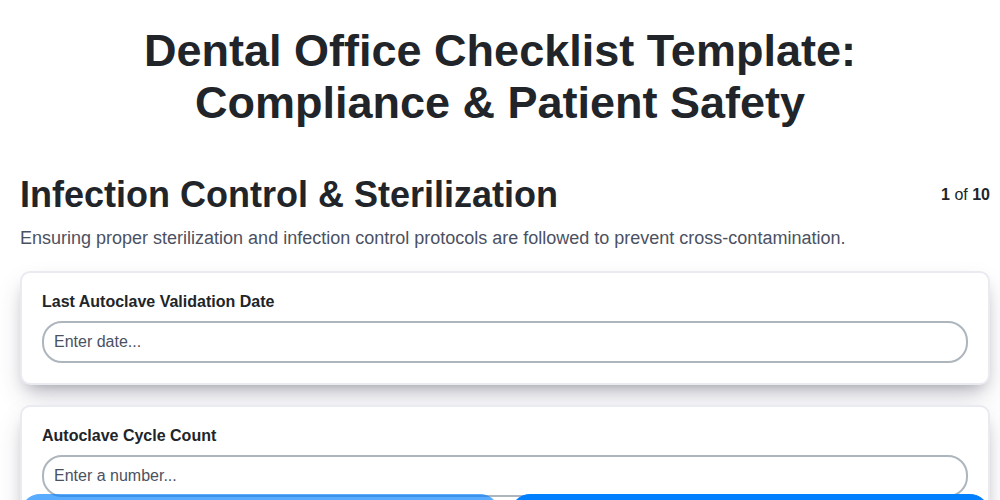
Your Dental Office Safety Net: The Compliance & Patient Safety Checklist Template
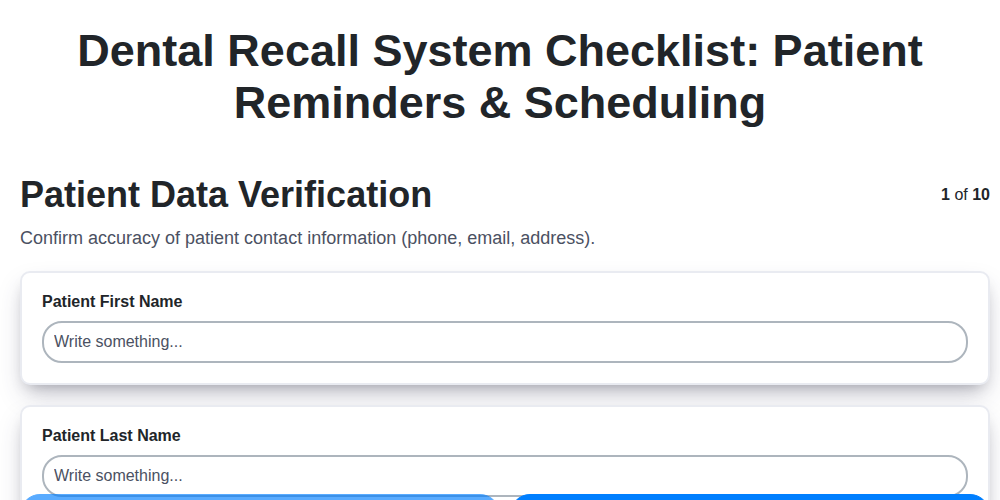
Mastering Dental Recalls: Your Ultimate Checklist Template

Mastering Dental Case Presentations: Your Checklist Template for Success

Your Dental Compliance Checklist: A State & Federal Guide
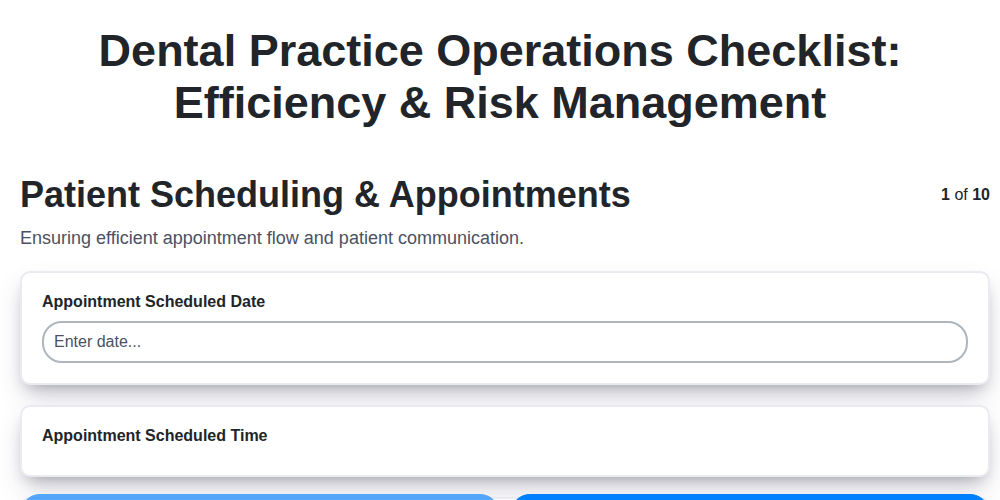
Dental Operations Checklist: Boost Efficiency & Manage Risk

Най-пълният списък за зъботехническа лаборатория: изработка и контрол на качеството

Your Complete Dental Infection Control Checklist: PPE & Surface Disinfection
Овладяване на зъбните прегледи: Ваш изчерпателен шаблон за проверка на записи
Можем да го направим заедно
Нуждаете се от помощ с
Checklists?
Имате въпрос? Тук сме, за да помогнем. Моля, изпратете запитването си и ние ще отговорим своевременно.