Manufacturing Scrap Reduction Workflow: A Step-by-Step Guide
Публикувано: 30.03.2026 Обновено: 31.03.2026
Съдържание
- Introduction: The High Cost of Manufacturing Scrap
- 1. Retrieve Scrap Data: Laying the Foundation
- 2. Calculate Total Scrap Value: Understanding the Financial Impact
- 3. Initial Scrap Report: Identifying Problem Areas
- 4. Assign Scrap Investigation: Who's on the Case?
- 5. Fetch Machine Performance Data: Looking Beyond the Scrap
- 6. Review Machine Data: Spotting Performance Anomalies
- 7. Calculate Defect Rate per Machine: Quantifying the Issue
- 8. Log Investigation Findings: Building a Knowledge Base
- 9. Propose Corrective Actions: Brainstorming Solutions
- 10. Update Scrap Record with Findings: Documenting the Plan
- 11. Implement Corrective Action: Putting the Plan into Motion
- 12. Notify Quality Control of Action: Keeping Everyone Informed
- 13. Retrieve Post-Action Scrap Data: Measuring the Impact
- 14. Final Scrap Reduction Report: Success & Lessons Learned
- Resources & Links
TLDR: Stop wasting money and materials! This workflow guides you through a systematic process - from tracking scrap data to implementing corrective actions - to pinpoint the root causes of manufacturing defects, reduce scrap rates, and ultimately boost your bottom line. It's a detailed, step-by-step guide to optimizing your production and minimizing waste.
Introduction: The High Cost of Manufacturing Scrap
Manufacturing scrap isn't just about throwing away material; it's about throwing away money, time, and resources. It impacts profitability, increases production costs, and can even damage a company's reputation. While some scrap is unavoidable in any manufacturing process, excessive or poorly managed scrap signals inefficiencies that are costing your business significantly. Beyond the direct material costs, consider the labor hours spent producing scrap, the energy consumed, and the potential for delayed shipments due to rework or production slowdowns. Addressing scrap reduction isn't merely a sustainability initiative; it's a vital strategy for optimizing operations and boosting your bottom line. This article outlines a comprehensive workflow designed to pinpoint scrap sources, implement targeted solutions, and ultimately, minimize waste in your manufacturing processes.
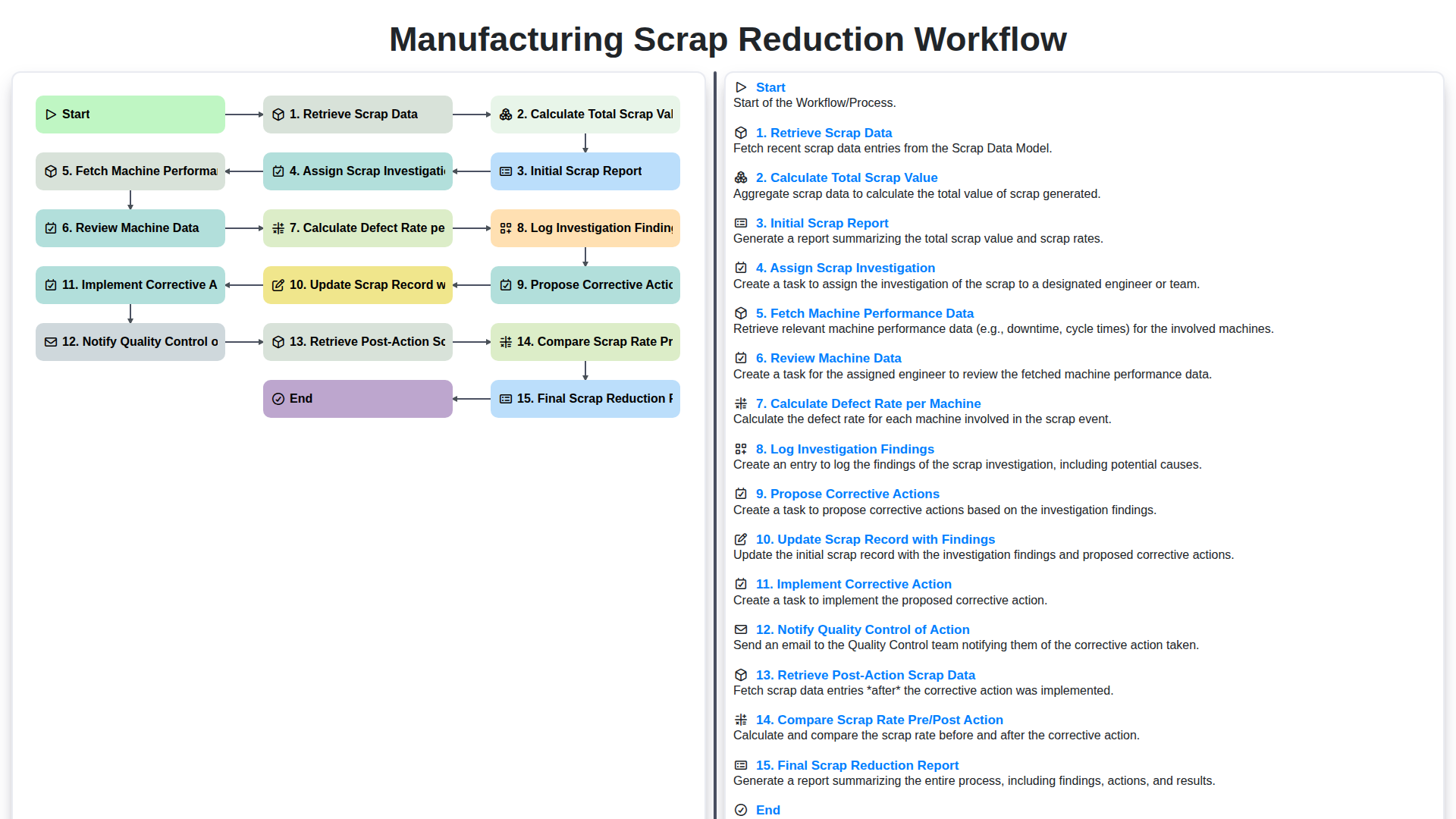
1. Retrieve Scrap Data: Laying the Foundation
The entire workflow hinges on accurate and complete scrap data. This initial step involves gathering information from various sources within the manufacturing process. This isn't simply a count of scrapped items; it requires detailed records. We need to capture specifics like:
- Date and Time of Scrap: Critical for correlating scrap events with specific shifts, production runs, or even machine cycles.
- Product ID/Batch Number: Identifies the affected product or production batch.
- Scrap Reason Code: A standardized coding system classifying why the item was scrapped (e.g., dimensional error, surface defect, material failure). Consistency here is crucial for trend analysis.
- Quantity Scrapped: The number of units rejected.
- Machine/Workstation Involved: Pinpoints the location in the process where the scrap occurred.
- Operator Involved (Optional): While sensitive, recording the operator can sometimes reveal training or procedural issues.
- Material Used (if relevant): Identifying specific raw materials linked to scrap can highlight material quality concerns.
This data typically comes from machine monitoring systems, operator logs, quality inspection reports, and scrap bins. Ensuring all these data streams are integrated and accessible is the first, vital step in any successful scrap reduction program.
2. Calculate Total Scrap Value: Understanding the Financial Impact
Calculating the total scrap value isn't just about knowing how much material is being wasted; it's about understanding the direct financial impact on your manufacturing process. This step moves beyond simply quantifying scrap volume and assigns a monetary value to it.
To accurately calculate the total scrap value, consider these factors:
- Raw Material Cost: Determine the cost per unit of the raw materials that make up the scrapped product.
- Labor Costs: Factor in the labor directly involved in producing the scrapped units. This includes machine operators, quality inspectors, and any personnel involved in handling the scrap.
- Overhead Costs: Account for a portion of your overhead costs associated with the scrap - energy used, facility usage, etc. While precisely attributing overhead can be challenging, a reasonable estimate is vital for a complete picture.
- Processing Costs (if applicable): If scrap material requires additional processing before disposal or recycling, include those associated costs.
- Scrap Disposal/Recycling Costs: Factor in any expenses related to disposing of or recycling the scrap material. Often, you might even receive credit for recyclable scrap.
By meticulously calculating the scrap value, you gain a compelling argument for investing in reduction efforts. It transforms what might seem like a technical issue into a clear, quantifiable business opportunity. This figure will serve as a benchmark to measure the effectiveness of corrective actions taken later in the workflow.
3. Initial Scrap Report: Identifying Problem Areas
The first step after retrieving your scrap data is to compile an Initial Scrap Report. This isn't a deep dive - it's a snapshot. The purpose is to quickly identify which areas, products, or processes are exhibiting the highest scrap rates.
This report should include:
- Scrap Volume by Product: Clearly show the quantity of scrap generated for each product or product variant.
- Scrap Rate by Production Line: Calculate the scrap rate (scrap volume / total production volume) for each production line.
- Material Type Breakdown: Identify if scrap is heavily concentrated in specific materials.
- Visualizations: Charts and graphs are crucial here. A bar graph comparing scrap volume across product lines or a pie chart illustrating material scrap distribution can highlight problem areas immediately.
The goal isn't to find the cause of the scrap yet. It's simply to flag the areas demanding further investigation. This report provides the foundation for targeted action and ensures your team focuses efforts where they're most needed.
4. Assign Scrap Investigation: Who's on the Case?
Once the initial scrap report highlights areas of concern, it's crucial to assign a dedicated investigation. This isn't just about pointing fingers; it's about identifying the root cause and implementing solutions.
The investigation team should typically include representatives from relevant departments - often a mix of production engineers, quality technicians, and maintenance personnel. The selection should be based on expertise, considering the type of scrap identified. For example, a dimensional accuracy issue might warrant a production engineer, while a surface finish defect might require a material specialist.
Clearly define the scope and timeline for the investigation. Provide the assigned team with access to all relevant data from the initial scrap report and any preliminary observations. Empower them to ask questions, observe processes firsthand, and gather any additional information needed to uncover the underlying issues. Document who is assigned, their roles, and deadlines to ensure accountability and progress tracking. A well-defined assignment sets the stage for a thorough and effective investigation.
5. Fetch Machine Performance Data: Looking Beyond the Scrap
While scrap data provides the what - the amount of material being wasted - understanding why requires a deeper dive. That's where machine performance data comes into play. This isn't just about uptime; it's about analyzing key metrics that can be early warning signs of emerging problems.
What kind of data are we talking about? Think cycle times, temperature readings, pressure levels, vibration analysis, and even sensor data related to material feed and processing. Ideally, you're pulling data from your Manufacturing Execution System (MES) or Programmable Logic Controllers (PLCs) associated with each machine involved in the scrap generation.
The goal here isn't to overwhelm yourself with numbers. Instead, we're looking for deviations from established baselines. A sudden increase in cycle time could indicate a tool wearing down, a temperature fluctuation might point to a cooling system issue, and unusual vibration could suggest misalignment. Correlating these performance metrics with the scrap data collected earlier allows us to pinpoint potential root causes that might otherwise be missed. Essentially, machine performance data provides the context needed to move beyond simply identifying scrap to understanding its underlying drivers.
6. Review Machine Data: Spotting Performance Anomalies
Once a scrap investigation is assigned, it's time to dive deep into the machine's performance data. This isn't about finding fault; it's about understanding what the machine was doing when the scrap occurred. We're looking for anomalies - deviations from the normal operating parameters.
What kind of data are we talking about? This will vary depending on the machine and the manufacturing process, but common metrics include:
- Cycle Time: Is the machine consistently taking longer or shorter cycles than usual?
- Temperature: Fluctuations in temperature, whether it's tooling temperature or ambient temperature, can impact part quality.
- Pressure: Incorrect pressure settings can lead to defects.
- Vibration: Excessive vibration indicates potential mechanical issues.
- Speed: Variations in speed, even slight ones, can affect precision.
- Sensor Readings: Any data points from sensors related to the process (e.g., material thickness, laser power, coolant flow).
Plotting these metrics over time, particularly focusing on the period around the scrap events, is key. Look for patterns, spikes, or gradual drifts that correlate with the increased scrap. A visual representation often makes the anomalies much easier to identify. Don't be afraid to zoom in and scrutinize. The smallest deviations can sometimes have significant consequences.
7. Calculate Defect Rate per Machine: Quantifying the Issue
Calculating a defect rate per machine is crucial for pinpointing the root causes of scrap. It moves beyond simply knowing how much scrap exists and starts to identify where the problem lies. Here's how we do it:
First, we gather the scrap data associated with each machine - this will be linked back to specific production runs. We then divide the number of defects attributed to each machine by the total number of parts processed by that same machine during the same timeframe.
Formula: Defect Rate = (Number of Defects Attributed to Machine X) / (Total Parts Processed by Machine X)
For example, if Machine A produced 1,000 parts and 20 were scrapped due to defects directly linked to Machine A, Machine A's defect rate would be 2% (20/1000 = 0.02).
It's important to ensure accurate data linkage here. Linking scrap to specific machines requires robust tracking systems and often necessitates detailed production logs. A high defect rate for one machine flags it for immediate, focused investigation. A consistent, but lower, defect rate might still indicate an underlying, systemic issue worth exploring.
8. Log Investigation Findings: Building a Knowledge Base
A crucial, often overlooked, step in effective scrap reduction is meticulously documenting the investigation process. Don't let valuable insights disappear! This isn't just about noting what happened; it's about capturing why it happened and what was considered.
Each investigation should result in a detailed log entry. This log should include:
- Date and Time: When the investigation began and ended.
- Scrap Event Details: Link to the original scrap record being investigated.
- Investigation Team: Who participated in the investigation?
- Potential Causes Explored: List all possible reasons for the scrap - even those ultimately ruled out.
- Data Analyzed: Specific data reviewed (e.g., machine readings, operator interviews, material lot records).
- Root Cause Hypothesis: A clear statement of the suspected root cause.
- Supporting Evidence: Data or observations that support the identified root cause.
- Rejected Hypotheses: Why other potential causes were dismissed.
This log isn't just for the current investigation; it's a vital building block for a knowledge base. Over time, this accumulated data allows for:
- Pattern Recognition: Identifying recurring issues and common root causes.
- Faster Troubleshooting: Referencing previous investigations for similar scrap events.
- Proactive Prevention: Anticipating potential problems before they lead to scrap.
- Continuous Improvement: Learning from past mistakes and refining processes.
Consider using a structured format for your log entries - a spreadsheet, a dedicated software solution, or even a shared document - to ensure consistency and facilitate searching. A centralized, searchable knowledge base turns scrap investigations from isolated events into valuable learning opportunities.
9. Propose Corrective Actions: Brainstorming Solutions
Once the investigation findings are logged, the next crucial step is to brainstorm and propose concrete corrective actions. This isn't just about identifying what went wrong; it's about formulating solutions. This phase requires a collaborative effort, involving operators, maintenance personnel, engineers, and quality assurance representatives - anyone with relevant expertise.
Here's how to effectively propose corrective actions:
- Root Cause Focus: Ensure proposed actions directly address the root causes identified during the investigation. Don't just treat the symptoms.
- Brainstorming Techniques: Utilize brainstorming techniques like the 5 Whys or a fishbone diagram (Ishikawa diagram) to generate a wide range of potential solutions.
- Feasibility Assessment: Briefly assess the feasibility of each proposed action. Consider factors like cost, implementation time, and potential impact on production. Prioritize actions with a high potential for impact and reasonable implementation.
- Categorize Actions: Group actions into categories like:
- Process Adjustments: Modifying operating procedures.
- Equipment Maintenance: Scheduled or preventative maintenance.
- Operator Training: Addressing skill gaps or reinforcing best practices.
- Material Changes: Evaluating and potentially changing raw materials.
- Document and Prioritize: Document all proposed actions, along with a brief rationale and estimated effort/cost. Prioritize actions based on potential impact and feasibility. The team should then rank these actions for subsequent implementation.
10. Update Scrap Record with Findings: Documenting the Plan
The investigation isn't just about identifying the root cause; it's about creating a documented roadmap for improvement. This step, "Update Scrap Record with Findings," is crucial for transparency, accountability, and future learning.
During this phase, meticulously record all findings from the investigation directly into the scrap record. This includes:
- Identified Root Cause: Clearly state the identified reason for the scrap. Be specific and avoid vague statements.
- Investigation Team & Dates: Who was involved and when did the investigation take place?
- Data Reviewed: A brief summary of the data analyzed (machine performance, defect trends, etc.)
- Proposed Corrective Actions: A direct reference to the corrective actions proposed in the previous step.
- Responsible Party: Assign ownership for implementing each corrective action.
- Target Completion Date: Set a realistic deadline for each action.
This detailed documentation forms a valuable historical record. It allows others to understand the thought process behind the corrective actions and provides a baseline for evaluating their effectiveness. It also contributes to a continuous improvement culture by providing readily accessible information for future scrap reduction efforts.
11. Implement Corrective Action: Putting the Plan into Motion
Now that the investigation is complete, and corrective actions have been proposed and approved, it's time to put them into motion. This isn't just about doing something; it's about methodical, documented implementation.
Key Considerations for Implementation:
- Clear Assignment & Timeline: Assign specific individuals or teams responsibility for each corrective action, and establish realistic deadlines. Vague assignments and unrealistic timelines often lead to delays and inaction.
- Training & Communication: If the corrective action involves changes to processes or equipment operation, ensure all affected personnel receive adequate training. Clear communication is critical to prevent errors and ensure buy-in.
- Document Implementation: Keep detailed records of how the corrective action was implemented. This includes dates, personnel involved, any deviations from the plan, and any immediate observations. This documentation is invaluable for future analysis and troubleshooting.
- Pilot Programs (Where Applicable): For significant changes, consider a pilot program in a limited area before full-scale implementation. This allows for fine-tuning and identification of unforeseen challenges in a controlled environment.
- Verification of Implementation: Don't just assume the action was performed correctly. Implement a verification step - perhaps a checklist or a short observation - to confirm that the corrective action was carried out as planned.
Implementing corrective actions effectively requires discipline and a commitment to following through. It's a crucial step in truly driving down scrap and improving manufacturing efficiency.
12. Notify Quality Control of Action: Keeping Everyone Informed
Transparency and collaboration are crucial for a successful scrap reduction program. Once a corrective action has been proposed and approved, it's vital to immediately notify the Quality Control (QC) team. This isn't simply a courtesy; it's a critical step for several reasons.
Firstly, QC professionals possess valuable expertise in defect identification and analysis. Keeping them informed allows them to be aware of the actions taken and potentially offer additional insights or validation. Secondly, it ensures a consistent approach to quality standards across the entire manufacturing process. They can monitor the implemented change and contribute to a unified definition of acceptable quality. Finally, proactive communication helps to avoid confusion and reinforces the shared responsibility for minimizing scrap. A simple notification - whether through email, a shared platform update, or a brief meeting - keeps everyone aligned and demonstrates a commitment to continuous improvement.
13. Retrieve Post-Action Scrap Data: Measuring the Impact
Once corrective actions have been implemented, it's crucial to assess their effectiveness. This step involves retrieving scrap data after the actions have been in place for a sufficient period - typically mirroring the timeframe used for initial data collection. This ensures a fair comparison. Focus on gathering the same data points as in the initial retrieval phase: quantity of scrap, part numbers affected, and reason codes. Consistency is key for a reliable comparison. Don't be tempted to alter the data collection methods at this stage; maintain the integrity of the process to accurately gauge the impact of your interventions. This data will directly feed into the final assessment and report, providing concrete evidence of the workflow's success.
14. Final Scrap Reduction Report: Success & Lessons Learned
The culmination of our manufacturing scrap reduction workflow is the Final Scrap Reduction Report. This isn't just a concluding document; it's a vital record for continuous improvement. This report synthesizes all data collected throughout the process, quantifying the impact of the implemented corrective actions and identifying key takeaways for future preventative measures.
The report will detail:
- Scrap Rate Comparison: A clear comparison of the scrap rate before corrective actions were implemented versus the scrap rate after the period of action implementation. This visually demonstrates the effectiveness of the interventions.
- Value of Scrap Reduction: The total monetary value of scrap avoided, calculated using the Total Scrap Value data gathered in earlier stages. This highlights the financial benefits of the workflow.
- Machine Performance Analysis Summary: A concise overview of machine performance data, outlining trends and any consistently problematic machines.
- Root Cause Insights: A recap of the identified root causes of scrap, drawing from investigation findings and machine data reviews. This serves as a valuable resource for training and process refinement.
- Corrective Action Effectiveness: An evaluation of the implemented corrective actions, noting which were most effective and why.
- Lessons Learned: A critical section documenting what worked well within the workflow, what could be improved, and any unexpected challenges encountered. This includes reflections on data collection, investigation techniques, and corrective action implementation.
- Recommendations: Actionable recommendations for sustaining scrap reduction gains and proactively preventing future scrap generation. This might include process adjustments, enhanced training programs, or equipment upgrades.
This report isn't meant to be a static document. It's a living record that informs ongoing process improvement initiatives and helps ensure that the hard-won gains in scrap reduction are maintained and expanded upon.
Resources & Links
- National Institute of Standards and Technology (NIST): NIST provides data, standards, and practices relevant to manufacturing process improvement and quality control - a core element of scrap reduction.
- Quality America: Provides consulting and tools for quality management systems, including defect reduction and process optimization, aligning with the workflow steps.
- American Society for Quality (ASQ): Offers training, certifications, and resources for quality professionals, covering topics directly related to scrap reduction methodologies.
- The Lean Enterprise Institute: Provides information and tools related to Lean Manufacturing, a philosophy heavily focused on eliminating waste - including scrap - through process improvement.
- Six Sigma: A data-driven methodology for process improvement and defect reduction; many tools and concepts are directly applicable to scrap reduction workflows.
- International Organization for Standardization (ISO): Provides standards (like ISO 9000) related to quality management, offering a framework for implementing scrap reduction initiatives.
- MFG.net: A manufacturing industry portal offering news, articles, and resources on various manufacturing topics, including quality control and waste reduction.
- APICS (now ASCM): Provides supply chain and operations management resources, relevant to optimizing processes that impact scrap rates. They offer certifications like CPIM and CSCP.
- Reliability Solutions: Specializes in reliability engineering and maintenance strategies, which are key to preventing machine failures that lead to scrap.
- Keyence: Provides sensors, measurement systems, and machine vision solutions - technologies useful for real-time defect detection and scrap monitoring, enhancing data collection steps.
Често Задавани Въпроси
What is a manufacturing scrap reduction workflow?
A manufacturing scrap reduction workflow is a structured, step-by-step process designed to identify, analyze, and eliminate sources of waste and defective materials during the production cycle to improve efficiency and reduce costs.
What are the first steps in implementing a scrap reduction strategy?
The initial steps involve baseline data collection, where you measure current scrap rates, and process mapping, where you identify every stage of production where material loss occurs.
How can Root Cause Analysis (RCA) help reduce manufacturing scrap?
Root Cause Analysis helps move beyond treating symptoms to identifying the underlying reasons for defects—such as machine malfunction, poor-quality raw materials, or human error—allowing for permanent corrective actions.
What role does preventive maintenance play in scrap reduction?
Preventive maintenance ensures that machinery operates within precise tolerances. By reducing unexpected breakdowns and tool wear, you minimize the production of out-of-spec parts that contribute to scrap levels.
How can employees contribute to a scrap reduction workflow?
Employees can contribute through standardized training, adhering to updated SOPs (Standard Operating Procedures), and participating in continuous improvement initiatives like Kaizen or Six Sigma.
What metrics should be tracked to measure the success of the workflow?
Key metrics include the Scrap Rate percentage, Cost of Poor Quality (COPQ), Yield Rate, and the reduction in material waste weight or volume over a specific period.
Коментари
Все още няма коментари. Бъдете първият, който добави!
Демонстрация на решение за управление на производството
Спрете да се занимавате с документация и да се борите с несвързани системи! Нашето решение осигурява яснота и контрол върху производствения ви процес. От стандартни оперативни процедури (СОП) и поддръжка на оборудване до контрол на качеството и проследяване на инвентара, ние опростяваме всяка стъпка.
Свързани статии
Шаблон за контролна листа Кайдзен: Вашият път към постоянно подобрение

Machine Safety Audit Checklist: Your Guide to a Safer Manufacturing Workplace
Mastering Supplier Performance: Your Free Supplier Scorecard Checklist Template
Your Ultimate RCM Checklist Template: A Step-by-Step Guide

Шаблон за контролен списък LPA: Вашето ръководство за слоести одити на процеси

Вашият краен шаблон за контролен списък за заключване/етикетиране (ЛОТО)

Your Ultimate FSC 22000 Checklist Template
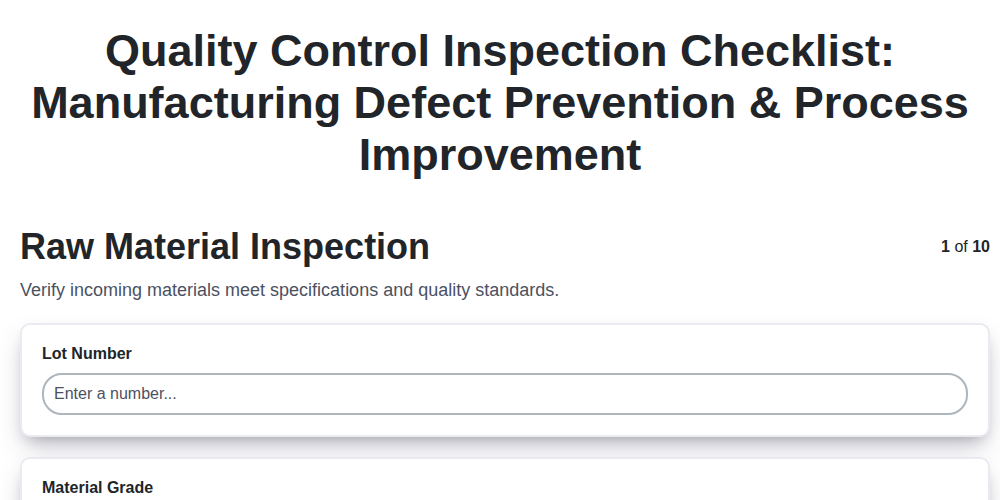
Шаблон за проверка на качеството: Предотвратяване на дефекти и подобряване на производствените процеси
Можем да го направим заедно
Нуждаете се от помощ с
Checklists?
Имате въпрос? Тук сме, за да помогнем. Моля, изпратете запитването си и ние ще отговорим своевременно.