Future-Proofing Your Garage: The 2026 Automotive Technician Training & Skill Gap Checklist Template
Publicado: 31/10/2026 Atualizado: 01/11/2026
Índice
- Introduction: Navigating the Shifting Landscape of Automotive Service in 2026
- Phase 1: Establishing the Foundation - Technician Profile & Core Competency Assessment
- Phase 2: Mastering the Digital Engine - Diagnostic Software & Electronic Systems Proficiency
- Phase 3: The Electric Transition - EV & Hybrid Technology Competency
- Phase 4: Precision Engineering - Advanced Mechanical Repair & Specialized Skills
- Phase 5: Streamlining Operations - Digital Documentation & Workshop Management Software
- Phase 6: Safety First - Workshop Safety & PPE Compliance Standards
- Phase 7: The Human Element - Customer Communication & Service Advisory Skills
- Phase 8: Asset Longevity - Specialized Tool & Equipment Maintenance Knowledge
- Phase 9: Long-term Growth - Professional Development & Certification Roadmap
- Conclusion: Implementing Your Skill Gap Strategy for a Competitive Advantage
- Resources & Links
TLDR: Stay ahead of the evolving automotive landscape with our 2026 Technician Skill Gap Checklist. This essential guide helps workshop managers identify critical competency gaps across EV/Hybrid systems, advanced diagnostics, digital workshop management, and customer service to ensure your team is fully equipped for the next generation of vehicle technology.
Introduction: Navigating the Shifting Landscape of Automotive Service in 2026
The automotive landscape is no longer changing; it has fundamentally transformed. As we move into 2026, the era of the grease monkey has officially been superseded by the era of the systems engineer. The traditional workshop, once defined by mechanical intuition and heavy wrenches, is now a high-tech hub of complex software integration, high-voltage safety protocols, and data-driven diagnostics.
The New Reality of the Modern Workshop
The rapid acceleration of Electric Vehicle (EV) adoption, the integration of Advanced Driver Assistance Systems (ADAS), and the rise of Software-Defined Vehicles (SDVs) have created a widening chasm between traditional mechanical skills and the requirements of the modern service bay. For workshop owners and service managers, this gap isn't just a training hurdle-it is a significant business risk.
Failure to bridge this skill gap leads to increased diagnostic times, higher comeback rates, and the loss of high-margin repair opportunities. Conversely, a workforce that is prepared for the complexities of 2026 becomes a powerful competitive advantage, driving customer trust and operational efficiency.
Why a Structured Assessment is Non-Negotiable
In an era where a single vehicle repair can involve both a physical component and a complex software recalibration, guessing at your team's ability is no longer an option. You cannot manage what you do not measure.
This checklist is designed to serve as a diagnostic tool for your human capital. It is not merely a way to identify what your technicians don't know, but a strategic roadmap to cultivate what they must master. By systematically evaluating your team against these nine critical pillars, you can transition from a reactive training model to a proactive, future-ready operational strategy.
Objectives of this Checklist:
- Identify Critical Vulnerabilities: Pinpoint exactly where technical deficiencies could lead to safety risks or revenue loss.
- Optimize Training ROI: Move away from generic training and toward targeted, high-impact skill development.
- Standardize Excellence: Ensure a uniform level of competency across your entire technical team, regardless of seniority.
- Enhulate Retention: Provide your technicians with a clear, professional growth trajectory, fostering loyalty in a highly competitive labor market.
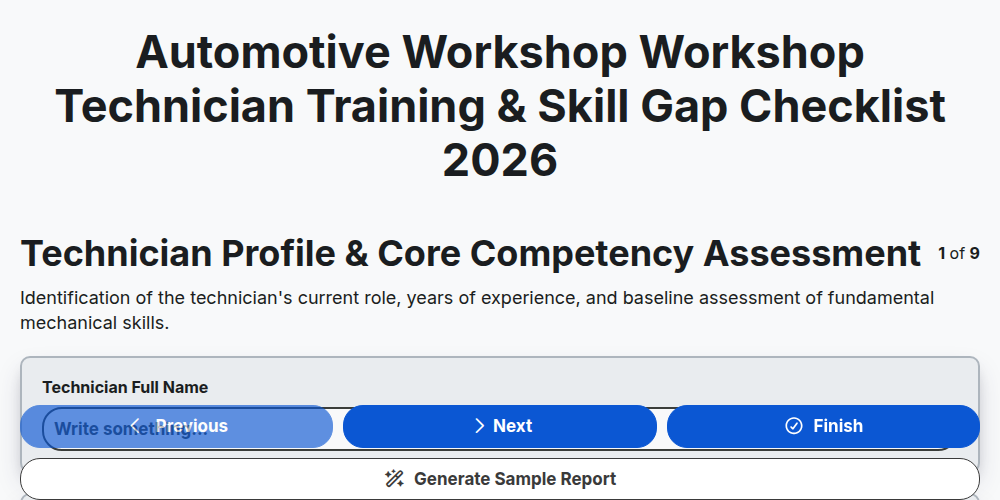
Phase 1: Establishing the Foundation - Technician Profile & Core Competency Assessment
Benchmarking Current Capabilities
Before implementing new training programs, you must first understand your baseline. You cannot bridge a gap that you haven't first measured. The first phase of your 2026 audit focuses on moving away from gut feelings about staff performance and moving toward a data-driven assessment of your workshop's actual capabilities.
Defining the Modern Technician Persona
The role of a technician in 2026 is no longer strictly mechanical; it is a hybrid of mechanical mastery and digital literacy. To build an effective checklist, you must assess your team against a modernized competency framework that includes:
- Technical Proficiency: Assessing fundamental mechanical skills versus specialized electronic skills.
- Digital Fluency: The ability to navigate complex diagnostic interfaces and integrated workshop ecosystems.
- Adaptability Quotient: Evaluating how quickly a technician can transition from internal combustion engine (ICE) workflows to high-voltage EV procedures.
The Skills Audit Process
To execute this phase effectively, implement a standardized assessment for every member of your technical team. This involves more than just a driving test; it requires a multi-layered review:
- Self-Assessment Surveys: Empower technicians to identify where they feel confident and where they feel overwhelmed by new technologies.
- Practical Competency Testing: Observing hands-on performance in controlled scenarios, specifically focusing on the integration of diagnostic tools with mechanical tasks.
- Performance Data Review: Analyzing historical repair times, comeback rates, and diagnostic accuracy to identify hidden patterns of inefficiency.
Identifying the Skill Decay Risk
As vehicle architecture shifts toward Software-Defined Vehicles (SDVs), certain traditional skills may become secondary, while others become critical. Use this assessment phase to identify skill decay-where technicians may be losing proficiency in legacy systems while simultaneously lacking the high-voltage training required for the incoming 2026 fleet.
By the end of Phase 1, your goal is to produce a Competency Heat Map: a visual representation of where your workshop is Green (Proficient), Yellow (Developing), or Red (Critical Gap). This map will serve as the blueprint for all subsequent training investments.
Phase 2: Mastering the Digital Engine - Diagnostic Software & Electronic Systems Proficiency
Navigating the Complexity of Modern Vehicle Architectures
As we move into 2026, the mechanical era of the workshop has officially merged with the computational era. A technician's ability to turn a wrench is now secondary to their ability to interpret data. To bridge the skill gap, your training program must move beyond basic OBD-II scanning and focus on deep-system integration.
Beyond the Scanner: Advanced Data Interpretation
It is no longer enough to simply read a fault code. A proficient technician must be able to perform Live Data Stream Analysis to identify intermittent sensor failures and understand the relationship between various Controller Area Network (CAN bus) signals.
Key competencies to audit include:
- Protocol Fluency: Understanding CAN, LIN, and Automotive Ethernet communication protocols.
- Oscilloscope Mastery: Using signal analyzers to diagnose electrical waveforms and sensor degradation.
- Module Programming & Flashing: Proficiency in ECU re-flashing, adaptation, and software updates without risking bricked modules.
Integrating Ecosystem Diagnostics
Modern vehicles are a web of interconnected ECUs. Your technicians must be trained to look at the vehicle as a single, integrated ecosystem rather than a collection of isolated parts.
Training Focus Areas for 202 and beyond:
- Gateway Module Navigation: Navigating security gateways that prevent unauthorized access to vehicle functions.
- Sensor Fusion Analysis: Understanding how ADAS (Advanced Driver Assistance Systems)-related sensors (Radar, LiDAR, Camera) interact with the vehicle's braking and steering logic.
- Diagnostic Software Versatility: Mastery of both OEM-specific software and high-end aftermarket multi-brand diagnostic platforms.
The 2026 Benchmark: A technician is considered digitally proficient when they can trace a fault from a software-driven command through the physical wiring to the mechanical actuator.
Phase 3: The Electric Transition - EV & Hybrid Technology Competency
Navigating the High-Voltage Frontier
As we approach 2026, the shift toward electrification is no longer a future projection-it is the current reality of the workshop floor. Assessing competency in EV and hybrid systems is arguably the most critical component of your skill gap analysis. A technician who excels at internal combustion engines (ICE) but lacks high-voltage (HV) literacy represents a significant liability and a missed revenue opportunity.
Core EV Competency Benchmarks
To ensure your team is prepared for the next wave of vehicle arrivals, evaluate proficiency in the following critical areas:
- High-Voltage Safety Protocols: Beyond basic PPE, technicians must demonstrate mastery in de-energizing procedures, testing for the absence of voltage, and managing insulated tools.
- Battery Pack Diagnostics & Service: The ability to perform cell-level diagnostics, manage thermal management systems, and understand battery degradation patterns is essential.
- Regenerative Braking & Motor Control Systems: Understanding the integration between electric motors, inverters, and braking systems is vital for complex troubleshooting.
- DC Fast Charging & AC Level 2 Infrastructure: Technicians must understand the nuances of charging protocols and how onboard chargers interact with external power sources.
Identifying the Skill Gap
When auditing your staff, look beyond general knowledge. Use this checklist to categorize your team into three tiers:
- Foundational: Familiarity with EV terminology and basic safety precautions.
- Intermediate: Ability to perform routine maintenance on hybrids and basic-level diagnostic troubleshooting.
- Advanced/Specialist: Proficiency in high-voltage component replacement, advanced thermal system repair, and complex software-based drivetrain calibration.
The 2026 Goal: Your objective should be to move as many technicians as possible from the Foundational tier to Advanced, ensuring your workshop remains capable of servicing the high-margin, high-complexity electric vehicles that will dominate the market by the end of the decade.
Phase 4: Precision Engineering - Advanced Mechanical Repair & Specialized Skills
Mastering the New Era of Mechanical Precision
As vehicle architectures become increasingly complex, the boundary between traditional mechanics and precision engineering is blurring. In 2026, knowing how to fix it is no longer enough; technicians must possess the ability to execute repairs with micron-level accuracy and understand the interplay between mechanical components and high-speed digital sensors.
Beyond the Wrench: High-Precision Competencies
To bridge the skill gap in this phase, your training checklist must move beyond basic component replacement and focus on the following critical areas:
- Micro-Tolerance Component Calibration: As engine designs and suspension geometries become tighter, technicians must be proficient in using precision measuring instruments (micrometers, dial indicators, and laser alignment tools) to ensure components meet exact OEM specifications.
- Advanced Thermal Management Systems: With the rise of high-performance EVs and heavy-duty hybrids, mastering the repair and maintenance of complex liquid cooling loops and heat exchanger systems is non-negotiable.
- Sensor-Integrated Mechanical Assemblies: Technicians must understand how mechanical wear affects sensor feedback. This includes the ability to service components like electronically controlled dampers, active aero-flaps, and variable valve timing (VVT) systems without compromising sensor integrity.
The Shift from Repair to Re-Engineering
The modern workshop is transitioning from a parts-swapping environment to a technical laboratory. To ensure your team stays ahead of the 2026 curve, evaluate their proficiency in:
- Material Science Literacy: Understanding how new composites, lightweight alloys, and high-strength steels react to heat and mechanical stress during repair processes.
- Structural Integrity Verification: Assessing the ability to perform non-destructive testing (NDT) to identify micro-fractures or fatigue in critical chassis and drivetrain components.
- Precision Fastening Protocols: Mastery of torque-to-yield procedures and the application of specialized adhesives and thread-locking compounds essential for modern lightweight assemblies.
Identifying the Gap
When auditing your team, ask: Can the technician identify when a mechanical failure is actually a symptom of a calibration error? If the answer is no, your training roadmap needs to pivot from basic mechanical repair toward advanced system integration and precision diagnostics.
Phase 5: Streamlining Operations - Digital Documentation & Workshop Management Software
Bridging the Digital Divide in the Modern Bay
As we approach 2026, the paper-and-pen era of automotive repair is officially a relic of the past. For a workshop to remain profitable and scalable, the technician's proficiency must extend beyond the wrench and into the digital interface. A skill gap in digital literacy can lead to lost revenue, inaccurate billing, and delayed vehicle turnaround times.
Mastering the Digital Workflow
In the modern landscape, a technician's job isn't finished when the bolt is torqued; it is finished when the digital record is complete. This phase of the checklist focuses on ensuring your team can seamlessly navigate the software ecosystem that drives your business.
Key Competencies to Evaluate:
- Real-Time Digital Inspection Integration: Can your technicians use tablets to capture high-resolution images and videos of faulty components? The ability to document findings digitally is the most powerful tool for building customer trust.
- Precision in Digital Vehicle Health Reports (DVHR): Assess whether technicians can accurately translate complex mechanical issues into clear, standardized digital reports that translate directly to the service advisor's desk.
- Workshop Management System (WMS) Literacy: Proficiency in logging labor times, tracking parts usage, and updating job statuses in real-time is critical to maintaining an efficient shop flow and preventing lost hours.
- Data-Driven Diagnostic Integration: Evaluate how effectively technicians bridge the gap between scanning tool data and the workshop management software to ensure repair histories are comprehensive and searchable.
Why Digital Proficiency is a KPI
The transition to digital documentation is not just about organization; it is about data integrity. When technicians master these software tools, the garage gains access to invaluable analytics-such as average repair times and common failure patterns-that allow for smarter business decisions.
Reducing the friction between the mechanical repair and the digital record ensures that your workshop operates as a high-performance, data-driven environment ready for the complexities of the 2026 automotive market.
Phase 6: Safety First - Workshop Safety & PPE Compliance Standards
Navigating the Evolving Risks of the Modern Workshop
As vehicle architectures become more complex, the definition of safety in the workshop is undergoing a radical transformation. In 2026, safety compliance is no longer just about preventing trips and falls; it is about managing high-voltage risks, chemically advanced fluids, and sophisticated sensor-driven environments.
To bridge the skill gap, your training checklist must move beyond basic compliance and focus on advanced hazard mitigation.
High-Voltage Safety & Electrical Arc Flash Protection
With the surge in EV and Hybrid integration, technicians must be assessed on their ability to manage high-voltage (HV) ecosystems.
- De-energizing Protocols: Proficiency in verifying the zero-voltage state before commencing work.
- Insulated Tooling Audits: Regular inspection of Class 0 and Class 00 rated gloves and insulated hand tools for punctures or degradation.
- PPE Integrity: Mandatory training on the use of arc-flash rated face shields and specialized footwear designed for electrical insulation.
Chemical Management & New-Age Fluid Hazards
The transition to sustainable workshop practices introduces new chemical complexities.
- REACH & Chemical Safety: Mastery of Safety Data Sheets (SDS) for new coolant types, battery electrolytes, and advanced cleaning solvents.
- Spill Containment Mastery: Implementation of rapid-response protocols for specialized fluids that may react differently to traditional absorbents.
Integrated Safety Monitoring & Digital Compliance
Safety in 2026 is data-driven. Your checklist should include:
- Digital PPE Tracking: Using workshop management software to log the lifecycle and inspection dates of critical safety gear.
- Ergonomic Assessment: Training technicians to utilize smart lifting aids and exoskeleton support where applicable to reduce long-term musculoskeletal strain.
- Automated Hazard Reporting: Ensuring every technician is proficient in using digital platforms to report near-misses in real-time, turning safety data into actionable training insights.
Phase 7: The Human Element - Customer Communication & Service Advisory Skills
Bridging the Gap Between the Wrench and the Client
As vehicles become more complex, the role of the technician is evolving from a pure mechanical expert to a technical consultant. In 2026, the ability to explain a complex software update or an EV battery degradation report is just as critical as the ability to perform the repair itself. A technician who can communicate effectively reduces comebacks, builds long-term trust, and directly increases the workshop's profitability.
Mastering the Art of Technical Translation
The modern customer is often highly informed but lacks specialized technical knowledge. The skill gap here isn't about knowing less; it's about the ability to translate complex diagnostic data into understandable, actionable information.
- Translating Diagnostics: Can the technician explain why a specific sensor failure impacts vehicle drivability without using overwhelming jargon?
- Visual Evidence Integration: Utilizing digital vehicle inspections (DVI) to show customers real-time photos or videos of worn components to validate repair recommendations.
- Transparency in Estimates: Clearly articulating the difference between immediate safety concerns and future maintenance needs to manage customer expectations and budgets.
The Service Advisor Synergy
The boundary between the workshop floor and the service desk is blurring. To optimize workshop flow, technicians must possess the soft skills required to support the advisory process.
- Active Listening: Training technicians to capture precise symptoms from the customer during the vehicle drop-off phase to reduce diagnostic time.
- Confidence in Recommendation: Empowering technicians to support the Service Advisor's recommendations with technical evidence, ensuring a unified front to the client.
- Managing Expectations: Developing the ability to provide realistic timelines for complex repairs, especially when waiting on specialized electronic components or EV parts.
Building Trust through Professionalism
In an era of digital reviews and instant feedback, every interaction is a branding opportunity. Evaluating a technician's communication skills means looking at their ability to maintain a professional demeanor that reflects the high-tech standards of a modern, 2026-ready facility.
Phase 8: Asset Longevity - Specialized Tool & Equipment Maintenance Knowledge
Maintaining the Backbone of Your Workshop
In 2026, a workshop technician's role extends far beyond turning wrenches. As vehicles become increasingly reliant on complex sensors, high-voltage systems, and delicate-to-calibrate hardware, the tools used to service them have become as sophisticated as the cars themselves. Neglecting the maintenance of your diagnostic computers, precision measuring instruments, and heavy-duty lifting equipment is no longer just a maintenance issue-it is a direct threat to your workshop's profitability and safety compliance.
Precision Calibration & Diagnostic Tool Care
Modern diagnostics are only as accurate as the software and hardware driving them. This stage of the checklist focuses on the technician's ability to:
- Software Integrity: Regularly checking for firmware updates and ensuring diagnostic interfaces are compatible with the latest vehicle communication protocols.
- Sensor Calibration: Understanding the strict maintenance schedules for torque wrenches, micrometers, and laser alignment systems to ensure precision remains more than just a buzzword.
- Hardware Hygiene: Implementing protocols for the cleaning and protection of sensitive electronic probes, battery testers, and scanning tablets from oil, debris, and electrostatic discharge.
Heavy Equipment & Lifting Safety
The integrity of your workshop's physical infrastructure is non-negotiable. Technicians must be trained to identify early signs of wear in:
- Hydraulic Systems: Monitoring for leaks, pressure drops, and fluid degradation in lifts, presses, and jack stands.
- Pneumatic Maintenance: Managing moisture levels and lubrication in air lines and pneumatic tools to prevent internal corrosion and tool failure.
- Battery & Charging Station Upkeep: Ensuring that high-voltage charging units for EVs are inspected for terminal corrosion and cable integrity.
The Cost of Neglect
A technician who understands tool maintenance prevents the hidden costs of the workshop: unplanned downtime, inaccurate repairs leading to customer comebacks, and the massive capital expenditure of replacing avoidable equipment failures. Use this phase of the checklist to ensure your team treats your workshop's assets with the same precision they apply to a vehicle's engine.
Phase 9: Long-term Growth - Professional Development & Certification Roadmap
Mapping the Path to Mastery
The final stage of your training audit isn't about identifying what is missing today, but predicting what will be required tomorrow. In an era of rapid-fire technological disruption, a technician's skill set has a shorter half-life than ever before. To prevent your workforce from becoming obsolete, your roadmap must transition from reactive troubleshooting to proactive career architecture.
Building a Continuous Learning Ecosystem
A certification roadmap is more than just a list of seminars; it is a strategic blueprint for employee retention and operational excellence. As we move into 2026, the focus must shift from one-and-done training sessions to a culture of continuous upskilling.
Key Components of the 2026 Roadmap:
- Tiered Certification Tracks: Establish clear milestones for technicians, moving from General Service Technicians to Master Diagnostic Specialists and EV/High-Voltage Specialists. Each tier should be tied to specific, measurable competency benchmarks.
- Manufacturer-Specific Accreditation: Ensure your team maintains direct links to OEM (Original Equipment Manufacturer) training modules. As vehicle architectures become increasingly software-defined, staying synced with manufacturer updates is non-negotiable.
- The Digital Literacy Standard: Integrate training for emerging diagnostic platforms, augmented reality (AR) assisted repairs, and advanced telematics interpretation. The modern technician must be as proficient with a tablet as they are with a torque wrench.
- Subsidized Skill Acquisition: Incentivize professional growth by offering workshops or workshops-funded certifications. This not only closes the skill gap but serves as a powerful tool for reducing technician turnover in a highly competitive labor market.
Strategic Implementation
When auditing this final phase, ask yourself: If a new vehicle technology is released in 12 months, does my team have the structural framework to absorb that knowledge without disrupting workshop productivity?
The goal of this roadmap is to transform your workshop from a place that simply fixes cars into a high-tech laboratory of automotive expertise, ensuring your garage remains the preferred destination for the next generation of intelligent vehicles.
Conclusion: Implementing Your Skill Gap Strategy for a Competitive Advantage
Turning the Checklist into Actionable Growth
The transition toward an electrified, software-defined automotive landscape is no longer a distant projection-it is the current reality. As we approach 2026, the gap between traditional mechanical expertise and the high-tech demands of modern vehicle architecture will only widen. Using this checklist is not merely about identifying weaknesses; it is about building a strategic roadmap to ensure your workshop remains a leader in the industry rather than a relic of the past.
From Identification to Implementation
A checklist is only as valuable as the action it inspires. Once you have completed your assessment, avoid the temptation to overhaul everything at once. Instead, adopt a tiered approach to closing the identified gaps:
- The Immediate Fix (Safety & Compliance): Address gaps in Workshop Safety & PPE Compliance and Specialized Tool Maintenance immediately. These are non-negotiable for operational stability and risk mitigation.
- The Core Evolution (Diagnostic & Mechanical): Prioritize training in Diagnostic Software and Advanced Mechanical Skills. These are the engines of your workshop's daily productivity and repair accuracy.
- The Future-Proofing Phase (EV & Digital): Allocate long-term budget for EV & Hybrid Competency and Digital Workshop Management. These skills will define your ability to capture the next generation of high-value customers.
Cultivating a Culture of Continuous Learning
The most successful workshops of 2026 will be those that treat the Professional Development & Certification Roadmap as a living document. By integrating training into the weekly rhythm of the shop, you transform training from a chore into a competitive advantage.
When your technicians are proficient in the latest electronic systems and your service advisors are masters of digital communication, you create a virtuous cycle: higher technical accuracy leads to fewer comebacks, which leads to higher customer trust, which ultimately drives workshop profitability.
Final Thought
The automotive industry is undergoing its most significant transformation in a century. The technicians who thrive will be those who blend traditional mechanical intuition with advanced digital fluency. Use this checklist to audit your current state, identify your trajectory, and ensure your team is prepared to lead the road ahead.
Resources & Links
- ASE (National Institute for Automotive Service Excellence): The gold standard for automotive technician certification and industry-recognized skill validation.
- AutoTech Schools: Online training platform focused on modern automotive technology and hands-on learning modules.
- Edmunds: Comprehensive automotive news and trends to help stay ahead of vehicle technology shifts.
- OSHA (Occupational Safety and Health Administration): Essential regulatory guidelines for workshop safety, chemical handling, and PPE compliance.
- AutoFocus: Insights into the future of mobility, including EV infrastructure and connected vehicle ecosystems.
- Mitchell 1: Leading provider of shop management software and-repair information for modern garages.
- iFixit: A resource for understanding repairability and mechanical disassembly logic.
- Electrified: Focuses on the transition to electric vehicles and the specialized skills required for EV maintenance.
- Autodata: Critical technical data, wiring diagrams, and diagnostic information for workshop efficiency.
- SkillUp: General professional development resources to aid in long-term career roadmap planning.
- Fleet Maintenance Magazine: Industry updates regarding heavy-duty technology, diagnostic software, and workshop management.
- Denton Automotive: Resources regarding advanced automotive training and technical service excellence.
- PwC (Automotive Insights): High-level economic and industry trends regarding the global automotive landscape and labor shifts.
- LinkedIn Learning: Platform for developing soft skills, such as customer communication and management leadership.
- Snap-on Tools: Information on high-end diagnostic equipment and specialized tool maintenance essentials.
- Automotive News: The industry's premier source for news on the shifting landscape of the automotive service sector.
Comentários
Ainda não existem comentários. Seja o primeiro a adicionar um!
Demonstração da Solução de Gestão para a Indústria Automobilística
Otimize a sua produção automóvel! O ChecklistGuro digitaliza os fluxos de trabalho, desde a inspeção de peças até aos testes finais. Reduza erros, aumente a eficiência e garanta o cumprimento dos padrões de qualidade. Obtenha resultados com o nosso Sistema Operacional de Trabalho.
Artigos relacionados
Automotive Customer Satisfaction: Your Follow-Up Checklist for Lasting Loyalty
The Ultimate Automotive Sales Prospect Follow-Up Checklist: Close More Deals

The Ultimate Vehicle Registration & Insurance Validation Checklist

Drive Sales Success: Your Automotive Sales Team Performance Tracking Checklist
The Ultimate Automotive Dealer Operations Checklist: A Comprehensive Guide
The Ultimate Tire Pressure & Condition Checklist Template

Maximize Your Trade-In: The Automotive Appraisal Checklist You Need
Streamline Your Shop: The Ultimate Automotive Parts Ordering & Receiving Checklist
Precisa de ajuda com o(a) Automotivo?
Tem alguma dúvida? Estamos aqui para ajudar. Envie a sua questão e responderemos o mais breve possível.