The Ultimate HACCP Implementation Checklist: A Step-by-Step Guide to Food Safety Compliance
Publicado: 22/11/2026 Atualizado: 23/11/2026
Índice
- Introduction to HACCP: Why Systematic Food Safety Matters
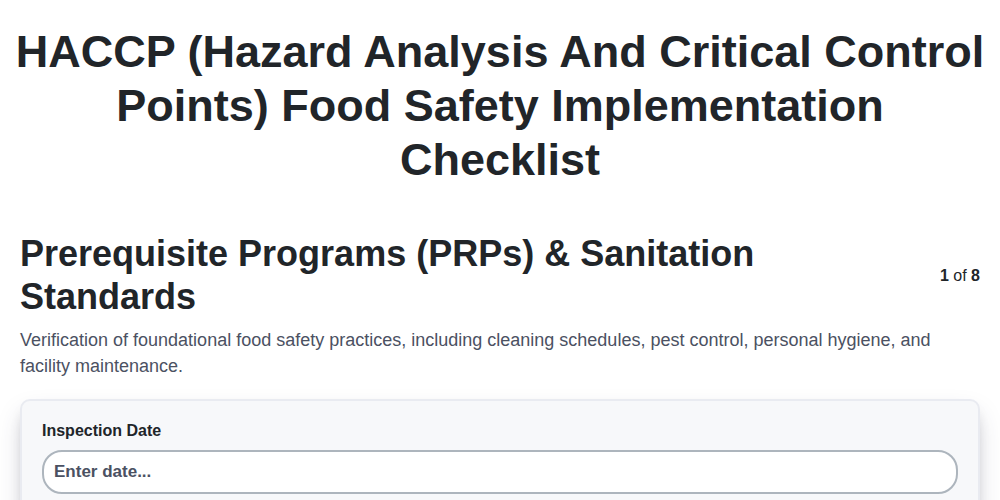
- Step 1: Laying the Foundation with Prerequisite Programs (PRPs) & Sanitation Standards
- Step 2: Conducting a Comprehensive Hazard Analysis & Risk Assessment
- Step 3: Identifying Your Critical Control Points (CCPs)
- Step 4: Establishing Science-Based Critical Limits
- Step 5: Implementing Robust Monitoring Procedures & Surveillance
- Step 6: Developing Corrective Actions & Deviation Management Protocols
- Step 7: Executing Verification & Validation Activities
- Step 8: Mastering Record Keeping & Documentation Control
- Conclusion: Ensuring Long-Term HACCP Success
- Resources & Links
TLDR: Master food safety compliance with our comprehensive HACCP implementation checklist. This guide breaks down the essential steps-from establishing Prerequisite Programs (PRPs) and performing hazard analyses to defining critical limits, monitoring procedures, and maintaining robust documentation-to help you ensure food safety and regulatory success.
Introduction to HACCP: Why Systematic Food Safety Matters
Why a Systematic Approach is Non-Negotiable
In the food industry, good hygiene is never enough. While cleanliness is a vital foundation, it is a reactive measure-it focuses on cleaning up after a mess has already been made. To ensure true food safety, businesses must shift from a reactive mindset to a proactive one. This is where HACCP (Hazard Analysis and Critical Control Points) becomes the gold standard.
HACCP is a systematic, science-based approach designed to identify, evaluate, and control biological, chemical, and physical hazards that could compromise food safety. Rather than inspecting finished products for defects, HACCP allows you to monitor the entire production process, pinpointing exactly where things could go wrong before they ever reach the consumer.
The High Stakes of Food Safety Compliance
The importance of implementing a robust HACCP plan extends far beyond simple regulatory compliance. For food manufacturers, processors, and even large-scale caterers, the stakes include:
- Consumer Protection: The primary goal is preventing foodborne illnesses and protecting the health of your customers.
- Brand Integrity: A single food safety incident or a widespread product recall can cause irreparable damage to your brand reputation and consumer trust.
- Regulatory Compliance: Adhering to HACCP principles is often a legal requirement under global food safety regulations (such as FSMA in the US or EU food law).
- Operational Efficiency: By identifying critical points of failure, you reduce waste, minimize product loss, and streamline your production workflows.
Implementing HACCP can feel like a daunting task, but it is essentially a roadmap for excellence. By following a structured checklist, you can transform food safety from a complex legal burden into a seamless, integrated part of your daily operations.
Step 1: Laying the Foundation with Prerequisite Programs (PRPs) & Sanitation Standards
Building the Foundation of Food Safety
Before you can implement a HACCP plan, you must first ensure that your facility meets the fundamental requirements of food safety. Think of HACCP as the advanced structural engineering of your safety plan; however, it cannot stand without a solid foundation of Prerequisite Programs (PRPs).
PRPs are the basic operational conditions and activities necessary to maintain a hygienic environment. Without robust PRPs, your HACCP plan will likely fail because the preventative measures will be overwhelmed by avoidable environmental hazards.
Core Components of Prerequisite Programs
To ensure your facility is ready for hazard analysis, you must audit and implement the following sanitation and operational standards:
- Good Manufacturing Practices (GMPs): Establish strict rules for personnel hygiene, including handwashing protocols, proper use of hairnets/gloves, and clean uniform requirements.
- Sanitation Standard Operating Procedures (SSOPs): Develop detailed, written instructions for cleaning and sanitizing all food-contact surfaces, equipment, and the facility environment.
- Pest Control Management: Implement a proactive program to prevent, monitor, and eliminate pest activity within the production area.
- Supplier Control & Raw Material Verification: Ensure that all ingredients and packaging materials are sourced from approved suppliers and meet predefined safety specifications.
- Equipment Maintenance & Calibration: Establish a schedule for preventive maintenance to ensure machinery operates correctly and that sensors (like thermometers) provide accurate readings.
- Facility Design & Flow: Ensure the physical layout of your plant prevents cross-contamination by separating raw materials from processed goods and managing air/water flow effectively.
- Training & Competency: Documented training for all staff members regarding food handling, allergen management, and cleaning procedures.
Why This Step is Non-Negotiable
If your sanitation standards are weak, hazards will be constantly introduced into your production line. By mastering your PRPs first, you reduce the number of Critical Control Points (CCPs) you need to manage later, making your HAC&&CP plan more efficient, manageable, and effective.
Step 2: Conducting a Comprehensive Hazard Analysis & Risk Assessment
Evaluating Potential Threats to Food Safety
Once your Prerequisite Programs (PRPs) are firmly in place, the core of the HACCP system begins with the Hazard Analysis. This is the most critical stage of the process, as it serves as the foundation upon which your entire food safety plan is built. The goal here is not just to identify what could go wrong, but to scientifically evaluate the significance of each potential threat.
In this phase, you must scrutinize every stage of your production process-from raw material receiving to storage, processing, and final distribution-to identify potential biological, chemical, or physical hazards.
Identifying the Three Primary Hazard Categories
To conduct a thorough assessment, you must categorize potential hazards into three distinct areas:
- Biological Hazards: This includes pathogens such as Salmonica, Listeria, E. coli, and various viruses or molds that can cause foodborne illness.
- Chemical Hazards: This covers anything from naturally occurring toxins (like mycotoxins) to unintended additives, such as pesticide residues, cleaning agent leftovers, or allergens.
- Physical Hazards: These are foreign objects that could cause injury to a consumer, such as metal fragments, glass, hard plastic, or wood splinters.
The Risk Assessment Matrix: Severity vs. Likelihood
Identifying a hazard is only half the battle; you must also determine its level of risk. To do this effectively, food safety teams use a risk assessment matrix based on two key variables:
- Severity: If this hazard occurs, how much harm would it cause? (e.g., A minor stomach upset vs. a life-threatening allergic reaction or fatality).
- Likelihood: How probable is it that this hazard will be present in your product at a specific point in the process?
Determining Significance
By cross-referencing the severity of a hazard with its likelihood, you can categorize risks as Low, Medium, or High.
- Low Risk: Hazards that are unlikely to occur and have minimal impact may not require a specific control point.
- High/Significant Risk: Hazards that are highly likely to occur or have severe health consequences are the primary candidates for your Critical Control Points (CCPs).
Pro-Tip: Never skip the process flow review before this step. You cannot analyze hazards for a step in your production line that you haven't clearly defined and documented. A thorough hazard analysis ensures that your resources are focused on the risks that actually matter, preventing safety fatigue and ensuring a robust, efficient HACCP plan.
Step 3: Identifying Your Critical Control Points (CCPs)
Pinpointing the Critical Junctions in Your Process
Once you have completed your thorough hazard analysis and understood the risks involved, the next vital step is distinguishing between a general control measure and a Critical Control Point (CCP).
Not every step in your food production process is a CCP. While many steps are essential for maintaining general hygiene, a CCP is a specific stage where a control measure must be applied to prevent, eliminate, or reduce a food safety hazard to an acceptable level. If this step fails, the safety of the final product is directly compromised.
How to Determine if a Step is a CCP
To accurately identify your CCPs, most food safety professionals utilize a Decision Tree. This logic-based tool helps you evaluate each identified hazard through a series of questions:
- Are there preventive measures in place for this hazard?
- Is this step specifically designed to eliminate or reduce the hazard?
- Could contamination occur, or could the hazard increase, after this step?
- Will a subsequent step effectively eliminate the risk?
Distinguishing CCPs from Prerequisite Programs (PRPs)
It is common to confuse a CCP with a standard sanitation procedure. For example, washing hands is a vital Prerequisite Program (PRP) that reduces overall microbial load, but it is usually not a CCP because it lacks a measurable, specific limit that is monitored to prevent a specific, high-level hazard in a controlled manner.
In contrast, a cooking stage that must reach a specific internal temperature (e.g., 165°F/74°C) to kill pathogens is a classic example of a CCP.
The Goal of Identification
The objective of this stage is to create a focused list of non-negotiable points in your production line. By narrowing your focus to these specific points, you ensure that your resources, monitoring efforts, and staff training are concentrated where they matter most, ensuring maximum protection for your consumers and total compliance with regulatory standards.
Step 4: Establishing Science-Based Critical Limits
Defining the Boundaries of Safety
Once you have identified your Critical Control Points (CCPs), the next-and arguably most vital-step is establishing Critical Limits. A critical limit is a maximum or minimum value to which a biological, chemical, or physical parameter must be controlled to prevent, eliminate, or reduce a food safety hazard to an acceptable level.
Think of a critical limit as the line in the sand. If your process stays on one side of the line, your food is safe; if it crosses that line, you have a potential food safety crisis on your hands.
What Makes a Good Critical Limit?
A common mistake in HACCP implementation is setting limits that are too vague. A limit like cook the meat until it is hot is not a critical limit because it is subjective and unmeasurable. To ensure compliance and safety, every limit must be measurable and observable.
To be effective, your critical limits should be based on:
- Scientific Evidence: Use validated studies, regulatory requirements (such as FDA or USDA standards), or recognized food science literature.
- Measurable Parameters: Use specific units of measure, such as temperature (°C/°F), time (minutes/hours), pH levels, moisture content (aw), or acidity.
- Clear Thresholds: Define exactly where the danger zone begins. For example, Internal temperature of poultry must reach 165°F (74°C) for at least 15 seconds.
Avoiding Common Pitfalls
When establishing these boundaries, keep these three principles in mind:
- Precision over Convenience: Do not set a limit based on what is easy for your staff to achieve; set it based on what is required to kill the pathogen.
- Distinguish Between Limits and Operational Limits: While a Critical Limit is the absolute fail point, many smart producers also use Operational Limits. For example, if your critical limit for a fridge is 40°F, you might set an operational limit of 38°F to allow your team to react before a violation actually occurs.
- Consistency is Key: Ensure that the limits established in your HACCP plan are the exact same values used in your monitoring logs and staff training manuals.
By establishing rigorous, science-backed critical limits, you move from a reactive state of hoping for the best to a proactive state of ensuring safety.
Step 5: Implementing Robust Monitoring Procedures & Surveillance
Ensuring Consistency Through Active Surveillance
Once you have established your Critical Control Points (CCPs) and defined your critical limits, the focus shifts from planning to execution. Monitoring is the eyes and ears of your food safety system. It is the process of conducting planned observations or measurements to ensure that every CCP remains within its defined safety boundaries.
Without effective monitoring, you are essentially flying blind, unable to detect a deviation until a product has already left your facility.
Defining Your Monitoring Parameters
To implement an effective surveillance program, every monitoring activity must answer four fundamental questions:
- What is being monitored? (e.g., internal temperature, pH levels, metal detector sensitivity, or cooking time).
- How is it being monitored? (e.g., using a calibrated probe thermometer, digital sensors, or visual inspections).
- How often is it being monitored? (e.g., every 30 minutes, once per batch, or at the start of every shift).
- Who is responsible? (Assigning specific roles to trained personnel to ensure accountability).
Real-Time Surveillance vs. Periodic Testing
A high-standard HACCP plan utilizes a two-tier approach to surveillance:
- Continuous/Frequent Monitoring: This involves real-time checks during the production process. For high-risk steps like pasteurization or cooling, monitoring should be continuous or occur at high frequencies to catch deviations immediately.
- Periodic Surveillance: This involves less frequent, more in-depth testing, such as microbiological swabbing of equipment or auditing the accuracy of temperature logs. This serves as a secondary layer to ensure the entire system is functioning as intended.
The Importance of Calibration and Equipment Accuracy
Monitoring is only as reliable as the tools being used. A critical component of your surveillance step is a Calibration Schedule. If a thermometer is reading 2 degrees lower than the actual temperature, your monitoring data will provide a false sense of security, potentially allowing unsafe products to pass through the line. Ensure all measuring devices are calibrated against a traceable standard at regular, documented intervals.
Training Personnel for Accurate Data Collection
The strength of your monitoring program relies heavily on the human element. Personnel performing the checks must be trained not only on how to use the equipment but also on the critical importance of data integrity. Monitoring is not a box-ticking exercise; it is a vital safety intervention. Ensure your team understands that an inaccurate reading or a missed check is a direct threat to consumer safety and business continuity.
Step 6: Developing Corrective Actions & Deviation Management Protocols
Turning Deviations into Opportunities for Improvement
Identifying a problem is only half the battle; the true strength of a HACCP plan lies in how you respond when things go wrong. In the world of food safety, a deviation occurs whenever a Critical Limit is breached-for example, if a refrigeration unit rises above the required temperature or a pasteurization cycle fails to reach the target heat.
Without a predefined Corrective Action Plan, your facility is left in a reactive state, increasing the risk of releasing unsafe products into the market.
Defining Your Response Strategy
A robust deviation management protocol must address three specific areas:
- Immediate Action (The Fix): What must be done right now to bring the process back under control? This might involve adjusting equipment settings, restarting a cooling cycle, or re-sanitizing a surface.
- Product Disposition (The Safety Check): What happens to the food affected by the deviation? You must have clear instructions on whether the product should be held, reworked, or discarded. The primary goal is to ensure no unsafe product reaches the consumer.
- Root Cause Analysis (The Prevention): This is the most critical step for long-term compliance. You must investigate why the deviation occurred. Was it human error, equipment failure, or a lapse in training? Addressing the root cause prevents the same mistake from repeating.
Essential Components of a Corrective Action Protocol
To ensure your management plan is audit-ready, your protocol should include the following elements:
- Clear Thresholds: Define exactly what constitutes a deviation so staff members don't have to guess when to trigger the protocol.
- Defined Responsibilities: Assign specific roles. Who is responsible for identifying the deviation, who has the authority to discard product, and who is responsible for notifying management?
- Traceability Links: Ensure that every corrective action is linked back to a specific batch or lot number.
- The Closed-Loop Method: A deviation is not considered resolved until a corrective action has been documented and a verification step has confirmed that the process is back within safe limits.
Pro-Tip for Implementation
Treat deviations as free lessons. Instead of viewing a breach in critical limits as a failure, view it as a vital data point that allows you to strengthen your food safety culture and refine your Prerequisite Programs.
Step 7: Executing Verification & Validation Activities
Ensuring Your System Actually Works
Once your HACCP plan is designed and implemented, the work isn't finished. You cannot simply set it and forget it. To ensure your food safety management system is functioning as intended and remains effective against evolving biological, chemical, and physical hazards, you must implement a rigorous cycle of Verification and Validation.
While these two terms are often used interchangeably, they serve two distinct and critical roles in food safety.
Verification: Are we doing what we said we would do?
Verification is the process of checking the operational side of your HACCP plan. It is an audit-style approach to confirm that your procedures are being followed correctly and that your monitoring systems are working.
To execute effective verification, your checklist should include:
- Record Reviews: Regularly auditing monitoring logs, temperature charts, and sanitation records to ensure they are being completed accurately and on time.
- Equipment Calibration: Periodically checking that thermometers, scales, and metal detectors are functioning within specified accuracy ranges.
- Observation & Auditing: Performing floor walks to observe staff performing CCP monitoring and conducting internal audits of your Prerequisite Programs (PRPs).
- Testing Protocols: Conducting microbiological or chemical testing of finished products or environmental swabs to confirm that your sanitation processes are working.
Validation: Is our plan actually effective?
Validation is the scientific proof that your HACCP plan is capable of controlling the identified hazards. It asks the fundamental question: Is the science behind our critical limits sound?
Validation occurs before a plan is implemented and whenever a significant change occurs. Key activities include:
- Scientific Literature Review: Using peer-reviewed studies or regulatory guidelines (like FDA or USDA standards) to prove that a specific temperature or time is sufficient to kill a pathogen.
- Experimental Testing: Running controlled trials to observe how specific process changes affect hazard control.
- Reviewing New Data: Updating your plan based on new results from your verification activities (e.g., if a lab test shows a pathogen survived a validated temperature, your limit must be re-evaluated).
The Feedback Loop
The relationship between verification and validation creates a continuous loop of improvement. If your verification shows that staff are failing to record temperatures, you need training. If your validation shows that your current cooking temperature is no longer sufficient for a new raw ingredient, you need to update your entire HACCP plan.
By treating these activities as an ongoing cycle rather than a one-time task, you move from mere compliance to true food safety culture.
Step 8: Mastering Record Keeping & Documentation Control
The Backbone of Compliance: Why Documentation is Non-Negotiable
In the world of food safety, there is a golden rule: If it isn't documented, it didn't happen.
Even if your HACCP plan is scientifically perfect and your staff follows every procedure to the letter, you are technically non-compliant if you cannot prove it through organized, accessible, and accurate records. Documentation serves two vital purposes: it provides the evidence required during regulatory audits and acts as a diagnostic tool to identify trends before they become food safety crises.
Essential Elements of a Robust Documentation System
To ensure your documentation control is audit-ready, your system must move beyond simple paper checklists. A professional-grade HACCP documentation strategy should include:
- Completeness and Accuracy: Every log-from temperature checks to sanitation schedules-must be filled out in real-time. Retrospective logging (filling out logs at the end of a shift from memory) is a major red flag for auditors and undermines the integrity of your entire HACCP plan.
- Traceability: Your records must allow you to trace a finished product back to its raw ingredients and forward to its distribution destination. This is critical during a product recall.
- Data Integrity & Accessibility: Whether you use paper logs or digital HACMS (HACCP Management Software), records must be easy to retrieve. In the event of an inspection, being unable to find a specific deviation report can lead to immediate non-compliance findings.
- Version Control: Ensure that the staff is always using the most current version of a form. Using an outdated monitoring sheet can lead to the omission of new, critical parameters.
Managing Deviations and Corrective Actions
Documentation control isn't just about recording success; it is most critical when things go wrong. When a Critical Limit is breached, your documentation must capture the What, Why, and How:
- What happened? (The specific deviation)
- Why did it happen? (The root cause)
- How was it fixed? (The immediate corrective action)
- How will we prevent it from happening again? (The preventive action)
Tips for Streamlining Your Records
- Standardize Formats: Use consistent templates across all production lines to reduce training errors.
- Implement Digital Solutions: Moving toward digital logging reduces human error, prevents lost paperwork, and provides real-time alerts when temperatures drift outside safe zones.
- Schedule Regular Audits of the Records: Periodically review your logs to ensure they are being completed correctly, signatures are present, and no gaps exist in the timeline.
By mastering your documentation control, you transform your HACCP plan from a static document sitting on a shelf into a living, breathing shield that protects your brand, your customers, and your business.
Conclusion: Ensuring Long-Term HACCP Success
Beyond the Checklist: Cultivating a Culture of Food Safety
Implementing a HACCP plan is not a one-and-done task; it is a continuous journey toward operational excellence. While the checklist provided above serves as your roadmap, the true strength of your food safety management system lies in its execution and evolution. A document sitting on a shelf provides no protection; a living, breathing system integrated into your daily culture does.
Moving from Compliance to Commitment
The transition from merely checking boxes to achieving true food safety excellence requires three fundamental pillars:
- Continuous Training: Food safety is only as strong as your frontline staff. Regular training ensures that every team member understands not just what the critical limits are, but why they matter to the consumer.
- Proactive Auditing: Don't wait for an official inspection to find gaps. Conduct regular internal audits of your PRPs and CCPs to identify potential failures before they result in a non-conformance.
- The Continuous Improvement Mindset: Use your verification and validation data as a tool for growth. If you notice frequent deviations in a specific process, view it as an opportunity to refine your procedures or upgrade your technology.
Final Thoughts
Navigating HACCP implementation can feel overwhelming, but by breaking it down into these structured steps-from establishing your Prerequisite Programs to rigorous record-keeping-you transform a complex regulatory requirement into a manageable, life-saving standard. By strictly adhering to this checklist, you are doing more than just avoiding recalls; you are building a foundation of trust with your customers and ensuring the integrity of your brand for years to come.
Resources & Links
- U.S. Food and Drug Administration (FDA): The primary regulatory body providing official guidelines, regulations, and compliance standards for food safety in the United States.
- USDA Food Safety and Inspection Service (FSIS): Provides essential resources for meat, poultry, and egg product producers regarding HACCP regulations and inspection protocols.
- Codex Alimentarius: The international standard-setting body that provides the global foundation for HACCP principles and food hygiene practices.
- ISO (International Organization for Standardization): Access information on ISO 22000, the international standard for food safety management systems.
- CFIA (Canadian Food Inspection Agency): Comprehensive guides on food safety regulations and HACCP implementation for those operating in or exporting to Canada.
- European Food Safety Authority (EFSA): Provides scientific advice and risk assessments regarding food safety standards across the European Union.
- Food and Agriculture Organization of the United Nations (FAO): Global resources on food security and best practices for maintaining hygiene throughout the food supply chain.
- Association of Certified Food Protection Professionals (ACFPP): A professional organization offering training, certification, and resources for food safety professionals.
- ISO 22000 Implementation Resources: Specialized information regarding the integration of HACCP principles into the ISO 22000 management framework.
- FoodSafety.gov: A collaborative effort from the US government to provide actionable food safety information for consumers and industry.
- International Sanitary/Phytosanitary Measures Convention (ISPM): Focuses on international standards for protecting global plant and animal health, relevant to raw material safety.
- PWC Food Safety Insights: Global consulting perspectives on supply chain management, risk assessment, and regulatory compliance landscapes.
- Deloitte Food Safety & Quality: Expert analysis on food safety technology, traceability, and managing global food supply chain risks.
- Food Manufacturing News: Industry news and technical articles regarding manufacturing processes, sanitation, and HACCP updates.
- ScienceDirect - Food Science: Access peer-reviewed scientific studies regarding hazard analysis, microbiology, and validation of critical limits.
- FSIS HACCP Compliance Tools: Direct access to templates, checklists, and compliance verification tools for meat and poultry establishments.
Comentários
Ainda não existem comentários. Seja o primeiro a adicionar um!
Demonstração da Solução de Gestão da Produção
Pare de perder tempo com burocracia e sistemas desconexos! A nossa solução traz clareza e controlo ao seu processo de produção. Desde os procedimentos operacionais padrão (POP) e a manutenção de equipamentos até ao controlo de qualidade e ao acompanhamento de inventário, simplificamos cada etapa.
Artigos relacionados
Kaizen Checklist Template: Your Path to Continuous Improvement

Machine Safety Audit Checklist: Your Guide to a Safer Manufacturing Workplace
Mastering Supplier Performance: Your Free Supplier Scorecard Checklist Template
Your Ultimate RCM Checklist Template: A Step-by-Step Guide

Modelo de Lista de Verificação de LPA: O Seu Guia para Auditorias de Processos em Camadas

Your Ultimate Lockout/Tagout (LOTO) Checklist Template

Your Ultimate FSC 22000 Checklist Template
Quality Control Inspection Checklist Template: Prevent Defects & Improve Manufacturing Processes
Precisa de ajuda com o(a) Fabricação?
Tem alguma dúvida? Estamos aqui para ajudar. Envie a sua questão e responderemos o mais breve possível.