The Ultimate CRM Lead Scoring Optimization Checklist 2026: A Strategic Template for High-Conversion Growth
Published: 10/31/2026 Updated: 11/01/2026
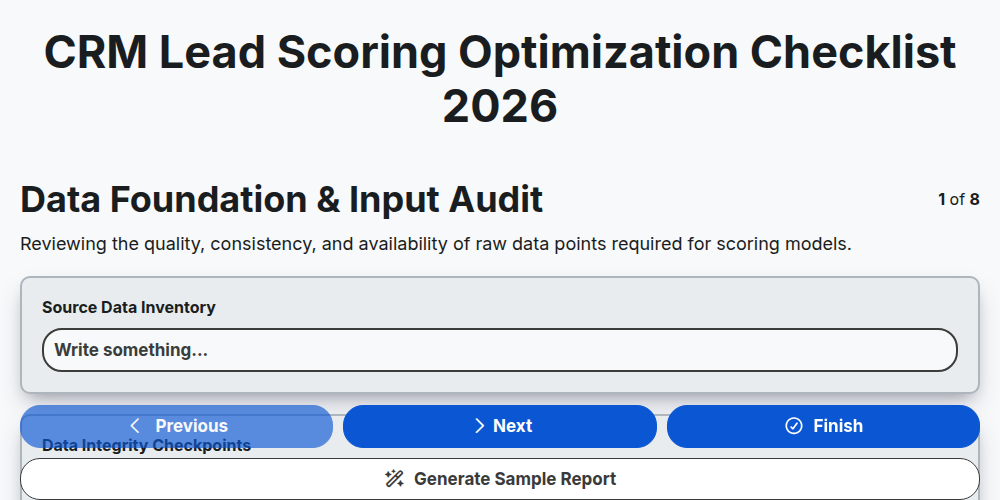
Table of Contents
- Introduction: Why Lead Scoring is the Engine of 2026 Revenue Growth
- Phase 1: Data Foundation & Input Audit: Cleaning the Pipeline
- Phase 2: Lead Attribute Definition: Identifying High-Value Identifiers
- Phase 3: Scoring Logic & Weighting Configuration: Balancing Intent vs. Fit
- Phase 4: Behavioral Trigger Setup: Capturing Real-Time Engagement
- Phase 5: Implementing Lead Decay & Negative Scoring Rules
- Phase 6: Sales & Marketing Alignment (SLA): Ensuring Unified Definitions
- Phase 7: Automation & Workflow Verification: Testing the Tech Stack
- Phase 8: Performance Monitoring & Continuous Feedback Loops
- Conclusion: Scaling Your Scoring Model for Long-Term Success
- Resources & Links
TLDR: Ensure your sales and marketing teams are perfectly aligned in 2026 with this comprehensive guide to optimizing your CRM lead scoring. This checklist provides a step-by-step framework-covering everything from data audits and behavioral triggers to lead decay rules and automated feedback loops-to help you transform raw data into high-intent, high-conversion sales opportunities.
Introduction: Why Lead Scoring is the Engine of 2026 Revenue Growth
The Future of Demand Generation: Why Static Scoring is Dead
As we enter 2026, the landscape of B2B demand generation has shifted from volume at all costs to precision at scale. With the integration of hyper-personalized AI agents and increasingly sophisticated buyer journeys, the traditional method of simply counting email opens or page visits is no longer enough to drive revenue. In today's ecosystem, a poorly optimized lead scoring model isn't just a missed opportunity-it's a direct drain on your sales team's productivity and a primary cause of marketing-sales friction.
Moving Beyond the Point System
In the past, lead scoring was a reactive way to categorize databases. Today, it must be a predictive engine. As buyers interact with more fragmented touchpoints-from LinkedIn conversational ads to automated research bots-your CRM must be able to distinguish between a casual browser and a high-intent buyer in real-time.
The goal of lead scoring in 2026 is to solve the Signal-to-Noise problem. If your sales team is chasing leads that lack intent, you are wasting expensive human capital. Conversely, if your high-intent leads are sitting in a queue waiting for manual follow-up, you are losing market share to faster competitors.
The Strategic Mandate for 2026
Optimizing your lead scoring model is not a set it and forget it task. It requires a systematic audit of your data integrity, a deep dive into behavioral psychology, and a rigorous alignment between your marketing and sales functions.
This checklist is designed to serve as your strategic blueprint. It moves beyond the basic mechanics of assigning points and dives into the structural optimization required to turn your CRM from a mere database into a high-velocity revenue driver. By following this framework, you will ensure that every lead passed to your sales team is not just a contact, but a qualified opportunity ready for conversion.
Phase 1: Data Foundation & Input Audit: Cleaning the Pipeline
Establishing the Bedrock of Accuracy
Before you can implement advanced predictive modeling or AI-driven scoring in 2026, you must ensure your underlying data architecture is pristine. A sophisticated scoring algorithm applied to dirty data will only accelerate the rate at which you pass unqualified leads to your sales team.
The Garbage In, Garbage Out Audit
The first step in optimization is a rigorous audit of your CRM's historical data. In the current landscape of fragmented customer journeys, fragmented data is your greatest enemy. You must evaluate your existing database for:
- Completeness: Identify high-value fields (e.g., Industry, Job Title, Revenue) that are frequently left blank. If a field is null, your scoring engine cannot function.
- Consistency: Standardize your inputs. Ensure that USA, United States, and U.S. are merged into a single, unified value to prevent the dilution of regional scoring weights.
- Data Decay: Identify and purge or refresh stale records. Leads that haven't interacted with your brand in 18+ months should be flagged for a separate re-engagement track rather than being factored into your active scoring logic.
Validating Integration Points
In 2026, lead data no longer lives solely in the CRM. It flows from webinars, LinkedIn Lead Gen forms, intent data providers, and product-led usage signals.
Auditing the Source Pipeline
Ensure that every touchpoint is correctly mapping to the appropriate CRM fields. A common failure point in lead scoring is the Data Silo Gap, where a high-intent action (like a pricing page visit) is recorded in your marketing automation tool but fails to sync to the CRM, leaving your scoring engine blind to critical buyer signals.
Technical Hygiene Check
Before moving to attribute definition, perform a structural audit of your custom fields. Remove redundant, obsolete, or trivial (ROT) fields that clutter the interface and slow down processing. A lean, well-mapped data schema is the prerequisite for any high-performance scoring model.
Phase 2: Lead Attribute Definition: Identifying High-Value Identifiers
Defining the DNA of a High-Value Lead
Once you have audited your existing data architecture, the next critical step is moving beyond basic demographics. In 2026, lead scoring success is no longer about simply knowing who a lead is, but identifying the specific attributes that correlate with closed-won revenue. This phase is about isolating the variables that separate a window shopper from a future champion.
To optimize your scoring model, you must categorize your attributes into two distinct buckets: Firmographic/Demographic Data and Intent-Based Indicators.
1. Firmographic & Demographic Attributes (The Fit Layer)
This layer defines the Ideal Customer Profile (ICP). If a lead doesn't match your target industry or company size, no amount of engagement should push them to sales. Focus on defining:
- Industry Relevance: Mapping specific NAICS codes or industry sectors to your highest-LTV (Lifetime Value) segments.
- Company Scale: Using revenue, employee count, or seat count as a threshold for high-value scoring.
- Decision-Maker Authority: Identifying job functions, seniority levels, and departmental relevance.
- Geographic Precision: Ensuring lead attributes align with your current service territories and market focus.
2. Intent & Contextual Attributes (The Interest Layer)
In a modern CRM ecosystem, attributes must capture the context of the interaction. This is where you identify signals that indicate a lead is moving through the buying journey.
- Technographic Data: Identifying if the lead is currently using a competitor's tool or a complementary technology stack.
- Content Affinity: Tracking which specific whitepapers, webinars, or case studies a lead consumes to determine their specific pain points.
- Product-Led Signals: (If applicable) Tracking feature usage, trial milestones, or API calls that signify deep engagement with your product.
3. The Golden Signal Identification
The ultimate goal of this phase is to identify your Golden Signals-the specific combination of attributes that consistently appear in your most successful conversions.
Pro-Tip for 2026: Don't just look at what leads do; look at what they are. A lead with high engagement (behavior) but zero profile fit (attributes) is a false positive that wastes sales productivity. Your attribute definition must act as a filter that prioritizes quality over quantity.
Phase 3: Scoring Logic & Weighting Configuration: Balancing Intent vs. Fit
Engineering the Algorithm: The Art of Weighting
Once you have identified your key attributes, the most critical-and complex-step is determining exactly how much each data point is worth. In 2026, a binary yes/no approach to scoring is obsolete. To drive high-velocity growth, you must move toward a nuanced weighting system that distinguishes between Firmographic Fit (who they are) and Behavioral Intent (what they are doing).
The Dual-Track Scoring Model
To optimize your CRM, your configuration should be split into two distinct categories:
1. The Baseline Fit Score (Static Weighting) This represents the ideal customer profile (ICP) alignment. These are attributes that rarely change and serve as the foundation of a qualified lead.
- High Weight (e.g., +20 points): Perfect industry match, target revenue bracket, or decision-maker job title.
- Low Weight (e.g., +5 points): Geographical proximity or secondary industry relevance.
** 2. The Intent-Based Score (Dynamic Weighting)** This represents the urgency of the lead. These points are highly volatile and should fluctuate based on real-time interactions.
- High Weight (e.g., +15 points): Requesting a demo, pricing page visits, or interacting with a bottom-of-funnel case study.
- Low Weight (e.g., +2 points): Social media engagement, reading a generic blog post, or downloading a top-of-funnel ebook.
Avoiding the Point Inflation Trap
A common mistake in CRM optimization is assigning too much weight to high-frequency, low-value actions. If a lead receives +10 points every time they open an email, your sales team will quickly face lead fatigue from an influx of inflated, low-quality notifications.
Strategic Tip for 2026: Implement Diminishing Returns in your logic. The first time a user visits your pricing page, it's worth high value. The fifth time they visit in a single week, the incremental point value should decrease. This ensures your scoring reflects genuine new interest rather than repetitive automated browsing.
Implementation Checklist for Phase 3:
- Define a clear distinction between Fit points and Intent points.
- Audit all high-weight triggers to ensure they correlate with actual sales conversions.
- Set a maximum point ceiling to prevent leads from becoming hyper-inflated through repetitive behavior.
- Validate that the total possible score aligns with your Sales Development Representative (SDR) threshold for Marketing Qualified Lead (MQL) handoff.
Phase 4: Behavioral Trigger Setup: Capturing Real-Time Engagement
Moving Beyond Static Demographics: The Power of Real-Time Signals
In 2026, a lead's job title and industry are no longer enough to determine intent. With the rise of hyper-personalized marketing, the true value lies in behavioral intelligence. This phase of the checklist focuses on moving your scoring model from a static snapshot of a person to a dynamic movie of their interactions with your brand.
To optimize your scoring, you must configure triggers that capture high-intent actions as they happen, allowing your sales team to strike while the iron is hot.
Defining High-Intent vs. Low-Intent Actions
Not all digital footprints are created equal. Your setup must distinguish between window shopping and buying signals.
- High-Intent Triggers (The Fast Track): These are actions that indicate a direct interest in your solution.
- Requesting a live demo or a personalized audit.
- Visiting your pricing page multiple times within 48 hours.
- Downloading a bottom-of-the-funnel (BOFU) case study or comparison guide.
- Interacting with a Contact Sales CTA.
- Low-Intent Triggers (The Nurture Track): These indicate interest in your brand, but not necessarily your product.
- Reading a top-of-funnel (TOFU) blog post.
- Following your company on LinkedIn.
- Attending a general webinar or industry event.
Configuring the Automation Engine
Once you have identified the signals, you must ensure your CRM is technically equipped to process them.
1. Multi-Channel Integration
Ensure your scoring engine isn't siloed. Your triggers must aggregate data from:
- Website Tracking: Page depth, time on site, and specific high-value page visits.
- Email Engagement: Not just open rates, but click-through rates on specific deep links within your newsletters.
- Ad Tech Integration: Retargeting engagement and clicks from LinkedIn or Google Ads.
- Content Consumption: Tracking interactions with gated assets and interactive tools (like ROI calculators).
2. Threshold & Velocity Alerts
The goal of behavioral scoring is speed. Configure your workflow to trigger an immediate notification to Sales Development Reps (SDRs) when a lead crosses a specific behavioral threshold within a compressed timeframe. If a lead visits three high-intent pages in one hour, that velocity should trigger an immediate priority alert.
The 2026 Pro-Tip: Predictive Behavioral Modeling
As you move into 2026, leverage AI-driven behavioral patterns. Instead of manually picking triggers, use your CRM's machine learning capabilities to identify hidden patterns-such as a specific sequence of webinar attendance followed by a whitepaper download-that historically correlate with high conversion rates in your specific database.
Phase 5: Implementing Lead Decay & Negative Scoring Rules
The Art of the Penalty: Implementing Lead Decay & Negative Scoring Rules
While positive scoring drives momentum, a high-performing CRM strategy in 2026 requires an equally robust system for removing momentum. If you only focus on adding points, your sales pipeline will eventually become cluttered with zombie leads-prospects that were once interested but have since gone cold, artificially inflating your conversion metrics and wasting your sales team's time.
To maintain a high-signal environment, your optimization phase must include two critical components: Lead Decay and Negative Scoring.
1. Implementing Lead Decay (The Cooldown Mechanism)
Lead decay is the automated reduction of points based on the passage of time. In a fast-paced digital landscape, interest has a half-life. A lead that downloaded a whitepaper six months ago is significantly less hot than one who visited your pricing page this morning.
- Time-Based Depreciation: Define specific intervals (e.g., weekly or monthly) where points are deducted if no new engagement is recorded.
- Activity Recency Weighting: Implement a rule that lowers the total score as the Last Activity Date moves further into the past.
- Lifecycle Stage Decay: Ensure that once a lead moves into a different stage (e.g., from MQL to SQL), the old engagement points are reset or decayed to prevent score bloating.
2. Deploying Negative Scoring (The Disqualification Logic)
Negative scoring is your primary tool for filtering out noise and unqualified noise. This isn't just about removing bad leads; it's about proactively de-prioritizing prospects that exhibit anti-intent signals.
- Firmographic Mismatches: If a lead's company size or industry falls outside your Ideal Customer Profile (ICP), assign a heavy negative point value to immediately drop them below the sales threshold.
- Unproductive Behavior: Assign negative points for actions that indicate low intent or noise, such as unsubscribing from specific newsletters, visiting the Careers page (often a signal of job seekers rather than buyers), or repeated bounces from email campaigns.
- Competitor Signals: If your CRM can identify signals related to competitors (e.g., visiting competitor review sites or using specific competitor-related keywords), use negative scoring to deprioritize these leads.
3. The Golden Rule: The Net Score Equilibrium
The goal of Phase 5 is to achieve a Net Score that represents true, current intent. By balancing aggressive positive triggers with disciplined decay and negative rules, you ensure that your Sales Development Representatives (SDRs) only see leads that are not just potentially interested, but actively engaged and qualified.
Checklist Verification for Phase 5:
- Have we defined the specific time intervals for score depreciation?
- Is there a clear distinction between low intent and disqualified (Negative vs. Decay)?
- Are negative scores large enough to counteract high-value, low-intent actions (like downloading a generic ebook)?
- Does the decay logic trigger an automated task for re-engagement or a move to a Nurture sequence?
Phase 6: Sales & Marketing Alignment (SLA): Ensuring Unified Definitions
Bridging the Gap Between Lead Generation and Revenue
The most sophisticated scoring algorithm in the world will fail if your Sales and Marketing teams are operating under different sets of assumptions. In 2026, Lead Scoring can no longer be a siloed marketing function; it must be a shared revenue driver.
The goal of this phase is to establish a Service Level Agreement (SLA) that formalizes exactly what constitutes a Sales Ready Lead (SRL) and what the expectations are for follow-up.
Establishing the Handover Threshold
Before finalizing your weights, you must achieve consensus on the MQL-to-SQL Transition Point.
- The Definition of Ready: At what specific score does a lead move from a marketing nurture track to an active sales queue?
- The Handover Protocol: Once a lead hits the threshold, how quickly is Sales notified, and what is the expected Time to First Touch?
Defining Lead Quality Standards
Alignment requires a unified vocabulary. Use this stage to audit your definitions of:
- MQL (Marketing Qualified Lead): Leads that meet the demographic/firmographic criteria and have shown specific engagement.
- SQL (Sales Qualified Lead): Leads that have been vetted by Sales and are deemed to have active intent and budget.
- Disqualification Criteria: A shared list of junk attributes (e.g., student status, competitors, or non-target regions) that should trigger immediate exclusion from the scoring engine.
The Feedback Loop: Closing the Loop on Lead Quality
The SLA is not a static document; it is a continuous feedback mechanism. To optimize your 2026 strategy, implement a mandatory Lead Disposition Workflow:
- Feedback Injection: When Sales rejects a lead, they must select a specific Reason Code (e.g., Wrong Persona, No Budget, Low Intent).
- Data-Driven Refinement: Marketing uses these reason codes to adjust the Scoring Logic & Weighting Configuration (Phase 3) and Lead Decay Rules (Phase 5).
- Monthly Alignment Meetings: A recurring cadence where both teams review the Lead Conversion Rate and Lead Velocity to ensure the scoring model still reflects the current market reality.
Pro-Tip for 2026: Use your CRM's automated reporting to track Lead Rejection Rates by source. If one channel produces high scores but high rejection rates, your scoring model is likely over-weighting vanity engagement (like eBook downloads) and under-weighting intent signals.
Phase 7: Automation & Workflow Verification: Testing the Tech Stack
Ensuring Your Logic Translates to Action
Even the most mathematically perfect lead scoring model is worthless if the underlying automation fails to trigger. In 2026, where AI-driven orchestration handles much of the heavy lifting, the margin for error in your CRM workflows has shrunk to near zero. This phase is about moving from theory to reality-ensuring that when a lead hits a specific score threshold, the right person, at the right time, receives the right notification.
1. End-to-End Workflow Auditing
The goal here is to trace a lead's journey from the initial trigger to the final task creation. You must verify that your CRM is not just calculating scores, but actively executing the downstream consequences of those scores.
- Trigger Accuracy: Confirm that score updates are real-time. If a lead downloads a whitepaper, does the score update instantly, or is there a sync delay that creates a cold outreach opportunity?
- Routing Precision: Audit your Lead Assignment Rules. Are high-scoring leads being routed to your Tier 1 Account Executives immediately, or are they getting stuck in a general queue?
- Notification Integrity: Check the alert fatigue factor. Ensure that notifications (Slack, Email, or CRM mobile alerts) are being sent to the correct owners and are formatted with actionable data (e.g., High Intent Lead: [Name] just visited the pricing page).
2. The Ghost Lead Stress Test
One of the most common failures in CRM optimization is the silent failure-where a lead meets the scoring criteria, but no workflow triggers.
- Edge Case Testing: Intentionally create test leads with extreme attributes (e.g., a massive enterprise firm with zero engagement vs. a small startup with high engagement) to see if your automation handles both extremes according to your logic.
- Integration Health Check: Verify that third-party data enrichment tools (like 6sense, ZoomInfo, or Clearbit) are communicating correctly with your scoring engine. A break in the API bridge can lead to static leads that never receive the updates necessary to move through the funnel.
3. Error Handling & Fallback Procedures
Automation is prone to logic loops and data collisions. A robust 2026 strategy requires a safety net.
- Conflict Resolution: What happens if a lead qualifies for two different sales territories simultaneously? Define the tie-breaker rule in your workflow configuration.
- The Dead End Audit: Identify leads that have reached a high score but have stalled in a specific status. Ensure there is a secondary automation (a re-engagement workflow) that triggers if a high-score lead remains inactive for more than 48 hours.
Phase 8: Performance Monitoring & Continuous Feedback Loops
The Cycle of Continuous Improvement
Optimization is not a set it and forget it task. In the 2026 landscape of AI-driven CRM ecosystems, a lead scoring model that worked in Q1 may be obsolete by Q3 due to shifting market trends, new product launches, or changes in buyer behavior. To prevent your scoring model from becoming stagnant, you must implement a rigorous monitoring framework.
Establishing Key Performance Indicators (KPIs)
To know if your optimization efforts are working, you must track specific metrics that correlate scoring accuracy with revenue. Focus on these three primary indicators:
- MQL to SQL Conversion Rate: The ultimate litmus test. If your lead scores are increasing but your conversion rate is dropping, you are likely inflating scores for low-intent leads.
- Sales Acceptance Rate (SAR): Monitor how many leads passed from marketing are actually accepted by the sales team. A high rejection rate indicates a breakdown in your attribute definition or weighting.
- Win Rate by Score Range: Analyze whether high-scoring leads are actually closing at a higher frequency than low-scoring ones. This validates the predictive power of your model.
The Feedback Loop: Bridging the Gap Between Data and Sales
The most common failure in lead scoring is the black box effect, where marketing operates in a vacuum. To avoid this, establish a formal feedback mechanism:
- Monthly Score Audits: Hold a monthly sync between Sales Operations and Demand Generation to review Lost Leads that had high scores. Identify if there was a missing Negative Scoring rule that failed to disqualify them.
- The False Positive Log: Empower your sales representatives to flag leads that arrived with high scores but showed zero intent. Use these instances to recalibrate your Behavioral Trigger Setup.
- Closed-Loop Reporting: Ensure your CRM is configured to feed Closed-Won data back into the scoring engine. The attributes present in your most successful deals should automatically inform the weight increases in your scoring logic.
Leveraging Predictive Analytics for Future-Proofing
By 2026, manual adjustments should be supplemented by predictive modeling. Use your historical data to identify hidden correlations-such as a specific combination of firmographic data and recent web activity-that human analysts might miss. Continuous monitoring ensures that your scoring model evolves from a reactive rule-based system into a proactive, revenue-driving engine.
Conclusion: Scaling Your Scoring Model for Long-Term Success
Moving Beyond a Set and Forget Mentality
As we approach 2026, the era of static, one-time lead scoring is officially over. With the rapid integration of predictive AI and real-time intent data into modern CRM ecosystems, your lead scoring model must be viewed as a living organism rather than a static configuration. A checklist is a powerful starting point, but true optimization lies in your ability to iterate.
The Continuous Optimization Cycle
To ensure your scoring model drives sustained revenue rather than just inflated metrics, focus on these three pillars of long-term success:
- Agile Auditing: Don't wait for a drop in conversion rates to revisit your weights. Schedule quarterly Weighting Reviews to ensure your scoring logic still aligns with shifting market dynamics and changing buyer personas.
- Data Integrity as a Prerequisite: No amount of sophisticated logic can compensate for poor data. As you scale, prioritize the automation of data enrichment to ensure your Data Foundation remains robust and error-free.
- The Feedback Loop Loophole: The most common failure point in lead scoring is the disconnect between Sales and Marketing. Foster a culture where Sales provides qualitative feedback on lead quality, and Marketing uses that data to refine the Behavioral Trigger thresholds.
Future-Proofing Your Revenue Engine
The ultimate goal of this checklist is to bridge the gap between marketing effort and sales impact. By systematically implementing these eight steps, you are not just organizing your CRM; you are building a high-precision engine designed to identify high-intent opportunities before your competitors even know they exist.
As AI continues to refine how we interpret buyer signals, your ability to maintain a structured, audited, and aligned scoring framework will be your greatest competitive advantage in 2026 and beyond.
Resources & Links
- Salesforce: Industry-leading CRM platform providing deep insights into lead management and automated scoring capabilities.
- HubSpot: Comprehensive marketing and sales platform with advanced tutorials on inbound lead scoring and automation.
- Adobe Marketo Engage: Enterprise-grade marketing automation tools for complex behavioral tracking and multi-touch attribution.
- Gartner: Global research and advisory service for strategic insights into sales technology trends and CRM maturity.
- Forbes Business Council: Expert perspectives on high-level revenue growth strategies and digital transformation in the sales pipeline.
- Zendesk: Resources for understanding the intersection of customer service data and lead qualification.
- Intercom: Specialists in real-time engagement and using conversational data to trigger behavioral scoring.
- Segment: Customer Data Platform (CDP) documentation for mastering data foundation and unified user profiles.
- Mixpanel: Product analytics tools essential for identifying high-value user behaviors and engagement patterns.
- CleverTap: Advanced user engagement platform focusing on real-time behavioral triggers and retention loops.
- Optimizely: Experimental design and A/B testing resources to validate scoring models and lead attribute weightings.
- Drift: Leaders in Conversational Marketing, useful for understanding intent-based lead identification.
- Tableau: Data visualization tools for creating performance monitoring dashboards and feedback loop reporting.
- Einstein AI (Salesforce): Deep dive into predictive scoring and using artificial intelligence to automate lead decay logic.
- Patternium: Strategic resources for designing scalable revenue operations and Sales/Marketing alignment (SLA) frameworks.
- Cognism: Focuses on high-quality prospecting data to improve the 'Fit' aspect of lead scoring attributes.
- ZoomInfo: B2B intelligence platform for enriching CRM data to enhance the input audit phase.
Comments
There are no comments yet. Be the first to add one!
CRM - Customer Relationship Management Solution Demo
Struggling to manage customer interactions & track leads? ChecklistGuro provides a centralized CRM solution, connecting your sales, marketing, & support teams for improved collaboration & customer experiences. Simplify your workflow & close more deals.
Related Articles
Top 10 Salesforce Alternatives for 2025
Top 10 Freshworks Alternatives for 2025
Top 10 Zoho Alternatives for 2025
Top 10 Microsoft Dynamics 365 Alternatives for 2025
Top 10 SuiteCRM Alternatives for 2025
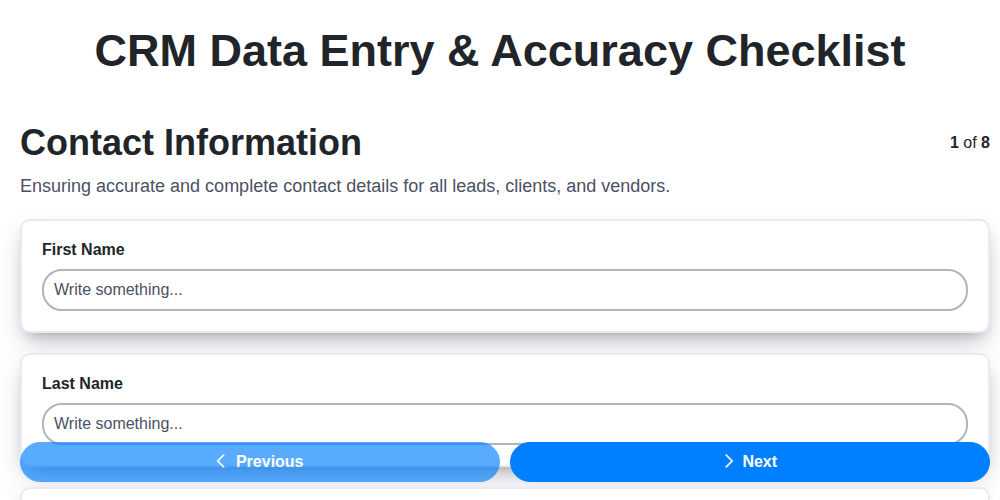
The Ultimate CRM Data Entry & Accuracy Checklist Template
Top 10 Acumatica Alternatives for 2025
Top 10 Bitrix24 Alternatives for 2025
Need help with
Customer Relationship Management (CRM)?
Have a question? We're here to help. Please submit your inquiry, and we'll respond promptly.