5 Common Mistakes in Public Transport Management
Published: 09/09/2026 Updated: 09/10/2026
Table of Contents
- 1. Fragmented Communication and Siloed Data Operations
- 2. Overlooking Real-Time Compliance and Safety Protocol Adherence
- 3. Inefficient Manual Checklist Management and Paper-Based Tracking
- 4. Lack of Scalable Process Standardization Across Fleet and Staff
- 5. Reactive Maintenance and Unpredictable Resource Allocation
- Resources & Links
TLDR: Managing public transport operations requires precision, yet many leaders struggle with fragmented data, manual compliance tracking, and reactive maintenance. This post identifies five critical management pitfalls-from communication silos to inefficient paper-based workflows-and explores how modern Work OS solutions like ChecklistGuro can automate standardization and optimize fleet efficiency.
1. Fragmented Communication and Siloed Data Operations
In the complex ecosystem of public transport, information is the lifeblood of efficient operations. One of the most critical mistakes management teams make is allowing critical data to live in isolation. When your dispatch information, maintenance logs, driver schedules, and incident reports exist in separate, disconnected silos, you create a visibility gap.
The Cost of Information Silos
When communication is fragmented, decision-makers are forced to rely on outdated or incomplete data. This lack of a single source of truth leads to:
- Delayed Response Times: When an incident occurs on a route, the time lost navigating between different communication channels can lead to significant service disruptions.
- Increased Human Error: Manually transferring data from one platform to another-or worse, from paper to digital-is a breeding point for inaccuracies.
- Inconsistent Decision-Making: Without a unified view of operations, project managers are often making strategic decisions based on snapshots rather than the full operational reality.
Bridging the Gap with Integrated Work OS
To move away from fragmented operations, modern transit leaders are moving toward integrated Work OS solutions. Instead of juggling multiple disconnected tools, the most successful operations utilize a centralized platform where every stakeholder-from depot managers to field staff-accesses the same real-time updates.
By implementing a specialized solution like ChecklistGuro, organizations can unify their workflows. Instead of searching through various emails, spreadsheets, and messaging apps, all operational checklists, real-time updates, and compliance data are housed in one accessible environment. This ensures that when a change is made in the field, it is instantly visible to the entire management team, effectively eliminating the dangerous blind spots caused by fragmented data.
2. Overlooking Real-Time Compliance and Safety Protocol Adherence
In the high-stakes world of public transport, there is zero margin for error. When safety protocols are neglected or compliance checks are treated as an afterthought, the consequences are catastrophic-ranging from heavy regulatory fines and legal liabilities to, most importantly, risking passenger lives.
The High Cost of Compliance Gaps
Many operations leads fall into the trap of treating safety audits as a once-a-month event rather than a continuous, real-time requirement. When your compliance monitoring relies on retrospective reviews of paper logs or end-of-shift summaries, you are essentially managing by looking in the rearview mirror. By the time a discrepancy is discovered, the violation has already occurred, and the damage-whether operational or reputational-is done.
The Paper Trail Fallacy
A common mistake is assuming that because a checklist was signed, the protocol was actually followed. Relying on manual, retrospective documentation creates a false sense of security. Without digital verification, it is nearly impossible to audit the moment a safety check was performed, making it difficult to ensure that drivers and ground staff are adhering to critical safety rhythms during their active shifts.
Bridging the Gap with Digital Oversight
To mitigate these risks, industry leaders are moving away from reactive auditing and toward proactive, real-time oversight.
Precision Through Automation
Modern transport management requires a system that enforces compliance at the point of execution. This is where a specialized Work OS becomes indispensable. By integrating real-time validation into your workflows, you ensure that:
- Mandatory steps cannot be bypassed: Digital workflows can prevent a task from being marked complete unless specific safety parameters are met.
- Instant Incident Alerts: If a critical safety check fails, the system notifies operations leads immediately, allowing for instant intervention before the vehicle leaves the depot.
- Audit-Ready Data: Instead of scrambling to reconstruct events during an inspection, you have a continuous, timestamped, and immutable record of every safety protocol followed.
While generic task managers provide basic tracking, ChecklistGuro's Public Transport Management solution is specifically engineered to turn compliance from a manual burden into an automated, unshakeable standard, ensuring that your safety protocols are not just documented, but actively enforced.
3. Inefficient Manual Checklist Management and Paper-Based Tracking
In the fast-paced world of public transit, much of the operational backbone still relies on legacy systems: paper logbooks, printed inspection sheets, and manual spreadsheets. While these methods may feel familiar, they are often the single greatest bottleneck to scaling a modern transport network.
The Cost of Analog Operations
Relying on manual documentation creates a dangerous visibility gap. When inspections, vehicle checks, and driver logs are recorded on paper, data becomes dead the moment the pen leaves the page. Information is trapped in physical folders, making it impossible to perform real-time audits or identify patterns of failure before they escalate into service disruptions.
The Hidden Risks of Manual Tracking:
- Delayed Response Times: By the time a manual error or a missed maintenance check is discovered during a weekly review, the damage-whether a broken vehicle or a safety violation-has already occurred.
- Data Integrity Issues: Paper logs are prone to human error, illegible handwriting, and, more critically, retrospective padding (where logs are filled out after the fact rather than at the time of inspection).
- The Administrative Burden: Operations Leads spend hours manually digitizing paper records into spreadsheets, diverting valuable time away from strategic fleet optimization and toward tedious data entry.
Transitioning to Digital Precision
To maintain a competitive edge and ensure passenger safety, the industry is shifting toward automated, digital-first workflows. Modernizing your checklist management isn't just about removing paper; it's about creating a single source of truth that flows instantly from the field to the management office.
While generic project management tools can offer basic digital forms, they often lack the specialized operational depth required for complex transit workflows. This is where ChecklistGuro excels. Unlike standard task managers, ChecklistGuro provides a specialized Public Transport Management solution designed to turn inspection data into actionable intelligence instantly. By replacing manual logs with automated, intelligent workflows, you ensure that every check is timestamped, every failure triggers an immediate alert, and your entire operation remains compliant and audit-ready at all times.
4. Lack of Scalable Process Standardization Across Fleet and Staff
When your operations expand, the complexity of managing a fleet and a diverse workforce grows exponentially. One of the most frequent-and costly-mistakes transit leaders make is failing to implement standardized processes that can scale alongside their network.
The Tribal Knowledge Trap
In many growing transport organizations, critical operational procedures exist only in the minds of veteran drivers or senior engineers. This reliance on tribet knowledge creates a dangerous dependency. When a key staff member leaves or a new shift begins, the lack of a documented, standardized workflow leads to inconsistent service delivery, increased error rates, and safety risks.
The Scaling Crisis
A process that works for five buses or two train lines rarely works for fifty. Without a unified digital framework, management often falls into the trap of ad-hoc management:
- Inconsistent Training: New recruits follow different versions of the same task.
- Uneven Service Quality: Passenger experience varies depending on which crew is on duty.
- Audit Nightmares: Difficulty in proving that standardized protocols were followed during regulatory inspections.
How Modern Software Solves the Scalability Gap
To move from reactive firefighting to proactive management, you need a Single Source of Truth. This is where specialized Work OS solutions become indispensable.
Standardizing via Digital Workflows
Instead of relying on fragmented spreadsheets or physical binders, top-tier management tools allow you to deploy standardized, digital checklists and SOPs (Standard Operating Procedures) instantly across your entire fleet.
While generic task managers can help with simple task tracking, specialized platforms like ChecklistGuro are designed specifically to bridge the gap between complex transport regulations and frontline execution. By using ChecklistGuro, operations leads can ensure that whether a driver is starting their shift in the city center or at a remote depot, the exact same high-standard protocol is followed, logged, and verified in real-time.
This level of standardization doesn't just mitigate risk-it provides the operational backbone necessary to scale your transit network without a corresponding increase in operational chaos.
5. Reactive Maintenance and Unpredictable Resource Allocation
The High Cost of Fixing It When It Breaks
In the complex ecosystem of public transport, waiting for a vehicle breakdown or a transit delay to occur before taking action is a recipe for operational chaos. Many transit agencies and private operators fall into the trap of reactive maintenance, relying on a break-fix mentality rather than a predictive one.
When maintenance is reactive, the consequences ripple through your entire network:
- Increased Operational Costs: Emergency repairs and unplanned downtime are significantly more expensive than scheduled upkeep.
- Service Disruptions: Unscheduled vehicle outages lead to missed stops, driver shortages, and a direct decline in passenger trust.
- Safety Risks: Neglecting regular inspections in favor of firefighting urgent issues compromises the safety of both passengers and staff.
The Resource Allocation Trap
Closely tied to reactive maintenance is the struggle with unpredictable resource allocation. Without a centralized system to track asset health and staff availability, Operations Leads often find themselves shuffling drivers and vehicles at the last minute to cover gaps. This patchwork approach creates a stressful environment for Team Leads and leads to inefficient use of your most valuable assets.
Moving from Reactive to Proactive with ChecklistGuro
To break this cycle, management must transition toward a standardized, automated inspection workflow. This is where the right technology becomes a competitive advantage.
While legacy systems often fail to bridge the gap between field inspections and office oversight, ChecklistGuro provides the specialized visibility needed to prevent these mistakes. By implementing our Public Transport Management solution, you can:
- Standardize Pre-Trip Inspections: Ensure every vehicle meets safety standards before it ever leaves the depot.
- Automate Alerting: Transform inspection data into actionable insights, triggering maintenance workflows the moment a fault is detected.
- Optimize Fleet Utilization: Use real-time data to predict downtime and allocate resources based on actual asset condition, not guesswork.
By integrating ChecklistGuro into your daily operations, you move away from the chaos of unpredictability and toward a streamlined, data-driven maintenance strategy that keeps your fleet moving and your passengers safe.
Resources & Links
- Institute for Transportation and Development Policy: Global organization providing research and tools for sustainable urban mobility and transit management.
- American Public Transportation Association: Industry leader providing data, advocacy, and best practices for public transit agencies.
- Transit Center: Non-profit focused on improving public transit through data-driven research and advocacy.
- McKinsey & Company: In-depth insights and reports on digital transformation and operational efficiency in urban mobility.
- IBM Transportation: Resources on how IoT and AI can break down data silos and integrate fragmented transit operations.
- Global Compliance Resources: Insights into maintaining regulatory standards and safety protocol adherence in regulated industries.
- SAP for Public Sector: Information on digitizing workflows and moving away from manual, paper-based tracking systems.
- Oracle Cloud Infrastructure: Technological solutions for scalable enterprise resource planning and standardized fleet management.
- Asset Management Best Practices: Articles regarding predictive maintenance strategies to move from reactive to proactive fleet care.
- Esri (GIS): Geospatial technology resources for optimizing resource allocation and route efficiency.
- Siemens Mobility: Global leader in intelligent transport systems and digitalized infrastructure management.
- ABB Mobility: Focus on electrification and smart charging infrastructure for modernizing public fleets.
- Project Management Institute (PMI): Frameworks for process standardization and managing large-scale transit projects.
- Gartner: Research and analytics on digitalizing supply chains and operational technology (OT) integration.
- CASETeCH: Resources regarding technology implementation and digital transformation in the transit sector.
- World Resources Institute: Global perspectives on sustainable urban transport and efficient resource management.
Comments
There are no comments yet. Be the first to add one!
Public Transport Management Solution Demo
Optimize public transport operations & enhance passenger experience! ChecklistGuro streamlines route planning, vehicle maintenance, and incident reporting. Improve efficiency, safety, and reliability. Manage it all with our Work OS.
Related Articles
Train Depot Emergency Audit: Your Checklist Template for Safety
Mastering the Crush: Your Public Transport Crowded Conditions Audit Checklist
Keeping Our Buses Clean: A Checklist for Air Quality Audits
The Ultimate Bus Route Audit Checklist: A Template for Public Transit Success
Keeping City Transit Rolling: Your Tram Maintenance Checklist Template
Keeping Wheels Turning Safely: Your Bus Depot Safety Checklist Template
Mastering ATP Safety: Your Train Inspection Checklist Template
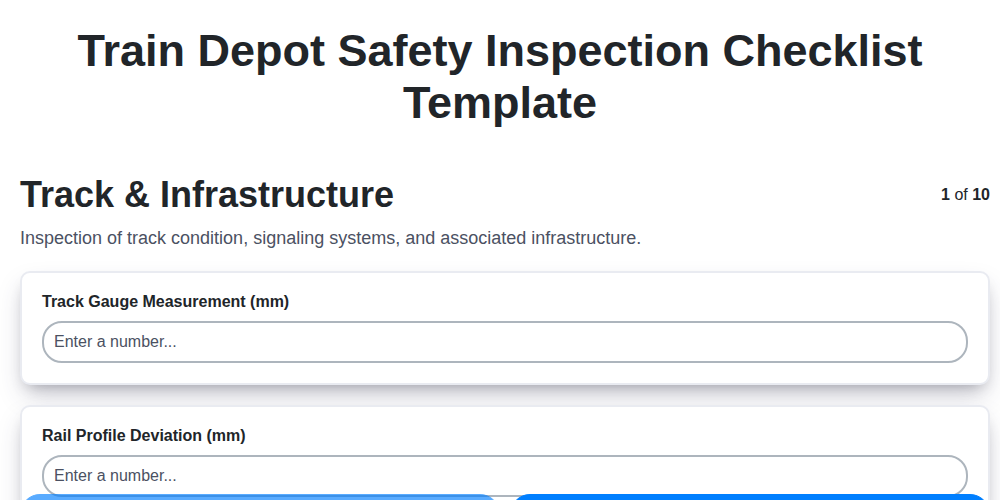
Train Depot Safety Inspection Checklist Template: Your Guide to a Safer Facility
Need help with
Checklists?
Have a question? We're here to help. Please submit your inquiry, and we'll respond promptly.