The Ultimate 2026 Cobot Deployment Guide: The Essential Workflow & Safety Integration Checklist
Published: 10/28/2026 Updated: 10/29/2026
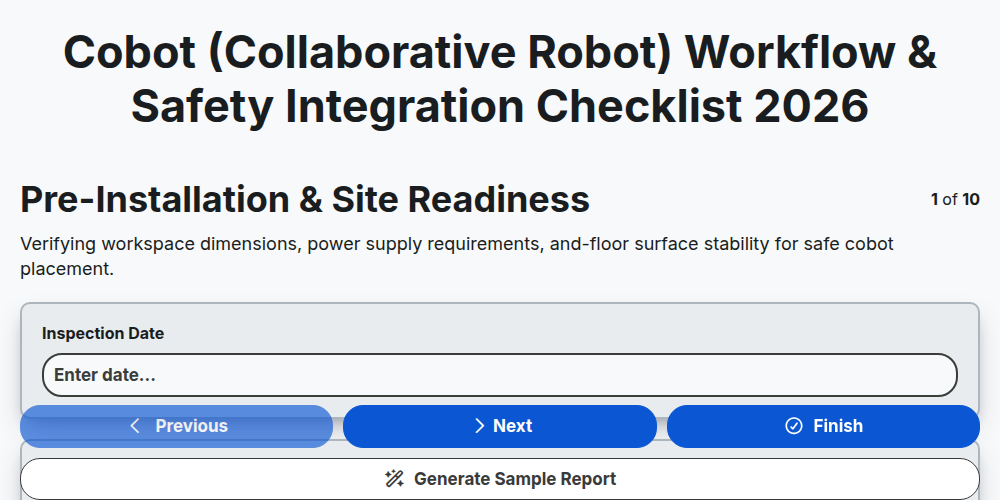
Table of Contents
- Introduction: Navigating the New Era of Collaborative Automation
- Phase 1: Pre-Installation & Site Readiness
- Phase 2: Safety Sensor & Guarding Verification
- Phase 3: Programming & Task Logic Validation
- Phase 4: Human-Robot Interaction (HRI) Assessment
- Phase 5: Force & Torque Limiting Verification
- Phase 6: End-Effector & Tooling Safety
- Phase 7: Workflow Integration & Cycle Time Audit
- Phase 8: Operator Training & Competency Check
- Phase 9: Maintenance & Software Compliance
- Phase 10: Post-Deployment Performance Review
- Conclusion: Ensuring Long-Term ROI and Safety Compliance
- Resources & Links
TLDR: Master your 2026 cobot implementation with this comprehensive integration checklist. Covering everything from pre-installation site readiness and advanced safety sensor verification to human-robot interaction (HRI) assessments and post-deployment performance audits, this guide ensures your collaborative automation is safe, efficient, and fully compliant with the latest industry standards.
Introduction: Navigating the New Era of Collaborative Automation
As we approach 2026, the landscape of industrial automation has undergone a fundamental shift. We have moved past the era of caged industrial robots and entered the age of true human-machine synergy. The modern factory floor is no longer a place of physical separation, but a shared workspace where humans and Collaborative Robots (cobots) work side-by-side in seamless, fluid motions.
The Evolution of Coexistence
The promise of cobots-flexibility, ease of programming, and a smaller footprint-has been realized. However, this proximity brings a new level of complexity to operational excellence. In 2026, safety is no longer just about preventing collisions; it is about managing the sophisticated interplay between intelligent sensors, adaptive software, and human behavior.
Why a Systematic Checklist is Non-Negotiable
Integrating a cobot is not a plug-and-play event. A failure in the integration phase doesn't just result in downtime-it creates significant safety risks and systemic inefficiencies that can cripple your ROI. As AI-driven vision systems and more sensitive force-torque sensors become standard, the margin for error in deployment has narrowed.
Whether you are upgrading an existing line or commissioning a brand-new automated cell, your integration strategy must be airtight. This guide provides a comprehensive, 10-point professional checklist designed to ensure your deployment is safe, compliant, and optimized for maximum throughput.
What this guide covers:
By following this structured framework, you will move through the entire lifecycle of deployment-from initial site readiness to post-deployment performance audits-ensuring that your robotic workforce is an asset, not a liability.
Phase 1: Pre-Installation & Site Readiness
Laying the Foundation: Preparing Your Workspace for Success
Before a single bolt is tightened or a line of code is written, the success of your cobot integration depends entirely on the preparation of your physical and digital environment. In 2026, plug-and-play is a myth; true seamless integration requires a proactive approach to site readiness to prevent costly downtime and safety bottlenecks.
Infrastructure and Spatial Planning
The physical footprint of a collaborative robot is often smaller than traditional industrial robots, but its operational safety envelope requires careful calculation.
- Workcell Layout & Clearances: Ensure the designated area accommodates not just the robot arm, but the full range of motion (the reach envelope) and the required clearance for human operators to move around the cell without obstruction.
- Power & Connectivity Requirements: Verify that your facility provides stable, regulated power supplies compliant with the cobot's specifications. Additionally, ensure high-speed, low-latency industrial Wi-Fi or 5G/6G connectivity is available for real-time telemetry and cloud-based monitoring.
- Floor Integrity & Stability: Confirm that the mounting surface (pedestal, mobile platform, or fixed base) is capable of absorbing the dynamic forces and vibrations generated during high-speed maneuvers to prevent base drift.
Digital & System Readiness
In the era of Industry 5.0, the cobot must be a functional node within your broader digital ecosystem.
- Network Security & IT Integration: Work with your IT department to ensure the cobot's communication protocols (such as OPC UA or MQTT) are integrated into your existing Manufacturing Execution System (MES) and Enterprise Resource Planning (ERP) software while maintaining strict cybersecurity protocols.
- Data Infrastructure: Prepare the necessary edge computing or cloud storage capabilities to handle the influx of telemetry data, sensor logs, and vision-system inputs that modern cobots generate.
- Utility & Auxiliary Support: Ensure all peripheral utilities-such as compressed air for pneumatic grippers, vacuum lines, or specialized cooling systems-are pre-routed and tested to meet the operational demands of the automated workflow.
Phase 2: Safety Sensor & Guarding Verification
Ensuring the Perimeter of Safety
While the primary advantage of a cobot is its ability to operate alongside humans without bulky physical cages, safety does not mean unmonitored. In 2026, safety standards have evolved to demand more sophisticated, intelligent sensing layers. This phase focuses on verifying that your robot can detect an intrusion or a deviation before a collision occurs.
1. Area Scanner & Light Curtain Calibration
Even in collaborative environments, safety zones are critical. You must verify that your laser area scanners are precisely calibrated to your workstation layout.
- Warning Zone Verification: Ensure the scanner triggers a Reduced Speed mode when an operator enters the outer perimeter.
- Stop Zone Verification: Confirm the robot reaches a complete, controlled standstill the moment a human breaches the innermost safety boundary.
- Blind Spot Audit: Physically walk the perimeter to ensure no structural pillars or equipment obstruct the scanner's line of sight.
2. Sensor Integration & Signal Latency Test
A safety sensor is only as good as its communication speed. In a high-speed 2026 manufacturing environment, even a millisecond of latency can be the difference between a near-miss and an injury.
- E-Stop Loop Integrity: Test every Emergency Stop (E-Stop) button-including those on the teach pendant, the robot controller, and external perimeter buttons-to ensure they trigger an immediate power-off of the actuators.
- Latency Benchmarking: Measure the time elapsed between a sensor trigger and the robot's deceleration. This must align with your predefined safety risk assessment.
3. Intelligent Guarding & Virtual Fencing
With the rise of AI-driven vision systems, much of your guarding may now be digital.
- Vision System Validation: If using 3D cameras for human detection, verify that the system can distinguish between a human limb and a static object (like a misplaced bin).
- Dynamic Boundary Check: Ensure that if the cobot's programmed path changes, the digital safety zones update accordingly to prevent the arm from swinging into unauthorized workspaces.
Phase 3: Programming & Task Logic Validation
Refining the Intelligence: Programming & Task Logic Validation
Once the physical workspace is prepared and sensors are positioned, the focus shifts from hardware to the brain of the operation. In 2026, cobot deployment is no longer just about teaching points; it is about validating the complex decision-making logic that allows the robot to navigate a dynamic environment alongside humans.
Validating Logic Flow and Error Handling
A functional cobot is useless if it cannot handle the unexpected. During this phase, your checklist must ensure that the programmed logic accounts for more than just the happy path.
- Edge Case Simulation: Test how the robot responds to interrupted cycles, sensor-triggered stops, and unexpected object placement.
- Error Recovery Protocols: Verify that the system has clear, automated instructions for recovering from a fault without requiring a full manual reset of the entire production line.
- Logic Branching Accuracy: Ensure that conditional statements (e.g., if part is present, then pick; if part is missing, then alert) execute with zero latency.
Sensor-Logic Synchronization
The integration between your safety sensors and the robot's motion controller is the most critical link in the safety chain. You must verify that the Stop or Slow Down commands are being processed in real-time.
- Latency Testing: Measure the delay between a safety violation (e.g., a light curtain breach) and the robot's deceleration.
- Adaptive Speed Validation: If using software-defined safety zones, confirm that the robot transitions smoothly between High Speed and Collaborative Speed modes as humans approach the work envelope.
Digital Twin & Simulation Verification
Before the final live run, leverage 2026's advanced digital twin capabilities. Use your simulation data to cross-reference the physical deployment.
- Path Collision Checks: Use simulated environments to ensure the programmed trajectory does not infringe upon restricted zones or create pinch points near fixed machinery.
- Cycle Consistency Audit: Compare the simulated cycle time against the actual physical execution to identify any software-induced bottlenecks or logic-driven delays.
Phase 4: Human-Robot Interaction (HRI) Assessment
Navigating the Human Element: The HRI Assessment
As we move into 2026, the definition of safety has evolved from simple physical separation to sophisticated, real-time synergy. The Human-Robot Interaction (HRI) Assessment is perhaps the most critical phase of your deployment. It is the stage where you move beyond checking if the robot can work and start verifying if it can work safely alongside your team.
In a modern collaborative environment, the goal is to minimize robot-induced friction-the psychological and physical stressors that occur when human workflows are interrupted by unpredictable machine movements.
Evaluating Spatial Dynamics and Proximity
During this assessment, you must analyze the Shared Workspace versus the Collaborative Workspace. Even if a cobot is designed to stop upon contact, the way it moves through a human's natural walking path can create significant ergonomic and psychological hazards.
- Path Interference: Does the robot's swing radius intersect with common pedestrian walkways?
- Ergonomic Impact: Does the robot's presence force operators into awkward postures or repetitive reaching motions?
- Visual Cues: Are there clear, intuitive indicators (such as LED light rings or projection mapping) that signal the robot's next intended movement to the operator?
Psychological Safety and Cognitive Load
Safety in 2026 isn't just about avoiding collisions; it's about managing the operator's cognitive load. A robot that moves with jittery, unpredictable, or overly aggressive acceleration can induce automation anxiety, leading to operator fatigue and increased error rates.
- Predictability Audit: Does the robot follow smooth, human-readable trajectories?
- Transparency of Intent: Can an operator standing nearby instantly discern if the robot is in an active, paused, or error state without checking a remote terminal?
- Stress Mitigation: Evaluate whether the robot's speed and rhythm allow the human worker to maintain their natural workflow without feeling chased by the machine.
Incident Response and Handover Protocols
Finally, this phase must validate the seamlessness of manual interventions. If an operator needs to adjust a part mid-cycle, the transition from autonomous mode to manual/lead-through mode must be intuitive and fail-safe.
- Seamless Handover: Test the transition period when a human takes control of a task from the robot.
- Emergency Accessibility: Ensure that manual E-stops and reset buttons are positioned for easy access by the human, not just the technician.
Phase 5: Force & Torque Limiting Verification
Ensuring Precision through Power and Force Limiting (PFL)
As we move into 2026, the standard for collaborative robotics has shifted from can it stop? to can it react with extreme precision? The core value of a cobot lies in its ability to work alongside humans without physical barriers, but this capability is entirely dependent on the integrity of its Force and Torque Limiting (FCL) systems.
In this phase, the goal is to validate that the robot's internal sensors can detect unexpected resistance-such as an accidental human contact-and trigger a safety-rated stop before any injury or equipment damage occurs.
Critical Verification Steps
To ensure your deployment meets the highest safety standards, your technical team must execute the following validation protocols:
- Sensor Sensitivity Calibration: Verify that the robot's joint torque sensors and skin sensors (if equipped) are calibrated to the specific payload of your application. A robot calibrated for a light gripper may fail to detect a collision when carrying a heavy end-effector.
- Impact Force Measurement: Using specialized bio-fidelic pressure sensors or force gauges, simulate contact scenarios at various speeds. You must ensure that the peak impact force remains below the ISO/TS 15066 permissible limits for different parts of the human body (e.g., arms, hands, or torso).
- Transient vs. Quasi-Static Contact Analysis:
- Transient Contact: Test the robot's ability to respond during high-speed, momentary impacts.
- Quasi-Static Contact: Test the robot's ability to detect clamping or trapping scenarios where a limb might be pinned between the robot and a fixed object.
- Payload-Dependent Stop Distance Validation: Validate that the braking distance of the cobot is consistent across its entire working envelope, even when operating at maximum extension or maximum payload capacity.
The 2026 Compliance Standard
With the increasing complexity of AI-driven motion planning, black box movements are no longer acceptable. Your verification process must confirm that the robot's safety-rated monitored stop remains deterministic-meaning the robot's reaction time is predictable and measurable, regardless of how complex the programmed path may be.
Pro-Tip for Integrators: Never skip the empty gripper vs. full payload testing. A common failure point in cobot safety is a system that is safe while empty but exceeds force limits once the tool and workpiece are attached.
Phase 6: End-Effector & Tooling Safety
Ensuring Tooling Integrity and Safety
The end-effector-often referred to as the business end of the robot-is where the theoretical safety of the cobot meets the physical reality of the production line. Even if the robotic arm itself is collaborative, a sharp tool, a heated gripper, or a high-speed vacuum suction cup can negate all safety benefits. In 2026, compliance requires a granular look at every component attached to the robot's flange.
1. Gripper and Tooling Risk Assessment
Before the cobot begins its first cycle, you must evaluate the inherent hazards of the tool itself.
- Pinch Point Analysis: Identify any new mechanical pinch points created by the gripper's movement or the interaction between the tool and the workpiece.
- Sharp Edge Mitigation: Ensure that any cutting, piercing, or handling tools are equipped with guarding or that the workflow prevents human contact during active movement.
- Temperature Monitoring: If using thermal bonding or heat-based tools, verify that the end-effector's temperature stays within the safe thresholds defined for human-robot proximity.
2. Pneumatic and Electrical Interlock Verification
The safety of the tool is only as reliable as its fail-safe mechanisms.
- Loss of Pressure Protocol: In the event of a pneumatic failure, does the gripper maintain a fail-safe grip to prevent dropping heavy workpieces?
- Emergency Stop (E-Stop) Integration: Confirm that the end-effector is integrated into the global E-Stop circuit. If the robot stops, all auxiliary tooling must also cease hazardous motion immediately.
- Electrical Isolation: Ensure all cabling for smart grippers or sensors is routed to prevent snagging or accidental disconnection during high-speed maneuvers.
3. Payload and Center of Gravity (CoG) Validation
Incorrectly calculating the weight or balance of the tool can lead to unexpected momentum shifts.
- Mass Verification: Double-check that the weight of the end-effector plus the workpiece does not exceed the rated payload capacity of the cobot.
- Moment of Inertia Check: Ensure the tool's geometry does not create an unbalanced load that could trigger unintended safety stops or degrade the precision of the motion path.
- Dynamic Load Testing: Perform low-speed tests to observe how the robot handles the inertia of the tool during rapid directional changes.
Phase 7: Workflow Integration & Cycle Time Audit
Optimizing Productivity: The Critical Audit Phase
Once the safety parameters are verified and the robot's logic is validated, the focus shifts from Can it work safely? to Can it work efficiently? The Workflow Integration & Cycle Time Audit is the bridge between a functional installation and a high-performing automated cell.
In 2026, a cobot is only as valuable as its ability to augment human productivity without creating new bottlenecks. This phase is about fine-tuning the synergy between the robotic arm, the existing production line, and the human operators.
Synchronizing the Production Stream
The primary goal of this audit is to ensure that the cobot does not become a speed bump in your manufacturing process. You must analyze the hand-off points where parts move from a manual station to the cobot or from the cobot to a downstream conveyor.
- Upstream/Downstream Dependency: Check if the cobot's arrival time aligns with part availability.
- Buffer Analysis: Evaluate if the current part buffers (infeed/outfeed) are sufficient to handle minor fluctuations in robot cycle speed.
- Bottleneck Identification: Use real-time telemetry to identify if the cobot is idling due to upstream delays or if it is causing a backlog in the subsequent station.
The Cycle Time Precision Audit
A common pitfall in cobot deployment is focusing solely on the robot motion time while ignoring the total cell cycle time. Your audit should include:
- Motion Path Optimization: Review the programmed trajectories. Are there unnecessary decelerations or overly cautious movements that, while safe, are unnecessarily inflating cycle times?
- Latency Assessment: In 2026, with the rise of IIoT-connected cells, measure the communication latency between sensors, PLC commands, and the cobot controller.
- The Takt Time Alignment: Compare the cobot's actual cycle time against your target Takt time. If the cobot cannot meet the required rate, you must decide whether to optimize the pathing or re-engineer the task logic.
Balancing Speed and Safety (The 2026 Standard)
As we move toward more advanced AI-driven vision systems, the boundary between Safety Speed and Production Speed is becoming more fluid. Use this audit to verify that the robot's Speed and Separation Monitoring (SSM) is functioning dynamically.
The objective is to reach a state where the robot operates at maximum programmed velocity when the workspace is clear, but seamlessly transitions to reduced speed only when a human enters the collaborative zone-minimizing downtime without compromising the safety protocols established in previous phases.
Phase 8: Operator Training & Competency Check
Ensuring Human-Centric Operational Excellence
Deploying a collaborative robot is not merely a technical milestone; it is a human transition. As we move into 2026, the focus of automation has shifted from replacement to augmentation. Therefore, the final pillar of a successful integration is ensuring that your workforce is not only capable of operating the new technology but is confident and empowered by it.
Establishing a Robust Competency Framework
A cobot is only as safe and efficient as the person operating its interface. Training must move beyond simple on/off instructions to a comprehensive competency framework that covers:
- Standard Operating Procedures (SOPs): Detailed guidance on routine task execution, start-up sequences, and end-of-shift shutdown protocols.
- Emergency Response Mastery: Beyond knowing where the E-stop is, operators must be trained in the specific recovery steps required after a safety violation or a collision detection event.
- Error Handling & Troubleshooting: Empowering operators to identify common sensor obstructions or minor software hiccups prevents unnecessary downtime and reduces reliance on external engineers.
The 2026 Standard: Adaptive Learning & Upskilling
In the era of Industry 5.0, training must be continuous. We recommend implementing a multi-tiered approach to operator readiness:
- Level 1: Basic Interaction (Daily Users): Focuses on safe coexistence, monitoring the cobot's workspace, and managing basic interface inputs.
- Level 2: Advanced Configuration (Super-Users): Training focused on reprogramming simple logic, swapping end-effectors, and performing first-line maintenance.
- Level 3: Safety Oversight (Safety Officers): Specialized training for verifying sensor integrity and conducting periodic safety audits.
Verification of Competency
The checklist is not complete until a formal competency assessment is performed. This should include a Practical Skills Validation, where operators demonstrate their ability to navigate a simulated fault, and a Safety Awareness Audit, ensuring they can recognize the subtle boundaries of the robot's collaborative workspace.
Pro-Tip for 2026: Leverage Augmented Reality (AR) overlays during training. Using AR to visualize the cobot's safety zones and intended motion paths significantly flattens the learning curve and reduces the anxiety often associated with working alongside moving machinery.
Phase 9: Maintenance & Software Compliance
Ensuring Long-Term Reliability and Digital Integrity
Deployment does not end when the robot completes its first successful cycle. In the 2026 manufacturing landscape, a cobot is only as reliable as its last software update and as safe as its most recent inspection. As cobots become increasingly interconnected via IIoT (Industrial Internet of Things) ecosystems, compliance must move beyond physical checks to include digital and systemic oversight.
Software Integrity and Cybersecurity
In an era of hyper-connectivity, the software driving your cobot is a critical point of failure. Maintenance must now include:
- Firmware Lifecycle Management: Establishing a rigorous schedule for manufacturer-approved updates to ensure all safety patches and performance optimizations are applied.
- Cybersecurity Audits: Regularly verifying that the cobot's network permissions are restricted and that any remote monitoring tools are protected against unauthorized access.
- Algorithm Calibration: Periodic checks to ensure that the motion planning software and collision-avoidance algorithms are operating with the intended precision.
Preventive Maintenance & Hardware Health
To prevent unplanned downtime and maintain the Collaborative aspect of your workflow, implement a standardized maintenance protocol:
- Sensor & Vision System Calibration: Regularly cleaning and recalibrating 3D vision systems and safety sensors to prevent false stops or, more critically, failures to detect human presence.
- Wear and Tear Assessment: Systematic inspection of joint lubrication, cable integrity, and the mechanical fatigue of the robot arm.
- Battery & Power Stability: Monitoring power quality and backup battery health to ensure that sudden outages do not lead to corrupted waypoints or unsafe mechanical drifts.
Compliance & Documentation Audit
Safety is a continuous state of being, not a one-time checkbox.
- The Digital Logbook: Maintaining a real-time, digital audit trail of all software changes, safety resets, and maintenance interventions.
- Regulatory Alignment: Ensuring that all updates and modifications remain in strict accordance with evolving ISO and ANSI standards for collaborative robotics.
Phase 10: Post-Deployment Performance Review
The Final Milestone: Ensuring Long-Term ROI and Safety Stability
The deployment of a collaborative robot is not a set it and forget it event. Once the initial integration is complete and the cobot is officially part of your production line, the focus must shift from installation to continuous optimization. The Post-Deployment Performance Review is the critical final step that determines whether your cobot remains a productive asset or becomes a costly bottleneck.
1. Analyzing KPIs vs. Pre-Deployment Projections
After the first 30 to 90 days of operation, perform a deep dive into your Key Performance Indicators (KPIs). Compare your actual real-world data against the benchmarks established during the Workflow Integration & Cycle Time Audit.
- Cycle Time Consistency: Is the cobot maintaining the predicted takt time, or are frequent resets or minor errors causing drift?
- Uptime & Availability: Are there unplanned stops that weren't present during the testing phase?
- Yield & Quality Rates: Has the introduction of the cobot reduced scrap rates as expected, or are there subtle precision issues emerging under full-load conditions?
2. Safety Integrity Re-Validation
Even though safety was verified during the Safety Sensor & Guarding Verification phase, the live environment introduces new variables.
- Environmental Changes: Have changes in floor layout, lighting, or additional machinery interfered with the cobot's optical sensors or area scanners?
- Incident Log Review: Review every near-miss or emergency stop (E-Stop) triggered during the initial weeks. These logs are goldmines for identifying hidden flaws in the Human-Robot Interaction (HRI) design.
3. Continuous Improvement Loop (Kaizen)
A successful 2026 deployment utilizes a feedback loop between the operators and the engineering team.
- Operator Feedback Integration: Use the insights gained during the Operator Training & Competency Check to identify workarounds that staff might have developed. If an operator is manually bypassing a part of the workflow to save time, your integration logic needs refinement.
- Scalability Assessment: Evaluate if the current end-effector configuration and task logic can be easily adapted for future product iterations or increased throughput demands.
4. Scheduling the First Iterative Audit
Treat the post-deployment review as the trigger for your long-term maintenance and software update schedule. This phase ensures that the Collaborative aspect of your robot stays safe, efficient, and aligned with your evolving manufacturing goals.
Conclusion: Ensuring Long-Term ROI and Safety Compliance
Implementing a collaborative robot is not a plug-and-play event; it is a strategic evolution of your production line. As we move into 2026, the margin for error in automation is shrinking. The complexity of advanced AI-driven logic and the increasing proximity of human workers to automated cells mean that a single oversight in your integration checklist can lead to costly downtime, safety breaches, or hardware fatigue.
Beyond the Initial Launch
A successful deployment is measured by more than just the first successful cycle. The true value of a cobot lies in its ability to scale alongside your business. By strictly adhering to the Pre-Installation, Safety Verification, and HRI Assessment phases, you are not just preventing accidents-you are building a foundation for predictable, high-quality output.
Key Takeaways for 2026 Integration:
- Prioritize Safety as a Function of Design: Don't treat safety sensors and force-limiting verification as an afterthought. Safety must be baked into the initial site readiness and programming logic.
- Focus on the Human Element: The most advanced robot is useless if your workforce is untrained or intimidated by it. Continuous operator competency checks are the heartbeat of a functional HRI strategy.
- Audit for Efficiency, Not Just Completion: Use the Workflow Integration and Cycle Time Audit to ensure the cobot is actually augmenting your throughput, rather than becoming a bottleneck.
- Commit to Lifecycle Compliance: Automation is dynamic. Regular software compliance updates and maintenance audits are essential to ensure that collaborative remains safe as the robot's logic evolves.
The Bottom Line
As the industry shifts toward more flexible, high-mix, low-volume production, the ability to rapidly and safely deploy cobots will be your greatest competitive advantage. Use this checklist as your roadmap to navigate the complexities of modern automation, ensuring that your investment delivers maximized ROI and, most importantly, a safe, seamless environment for your most valuable asset: your people.
Resources & Links
- ISO (International Organization for Standardization): The primary source for global industrial standards, specifically ISO 10218 and ISO/TS 15066 regarding robot safety.
- OSHA (Occupational Safety and Health Administration): Essential for regulatory compliance, workplace safety guidelines, and legal requirements for human-robot interaction in the US.
- NIST (National Institute of Standards and Technology): Provides high-level research and technical frameworks for automation, sensor accuracy, and manufacturing interoperability.
- Universal Robots: A leader in cobot technology; excellent for studying real-world deployment case studies and programming logic.
- ABB Robotics: Global resource for advanced robotics, focusing on force/torque sensing, precision, and integrated industrial software.
- FANUC America: Detailed technical insights into industrial robot programming, end-effector integration, and complex automation workflows.
- IEEE Robotics and Automation Society: Academic and professional resource for the latest advancements in Human-Robot Interaction (HRI) and sensor technology.
- CISA (Cybersecurity & Infrastructure Security Agency): Crucial for Phase 9 (Software Compliance), focusing on protecting connected industrial automation from cyber threats.
- Machine Safety Institute: Specialized knowledge regarding safety guarding, light curtains, and physical barriers in automated environments.
- Siemens Industrial Automation: Provides documentation on PLC programming, digital twins, and integrating cobots into larger manufacturing execution systems (MES).
- Schunk: The industry standard for end-effector (gripper) technology and robotic tooling safety considerations.
- Keyence: Advanced resources for vision systems, sensor integration, and precision measurement during the validation phase.
- Rockwell Automation: Focuses on the convergence of IT and OT, providing tools for monitoring performance and ROI in smart factories.
- The Factory Network: Industry news and trends regarding the future of manufacturing, helpful for understanding the 2026 automation landscape.
- Automation World: Comprehensive articles on automation trends, deployment strategies, and workforce training for the era of Industry 4.0.
Comments
There are no comments yet. Be the first to add one!
Manufacturing Management Solution Demo
Stop chasing paperwork and wrestling with disconnected systems! Our solution brings clarity and control to your production process. From standard operating procedures (SOPs) and equipment maintenance to quality control and inventory tracking, we simplify every step.
Related Articles
Kaizen Checklist Template: Your Path to Continuous Improvement

Machine Safety Audit Checklist: Your Guide to a Safer Manufacturing Workplace
Mastering Supplier Performance: Your Free Supplier Scorecard Checklist Template
Your Ultimate RCM Checklist Template: A Step-by-Step Guide

LPA Checklist Template: Your Guide to Layered Process Audits

Your Ultimate Lockout/Tagout (LOTO) Checklist Template

Your Ultimate FSC 22000 Checklist Template
Quality Control Inspection Checklist Template: Prevent Defects & Improve Manufacturing Processes
Need help with
Manufacturing?
Have a question? We're here to help. Please submit your inquiry, and we'll respond promptly.