Mastering Efficiency: A Comprehensive Hotel Inventory and Supply Chain Management Workflow Template
Published: 05/31/2026 Updated: 10/05/2026
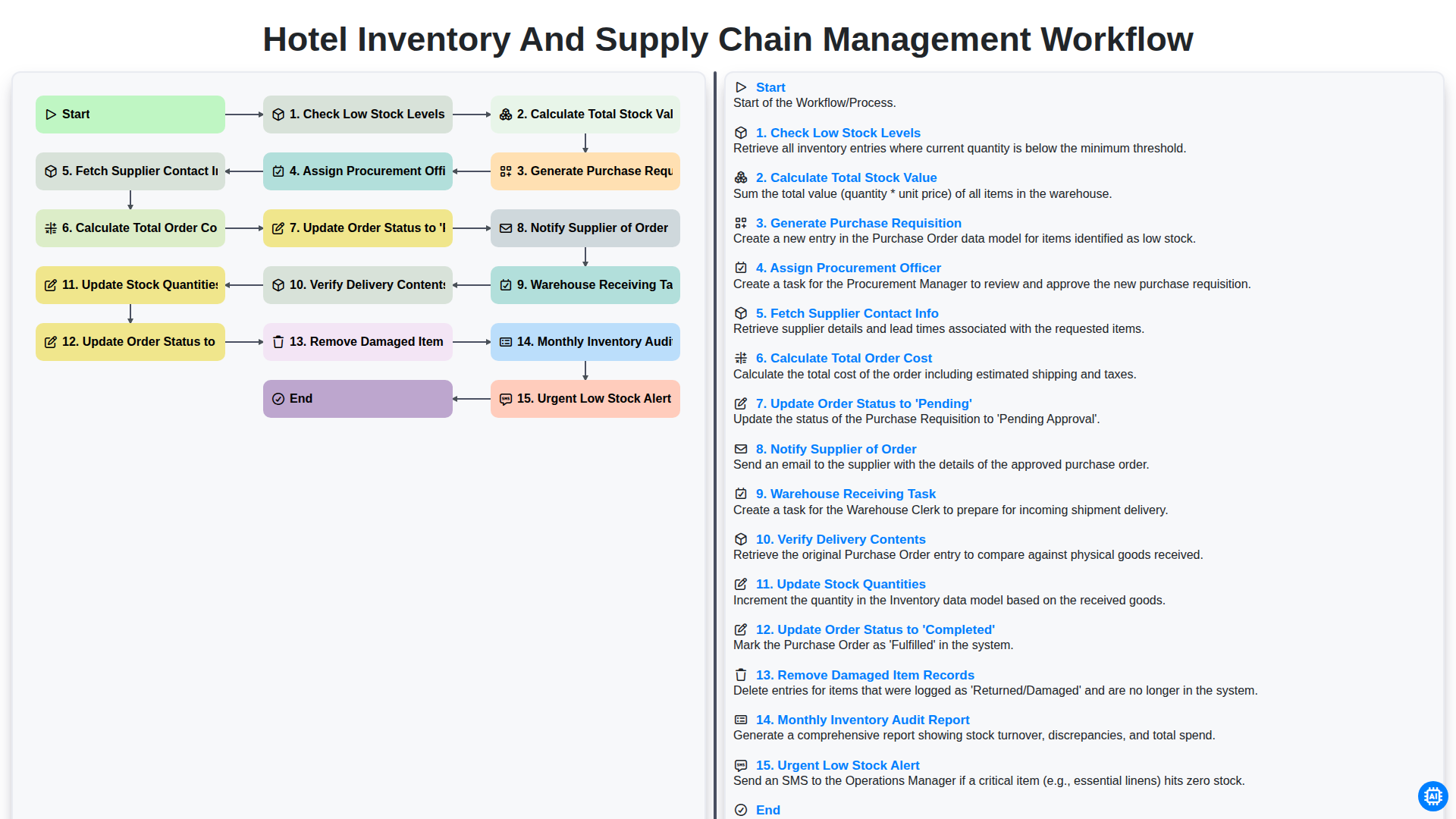
Table of Contents
- Introduction: The Importance of Streamlined Inventory Management in Hospitality
- Phase 1: Proactive Monitoring and Stock Assessment
- Step 1: Continuous Monitoring through Low Stock Level Checks
- Step 2: Financial Oversight via Total Stock Value Calculation
- Step 3: Implementing Urgent Low Stock Alert Protocols
- Phase 2: The Procurement and Requisition Process
- Step 4: Generating Accurate Purchase Requisitions
- Step 5: Streamlining Responsibility by Assigning Procurement Officers
- Step 6: Managing Supplier Relations and Cost Estimation
- Step 7: Finalizing Order Costs and Transitioning to Pending Status
- Phase 3: Supplier Communication and Order Execution
- Step 8: Automating Supplier Notifications
- Phase 4: Receiving, Verification, and Inventory Update
- Step 9: Warehouse Receiving and Delivery Verification
- Step 10: Synchronizing Stock Quantities and Order Completion
- Step 11: Quality Control and Removing Damaged Item Records
- Phase 5: Long-term Auditing and Strategic Reporting
- Step 12: Conducting the Monthly Inventory Audit Report
- Conclusion: Maximizing Operational ROI through Workflow Automation
- Resources & Links
TLDR: Streamline your hotel operations with this end-to-end inventory and supply chain workflow, designed to automate everything from low-stock detection and procurement to warehouse verification and monthly auditing to ensure zero downtime and optimal stock accuracy.
Introduction: The Importance of Streamlined Inventory Management in Hospitality
In the fast-paced world of hospitality, the difference between a seamless guest experience and an operational crisis often lies in the details of the supply chain. Whether it is ensuring that premium linens are always available for arriving guests or making sure the kitchen never runs out of essential ingredients during a peak dinner service, consistency is the backbone of hotel reputation.
Managing hotel inventory is a complex balancing act. Unlike retail, hospitality involves a continuous flow of perishable goods, high-turnover consumables, and essential amenities that must be replenished with precision. When the workflow governing these supplies is fragmented, the consequences are immediate: increased food waste, inflated operational costs, and, most detrimentally, a decline in guest satisfaction.
A streamlined, automated inventory and supply chain management workflow does more than just track boxes on a shelf; it provides real-time visibility into your operational health. By integrating systematic checks, automated procurement triggers, and rigorous auditing processes, hotels can transition from a reactive firefighting mode to a proactive management style. This allows management to optimize stock levels, reduce capital tied up in excess inventory, and ensure that the supply chain remains an invisible, efficient engine driving the hotel's success.
Phase 1: Proactive Monitoring and Stock Assessment
The foundation of an efficient supply chain lies in visibility and foresight. The first phase of the workflow focuses on proactive monitoring and stock assessment to prevent the disruptions caused by stockouts or overstocking. This phase begins with a continuous cycle of Checking Low Stock Levels, where automated triggers or manual reviews identify items approaching their reorder points.
To maintain financial clarity, the system must simultaneously Calculate Total Stock Value, providing management with real-time insights into capital tied up in inventory. For critical items, the system triggers an Urgent Low Stock Alert, ensuring that high-priority shortages are addressed before they impact guest satisfaction. By combining granular item tracking with high-level financial oversight, hotels can transition from a reactive firefighting mode to a strategic, data-driven approach to inventory management.
Step 1: Continuous Monitoring through Low Stock Level Checks
The foundation of an efficient supply chain begins with proactive oversight rather than reactive scrambling. The first critical step in our workflow is the Check Low Stock Levels phase. Instead of waiting for a shelf to become empty, the system continuously monitors real-time inventory data against predefined minimum threshold levels.
By implementing automated alerts, the management team can identify exactly which items are approaching their reorder points before they impact guest services. This continuous monitoring prevents the out-of-stock scenarios that can disrupt hotel operations-such as running out of essential linens or breakfast supplies-ensuring that the procurement cycle begins precisely when needed to maintain seamless service continuity.
Step 2: Financial Oversight via Total Stock Value Calculation
Once low stock levels are identified, the next critical phase in the workflow is calculating the Total Stock Value. This step moves the focus from simple quantity monitoring to financial oversight. By aggregating the current quantity of each item multiplied by its unit cost, management gains a real-time snapshot of the capital tied up in inventory.
This calculation serves two vital purposes: first, it allows for better cash flow management by helping the procurement team understand the financial impact of restocking; second, it acts as a baseline for budgeting. Knowing the total value of on-hand stock ensures that the subsequent purchase requisitions are weighed against the company's existing investment, preventing overstocking and reducing the risk of capital being wasted on excess inventory.
Step 3: Implementing Urgent Low Stock Alert Protocols
In a fast-paced hospitality environment, waiting for a scheduled audit to discover a shortage can lead to operational paralysis. To prevent the dreaded out-of-stock scenario, it is essential to implement Urgent Low Stock Alert protocols.
Unlike the standard routine of checking low stock levels, an urgent alert acts as a critical fail-safe triggered by automated thresholds. When a high-turnover item-such as essential linens, cleaning chemicals, or breakfast staples-hits a pre-defined minimum quantity, the system should immediately bypass the standard daily checklist and trigger an instant notification to both the procurement officer and the department head.
Integrating these real-time alerts into your workflow ensures that the Generate Purchase Requisition step is initiated long before a shortage impacts guest satisfaction. By treating these alerts as high-priority tasks, you bridge the gap between routine monitoring and crisis management, ensuring your supply chain remains resilient even during unexpected surges in hotel occupancy.
Phase 2: The Procurement and Requisition Process
Once the initial stock assessment identifies a need for replenishment, the workflow shifts from monitoring to action. This phase is the engine of the supply chain, transforming raw data into formal procurement tasks.
The process begins by generating a purchase requisition based on the identified shortages. To ensure accountability and streamlined operations, the system then assigns a procurement officer to oversee the request. With a dedicated lead managing the request, the next step involves fetching supplier contact information from the centralized database to ensure seamless communication.
Precision is critical during this stage; therefore, the system automatically calculates the total order cost to ensure the request aligns with the department's budget. Once the costs are verified, the order status is updated to 'Pending', signaling that the request is awaiting approval or processing. The final step in this phase is to notify the supplier of the order, officially initiating the delivery pipeline and moving the items from requested to in transit.
Step 4: Generating Accurate Purchase Requisitions
Once the system identifies that stock levels have dipped below their predefined thresholds, the next critical stage is the automated generation of the Purchase Requisition. This step acts as the bridge between inventory monitoring and active procurement, ensuring that the transition from low stock to order placed is seamless and error-free.
An accurate purchase requisition does more than just list items; it pulls real-time data to ensure the procurement team is working with the most current information. The system automatically aggregates the required quantities needed to replenish stock to optimal levels, effectively eliminating the guesswork and human error often associated with manual entry. By automating this process, the workflow ensures that every request is standardized, making it easier to track exactly what is being requested, when, and why. This precision is vital for maintaining a lean inventory and preventing both overstocking and critical shortages.
Step 5: Streamlining Responsibility by Assigning Procurement Officers
Once a purchase requisition has been generated, the next critical step in the workflow is to Assign a Procurement Officer. In a large-scale hotel operation, automation allows you to transition from a generic request to a specific point of accountability.
By assigning a dedicated officer to each requisition, you eliminate the ambiguity that often leads to delays in the supply chain. This step ensures that there is a single person responsible for tracking the lifecycle of the order, from the moment the requisition is approved to the point the goods arrive at the loading dock. This accountability is vital for preventing lost orders and ensures that if a bottleneck occurs-such as a delay in retrieving supplier contact info or a discrepancy in pricing-there is a clear owner tasked with resolving the issue. Integrating this assignment into your digital workflow transforms a manual, disorganized process into a structured, traceable, and highly efficient procurement pipeline.
Step 6: Managing Supplier Relations and Cost Estimation
Once the purchase requisition has been assigned to a dedicated procurement officer, the focus shifts from internal oversight to external coordination. This stage is critical for maintaining budget integrity and ensuring seamless communication with your vendors. The process begins by fetching supplier contact info from your centralized database, ensuring that the person responsible for the order has the most up-to-date details to prevent delays.
With the necessary contact information at hand, the procurement officer must then calculate the total order cost. This step involves aggregating the prices of all requested items, including any applicable taxes or shipping fees, to ensure the replenishment remains within the hotel's budgetary constraints. Once the financial scope is confirmed, the system must update the order status to 'Pending', signaling that the request is officially in the procurement pipeline. The final, vital action in this stage is to notify the supplier of the order, initiating the fulfillment process and setting the stage for the physical arrival of goods at the hotel.
Step 7: Finalizing Order Costs and Transitioning to Pending Status
Once the initial requisition has been drafted and the procurement officer has been assigned, the workflow moves into the critical phase of financial validation. At this stage, the system automatically calculates the total order cost by aggregating the unit prices and quantities of all items listed in the requisition. This step is vital for budget oversight, ensuring that the proposed purchase aligns with the hotel's procurement budget before any commitments are made to external vendors.
After the total cost is verified, the workflow transitions the order status from Draft to 'Pending'. This status change serves as a formal signal that the request has passed internal review and is now awaiting external action. By moving the order to a 'Pending' state, the system creates a clear audit trail, indicating that the procurement process is officially in motion and that the funds are earmarked for this upcoming expenditure.
Phase 3: Supplier Communication and Order Execution
Once the purchase requisition has been approved and a specific procurement officer has been assigned to the task, the workflow shifts from internal assessment to external execution. The next critical step is to fetch supplier contact info from the centralized database to ensure the procurement officer is reaching out to the correct, verified vendors.
With the necessary contact details in hand, the officer must calculate the total order cost, accounting for unit prices and quantities, to ensure the budget remains within operational limits. Once the cost is validated, the system must update the order status to 'Pending' to maintain a real-time paper trail of all active commitments.
The process then moves into active communication: the system or officer will notify the supplier of the order, officially initiating the fulfillment process. This seamless transition from internal calculation to external notification is vital to preventing delays in the supply chain and ensuring that the hotel's replenishment cycle remains uninterrupted.
Step 8: Automating Supplier Notifications
Once the purchase order has been prepared and the order status is updated to 'Pending', the next critical step in an efficient supply chain is to Notify Supplier of Order. Manually drafting and sending emails for every replenishment cycle is not only time-consuming but also prone to human error, such as typos in quantities or incorrect delivery addresses.
By integrating automated notifications into your workflow, your system can instantly trigger an email or EDI (Electronic Data Interchange) alert to the supplier the moment the procurement officer approves the requisition. This automation ensures that your order enters the supplier's processing queue without delay, significantly reducing the lead time between identifying a shortage and receiving the goods. Speed is the essence of inventory management; the faster the supplier is notified, the faster your stock levels begin to recover, preventing potential stockouts that could disrupt hotel operations.
Phase 4: Receiving, Verification, and Inventory Update
Once the supplier has been notified and the order is in transit, the workflow shifts focus to the physical arrival of goods. This phase is critical for maintaining data integrity and preventing discrepancies between your digital records and actual warehouse stock.
The process begins with the Warehouse Receiving Task, where the incoming shipment is physically logged upon arrival. The receiving team must then perform a rigorous Verify Delivery Contents step, cross-referencing the physical items against the original purchase requisition and the supplier's packing slip. This ensures that the quantity and quality of the goods received match exactly what was ordered.
During this inspection, it is vital to Remove Damaged Item Records from the incoming tally; any goods that arrived broken or expired must be flagged for returns or credits immediately rather than being added to the usable stock. Once the shipment is confirmed as accurate and intact, the system must automatically Update Stock Quantities to reflect the new arrivals, ensuring the digital inventory levels are current. Finally, to close the loop on the procurement cycle, the system must Update Order Status to 'Completed', signaling to the finance and management teams that the procurement lifecycle for this specific requisition is officially finalized.
Step 9: Warehouse Receiving and Delivery Verification
Once the supplier has dispatched the goods and they arrive at your facility, the workflow moves into the critical phase of Warehouse Receiving and Delivery Verification. This step acts as the final quality control checkpoint before any new items are officially integrated into your usable inventory.
The process begins with the Warehouse Receiving Task, where the receiving team prepares the loading area and gathers the necessary documentation, such as the original purchase requisition and the supplier's packing slip. The most vital component of this stage is to Verify Delivery Contents against both the physical goods received and the initial order details. This involves a meticulous count of quantities and a thorough inspection for any signs of leakage, breakage, or expiration issues.
If discrepancies are found, the team must immediately Remove Damaged Item Records from the incoming batch to ensure that only high-quality, usable stock is entered into the system. Once the inspection is finalized and the shipment is deemed accurate, the final two actions are performed: Update Stock Quantities to reflect the newly arrived items in your digital database and Update Order Status to 'Completed'. Completing this step ensures that your real-time inventory levels are accurate, preventing the common pitfall of phantom stock and maintaining the integrity of your entire supply chain.
Step 10: Synchronizing Stock Quantities and Order Completion
Once the warehouse team has finished the physical verification of the delivery, the workflow moves into its most critical phase: data synchronization. This step is where the physical reality of the warehouse meets your digital records.
First, the system must automatically update stock quantities to reflect the newly arrived goods. This real-time adjustment is vital to ensure that the sales and front-desk teams are working with accurate data, preventing the risk of overselling items that are technically out of stock. Immediately following the stock update, the system must update the order status to 'Completed'. This closes the loop on the procurement cycle, signaling to the finance and management departments that the transaction is finalized and the budget has been utilized. This seamless transition from receiving to digital updating ensures that your inventory levels always mirror your actual physical holdings, maintaining a single source of truth for your entire operation.
Step 11: Quality Control and Removing Damaged Item Records
Once the warehouse team has finished verifying the delivery contents against the purchase order, the workflow moves into a critical stage of quality assurance. Not every item that arrives in a shipment will be in perfect condition; transit damage, leaks, or manufacturing defects are inevitable parts of the supply chain.
During this step, the receiving staff must meticulously inspect all goods for any signs of compromise. If a discrepancy or a damaged item is identified, it must be documented immediately. The workflow requires the team to remove or flag damaged item records from the received tally to ensure that your digital inventory reflects only sellable, usable stock. This prevents the error of inflating your inventory value with unusable goods and ensures that any necessary insurance claims or returns to the supplier are backed by accurate, real-time data. Maintaining this level of precision ensures that your Update Stock Quantities step remains a true reflection of your operational capacity.
Phase 5: Long-term Auditing and Strategic Reporting
Beyond the daily cycle of replenishment and receiving, true operational excellence is achieved through consistent oversight and data-driven decision-making. To ensure the integrity of your supply chain, the workflow concludes with two critical layers of long-term monitoring: the Monthly Inventory Audit Report and the Urgent Low Stock Alert system.
The Monthly Inventory Audit Report serves as your primary tool for financial and operational reconciliation. By aggregating all stock movements, procurement costs, and discrepancies recorded throughout the month, this report allows management to identify trends, analyze supplier performance, and detect systematic errors in the receiving process. It transforms raw data into actionable insights, ensuring that your physical stock levels align perfectly with your digital records.
Complementing this high-level oversight is the Urgent Low Stock Alert mechanism. While the standard workflow manages routine replenishment, this automated trigger acts as a safety net for critical items. By instantly flagging high-priority shortages that bypass standard replenishment cycles, this feature prevents emergency stockouts and protects your guest experience from the disruption of unavailable amenities. Together, these auditing components ensure that your inventory management remains proactive rather than reactive, fostering a resilient and cost-effective supply chain.
Step 12: Conducting the Monthly Inventory Audit Report
The final stage of the workflow is the Monthly Inventory Audit Report, a critical checkpoint designed to ensure the integrity of your digital records against physical reality. While the automated system tracks real-time movements, periodic human verification is essential to identify discrepancies caused by shrinkage, unrecorded breakage, or administrative errors.
During this audit, the system aggregates all data from the month-including all completed purchase orders, received goods, and removed damaged items-to produce a comprehensive overview of your current stock health. This report serves as the single source of truth, allowing management to evaluate supplier performance, analyze consumption patterns, and refine procurement strategies. By reconciling the digital inventory with a physical count, you bridge the gap between operational activity and financial accuracy, ensuring that your supply chain remains robust and your budget remains predictable.
Conclusion: Maximizing Operational ROI through Workflow Automation
Implementing a structured workflow-from the initial detection of low stock levels to the final monthly audit report-does more than just organize your warehouse; it transforms your entire supply chain into a strategic asset. By automating the transition from a purchase requisition to supplier notification and final stock updates, you eliminate the human errors and manual delays that typically lead to costly overstocking or critical shortages.
The true ROI of this automated approach lies in the reduction of hidden costs: less time spent on manual verification, fewer payments lost to damaged or incorrect deliveries, and the prevention of emergency shipping fees through urgent low-stock alerts. Ultimately, by replacing fragmented manual tasks with a seamless, end-to-end digital pipeline, you empower your procurement officers to move away from firefighting and toward high-level decision-making, ensuring your hotel operations remain both lean and highly profitable.
Resources & Links
- Hospitality Net: A leading industry resource for global hospitality news, trends, and best practices in hotel operations and management.
- Supply Chain Brain: Expert insights into supply chain management, logistics, and procurement strategies to optimize operational efficiency.
- Hotel Management Network: Deep dives into hotel technology, operational workflows, and managing large-scale hospitality assets.
- Forbes Business: Strategic business intelligence regarding cost control, financial oversight, and ROI maximization in corporate environments.
- Cornell Hospitality Report: Academic and practical research focused on optimizing hospitality workflows and data-driven decision making.
- Gartner Supply Chain Research: Advanced research and frameworks for implementing automation and digital transformation in procurement processes.
Frequently Asked Questions
What is the primary goal of a hotel inventory and supply chain management workflow?
The primary goal is to optimize operational efficiency by ensuring essential supplies are always available, reducing waste, minimizing holding costs, and preventing stockouts that could impact guest satisfaction.
What are the key components included in the management workflow template?
The template covers essential stages including procurement planning, vendor management, receiving protocols, storage organization, stock auditing, and automated reorder point triggers.
How can hotels prevent overstocking and food waste using this template?
By implementing standardized tracking and setting automated reorder points based on historical usage data, hotels can maintain optimal stock levels and reduce the risk of items expiring or taking up unnecessary space.
What role does technology play in mastering hotel inventory management?
Technology, such as Integrated Property Management Systems (PMS) and inventory software, automates data entry, provides real-time visibility into stock levels, and generates predictive analytics for better forecasting.
How often should a hotel conduct physical inventory audits?
While frequency depends on the item type (e.g., perishables vs. linens), the template recommends regular cycle counts for high-value items and full physical audits on a monthly or quarterly basis to ensure system accuracy.
How does an efficient supply chain impact the guest experience?
An efficient supply chain ensures that all guest-facing amenities, from toiletries to restaurant ingredients, are consistently available, thereby maintaining service standards and preventing service failures.
Comments
There are no comments yet. Be the first to add one!
Hospitality Management Solution Demo
Running a hotel, restaurant, or other hospitality business is demanding. ChecklistGuro's Work OS platform simplifies management, from reservations and guest services to inventory and staff scheduling. Improve efficiency, enhance guest experience, and boost profitability! See how ChecklistGuro can transform your hospitality operations.
Related Articles
Your Ultimate Security Camera Monitoring Log Checklist Template
Payroll Processing Verification Checklist Template: Your Guide to Accuracy
Complaint Handling Checklist Template: Resolve Issues & Retain Customers

Emergency Evacuation Drill Documentation: Your Checklist Template Guide

Mastering Incident Response: Your Free Reporting Protocol Checklist Template
Conquer Your Kitchen: A Monthly Deep Cleaning Checklist Template
Mastering Food Safety: Your Free Temperature Control Checklist Template
Mastering Hand Hygiene: Your Compliance Checklist Template
Need help with
Checklists?
Have a question? We're here to help. Please submit your inquiry, and we'll respond promptly.