How to Improve your Supply Chain Management (SCM) with AI in 2026?
Published: 05/13/2026 Updated: 05/14/2026
Table of Contents
- The State of Supply Chain Management in 2026
- The Shift from Reactive to Predictive: Why AI is Non-Negotiable
- Key AI-Driven Innovations Reshaping SCM
- Eliminating Blind Spots with Real-Time Predictive Analytics
- Automating Inventory Management with Intelligent Forecasting
- Enhancing Supplier Relationship Management through AI Pattern Recognition
- Optimizing Logistics and Last-Mile Delivery with Autonomous Intelligence
- Reducing Operational Risk and Mitigating Global Disruptions
- How to Integrate AI into Your Existing Workflows
- Meet Tony: Revolutionizing SCM with the ChecklistGuro AI Assistant
- Leveraging ChecklistGuro for Seamless AI Implementation
- Overcoming Common Challenges in AI Adoption
- Measuring Success: Key Performance Indicators (KPIs) for AI-Enabled SCM
- Future-Proofing Your Business: The Roadmap Ahead
- Resources & Links
TLDR: Master the integration of artificial intelligence into your logistics workflows with this comprehensive implementation checklist. Learn how to leverage AI-driven predictive analytics and the ChecklistGuro AI Assistant, Tony, to automate routine tasks, reduce operational bottlenecks, and transform your supply chain from reactive to proactive in 2026.
The State of Supply Chain Management in 2026
By 2026, the global supply chain landscape has moved far beyond the era of simple digital tracking. We are no longer just managing visibility; we are managing predictability. As global markets face increasing volatility-from shifting geopolitical climates to unpredictable climate patterns-the traditional, manual methods of oversight have become a liability. For business owners, the wait and see approach to logistics is no longer sustainable.
The modern supply chain environment is now defined by hyper-complexity. With much longer lead times and more fragmented supplier networks, the margin for error has shrunk to near zero. Companies that rely on static spreadsheets and reactive troubleshooting are finding themselves constantly one step behind, struggling with unexpected stockouts or bloated inventory costs. In this new era, the competitive advantage has shifted to those who can process massive amounts of real-time data to anticipate disruptions before they hit the bottom line. To survive 2026, your SCM strategy must transition from a defensive posture to an automated, intelligent, and self-correcting ecosystem.
The Shift from Reactive to Predictive: Why AI is Non-Negotiable
In the traditional supply chain landscape, businesses have long operated in a reactive mode-responding to disruptions, stockouts, or shipping delays only after they have already impacted the bottom line. This firefighting approach is no longer sustainable in the hyper-connected, high-velocity market of 2026. As global complexities increase, the cost of waiting for a problem to manifest is simply too high.
The shift to a predictive model is where Artificial Intelligence becomes a fundamental necessity rather than a luxury. Unlike traditional software that merely records what has happened, AI-driven SCM analyzes massive datasets to forecast what will happen. By identifying patterns in weather shifts, geopolitical instability, and fluctuating consumer demand, AI allows managers to anticipate disruptions weeks before they hit the warehouse floor.
Implementing AI within your workflow means moving from What went wrong? to What is about to happen, and how do we prevent it? With tools like ChecklistGuro, this transition becomes seamless. By utilizing an intelligent assistant like Tony, your team can move away from manual monitoring and toward automated decision-making, ensuring your supply chain stays resilient, agile, and always one step ahead of the competition.
Key AI-Driven Innovations Reshaping SCM
As we move into 2026, the landscape of Supply Chain Management is shifting from simple automation to true autonomous intelligence. The integration of AI is no longer a luxury for large enterprises; it has become a fundamental necessity for any business owner looking to remain competitive. Here are the pivotal innovations currently redefining the industry:
- Predictive Demand Forecasting: Gone are the days of relying solely on historical data and gut feelings. Modern AI algorithms now analyze vast datasets-including global market trends, weather patterns, and even social media shifts-to predict demand fluctuations with unprecedented accuracy. This allows you to optimize inventory levels, drastically reducing both stockouts and costly overstock situations.
- Autonomous Logistics and Route Optimization: AI is revolutionizing how goods move from point A to point B. Real-time intelligent routing engines now process live traffic, fuel costs, and even port congestion data to dynamically reroute shipments. This minimizes delays and slashes carbon footprints, ensuring your delivery timelines are more reliable than ever.
- Intelligent Risk Management: The ability to anticipate disruptions is the greatest advantage of 2026 technology. AI-driven monitoring systems act as an early warning system, identifying potential threats in the global supply network-such as geopolitical shifts or supplier failures-before they impact your bottom line.
- Hyper-Automated Warehouse Management: Within the four walls of the warehouse, AI-driven vision systems and intelligent sorting algorithms are optimizing space utilization and picking accuracy. When paired with intelligent task management, these technologies ensure that the transition from receiving to shipping is seamless and error-free.
By implementing these innovations through structured, AI-enhanced workflows, managers can transition from managing crises to orchestrating high-performance, self-optimizing supply chains.
Eliminating Blind Spots with Real-Time Predictive Analytics
In 2026, the greatest threat to a stable supply chain isn't just a physical disruption-it's the information gap. Traditional management relies on historical data, meaning you are essentially driving your business by looking in the rearview mirror. By the time a delay is recorded in a standard spreadsheet, the damage to your bottom line is already done.
Integrating AI into your SCM shifts your strategy from reactive firefighting to proactive navigation. Advanced predictive analytics can now process millions of data points-ranging from global weather patterns and geopolitical shifts to real-time port congestion and sudden changes in consumer demand-to forecast disruptions before they hit your warehouse.
By utilizing intelligent automation, you can identify patterns that are invisible to the human eye. Instead of discovering a shortage when an order fails to ship, AI-powered systems alert you weeks in advance, allowing you to reroute shipments or adjust inventory levels dynamically. This creates a self-healing supply chain where decisions are driven by real-time foresight rather than outdated reports, effectively eliminating the blind spots that lead to costly stockouts and wasted overhead.
Automating Inventory Management with Intelligent Forecasting
By 2026, the era of manual spreadsheet updates and gut-feeling ordering is officially over. The most significant way to gain a competitive edge is by transitioning from reactive replenishment to intelligent, automated forecasting. Traditional inventory management often suffers from the bullwhip effect, where small fluctuations in consumer demand cause massive, costly overstocking or critical stockouts.
Integrating AI into your SCM allows you to move beyond looking at historical data to analyzing real-time, multi-dimensional variables. AI algorithms can now process unprecedented amounts of data-including global shipping delays, fluctuating raw material costs, weather patterns, and even social media trends-to predict demand with surgical precision.
With ChecklistGuro, this isn't just a theoretical concept. By implementing our AI-driven checklists, you can automate the monitoring of your stock levels and trigger smart reorder points that adjust dynamically to market shifts. Our AI Assistant, Tony, acts as your 24/7 inventory watchdog, analyzing your supply chain patterns to alert you to potential shortages before they impact your bottom line. Instead of spending hours auditing warehouse levels, your team can focus on strategic scaling, knowing that your inventory levels are being optimized by intelligent, automated foresight.
Enhancing Supplier Relationship Management through AI Pattern Recognition
In 2026, managing supplier relationships is no longer about manual tracking and reactive troubleshooting; it is about predictive intelligence. Traditional SCM often suffers from information silos, where critical signals regarding supplier instability or delivery delays are buried in mountains of unstructured data.
By integrating AI into your management workflow, you can leverage advanced pattern recognition to identify hidden trends before they become crises. AI algorithms can scan thousands of data points-ranging from geopolitical shifts and weather patterns to supplier lead-time fluctuations and historical performance metrics-to detect subtle anomalies that the human eye might miss.
Using the ChecklistGuro platform, you can implement automated monitoring templates that feed directly into Tony, our specialized AI Assistant. Tony doesn't just report that a delay has happened; he recognizes the pattern of increasing latency from a specific region and alerts you to diversify your sourcing options ahead of time. This transition from detecting errors to predicting disruptions allows business owners to maintain seamless continuity, negotiate better terms based on data-driven insights, and build a more resilient, automated supplier ecosystem.
Optimizing Logistics and Last-Mile Delivery with Autonomous Intelligence
By 2026, the last mile is no longer just a logistical hurdle; it is a data-driven battlefield. As customer expectations for instant gratification reach an all-time high, traditional manual routing and reactive scheduling are no longer sufficient to maintain profitability. This is where autonomous intelligence changes the game.
Integrating AI into your logistics framework allows your operations to shift from simply tracking shipments to predicting disruptions. Through advanced machine learning algorithms, your supply chain can now analyze real-time variables-such as shifting weather patterns, sudden traffic surges, and even localized socio-economic trends-to recalculate delivery routes in milliseconds.
With the power of ChecklistGuro, this transformation becomes accessible to business owners without needing a team of data scientists. By implementing AI-driven checklists, you can automate the monitoring of delivery milestones and use Tony, our intelligent AI Assistant, to flag potential delays before they even occur. Instead of reacting to a missed delivery window, your system proactively suggests alternative carriers or reroutes shipments, ensuring your last-mile delivery remains seamless, cost-effective, and incredibly resilient.
Reducing Operational Risk and Mitigating Global Disruptions
In an era of increasing geopolitical instability and unpredictable climate events, the ability to predict a disruption before it hits your bottom line is the ultimate competitive advantage. Traditionally, risk management in supply chain management has been reactive-responding to a crisis only after a shipment is delayed or a supplier fails.
By 2026, AI-driven SCM moves the needle from reaction to anticipation. By integrating intelligent monitoring tools within your ChecklistGuro workflow, you can implement Predictive Risk Mitigation. AI algorithms can now ingest massive datasets-including real-time weather patterns, global news feeds, and port congestion data-to alert you to potential delays weeks in advance.
Using the ChecklistGuro platform, you can utilize Tony, our advanced AI Assistant, to execute automated contingency plans. When a high-risk alert is triggered, Tony doesn't just notify you; he can instantly cross-reference your digital checklists to identify alternative suppliers, calculate the cost implications of rerouting, and prepare a pre-vetted Plan B task list for your team to execute immediately. This turns a potential supply chain catastrophe into a manageable, automated adjustment, ensuring your operations remain resilient despite global volatility.
How to Integrate AI into Your Existing Workflows
Integrating AI into your supply chain isn't about replacing your current processes-it's about augmenting them with intelligent automation. To avoid the common pitfall of tech overwhelm, you should approach integration as a step-by-step transition rather than an overnight overhaul.
Start by identifying your most repetitive, data-heavy bottlenecks. Are you manually tracking shipment delays, or struggling to reconcile inventory discrepancies? These are the ideal entry points for AI. The key is to look for tasks where pattern recognition can replace manual inspection.
The most effective strategy is to layer AI on top of your existing operational checklists. By using a Work OS like ChecklistGuro, you can keep your established SOPs (Standard Operating Procedures) intact while introducing Tony, our AI Assistant, to handle the heavy lifting. Instead of changing what you do, you change how much effort it takes to do it.
For example, instead of a manager manually auditing every delivery log, you can use AI to scan your digital checklists, flagging only the anomalies that require human intervention. This human-in-the-loop approach ensures that you maintain total control over your supply chain while benefiting from the lightning-fast processing speeds of 2026-era AI. Focus on digitizing your current workflows first; once your processes live within a structured digital environment, deploying AI becomes a seamless upgrade rather than a disruptive reconstruction.
Meet Tony: Revolutionizing SCM with the ChecklistGuro AI Assistant
In the complex landscape of 2026 supply chain logistics, data overload is one of the greatest hurdles for managers. This is where Tony, the powerhouse AI Assistant built directly into the ChecklistGuro Work OS, becomes your most valuable team member.
Unlike standard automation tools that simply follow static rules, Tony acts as an intelligent layer of oversight across your entire SCM ecosystem. Tony doesn't just store your checklists; he understands them. By analyzing real-time data flowing through your supply chain, Tony can proactively alert you to potential disruptions, suggest optimized reorder points, and even draft contingency plans before a delay hits your warehouse.
Whether you are managing vendor compliance, tracking shipments, or auditing inventory levels, Tony works alongside you to ensure no step in your SCM checklist is missed. He can interpret complex logistics patterns, answer spontaneous queries about stock discrepancies, and turn massive datasets into actionable, human-readable insights. With Tony, you aren't just managing a supply chain; you are leading an intelligent, self-correcting operation that learns and grows with your business.
Leveraging ChecklistGuro for Seamless AI Implementation
Implementing AI in your supply chain doesn't have to be a chaotic overhaul of your entire infrastructure. The secret to a successful transition lies in structured, repeatable processes. This is where ChecklistGuro becomes your most valuable asset.
Our platform provides the specialized SCM templates you need to bridge the gap between traditional logistics and AI-driven automation. Instead of guessing where to start, our checklists guide you through every stage of the integration-from auditing your current data quality to deploying automated monitoring agents.
The real game-changer, however, is Tony, your dedicated AI Assistant within the ChecklistGuro ecosystem. While the checklists provide the roadmap, Tony provides the intelligence. You can use Tony to analyze your checklist progress, identify potential risks in your supply chain data, and instantly generate actionable insights based on your specific operational constraints. By combining structured operational workflows with Tony's real-time analytical power, you aren't just adopting new software; you are building a self-optimizing supply chain ecosystem that learns and grows with your business.
Overcoming Common Challenges in AI Adoption
Transitioning to an AI-driven supply chain is not without its hurdles. Many business owners face the same implementation paralysis when faced with complex data landscapes and shifting logistics demands. The most common obstacles include fragmented data silos, the steep learning curve of new technologies, and the fear of losing human oversight in automated processes.
One of the primary challenges is data fragmentation. When your inventory, shipping, and supplier data live in separate, disconnected systems, AI cannot create a single version of the truth. To overcome this, you need a centralized Work OS like ChecklistGuro that unifies your workflows, ensuring your AI tools are working with consistent, real-time information.
Another significant hurdle is complexity fatigue. Managers often feel overwhelmed by the sheer volume of new analytical tools available. This is where the concept of Augmented Intelligence becomes vital. Instead of replacing your team, the goal is to use AI to handle the heavy lifting-like pattern recognition and anomaly detection-while leaving strategic decision-making to your experts. By using an intelligent assistant like Tony, you bridge the gap between complex data and actionable insights, turning intimidating technology into a user-friendly companion that guides your team through every operational step.
Measuring Success: Key Performance Indicators (KPIs) for AI-Enabled SCM
To truly understand if your transition to an AI-driven supply chain is delivering a return on investment, you cannot rely on intuition alone. In the era of 2026, success is defined by data-driven precision. When you implement AI via ChecklistGuro, you move beyond tracking historical data to analyzing real-time predictive outcomes.
To evaluate your progress, focus on these critical KPIs:
- Forecast Accuracy Improvement: Measure the reduction in the gap between your predicted demand and actual sales. A successful AI implementation should significantly minimize demand volatility by identifying patterns that human analysts might miss.
- Order Cycle Time Reduction: Track the total time elapsed from order placement to delivery. AI optimizes routing and warehouse processing; therefore, a downward trend in cycle time is a direct indicator of efficient AI orchestration.
- Inventory Turnover Ratio: Monitor how many times your inventory is sold and replaced over a period. AI-driven replenishment prevents both overstocking (which ties up capital) and stockouts (which lose revenue) by maintaining the Goldilocks zone of inventory levels.
- AI-Driven Decision Speed: Use ChecklistGuro to track the time taken to respond to supply chain disruptions. This KPI measures how quickly your team-supported by Tony-can execute contingency plans when the AI flags a potential bottleneck.
- Cost Per Order (CPO) Reduction: Track the decline in operational expenses, including warehousing, shipping, and administrative overhead, as automated workflows and intelligent routing take over manual, error-prone processes.
By monitoring these metrics through your automated checklists, you turn raw data into a strategic roadmap for continuous improvement.
Future-Proofing Your Business: The Roadmap Ahead
As we approach 2026, the margin for error in global logistics is shrinking. The era of just-in-case inventory and manual spreadsheets is rapidly being replaced by an era of hyper-efficiency and autonomous decision-making. To stay competitive, business owners can no longer view AI as a luxury or a futuristic concept-it is becoming a fundamental requirement for survival.
Future-proofing your business means moving beyond simple automation and embracing a strategy of predictive intelligence. This roadmap involves transitioning from reactive troubleshooting to proactive orchestration. By implementing structured AI workflows today, you are building a foundation that can withstand market volatility, labor shortages, and shifting consumer demands.
The path forward isn't about replacing your human expertise; it is about augmenting it. By utilizing intelligent checklists and AI assistants like Tony on the ChecklistGuro platform, you can ensure that your team is always operating on the most current data, following optimized processes, and identifying risks before they manifest as costly disruptions. The roadmap to 2026 is clear: integrate, automate, and scale.
Resources & Links
- Gartner Supply Chain Research: Expert insights and strategic analysis on the state of global supply chain trends and technology adoption for 2026.
- McKinsey & Company - Operations Practice: In-depth studies on the transition from reactive to predictive supply chain models through digital transformation.
- IBM Supply Chain Intelligence: Information on real-time predictive analytics and how AI-driven visibility reduces operational blind spots.
- Oracle Supply Chain Management: Technical resources regarding automated inventory management and intelligent demand forecasting software.
- SAP Integrated Business Planning: Insights into enhancing supplier relationship management (SRM) and pattern recognition in global procurement.
- Supply Chain Brain: Industry news covering innovations in autonomous logistics and last-mile delivery optimization.
- Forrester Research: Market forecasts on risk mitigation strategies and the impact of AI on global supply chain disruptions.
- ChecklistGuro AI: The official platform for the ChecklistGuro AI Assistant, demonstrating seamless AI integration and workflow automation.
- Supply Chain Management Review: Professional resources for measuring KPIs and evaluating the success of AI implementation in enterprise workflows.
Comments
There are no comments yet. Be the first to add one!
SCM - Supply Chain Management Solution Demo
Struggling with supply chain disruptions & lack of visibility? ChecklistGuro delivers a centralized SCM solution, connecting your suppliers, manufacturers, & distributors for improved collaboration and control. Simplify operations & boost efficiency.
Related Articles
How to increase your efficiency with Logistics Management Software
How to Save Money on Logistics Management Software
The Ultimate Raw Material Sourcing Checklist for Manufacturing
Restaurant Inventory Checklist Template: Your Guide to Food & Supply Control
How to Find and Choose the Best Logistics Management Software
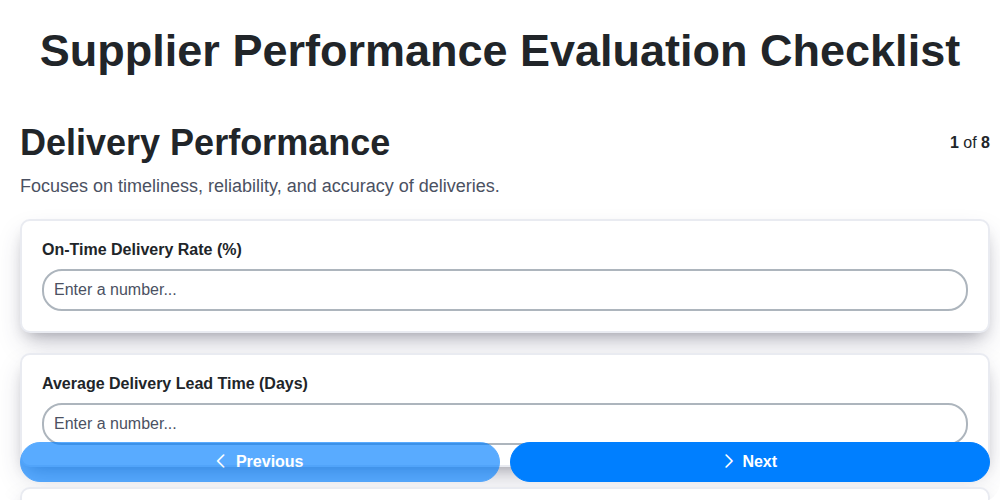
The Ultimate Supplier Performance Evaluation Checklist Template
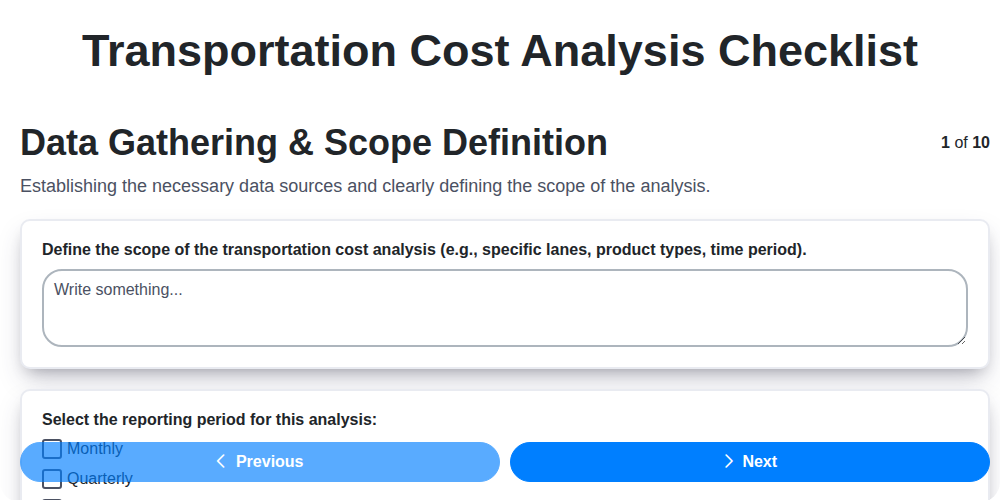
Transportation Cost Analysis Checklist Template: Your Guide to Savings
How to improve your Logistics Management
We can do it Together
Need help with
Checklists?
Have a question? We're here to help. Please submit your inquiry, and we'll respond promptly.