Material Requirements Planning (MRP) Workflow for Manufacturers
Published: 03/30/2026 Updated: 07/02/2026
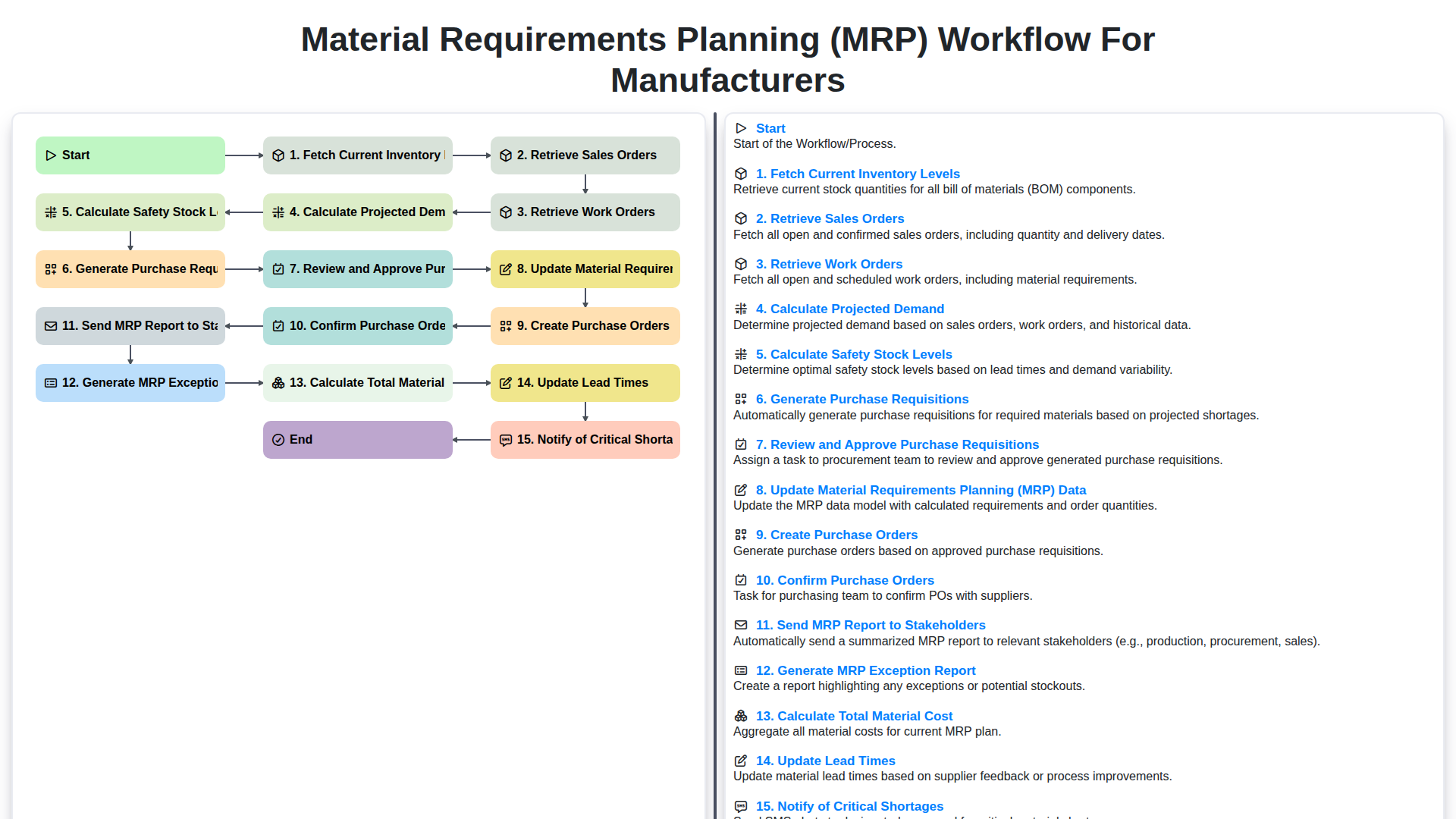
Table of Contents
- Understanding the MRP Workflow
- 1. Fetch Current Inventory Levels
- 2. Retrieve Sales Orders: The Demand Signal
- 3. Gathering Work Order Information
- 4. Calculating Projected Demand: Forecasting the Future
- 5. Determining Safety Stock Levels: Building a Buffer
- 6. Generating Purchase Requisitions: Identifying Material Needs
- 7. Review and Approval of Purchase Requisitions
- 8. Updating the Material Requirements Planning (MRP) Data
- 9. Creating Purchase Orders: Formalizing the Commitment
- 10. Confirming Purchase Orders: Securing Supply
- 11. Distributing the MRP Report to Stakeholders
- 12. Identifying and Reporting Exceptions
- 13. Calculating Total Material Costs
- 14. Maintaining Accurate Lead Times & Shortage Notifications
- Resources & Links
TLDR: This workflow guides manufacturers through planning material needs - from checking current stock and sales orders to generating purchase orders and managing potential shortages. It ensures you have the right materials, at the right time, minimizing waste and maximizing production efficiency.
Understanding the MRP Workflow
The Material Requirements Planning (MRP) workflow is the backbone of efficient manufacturing, ensuring you have the right materials, in the right quantities, at the right time. It's a cyclical process designed to minimize stockouts and excess inventory, ultimately optimizing your production schedule and reducing costs. Let's break down the key steps involved.
First, we Fetch Current Inventory Levels, providing a baseline of what's on hand. This is crucial for accurate planning. Next, we Retrieve Sales Orders - understanding future demand is paramount. Concurrent with this, we Retrieve Work Orders to account for production already in progress and planned. These inputs feed into Calculate Projected Demand, using historical data, forecasts, and sales orders to anticipate material needs. To buffer against uncertainty, we then Calculate Safety Stock Levels, ensuring enough stock to cover unexpected spikes in demand or supply chain disruptions.
Based on these calculations, we Generate Purchase Requisitions, formally requesting materials from suppliers. These requisitions undergo Review and Approve Purchase Requisitions, a vital step for budget control and ensuring accuracy. The approved requisitions then update the Update Material Requirements Planning (MRP) Data, reflecting the planned material acquisition. This triggers the Create Purchase Orders, which are sent to suppliers. Following order placement, Confirm Purchase Orders with the suppliers solidifies the agreement.
To keep everyone informed, a Send MRP Report to Stakeholders is generated, providing visibility into material availability and projected timelines. Simultaneously, a Generate MRP Exception Report highlights any potential issues, such as late deliveries or material shortages. A critical calculation of Calculate Total Material Cost is performed to analyze spend and identify cost-saving opportunities. Recognizing the dynamic nature of manufacturing, we continually Update Lead Times based on actual supplier performance. Finally, a Notify of Critical Shortages system alerts relevant personnel when stock levels fall below defined thresholds, allowing for proactive intervention. This entire process is continuously repeated to maintain a responsive and efficient supply chain.
1. Fetch Current Inventory Levels
Accurate inventory data is the bedrock of any successful MRP system. This initial step involves pulling real-time information on what materials and components you currently have on hand. This isn's just about knowing the quantity; it also includes details like lot numbers, expiration dates (for perishable goods), and location within your warehouse or facility. We typically integrate directly with your existing inventory management system (IMS) via API to automate this process, ensuring the data is as up-to-date as possible. Manual input is possible, but carries a higher risk of error and is less efficient. The accuracy of this step directly impacts the reliability of all subsequent calculations and planning.
2. Retrieve Sales Orders: The Demand Signal
Accurate material planning hinges on a clear understanding of future demand. Sales orders are the primary demand signal that kicks off this process. This isn't just about existing orders; it's about projected future sales as well.
We retrieve sales orders from your ERP or CRM system, factoring in:
- Confirmed Orders: These are orders with a firm delivery date and customer commitment.
- Forecasted Sales: Leveraging historical data, market trends, and sales team input, we incorporate anticipated sales volume for upcoming periods. This forecast is crucial for proactive material acquisition, not just reactive order fulfillment.
- Sales Promotions: Planned promotions or discounts significantly impact demand. These need to be meticulously accounted for to avoid stockouts or excess inventory.
- Customer Commitments: Any verbal commitments or pre-arranged deals with customers need to be included in the overall demand picture.
The more comprehensive and accurate the sales order data we collect, the more reliable your MRP calculations will be. We strive to integrate sales order information dynamically, ensuring real-time adjustments to your material plans as demand fluctuates.
3. Gathering Work Order Information
Understanding your current work orders is crucial for accurate material planning. These represent the materials already committed for production, independent of forecasted demand. We need to pull data from your work order management system, specifically focusing on:
- Bill of Materials (BOM): Each work order will specify the components and raw materials required to complete the finished product. The BOM details the quantity of each material needed.
- Start and End Dates: Knowing when work orders are scheduled to begin and finish helps determine the timing of material requirements. This dictates when those materials need to be available.
- Quantity to Produce: The number of units specified in each work order directly informs the amount of raw materials needed.
- Work Order Status: Understanding the progress of each work order (e.g., planned, in progress, completed) helps avoid double-counting materials or planning for requirements that are already covered.
Accurate work order data is the bedrock of a reliable MRP system. Any discrepancies here will cascade into inaccurate material requirements and potential production delays.
4. Calculating Projected Demand: Forecasting the Future
Accurate projected demand is the bedrock of any successful MRP system. This isn't simply about guessing; it's about leveraging historical data, market trends, and a healthy dose of informed assumptions. We use a combination of forecasting techniques to achieve this, tailored to the specific characteristics of each material.
Here's a breakdown of what goes into our demand forecasting:
- Historical Sales Data: This forms the foundation. We analyze past sales figures, identifying patterns, seasonality, and growth trends.
- Sales Forecasts: Input from the sales team is crucial. They provide insights into anticipated customer demand based on marketing campaigns, promotions, and known contracts.
- Market Trends: External factors like economic conditions, competitor activity, and emerging technologies can significantly impact demand. We constantly monitor these trends to adjust our forecasts.
- Product Lifecycle: Understanding where a product sits within its lifecycle - introduction, growth, maturity, decline - allows us to adjust forecasting models accordingly. Early-stage products might rely more on sales team estimates, while established products can leverage more historical data.
- Statistical Forecasting Models: We employ various statistical models like moving averages, exponential smoothing, and regression analysis to refine our predictions. The choice of model depends on the data availability and the patterns observed.
The result is a projected demand forecast for each material, expressed in units needed for a specific time period. This forecast, while not perfect, provides a critical input for subsequent steps in the MRP workflow, allowing us to plan material purchases proactively and avoid costly stockouts or overstocking.
5. Determining Safety Stock Levels: Building a Buffer
Safety stock isn't just a nice-to-have; it's a critical buffer against unexpected demand spikes or supply chain disruptions. Calculating it effectively involves considering several factors to avoid both stockouts and excessive inventory costs.
Here's a breakdown of the key components:
- Historical Demand Variability: Analyze past sales data to understand how much demand fluctuates. Higher variability necessitates higher safety stock. Look beyond averages - consider seasonal patterns, promotional effects, and market trends.
- Lead Time Variability: How reliable are your suppliers? If lead times are unpredictable, you need a larger safety stock to cover potential delays. Track supplier performance and factor in potential disruptions.
- Service Level: What percentage of customer orders do you want to fulfill immediately from stock? A higher service level (e.g., 99%) requires a higher safety stock than a lower one.
- Statistical Formulas: Common formulas for calculating safety stock include:
- Basic Formula: Safety Stock = Z * σ * √Lead Time
* Where:
- Z = Z-score corresponding to desired service level (e.g., Z = 1.645 for 95% service level)
- σ = Standard deviation of demand during the lead time
- Lead Time = Lead time in days/weeks/months
- Dynamic Adjustment: Safety stock levels aren't static. Regularly review and adjust them based on changing market conditions, supplier performance, and historical data. Consider using software that automatically adjusts safety stock based on predefined rules.
6. Generating Purchase Requisitions: Identifying Material Needs
Once the projected demand and safety stock levels are calculated, the next critical step is generating purchase requisitions. This is where the MRP system translates those calculated needs into actionable requests for procurement. The system automatically identifies materials that fall below reorder points, considering the lead times required to replenish them.
Each generated purchase requisition details the specific material, the quantity needed, the required delivery date (based on projected demand and lead times), and the suggested vendor (often based on historical data and vendor performance). It's important to note that while the MRP system suggests these values, they aren't necessarily final. The requisition serves as a starting point for the procurement team. Factors like current vendor capacity, potential price fluctuations, or internal prioritization might necessitate adjustments to the suggested quantities or delivery dates before formally approving the purchase. The requisition also provides a clear audit trail, documenting the reasoning behind the material need and the data used to calculate it. This transparency is crucial for efficient procurement and proactive problem-solving.
7. Review and Approval of Purchase Requisitions
Before purchase requisitions are sent to suppliers, they need a thorough review and approval process. This isn't just about checking numbers; it's about ensuring accuracy, cost-effectiveness, and alignment with overall business strategy.
Typically, the review process involves several key stakeholders. First, the requester (often the planning or production team) ensures the requisition accurately reflects the material needs and quantities calculated by the MRP system. Next, a designated approver - often a purchasing manager or a team lead - scrutinizes the requisition. They verify the justification for the requested materials, check pricing against established vendor contracts, and assess the impact on budget.
This approval stage might also include a check for alternative suppliers or materials that could reduce costs or mitigate risk. Complex or high-value requisitions may require approval from multiple tiers of management. A clear audit trail documenting who approved what and when is essential for accountability and traceability. This entire process helps prevent unnecessary or incorrect purchases, ultimately protecting the company's resources and streamlining the procurement cycle.
8. Updating the Material Requirements Planning (MRP) Data
Updating the MRP data is a crucial step, acting as the consolidation point where all previous calculations and forecasts are integrated into your system. This isn't just about entering numbers; it's about maintaining data integrity and accuracy for effective planning.
The data being updated will encompass several key areas:
- Planned Receipts: This reflects the quantities you expect to receive through purchase orders, shop orders, or other planned sources.
- Net Requirements: This is the difference between gross requirements (demand) and planned receipts. It indicates what needs to be procured or produced.
- Scheduled Receipts: These are projected dates when planned receipts are expected to arrive.
- Work Order Start and End Dates: Adjusted based on the updated material availability.
This process usually involves a system update triggered by the MRP run. Accurate input here directly impacts production schedules, inventory levels, and overall financial projections. Regular audits of this data are highly recommended to identify and correct any discrepancies arising from data entry errors or changes in business conditions.
9. Creating Purchase Orders: Formalizing the Commitment
Once purchase requisitions are approved, the next crucial step is translating those needs into formal Purchase Orders (POs). This isn't just a paperwork exercise; it's a legally binding commitment to a supplier. The PO details everything agreed upon in the requisition: the specific materials, quantities, agreed-upon price, delivery date, and shipping terms.
Automated MRP systems streamline this process. Approved requisitions often trigger automatic PO generation, pulling data directly from the requisition details. However, human oversight remains vital. Before a PO is finalized, a purchasing professional should review it to ensure accuracy, verify supplier contract terms, and confirm any potential price fluctuations or logistical considerations not already factored in.
The PO is then formally sent to the supplier, initiating the procurement process. Clear communication at this stage minimizes misunderstandings and sets the stage for a successful delivery. Proper documentation, including tracking numbers and confirmation receipts, is crucial for maintaining transparency and accountability throughout the entire process.
10. Confirming Purchase Orders: Securing Supply
Once purchase requisitions are approved, the next critical step is confirming the purchase orders (POs). This isn't merely about sending them; it's about actively securing the supply chain. Confirmation signifies that both your company and the supplier have formally agreed to the terms, quantities, and delivery dates outlined in the PO.
Confirmation typically involves a two-way communication, often facilitated through an electronic data interchange (EDI) system or supplier portal. This process ensures that the supplier acknowledges receipt of the PO and commits to fulfilling the order. It provides visibility for both parties, allowing for early identification of potential discrepancies or roadblocks.
Without proper confirmation, there's a risk of misunderstandings, delays, or even complete order cancellation. Confirmation helps lock in pricing, quantity, and schedule, reducing the likelihood of unexpected cost increases or delivery postponements. It's a cornerstone of reliable material flow and a vital element in a robust MRP workflow. Look for confirmation reports within your MRP system and proactively follow up with suppliers if confirmations are delayed.
11. Distributing the MRP Report to Stakeholders
Sharing the MRP report isn't just about generating data; it's about transparency and collaborative decision-making. Distributing the report to relevant stakeholders - including production managers, purchasing teams, sales representatives, and even executive leadership - ensures everyone has a clear understanding of the current material situation and any potential challenges.
The format of the report can vary depending on the stakeholder's needs. A high-level executive summary might focus on key trends and potential risks, while a production manager might require more detailed information about specific materials and timelines. Consider using dashboards and visualizations to make the data more accessible and understandable. Regularly scheduled distribution (e.g., weekly or bi-weekly) is critical to keep stakeholders informed and proactive. Encourage feedback and open communication to continuously improve the MRP process and ensure the report remains a valuable tool for everyone involved.
12. Identifying and Reporting Exceptions
Even the most meticulously planned MRP system can encounter hiccups. Identifying and proactively reporting these exceptions is crucial for maintaining production continuity and minimizing disruptions. The MRP Exception Report serves as your early warning system, highlighting potential problems that require immediate attention.
These exceptions often stem from deviations from the plan. Examples include:
- Significant Demand Fluctuations: Unexpected surges or drops in sales orders that deviate significantly from forecasts.
- Supplier Issues: Late deliveries, quality problems, or capacity constraints from suppliers.
- Internal Production Problems: Unexpected machine breakdowns, labor shortages, or quality issues impacting work order completion.
- Material Cost Variance: Actual material costs exceeding budgeted levels.
- Lead Time Changes: Unforeseen delays in material delivery affecting planned production schedules.
The MRP Exception Report should clearly outline these deviations, including the affected material, the reason for the exception, and the potential impact on production. Critical shortages, particularly those affecting key components, should be flagged immediately with a direct notification to relevant personnel (production managers, buyers, and stakeholders). A robust exception reporting process empowers the team to swiftly address issues, mitigate risks, and keep the manufacturing process running smoothly. Regular review of these reports and proactive investigation into their causes is vital for continuous improvement of the MRP system.
13. Calculating Total Material Costs
Calculating the total material cost isn't just about the purchase price. It's a crucial step in accurate MRP and ultimately, profitability. This involves much more than just the unit cost from your supplier. We need to consider the total cost of acquiring and managing those materials.
Here's a breakdown of what needs to be factored in:
- Purchase Price: This is the obvious one - the price per unit from your supplier.
- Freight/Shipping Costs: Transportation isn't free. Include all costs associated with getting materials to your facility.
- Import Duties & Taxes: If you're importing materials, factor in applicable import duties and taxes.
- Handling Costs: Costs associated with receiving, inspecting, and moving materials within your facility.
- Storage Costs: The cost of warehousing and storing materials, including rent, utilities, and labor.
- Insurance: Insurance premiums for materials in storage and transit.
- Obsolescence & Spoilage: Account for potential losses due to materials becoming obsolete or spoiling.
- Administrative Costs: The time and effort spent on procuring, processing, and paying for materials.
By aggregating these costs, you're calculating a more realistic and actionable total material cost. This figure feeds back into your MRP calculations, allowing you to make better purchasing decisions and optimize inventory levels to minimize waste and maximize efficiency. It also provides a clearer picture of the true cost of production.
14. Maintaining Accurate Lead Times & Shortage Notifications
The beauty of an MRP system lies in its ability to proactively manage material needs. However, this relies heavily on the accuracy of the data it uses, particularly lead times and the system's ability to flag critical shortages. Outdated or inaccurate lead times will throw off the entire MRP calculation, leading to either overstocking or, far worse, production stoppages.
Updating Lead Times: Lead times aren't static. They fluctuate due to supplier changes, transportation delays, or even seasonal variations. Regularly review and update lead times, ideally at least quarterly, and more frequently if you experience consistent discrepancies. This review should involve cross-referencing with supplier data and internal tracking of delivery performance. Document the rationale for any changes to maintain transparency and facilitate future adjustments.
Proactive Shortage Notifications: The MRP system's ability to notify you of critical shortages is invaluable. Configure these notifications to be triggered at appropriate thresholds (e.g., when stock falls below the reorder point, or when projected demand exceeds available supply). Don't just react to the alerts - investigate the root cause. Are lead times consistently longer than expected? Is the demand forecast inaccurate? These insights allow for continuous improvement of your planning process and stronger supplier relationships. Ignoring these notifications is a recipe for disruption and lost production.
Resources & Links
- APICS (The Association for Supply Chain Management): The leading professional organization for supply chain management, offering certifications (like CPIM and CSCP) and resources related to MRP and production planning.
- NetSuite: A popular ERP system offering MRP functionality. Their website provides information, case studies, and content about leveraging MRP for manufacturing.
- Oracle: Another major ERP vendor with a robust MRP module. Offers whitepapers, guides, and product details related to supply chain planning.
- Microsoft Dynamics 365 Manufacturing: Microsoft's ERP solution provides MRP capabilities; their website contains implementation guides and overviews.
- Infor: A global technology company offering industry-specific ERP solutions, including MRP, with content and resources available.
- Manufacturing MAP: A resource for manufacturing professionals. While not solely focused on MRP, it provides articles and insights covering various manufacturing processes including planning.
- QAD: A cloud-based ERP provider focused on manufacturing industries. Their website offers articles, demos, and product information about their MRP module.
- The Lean Enterprise Institute: While broader than just MRP, understanding Lean principles is crucial for optimizing workflows and reducing waste in manufacturing processes, including material planning. Their site provides resources on Lean methodologies.
- Supply Chain 24/7: A news and information website focused on supply chain topics, including articles on MRP and related technologies.
- Simplilearn: Offers online courses and resources, some of which cover ERP systems and manufacturing processes, including introductions to MRP.
Frequently Asked Questions
What is Material Requirements Planning (MRP) in a manufacturing context?
MRP is a production planning, scheduling, and inventory control system used to manage manufacturing processes. It ensures that materials and components are available for production and finished goods are available for delivery, meeting both supply and demand requirements.
What are the core inputs required for an effective MRP workflow?
The three essential inputs for MRP are the Master Production Schedule (MPS), the Bill of Materials (BOM), and the Inventory Status File (which includes current stock levels, on-order items, and lead times).
What are the primary steps in the MRP process?
The workflow typically follows these steps: 1. Netting (calculating net requirements), 2. Explosion (breaking down components via the BOM), 3. Offsetting (applying lead times to determine when orders must be placed), and 4. Order Explosion (generating planned order releases).
How does MRP help in reducing manufacturing costs?
MRP optimizes inventory levels by preventing overstocking (reducing carrying costs) and avoiding stockouts (reducing production delays and expedited shipping costs), leading to a more efficient use of working capital.
What is the difference between MRP and MRP II?
While MRP focuses primarily on material availability and inventory, MRP II (Manufacturing Resource Planning) is more comprehensive, incorporating additional data such as capacity planning, labor availability, and financial tracking into the production loop.
What are some common challenges when implementing an MRP workflow?
Common challenges include inaccurate data entry (incorrect BOMs or inventory counts), poor integration with other departments, and failure to account for fluctuating lead times or unexpected supply chain disruptions.
Comments
There are no comments yet. Be the first to add one!
Manufacturing Management Solution Demo
Stop chasing paperwork and wrestling with disconnected systems! Our solution brings clarity and control to your production process. From standard operating procedures (SOPs) and equipment maintenance to quality control and inventory tracking, we simplify every step.
Related Articles
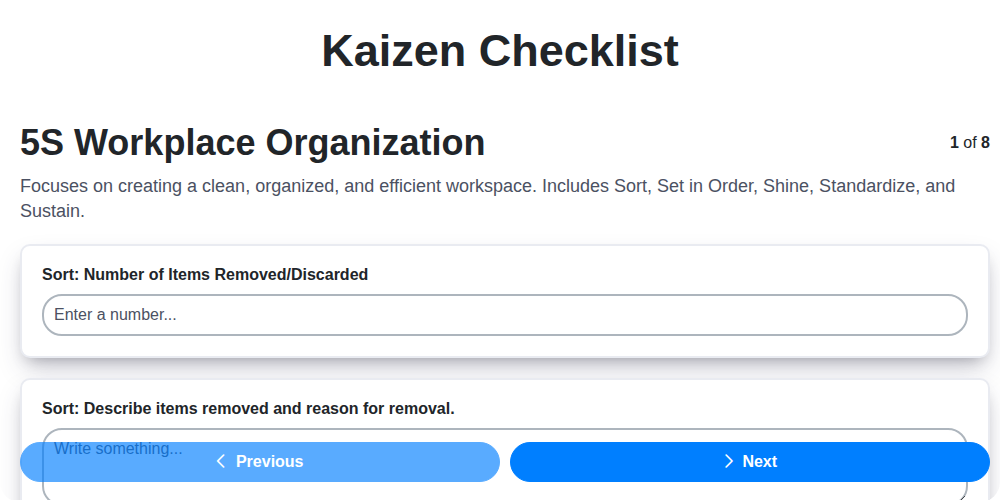
Kaizen Checklist Template: Your Path to Continuous Improvement

Machine Safety Audit Checklist: Your Guide to a Safer Manufacturing Workplace
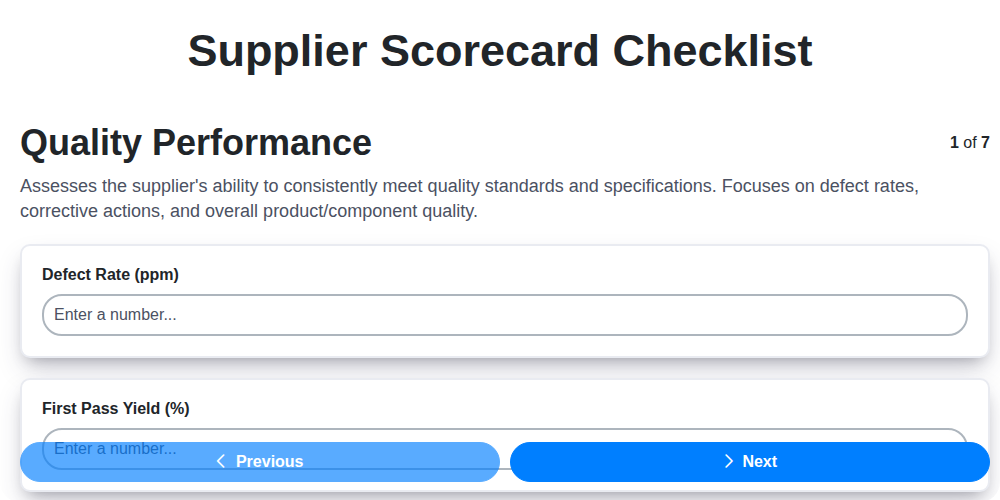
Mastering Supplier Performance: Your Free Supplier Scorecard Checklist Template
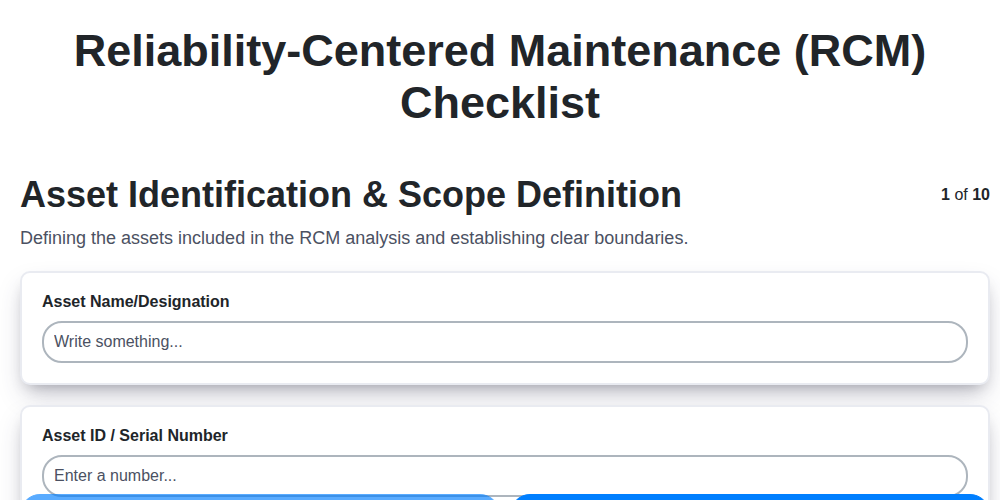
Your Ultimate RCM Checklist Template: A Step-by-Step Guide

LPA Checklist Template: Your Guide to Layered Process Audits

Your Ultimate Lockout/Tagout (LOTO) Checklist Template

Your Ultimate FSC 22000 Checklist Template
Quality Control Inspection Checklist Template: Prevent Defects & Improve Manufacturing Processes
Need help with
Checklists?
Have a question? We're here to help. Please submit your inquiry, and we'll respond promptly.