Paper vs ChecklistGuro in Supply Chain Management (SCM)
Published: 20.12.2025 Updated: 02.07.2026
Table of Contents
- Introduction: The Critical Role of Checklists in Supply Chain Management
- Understanding Supply Chain Checklists: What They Track & Why They Matter
- The Limitations of Paper-Based Checklists in SCM
- Common Supply Chain Checklists: Examples & Use Cases
- Introducing ChecklistGuro: A Digital Solution for SCM
- How ChecklistGuro Streamlines Your Supply Chain Processes
- Key Features of ChecklistGuro for SCM
- Paper vs. ChecklistGuro: A Feature Comparison
- Real-World Benefits: Increased Efficiency & Reduced Errors
- Cost Savings: Beyond Just Paper & Printing
- Improved Visibility & Traceability with ChecklistGuro
- Scalability: Adapting to Growth with Digital Checklists
- Implementation: Getting Started with ChecklistGuro
- Conclusion: Embracing Digital Checklists for a Robust SCM
- Resources & Links
TLDR: Tired of disorganized paper checklists slowing down your supply chain? This post breaks down how checklists are crucial for SCM - from tracking shipments to quality control - and shows you why a digital solution like ChecklistGuro, with its automation and real-time visibility, is far more efficient than managing everything manually with paper. Learn how to streamline your processes and reduce errors!
Introduction: The Critical Role of Checklists in Supply Chain Management
Supply chain management (SCM) is a complex web of processes, from sourcing raw materials to delivering finished products to customers. Each stage is fraught with potential pitfalls - delays, errors, quality issues, and compliance violations - that can significantly impact your bottom line and reputation. This is where checklists become absolutely vital.
Think of checklists as the backbone of a well-managed supply chain. They provide a structured, step-by-step guide to ensure every task is completed correctly and consistently. Whether you're verifying the condition of incoming goods, confirming the accuracy of inventory counts, or documenting the steps in a quality control procedure, checklists provide a clear path forward.
Historically, these checklists have lived on paper - often handwritten and scattered across departments. While paper checklists have their place, they're increasingly proving to be a bottleneck in today's fast-paced business environment. We'll explore why in this article, but first, let's solidify what these checklists are actually doing in a typical SCM context. They're not just about ticking boxes; they're essential tools for:
- Ensuring Quality: Verifying product specifications, inspecting for defects, and confirming adherence to industry standards.
- Maintaining Compliance: Documenting adherence to regulations and internal policies, reducing legal risks.
- Improving Efficiency: Standardizing processes and minimizing errors, saving time and resources.
- Boosting Visibility: Providing a clear record of completed tasks and potential issues, facilitating better decision-making.
- Facilitating Traceability: Enabling tracking of goods and processes throughout the supply chain, crucial for recalls and audits.
Understanding Supply Chain Checklists: What They Track & Why They Matter
Supply chain management is a complex web of processes, people, and logistics. Without meticulous tracking and verification, bottlenecks, errors, and ultimately, lost profits, are almost inevitable. That's where checklists come in. They're more than just boxes to tick; they're the backbone of a well-managed supply chain.
Think about it - a single delayed shipment can ripple through the entire chain, impacting production, customer delivery, and ultimately, your bottom line. Supply chain checklists ensure consistency and accountability at every stage.
Here's a glimpse of what these vital checklists typically track:
- Procurement & Ordering: Confirming supplier compliance, verifying order accuracy, tracking lead times, and ensuring ethical sourcing.
- Inventory Management: Maintaining accurate stock levels, conducting cycle counts, managing storage conditions, and preventing obsolescence.
- Warehousing & Distribution: Confirming proper receiving procedures, tracking location accuracy, validating packing and labeling, and ensuring timely dispatch.
- Transportation & Logistics: Verifying shipment integrity, tracking delivery timelines, confirming temperature control (for perishables), and managing customs clearance.
- Quality Control: Inspecting raw materials, monitoring production processes, verifying finished goods, and ensuring adherence to quality standards.
- Compliance & Audits: Maintaining records for regulatory requirements, ensuring safety protocols are followed, and documenting audit findings.
The beauty of a well-defined checklist is its ability to standardize processes. It minimizes human error, provides a clear audit trail, and empowers everyone involved to understand their responsibilities. When everyone is on the same page, the entire supply chain operates more smoothly, predictably, and efficiently.
The Limitations of Paper-Based Checklists in SCM
Paper checklists, while familiar and seemingly simple, present significant limitations in today's fast-paced supply chain environment. The core issue lies in their inherent inflexibility and lack of real-time data visibility.
Think about it: a paper checklist is static. Updates require manual rewriting, which is prone to errors and often delayed. Sharing information with team members, suppliers, or customers becomes a cumbersome process involving faxes, emails, or even physical delivery. This lack of instant communication can lead to bottlenecks and misunderstandings.
Furthermore, analyzing the data collected on paper is a nightmare. Compiling and interpreting information from scattered sheets is time-consuming and difficult, hindering your ability to identify trends, pinpoint inefficiencies, and make data-driven decisions. Audits become protracted affairs, requiring hours of painstaking review.
Finally, consider the risk of loss or damage. A misplaced checklist can derail critical steps, while a water-damaged document can lead to total loss of information. Digital solutions eliminate these risks through secure cloud storage and data backups.
Ultimately, relying on paper checklists in SCM isn't just inconvenient - it's actively hindering your ability to operate efficiently and competitively.
Common Supply Chain Checklists: Examples & Use Cases
Let's dive into some practical examples of checklists commonly used in supply chain management. These aren't just random lists; they represent critical control points that, when properly managed, contribute significantly to a smooth and efficient supply chain.
1. Receiving & Inventory Checklists: These checklists are your first line of defense when goods arrive. They verify quantities against purchase orders, check for damages, and ensure the correct items are received. A typical checklist includes items like:
- Confirmation of delivery date and time
- Verification of quantity and product codes
- Inspection for visible damage (packaging and product)
- Documentation of any discrepancies
- Confirmation of receipt by designated personnel
2. Warehouse Operations Checklists: These ensure efficient and accurate inventory management within your warehouse. Examples include:
- Putaway Checklist: Verifies proper storage location and condition of goods.
- Picking Checklist: Ensures accuracy and speed in fulfilling orders.
- Cycle Counting Checklist: Confirms inventory levels and identifies discrepancies.
3. Shipping & Delivery Checklists: These are essential for ensuring orders reach customers on time and in good condition. They cover:
- Verification of shipping address and details.
- Proper packaging and labeling.
- Selection of appropriate carrier and service level.
- Tracking information updates.
- Confirmation of delivery and customer signature (if applicable).
4. Quality Control Checklists: Maintaining product quality throughout the supply chain is paramount. These checklists ensure adherence to quality standards at various stages:
- Supplier Quality Checklists: Evaluate supplier performance and identify potential issues.
- In-Process Quality Checklists: Monitor production processes and identify defects.
- Final Product Inspection Checklist: Verify final product quality before shipment.
5. Transportation Checklists: Covering everything from driver pre-trip inspections to route compliance, these are vital for safety and efficiency:
- Vehicle inspection (brakes, tires, lights)
- Cargo securement verification
- Driver log adherence
- Route compliance
- Temperature monitoring (for temperature-sensitive goods)
These are just a few examples, and the specific checklists you need will depend on your unique supply chain processes. The key is to identify your critical control points and create checklists that ensure consistent execution and accountability.
Introducing ChecklistGuro: A Digital Solution for SCM
ChecklistGuro isn't just another digital checklist tool; it's a purpose-built platform designed to streamline complex workflows. For Supply Chain Management, this translates to a powerful way to digitize and automate those critical processes previously handled with paper. Imagine a centralized hub where every stakeholder - from warehouse staff to logistics providers - can access the same, up-to-date information, execute checklists, and instantly report results.
Here's what sets ChecklistGuro apart for SCM:
- Customizable Templates: We provide a library of SCM checklist templates to get you started, but you can easily adapt them or create your own from scratch to match your specific requirements. Whether it's inbound inspection, outbound shipment verification, or equipment maintenance, we've got you covered.
- Real-time Visibility: Eliminate the guesswork. Track progress in real-time, identify bottlenecks, and proactively address issues before they impact your operations. Dashboards and reporting tools provide actionable insights.
- Automated Notifications & Reminders: Say goodbye to missed steps and delayed actions. Automated notifications ensure that the right people are informed at the right time.
- Integration Capabilities: Connect ChecklistGuro with your existing ERP, WMS, and other business systems to create a seamless flow of information. (We're constantly expanding our integration options!)
- Secure and Accessible: Access your checklists from anywhere, on any device. Our platform is built with robust security measures to protect your data.
- Collaboration Features: Facilitate seamless communication and collaboration between team members involved in the supply chain process. Assign tasks, add comments, and share files directly within checklists.
How ChecklistGuro Streamlines Your Supply Chain Processes
ChecklistGuro isn't just about digitizing your existing paper checklists; it's about fundamentally rethinking how your supply chain operates. Here's how:
- Automated Task Assignment & Notifications: Forget chasing people down to complete tasks. ChecklistGuro automatically assigns tasks to responsible parties and sends timely notifications - ensuring nothing falls through the cracks.
- Real-time Visibility & Tracking: See exactly where your products are, what stage each process is in, and who's accountable for each step - all in one central dashboard. This eliminates guesswork and allows for proactive problem-solving.
- Data-Driven Insights: ChecklistGuro captures valuable data with every completed checklist. Analyze this data to identify bottlenecks, inefficiencies, and areas for improvement in your supply chain. Generate reports easily to share with your team and stakeholders.
- Mobile Accessibility: Empower your team with mobile access to checklists, enabling real-time updates and data collection from anywhere, whether they're in a warehouse, on a truck, or visiting a supplier.
- Customizable Workflows: Design workflows that precisely match your unique supply chain processes. Add conditional logic, branching paths, and automated approvals to tailor the system to your specific needs.
- Integration Capabilities: Connect ChecklistGuro with your existing systems (ERP, CRM, etc.) to eliminate data silos and automate data transfer, further streamlining your operations. This ensures information flows seamlessly across your entire organization.
Key Features of ChecklistGuro for SCM
ChecklistGuro isn't just a digital checklist; it's a comprehensive SCM management platform. Here's a deeper dive into the features that make it a game-changer:
- Customizable Checklist Templates: While we offer pre-built SCM checklist templates (covering everything from warehouse receiving to final delivery inspections), you can easily tailor them to your exact needs. Add steps, modify descriptions, and integrate specific data points relevant to your processes.
- Real-time Tracking & Visibility: Forget chasing down updates. With ChecklistGuro, you get instant visibility into the status of every task. Track progress on a Kanban board, see who's responsible for each step, and identify bottlenecks quickly.
- Automated Notifications & Reminders: Reduce delays and ensure accountability with automated reminders and notifications. Assign tasks to team members and receive alerts when deadlines are approaching or steps are missed.
- Data Capture & Reporting: Beyond simply completing checklists, ChecklistGuro captures valuable data at each stage of the supply chain. Generate reports on key metrics like cycle times, error rates, and team performance. This data fuels continuous improvement.
- Mobile Accessibility: Equip your team with the power of ChecklistGuro on the go. Our mobile app allows for real-time updates from anywhere, whether it's on the warehouse floor, in a delivery truck, or on-site at a supplier's facility.
- Integrations: We understand that your SCM isn't a siloed function. ChecklistGuro seamlessly integrates with popular business tools (like Slack, Google Sheets, and more - check our integrations page for a full list) to enhance overall efficiency.
- Role-Based Access Control: Secure your data and control access levels with role-based permissions. Assign specific roles to team members, limiting their access to sensitive information and functionalities.
Paper vs. ChecklistGuro: A Feature Comparison
Let's get down to specifics. While both paper checklists and ChecklistGuro aim to ensure tasks are completed, their capabilities differ dramatically. Here's a breakdown comparing key features:
| Feature | Paper Checklists | ChecklistGuro |
|---|---|---|
| Real-time Visibility | None. Information is static and relies on manual updates. | Instant visibility across the entire supply chain. Updates are reflected immediately for all stakeholders. |
| Collaboration | Limited. Requires physical handoffs or cumbersome email chains. | Seamless collaboration with assigned users receiving notifications and updates directly within the platform. |
| Data Accuracy | Prone to human error during manual recording and transcription. | Significantly reduced errors thanks to digital input and automated calculations. |
| Reporting & Analytics | Impossible without significant manual effort. | Built-in reporting and analytics provide valuable insights into performance, bottlenecks, and areas for improvement. |
| Automation | Zero automation. Each step is manual. | Automate recurring tasks, assign responsibilities, and trigger alerts based on pre-defined conditions. |
| Accessibility | Limited to physical location of the checklist. | Accessible from anywhere with an internet connection, ideal for dispersed teams. |
| Scalability | Difficult to scale as the supply chain grows. | Easily scalable to accommodate growing business needs and complexity. |
| Audit Trail | Non-existent. Difficult to track changes or accountability. | Comprehensive audit trail records all changes and actions, ensuring accountability and compliance. |
| Cost | Low initial cost, but accumulates with printing, storage, and potential errors. | Subscription-based, but offers a strong ROI through increased efficiency and reduced errors. |
This table highlights the critical difference: Paper checklists represent a legacy approach, while ChecklistGuro offers a modern, efficient, and data-driven solution to supply chain management.
Real-World Benefits: Increased Efficiency & Reduced Errors
Let's be honest, supply chain management is complex. Paper-based checklists, while seemingly simple, quickly become a source of frustration and inefficiency. Think about it: lost forms, illegible handwriting, delayed updates, and the constant risk of human error. These issues add up, impacting everything from on-time deliveries to product quality and ultimately, your bottom line.
Here's how transitioning to a digital solution like ChecklistGuro directly translates to tangible benefits:
- Reduced Errors: Manual data entry is a breeding ground for mistakes. ChecklistGuro's digital forms minimize input errors and enforce data validation, ensuring accuracy and consistency across your entire supply chain.
- Faster Completion Times: Digital checklists can be completed faster than paper ones. Features like pre-populated fields, dropdown menus, and the ability to capture photos directly into the checklist drastically reduce the time spent on each task.
- Improved Visibility & Traceability: With a digital platform, everyone involved has access to real-time updates. Track progress, identify bottlenecks, and pinpoint issues as they arise, fostering better communication and accountability.
- Enhanced Compliance: Many supply chain processes require strict adherence to regulations. Digital checklists make it easier to document compliance activities and generate audit trails.
- Cost Savings: While there's an initial investment in software, the long-term cost savings from reduced errors, improved efficiency, and minimized waste far outweigh the expense. Think of it as an investment in operational excellence.
Consider a scenario where a critical shipment is delayed. With paper checklists, tracking down the cause can involve digging through piles of forms and contacting multiple parties. With ChecklistGuro, the information is readily available, allowing you to quickly identify the issue and implement corrective actions. This responsiveness is a competitive advantage in today's fast-paced market.
Cost Savings: Beyond Just Paper & Printing
While the obvious cost savings come from reduced paper and printing expenses, the true financial benefits of transitioning to a digital checklist system like ChecklistGuro extend far beyond that. Think about the hidden costs associated with manual processes:
- Time wasted searching for misplaced documents: How much time do employees spend hunting down paper checklists or invoices? This time adds up quickly, especially as your supply chain grows.
- Errors and Rework: Paper checklists are prone to human error, leading to incorrect data entry, missed steps, and costly rework. A single mistake can delay shipments, damage relationships with suppliers, and impact customer satisfaction. ChecklistGuro's guided workflows and built-in validation features minimize these errors.
- Inventory Management Inefficiencies: Manual tracking often leads to inaccurate inventory counts, resulting in stockouts or overstocking. Real-time data from ChecklistGuro allows for better inventory forecasting and optimization.
- Auditing & Compliance: Paper trails are often disorganized and difficult to audit, increasing the risk of non-compliance and potential fines. ChecklistGuro provides a centralized, auditable record of all activities.
- Reduced Training Costs: Digital checklists can be standardized and easily updated, reducing the time and resources required for employee training.
By automating processes and reducing errors, ChecklistGuro unlocks significant cost savings that impact your bottom line.
Improved Visibility & Traceability with ChecklistGuro
One of the biggest pain points in supply chain management is the black box effect - not knowing exactly where goods are, their condition, or who's responsible at each stage. Paper checklists, while helpful for basic documentation, often get lost, are difficult to share, and offer limited real-time insights.
ChecklistGuro solves this by providing complete, centralized visibility. Every checklist completion is recorded digitally, creating an audit trail that's accessible to authorized personnel across your organization.
Here's how it enhances traceability:
- Real-time Updates: See the status of each step in your supply chain immediately. No more waiting for reports or chasing down information.
- Complete Audit Trail: Easily track who completed each task, when, and any notes or issues they encountered. This is invaluable for compliance and identifying bottlenecks.
- Geolocation Tracking (Optional): Integrate with GPS to pinpoint the exact location of shipments or assets.
- Reporting & Analytics: Generate insightful reports to identify trends, measure performance, and optimize your supply chain processes.
- Reduced Disputes: Clear documentation minimizes disagreements about responsibilities and product condition.
This enhanced visibility isn't just about knowing where things are; it's about having the data to make informed decisions, proactively address potential problems, and continuously improve your supply chain's efficiency and resilience.
Scalability: Adapting to Growth with Digital Checklists
As your business expands, so too will the complexity of your supply chain. Paper-based systems, while seemingly manageable when you're a smaller operation, quickly become a bottleneck. Think about it: adding new suppliers, new distribution routes, or increased order volumes - each requires more checklists, more manual updates, and a higher risk of errors.
With paper, scaling means printing more forms, storing more files, and training more staff on the same, repetitive tasks. This eats into your resources and limits your ability to capitalize on growth opportunities.
ChecklistGuro, however, is designed for growth. Adding new processes, suppliers, or team members is as simple as creating a new checklist or inviting them to the platform. No need for additional filing cabinets, expensive printer cartridges, or endless photocopying. The platform automatically scales with your needs, ensuring your supply chain processes remain efficient and under control, even as your business flourishes. Real-time data collection and reporting also provide valuable insights into performance, allowing you to identify areas for optimization and anticipate future needs.
Implementation: Getting Started with ChecklistGuro
Okay, let's get started! Switching from paper to a digital solution might seem daunting, but with ChecklistGuro, it's surprisingly straightforward. Here's a breakdown of how to get up and running:
1. Account Creation & Team Setup: The first step is easy. Sign up for a ChecklistGuro account - we offer a free trial, so you can explore the platform before committing. Once you're in, add your team members and define their roles (e.g., Warehouse Manager, Quality Control Inspector, Receiving Clerk). This ensures everyone has the right access and permissions.
2. Template Selection & Customization: We offer a library of pre-built SCM checklist templates to cover common processes like receiving, warehousing, shipping, quality inspections, and more. Browse our templates and select those relevant to your business. Don't worry; customization is key! Each template is fully editable. You can:
- Add/Remove Steps: Tailor the checklist to match your exact workflow.
- Add Custom Fields: Capture specific data relevant to your unique products or processes (e.g., lot numbers, serial numbers, temperature readings).
- Define Assignees: Assign each step to a specific team member.
- Set Due Dates & Reminders: Ensure timely completion of tasks.
- Add Attachments: Include relevant documents, photos, or videos to each checklist.
3. Integrations (Optional but Powerful): ChecklistGuro integrates with popular business tools like Google Sheets, Slack, and more. These integrations allow you to automatically populate checklists with data, receive notifications about completed or overdue tasks, and share checklist data with other departments. We're continually adding new integrations, so check our integrations page for the latest options.
4. Training & Support: We provide comprehensive documentation and video tutorials to help you learn the platform. Our support team is also available to answer your questions and provide assistance. We want to ensure you're successful with ChecklistGuro!
5. Start Using & Iterate: Begin using your customized checklists to manage your supply chain processes. Monitor performance, gather feedback from your team, and continually refine your checklists to optimize efficiency. We recommend starting with a pilot program in one area of your supply chain to ensure a smooth transition.
Conclusion: Embracing Digital Checklists for a Robust SCM
The choice between paper checklists and a digital solution like ChecklistGuro isn't simply about convenience - it's about the future of your supply chain. While paper checklists have served their purpose, the complexities of modern supply chains demand greater efficiency, accuracy, and real-time visibility.
ChecklistGuro isn't just a digital replacement for paper; it's a platform designed to actively improve your SCM processes. By automating tasks, providing instant reporting, enabling collaboration, and minimizing human error, ChecklistGuro empowers your team to focus on strategic decision-making and proactive problem-solving.
Investing in a robust digital checklist solution isn't an expense; it's an investment in a more resilient, responsive, and ultimately, more profitable supply chain. Embrace the power of digital checklists and unlock the full potential of your operations. Ready to see how ChecklistGuro can transform your SCM?
Resources & Links
- APICS (The Association for Supply Chain Management): A leading professional association for supply chain and operations management, offering resources, certifications, and insights into best practices.
- The Institute for Supply Management (ISM): Offers insights, reports, and certifications related to procurement and supply management. Useful for understanding industry trends and terminology.
- Supply Chain Dive: A leading publication providing daily news and insights into the supply chain industry, covering trends, technologies, and challenges.
- Gartner: A research and advisory company providing insights on technology and business trends, including supply chain management. While behind a paywall for detailed reports, their website has some free resources and definitions.
- McKinsey & Company: A global management consulting firm. They often publish articles and reports on supply chain strategy and digital transformation. Look for free articles.
- ChecklistGuro: The platform discussed in the blog post - provides a digital checklist solution to streamline processes. Features detailed product information and use case examples.
- SAS - Supply Chain Management Resources: SAS offers various articles and resources related to supply chain management, covering topics like visibility, risk management, and optimization.
- BlueKai - Supply Chain Management Glossary: A glossary of common terms and definitions for supply chain management, helpful for understanding industry terminology used in the blog post.
Frequently Asked Questions
What is Supply Chain Management (SCM) and why is it important?
Supply Chain Management (SCM) involves the planning, execution, and control of all activities involved in sourcing, procurement, conversion, and logistics management. It's crucial for optimizing efficiency, reducing costs, improving customer satisfaction, and gaining a competitive advantage by ensuring goods and services are available when and where they are needed.
What are the main differences between using paper-based systems and ChecklistGuro for SCM?
Paper-based systems rely on manual processes, are prone to errors, difficult to track, and lack real-time visibility. ChecklistGuro offers a digital, automated approach with features like task assignment, progress tracking, automated reminders, reporting, and improved data accuracy, ultimately streamlining SCM processes.
What are the advantages of using ChecklistGuro over paper checklists in SCM?
ChecklistGuro offers numerous advantages including reduced errors, real-time tracking and visibility, improved collaboration, automated reporting, streamlined workflows, easier auditing, and increased overall efficiency. Paper-based systems simply can't match these capabilities.
What types of SCM processes can ChecklistGuro be used for?
ChecklistGuro is versatile and can be applied to various SCM processes like receiving inspections, quality control, warehouse operations, shipping and logistics, vendor management, and compliance audits. Essentially, any repeatable process within the supply chain can be digitized and optimized with ChecklistGuro.
How does ChecklistGuro improve collaboration within an SCM team?
ChecklistGuro allows for easy task assignment, notifications, and communication directly within the platform. Team members can see who's responsible for what, track progress in real-time, and leave comments or updates, fostering better collaboration and accountability.
Is ChecklistGuro suitable for small businesses or is it geared towards larger enterprises?
ChecklistGuro is designed to be scalable and beneficial for businesses of all sizes. Small businesses can leverage it to quickly improve efficiency and eliminate manual errors, while larger enterprises can use it to standardize processes and gain greater visibility across complex supply chains.
What kind of reporting capabilities does ChecklistGuro provide for SCM?
ChecklistGuro offers customizable reporting features allowing you to track key performance indicators (KPIs), identify bottlenecks, and measure the effectiveness of your SCM processes. Reports can be generated in various formats and shared with stakeholders.
How secure is the data stored within ChecklistGuro?
ChecklistGuro prioritizes data security and employs industry-standard security measures to protect sensitive information. Specific security protocols may vary depending on the subscription plan, but generally include data encryption, access controls, and regular security audits.
Is there a learning curve associated with using ChecklistGuro?
ChecklistGuro is designed to be user-friendly and intuitive, minimizing the learning curve. Most users can quickly adapt to the platform with minimal training. Comprehensive documentation and support resources are also available to assist with onboarding.
Can ChecklistGuro be integrated with other SCM software?
ChecklistGuro offers integration capabilities with various other SCM software through APIs and potentially pre-built integrations, although the specific integrations available may vary. Contact ChecklistGuro's support team for detailed integration options.
Comments
There are no comments yet. Be the first to add one!
SCM - Supply Chain Management Solution Demo
Struggling with supply chain disruptions & lack of visibility? ChecklistGuro delivers a centralized SCM solution, connecting your suppliers, manufacturers, & distributors for improved collaboration and control. Simplify operations & boost efficiency.
Related Articles
How to increase your efficiency with Logistics Management Software
How to Save Money on Logistics Management Software
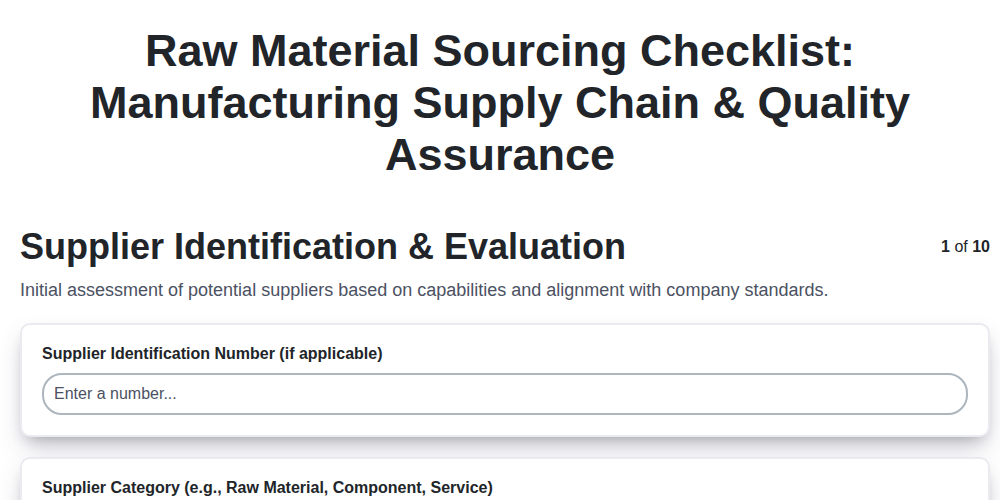
The Ultimate Raw Material Sourcing Checklist for Manufacturing
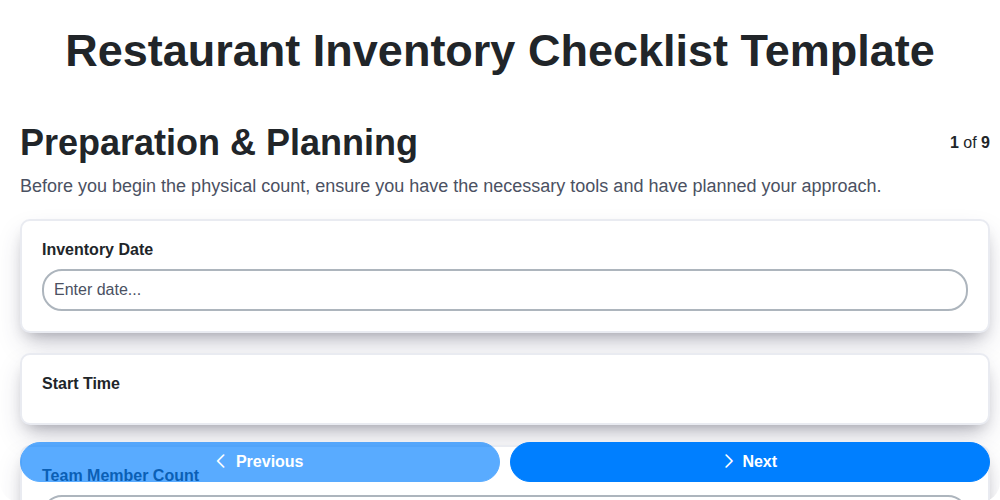
Restaurant Inventory Checklist Template: Your Guide to Food & Supply Control
How to Find and Choose the Best Logistics Management Software
The Ultimate Supplier Performance Evaluation Checklist Template
Transportation Cost Analysis Checklist Template: Your Guide to Savings
How to improve your Logistics Management
Need help with
Checklists?
Have a question? We're here to help. Please submit your inquiry, and we'll respond promptly.