Streamlining Compliance: A Step-by-Step Guide to the Policy Document Generation Process
Published: 06/09/2026 Updated: 10/05/2026
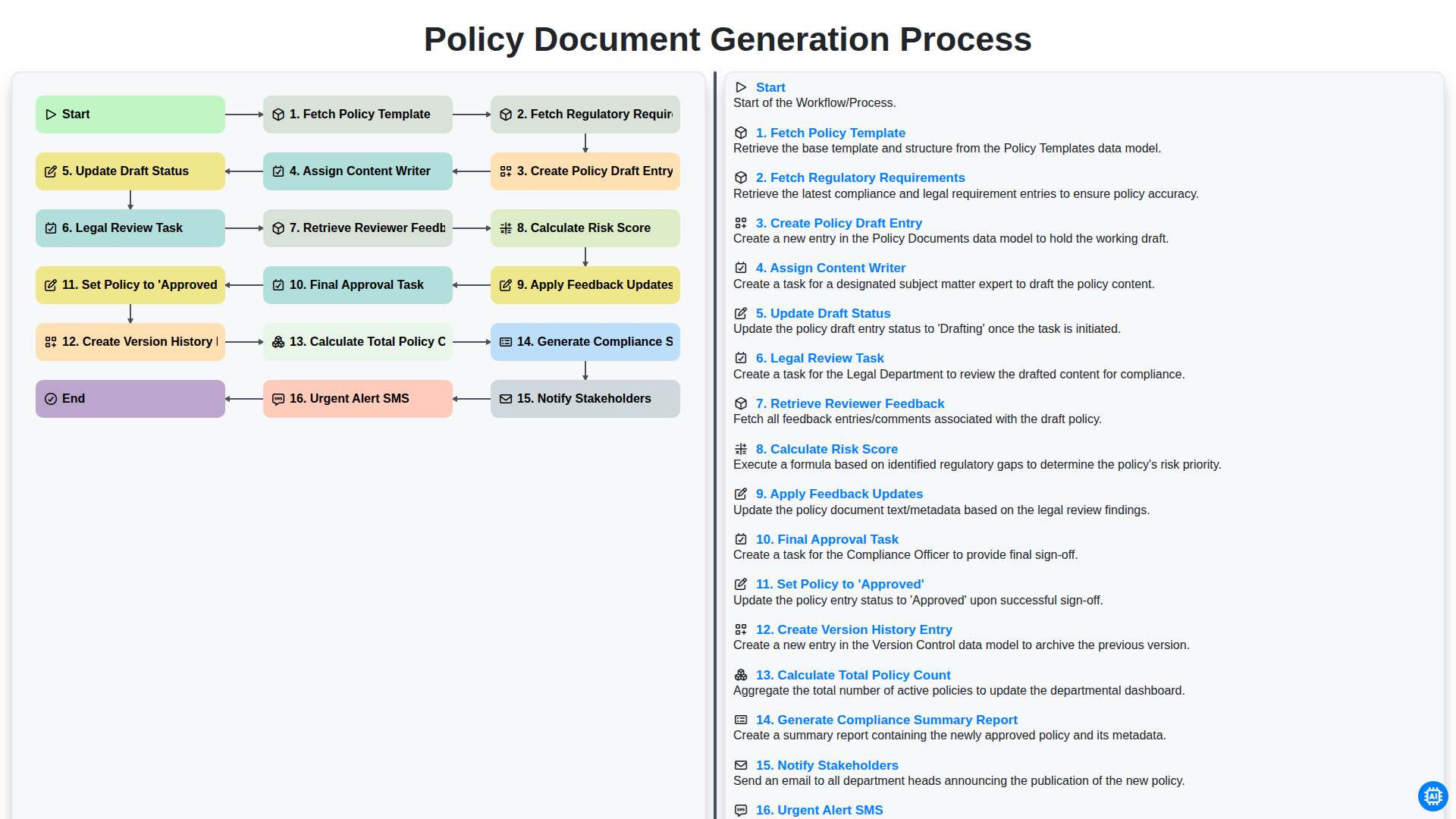
Table of Contents
- Introduction: The Importance of an Automated Policy Workflow
- Phase 1: Foundation and Requirements Gathering
- Step 1: Fetching the Standard Policy Template
- Step 2: Integrating Regulatory Requirements
- Phase 2: Drafting and Content Creation
- Step 3: Initializing the Policy Draft Entry
- Step 4: Assigning the Content Writer
- Step 5: Monitoring Progress through Draft Status Updates
- Phase 3: Rigorous Review and Risk Assessment
- Step 6: Initiating the Legal Review Task
- Step 7: Retrieving and Analyzing Reviewer Feedback
- Step 8: Calculating the Policy Risk Score
- Step 9: Implementing Feedback Updates
- Phase 4: Finalization and Compliance Reporting
- Step 10: Final Approval and Official Versioning
- Step 11: Finalizing the Policy Status and History
- Step 12: Generating Compliance Summaries and Stakeholder Notifications
- Managing Critical Updates: Urgent Alert SMS Systems
- Resources & Links
TLDR: Learn how to automate and optimize your compliance management with our end-to-end Policy Document Generation Workflow. This guide explores how the automated process moves from fetching templates and regulatory requirements to drafting, legal review, and risk assessment, ensuring seamless version control, stakeholder notification, and final approval with minimal manual intervention.
Introduction: The Importance of an Automated Policy Workflow
In an era of ever-evolving regulatory landscapes and tightening compliance standards, managing a company's policy library manually is no longer just a challenge-it is a significant operational risk. Traditional, manual methods of policy management often lead to fragmented communication, missed regulatory updates, and the dreaded version control nightmare, where outdated documents circulate within an organization.
An automated Policy Document Generation Process transforms this chaotic manual effort into a streamlined, predictable, and auditable pipeline. By replacing disjointed emails and spreadsheets with a structured workflow, organizations can ensure that every policy is born from verified regulatory requirements, undergoes rigorous legal scrutiny, and is systematically tracked from initial draft to final approval. Automating this lifecycle does more than just save time; it creates a single source of truth, mitigates human error, and ensures that your organization remains audit-ready at a moment's notice.
Phase 1: Foundation and Requirements Gathering
The initial stage of the policy lifecycle is critical, as it sets the structural and legal groundwork for the entire document. This phase focuses on two fundamental prerequisites: Fetching the Policy Template and Fetching Regulatory Requirements.
To ensure consistency across the organization, the process begins by retrieving a standardized template that aligns with company branding and formatting standards. However, a template alone is insufficient for compliance; the workflow simultaneously integrates the latest regulatory requirements. By pulling real-time regulatory data, the system ensures that the upcoming policy is built upon a foundation of current legal mandates, preventing gaps in compliance before the writing even begins. This dual-layered approach ensures that the policy is both structurally sound and legally relevant from the very first step.
Step 1: Fetching the Standard Policy Template
The foundation of any robust compliance framework lies in consistency. The process begins with the Fetch Policy Template step, where the system automatically retrieves the standardized, pre-approved template specifically designed for the policy type being created. By starting with a predefined structure, the workflow ensures that all necessary sections-such as scope, purpose, and definitions-are present from the very beginning. This eliminates the risk of structural omissions and ensures that every new policy adheres to the organization's established documentation standards right from the first click.
Step 2: Integrating Regulatory Requirements
Once the initial policy template has been fetched, the workflow moves into a critical phase of alignment: Integrating Regulatory Requirements. A policy is only as effective as its compliance with current laws, and this step ensures that your document is built on a foundation of legal necessity rather than guesswork.
During this stage, the system automatically fetches the latest regulatory requirements relevant to your industry and jurisdiction. This automated retrieval eliminates the manual burden of searching through dense legal databases and ensures that the most recent updates, mandates, and compliance standards are pulled directly into the workflow. By integrating these requirements early in the process, the system creates a compliance-first blueprint, ensuring that the subsequent draft is pre-aligned with the regulatory landscape, significantly reducing the risk of legal gaps or the need for extensive restructuring during the legal review phase.
Phase 2: Drafting and Content Creation
Once the foundational templates and regulatory requirements are gathered, the workflow transitions into the active production stage. This phase, known as Drafting and Content Creation, is where raw compliance data is transformed into structured, actionable policy language.
The process begins with the automated Creation of a Policy Draft Entry, which serves as the single source of truth for the document. To ensure high-quality output, the system then triggers the Assignment of a Content Writer, routing the task to the subject matter expert best suited for the specific regulatory scope. As the writer progresses, the system provides real-time visibility by continuously Updating the Draft Status, ensuring that project managers can monitor progress without manual check-ins. This streamlined approach eliminates bottlenecks, ensuring that the transition from a blank page to a comprehensive draft is both organized and transparent.
Step 3: Initializing the Policy Draft Entry
Once the necessary templates and regulatory requirements have been successfully retrieved, the workflow moves into the critical execution phase: Initializing the Policy Draft Entry. This step serves as the foundation of the entire lifecycle, where the structural framework of the document is officially established within the system.
During this stage, the system automatically creates a new, unique record in the policy management database. This isn't merely a placeholder; it is the creation of a living digital entity that will track every subsequent modification, comment, and version change. By formalizing the draft entry at this precise moment, the workflow ensures that all gathered regulatory data and template constraints are immediately linked to a specific file ID. This metadata-driven approach ensures that from the very first second of the policy's existence, it is anchored to the correct compliance standards, providing a transparent audit trail that is essential for high-stakes regulatory environments.
Step 4: Assigning the Content Writer
Once the initial draft entry has been created, the workflow moves into the execution phase by assigning a qualified Content Writer to the task. This is a critical junction in the process where the project moves from structural preparation to active content creation. The system identifies the most suitable writer based on the specific subject matter of the policy, ensuring that the individual assigned possesses the necessary domain expertise to interpret the retrieved regulatory requirements and template guidelines accurately. This assignment step ensures accountability and sets the foundation for the subsequent drafting and review cycles.
Step 5: Monitoring Progress through Draft Status Updates
Once the content writer has been assigned and the initial drafting begins, the workflow transitions into a critical phase of visibility: Updating the Draft Status. This step acts as the pulse of the entire generation process, ensuring that no policy sits in a vacuum.
As the writer progresses from initial research to a completed draft, real-time status updates serve as the single source of truth for project managers and stakeholders. By continuously updating the status, the system eliminates the need for manual follow-ups and check-in emails. This transparency allows the entire team to see exactly where a policy sits in the pipeline-whether it is currently being drafted, awaiting a secondary review, or undergoing legal scrutiny. This continuous loop of information ensures that bottlenecks are identified immediately, keeping the momentum toward final approval high.
Phase 3: Rigorous Review and Risk Assessment
Once the initial draft has been populated, the workflow transitions into its most critical stage: Rigorous Review and Risk Assessment. At this juncture, the focus shifts from content creation to validation and mitigation.
The process begins by triggering a Legal Review Task, ensuring that the document is scrutinized by subject matter experts to ensure alignment with current laws. During this phase, the system automatically performs a Retrieve Reviewer Feedback action, centralizing all comments and necessary corrections into a single stream.
To ensure the policy is not just legally sound but also operationally safe, the workflow executes a Calculate Risk Score function. This automated step evaluates the draft against predefined compliance benchmarks to identify potential vulnerabilities. Once the assessment is complete, the Apply Feedback Updates step ensures that every legal suggestion and risk mitigation strategy is integrated back into the document. This iterative loop of review and refinement continues until the Final Approval Task is successfully completed, ensuring that no policy moves forward without meeting the highest standards of accuracy and organizational safety.
Step 6: Initiating the Legal Review Task
Once the content writer has completed the initial draft and the status has been updated, the workflow automatically triggers the Legal Review Task. This is a critical checkpoint in the lifecycle of a policy document, ensuring that every clause, term, and condition aligns with both internal standards and external mandates.
During this stage, the document is routed to the legal department's queue, where subject matter experts scrutinize the text for potential liabilities, inaccuracies, or contradictions with existing company protocols. By automating this hand-off, the system eliminates the manual friction of email threads and lost attachments, ensuring that the legal team receives a standardized version of the draft and can begin their assessment immediately. This step acts as the primary gatekeeper, bridging the gap between creative drafting and regulatory compliance.
Step 7: Retrieving and Analyzing Reviewer Feedback
Once the legal review task is completed, the workflow moves into a critical phase of refinement: Retrieving Reviewer Feedback. This step is not merely about collecting comments; it is about integrating expert legal scrutiny back into the core document structure.
During this stage, the system automatically pulls all annotations, critiques, and required modifications made by the legal team directly into the active draft. This ensures that no critical regulatory nuance or legal loophole is overlooked. Instead of manual sorting, the workflow centralizes all feedback, providing a unified view of the necessary adjustments. This seamless retrieval is essential for maintaining the integrity of the policy, as it bridges the gap between the initial draft and the high-standard requirements needed for full compliance.
Step 8: Calculating the Policy Risk Score
Once the review feedback has been retrieved, the workflow moves into a critical analytical phase: Calculating the Policy Risk Score. This step is not merely about checking for errors, but about quantifying the potential impact of the policy's content on the organization's compliance posture.
The system evaluates the draft against predefined risk parameters, analyzing the complexity of the new requirements and the level of deviation from established regulatory standards. By assigning a numerical value to the policy's risk level, the workflow provides leadership with an immediate, data-driven snapshot of how much oversight is required. A high risk score may trigger more rigorous scrutiny in the subsequent legal review, while a low risk score allows for a more streamlined path to approval. This automated calculation ensures that the organization can prioritize its resources on the most critical policy updates, mitigating potential vulnerabilities before they reach the final approval stage.
Step 9: Implementing Feedback Updates
Once the legal and subject matter experts have completed their review, the workflow moves into the critical phase of refinement. After the Retrieve Reviewer Feedback step is completed, the system transitions into Apply Feedback Updates. This stage is where the raw insights and corrections provided during the review are integrated into the policy draft.
Rather than treating feedback as a separate manual task, this step ensures that every comment, redline, and suggestion is systematically addressed within the document. This phase acts as the bridge between the initial review and the final validation, ensuring that the policy evolves from a preliminary draft into a robust, legally-sound document. By automating the transition from feedback retrieval to implementation, the workflow minimizes the risk of oversight and ensures that no critical regulatory or legal requirement is left unaddressed before the final approval stage.
Phase 4: Finalization and Compliance Reporting
Once the policy has passed the final approval task, the workflow transitions from content creation to institutionalization. The system automatically sets the policy status to 'Approved', triggering a critical step in the audit trail: the creation of a Version History Entry. This ensures that every iteration of the document is preserved, providing a transparent lineage of changes for future audits.
To maintain high-level visibility across the organization, the system then performs a broader operational audit by calculating the Total Policy Count, ensuring the organization's documentation library remains up to date. This data is then synthesized into a Compliance Summary Report, a vital tool for leadership to assess the current regulatory standing of the firm.
Communication is the final piece of the loop. The workflow automatically triggers a Notify Stakeholders action, ensuring all relevant department heads and executors are aware of the new guidelines. However, in instances where a policy change introduces significant operational shifts or high-risk implications, the system is configured to trigger an Urgent Alert SMS, ensuring that critical updates are never missed by key decision-makers, regardless of their proximity to an inbox.
Step 10: Final Approval and Official Versioning
Once the legal team's feedback has been meticulously applied, the workflow enters its most critical stage: the Final Approval Task. This is the definitive checkpoint where the policy is reviewed one last time to ensure all previously identified risks have been mitigated and all regulatory requirements are satisfied.
Upon receiving the final sign-off, the system automatically triggers the Set Policy to 'Approved' action, transitioning the document from a working draft to an official organizational standard. To maintain a robust audit trail, the process doesn't stop there; the workflow immediately initiates a Create Version History Entry. This ensures that every iteration of the policy is documented, allowing for full transparency during internal audits or regulatory inspections. By automating this transition from approval to versioning, organizations can ensure that only the most current, verified documentation is accessible to the wider team, eliminating the risk of employees following outdated procedures.
Step 11: Finalizing the Policy Status and History
Once the legal review and feedback integration are complete, the workflow enters its final, critical phase of closure. The process moves into the Final Approval Task, where the designated authority performs a definitive check to ensure all previous modifications align with the organization's standards.
Upon successful validation, the system automatically executes a series of automated actions to ensure governance and continuity:
- Set Policy to 'Approved': The policy status is officially transitioned from 'Draft' or 'In Review' to 'Approved', making it an active, enforceable document within the organization.
- Create Version History Entry: To maintain a robust audit trail, the system automatically generates a new entry in the version history. This ensures that every change, from the initial draft to the final approved version, is documented for future compliance audits.
This stage ensures that no policy is ever lost in a vacuum; every approved document carries a clear lineage, providing transparency for both internal stakeholders and external regulators.
Step 12: Generating Compliance Summaries and Stakeholder Notifications
Once the policy reaches its final approved state and the version history is securely logged, the workflow transitions from content creation to organizational-wide distribution. This stage is critical for ensuring that the entire organization stays aligned with the newly established standards.
The system automatically triggers the Generation of a Compliance Summary Report. Rather than forcing stakeholders to sift through dense legal jargon, this automated step distills the core changes, key mandates, and required actions into a high-level executive summary. This ensures that department heads and auditors can immediately grasp the impact of the new policy without manual intervention.
To close the loop, the workflow initiates the Stakeholder Notification protocol. Automated emails are dispatched to all relevant parties, providing direct links to the updated document. However, in scenarios where a policy change introduces immediate operational shifts or critical compliance risks, the system escalates communication via an Urgent Alert SMS. This ensures that critical updates are not lost in a crowded inbox, providing a fail-safe mechanism to maintain real-time organizational awareness and continuous compliance.
Managing Critical Updates: Urgent Alert SMS Systems
In a fast-paced regulatory environment, speed is often just as critical as accuracy. While most policy updates follow a standard lifecycle of review and approval, certain changes-such as sudden legislative shifts or high-risk legal findings-demand immediate attention. This is where our Urgent Alert SMS system becomes an indispensable component of the workflow.
Rather than relying solely on email notifications, which may sit unread in an inbox, the automated SMS trigger ensures that key decision-makers are notified the moment a high-priority risk is detected or a critical deadline is approaching. By integrating real-time mobile alerts directly into the policy generation pipeline, we bridge the gap between notification and action, ensuring that critical updates are addressed instantly, minimizing compliance gaps and mitigating organizational risk before it escalates.
Resources & Links
- ISO Standards Catalog: A vital resource for understanding international standards and regulatory frameworks used during the 'Fetch Regulatory Requirements' phase.
- GRC Software Solutions: An industry-leading platform for automating policy workflows, risk scoring, and compliance reporting.
- Twilio Communication API: A technical resource for understanding how to implement 'Urgent Alert SMS' systems for real-time stakeholder notifications.
- Atlassian Work Management: A guide to using task management tools for assigning content writers and tracking 'Legal Review' status updates.
- Project Management Institute (PMI): Best practices for managing document version history, lifecycle management, and project workflow efficiency.
- Compliance Officer Magazine: In-depth articles regarding the importance of risk assessment and regulatory alignment in corporate policy creation.
Frequently Asked Questions
What is the main goal of streamlining the policy document generation process?
The primary goal is to increase efficiency, reduce manual errors, and ensure consistency and regulatory compliance across all organizational policies.
What are the key stages involved in generating a policy document?
The process typically involves identifying the need for a policy, gathering relevant regulatory requirements, drafting the content, reviewing for accuracy, obtaining formal approval, and distributing the document to stakeholders.
How can automation help in the policy creation lifecycle?
Automation can streamline repetitive tasks such as template population, version control, workflow notifications, and tracking the approval progress, which reduces the risk of human error.
Why is the review and approval stage critical in the process?
This stage ensures that the policy is legally sound, aligns with organizational goals, and has been vetted by subject matter experts and legal counsel to prevent compliance gaps.
How often should an organization review its existing policy documents?
Policies should be reviewed on a regular, scheduled basis (e.g., annually) or whenever there is a significant change in laws, regulations, or internal organizational structures.
Comments
There are no comments yet. Be the first to add one!
Insurance Management Solution Demo
Managing policies, claims, and compliance in the insurance industry is complex. ChecklistGuro's Work OS platform streamlines your operations, from underwriting and renewals to claims processing and reporting. Improve efficiency, reduce errors, and enhance customer satisfaction. Discover how ChecklistGuro can transform your insurance business!
Related Articles
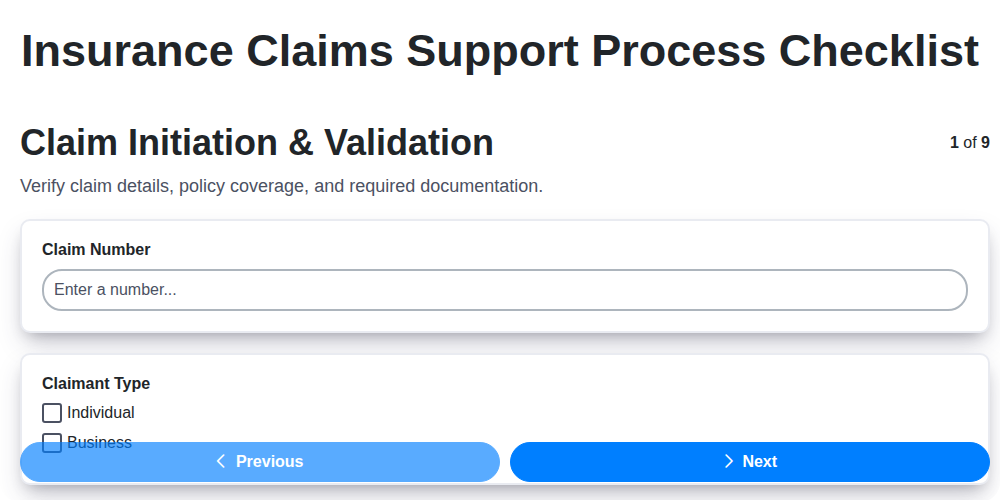
Streamline Claims: Your Insurance Claims Support Process Checklist Template
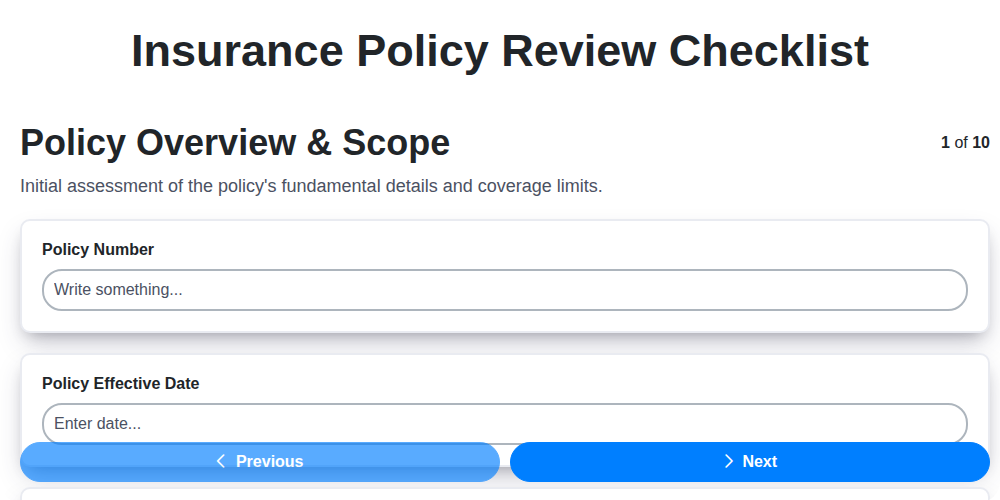
Your Insurance Policy Review Checklist: A Step-by-Step Guide
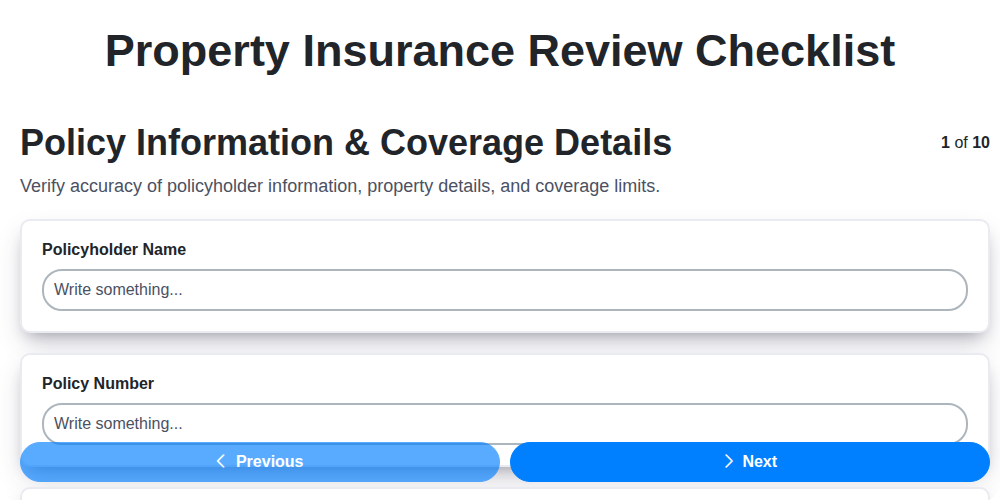
Your Property Insurance Review Checklist: A Step-by-Step Guide
Your Title Search & Insurance Checklist Template
Simplify Insurance Verification: Your Free Dental Checklist Template
Crop Insurance Policy Review Checklist: A Farmer's Guide

The Ultimate Vehicle Registration & Insurance Validation Checklist
Mastering the Policyholder Journey: Your Insurance Experience Survey Checklist
Need help with
Checklists?
Have a question? We're here to help. Please submit your inquiry, and we'll respond promptly.