Streamlining Uptime: The Power of Predictive Equipment Maintenance Workflows
Published: Updated: 04/16/2026
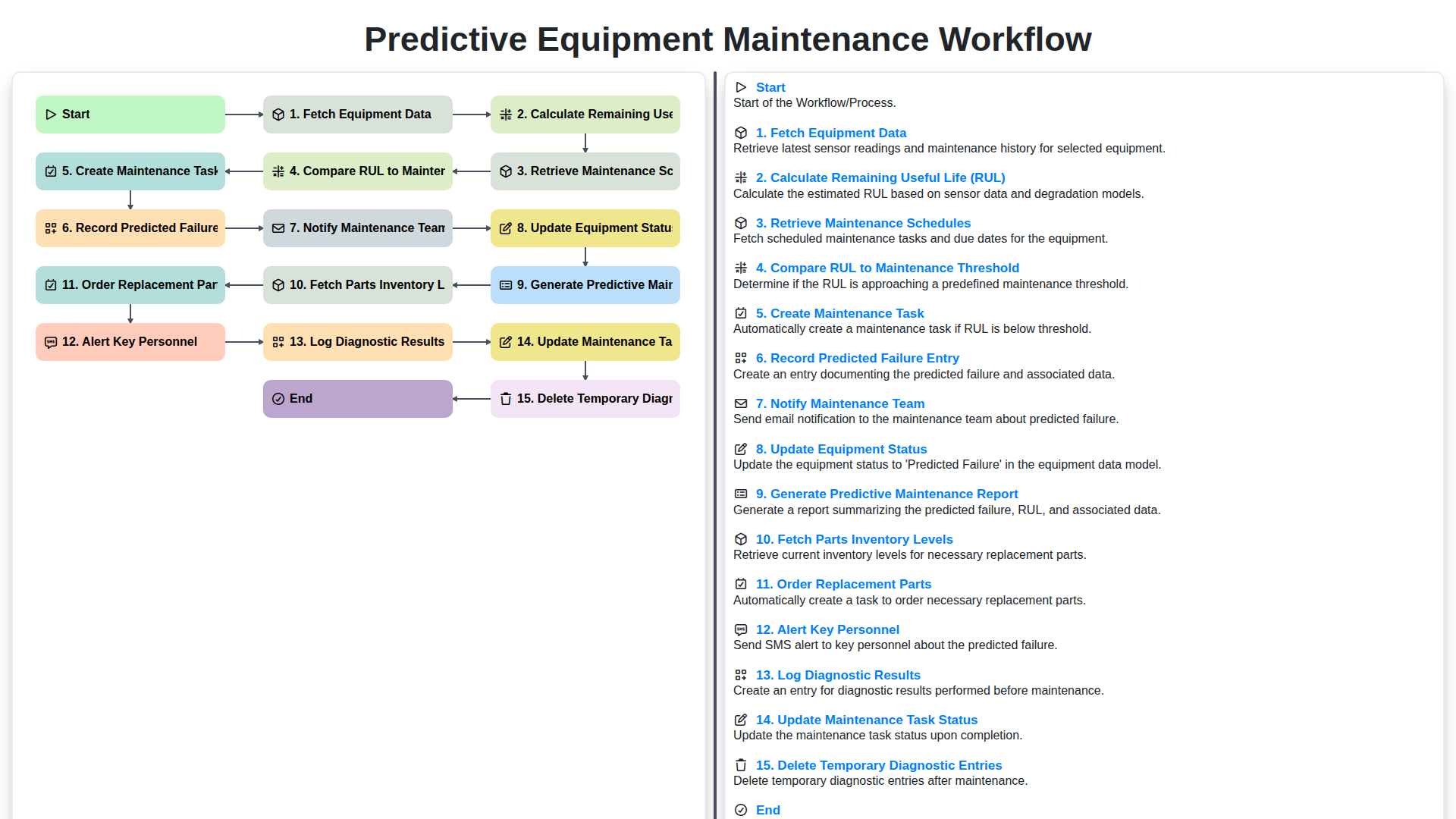
Table of Contents
- Introduction: The Shift to Predictive Maintenance
- Understanding the Core Workflow: From Data to Action
- Step 1: Data Ingestion and Analysis (Fetching Equipment Data)
- Step 2: The Predictive Engine (Calculating Remaining Useful Life - RUL)
- Step 3: Contextual Awareness (Retrieving Maintenance Schedules)
- Step 4: Decision Making (Comparing RUL to Maintenance Thresholds)
- Step 5: Action Initiation (Creating and Recording Maintenance Tasks)
- Step 6: Proactive Communication (Notifying the Maintenance Team)
- Step 7: Resource Management (Checking Parts Inventory and Ordering Replacements)
- Step 8: Closing the Loop (Logging Diagnostics and Updating Statuses)
- Step 9: Visibility and Reporting (Generating Comprehensive Predictive Reports)
- The Benefits: Maximizing Uptime and Minimizing Downtime
- Implementation Roadmap: Building Your Perfect Workflow
- Conclusion: Future-Proofing Your Operations
- Resources & Links
TLDR: This workflow automates predictive maintenance from start to finish. It automatically fetches equipment data, calculates remaining useful life (RUL), compares this to set thresholds, creates necessary maintenance tasks, notifies teams, manages parts ordering, logs diagnostics, and generates comprehensive reports-all minimizing unplanned downtime and maximizing asset uptime.
Introduction: The Shift to Predictive Maintenance
The traditional approach to equipment maintenance has largely been reactive-waiting for a breakdown before fixing it-or preventative, relying on rigid, time-based schedules regardless of actual equipment condition. This 'run-to-failure' or 'calendar-based' model is inherently inefficient. It often leads to unnecessary downtime from premature replacements, or conversely, catastrophic failures with little warning. Predictive Maintenance (PdM) marks a significant paradigm shift. Instead of adhering to fixed timetables or waiting for the inevitable breakdown, PdM leverages real-time data, advanced analytics, and machine learning to forecast when a failure is likely to occur and what component is at risk. This proactive capability moves maintenance from being a cost center of emergency repair to a strategic asset that maximizes uptime, optimizes resource allocation, and fundamentally extends the operational life of critical machinery.
Understanding the Core Workflow: From Data to Action
This entire predictive maintenance process isn't a series of isolated steps; it's a continuous, intelligent workflow. At its heart, the system orchestrates a seamless flow of information-from raw data signals to actionable work orders. The workflow begins by fetching equipment data, gathering real-time operational metrics. This data then feeds into the core calculation: determining the Remaining Useful Life (RUL). This calculated RUL is immediately cross-referenced with pre-set maintenance schedules and internal maintenance thresholds. If the calculated RUL falls below a critical point, the system automatically creates a maintenance task and proactively records a predicted failure entry.
This triggers immediate communication; the maintenance team is notified, and the system updates the equipment status to reflect the necessary intervention. Concurrently, the workflow executes necessary supporting actions: it calls for the fetching of parts inventory levels and, if shortages are predicted, automatically initiates an order for replacement parts. Key personnel are alerted with specific failure predictions, and diagnostic results are logged. The cycle is closed by updating the maintenance task status and, critically, by cleaning up temporary records (deleting temporary diagnostic entries) before finally generating a comprehensive predictive maintenance report. This tightly coupled sequence ensures that data insights are translated into physical, real-world maintenance action with minimal human latency.
Step 1: Data Ingestion and Analysis (Fetching Equipment Data)
The foundation of any predictive maintenance system is accurate and comprehensive data. This initial step, Fetch Equipment Data, is where we connect our workflow to the source of truth: your physical assets. We integrate with various sources-including IoT sensors, SCADA systems, operational logs, and historical failure records-to pull a real-time, holistic dataset for each piece of equipment. This ingested data includes operational metrics such as vibration levels, temperature readings, energy consumption, runtime hours, and historical performance deviations. The quality and breadth of this data directly dictate the accuracy of every subsequent prediction, making robust data ingestion the most critical initial checkpoint for the entire predictive loop.
Step 2: The Predictive Engine (Calculating Remaining Useful Life - RUL)
This is the heart of the entire workflow, where raw data transforms into actionable foresight. At this stage, the system doesn't just look at what is happening; it predicts what will happen. By taking the gathered equipment data-which could include vibration readings, temperature fluctuations, runtime hours, or oil particulate analysis-the predictive engine employs advanced machine learning models. These models, trained on historical failure data, identify subtle degradation patterns invisible to standard alert systems. The output is the Remaining Useful Life (RUL) for critical components. Instead of waiting for a failure threshold to be crossed, the RUL provides a quantified estimate, such as This bearing has an estimated 45 days of safe operation left. This single calculation drives the entire subsequent process, allowing maintenance shifts from reactive (fixing what's broken) to truly proactive (fixing what will break).
Step 3: Contextual Awareness (Retrieving Maintenance Schedules)
This step is crucial for ensuring that our proactive maintenance actions are aligned with the operational reality of the equipment. We don't just predict a failure; we know when it needs to be addressed relative to existing service plans. The workflow queries the central CMMS (Computerized Maintenance Management System) or EAM (Enterprise Asset Management) platform to retrieve the scheduled maintenance calendar for the specific asset. This pull includes planned preventative maintenance (PM) dates, service contract milestones, and any vendor-recommended inspection schedules. By cross-referencing the predicted failure date (from the RUL calculation) against the scheduled tasks, the system can identify potential conflicts-for instance, a predicted failure occurring just before a scheduled deep diagnostic check, which might allow for a more efficient, bundled repair effort.
Step 4: Decision Making (Comparing RUL to Maintenance Thresholds)
This stage is the core decision point of the entire workflow. After calculating the Remaining Useful Life (RUL) for critical components, the system must intelligently compare this prediction against pre-defined, scientifically or operationally determined maintenance thresholds. The comparison isn't a simple equality check; it requires nuanced logic. For instance, the system might use a 'Warning Zone' threshold, triggering an alert well before the 'Critical Threshold' is reached. If the calculated RUL falls below the warning level but is still significantly above zero, the workflow might initiate a 'Review' status, flagging the component for closer monitoring without immediate intervention. Conversely, if RUL is near zero or below the critical threshold, the system's decision pathway shifts immediately toward escalating the issue, triggering the creation of a high-priority maintenance task and potentially bypassing routine scheduling checks. This comparison layer transforms raw data (RUL) into actionable intelligence, dictating the immediate next steps-whether it's a gentle heads-up, a planned service ticket, or an emergency shutdown protocol.
Step 5: Action Initiation (Creating and Recording Maintenance Tasks)
This is the critical juncture where prediction translates directly into action. Once the comparison between the calculated Remaining Useful Life (RUL) and the defined maintenance threshold indicates a need for intervention, the workflow triggers the creation of a formal Maintenance Task. This task is not just a record; it's the actionable blueprint for repair. Concurrently, to ensure full traceability and historical context, a detailed Predicted Failure Entry is automatically recorded. This entry locks in the system's prediction-detailing the RUL calculation, the comparison made, and the recommended corrective action. This dual action ensures that maintenance teams have an immediate, structured work order while the system maintains a transparent, auditable trail of why the work order was generated.
Step 6: Proactive Communication (Notifying the Maintenance Team)
This crucial step transforms a mere calculation into actionable intelligence. Once the system determines that the Remaining Useful Life (RUL) falls below the defined maintenance threshold, the process triggers an immediate, multi-channel notification to the maintenance team. This isn't just a digital alert; it's the initiation of human response. Notifications are tailored based on the severity and urgency of the prediction. High-priority alerts might trigger direct calls or immediate ticketing system escalations, bypassing standard email queues. The communication must include all necessary context: the specific equipment ID, the calculated RUL, the predicted failure mode, and the recommended next steps derived from the predictive model's confidence interval. This proactive outreach ensures the maintenance team is not just told something is wrong, but is equipped with all the data needed to start planning repairs immediately, drastically reducing diagnostic lag time.
Step 7: Resource Management (Checking Parts Inventory and Ordering Replacements)
Next, the workflow shifts focus to resource management. Before a maintenance task can be fully committed to, we must verify the availability of necessary parts. This involves fetching the current parts inventory levels associated with the required components. If the stock count falls below the predefined threshold-either the required amount or a safety stock level-the system automatically initiates a purchase request. This triggers the ordering of replacement parts directly with suppliers, ensuring that the required materials are on their way before the maintenance window opens.
Step 8: Closing the Loop (Logging Diagnostics and Updating Statuses)
The predictive process isn't complete until the findings are formally documented and the system reflects the changes. This crucial final stage involves logging all diagnostic results, which provides a verifiable audit trail of the prediction and subsequent actions. Once the diagnostics are logged, the primary maintenance task associated with the prediction must be updated to reflect its current status-whether it has been escalated, scheduled, or resolved. Simultaneously, any temporary diagnostic entries created during the analysis phase should be cleared or deleted. This meticulous cleanup ensures data integrity, keeping the system clean and the recorded history accurate for future analysis.
Step 9: Visibility and Reporting (Generating Comprehensive Predictive Reports)
This crucial phase transforms raw data and calculated predictions into actionable business intelligence. Generating comprehensive predictive maintenance reports isn't just about displaying numbers; it's about telling a proactive story. The system compiles all preceding steps-the initial RUL calculations, the comparison against service thresholds, the generated maintenance tasks, and the logged diagnostic results-into one unified, easily digestible report. This report serves as the definitive snapshot for stakeholders, providing immediate answers to questions like, When will this asset likely fail? and What resources are required to prevent it? Beyond simple status updates, these reports often incorporate visualization tools, showing trending failure patterns over time, illustrating the cost savings realized by preventive action, and forecasting potential downtime if no intervention occurs. Furthermore, these reports directly feed into compliance documentation, providing an auditable trail of maintenance prediction, scheduling, and execution.
The Benefits: Maximizing Uptime and Minimizing Downtime
By implementing a structured predictive maintenance workflow, organizations can unlock significant operational advantages. The primary benefit is the drastic increase in equipment uptime. Instead of waiting for catastrophic failures that lead to unplanned shutdowns-which are incredibly costly-maintenance actions are triggered before the failure occurs. This proactive approach means machinery operates within its predicted healthy parameters for longer periods. Furthermore, minimizing downtime translates directly to cost savings. Predictability allows maintenance teams to schedule necessary interventions during planned downtimes, ensuring that revenue-generating assets are operational whenever they are needed most. This shift from reactive firefighting to strategic planning solidifies a more robust and reliable operational backbone for the entire facility.
Implementation Roadmap: Building Your Perfect Workflow
markdown The journey to a fully operational predictive maintenance system requires a phased, strategic approach. Instead of trying to implement every step at once, we recommend following a clear implementation roadmap, ensuring each component integrates smoothly with the last.
Our workflow naturally breaks down into several actionable phases:
Phase 1: Data Foundation and Prediction Engine Setup This initial phase focuses on gathering and understanding your asset data. We begin by establishing the capability to Fetch Equipment Data from various sources (IoT sensors, CMMS, etc.). Once the data pipeline is stable, the core intelligence is built by developing the model to Calculate Remaining Useful Life (RUL). This is the bedrock of the entire system. Simultaneously, we will Retrieve Maintenance Schedules to establish the baseline operational expectations.
Phase 2: Decision Making and Action Triggering With predictions in hand, the system becomes proactive. The critical decision point is reached when we Compare RUL to Maintenance Thresholds. If the RUL drops below a predefined safety or efficiency threshold, the system automatically proceeds to Create a Maintenance Task. At this stage, the risk is formalized by Recording a Predicted Failure Entry, providing immediate visibility into potential issues before they occur.
Phase 3: Communication and Execution A prediction is useless without action. Therefore, the workflow immediately initiates communication via Notifying the Maintenance Team. Concurrently, the asset's record is updated by Updating the Equipment Status to 'At Risk' or 'Pending Inspection.' The output of these initial steps culminates in the Generating a Predictive Maintenance Report, giving stakeholders a holistic view of asset health.
Phase 4: Resource Management and Remediation Prediction must lead to physical action. This phase integrates supply chain awareness. The system will Fetch Parts Inventory Levels to check readiness. If parts are low, the automated step to Order Replacement Parts is triggered. To ensure human oversight, we Alert Key Personnel (supervisors, procurement). As technicians diagnose the issue, they Log Diagnostic Results.
Phase 5: Workflow Closure and Optimization The final steps ensure data integrity and continuous improvement. Once the task is addressed, the system requires updates: Updating the Maintenance Task Status (e.g., 'Completed'). For clean data governance, we perform necessary cleanup, such as Deleting Temporary Diagnostic Entries. Finally, reviewing the entire cycle allows us to refine the models and processes, ensuring the system's accuracy improves with every passing month.
Conclusion: Future-Proofing Your Operations
By implementing a structured Predictive Equipment Maintenance Workflow, organizations move beyond reactive repairs to a state of proactive operational excellence. This cyclical process-from fetching raw equipment data to automatically ordering parts and generating comprehensive reports-creates a self-optimizing ecosystem. Adopting this methodology is not just an upgrade; it's a fundamental shift in operational strategy, transforming maintenance from a cost center into a strategic asset that maximizes uptime, reduces unforeseen expenditures, and significantly enhances safety. Embracing predictive workflows is the most reliable way to future-proof your industrial operations against unpredictable failure rates and escalating costs.
Resources & Links
- Industry 4.0 & IoT Platforms : Resources detailing industrial IoT platforms, edge computing, and machinery data acquisition necessary for fetching equipment data.
- Predictive Maintenance Best Practices Guides : Articles from major tech providers offering foundational knowledge on the principles and best practices of utilizing machine learning for asset health prediction.
- ML Model Deployment in Industrial Settings : Case studies on deploying RUL algorithms, focusing on model accuracy, retraining, and integration into existing operational technology (OT) systems.
- CMMS/EAM System Functionality Reviews : Guides on modern Computerized Maintenance Management Systems (CMMS) and Enterprise Asset Management (EAM) tools that can house and manage maintenance schedules and tasks.
- Industrial Parts Lifecycle Management Solutions : Resources on inventory management, BOM (Bill of Materials) integration, and automated reordering processes for critical spare parts.
- Operational Excellence and Workflow Optimization : Thought leadership pieces on process mapping, workflow automation (BPM), and achieving 'zero downtime' targets in complex manufacturing environments.
- APM and Digital Twin Concept Overviews : In-depth articles explaining Digital Twins and Asset Performance Management (APM) which are foundational to creating a holistic predictive workflow.
Frequently Asked Questions
What is predictive equipment maintenance?
Predictive maintenance is a technique that uses data-driven analysis, such as real-time sensor monitoring and machine learning, to predict when an equipment failure might occur, allowing for repairs to be made just before the breakdown happens.
How does predictive maintenance differ from preventive maintenance?
While preventive maintenance is performed on a fixed schedule regardless of equipment condition, predictive maintenance relies on the actual condition of the machinery to trigger maintenance tasks, reducing unnecessary downtime and maintenance costs.
What are the primary benefits of implementing predictive maintenance workflows?
The main benefits include increased equipment uptime, reduced operational costs, extended machinery lifespan, improved safety, and the optimization of technician workloads through more efficient scheduling.
What role does automation play in streamlining maintenance workflows?
Automation helps by automatically capturing sensor data, analyzing it for anomalies, and triggering work orders in a CMMS (Computerized Maintenance Management System) without the need for manual inspection or human error.
What are the key components needed to build a predictive maintenance system?
A successful system requires IoT-enabled sensors for data collection, robust data storage/cloud infrastructure, advanced analytics or AI algorithms, and an integrated workflow management platform to execute repairs.
Found this Article helpful?
Manufacturing Management Solution Demo
Stop chasing paperwork and wrestling with disconnected systems! Our solution brings clarity and control to your production process. From standard operating procedures (SOPs) and equipment maintenance to quality control and inventory tracking, we simplify every step.
Related Articles
Kaizen Checklist Template: Your Path to Continuous Improvement

Machine Safety Audit Checklist: Your Guide to a Safer Manufacturing Workplace
Mastering Supplier Performance: Your Free Supplier Scorecard Checklist Template
Your Ultimate RCM Checklist Template: A Step-by-Step Guide

LPA Checklist Template: Your Guide to Layered Process Audits

Your Ultimate Lockout/Tagout (LOTO) Checklist Template

Your Ultimate FSC 22000 Checklist Template
Quality Control Inspection Checklist Template: Prevent Defects & Improve Manufacturing Processes
We can do it Together
Need help with
Checklists?
Have a question? We're here to help. Please submit your inquiry, and we'll respond promptly.