The Ultimate Restaurant Staff Shift Handover & Communication Protocol Checklist for 2026
Published: 10/30/2026 Updated: 10/31/2026
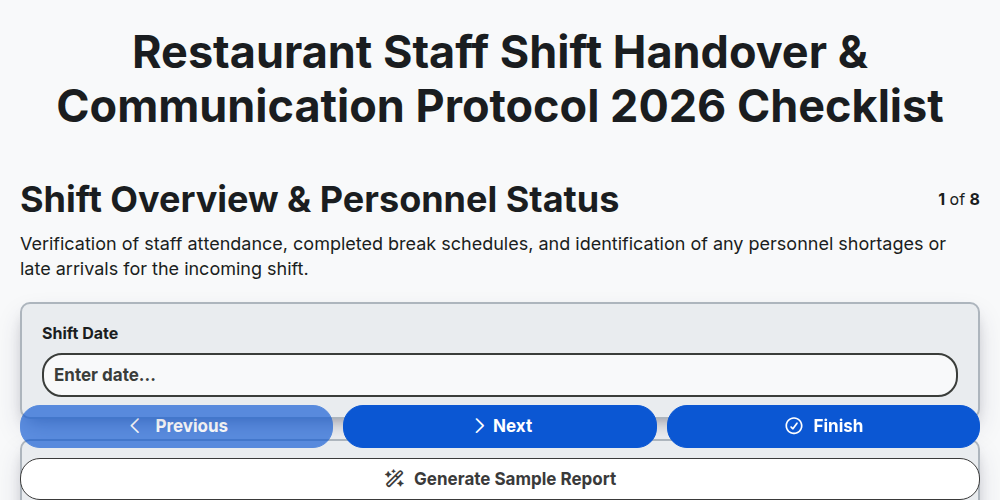
Table of Contents
- Introduction: Why Seamless Shift Handovers Define Restaurant Success in 2026
- The Importance of a Standardized Communication Protocol
- 1. Shift Overview & Personnel Status: Managing Your Team Dynamically
- 2. Financial & Cash Drawer Reconciliation: Ensuring Accuracy and Accountability
- 3. Service & Reservation Status: Transitioning the Floor Smoothly
- 4. Inventory & Stock Availability Update: Preventing Mid-Service Shortages
- 5. Facility & Equipment Maintenance Alerts: Proactive Infrastructure Care
- 6. Customer Feedback & Incident Summary: Closing the Loop on Guest Experience
- 7. Cleaning & Side-work Completion Audit: Maintaining High Operational Standards
- 8. Action Items & Pending Tasks: Setting the Next Shift Up for Success
- Leveraging Digital Tools for Real-Time Communication in 2026
- Conclusion: Building a Culture of Continuous Operational Excellence
- Resources & Links
TL Eliminate mid-shift chaos and operational errors with our comprehensive 2026 shift handover guide. This checklist provides a streamlined protocol for managing personnel updates, financial reconciliation, inventory tracking, and maintenance alerts, ensuring seamless communication and consistent service excellence between every shift.
Introduction: Why Seamless Shift Handovers Define Restaurant Success in 2026
In the fast-paced ecosystem of a modern restaurant, the transition between shifts is the most vulnerable period of the operational day. As we move into 2026, the margin for error has shrunk even further. With rising labor costs, heightened customer expectations for personalized service, and the integration of advanced real-time data, a sloppy handover is no longer just an inconvenience-it is a direct threat to your bottom line and brand reputation.
The High Cost of Communication Gaps
When a morning manager leaves without properly briefing the evening team, the consequences ripple through the entire operation. A missed note about a broken refrigerator, an unrecorded VIP reservation, or an unrecorded cash discrepancy can lead to a domino effect of chaos: wasted food, disgruntled guests, and stressed staff. In 2026, winging it is a luxury no restaurateur can afford.
Moving Beyond The Verbal Update
For years, many restaurants relied on a quick, informal chat between departing and arriving managers. While rapport is important, verbal communication is notoriously unreliable and prone to human error. To maintain consistency, a standardized, written, or digitally logged protocol is essential.
A structured handover protocol serves three critical functions:
- Operational Continuity: It ensures that the momentum of the service remains unbroken, regardless of personnel changes.
- Accountability: It creates a paper trail (or digital log) that clarifies who was responsible for specific tasks and where items stand.
- Data-Driven Management: It transforms anecdotal observations into actionable data that owners can use to identify recurring patterns in maintenance, waste, or service friction.
The 2026 Standard: Precision and Proactivity
As technology becomes more embedded in our workflows, a successful shift handover must be both comprehensive and streamlined. The following checklist is designed to move your team away from reactive firefighting and toward proactive management. By implementing this protocol, you aren't just passing on information; you are safeguarding the guest experience and ensuring that every shift begins with a foundation of clarity and control.
The Importance of a Standardized Communication Protocol
Why Consistency is Your Greatest Asset in 2026
In the fast-paced, high-pressure environment of a modern restaurant, information is the most valuable currency. As we move into 2026, the complexity of restaurant operations-driven by integrated POS systems, advanced delivery integrations, and heightened guest expectations-means that even a small gap in communication can lead to a massive breakdown in service.
A standardized shift handover protocol is not just about passing on notes; it is about maintaining the operational thread that connects the morning rush to the dinner service, and the weekday grind to the weekend surge.
Eliminating the Information Void
The most dangerous period in any restaurant shift is the void-that window of time during a staff changeover where critical information fails to transfer. When a closing manager leaves without notifying the opening manager about a broken refrigerator or a sudden spike in a specific allergy request, the incoming team is forced into a reactive, defensive stance.
A formal protocol transforms communication from a game of telephone into a structured data transfer, ensuring that the incoming team enters their shift with clarity rather than chaos.
Reducing Costly Errors and Turnover
Beyond immediate service quality, a structured handover protocol serves two vital bottom-line functions:
- Financial Integrity: By standardizing cash drawer reconciliation and financial reporting, you minimize the risk of discrepancies and internal shrinkage.
- Employee Retention: High turnover is often driven by shift friction-the frustration felt by staff when they inherit a messy station, uncompleted side-work, or unresolved equipment issues. A clear checklist creates accountability and ensures that no single team is unfairly burdened by the shortcomings of the previous shift.
Driving the Guest Experience
In 2026, guests expect seamless service. They do not want to repeat their preferences or experience delays because the server on duty was unaware of a reservation change or a particular menu shortage. By implementing a rigorous communication audit, you ensure that every staff member-from the host stand to the kitchen line-is operating from a single, unified version of the truth.
1. Shift Overview & Personnel Status: Managing Your Team Dynamically
Ensuring Continuity Through Personnel Clarity
In the fast-paced environment of a 2026 restaurant operation, a shift handover is much more than a quick goodbye between colleagues; it is a critical strategic transfer of information. The Shift Overview & Personnel Status section of your protocol serves as the foundation for the incoming team's success. It ensures that the incoming manager or floor supervisor enters the building with a complete mental map of the human resources available to them.
Tracking the Human Element
A successful handover must move beyond simply stating who is present. To maintain peak operational efficiency, the protocol should document:
- Current Staffing Levels: A clear breakdown of which Front of House (FOH) and Back of House (BOH) team members are currently on the clock and who is scheduled to arrive or depart next.
- Roster Deviations: Immediate notification of any late arrivals, early departures, or last-minute call-outs. In an era of fluctuating labor markets, knowing exactly how many hands on deck you have is vital for managing service pacing.
- Task Assignments & Role Rotation: Detailed notes on specific station assignments (e.g., who is managing the patio, who is lead on the grill, or who is assigned to the VIP section).
Managing Energy and Skill Distribution
Effective communication in this step also involves assessing the vibe and competency of the floor.
Identifying Skill Gaps and Training Needs
If a trainee is working alongside a veteran, or if a staff member is handling a new, high-pressure station for the first time, this must be noted. Highlighting these dynamics allows the incoming supervisor to provide targeted support, preventing service bottlenecks before they occur.
The Pulse of the Team
Beyond logistics, the handover should include a brief qualitative assessment of team morale. Is the team feeling fatigued after a heavy lunch rush? Is there friction between the kitchen and the service staff? By documenting the emotional and physical state of the team, you enable the incoming shift to implement necessary reset strategies, ensuring that the momentum of excellence remains unbroken across the 24-hour cycle.
2. Financial & Cash Drawer Reconciliation: Ensuring Accuracy and Accountability
Maintaining Financial Integrity Between Shifts
The transition between shifts is one of the most vulnerable moments for a restaurant's bottom line. Without a rigorous reconciliation process, discrepancies in cash, unpaid bills, or missing tips can lead to confusion, mistrust among staff, and significant revenue leakage.
In 2026, a seamless handover requires more than just counting the drawer; it requires a standardized audit trail that ensures the incoming manager or supervisor takes over a balanced station.
Key Verification Steps
To ensure total accountability, the outgoing supervisor must complete the following steps before officially handing over the keys:
- Cash Drawer Audit: Perform a physical count of all cash on hand, comparing the total against the POS (Point of Sale) end-of-shift report.
- Discrepancy Documentation: Any variance-whether an overage or a shortage-must be documented immediately. If the amount exceeds a predefined threshold (e.g., $5.00), a brief explanation must be noted in the handover log.
- Credit Card & Digital Payment Verification: Ensure all processed digital payments, including mobile wallets and contactless transactions, align with the closed checks in the system.
- Tip Distribution Review: Confirm that all-inclusive tip pooling or individual tip payouts for the shift have been accurately recorded and reconciled against the labor report.
- Petty Cash & Paid-Outs Check: Verify any paid-outs made during the shift (e.g., emergency ingredient runs or small repairs) by matching physical receipts to the logged transactions.
Digital Integration for 2026
In the modern era, manual logs are no longer sufficient. Your protocol should mandate that all reconciliation data is uploaded directly to your restaurant management software. This creates a digital paper trail that allows owners to track patterns of loss or error across different shifts and days, transforming simple bookkeeping into powerful loss-prevention intelligence.
3. Service & Reservation Status: Transitioning the Floor Smoothly
Mastering the Transition: The Heart of Service Continuity
In the high-pressure environment of a busy restaurant, the gap between a departing morning crew and an arriving evening crew is the most vulnerable moment in a 24-hour cycle. If the incoming manager or floor lead enters the building blind, the result is immediate chaos: missed VIPs, double-booked tables, and a fragmented guest experience.
The Service & Reservation Status section of your handover is not just a quick glance at the book; it is a strategic briefing designed to ensure the incoming team can hit the ground running without a single second of hesitation.
Key Elements of the Reservation & Service Update
To ensure a seamless transition, the handover must cover more than just how many covers are booked. It requires a deep dive into the nuances of the night ahead:
- The Reservation Roadmap: A detailed breakdown of upcoming bookings, including peak arrival windows and any large parties or heavy shifts that require extra staffing or specific table configurations.
- VIPs and Regulars: Identification of high-value guests, returning regulars, or individuals celebrating special milestones (anniversaries, birthdays). This ensures the incoming staff can provide that personalized touch from the moment the guest sits down.
- Dietary Red Flags: A critical transfer of information regarding severe allergies or specific dietary restrictions noted in previous bookings. In 2026, where kitchen precision is paramount, there is zero room for error in communicating these details.
- Table Management & Pacing: An update on the current state of the floor. Which tables are mid-course? Which are waiting on checks? Are there any lingering guests that might impact the rotation for the next shift?
- Special Requests & Pre-orders: Notifying the team of any pre-arranged menu requests, special decorations, or specific seating preferences that have been coordinated in advance.
Pro-Tip for 2026: Integrated Digital Syncing
As we move further into the era of smart hospitality, your handover protocol should leverage your POS and reservation system integration. The outgoing lead should ensure that all real-time notes updated in your digital reservation platform are physically or digitally signed off during the briefing, ensuring the paper trail and the digital data are in perfect alignment.
The goal is simple: The incoming team should feel as though they have been part of the service for the last four hours. When the service status is communicated clearly, the momentum of the restaurant never breaks.
4. Inventory & Stock Availability Update: Preventing Mid-Service Shortages
Mastering the Mid-Shift Stock Check
There is nothing more damaging to a restaurant's reputation or profit margin than a server having to apologize to a guest because a signature dish is suddenly unavailable. In the fast-paced environment of 2026, where precision and speed are paramount, the shift handover must serve as a real-time inventory audit to prevent mid-service shortages.
The Critical Item Alert
During the handover, the outgoing manager must clearly communicate the status of high-velocity items. This goes beyond simply noting what is low; it requires a specific focus on 86'd items (items out of stock) and products that are nearing their last call threshold.
Key Elements of the Inventory Handover:
- Protein & High-Value Stock Status: Detailed updates on primary proteins (e.g., steaks, seafood, or specialty vegetarian options) that drive the highest check averages.
- Prep-Level Verification: A quick check on whether essential prep components-such as sauces, garnishes, or house-made dressings-are sufficient for the upcoming rush.
- The Gap Identification: Identifying if any essential ingredients are currently being replenished or if a delivery is delayed, allowing the incoming team to adjust menu descriptions or server scripts immediately.
- Waste & Spoilage Review: A brief summary of any significant waste recorded during the previous shift to ensure the incoming team is aware of potential cost fluctuations.
Proactive Prevention Strategy
By integrating a rigorous stock update into your handover protocol, you transition from a reactive service model (responding to shortages) to a proactive one (managing expectations). This ensures that the front-of-house team is never caught off guard, maintaining the seamless dining experience that modern customers demand.
5. Facility & Equipment Maintenance Alerts: Proactive Infrastructure Care
Ensuring Operational Continuity Through Preventative Reporting
In a high-volume restaurant environment, equipment failure is one of the most significant hidden costs. A broken walk-in cooler, a malfunctioning POS terminal, or a faulty fryer during a peak dinner rush can lead to lost revenue and catastrophic service delays.
The shift handover protocol must act as the first line of defense in your maintenance strategy. Instead of treating maintenance as a reactive task, use this section of your checklist to transition into a proactive culture.
Critical Infrastructure Checkpoints
During the handover, the outgoing manager must communicate any deviations from standard operating procedures regarding your facility. This includes:
- Temperature Log Verifications: Reporting any fluctuations in refrigeration or hot-holding units that could compromise food safety.
- POS & Tech Health: Alerting the incoming team to any lagging software, printer jams, or connectivity issues with handheld ordering devices.
- Utility & Plumbing Alerts: Immediate notification of leaking faucets, clogged drains, or unusual HVAC behavior (e.g., unexpected temperature drops or rises in the dining area).
The Broken-to-Fixed Workflow
A successful 2026 protocol doesn't just list what is broken; it tracks the status of the repair. Every alert in the handover should include:
- The Symptom: What exactly is failing?
- The Immediate Workaround: How is the team managing the gap? (e.g., Fryer 2 is down; using Fryer 1 for all high-volume orders.)
- The Maintenance Status: Has a technician been called? Is there an open work order?
By documenting these alerts during every shift change, you prevent maintenance amnesia, where recurring issues are ignored until they become expensive emergencies. This ensures the incoming shift is never caught off guard by an infrastructure failure that was already known to the previous team.
6. Customer Feedback & Incident Summary: Closing the Loop on Guest Experience
Capturing the Guest Voice in Real-Time
In the fast-paced environment of a 2026 restaurant, a shift handover is not just about passing on tasks; it is about passing on the emotional temperature of your dining room. The Customer Feedback & Incident Summary section of your protocol ensures that the incoming manager isn't walking into a storm they aren't prepared for.
Effective communication in this category prevents feedback fatigue and ensures that a minor complaint in the lunch shift doesn't escalate into a devastating online review by the end of the dinner service.
Tracking the Vibe and Verbatim Feedback
Don't just record what went wrong; record the general sentiment of the shift. Use your digital logbook or handover app to note:
- Positive Highlights: Which dishes were the stars of the shift? Did a specific server receive a verbal compliment? (This boosts morale for the incoming team).
- Recurring Complaints: Was there a consistent delay in the kitchen? Was the music too loud? Identifying patterns allows for immediate operational adjustments.
- Specific Guest Feedback: Log any specific critiques regarding food temperature, service pacing, or dietary requirement accuracy.
Incident Reporting and Resolution Tracking
An incident is only a crisis if the next shift is unaware of it. Your protocol must mandate a standardized way to report:
- Service Mishaps: Spills, broken glassware, or incorrect orders.
- Staff/Guest Altercations: Any friction between customers or notable-level disturbances.
- Health & Safety Near-Misses: Any slip hazards or temperature deviations that were identified and addressed.
The Golden Rule of Incident Handover
Never leave a pending complaint open. If a guest left dissatisfied and a comp was issued, the incoming manager must know exactly what was promised (e.g., Table 4 was comped their dessert; they may call or return expecting a follow-up).
By closing the loop on every incident, you transform your handover from a simple list of facts into a powerful tool for continuous service recovery and brand protection.
7. Cleaning & Side-work Completion Audit: Maintaining High Operational Standards
The Gold Standard for Closing & Resetting
A successful shift doesn't end when the last customer leaves; it ends when the next team is set up for immediate success. The Cleaning & Side-work Completion Audit is the final line of defense against operational chaos. In 2026, where labor efficiency and hygiene standards are under higher scrutiny than ever, eyeballing the cleaning tasks is no longer enough.
Moving Beyond Is it clean? to Is it compliant?
The handover protocol must include a systematic verification of all side-work stations. This isn't just about sweeping floors; it is about ensuring that the foundation of the next shift's service is sterile, organized, and ready.
Key Audit Components for the Handover Checklist:
- Station Sanitation Verification: A documented check of all high-touch surfaces, condiment stations, and server side-stations to ensure they meet deep-cleaning standards.
- Restroom & Public Area Audit: A formal sign-off on the condition of guest-facing areas, ensuring replenishment of consumables (paper towels, soaps) and cleanliness of floors.
- Closed-Loop Side-work Validation: Ensuring that closing tasks (e.g., restocking glassware, refilling sauces, cleaning espresso machines) are not just done, but verified by a supervisor or the incoming lead.
- Waste Management & Disposal: Confirmation that all trash, recycling, and compost have been removed and bins have been sanitized to prevent pest issues or odors.
Why This Matters for the 2026 Workforce
In a high-turnover industry, a standardized audit removes the guesswork. When the morning crew walks into a restaurant that has passed a rigorous cleaning audit, they can focus 100% of their energy on guest experience rather than playing catch-up with dirty workstations. This prevents the snowball effect of neglected tasks that leads to long-term operational decay.
8. Action Items & Pending Tasks: Setting the Next Shift Up for Success
Closing the Loop: Turning Information into Action
A shift handover is more than just a summary of what happened; it is a blueprint for what needs to happen. The Action Items & Pending Tasks section is the most critical component of the protocol because it prevents the common information decay that occurs when critical tasks are forgotten between shifts.
To ensure a seamless transition, this section must bridge the gap between the outgoing team's responsities and the incoming team's priorities.
Identifying the Must-Dos
An effective handover doesn't just list vague ideas; it identifies specific, actionable tasks that require immediate attention. This includes:
- Urgent Follow-ups: Any customer requests, unresolved complaints, or VIP arrivals that require a personalized touch.
- Maintenance Dependencies: If a piece of equipment was flagged as malfunctioning in the maintenance section, the action item should specify if a technician has been called or if a temporary workaround is in place.
- Supply Reorders: Specific items that hit a critical low and need to be prioritized during the next delivery window.
The 2026 Standard: Clarity and Ownership
In 2026, leaving it for the next person is no longer an acceptable strategy. For a handover to be successful, every task listed in this section must follow the Task-Owner-Deadline framework:
- The Task: A clear, verb-driven description (e.g., Restock the garnishment station instead of Garnishes).
- The Owner: Assigning responsibility ensures accountability. Even if a manager oversees the shift, a specific team member should be the point of contact for the task.
- The Deadline: Establishing a timeframe (e.g., Before 6:00 PM rush) prevents tasks from being pushed indefinitely.
Digital Integration for Real-Time Tracking
To prevent the lost note syndrome, modern restaurants should move away from scraps of paper. Utilize your digital communication platform (such as specialized restaurant management apps or shared digital logs) to tag specific staff members in the action items. This creates a digital paper trail, allowing managers to track task completion and ensure that the morning shift isn't walking into a disorganized environment.
Pro-Tip: Always review the Action Items list during the physical walk-through between the outgoing and incoming managers. Verbal confirmation of these tasks is the final fail-safe against operational errors.
Leveraging Digital Tools for Real-Time Communication in 2026
The Digital Evolution of the Shift Handover
As we move through 2026, the era of the sticky note handover is officially over. The modern, high-performing restaurant relies on seamless, real-time data synchronization. To eliminate the margin for error, the 2026 protocol integrates mobile-first communication tools and automated logging to ensure that no detail is lost in transition.
Beyond the Logbook: Real-Time Data Integration
The most successful operators are no longer relying on verbal instructions alone. Today's protocol utilizes integrated Kitchen Display Systems (KDS) and automated POS reporting to bridge the gap between the closing and opening teams. By leveraging digital ecosystems, the Shift Overview & Personnel Status and Financial Reconciliation are no longer manual burdens but automated summaries pushed directly to management dashboards.
Smart Alerts and Proactive Maintenance
In an era of smart hospitality, your handover checklist should be part of your IoT (Internet of Things) ecosystem.
- Automated Maintenance Logs: Instead of manually noting a broken refrigerator, modern protocols use sensor-based alerts that automatically populate the Facility & Equipment Maintenance Alerts section of the digital checklist.
- Live Inventory Sync: As stock levels hit critical thresholds, your Inventory & Stock Availability Update should trigger automatic reorder alerts within your procurement software, ensuring the morning shift isn't met with unexpected shortages.
Centralizing the Feedback Loop
The digital handover serves as the single source of truth for Customer Feedback & Incident Summary. By integrating social media monitoring and digital reservation platforms directly into the handover template, the incoming manager receives a curated feed of every recent review, guest preference, and VIP arrival. This ensures that Service & Reservation Status is not just a list of names, but a comprehensive profile of the upcoming service's expectations.
Accountability Through Digital Auditing
The Cleaning & Side-work Completion Audit has transitioned from a simple checkbox to a visual verification process. Using tablet-based checklists, staff can upload photo evidence of completed station resets. This creates a transparent, timestamped audit trail that reduces friction between shifts and ensures that Action Items & Pending Tasks are tracked from creation to resolution, leaving zero room for ambiguity.
Conclusion: Building a Culture of Continuous Operational Excellence
Mastering the Art of the Seamless Transition
Implementing a standardized shift handover protocol is more than just a logistical necessity; it is a strategic investment in your restaurant's long-term success. In the fast-paced, high-pressure environment of 2026 hospitality, the difference between a smooth service and a chaotic one often lies in the quality of information passed between teams. When your morning crew communicates effectively with the evening team, you eliminate the re-learning period that typically leads to errors, food waste, and frustrated guests.
Turning Information into Action
A checklist should never be viewed as a box-ticking exercise or a bureaucratic burden. Instead, view it as a tool for empowerment. When your staff follows a structured protocol-from reconciling the cash drawer to auditing cleaning completion-they are taking ownership of the restaurant's standards. This level of accountability fosters a culture of professional pride and ensures that every team member, regardless of their shift, enters the floor with the confidence and clarity needed to excel.
Future-Proofing Your Operations
As we move deeper into 2026, the integration of digital logging and real-time communication tools will make this checklist even more powerful. Whether you use a physical clipboard or a high-tech digital dashboard, the goal remains the same: zero information loss.
By prioritizing consistent communication, you are doing more than preventing mistakes; you are building a foundation of operational excellence that:
- Reduces Staff Burnout: By eliminating the stress of hidden problems.
- Enhances Guest Experience: By ensuring service continuity and personalized care.
- Protects Your Bottom Line: Through rigorous oversight of inventory, finance, and equipment.
Start implementing these steps today, and transform your shift changes from a moment of friction into a moment of momentum.
Resources & Links
- 7shifts: A leading restaurant management platform specializing in workforce management, scheduling, and communication tools.
- Toast: Comprehensive restaurant POS and management software focusing on operational efficiency and integrated payments.
- Posist: Cloud-based restaurant management system designed to streamline inventory, billing, and back-of-house operations.
- sally: Resources for restaurant management and employee engagement to improve staff retention and communication.
- Restaurant Weekly: Industry news and trends focusing on the evolving landscape of restaurant technology and operations.
- National Restaurant Association: The primary authority providing industry standards, food safety guidelines, and operational best practices.
- Skopos: Expert insights into restaurant logistics and back-of-house workflow optimization.
- Foodservice Prep: Focuses on kitchen efficiency, prep lists, and managing inventory transitions between shifts.
- Slack: A digital communication tool widely used by modern restaurant groups for real-time team messaging and updates.
- Microsoft Teams: Collaborative workspace for large-scale hospitality groups to manage documentation and facility alerts.
- Square for Restaurants: Integrated tools for cash drawer reconciliation, payment processing, and real-time sales tracking.
- Tripleseat: Event and reservation management software to bridge the gap between sales, dining room, and service staff.
- FoodserviceTime: Digital news platform covering global trends in food service technology and supply chain management.
- Upwork: Useful for finding specialized consultants to help design custom operational SOPs and training manuals.
- Canva: A design tool perfect for creating visual checklists and printable shift handover templates for staff.
- HubSpot: Insights on customer experience management and using feedback loops to improve service quality.
- FoodSafety.gov: Essential regulatory guidelines for maintaining cleaning and sanitation standards during shift transitions.
Comments
There are no comments yet. Be the first to add one!
Hospitality Management Solution Demo
Running a hotel, restaurant, or other hospitality business is demanding. ChecklistGuro's Work OS platform simplifies management, from reservations and guest services to inventory and staff scheduling. Improve efficiency, enhance guest experience, and boost profitability! See how ChecklistGuro can transform your hospitality operations.
Related Articles
Your Ultimate Security Camera Monitoring Log Checklist Template
Payroll Processing Verification Checklist Template: Your Guide to Accuracy
Complaint Handling Checklist Template: Resolve Issues & Retain Customers

Emergency Evacuation Drill Documentation: Your Checklist Template Guide

Mastering Incident Response: Your Free Reporting Protocol Checklist Template
Conquer Your Kitchen: A Monthly Deep Cleaning Checklist Template
Mastering Food Safety: Your Free Temperature Control Checklist Template
Mastering Hand Hygiene: Your Compliance Checklist Template
Need help with
Hospitality?
Have a question? We're here to help. Please submit your inquiry, and we'll respond promptly.