The Ultimate Retail Cash Handling & Register Audit Checklist 2026: A Step-by-Step Guide to Preventing Shrinkage and Ensuring Accuracy
Published: 11/21/2026 Updated: 11/22/2026
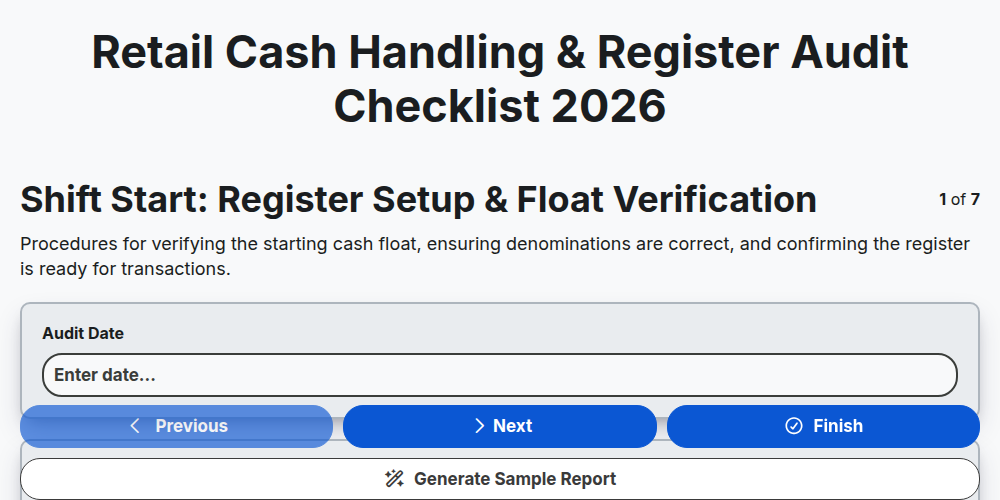
Table of Contents
- Introduction: Why Modern Cash Management is Crucial in 2026
- Phase 1: Shift Start - Setting the Foundation for Accuracy
- Register Setup & Float Verification: Ensuring a Precise Starting Point
- Phase 2: Active Monitoring - Maintaining Integrity During the Shift
- Transaction Monitoring & Compliance: Reducing Human Error and Fraud
- Phase 3: Secure Operations - Protecting the Physical Assets
- Cash Drawer Security & Handling Protocols: Best Practices for Cashiers
- Payment Method Verification: Managing Cash, Card, and Digital Wallets
- Phase 4: Mitigating Risk - Mid-Shift Security Measures
- Cash Drop & Safe Deposit Procedures: Minimizing On-Site Vulnerabilities
- Phase 5: Shift End - The Final Audit and Reconciliation
- Reconciliation & Discrepancy Audit: Identifying and Investigating Variances
- Documentation & Reporting: Creating an Audit Trail for Accountability
- Conclusion: Building a Culture of Financial Accountability
- Resources & Links
TLDR: Protect your retail profits and eliminate discrepancies with our 2026 comprehensive guide to cash management. This checklist provides a foolproof, step-by-step roadmap for managers and staff-covering everything from shift start float verification and real-time transaction monitoring to secure cash drop procedures and end-of-day reconciliation-to ensure total accountability and zero-shrinkage operations.
Introduction: Why Modern Cash Management is Crucial in 2026
In an era where digital payments are skyrocketing, it might be tempting to think that physical cash is becoming a relic of the past. However, for the modern retailer, cash remains a vital component of daily operations and a significant area of vulnerability. As we move into 2026, the complexity of retail transactions-combining traditional cash, mobile wallets, contactless payments, and hybrid gift card balances-has made the margin for error slimmer than ever.
The Rising Cost of Inaccuracy
Inaccurate cash management isn't just a nuisance; it is a direct hit to your bottom line. Every cent that disappears due to human error, negligence, or internal theft contributes to shrinkage, a silent profit killer that erodes margins and complicates inventory management. Without a standardized auditing process, small discrepancies can snowball into massive end-of-year losses that are nearly impossible to trace.
Beyond Just Counting Coins: The 2026 Landscape
Modern auditing in 2026 is no longer just about counting coins at the end of the night. It is about maintaining a rigorous, unbroken chain of custody. With the integration of more advanced Point of Sale (POS) systems and automated sensors, the expectation for precision has increased. A single breakdown in protocol-whether it's failing to verify a float at the start of a shift or neglecting to document a mid-day cash drop-can compromise the integrity of your entire financial reporting.
Why This Checklist is Your Best Defense
The goal of a robust audit checklist is to move from a reactive stance (fixing mistakes after they happen) to a proactive stance (preventing mistakes from occurring). By implementing a standardized, step-by-step verification process, you achieve three critical objectives:
- Enhanced Accountability: When every staff member follows the same verification steps, it becomes clear where gaps in the process exist.
- Operational Consistency: Standardized protocols ensure that whether a manager is present or not, the level of scrutiny remains high.
- Fraud Deterrence: Visible, frequent, and systematic auditing serves as a powerful psychological deterrent against both external theft and internal shrinkage.
In the following guide, we will break down the essential components of a 2026-ready audit, covering everything from the initial shift setup to the final reconciliation of the day's earnings.
Phase 1: Shift Start - Setting the Foundation for Accuracy
Setting the Stage for a Secure Shift
The integrity of your entire business day is determined in the first fifteen minutes of a shift. Financial discrepancies are often not the result of theft alone, but of sloppy foundational processes. By implementing a rigorous opening protocol, you create an audit trail that protects both your employees and your bottom line.
Register Setup & Float Verification
Before the first customer approaches the counter, the opening process must be treated as a formal audit. This stage is about ensuring that the starting point is documented and indisputable.
- Verify the Starting Float: Never assume the previous shift left the correct amount. Physically count the cash in the drawer and compare it against the recorded starting balance in your POS system.
- Check for Discrepancies Immediately: If the physical count does not match the expected float, notify a manager instantly. Document the discrepancy in your shift log before any transactions occur.
- Inspect Equipment Readiness: Ensure that receipt printers have paper, card terminals are functioning, and the cash drawer mechanism is smooth. A technical glitch during the first hour can lead to rushed, unverified transactions later.
- Prepare Change Supplies: Ensure you have sufficient denominations of small bills and coins. Running out of change mid-shift is a primary driver of shortcut behaviors that lead to accounting errors.
Establishing Accountability
The goal of the shift start is to establish a clean slate. When every cent is accounted for at the start of the day, it becomes much easier to identify exactly when and where a loss occurred during the subsequent hours. This transparency is your first line of defense against both internal error and external shrinkage.
Register Setup & Float Verification: Ensuring a Precise Starting Point
Every successful shift begins long before the first customer walks through the door. The integrity of your entire daily reconciliation depends entirely on the accuracy of your opening procedure. If your starting float is incorrect, every subsequent transaction calculation will be compromised, leading to phantom discrepancies that are nearly impossible to trace during the end-of-day audit.
The Foundation of Accuracy: The Morning Audit
The goal of the shift start is to establish a known zero point. This process ensures that the cash present in the drawer matches the recorded starting balance exactly. By verifying the float at the start of each shift, you eliminate the ability for staff to blame previous shifts for existing shortages.
Essential Steps for Shift Start Verification
1. Physical Count of the Starting Float
Before any transactions occur, the cashier must manually count all coins and bills within the drawer. Do not rely on what the previous shift said was left. A physical, hands-on count is the only way to guarantee the baseline is correct.
2. Comparison Against the Standard Float Amount
Once the count is complete, compare the physical total against your store's predefined standard float (e.g., $200.00).
- If the amount is correct: Proceed to register login.
- If there is a discrepancy: This must be noted immediately and reported to the manager on duty before the drawer is officially active.
3. Denomination Breakdown Verification
A common mistake in high-volume retail is having the correct total value but the wrong denomination mix. An audit-ready drawer should have a balanced amount of small denominations (singles, fives, and quarters) to ensure the cashier can provide change for large bills.
- Pro-Tip: If the float is heavy on $20 bills but lacks $1s and $5s, use this moment to perform a manager swap to rebalance the drawer.
4. Register Login & System Synchronization
After the physical cash is verified, the cashier must log into the POS (Point of Sale) system. Ensure that the system-reported starting balance matches your physical count. Any mismatch between the software's expected float and the physical cash must be reconciled in the system logs immediately to maintain a clean digital paper trail for 2026 compliance standards.
5. Audit Log Entry
The final step of the setup is documentation. Every shift start should be accompanied by a signed log-either digital or paper-confirming that the float was counted, verified, and found to be accurate (or noting the specific discrepancy found). This creates accountability and serves as the first line of defense against internal shrinkage.
Phase 2: Active Monitoring - Maintaining Integrity During the Shift
Once the shift is underway, the period between the opening and closing of the register is the most vulnerable window for human error and internal shrinkage. Effective management requires proactive oversight rather than just end-of-day reconciliation.
To ensure your store remains audit-ready throughout the day, follow these critical protocols:
Transaction Monitoring & Compliance
Monitoring is not about micromanaging staff, but about ensuring that every transaction follows the established Standard Operating Procedures (SOPs).
- Receipt Auditing: Periodically check that receipts are being printed and provided for every transaction to prevent under-the-table sales.
- Void and Refund Oversight: Implement a strict secondary authorization policy. Every void, return, or discount must be verified by a supervisor to prevent unauthorized price manipulations.
- No-Sale Tracking: Monitor the frequency of No Sale drawer openings. Frequent unexplained openings are a primary red flag for unauthorized access to the cash drawer.
Cash Drawer Security & Handling Protocols
The physical handling of cash is where most discrepancies originate. Strict adherence to handling protocols minimizes the risk of both error and theft.
- Single-Person Access: Only the assigned cashier should interact with their specific drawer. Never allow employees to share registers or borrow change from a colleague's drawer.
- Minimal Cash Exposure: Cashiers should never leave the register unattended or unlocked. Even a momentary distraction can lead to significant losses.
- The Clean Counter Rule: Keep the immediate area around the register free of personal items, extra loose change, or uncounted bills to prevent confusion and accidental loss.
Payment Method Verification
In 2026, retail payments are increasingly complex, involving a mix of traditional cash, digital wallets, and contactless credit. Each requires specific scrutiny.
- Credit Card Integrity: Ensure that all card transactions are properly authorized by the terminal and that the amount entered into the POS matches the amount processed by the merchant service provider.
- Digital Wallet Validation: Verify that QR code payments or NFC transactions are successfully completed and reflected in the system before the customer leaves the counter.
- Counterfeit Detection: For all high-denomination cash notes, utilize UV scanners or counterfeit detection pens. Never assume a bill is genuine based on appearance alone.
Transaction Monitoring & Compliance: Reducing Human Error and Fraud
Maintaining Integrity at the Point of Sale
In the modern retail landscape, transaction monitoring is no longer just about watching the till; it is about implementing a proactive system of checks and balances. As we move into 2026, the complexity of hybrid payments-combining traditional cash with digital wallets and buy now, pay later services-requires a more rigorous approach to compliance.
To protect your bottom line from both internal errors and external fraud, your audit process must focus on three core pillars:
1. Real-Time Transaction Auditing
Compliance begins with active oversight. Managers should perform periodic, unannounced spot checks of transaction logs against physical receipts.
- Void and Refund Oversight: Every voided transaction or processed refund must be accompanied by a verified reason code and, ideally, a supervisor's digital signature. High frequencies of voids are often the first red flag of sweethearting or internal theft.
- Transaction Velocity Checks: Monitor for unusually high numbers of no-sale drawer openings. This is a common tactic used to skim cash without recording a sale.
2. Adherence to Standard Operating Procedures (SOPs)
Compliance is only as strong as the staff's adherence to the rules. Your audit should verify that:
- Receipt Integrity: Every customer is offered a receipt, and every receipt is logged.
- Discount Authorization: All manual discounts or promotional overrides are verified against current marketing campaigns to prevent unauthorized price manipulation.
- Systematic Scanning: Ensure that items are being scanned individually rather than using bulk entries, which bypasses inventory accuracy and hides shrinkage.
3. Mitigating Modern Fraud Risks
With the rise of sophisticated digital fraud, compliance must extend to digital payment verification.
- Digital Wallet Authentication: Ensure that staff are verifying that the transaction amount on the handheld terminal matches the amount displayed on the customer's device.
- Audit Trail Consistency: Ensure that the digital paper trail created by your POS system matches the physical movement of cash and the digital logs of credit card processing.
By implementing these monitoring layers, you transform your register from a simple point of sale into a fortified checkpoint, significantly reducing the margin for error and creating a culture of accountability across your entire retail team.
Phase 3: Secure Operations - Protecting the Physical Assets
Transaction Monitoring & Compliance
Security in a retail environment isn't just about locking the drawer; it is about continuous vigilance. During active trading hours, managers must implement regular, unannounced spot checks to ensure that all transactions align with store policy.
- Void & Refund Audits: Review every voided transaction and processed refund in real-time. Every void should be accompanied by a clear reason code and, ideally, a supervisor's signature.
- Receipt Integrity: Ensure that every transaction generates a printed or digital receipt. Missing receipt logs are a primary red flag for internal shrinkage.
- Discount & Promo Verification: Monitor the use of employee discounts and promotional codes to ensure they are being applied to authorized transactions only.
Cash Drawer Security & Handling Protocols
The physical handling of currency is the most vulnerable moment in the retail cycle. To minimize the risk of error or theft, strict protocols must be enforced for every staff member.
The No-Touch Policy for Non-Authorized Personnel
Only the assigned cashier should interact with their specific drawer. Allowing multiple employees to use a single till creates accountability gaps where discrepancies can be blamed on anyone, making audits impossible.
Standardized Handling Procedures
- Minimize Open-Drawer Time: Cash drawers should only be opened when a transaction is actively being processed.
- The No-Stacking Rule: Instruct cashiers to keep bills flat and unfolded. Stacking multiple bills can lead to short-changing errors and makes it difficult to identify counterfeit notes.
- Counterfeit Detection: As part of the standard handling protocol, every high-denomination note must be passed through a UV counterfeit detector or verified using specialized pens before being placed in the drawer.
Payment Method Verification
In 2026, cash handling extends beyond physical paper money. A modern audit must include the verification of all digital and alternative payment streams.
- Credit & Debit Reconciliation: Ensure that the total transaction count on the POS matches the batch totals from the credit card processor.
- Mobile & Digital Wallet Audits: Verify that QR-code-based payments and NFC (Near Field Communication) transactions are being correctly logged in the system to prevent ghost transactions where a customer is charged but the sale is not recorded.
- Gift Card & Store Credit Checks: Audit the activation and redemption of gift cards to ensure that balance deductions match the physical sales recorded.
Cash Drop & Safe Deposit Procedures
To mitigate the risk of large-scale loss, a low-float policy should be enforced. This means that once a drawer reaches a certain threshold of cash, a cash drop must be performed.
- The Mid-Shift Drop: When the drawer exceeds a pre-defined limit (e.g., $500), excess cash must be removed and placed in a secure, bolted-down drop safe.
- Dual-Verification Method: Whenever possible, a manager should witness the cash drop. Both the cashier and the manager should sign a drop slip that records the amount removed and the time of the transfer.
- Secure Transit: Ensure the path from the register to the back-office safe is unobstructed and, if possible, monitored by high-definition CCTV to provide an audit trail of the movement of funds.
Cash Drawer Security & Handling Protocols: Best Practices for Cashiers
Ensuring the physical security of your cash drawer is the first line of defense against both internal errors and external theft. In 2026, as retail environments become more fast-paced and integrated with digital payments, maintaining strict, standardized handling protocols is non-negotiable for loss prevention.
Maintain Constant Surveillance and Control
The most fundamental rule of cash security is that the cash drawer should never be left unattended or left open.
- The Eyes On Rule: Cashiers must ensure the drawer is closed and locked immediately after every transaction. Even a few seconds of an open drawer can provide an opportunity for skimming or unauthorized access.
- Limit Access: Only the assigned cashier should have access to their specific drawer. Allowing colleagues to quick-check a drawer or process a transaction for someone else creates a breakdown in accountability that makes audits impossible.
Standardized Handling Procedures
How cash is physically moved from the customer to the drawer determines the level of human error involved in the process.
- The Count Twice Method: Always count the cash received from the customer aloud in front of them, and then recount it again before placing it into the drawer. This prevents disputes regarding the amount tendered.
- Avoid Stacking Bills: Never place new bills on top of old bills without verifying the denominations. Organized, flat bills prevent slip-ups where a $10 bill is accidentally tucked under a $50.
- Clear Counter Space: Keep the area around the register clear of clutter, personal belongings, and extra paperwork. A cluttered workspace is a breeding ground for distracted handling and missed denominations.
Managing High-Denomination Bills
Large bills (such as $50s and $100s) represent the highest risk for counterfeit fraud and loss.
- Immediate Authentication: Use high-speed counterfeit detection pens or UV light scanners for every high-value note received.
- Early Drops: Implement a strict policy where high-denomination bills are removed from the drawer and moved to the safe as soon as they reach a specific threshold. This minimizes the loss potential in the event of a robbery or drawer discrepancy.
Mitigating Internal and External Risks
Security protocols are not just about preventing theft from customers; they are about creating a transparent environment for employees.
- No Ring-Around Transactions: Ensure all items are scanned and paid for. Avoid the habit of holding items behind the counter or processing no-sale drawer openings without a supervisor present.
- The Role of Supervision: While cashiers manage the drawer, managers must perform unannounced spot audits throughout the shift. This reinforces the importance of the protocols and ensures that the standards are being upheld even when no one is watching.
Payment Method Verification: Managing Cash, Card, and Digital Wallets
Securing the Modern Point of Sale
In 2026, the complexity of the retail checkout has moved far beyond simple paper currency. As a retailer, your audit process must account for a multi-layered ecosystem of payment types. Relying solely on a cash-only mindset leaves your business vulnerable to errors and fraud. A robust verification process ensures that every cent-whether digital or physical-is accounted for before the drawer is even closed.
Verifying Physical Currency and Coins
While digital payments are rising, cash remains a high-risk area for shrinkage. Your audit must include:
- Denomination Accuracy: Periodically verifying that the physical count of bills and coins matches the recorded totals in the POS system.
- Counterfeit Detection: Ensuring all staff members are utilizing modern UV or infrared detection tools during high-value transactions.
- Tamper-Evident Checks: Inspecting all coin trays and bill organizers for signs of manipulation or skimming.
Auditing Card-Present Transactions
With the integration of advanced EMV (chip) and NFC (contactless) technologies, the focus has shifted from is the money there? to is the transaction valid?
- Authorization Verification: Confirming that every credit or debit transaction has a corresponding approved authorization code in the system.
- Signature and PIN Consistency: While rare in the era of contactless payments, ensuring that manual overrides or high-value PIN entries are properly logged.
- Terminal Connectivity Logs: Checking for any offline transactions that occurred during network outages, as these are prime targets for fraudulent chargebacks.
The New Frontier: Digital Wallets and QR Payments
As Apple Pay, Google Wallet, and localized QR-based payment systems become the standard, your checklist must include digital verification.
- Tokenization Accuracy: Ensuring that the digital token received by the processor matches the transaction amount logged in the register.
- Mobile App Integration: Verifying that all scans from third-party mobile wallets are correctly mapped to the appropriate revenue center in your audit trail.
- Cross-Platform Reconciliation: Ensuring that digital wallet transfers are reconciling perfectly with your merchant service provider's daily settlement report.
Phase 4: Mitigating Risk - Mid-Shift Security Measures
Maintaining Control During Peak Trading Hours
The middle of a shift is often the most vulnerable period for retail operations. High foot traffic, long queues, and employee fatigue can lead to lapses in protocol. To prevent skimming and clerical errors, your team must adhere to strict monitoring and security standards throughout the duration of the shift.
Transaction Monitoring & Compliance
Accuracy isn't just about the final tally; it is about the integrity of every single swipe, scan, and cash insertion. Managers should implement periodic spot checks to ensure that:
- Void & Refund Oversight: Every voided transaction or refund is accompanied by a signed receipt or manager override to prevent unauthorized removals of cash.
- Receipt Integrity: Every customer receives a printed or digital receipt, ensuring that every transaction is recorded in the POS system.
- Discount Verification: All manual discounts or promotional overrides are audited in real-time to prevent staff-led revenue leakage.
Cash Drawer Security & Handling Protocols
The cash drawer should be treated as a high-security zone. Implementing strict handling protocols minimizes the window of opportunity for internal shrinkage.
- The No-Finger Rule: Cash should never be left unattended or sitting on top of the register. Once a transaction is complete, the drawer must be closed immediately.
- Single-Drawer Policy: To maintain a clear audit trail, only one staff member should be responsible for a specific drawer at any given time. If a handover occurs, a mid-shift mini-reconciliation must be performed.
- Minimal Cash Exposure: Limit the amount of cash kept in the active till. Once a certain threshold is reached, follow the protocol for mid-shift drops.
Payment Method Verification
With the rise of diverse payment technologies in 2026, auditing extends beyond physical banknotes. Ensure your team is verifying:
- Digital Wallet Integrity: Confirm that NFC (Near Field Communication) payments and mobile wallets are processed through the encrypted terminal to prevent manual entry fraud.
- Check & Credit Scrutiny: For high-value transactions, ensure all secondary forms of payment (checks, gift cards, or manual credit entries) are cross-referenced with the digital ledger.
- Counterfeit Detection: Ensure all staff are trained on the latest UV and pattern-recognition tools to identify sophisticated counterfeit currency circulating in the 2026 market.
Cash Drop & Safe Deposit Procedures: Minimizing On-Site Vulnerabilities
Securing the Surplus: Moving Funds from Drawer to Vault
Once your cash drawer reaches a predetermined threshold, or at the conclusion of a scheduled interval, the transition of funds from the register to the store safe is one of the most high-risk moments in the retail workday. This phase of the audit process is where internal shrinkage and external theft are most likely to occur. To protect your revenue, follow these stringent protocols:
1. The Blind Drop Protocol
To maintain the integrity of your audit trail, implement a blind drop system. The employee performing the drop should count the excess cash without referencing the recorded sales figures from the POS system. This prevents skimming, where an employee might intentionally under-report a surplus to pocket the difference.
2. Dual Verification & Witnessing
Never allow a single employee to handle large cash transfers alone. A robust 2026 security standard requires a Two-Person Rule:
- The Counter: The cashier counts the funds.
- The Verifier: A manager or supervisor observes the count and verifies the amount against the drop slip. This creates a system of accountability and ensures that any discrepancies are identified immediately rather than discovered during the end-of-day reconciliation.
3. Secure Transit Routes
The physical movement of cash from the register to the back-office safe should be invisible to customers.
- Route Planning: Avoid paths that pass through high-traffic areas or near store entrances.
- Minimizing Exposure: Use opaque, tamper-evident deposit bags. The contents should never be visible during transit.
- Surveillance Coverage: Ensure that the path from the POS to the safe is covered by high-definition CCTV with no blind spots.
4. Tamper-Evident Documentation
Every deposit must be accompanied by a paper or digital trail.
- Sequential Bagging: Use numbered, one-time-use tamper-evident bags.
- Log Entry: Immediately log the bag number, the amount, the time of the drop, and the signatures of both the cashier and the witness into your digital audit log.
- Immediate Vault Entry: Once the funds reach the safe, the deposit should be logged into the central management system immediately to ensure the paper matches the physical in real-time.
5. Managing the Threshold Trigger
Don't wait until the end of the shift to clear the register. Establish a Cash Ceiling (e.g., $500 or $1,000). Once the drawer exceeds this amount, a mandatory cash drop must be triggered. Reducing the amount of liquid cash sitting in the register significantly lowers the incentive for targeted robberies and reduces the impact of human error during the final shift reconciliation.
Phase 5: Shift End - The Final Audit and Reconciliation
The end of a shift is the most critical window for identifying discrepancies. This is the moment where errors, theft, or procedural lapses transition from unknown to documented. A rigorous closing protocol ensures that what occurred during the day matches what remains in the drawer, allowing you to pinpoint exactly where the breakdown happened.
Reconciling the Register and Identifying Discrepancies
The primary goal of the shift end is to bridge the gap between your Point of Sale (POS) reports and the physical cash on hand.
- The Blind Count: Ideally, the closing associate should perform a blind count-counting the cash without first looking at the POS report. This prevents forcing the numbers to match a predetermined total.
- Comparing Totals: Once the physical count is complete, compare it against the Z-Report (the final daily transaction summary).
- Analyzing Overages and Shortages: Every cent must be accounted for.
- Small Discrepancies: Minor differences (often due to rounding or small change errors) should be logged.
- Significant Discrepancies: Large shortages or overages must trigger an immediate investigation into transaction logs, voided receipts, and CCTV footage.
Documentation and Reporting
In 2026, if it wasn't documented, it didn't happen. An audit trail is your best defense against internal shrinkage and external disputes.
Creating the Daily Audit Log
All findings must be recorded in a standardized daily log. This document should include:
- The Final Count Summary: Total cash, total credit, and total checks/gift cards.
- The Variance Report: A clear note of the exact amount of any overage or shortage.
- Incident Descriptions: If a specific transaction caused a discrepancy, note the transaction ID and the nature of the error.
Finalizing the Audit Trail
The audit process concludes with a formal sign-off. Both the departing associate and the supervisor/manager should review the reconciliation and sign the report. This shared accountability ensures that the responsibility for the drawer's integrity is distributed, making it much harder for fraudulent activity to go unnoticed.
By treating the shift end as a formal audit rather than a mere cleanup task, you transform your closing process from a routine chore into a powerful layer of loss prevention.
Reconciliation & Discrepancy Audit: Identifying and Investigating Variances
The Final Line of Defense: The End-of-Shift Audit
The shift end is the most critical moment in the cash handling lifecycle. This is when the theoretical numbers in your Point of Sale (POS) system meet the physical reality of the cash in your drawer. A thorough Reconciliation & Discrepancy Audit is not just about counting money; it is about identifying patterns of error, detecting potential internal theft, and ensuring that every cent is accounted for before the drawer is closed.
Step 1: The Physical Count vs. POS Report
The process begins with a blind count or a direct comparison. The auditor must count all physical currency, coins, and vouchers present in the drawer and compare them against the Z-Report or the system-generated end-of-day summary.
- Verify the Total Sales: Ensure the total recorded transactions match the sum of the individual payment types (Cash, Credit, Gift Cards).
- Check the Expected Float: Confirm that the starting float (the base amount used to make change) has been removed and remains untouched for the next shift.
Step 2: Analyzing the Variance (Overages and Shortages)
In a perfect world, the drawer balances to the penny. In reality, discrepancies occur. However, the goal of the 2026 audit standard is to move beyond simply fixing the balance and toward investigating the why.
- Identify the Magnitude: Small discrepancies (pennies or nickels) are often attributed to human error or rounding. Large discrepancies (significant dollar amounts) require immediate escalation.
- Determine the Type:
- Cash Shortage: Indicates potential unrecorded payouts, incorrect change given to customers, or unauthorized removals.
- Cash Overage: Often more overlooked than shortages, but equally dangerous. Overages frequently point to failed transaction voids, failure to ring up items, or skimming attempts where cash is pocketed but the sale is left unrecorded.
Step 3: Investigating the Root Cause
If a discrepancy exceeds your store's established threshold, the audit moves into a forensic phase. Do not simply balance the books and move on. Use the following investigative steps:
- Review Transaction Logs: Scan the shift logs for high frequencies of Voids, Refunds, or No Sale drawer openings. These are common areas for manipulation.
- Cross-Reference Receipts: Match physical credit card slips and manual transaction logs against the digital paper trail.
- Audit the Paper Trail: Check if any Paid-Outs (cash taken from the drawer to pay for small store supplies) were documented with a receipt.
Step 4: Implementing Corrective Action
The audit is only successful if it leads to prevention. If a specific cashier or shift consistently shows variances, the audit results should trigger a review of training protocols or a re-evaluation of security camera footage.
Pro-Tip for 2026: Use your audit findings to update your Shrinkage Trend Report. If you notice discrepancies always occur during mid-afternoon transitions, your next step should be reviewing your shift-change handover protocols.
Documentation & Reporting: Creating an Audit Trail for Accountability
The Foundation of Financial Integrity
A robust cash handling process is only as strong as the paperwork that supports it. Without meticulous documentation, even the most disciplined shift reconciliation becomes difficult to audit, making it nearly impossible to identify patterns of error or identify potential internal theft. In 2026, where digital integration meets physical transactions, your reporting must be seamless, searchable, and standardized.
Establishing a Paper and Digital Trail
Effective reporting serves two purposes: it provides immediate clarity during end-of-day balancing and acts as a historical record for long-term loss prevention analysis. Every discrepancy, no matter how small, must be documented in a way that is audit-ready.
- Standardized Incident Logs: Whenever a drawer is found to be over or short beyond a pre-defined threshold, a formal incident report should be completed. This log should include the date, time, register number, the exact amount of the discrepancy, and the names of the staff members involved.
- Digital Synchronization: Ensure that all physical end-of-day reports are immediately uploaded or synced with your Point of Sale (POS) system. This creates a time-stamped digital footprint that prevents backdating or manual tampering with records.
- The Reason Code Mandate: Implement a system where every significant variance is paired with a specific reason code (e.g., incorrect change given, miscounted float, coupon error). This transforms raw data into actionable insights.
The Role of Periodic Audits in Reporting
Reporting shouldn't just happen at the end of a shift; it should be a continuous loop of feedback. Use your accumulated documentation to conduct weekly or monthly Spot Audits.
Key Elements for a Comprehensive Audit Report
To ensure your management team has the necessary visibility, every audit report should contain the following elements:
- Total Net Sales vs. Total Cash Collected: A direct comparison of recorded transactions versus physical currency.
- Cash Drop Summaries: Documentation of every transfer from the register to the safe, cross-referenced with the safe's deposit log.
- Employee Accountability Sign-offs: A verification step where both the cashier and the supervisor sign off on the reconciliation, confirming that the count was witnessed and verified.
- Discrepancy Trend Analysis: A summary section that highlights if specific registers or specific shifts are experiencing recurring losses.
By prioritizing rigorous documentation, you move from a reactive stance-simply fixing errors-to a proactive strategy of preventing them. A well-maintained audit trail is your most powerful tool in reducing shrinkage and maintaining total operational transparency.
Conclusion: Building a Culture of Financial Accountability
Prioritizing Precision in an Evolving Retail Landscape
As we move into 2026, the complexity of retail transactions continues to grow. With the integration of more diverse payment technologies, mobile wallets, and automated self-checkout systems, the surface area for potential errors and internal shrinkage has expanded. Implementing a rigorous, standardized audit checklist is no longer just a best practice-it is a fundamental requirement for maintaining the financial health of your business.
Beyond the Paperwork: Cultivating Accountability
A checklist should never be viewed as a mere bureaucratic hurdle or a way to police your employees. Instead, view it as a framework for building a culture of accountability and transparency. When every team member-from the part-time cashier to the store manager-understands and adheres to the same strict protocols for shift starts, cash drops, and end-of-day reconciliations, you achieve several critical goals:
- Reduced Stress for Staff: Clear procedures eliminate guesswork, reducing the anxiety associated with discovering discrepancies during shift ends.
- Enhanced Loss Prevention: Consistent monitoring and security protocols act as a powerful deterrent against both external theft and internal shrinkage.
- Data-Driven Decision Making: Accurate documentation provides the high-quality data necessary to identify patterns, spot training gaps, and optimize labor scheduling.
Turning Audits into Opportunities
Use your periodic register audits as coaching moments rather than punitive measures. If discrepancies arise, use the data gathered from your Shift End Reconciliation to investigate the root cause. Is it a training issue? A hardware malfunction in the card reader? A flaw in the cash drop procedure?
By staying proactive and treating your cash handling processes as a living part of your operations, you protect your margins, empower your workforce, and ensure that your retail business remains profitable and secure in the years to come.
Resources & Links
- National Foundation for Credit Counseling: Provides insights into financial management principles that can be applied to large-scale retail fund management.
- Retail Dive: Industry news and analysis regarding retail technology trends and loss prevention strategies for 2026.
- National Association of Convenience Stores: Resources for managing high-volume cash transactions and operational security in small-format retail.
- SHRM (Society for Human Resource Management): Best practices for training employees on compliance, accountability, and internal theft prevention.
- PPAGlobal: Information on modern cash management solutions and automated cash recycling technology.
- Federal Trade Commission: Guidelines on preventing fraud and protecting business assets from external scams.
- CFO Magazine: Deep dives into financial auditing, reconciliation processes, and internal control frameworks.
- Loss Prevention Research Council: Scientific research and data-driven approaches to reducing shrinkage in retail environments.
- Stripe: Insights into the integration of digital wallets and the complexities of multi-channel payment reconciliation.
- Verifone: Resources on modern Point of Sale (POS) hardware security and transaction monitoring.
- Adyen: Advanced perspectives on managing unified commerce and global payment method verification.
- Investopedia: Educational resources on fundamental accounting principles used in daily cash audits.
- ARM Secure: Best practices for physical asset protection and high-security cash vault procedures.
- Scotiabank Business: Banking perspectives on managing cash deposits and minimizing on-site vulnerabilities.
- BigCommerce: Understanding the intersection of physical retail and digital inventory/cash management.
- Deloitte: Professional insights into risk management, auditing, and building a culture of financial accountability.
- PwC: Global standards for internal controls and fraud detection in retail operations.
Comments
There are no comments yet. Be the first to add one!
Retail Management Solution Demo
Boost retail efficiency! ChecklistGuro simplifies store operations, inventory management, and employee training. Improve customer experience and maximize profitability. Manage it all with our Work OS.
Related Articles
Seasonal Mulch & Gravel Checklist Template: Stay Stocked & Ready
Elevator & Escalator Inspection Checklist Template: Your Guide to Safety & Compliance
Daily Prescription Dispening Area Inspection Checklist Template

Weekly Waste Management & Recycling Checklist Template
Keep Your Storefront Sparkling: Your Daily & Weekly Cleaning Checklist Template
Your Ultimate Landscaping & Groundskeeping Checklist: Weekly & Monthly Templates
Monthly Stockroom Organization & Safety Checklist Template
Daily Dairy Case Inspection Checklist Template
Need help with
Retail?
Have a question? We're here to help. Please submit your inquiry, and we'll respond promptly.