Mastering the Customer Experience: The Ultimate Retail Customer Feedback & Complaint Resolution Checklist 2026
Published: 10/30/2026 Updated: 10/31/2026
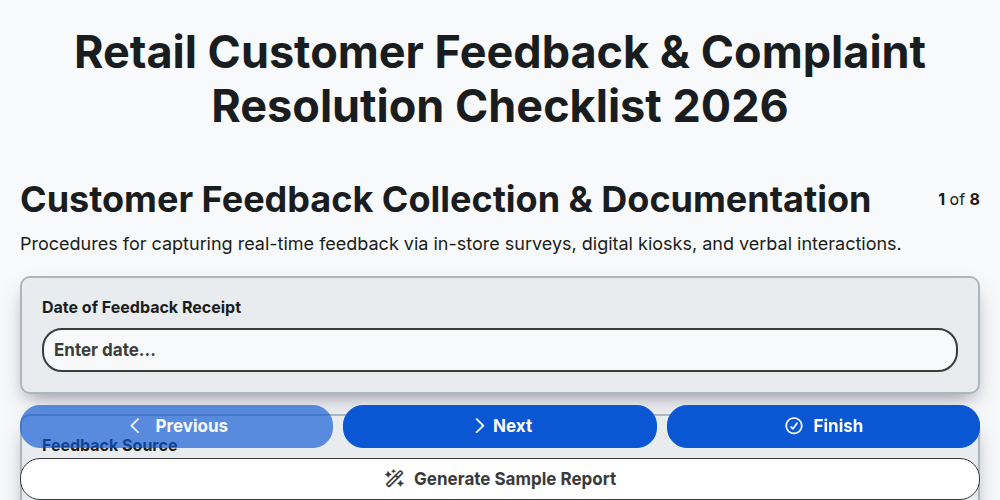
Table of Contents
- Introduction: Why Feedback Management is the Competitive Edge in 2026
- Phase 1: Customer Feedback Collection & Documentation
- Phase 2: Complaint Receipt & Immediate Response Protocols
- Phase 3: Issue Categorization & Severity Assessment
- Phase 4: Effective Resolution & Recovery Actions
- Phase 5: Staff Training & Continuous Follow-up
- Phase 6: Root Cause Analysis & Long-term Trend Tracking
- Phase 7: Closing the Loop: Customer Satisfaction Follow-up
- Phase 8: Reporting & Management Review for Strategic Growth
- Conclusion: Building a Culture of Continuous Improvement
- Resources & Links
TLDR: Stay ahead of the 2026 retail landscape by implementing a structured approach to customer satisfaction. This guide provides a comprehensive, step-by-step checklist-from rapid complaint response and severity assessment to deep-dive root cause analysis-designed to turn every customer grievance into an opportunity for brand loyalty and operational excellence.
Introduction: Why Feedback Management is the Competitive Edge in 2026
The New Era of Retail Loyalty
In 2026, the retail landscape has shifted far beyond the simple transaction. With the seamless integration of AI-driven shopping, hyper-personalized marketing, and the blurring lines between physical and digital storefronts, customers no longer just buy products-they buy experiences. In this highly competitive ecosystem, your product quality and pricing are merely the baseline; your true competitive advantage lies in how you listen to and respond to your customers.
The High Stakes of the Modern Consumer
Today's shoppers are more connected and vocal than ever before. A single unresolved friction point can escalate from a private frustration to a viral social media moment in minutes. Conversely, a brilliantly handled complaint can transform a frustrated critic into a lifelong brand advocate.
As we navigate 2026, reactive service is no longer enough. To thrive, retailers must move toward a proactive, systematic approach to feedback management. It is no longer about simply fixing what is broken; it is about leveraging every piece of data-whether a glowing review or a scathing complaint-to refine your operational excellence.
Beyond the Apology: The Need for a Systematic Framework
Many retail managers approach complaints with a firefighting mentality-responding to the crisis of the moment without addressing the spark that caused it. This leads to repetitive errors, high staff burnout, and eroding customer lifetime value.
To build a resilient brand, you need more than just good intentions; you need a repeatable, scalable process. This checklist is designed to move your team through the entire lifecycle of a customer interaction:
- Capturing the voice of the customer accurately.
- Responding with speed and empathy.
- Analyzing the data to prevent future friction.
- Evolving your business model based on real-world insights.
By implementing the following structured approach, you ensure that every piece of feedback becomes an opportunity for growth, turning the complaint department into your most powerful engine for continuous improvement.
Phase 1: Customer Feedback Collection & Documentation
Building the Foundation: Data-Driven Insights
In the rapidly evolving retail landscape of 2026, feedback is no longer just a suggestion box activity-it is your most valuable strategic asset. The first step in mastering the customer experience is moving from passive listening to active, structured documentation. You cannot resolve what you do not measure.
Multi-Channel Collection Strategies
To gain a 360-degree view of the customer journey, your collection process must be as frictionless as possible. In 2026, this means integrating automated touchpoints across every interaction layer:
- Post-Purchase Digital Surveys: Leveraging real-time SMS and email triggers immediately following a transaction.
- In-Store IoT Interactivity: Utilizing smart kiosks and QR-code-enabled signage to capture in-the-moment sentiment.
- Social Listening & Sentiment Analysis: Monitoring brand mentions and direct messages across social platforms using AI-driven tools.
- Direct Staff Feedback: Implementing a structured way for floor associates to log verbal feedback they encounter during face-to-face interactions.
The Golden Rule of Documentation: Standardization
Collecting data is useless if it isn't actionable. To turn raw comments into intelligence, every piece of feedback must be funneled into a centralized Unified Customer Experience (UCX) Platform.
Effective documentation requires more than just recording the text of a complaint; it requires capturing the metadata:
- Timestamp & Channel: When and where did the interaction occur?
- Customer Identity: Linking feedback to loyalty profiles to understand lifetime value (LTV).
- Contextual Tags: Tagging feedback by department (e.g., checkout, product quality, store ambiance, or delivery speed).
By treating feedback as structured data rather than isolated incidents, you transform your complaint management from a reactive firefighting mode into a proactive engine for retail excellence.
Phase 2: Complaint Receipt & Immediate Response Protocols
The Golden Window: Speed as a Competitive Advantage
In the fast-paced retail landscape of 2026, the interval between a customer expressing dissatisfaction and your first response is the most critical period for brand preservation. Modern consumers, empowered by instant communication channels, expect immediacy. How you handle the first few minutes of a complaint often determines whether a frustrated shopper becomes a lifelong advocate or a viral detractor.
Immediate Acknowledgment: The First Contact Rule
The goal of this phase is not necessarily to solve the problem instantly, but to ensure the customer feels heard. An effective protocol requires an automated yet personalized acknowledgment within minutes of a complaint being logged via chat, email, or social media.
- Validation over Defense: Train your frontline staff to use empathetic language. Avoid defensive buts and instead use I understand and Thank you for bringing this to our attention.
- Setting Expectations: Never leave a customer in a vacuum. If a complex issue requires investigation, the initial response must include a clear timeline (e.g., We are looking into your order discrepancy and will provide an update within two hours.).
Initial Triage and Calm Communication
The moment a complaint is received, the priority is de-escalation.
- Channel Synchronicity: Ensure that your response is consistent across all touchpoints. A customer shouldn't receive a warm apology on X (formerly Twitter) only to be met with a robotic, indifferent tone via email.
- Empowerment at the Frontline: To achieve true Immediate Response, frontline associates should be pre-authorized to take specific micro-actions-such as issuing an immediate apology discount code or a small loyalty point credit-without needing managerial approval. This immediate peace offering can significantly lower the customer's physiological stress level and prevent escalation.
Phase 3: Issue Categorization & Severity Assessment
Analyzing the Impact: Categorization & Severity Assessment
Once a complaint has been received and an initial response sent, the next critical step is to move from reactive firefighting to structured analysis. In the fast-paced retail landscape of 2026, simply fixing the problem isn't enough; you must understand the nature of the friction point to prevent it from recurring.
Defining the Scope through Categorization
Not all feedback is created equal. To make your data actionable, every piece of feedback and every complaint must be tagged into specific categories. This allows your management team to identify whether your issues are systemic or isolated. Key categories to track include:
- Product Quality & Defects: Issues relating to manufacturing errors, damaged goods, or misleading descriptions.
- Service & Staff Interaction: Complaints regarding staff behavior, lack of product knowledge, or long wait times.
- Logistics & Fulfillment: Failures in the delivery chain, incorrect order processing, or inventory inaccuracies.
- Digital & Omnichannel Friction: Glitches in the mobile app, checkout errors on the website, or discrepancies between online and in-store availability.
- Pricing & Promotional Errors: Disputes regarding discounts, loyalty point redemption, or unexpected fees.
Determining Severity: The Triage Model
Not every complaint requires an immediate escalation to the regional manager, but every complaint requires a proportional response. Implementing a severity assessment ensures your resources are allocated where they matter most.
Level 1: Low Severity (Minor Inconvenience)
These are nuisance issues that affect customer satisfaction but do not threaten brand reputation.
- Example: A minor delay in a non-urgent delivery or a small discrepancy in a loyalty point balance.
- Action: Standard resolution protocol; handled by frontline staff.
Level 2: Medium Severity (Significant Dissatisfaction)
These issues involve a failure in the core service promise and have the potential to drive a customer to a competitor.
- Example: Receiving a wrong item, rude service, or a broken product upon arrival.
- Action: Requires supervisor intervention and a personalized recovery plan.
Level-3: High Severity (Critical/Brand Risk)
These are red alert situations that could lead to legal implications, social media crises, or widespread loss of trust.
- Example: Safety concerns (product recalls), data breaches, or viral negative social media exposure.
- Action: Immediate escalation to senior management and crisis communication teams.
By meticulously categorizing and assessing severity, you transform a chaotic stream of complaints into a structured roadmap for operational improvement.
Phase 4: Effective Resolution & Recovery Actions
Turning Friction into Loyalty: The Art of Resolution
Once an issue has been identified and categorized, the focus shifts from management to action. In 2026, the goal of resolution is no longer just fixing the problem-it is about service recovery, a strategic process designed to turn a frustrated shopper into a brand advocate.
The Golden Rules of Resolution
To ensure your response aligns with modern consumer expectations, follow these three pillars:
- Speed and Agility: In an era of instant gratification, a delayed resolution is often perceived as a second insult. Aim for First Contact Resolution (FCR) whenever possible.
- Empowerment at the Frontline: The most successful retailers empower their floor staff and support agents to make real-time decisions (such as issuing instant discounts or replacements) without needing multiple layers of managerial approval.
- Personalization over Scripts: Avoid robotic, templated responses. Acknowledge the specific details of the customer's grievance to prove they have been heard.
Implementation Steps
1. Direct Remediation
The first step is the tangible fix. Depending on the nature of the complaint, this may include:
- Product Replacement/Refunds: Processing seamless returns or exchanges via automated, frictionless workflows.
- Service Correction: Correcting an error in billing, delivery, or in-store service immediately.
- Compensatory Gestures: Providing value-adds-such as loyalty points, discount vouchers for future visits, or small complimentary items-to acknowledge the inconvenience caused.
2. The Recovery Mindset
Resolution is incomplete if the customer's emotional state remains negative. The recovery phase involves:
- The Sincere Apology: Acknowledging the mistake without making excuses.
- Validation: Confirming that the customer's frustration is legitimate and that the brand takes accountability.
- Restoring Trust: Demonstrating through action that the mistake was an anomaly and that the brand is committed to higher standards moving forward.
3. Closing the Loop
Every resolution must be documented in your CRM. This ensures that when the customer next enters your store or visits your site, your team is aware of their history, allowing for a white-glove experience that proves their recent difficulty was handled with care.
Phase 5: Staff Training & Continuous Follow-up
Empowering Your Team for Long-Term Success
Resolution is a temporary fix, but training is a permanent solution. Once an individual complaint has been resolved, the focus must shift from the specific incident to the broader capability of your frontline team. In 2026, the most successful retailers don't just fix problems; they use every friction point as a micro-learning opportunity to prevent recurrence.
Implementing Real-Time Feedback Loops
To ensure your resolution efforts translate into improved service, implement a Post-Resolution Briefing protocol. This involves:
- Debriefing Critical Incidents: For high-severity complaints, hold brief, non-punitive huddles to discuss what happened and how the team responded.
- Role-Playing Modern Scenarios: Use the data collected in your trend tracking to simulate modern retail challenges, such as managing omnichannel delivery delays or navigating AI-driven chatbot frustrations.
- Empowerment Training: Train staff not just on how to follow a script, but on how to use their discretionary authority to make moment of truth decisions that rebuild trust instantly.
Closing the Loop with Systematic Follow-up
The final pillar of this phase is ensuring that the resolution wasn't just a one-off event. Continuous follow-up requires a dual approach:
1. Internal Follow-up: Audit and Refine
Don't let your new protocols gather dust. Periodically audit your resolution logs to ensure that the Resolution & Recovery Actions taken are consistent with your brand promise. If you find that staff are consistently struggling with the same type of complaint, it is a signal that your training or your internal processes need an update.
2. External Follow-up: The Re-engagement Strategy
The relationship with the customer is only restored once they feel heard. Use automated, personalized follow-ups to check in on the customer's experience post-resolution. A well-timed, thoughtful check-in can transform a formerly frustrated customer into a brand advocate, proving that your commitment to their satisfaction extends far beyond the closing of a support ticket.
Phase 6: Root Cause Analysis & Long-term Trend Tracking
Moving Beyond the Quick Fix: Analyzing the Why
Resolving a single complaint is a victory for customer retention, but true retail excellence in 2026 requires moving beyond reactive firefighting. To prevent the same issues from eroding your brand equity, you must transition from resolution to prevention.
Root Cause Analysis (RCA) is the process of looking past the surface-level symptom to identify the underlying systemic failure. If a customer complains about a late delivery, the resolution is a refund; the root cause might be a flaw in your new automated warehouse sorting logic.
Implementing the 5 Whys Framework
To effectively perform a deep dive, your management team should utilize the 5 Whys technique for every high-severity complaint:
- The Problem: The customer received a damaged item.
- Why? The packaging was insufficient for the weight.
- Why? The new eco-friendly mailers are too thin for heavy products.
- Why? The procurement team prioritized cost-cutting over durability.
- The Root Cause: Lack of a durability testing protocol for new sustainable packaging.
Turning Data into Intelligence: Trend Tracking
In 2026, data is only as valuable as the patterns you extract from it. Individual complaints are snapshots; trend tracking is the full movie. Use your CRM and feedback tools to monitor:
- Volume Spikes: Are complaints about checkout friction increasing after the recent UI update?
- Category Clusters: Is there a sudden rise in product quality mentions in a specific geographic region?
- Resolution Velocity: Are certain types of complaints taking longer to close than others?
Predictive Service Strategy
By documenting these trends, you transform your customer service department from a cost center into a strategic intelligence unit. This data should directly inform your 2026 procurement, logistics, and marketing strategies, allowing you to fix broken processes before the customer even notices them.
Phase 7: Closing the Loop: Customer Satisfaction Follow-up
Beyond the Resolution: Ensuring Long-Term Loyalty
The resolution of a complaint is not the finish line; it is merely the checkpoint. In the 2026 retail landscape, where consumer attention spans are shorter than ever and brand loyalty is increasingly fragile, the true test of your service lies in what happens after the issue is marked as closed.
The Customer Satisfaction Follow-up phase is where you transition from fixing a problem to building a relationship. Use this final stage to ensure that the recovery was successful and that the customer feels valued, rather than just processed.
The Post-Resolution Audit
Once the immediate grievance has been addressed, implement a structured follow-up protocol:
- The 24/48 Hour Check-In: For high-severity issues, a proactive outreach (via email, SMS, or a personalized call) within 24 to 48 hours is essential. A simple, We wanted to ensure the solution we provided met your expectations, demonstrates that the brand cares about the outcome, not just the closure of the ticket.
- Measuring Net Sentiment: Don't rely on assumptions. Deploy a brief, single-question micro-survey (e.g., On a scale of 1-10, how satisfied are you with how we handled your recent concern?) to gather quantitative data on your recovery effectiveness.
- The Surprise and Delight Opportunity: If a customer experienced significant friction, this is the moment to deploy a recovery incentive-such as a discount code for their next visit or a loyalty point bonus. This pivots the memory of a negative event into a positive brand interaction.
Avoiding Follow-up Fatigue
While engagement is key, precision is vital. Ensure your follow-up strategy is:
- Non-Intrusive: Avoid overwhelming the customer with multiple touchpoints. One well-timed, meaningful interaction is more impactful than a barrage of automated emails.
- Omnichannel-Consistent: If the complaint was handled via Instagram DM, the follow-up should ideally occur through that same channel to maintain a seamless conversational flow.
Pro-Tip for 2026: Use AI-driven sentiment analysis to determine which customers require a human touch and which can be handled via automated, personalized follow-up workflows. The goal is to be personal, not just persistent.
Phase 8: Reporting & Management Review for Strategic Growth
Transforming Data into Strategy
The final stage of the resolution cycle is where individual fixes evolve into organizational intelligence. Reporting and Management Review is not merely about documenting what went wrong; it is about auditing your entire operational ecosystem to ensure that the same mistake never happens twice. In the 2026 retail landscape, where-data-driven agility defines market leaders, this phase is your most powerful tool for long-term scaling.
The Pillars of Effective Management Review
To move beyond reactive firefighting and toward proactive excellence, your review process should focus on three critical pillars:
1. The KPI Dashboard: Beyond the Surface
Effective reporting must move past total number of complaints and dive into high-level performance indicators. Your management reviews should analyze:
- Resolution Velocity: The average time taken from initial complaint receipt to final satisfaction confirmation.
- First-Contact Resolution (FCR) Rate: The percentage of issues resolved without requiring follow-up or escalation.
- Sentiment Shift Metrics: Tracking the movement of customer sentiment from dissatisfied to neutral or loyal following an intervention.
- Cost of Resolution: Calculating the operational overhead required to rectify errors, helping to justify investments in preventative technology.
2. Cross-Departmental Feedback Loops
A common mistake in retail management is siloing complaint data within the Customer Service department. For a truly effective review, the insights gathered must be disseminated to:
- Supply Chain & Logistics: To address recurring shipping delays or product damage.
- Inventory Management: To flag recurring stockouts or inaccuracies in digital/physical availability.
- Marketing & Product Development: To identify if customer expectations are being misaligned by promotional messaging or if product features are failing in real-world use.
3. Iterative Strategy Calibration
The ultimate goal of the Management Review is strategic iteration. Use your monthly or quarterly reviews to ask: "Are our current training protocols sufficient, or do we need to overhaul our tech stack?"
By treating every complaint report as a blueprint for operational improvement, you transform a cost center (complaint resolution) into a value driver (customer retention). In 2026, the retailers who win will be those who use their reporting to turn every customer grievance into a roadmap for a superior shopping experience.
Conclusion: Building a Culture of Continuous Improvement
Turning Challenges into Competitive Advantages
Implementing a structured checklist for feedback and complaint resolution is more than just a way to manage unhappy customers; it is a strategic blueprint for long-term retail excellence. In the fast-paced, hyper-connected landscape of 2026, the margin for error is slimmer than ever. A single unresolved grievance can amplify across social platforms instantly, but a flawlessly executed recovery can transform a critic into a lifelong brand advocate.
Moving Beyond Reactive Management
The goal of this checklist is to shift your retail operations from a reactive state-where you are simply putting out fires-to a proactive state, where your data-driven insights prevent fires from starting in the first place. By consistently applying these eight steps, you are not just solving individual problems; you are building an intelligence system that informs your entire business strategy.
The Long-Term Impact
When your team masters this cycle, you unlock three critical benefits:
- Operational Resilience: Your staff will feel empowered and confident, knowing exactly how to navigate high-pressure situations without constant managerial intervention.
- Data-Driven Growth: Through Root Cause Analysis and Trend Tracking, your feedback becomes a roadmap for product development, inventory management, and service enhancements.
- Enhanced Brand Loyalty: In a crowded market, the human element of a perfect resolution is your greatest differentiator. Customers stay where they feel heard, valued, and respected.
As you move into 2026, remember that every complaint is a free piece of consultancy. Treat every piece of feedback as an opportunity to refine your processes, polish your service, and ultimately, outpace the competition through an unwavering commitment to the customer experience.
Resources & Links
- Forbes Business Council: Insights on leadership and the evolving landscape of customer-centric business strategies.
- Zendesk: Industry-leading tools and research regarding customer service trends and omnichannel support.
- Salesforce: Resources for managing customer relationships and leveraging CRM data for feedback loops.
- HubSpot Blog: Expert guides on inbound methodology and using customer feedback to drive marketing and sales.
- Gartner: Strategic insights and research on the future of customer experience (CX) technology and trends.
- McKinsey & Company: Deep dives into operational excellence and the economic impact of customer loyalty.
- Deloitte Insights: Analysis on digital transformation in retail and large-scale organizational change management.
- SurveyMonkey: Practical tools and methodologies for effective customer feedback collection and survey design.
- Typeform: Resources on creating engaging, high-conversion customer feedback forms and surveys.
- Intercom: Innovations in conversational support and automated complaint resolution protocols.
- Qualtrics: Advanced methodologies for Experience Management (XM) and root cause analysis.
- Shopify Blog: Retail-specific advice on managing customer satisfaction and online/offline feedback integration.
- Klarna Newsroom: Case studies on modernizing the retail checkout and post-purchase customer experience.
- CX Best Practices: Detailed frameworks for implementing immediate response protocols and escalation matrices.
- Harvard Business Review: Academic and practical perspectives on building a culture of continuous improvement and service recovery.
- Hotjar: Tools for understanding user behavior and identifying friction points in the customer journey.
- Customer Feedback Loop Guide: Specific strategies for 'Closing the Loop' and ensuring long-term customer retention.
Comments
There are no comments yet. Be the first to add one!
Retail Management Solution Demo
Boost retail efficiency! ChecklistGuro simplifies store operations, inventory management, and employee training. Improve customer experience and maximize profitability. Manage it all with our Work OS.
Related Articles
Seasonal Mulch & Gravel Checklist Template: Stay Stocked & Ready
Elevator & Escalator Inspection Checklist Template: Your Guide to Safety & Compliance
Daily Prescription Dispening Area Inspection Checklist Template

Weekly Waste Management & Recycling Checklist Template
Keep Your Storefront Sparkling: Your Daily & Weekly Cleaning Checklist Template
Your Ultimate Landscaping & Groundskeeping Checklist: Weekly & Monthly Templates
Monthly Stockroom Organization & Safety Checklist Template
Daily Dairy Case Inspection Checklist Template
Need help with
Retail?
Have a question? We're here to help. Please submit your inquiry, and we'll respond promptly.