Mastering Operational Excellence: The Ultimate SBI (Standard Business Instructions) SOP Compliance Checklist Template
Published: 10/31/2026 Updated: 11/01/2026
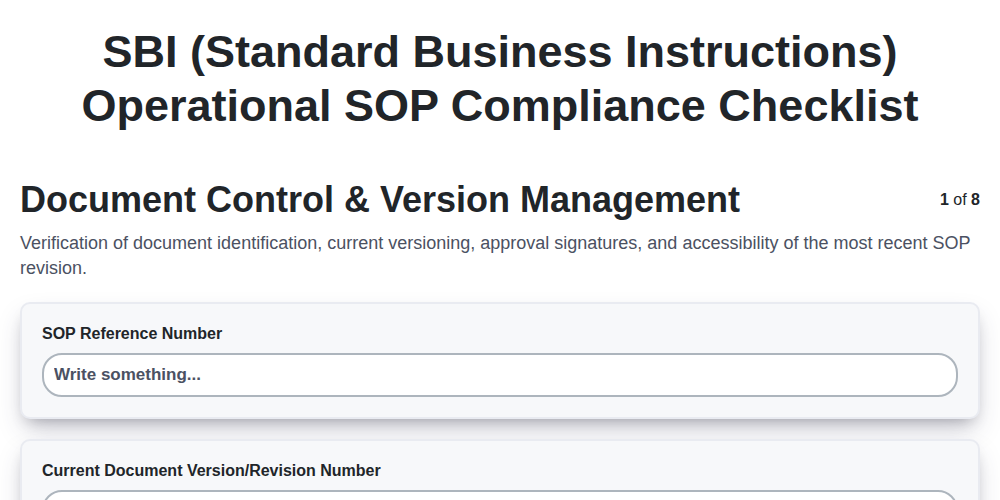
Table of Contents
- Introduction: Why SBI Compliance is the Backbone of Operational Excellence
- The Importance of Standard Business Instructions (SBI) in Scalable Growth
- Foundational Pillar 1: Document Control & Version Management
- Ensuring Accuracy: Training & Competency Verification
- The Core of Execution: Standard Operating Procedure (SOP) Adherence
- Operational Readiness: Resource & Equipment Management
- Optimizing the Workflow: Workplace Environment & Setup
- Safety First: Comprehensive Safety & Hazard Mitigation
- Maintaining Integrity: Data Logging & Documentation Accuracy
- Continuous Improvement: Incident Reporting & Deviation Management
- How to Implement This Checklist into Your Daily Operations
- Conclusion: Building a Culture of Compliance and Precision
- Resources & Links
TLDR: Ensure seamless operational consistency and risk mitigation with our comprehensive SBI compliance checklist. Learn how to audit your processes across eight critical pillars-from document control and training verification to safety management and incident reporting-to drive peak organizational performance.
Introduction: Why SBI Compliance is the Backbone of Operational Excellence
The Cost of Chaos vs. The Power of Precision
In the fast-paced landscape of modern industry, the difference between a seamless operation and a costly breakdown often lies in a single, overlooked detail. Whether you are managing a manufacturing plant, a high-tech laboratory, or a complex service center, the foundation of consistent quality is not just hard work-it is Standard Business Instructions (SBI) compliance.
When operations deviate from established protocols, the consequences ripple through the entire organization. You face more than just minor errors; you face increased safety risks, wasted resources, inconsistent product quality, and a fundamental erosion of stakeholder trust.
Bridging the Gap Between Strategy and Execution
An SOP (Standard Operating Procedure) is only as valuable as its consistent application. You can have the most sophisticated, high-level operational strategy in the world, but if your frontline execution lacks a standardized framework, that strategy will inevitably fail.
This is where SBI Compliance acts as your operational anchor. It transforms abstract guidelines into repeatable, measurable, and auditable actions. Achieving compliance means moving away from reactive firefighting and toward a culture of proactive precision.
Why a Checklist is Your Most Powerful Tool
Compliance is not a one-time event; it is a continuous state of readiness. A structured compliance checklist serves several critical functions:
- Standardization: It ensures that every shift, every operator, and every department follows the exact same gold standard.
- Risk Mitigation: It identifies gaps in safety or resource readiness before they escalate into incidents.
- Accountability: It provides a clear audit trail, making it easy to verify who performed which task and how it was executed.
- Continuous Improvement: By measuring adherence to SBIs, you gain the data necessary to identify bottlenecks and refine your processes.
In this guide, we will break down the essential components of an SBI Operational SOP Compliance Checklist, providing you with a blueprint to audit your processes, empower your workforce, and drive unparalleled operational excellence.
The Importance of Standard Business Instructions (SBI) in Scalable Growth
Why Consistency is the Engine of Scalable Growth
In the journey from a small startup to a market leader, the single greatest challenge is not just growing-it is growing without losing control. Many organizations hit a complexity ceiling where manual oversight is no longer possible, and even well-meaning employees begin to deviate from proven methods. This is where Standard Business Instructions (SBI) become your most valuable strategic asset.
Beyond Simple Instructions: The Power of SBI
While a Standard Operating Procedure (SOP) tells you what needs to be done, an SBI provides the granular, step-by-step tactical guidance on how it must be executed to ensure uniform quality. When these instructions are followed with precision, they transform individual talent into institutional intelligence.
Driving Predictability and Reducing Risk
The true value of an SBI compliance checklist lies in three core areas:
- Eliminating Operational Variance: Scaling requires copy-paste excellence. SBI compliance ensures that whether a task is performed in your headquarters or a remote branch, the output remains identical, protecting your brand reputation.
- Accelerating Onboarding: As you hire new talent, a robust SBI framework reduces the learning curve. Instead of relying on tribal knowledge-which often fades or becomes distorted-new team members have a single, authoritative source of truth to guide them.
- Mitigating Costly Errors: Inconsistency is expensive. Whether it is wasted raw materials, data entry errors, or safety lapses, deviations from the standard lead to direct bottom-line losses. A rigorous compliance checklist acts as an early warning system, catching deviations before they escalate into operational crises.
Ultimately, mastering SBI compliance is about moving from a culture of reactive firefighting to a culture of proactive precision. By implementing a standardized checklist, you aren't just enforcing rules; you are building a foundation for limitless, sustainable expansion.
Foundational Pillar 1: Document Control & Version Management
Ensuring a Single Source of Truth
In any high-performing organization, information decay is a silent killer of productivity. The foundation of any Standard Business Instruction (SBI) is not just the existence of a document, but the certainty that the version being used on the shop floor or in the office is the most current, approved, and accurate iteration.
Without rigorous document control, teams risk executing outdated protocols, which leads to inconsistent outputs, increased error rates, and significant safety risks.
The Essentials of Version Integrity
To achieve true operational excellence, your compliance checklist must verify that the following elements are strictly managed:
- Current Revision Verification: A formal check to ensure that the document ID and revision number match the master index held by the Quality or Compliance department.
- Obsolete Document Removal: A systematic process to ensure that all superseded versions are physically and digitally removed from circulation to prevent accidental use.
- Approval Traceability: Verification that the document bears the necessary electronic or physical signatures from authorized stakeholders (e.g., Department Heads or Quality Assurance).
- Accessibility and Readability: Ensuring that the latest version is not only available but is stored in a format and location that is easily accessible to all relevant personnel during active operations.
Why This Matters for Compliance
Mastering version management eliminates the guesswork from operations. When your team knows that every instruction they follow has been vetted and is the most recent update, you build a culture of precision. This pillar serves as the bedrock upon which all other operational steps-from training to safety-are built.
Ensuring Accuracy: Training & Competency Verification
Bridging the Gap Between Instruction and Execution
A Standard Operating Procedure (SOP) is only as effective as the person executing it. You can have the most meticulously documented processes in the world, but if your team lacks the necessary knowledge or hasn't been properly vetted on the latest updates, the entire operational chain is at risk of failure.
In the context of SBI compliance, Training & Competency Verification is the critical bridge between having a manual and knowing the task. It is the mechanism that ensures every team member possesses both the theoretical understanding and the practical skill required to perform their duties without error.
Key Components of the Verification Process
To ensure your checklist is truly driving compliance, focus on these three pillars:
- Onboarding & Curriculum Alignment: Verification begins long before the first task is performed. Every new hire must undergo a structured training program that aligns specifically with the current version of the SBI. This includes understanding not just the how, but the why behind specific safety and quality controls.
- Hands-On Competency Assessment: Reading a document is not proof of mastery. Effective compliance requires practical demonstrations. This involves shadowing periods followed by reverse shadowing, where a supervisor observes the employee performing the SOP in real-time to identify any-unconscious deviations or technical gaps.
- Periodic Re-Certification: Knowledge decay is a real operational threat. An effective checklist must include a schedule for refresher training, especially following any significant updates to the Document Control or changes in equipment technology.
The Audit Trail of Competency
From a compliance standpoint, if it wasn't documented, it didn't happen. Your verification process must produce a paper (or digital) trail that includes:
- Training Logs: Records of who was trained, on what date, and by which supervisor.
- Skill Matrices: A visual tool that tracks the proficiency levels of each team member across various SBI tasks.
- Assessment Results: Verifiable evidence of passed competency tests or practical evaluations.
By prioritizing this step in your SBI checklist, you transform your SOPs from passive documents into an active, high-performance culture of precision.
The Core of Execution: Standard Operating Procedure (SOP) Adherence
The Heart of Consistency: Ensuring True SOP Adherence
At the center of every Standard Business Instruction (SBI) lies a single, critical question: Are we actually doing what we documented?
You can have the most sophisticated, high-tech, and well-written manuals in the industry, but they are nothing more than paper tigers if the execution on the shop floor or in the office deviates from the written word. SOP adherence is the bridge between theoretical strategy and operational reality. When adherence fails, the entire foundation of quality control, safety, and scalability begins to crumble.
Moving Beyond Check-the-Box Compliance
True adherence is not simply about following steps in a vacuum; it is about maintaining the integrity of the entire operational ecosystem. To master compliance, organizations must move away from a culture of surface-level checking and toward a culture of rigorous precision.
To ensure your team is staying aligned with your SBIs, your checklist must focus on these three pillars of adherence:
1. Eliminating Procedural Drift
Over time, teams often develop workarounds-small, undocumented shortcuts taken to save time or bypass perceived inconveniences. This is known as procedural drift. A robust compliance checklist identifies these deviations immediately, ensuring that the tried and true method remains the only method.
2. Synchronizing Intent with Action
The goal of an SBI is to ensure a predictable outcome every single time. Adherence verification ensures that the intent behind a step (e.g., ensure the valve is tightly sealed) is being met with the correct action (e.g., verifying torque levels meet specification). We don't just check if a task was done; we check if it was done to the standard required.
3. Building a Feedback Loop
Adherence monitoring should not be a punitive process, but a diagnostic one. If a team is consistently deviating from an SOP, the checklist serves as an early warning system. It allows management to determine if the deviation is due to a lack of training, a flaw in the original instruction, or an environmental obstacle that needs to be addressed.
By focusing on strict adherence, you transform your SOPs from static documents into living, breathing engines of operational excellence.
Operational Readiness: Resource & Equipment Management
Ensuring Seamless Execution Through Resource & Equipment Readiness
In the realm of Standard Business Instructions (SBI), even the most perfectly documented procedure will fail if the necessary tools are missing or non-functional. Operational readiness is the bridge between a theoretical plan and successful execution. When we talk about Resource & Equipment Readiness, we are moving beyond the how-to and focusing on the what and where.
To maintain compliance and prevent costly downtime, your checklist must ensure that every physical and digital asset required for a task is accounted for and prepared before the process begins.
Critical Components of Resource Readiness
To achieve true operational excellence, your compliance audit should focus on three core pillars:
1. Inventory Availability and Accessibility Compliance begins with ensuring that all necessary raw materials, components, or software licenses are present.
- Verification Point: Are all required materials physically available at the workstation?
- Verification Point: Are consumable supplies (e.g., lubricants, packaging, or disposable tools) stocked to cover the entire duration of the shift?
2. Equipment Calibration and Functionality A procedure performed with uncalibrated or malfunctioning equipment is a violation of SBI standards. This step is critical for maintaining output quality and safety.
- Pre-use Inspection: Has the equipment been checked for visible wear, leaks, or mechanical irregularities?
- Calibration Status: Is there documented proof that all measuring and precision tools are within their valid calibration window?
- Power and Utility Check: Are all necessary utilities (compressed air, electricity, water, or network connectivity) stable and operational?
3. Tooling and Ancillary Asset Management Often, the small things are the greatest points of failure. This includes the specialized tools, templates, or digital interfaces used to execute the SOP.
- Completeness Check: Are all sub-tools (e.g., specialized wrenches, digital scanners, or specific software modules) present?
- Maintenance Integrity: Are all auxiliary tools in a clean, sanitized, or ready-to-use state according to the specific SOP requirements?
The Cost of Neglect
Failure to verify resource readiness leads to more than just delays; it triggers a domino effect of Deviation Management issues. When a resource is missing, operators are often forced to improvise-leading to unauthorized workarounds, safety hazards, and the eventual breakdown of the entire SBI framework. By integrating a rigorous equipment check into your compliance routine, you transform your operations from reactive firefighting to proactive precision.
Optimizing the Workflow: Workplace Environment & Setup
Creating the Foundation for Success
A standard operating procedure is only as effective as the environment in which it is executed. You can have the most detailed instructions in the world, but if the physical or digital workspace is disorganized, even the most seasoned professionals will struggle to maintain compliance. The Workplace Environment & Setup phase of the SBI checklist focuses on ensuring that the stage is set for seamless execution.
Eliminating Environmental Friction
Operational excellence requires minimizing distractions and removing physical barriers to productivity. When auditing your setup, consider the following elements:
- Station Ergonomics & Accessibility: Are all necessary tools, digital interfaces, and physical assets positioned within easy reach to prevent unnecessary movement or fatigue?
- Workspace Organization (5S Integration): Is the workspace free of clutter? A disorganized station is a breeding ground for errors and safety risks.
- Resource Availability: Are the specific materials, software licenses, or raw components required for the specific SBI task present and ready for use before the process begins?
Optimizing the Digital and Physical Interface
In modern operations, the workplace is often a hybrid of physical space and digital architecture. Compliance means ensuring that the digital environment mirrors the physical requirements:
- Digital Workspace Configuration: Are the necessary software applications, folder structures, and communication channels properly configured and accessible?
- Hardware Readiness: Are all peripherals-scanners, printers, tablets, or specialized machinery-calibrated and connected to the central network?
The Impact of Proper Setup on Compliance
Neglecting the setup phase leads to process drift, where employees begin improvising because the standard environment doesn't support the standard instruction. By rigorously verifying your workplace setup, you reduce the cognitive load on your team, allowing them to focus entirely on following the SOP precisely, thereby driving consistency and reducing the margin for human error.
Safety First: Comprehensive Safety & Hazard Mitigation
Prioritizing Protection: The Core of Safety & Hazard Mitigation
In the realm of Standard Business Instructions (SBI), safety is not merely a secondary consideration-it is the foundation upon which all operational efficiency is built. A single oversight in hazard mitigation can lead to catastrophic downtime, regulatory penalties, and, most importantly, compromised employee well-being.
When executing your compliance checklist, the Safety & Hazard Mitigation section requires a rigorous, proactive approach. It is not enough to simply check a box; you must actively verify that the environment is inherently safe for the task at hand.
Critical Verification Points
To ensure your operations remain compliant and your team remains protected, your checklist should focus on the following key areas:
- PPE Compliance Audit: Verify that all required Personal Protective Equipment (PPE) is not only present but in optimal working condition. This includes checking for expiration dates on filters, structural integrity of helmets, and the cleanliness of eye protection.
- Hazard Identification & Marking: Ensure that all potential trip hazards, chemical spills, or electrical risks are clearly identified, marked with appropriate signage, and cordoned off according to SBI protocols.
- Emergency Protocol Accessibility: Confirm that emergency exits, eyewash stations, fire extinguishers, and first aid kits are unobstructed and that their locations are clearly visible to all staff members on shift.
- Pre-Task Risk Assessment (PTRA): Validate that a dynamic risk assessment has been conducted for any high-risk maneuvers. Ensure that all team members are aware of the Stop Work Authority if they encounter an unidentified hazard.
- Lockout/Tagout (LOTO) Verification: For any maintenance or equipment-related tasks, ensure that energy isolation procedures are strictly followed and that all locks and tags are applied and documented.
Moving from Reactive to Proactive
The goal of integrating safety into your SBI checklist is to transition your culture from reactive (responding to accidents) to proactive (preventing them through systematic inspection). By treating safety mitigation as a non-negotiable component of your operational standard, you safeguard your most valuable asset: your people.
Maintaining Integrity: Data Logging & Documentation Accuracy
The Backbone of Audit-Readiness: Data Logging & Documentation Accuracy
In the world of Standard Business Instructions (SBI), a process is only as reliable as its paper trail. You can have the most efficient workflow in the world, but if you cannot prove that the steps were followed, you effectively have no process at all. Data logging and documentation accuracy serve as the single source of truth for your operations, providing the empirical evidence required for regulatory compliance, quality assurance, and continuous improvement.
Precision in Record-Keeping
Compliance fails when there is a gap between what happened on the floor and what is recorded in the logs. To maintain high operational integrity, your checklist must ensure that every entry is:
- Real-Time and Contemporaneous: Documentation should occur at the moment of the task completion to prevent memory-based errors or retrospective inaccuracies.
- Legible and Unambiguous: Whether digital or manual, records must be easily readable by auditors, supervisors, and team members.
- Complete: Every required field, timestamp, and signature must be accounted for. Missing data points are often treated as unperformed tasks during a compliance audit.
Eliminating the Guesswork Factor
Inaccurate documentation creates a ripple effect of risk. Incomplete logs can lead to failed audits, even if the physical work was performed perfectly. Furthermore, poor data integrity prevents leadership from making informed, data-driven decisions. When your logs are accurate, you gain the ability to track trends, identify recurring bottlenecks, and implement corrective actions with confidence.
Key Audit Verifications for this Step:
To ensure your team is meeting the standard, use these specific verification points within your checklist:
- Verification of Entry Integrity: Are all logs signed, dated, and time-stamped correctly?
- Error Correction Protocol: Is there a standardized method for correcting mistakes (e.g., a single line-through, initial, and date) to avoid the appearance of data tampering?
- Data Integrity Checks: Do the recorded metrics align with the observed physical outputs?
- Completeness Audit: Are there any ghost entries or blank cells that indicate skipped steps or neglected reporting?
Continuous Improvement: Incident Reporting & Deviation Management
The Safety Net for Operational Integrity
Even with the most robust Standard Business Instructions (SBI) in place, no process is entirely immune to unexpected variables. The true measure of an organization's operational maturity is not the absence of errors, but the efficiency and transparency with which it responds to them.
Within the scope of your compliance checklist, Incident Reporting & Deviation Management serves as your organization's fail-safe mechanism. This step ensures that when the gap between how we planned to work and how we actually worked emerges, it is documented, analyzed, and corrected.
Identifying and Capturing Deviations
A deviation is any departure from the established SOP. Whether it is a minor skip in a documentation step or a significant technical malfunction, every deviation must be captured in real-time. A compliant system requires:
- Immediate Reporting Protocols: A clear, non-punitive pathway for employees to report errors or process shifts as soon as they occur.
- Standardized Incident Logs: Uniform templates that capture the what, when, where, and who of the event to ensure data consistency.
From Reactive Response to Proactive Prevention
The goal of deviation management is not merely to fix the mistake, but to perform a root-cause analysis (RCA) that prevents recurrence. By treating every incident as a data point for improvement, you transform a potential failure into a strategic advantage.
Checklist Audit Points for Deviation Management:
To ensure your compliance checklist is functioning effectively, verify the following during your audits:
- Timeliness: Are incidents being logged within the required timeframe of discovery?
- Traceability: Can an incident report be linked back to a specific version of the SOP and a specific timestamp?
- Corrective and Preventive Actions (CAPA): Is there evidence that deviations resulted in tangible updates to the SBI or training programs?
- Closed-Loop Verification: Is there a documented process to confirm that the corrective action taken actually resolved the issue?
By integrating rigorous deviation management into your SBI framework, you move beyond simple compliance and enter the realm of continuous operational evolution.
How to Implement This Checklist into Your Daily Operations
Implementing a compliance checklist is not merely about ticking boxes; it is about fostering a culture of precision and accountability. To move from a static document to a living operational standard, follow these strategic steps:
1. Integration into Existing Workflows
A checklist should never feel like an extra task. To ensure high adoption rates, integrate the SBI checklist into your existing digital or physical workflows.
- Digital Integration: Embed the checklist within your Task Management Software (e.g., Asana, Jira, or Trello) so that compliance becomes a prerequisite for marking a task as complete.
- Point-of-Use Accessibility: For physical operations, place laminated versions of the checklist at the specific workstations where the SOP is executed.
2. The Verification, Not Just Inspection Approach
The biggest mistake organizations make is treating the checklist as a post-mortem activity.
- Real-Time Auditing: Shift from auditing at the end of the week to real-time verification. Supervisors should use the checklist to observe processes as they happen.
- Role-Based Responsibility: Assign specific sections of the checklist to different stakeholders. For example, the Floor Manager focuses on Resource & Equipment Readiness, while the Quality Assurance Lead focuses on Data Logging & Documentation Accuracy.
3. Establish a Closed-Loop Feedback System
A checklist is only as good as the data it generates. When a deviation is identified in the Incident Reporting & Deviation Management section, it must trigger a response.
- The Feedback Loop: When a No or Non-compliant is recorded, it should automatically trigger a root cause analysis (RCA).
- Iterative Updates: Use the insights gathered from failed checks to update your Document Control & Version Management. If a step is consistently missed, the SOP itself may need redesigning to be more intuitive.
4. Training and Continuous Calibration
Compliance fails when the why is lost.
- Contextual Training: Use the Training & Competency Verification section as a training tool. Show employees not just what to check, but the safety and operational risks involved if a check is missed.
- Regular Audits of the Auditor: Periodically review the completed checklists to ensure that compliance fatigue isn't setting in and that the checks are being performed with the required rigor.
Summary Table for Implementation
| Phase | Action Item | Goal |
|---|---|---|
| Deployment | Embed in daily digital workflows | Minimize friction and task abandonment |
| Monitoring | Conduct live, unannounced spot checks | Ensure real-time adherence to SOPs |
| Correction | Trigger RCA for every deviation found | Prevent recurrence of operational errors |
| Evolution | Update SOPs based on checklist trends | Continuous operational improvement |
Conclusion: Building a Culture of Compliance and Precision
The Path Forward: Beyond the Checklist
Implementing an SBI Operational SOP Compliance Checklist is not merely about ticking boxes or passing an audit; it is about fundamentally shifting your organizational mindset from reactive firefighting to proactive excellence. When you move from doing things our way to following the standardized way, you eliminate the costly variables that lead to errors, downtime, and safety risks.
Turning Compliance into a Competitive Advantage
A robust compliance framework provides more than just operational stability; it builds a foundation of trust.
- For your team: It provides clarity, reduces ambiguity, and empowers employees with the confidence that they have the right tools, training, and instructions to succeed.
- For your customers: It guarantees a consistent, high-quality output that honors the brand promise every single time.
- For your leadership: It provides the data-driven visibility needed to identify bottlenecks, mitigate risks before they escalate, and drive continuous improvement.
Continuous Improvement: The Final Step
Remember, a checklist is a living document. The strength of your SBI compliance lies in your willingness to revisit, refine, and evolve these steps. Use the insights gained from your Incident Reporting and Data Logging to update your Document Control, ensuring that your Standard always reflects your Best.
By integrating these eight critical pillars into your daily operations, you aren't just managing tasks-you are engineering a culture of precision, safety, and unparalleled operational excellence.
Resources & Links
- ISO (International Organization for Standardization): The global authority on standard operating procedures and quality management systems (ISO 9001) essential for SBI compliance.
- Six Sigma: Resources for learning continuous improvement methodologies like DMAIC to reduce deviations and enhance operational excellence.
- ASQ (American Society for Quality): Professional resources for quality auditing, document control, and establishing competency verification standards.
- Lean Enterprise Institute: Guides on optimizing workflows, reducing waste, and creating efficient workplace environments through Lean principles.
- SHRM (Society for Human Resource Management): Expertise in managing training, competency verification, and employee accountability within standardized processes.
- OSHA (Occupational Safety and Health Administration): Essential guidelines for the Safety and Hazard Mitigation section of your compliance checklist.
- NIST (National Institute of Standards and Technology): Technical frameworks for data integrity, documentation accuracy, and measurement standardization.
- McKinsey & Company: Insights into operational excellence, scaling businesses, and driving organizational transformation.
- Forbes Business Council: Articles on building a culture of precision and managing growth through scalable business instructions.
- ScienceDirect: Academic research on process management, incident reporting, and the mechanics of operational efficiency.
- Atlassian: Tools and methodologies for project management, version control, and documenting workflows.
- Asana: Work management software examples for implementing checklists into daily operational routines.
- Trello: Visualizing SOP adherence and tracking resource/equipment management using Kanban boards.
- MindTools: Management training resources for developing leadership skills to enforce compliance and accountability.
- Gartner: Research and insights on supply chain management and operational technology integration.
- Project Management Institute (PMI): Standardized frameworks for managing complex tasks, resources, and deviation management.
Comments
There are no comments yet. Be the first to add one!
Manufacturing Management Solution Demo
Stop chasing paperwork and wrestling with disconnected systems! Our solution brings clarity and control to your production process. From standard operating procedures (SOPs) and equipment maintenance to quality control and inventory tracking, we simplify every step.
Related Articles
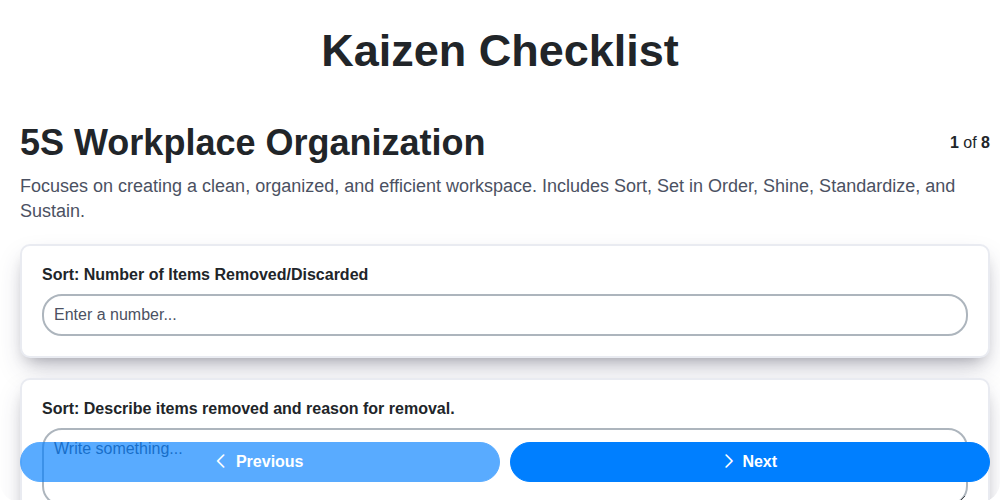
Kaizen Checklist Template: Your Path to Continuous Improvement

Machine Safety Audit Checklist: Your Guide to a Safer Manufacturing Workplace
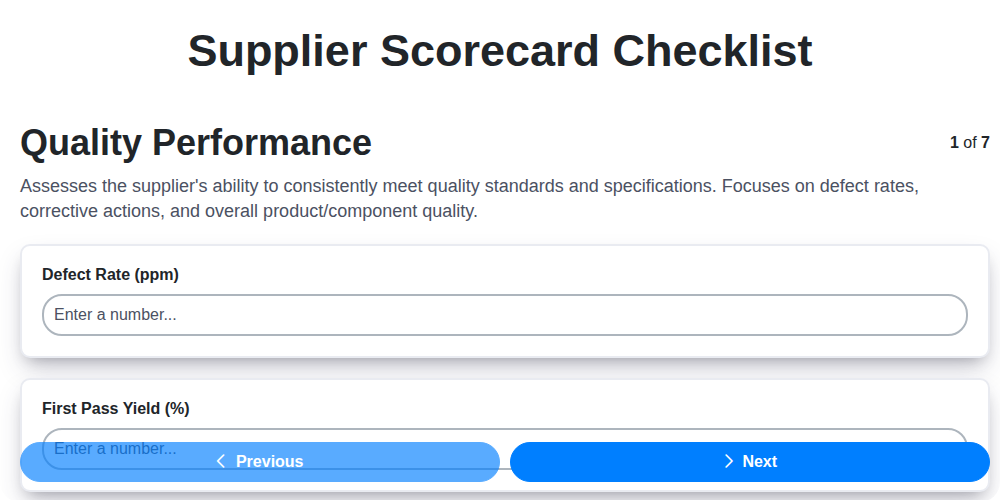
Mastering Supplier Performance: Your Free Supplier Scorecard Checklist Template
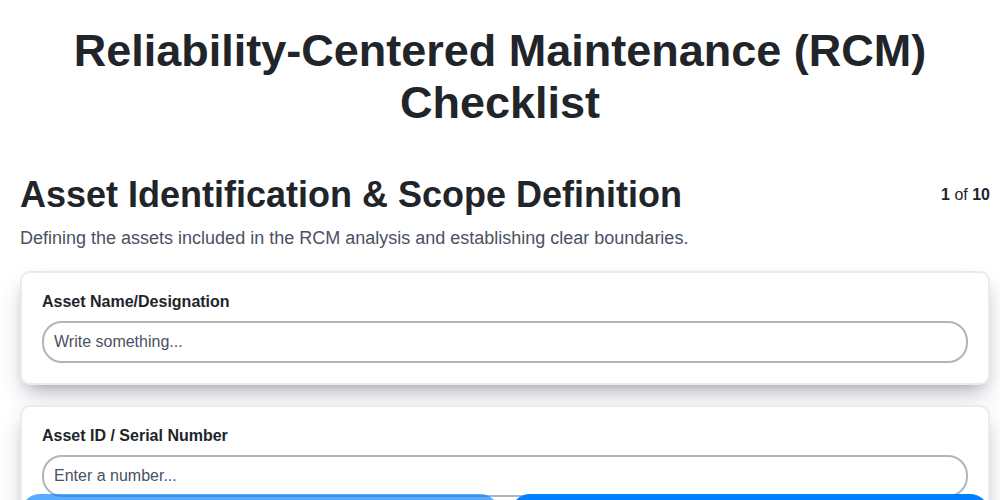
Your Ultimate RCM Checklist Template: A Step-by-Step Guide

LPA Checklist Template: Your Guide to Layered Process Audits

Your Ultimate Lockout/Tagout (LOTO) Checklist Template

Your Ultimate FSC 22000 Checklist Template
Quality Control Inspection Checklist Template: Prevent Defects & Improve Manufacturing Processes
Need help with
Manufacturing?
Have a question? We're here to help. Please submit your inquiry, and we'll respond promptly.