The 2026 Green Logistics Roadmap: A Comprehensive Supply Chain Sustainability & Compliance Checklist
Published: 10/31/2026 Updated: 11/01/2026
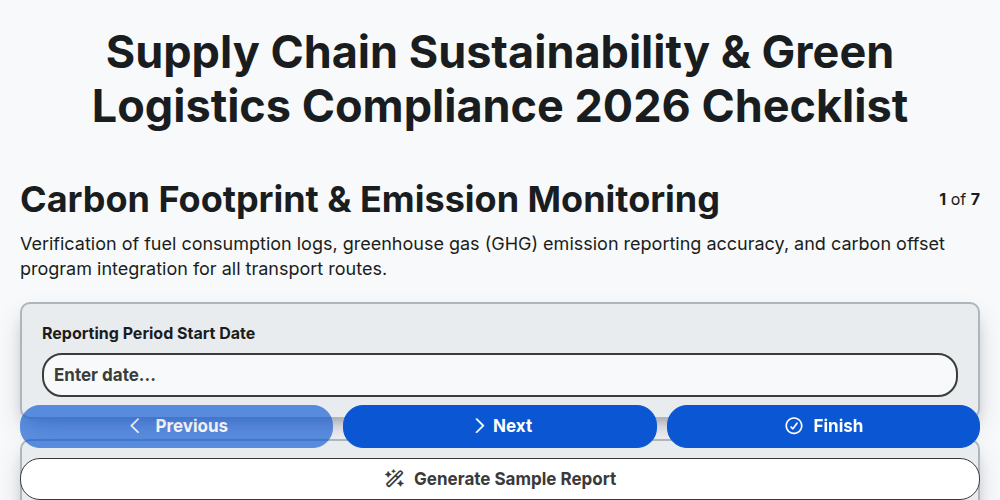
Table of Contents
- Introduction: Navigating the 2026 Sustainability Landscape
- 1. Carbon Footprint & Emission Monitoring: Measuring Your Impact
- 2. Sustainable Packaging & Material Management: Reducing the Plastic Footprint
- 3. Carrier & Vendor Sustainability Compliance: Auditing Your Extended Supply Chain
- 4. Energy Efficiency & Warehouse Green Operations: Decarbonizing the Hub
- 5. Route Optimization & Fuel Reduction Strategy: Smarter Miles, Lower Emissions
- 6. Waste Management & Circular Logistics: Embracing the Closed-Loop Economy
- 7. Regulatory Compliance & Environmental Reporting: Staying Ahead of 2026 Mandates
- Conclusion: Building a Resilient and Future-Proof Supply Chain
- Resources & Links
TLDR: As 2026 approaches, supply chain resilience depends on integrating sustainability into core operations. This checklist provides a strategic roadmap for navigating upcoming environmental regulations, focusing on carbon monitoring, sustainable packaging, vendor compliance, energy-efficient warehousing, and circular logistics to ensure your operations are both green and compliant.
Introduction: Navigating the 2026 Sustainability Landscape
Navigating the 2026 Sustainability Landscape
As we approach 2026, the concept of sustainability in supply chain management has transitioned from a corporate social responsibility (CSR) luxury to a fundamental operational requirement. The landscape of global logistics is undergoing a seismic shift, driven by a perfect storm of stringent new environmental regulations, heightened investor scrutiny, and a consumer base that demands radical transparency.
The era of voluntary green initiatives is closing. We are entering a period of mandatory compliance, where greenwashing is no longer a viable defense against legal and financial repercussions. For logistics leaders, the challenge is no longer just about optimizing for cost and speed, but about re-engineering the entire value chain to operate within the boundaries of a low-carbon economy.
The Shift from Reactive to Proactive Compliance
By 2026, the complexity of global reporting standards-such as the expansion of the CSRD (Corporate Sustainability Reporting Directive) and evolving carbon border adjustment mechanisms-means that every node in your supply chain must be digitally traceable and environmentally accountable. A single carbon-heavy link in your logistics chain can now compromise the sustainability ratings of your entire brand.
Why a Checklist is Your Most Vital Strategic Asset
Navigating this transition requires more than just high-level goals; it requires a granular, actionable framework. To remain competitive and compliant, companies must move beyond broad promises and implement specific, measurable strategies across every operational layer-from the energy consumption of a single warehouse to the fuel efficiency of the last-mile delivery vehicle.
The following checklist is designed to serve as your strategic roadmap. It is not merely a list of nice-to-haves, but a rigorous audit of the essential pillars required to future-proof your operations, mitigate regulatory risk, and lead the transition toward a circular, carbon-neutral logistics ecosystem.
1. Carbon Footprint & Emission Monitoring: Measuring Your Impact
The Foundation of Accountability: Tracking Every Gram of CO2
As we approach 2026, guessing your environmental impact is no longer an option. With tightening global regulations and the rise of science-based targets, the ability to precisely measure, track, and report carbon emissions has moved from a corporate social responsibility (CSR) luxury to a core operational requirement.
Establishing a Real-Time Carbon Baseline
To manage what you cannot measure is impossible. The first step in your 2026 roadmap is the implementation of robust monitoring systems that move beyond annual estimates toward real-time visibility. This involves:
- Scope 1, 2, and 3 Integration: Moving beyond simple energy usage (Scope 2) and direct fleet emissions (Scope 1) to tackle the much more complex Scope 3 emissions-those occurring in your upstream supply chain and downstream distribution.
- IoT and Sensor Integration: Utilizing telematics and IoT devices within your fleet and warehouse facilities to capture granular data on fuel consumption and energy spikes as they happen.
- Digital Twin Technology: Leveraging digital replicas of your supply chain to simulate how changes in logistics patterns will affect your total carbon output before they are implemented in the real world.
From Reactive Reporting to Predictive Analytics
In 2026, monitoring should not just be a retrospective look at last year's failures; it must be a predictive tool for future success.
Key Performance Indicators (KPIs) to Monitor:
- Carbon Intensity per Unit: Measuring the CO2e emitted per pallet, per container, or per order delivered.
- Emissions Variance: Tracking the gap between your projected emission targets and actual operational output.
- Emission Hotspot Identification: Pinpointing specific nodes in your network-whether a particular shipping lane or a specific regional hub-that are disproportionately contributing to your carbon footprint.
By establishing a high-fidelity monitoring framework, you turn carbon data into a strategic asset, allowing your organization to make data-driven decisions that balance operational efficiency with environmental stewardship.
2. Sustainable Packaging & Material Management: Reducing the Plastic Footprint
Beyond the Box: Redefining Packaging for a Circular Economy
As we approach 2026, sustainable packaging has evolved from a marketing buzzword into a core operational requirement. With stricter global regulations regarding single-use plastics and extended producer responsibility (EPR), your packaging strategy must transition from a linear use-and-dispose model to a circular, regenerative approach.
Transitioning to Bio-based and Recyclable Materials
The primary objective for 2026 is the elimination of non-recyclable polymers. To ensure compliance and sustainability, your checklist should prioritize:
- Biodegradable & Compostable Alternatives: Implementing mushroom-based packaging, seaweed derivatives, or cornstarch-based films for protective layers.
- Mono-material Construction: Moving away from multi-layer laminates (which are notoriously difficult to recycle) toward single-material structures that can be easily processed by existing recycling infrastructure.
- Post-Consumer Recycled (PCR) Content: Increasing the percentage of PCR content in corrugated boxes and shipping mailers to reduce the demand for virgin pulp.
Dimensional Weight Optimization & Right-Sizing
Sustainability in packaging isn't just about the material; it is about the volume of air being shipped. Over-sized packaging leads to empty space transit, which inflates carbon emissions per unit.
- Automated Right-Sizing Technology: Utilizing 3D scanning technology to create custom-fit packaging for every order, significantly reducing the need for void fillers.
- Void Fill Minimization: Phasing out expanded polystyrene (EPS) and plastic bubble wrap in favor of paper-based honeycomb structures or recycled paper padding.
The Rise of Reusable Packaging Systems
The most sustainable package is the one that is never thrown away. Forward-thinking supply chains are now integrating Returnable Transit Packaging (RTP) into their logistics loops.
- Closed-Loop Systems: Implementing durable, collapsible, and trackable shipping containers for B2-B or B2C high-value goods.
- Reverse Logistics Integration: Designing packaging that is easy for the end-consumer to return via existing postal networks, ensuring the lifecycle of the material is extended across multiple use cycles.
Compliance Audit Trail
By 2026, simply claiming a package is eco-friendly will be insufficient. Your management strategy must include verifiable data points:
- Material Traceability: Documenting the origin and end-of-life instructions for all packaging components.
- Plastic Tax Preparedness: Ensuring all packaging components comply with upcoming regional plastic levies and packaging waste directives.
3. Carrier & Vendor Sustainability Compliance: Auditing Your Extended Supply Chain
Strengthening the Links in Your Network
As we approach 2026, the scope of sustainability accountability has expanded far beyond your own warehouse walls. The Green mandate now extends to every node in your supply chain. For modern logistics leaders, compliance is no longer just about your internal processes; it is about the environmental integrity of your entire vendor ecosystem.
To achieve true compliance, you must move from passive observation to active auditing of your third-party partners.
Establishing the Green Code of Conduct
The first step in vendor compliance is formalizing your expectations. You cannot hold partners accountable to standards that have not been explicitly communicated.
- Standardized Sustainability Clauses: Integrate specific environmental KPIs into all new and renewing Service Level Agreements (SLAs).
- Minimum Thresholds: Define non-negotiable requirements regarding carbon reporting, idling policies, and prohibited materials.
The Vendor Audit Framework
A checklist for 2026 must include a multi-tiered auditing approach to ensure your upstream and downstream partners are not creating hidden emissions or compliance risks.
- Tier 1: Data Transparency & Reporting Require vendors to provide standardized emissions data (Scope 3 emissions integration). If a carrier cannot provide verifiable data regarding their fleet's fuel efficiency or carbon output, they represent a significant regulatory risk to your reporting accuracy.
- Tier 2: Operational Verification Move beyond self-reported surveys. Conduct periodic audits (either via third-party agencies or digital monitoring) to verify that vendors are adhering to promised green practices, such as the use of electric vehicles (EVs) or renewable energy in their distribution centers.
- Tier 3: Risk Assessment of Sub-Contractors The cascade effect is a major compliance hurdle. Ensure your primary carriers have visibility into their own sub-contractors. A failure in a sub-contractor's environmental compliance is legally and reputationally your failure.
Incentivizing the Transition
Compliance does not have to be purely punitive. The most resilient 2026 supply chains will utilize Preferred Provider Programs. By offering longer contract terms, higher volumes, or faster payment cycles to vendors who meet or exceed your sustainability benchmarks, you transform compliance from a regulatory burden into a competitive advantage for your partners.
4. Energy Efficiency & Warehouse Green Operations: Decarbonizing the Hub
Optimizing the Core of Your Distribution Network
As the nodes of the supply chain, warehouses and distribution centers are no longer just storage spaces; they are critical battlegrounds for carbon reduction. By 2026, achieving sustainability compliance requires moving beyond simple recycling programs toward a fully integrated, energy-intelligent operational model.
Transitioning to Smart, Low-Carbon Warehousing
To meet upcoming environmental benchmarks, focus on these three pillars of warehouse decarbonization:
- Renewable Energy Integration: The shift from grid-dependence to self-sufficiency is paramount. This includes the deployment of-on-site solar PV arrays, wind energy partnerships, and the integration of-battery energy storage systems (BESS) to manage peak loads and ensure 24/7 green energy availability.
- The Electrification of Material Handling Equipment (MHE): Transitioning from internal combustion engine (ICE) forklifts to electric-powered alternatives is no longer optional. For 2026 compliance, focus on high-efficiency Lithium-ion fleets and automated, energy-regenerative technologies that recapture energy during braking and lifting cycles.
- Smart Building Automation & IoT: Implementing AI-driven Building Management Systems (BMS) allows for real-time monitoring of lighting, HVAC, and temperature controls. Utilizing motion-sensor LED lighting and automated climate control in dark warehouse zones can reduce facility energy consumption by up to 30%.
Implementing Zero-Emission Thermal Management
Temperature-controlled logistics (Cold Chain) remains one of the highest energy consumers in the supply chain. To future-proof your operations, consider:
- High-Performance Insulation: Upgrading facility envelopes to reduce thermal leakage.
- Phase Change Materials (PCMs): Utilizing advanced materials to maintain stable temperatures with minimal mechanical refrigeration.
- Predictive Cooling: Using predictive analytics to adjust cooling intensity based on real-time weather data and inventory turnover rates, preventing energy waste during low-activity periods.
By treating the warehouse as an active participant in the energy ecosystem rather than a passive consumer, companies can significantly lower their Scope 2 emissions and drive the global transition toward a net-zero logistics landscape.
5. Route Optimization & Fuel Reduction Strategy: Smarter Miles, Lower Emissions
Maximizing Efficiency Through Intelligent Logistics
In 2026, route optimization has evolved from a simple cost-saving measure to a critical pillar of environmental stewardship. The goal is no longer just about finding the fastest route, but the greenest one-minimizing the carbon intensity of every mile traveled.
The Shift from Distance to Density
Traditional logistics focused heavily on minimizing distance. However, a modern green strategy prioritizes load density and trip frequency. By leveraging advanced AI-driven routing engines, companies can now move beyond simple GPS navigation to achieve:
- Dynamic Rerouting: Real-time adjustments to avoid traffic congestion and idling periods, which are massive contributors to unnecessary fuel combustion.
- Backhaul Optimization: Eliminating empty miles by ensuring that vehicles returning from deliveries are utilized for pickups or repositioning, effectively doubling the utility of every liter of fuel consumed.
- Load Consolidation: Utilizing predictive analytics to aggregate smaller, frequent shipments into larger, consolidated movements, reducing the total number of vehicles on the road.
Strategic Fuel Reduction Tactics
Reducing fuel consumption is the most direct way to impact your Scope 1 and Scope 3 emissions. To remain compliant with 2026 environmental standards, your roadmap should include:
- Alternative Fuel Integration: Planning routes that specifically accommodate the infrastructure requirements of EV (Electric Vehicle) fleets, such as strategic proximity to high-speed charging hubs or hydrogen refueling stations.
- Telematics & Driver Behavior Monitoring: Implementing real-time data feeds to monitor aggressive acceleration, excessive idling, and suboptimal braking patterns, all of which significantly degrade fuel efficiency.
- Micro-fulfillment and Last-Mile Density: Utilizing urban micro-hubs to shorten the final leg of the delivery process, allowing for the deployment of zero-emission cargo bikes or small-scale electric vans in high-density areas.
The Bottom Line
Every kilometer saved is a victory for both the balance sheet and the planet. By transitioning from reactive routing to proactive, intelligence-led optimization, logistics leaders can transform their transport networks from carbon-heavy liabilities into streamlined, sustainable assets.
6. Waste Management & Circular Logistics: Embracing the Closed-Loop Economy
Moving Beyond Disposal: The Circular Imperative
By 2026, the transition from a take-make-dispose model to a circular economy will no longer be a competitive advantage-it will be a baseline requirement for market entry. As global regulations tighten around product lifecycles, the focus of logistics is shifting from simply moving goods to managing the entire lifecycle of materials.
Transitioning to Closed-Loop Systems
The core of circular logistics lies in designing supply chains that prioritize the continuous reuse, refurbishment, and recycling of resources. This requires a strategic overhaul of how products enter and exit your ecosystem.
- Reverse Logistics Optimization: Developing robust processes for returns, repairs, and re-manufacturing. Efficient reverse logistics ensures that returned goods are recaptured for value rather than being diverted to landfills.
- Asset Recovery Programs: Implementing systems to reclaim high-value components and materials from end-of-life products, reducing the need for virgin resource extraction.
- Closed-Loop Packaging Systems: Moving toward reusable transit packaging (RTP) and standardized containers that can circulate through the supply chain multiple times, significantly reducing single-use waste.
Strategies for Waste Minimization
To achieve true sustainability, your logistics operations must focus on the elimination of waste at the source.
- Zero-Waste-to-Landfill Initiatives: Setting measurable targets to divert all operational waste-from warehouse dunnage to broken pallets-into recycling or composting streams.
- Resource Decoupling: Leveraging data to ensure that business growth is no longer tethered to increased waste production. This involves using predictive analytics to prevent overstocking and obsolescence.
- Collaborative Recycling Ecosystems: Partnering with specialized waste management firms to ensure that waste is treated as a secondary raw material, reintegrating it back into the production loop.
The Compliance Connection
As we approach 2026, regulatory bodies are increasing scrutiny on extended producer responsibility (EPR). Companies must be prepared to provide transparent documentation regarding the end-of-life fate of their products. Implementing a circular approach is the most effective way to mitigate the legal and financial risks associated with emerging global waste directives.
7. Regulatory Compliance & Environmental Reporting: Staying Ahead of 2026 Mandates
Navigating the New Era of Transparency
As we approach 2026, the era of voluntary sustainability is officially over. Regulatory bodies worldwide-from the EU's Corporate Sustainability Reporting Directive (CSRD) to evolving SEC climate disclosure rules in the US-have shifted the landscape from optional CSR reports to mandatory, audited environmental disclosures. Compliance is no longer just about being green; it is about being audit-ready.
To ensure your organization remains compliant and avoids significant legal and financial penalties, your 2026 strategy must focus on two critical pillars: traceable data and standardized reporting.
The Shift from Estimates to Real-Time Verifiability
The biggest challenge for 2026 is the elimination of greenwashing through rigorous data validation. Regulators are moving away from accepting industry-average estimates. Instead, they are demanding primary data.
- Scope 3 Granularity: You can no longer rely on vague approximations for your upstream and downstream emissions. Compliance now requires granular data from your entire value chain, necessitating deep integration with vendor reporting systems.
- Audit-Ready Documentation: Environmental data must now carry the same level of rigor as financial data. This means implementing digitalized, immutable logs of fuel consumption, energy usage, and waste metrics that can withstand third-party verification.
Key Compliance Action Items for 2026
1. Harmonized Reporting Frameworks
Ensure your reporting aligns with global standards such as the GRI (Global Reporting Initiative) and ESRS (European Sustainability Reporting Standards). Discrepancies in how you report carbon intensity versus total emissions can lead to regulatory scrutiny and loss of investor confidence.
2. Digitalizing the Paper Trail
Manual spreadsheets are the greatest risk to your compliance posture. Transition toward Automated Environmental Management Systems (EMS) that can:
- Capture real-time emissions data from telematics.
- Integrate directly with ERP systems to track material lifecycles.
- Generate standardized reports for different regional regulatory bodies automatically.
3. Preparing for Carbon Border Adjustments
With the expansion of mechanisms like the CBAM (Carbon Border Adjustment Mechanism), compliance now involves tracking the embedded emissions of goods entering specific jurisdictions. Your reporting must be able to prove the carbon intensity of imported components to avoid unexpected carbon tariffs at the border.
4. Proactive Stakeholder Communication
Compliance is your opportunity to build brand equity. Use your verified reports to communicate transparently with investors, customers, and regulators. A robust compliance framework doesn't just mitigate risk-it serves as a competitive advantage in a market that increasingly rewards transparency and environmental accountability.
Conclusion: Building a Resilient and Future-Proof Supply Chain
Navigating the Transition to 2026
The shift toward green logistics is no longer a discretionary nice-to-have for corporate social responsibility reports; it has become a fundamental requirement for operational survival. As we approach 2026, the landscape of global trade is being reshaped by stringent carbon taxes, stricter environmental regulations, and a consumer base that demands radical transparency.
The checklist provided above is more than just a compliance guide-it is a strategic blueprint for long-term resilience. By systematically addressing everything from carbon footprint monitoring to circular waste management, your organization can mitigate the risks of regulatory penalties and resource scarcity.
Turning Compliance into Competitive Advantage
While the initial investment in sustainable packaging, energy-efficient warehousing, and route optimization may seem significant, the long-term dividends are undeniable:
- Cost Reduction: Efficient route optimization and energy-saving operations directly lower fuel and utility expenditures.
- Brand Loyalty: Demonstrating measurable progress in sustainable material management builds trust with eco-conscious partners and end-consumers.
- Risk Mitigation: Proactive alignment with evolving environmental reporting standards protects your supply chain from sudden legislative disruptions.
Final Thoughts for Supply Chain Leaders
The road to 2026 requires a transition from reactive compliance to proactive innovation. Success will not come from checking boxes in isolation, but from integrating these seven pillars into the very fabric of your logistics DNA. Start by auditing your current carbon footprint and vendor compliance today, so that by 2026, your supply chain is not just compliant, but a leader in the global green economy.
Resources & Links
- U.S. Environmental Protection Agency (EPA): Essential for understanding federal emissions standards, waste management regulations, and greenhouse gas reporting protocols.
- GS1 Global: The global standard for supply chain visibility, crucial for tracking packaging materials and product lifecycles.
- Supply Chain Management Review: In-depth industry analysis and case studies on logistics innovation and sustainable supply chain strategies.
- European Environment Agency: Key resource for understanding the EU's stringent environmental mandates and carbon border adjustment mechanisms (CBAM).
- Science Based Targets initiative (SBTi): The gold standard for companies looking to align their decarbonization roadmaps with the Paris Agreement goals.
- Mordor Intelligence: Market research and trends regarding the growth of green logistics and electric vehicle integration in supply chains.
- Gartner Supply Chain: Strategic insights and frameworks for managing vendor compliance and digital transformation in logistics.
- World Business Council for Sustainable Development: A global organization focused on engaging business leaders to accelerate the transition to a sustainable world.
- ISO (International Organization for Standardization): Access to ISO 14001 (Environmental Management) and ISO 14064 (Greenhouse Gas Accounting) standards.
- United Nations Environment Programme: Global perspectives on the circular economy and the impact of industrial waste on planetary health.
- Supply Chain Brain: News and updates on technological advancements in route optimization and warehouse automation.
- McKinsey & Company - Sustainability Practice: High-level strategic consulting resources on decarbonizing global value chains and operational efficiency.
- Carbon Trust: Specialists in helping organizations reduce emissions through carbon footprinting and energy efficiency audits.
- Ellen MacArthur Foundation: The leading authority on the circular economy and redesigning logistics for closed-loop systems.
- Reuters Sustainability: Real-time news on global regulatory shifts, ESG reporting mandates, and environmental policy changes.
- World Resources Institute (WRI): Research-driven insights into managing climate risk and resource efficiency in global trade.
Comments
There are no comments yet. Be the first to add one!
Logistics Management Solution Demo
Tired of shipping delays, lost packages, and inefficient routes? ChecklistGuro's Work OS platform streamlines your entire logistics operation, from warehouse management and order fulfillment to route optimization and delivery tracking. Gain real-time visibility, reduce costs, and improve customer satisfaction. Learn how ChecklistGuro can transform your logistics business!
Related Articles
The Ultimate Refrigerated Cargo Temperature Control Checklist Template
Mastering Your Fleet: A Vehicle Maintenance Log Review Template
Master Your Returns: The Ultimate Returns Processing Efficiency Audit Checklist
Data Privacy Policy Compliance: Your Essential Checklist Template
Delivery Confirmation Audit: Your Checklist Template for Process Excellence
Your Pallet Inspection & Maintenance Checklist Template
Fuel Efficiency Monitoring: Your Checklist Template for Savings
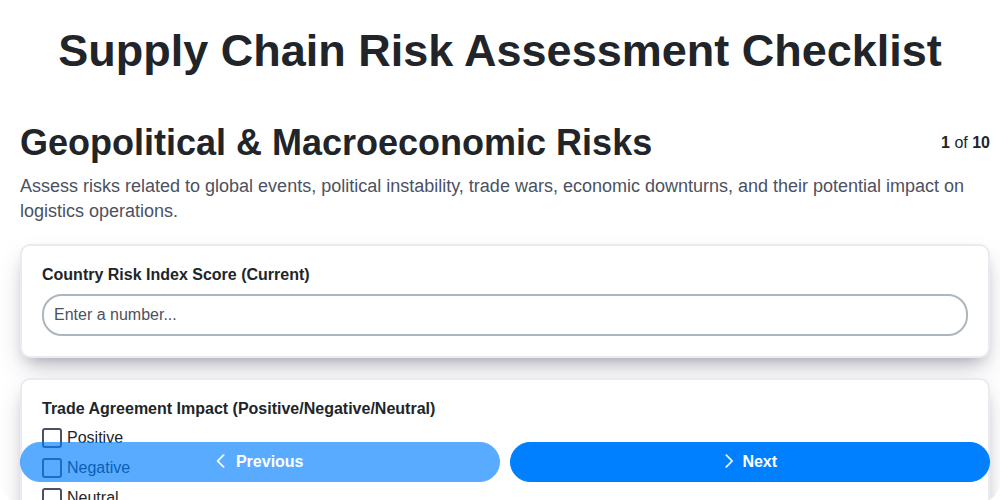
Supply Chain Risk Assessment: Your Essential Checklist Template
Need help with
Logistics?
Have a question? We're here to help. Please submit your inquiry, and we'll respond promptly.