The 10 Best Supply Chain Management (SCM) Software of 2025
Published: 12/21/2025 Updated: 12/22/2025
Table of Contents
- Introduction: The Evolving Landscape of Supply Chain Management
- What is Supply Chain Management (SCM) Software?
- Key Features to Look for in SCM Software
- 1. <a href="https://www.netsuite.com/portal/products/erp/supply-chain-management.shtml" target="_blank">Oracle NetSuite SCM</a>
- 2. <a href="https://www.sap.com/products/acquired-brands/what-is-ariba.html" target="_blank">SAP Ariba</a>
- 3. <a href="https://blueyonder.com/en/" target="_blank">Blue Yonder</a>
- 4. <a href="https://www.kinaxis.com/en/solutions/platform" target="_blank">Kinaxis RapidResponse</a>
- 5. <a href="https://www.manh.com/solutions/supply-chain-management-software" target="_blank">Manhattan Associates</a>
- 6. <a href="https://www.infor.com/solutions/scm" target="_blank">Infor SCM</a>
- 7. <a href="https://www.microsoft.com/en-us/dynamics-365/products/supply-chain-management" target="_blank">Microsoft Dynamics 365</a>
- 8. <a href="https://www.odoo.com/app/inventory" target="_blank">Odoo Inventory</a>
- 9. <a href="https://www.fishbowlinventory.com/" target="_blank">Fishbowl Inventory</a>
- 10. <a href="https://www.zoho.com/inventory/" target="_blank">Zoho Inventory</a>
- 11. <a href="https://checklistguro.com/solutions/scm" target="_blank">ChecklistGuro</a>: BPM for Supply Chain Visibility & Control
- Choosing the Right SCM Software for Your Business
- The Future of SCM Software: Trends to Watch
- Resources & Links
TLDR: Overwhelmed by supply chain complexity? This guide breaks down the 10 top SCM software solutions for 2025, highlighting key features for inventory management, logistics, forecasting, and more. We'll help you find the perfect fit to streamline your operations, reduce costs, and boost efficiency - no matter your business size or industry. Plus, learn how these checklists (built into or compatible with the software) will keep you on track and ensure seamless execution of each process.
Introduction: The Evolving Landscape of Supply Chain Management
The modern supply chain is no longer a linear process; it's a complex, interconnected web of suppliers, manufacturers, distributors, retailers, and increasingly, customers. Globalization, e-commerce boom, and unforeseen disruptions like the recent pandemic have dramatically reshaped how businesses operate and manage their supply chains. Traditional methods simply can't keep pace with the demands for speed, agility, and visibility.
Businesses are now prioritizing resilience - the ability to withstand and recover from unexpected events - and sustainability, incorporating ethical sourcing and environmentally conscious practices. This shift requires more than just efficient logistics; it demands a holistic, data-driven approach. Technology plays a crucial role in this transformation, empowering businesses to anticipate trends, optimize operations, and build more responsive and customer-centric supply chains. The software solutions we'll explore in this guide are designed to meet these evolving needs and help businesses not just survive, but thrive in the dynamic landscape of 2025 and beyond.
What is Supply Chain Management (SCM) Software?
Supply Chain Management (SCM) software is more than just a digital upgrade to spreadsheets and phone calls. It's a comprehensive suite of tools designed to manage and optimize every step of your product's journey - from raw materials sourcing to the final delivery to the customer's hands. Think of it as the central nervous system for your entire supply chain.
Traditionally, businesses managed supply chain functions in silos - procurement, warehousing, transportation, and distribution often operated independently. SCM software breaks down these silos, providing a unified view and enabling collaboration across departments and even with external partners like suppliers and distributors.
Here's a breakdown of what SCM software typically encompasses:
- Demand Forecasting: Predicting future demand to optimize inventory levels and avoid stockouts or overstocking.
- Inventory Management: Tracking inventory levels, locations, and movement, minimizing waste and maximizing efficiency.
- Procurement: Automating and streamlining the sourcing and purchasing of raw materials and components.
- Warehouse Management: Optimizing warehouse operations, including receiving, storage, picking, packing, and shipping.
- Transportation Management: Planning, executing, and optimizing the movement of goods, reducing transportation costs and improving delivery times.
- Supplier Relationship Management (SRM): Managing relationships with suppliers, improving communication, and ensuring timely delivery of materials.
- Order Management: Processing customer orders, tracking order status, and managing returns.
- Analytics and Reporting: Providing insights into supply chain performance, identifying areas for improvement, and making data-driven decisions.
Modern SCM software often incorporates technologies like Artificial Intelligence (AI), Machine Learning (ML), and the Internet of Things (IoT) to further enhance efficiency and visibility.
Key Features to Look for in SCM Software
When evaluating SCM software, it's easy to get bogged down in jargon and complex features. However, focusing on core functionalities will ensure you select a solution that genuinely addresses your business needs. Here's a breakdown of the key features you should prioritize in 2025:
- Inventory Management: Robust inventory tracking is paramount. Look for features like real-time visibility, automated reordering, lot tracking, and expiration date management. Demand forecasting integration is a huge plus.
- Warehouse Management (WMS): Efficient warehouse operations are critical. This includes features for receiving, putaway, picking, packing, and shipping. Consider features like barcode scanning, task management, and location optimization.
- Transportation Management (TMS): Optimizing logistics and reducing shipping costs is essential. Look for route optimization, carrier selection, shipment tracking, and freight auditing capabilities.
- Demand Forecasting: Accurate demand predictions minimize stockouts and overstocking. AI-powered forecasting features are becoming increasingly important.
- Supplier Relationship Management (SRM): Managing your supplier network effectively is crucial. Look for features like supplier portals, performance tracking, and contract management.
- Order Management: A centralized order management system ensures accurate processing and timely fulfillment.
- Collaboration Tools: Seamless communication and data sharing between departments and partners are vital.
- Reporting & Analytics: Comprehensive reporting provides insights into supply chain performance, allowing for data-driven decision-making. Look for customizable dashboards and real-time data visualization.
- Risk Management: Supply chain disruptions are a constant threat. Look for features that help you identify and mitigate risks, such as supplier diversification and alternative sourcing options.
- Integration Capabilities: The software should seamlessly integrate with your existing ERP, CRM, and other business systems. APIs and pre-built integrations are a big advantage.
1. Oracle NetSuite SCM
NetSuite SCM consistently ranks among the leaders, and for good reason. It's a comprehensive, cloud-based ERP solution with a robust supply chain management module designed for mid-sized to large enterprises. What truly sets NetSuite apart is its unified platform approach. You're not just getting SCM; you're getting finance, CRM, and e-commerce all integrated.
Key Strengths for 2025:
- Advanced Forecasting: NetSuite's demand planning capabilities leverage machine learning to predict future demand with greater accuracy, minimizing stockouts and overstocking. Expect enhanced algorithms and more granular data analysis.
- Omnichannel Inventory Management: The ability to manage inventory across various channels - online stores, brick-and-mortar locations, and marketplaces - will be crucial, and NetSuite excels here. Look for even tighter integration with emerging e-commerce platforms.
- Supplier Collaboration Portal: Enhanced real-time visibility for suppliers allows for improved communication and streamlined workflows. 2025 will see a greater emphasis on collaborative planning, forecasting, and replenishment.
- Blockchain Integration: While still in its early stages, NetSuite is exploring blockchain for supply chain transparency and traceability - a feature likely to become more prominent in 2025.
- AI-Powered Automation: Expect expanded automation capabilities throughout the SCM module, from order fulfillment to shipping processes.
Potential Drawbacks:
- Cost: NetSuite is a premium solution and can be expensive, particularly for smaller businesses.
- Complexity: The breadth of functionality can be overwhelming, requiring a significant investment in training and implementation.
- Customization: While customizable, extensive modifications can be costly and time-consuming.
Checklist Integration: NetSuite's Workflows and saved searches allow for the creation of custom checklists to ensure compliance with specific supply chain processes, quality control measures, and regulatory requirements. We're seeing a move towards more dynamic checklists within NetSuite, triggered by specific events and data points.
2. SAP Ariba
SAP Ariba stands as a titan in the SCM landscape, particularly renowned for its robust supplier management capabilities. In 2025, it continues to evolve, focusing on AI-powered insights and enhanced user experience. It's more than just procurement; Ariba offers a comprehensive suite encompassing sourcing, contract management, supplier collaboration, direct and indirect material procurement, and even financial supply chain solutions.
Key Strengths in 2025:
- AI-Driven Supplier Discovery: Ariba leverages AI to identify and onboard new, qualified suppliers, broadening your sourcing options and potentially lowering costs.
- Dynamic Discounting: Automated negotiation tools help you secure the best possible pricing and payment terms.
- Real-Time Visibility: Gain complete transparency into your supply chain, from order placement to delivery.
- Enhanced Collaboration: Improved communication and collaboration tools for seamless interaction with suppliers.
- Sustainability Focus: Ariba's 2025 updates heavily emphasize supplier sustainability assessment and compliance, allowing you to build a more ethical and responsible supply chain.
Who is it for? Ariba is best suited for large enterprises with complex supply chains and significant procurement volumes. Its implementation can be complex and requires a dedicated team, but the potential ROI is substantial. The 2025 updates aim to make it more accessible to mid-sized businesses as well, with modular deployment options available. Be prepared for a potentially lengthy implementation process and ongoing training requirements.
3. Blue Yonder
Blue Yonder stands as a heavyweight in the SCM software landscape, offering a comprehensive suite of solutions that cater to large enterprises with intricate supply chain needs. They're particularly strong in retail, manufacturing, and consumer goods, focusing on areas like demand forecasting, inventory optimization, warehouse management, and transportation planning.
What sets Blue Yonder apart is its robust AI and machine learning capabilities, enabling them to offer predictive analytics for improved decision-making. Their Luminate platform integrates data from across the supply chain to provide a single view of operations and allows for automated responses to disruptions. This includes proactive inventory adjustments, optimized routing, and improved supplier collaboration.
However, Blue Yonder's complexity and high cost make it a better fit for established, large-scale businesses with dedicated IT resources. Implementation can be lengthy and requires significant investment in training and integration. For smaller businesses, the breadth of their offerings may be overwhelming, and alternative solutions with a more focused scope might be more suitable. They offer modular solutions, but even those can require substantial commitment. Key features include:
- Demand Forecasting: Advanced algorithms for accurate prediction.
- Inventory Optimization: Balancing inventory levels to minimize costs and avoid stockouts.
- Warehouse Management System (WMS): Managing warehouse operations efficiently.
- Transportation Management System (TMS): Optimizing transportation routes and costs.
- Supply Chain Planning (SCP): Holistic planning across the entire supply chain.
4. Kinaxis RapidResponse
Kinaxis RapidResponse stands out for its focus on concurrent planning and rapid response capabilities. Unlike many SCM solutions that operate in silos, RapidResponse fosters collaboration across departments - sales, finance, operations, and more - enabling real-time adjustments to supply chain plans based on changing demand signals or disruptions.
Think of it as a virtual war room for your supply chain. Users can visually model different scenarios, instantly analyze the impact of changes, and react quickly to unexpected events like supplier issues or sudden spikes in customer orders. The platform's strength lies in its ability to handle complexity, allowing businesses to balance conflicting objectives (like minimizing inventory versus maximizing service levels) and optimize their entire network.
RapidResponse isn't just about reacting to problems; it's about proactively identifying and mitigating risks. It leverages advanced analytics and machine learning to forecast demand with greater accuracy and identify potential bottlenecks before they impact performance. While it's a powerful tool, its complexity often makes it best suited for larger enterprises with more sophisticated supply chain needs and dedicated implementation teams. Integration with other systems is crucial for full functionality, and the upfront investment and learning curve can be significant.
5. Manhattan Associates
Manhattan Associates consistently ranks among the leaders in SCM software, and their offerings for 2025 are no exception. They cater particularly well to larger enterprises and complex supply chains. Their strength lies in their comprehensive suite, covering everything from warehouse management (WMS) and transportation management (TMS) to order management and retail execution.
What Makes Manhattan Associates Stand Out in 2025?
- Advanced Warehouse Management: Their WMS solutions are highly customizable and boast advanced capabilities like slotting optimization, task interleaving, and yard management. Expect significant improvements in warehouse efficiency and throughput.
- AI and Machine Learning Integration: Manhattan is doubling down on AI and machine learning, incorporating these technologies to optimize inventory levels, predict demand fluctuations, and automate decision-making. Look for even more intelligent route planning and proactive problem resolution.
- Unified Commerce Capabilities: Their platform provides a true omnichannel experience, enabling seamless integration between online and offline channels. This is crucial for businesses facing evolving customer expectations.
- Robust Analytics and Reporting: Gain deep visibility into your supply chain performance with real-time dashboards and customizable reports.
- Focus on Sustainability: Manhattan is emphasizing sustainability features, helping businesses track and reduce their environmental impact.
Who is it Best For?
Manhattan Associates is ideal for large, established businesses with complex supply chains and a need for a highly customizable and integrated platform. While the initial investment can be significant, the long-term benefits in terms of efficiency and visibility are substantial. Smaller businesses might find the platform too complex and costly.
Checklist Integration: Manhattan Associates' WMS and TMS often have integrated checklists for various processes - receiving, putaway, picking, packing, shipping, and more. These checklists ensure adherence to standard operating procedures and minimize errors. They also offer API integrations allowing connection to third-party checklist platforms like ChecklistGuro for more flexible checklist management.
6. Infor SCM
Infor SCM distinguishes itself with its deep industry-specific solutions. Rather than offering a one-size-fits-all approach, Infor tailors its software to meet the unique needs of sectors like manufacturing, distribution, retail, and healthcare. This specialization results in features designed for specific challenges, such as complex regulatory compliance in pharmaceuticals or intricate production processes in aerospace.
Key strengths include robust demand planning, inventory optimization, and warehouse management capabilities. Their cloud-based platform offers scalability and accessibility, allowing for real-time data visibility across the entire supply chain. Infor's "Cockpit" analytics dashboard provides intuitive reporting and allows users to quickly identify and address potential bottlenecks.
However, the complexity of Infor's offerings can be a double-edged sword. Implementation can be involved and require significant expertise. It's often a better fit for larger enterprises with established supply chain processes that require highly specialized solutions. While their breadth of features is impressive, smaller businesses might find some capabilities unnecessary and the cost prohibitive. Integrating with legacy systems can also be a hurdle, though Infor offers various integration tools and support. Checklists, particularly those detailing implementation steps or training procedures, are crucial for successful adoption of Infor SCM's breadth of functionalities.
7. Microsoft Dynamics 365
Microsoft Dynamics 365 Supply Chain Management stands out as a robust and highly customizable solution, especially appealing to larger enterprises already invested in the Microsoft ecosystem. It's more than just software; it's a comprehensive platform integrating SCM with other business functions like finance, sales, and service.
Key Strengths:
- End-to-End Visibility: Provides a unified view of your entire supply chain, from planning and procurement to manufacturing and distribution.
- Advanced Planning: Leverages AI and machine learning for demand forecasting, inventory optimization, and production scheduling.
- Manufacturing Excellence: Supports various manufacturing processes, including discrete, process, and mixed-mode.
- Warehouse Management: Offers features for warehouse layout, task management, and inventory control.
- Transportation Management: Optimizes transportation routes, carriers, and costs.
- Integration Capabilities: Seamlessly integrates with other Microsoft products and third-party applications.
- Customization: Highly adaptable to specific business needs through its extensive customization options.
Who It's Best For:
Large and mid-sized businesses with complex supply chain requirements, existing Microsoft users, and organizations needing deep customization capabilities. Be prepared for a potentially steeper learning curve and a significant upfront investment.
Checklist Integration: Dynamics 365 allows for the creation and integration of checklists for key SCM processes. Think quality control checklists for raw materials, maintenance checklists for machinery, or detailed picking and packing checklists for outbound logistics. These checklists, often customizable within the platform, ensure adherence to procedures and contribute to overall operational excellence.
8. Odoo Inventory
Odoo Inventory stands out as a highly adaptable and modular solution, particularly appealing to businesses already invested in the broader Odoo ecosystem. It's more than just inventory management; it's a component of a comprehensive suite encompassing accounting, manufacturing, sales, and more. This integration can lead to exceptional data flow and process automation across your entire organization.
Key Strengths:
- Deep Integration: Seamlessly connects with other Odoo modules, eliminating data silos and automating workflows. Imagine sales orders triggering automatic inventory adjustments and replenishment requests!
- Scalability: Handles both simple and complex inventory needs, suitable for startups and large enterprises alike. You can start with core inventory tracking and add more advanced features (like barcode scanning, warehouse management, and traceability) as your business grows.
- Customization: Odoo's open-source nature allows for extensive customization. You can tailor the system to perfectly align with your unique business processes and reporting requirements.
- Real-Time Visibility: Provides a clear, real-time view of inventory levels, movements, and valuations across multiple locations.
- Drop Shipping Support: Integrated capabilities for managing drop shipping operations.
Potential Downsides:
- Learning Curve: The breadth of the Odoo suite can be initially overwhelming. Requires dedicated time and potentially training for users.
- Implementation Complexity: While modular, implementation can be complex, especially if integrating with other systems beyond the Odoo ecosystem.
- Cost Considerations: While the base system is open-source, costs can escalate quickly with add-on modules and implementation services.
Checklist Integration: Odoo's flexibility allows for checklists to be incorporated at various points in the inventory process. Examples include receiving checklists for incoming shipments, picking checklists for order fulfillment, and cycle counting checklists to ensure accuracy. The platform's app store also offers specific checklist apps that can further enhance inventory management workflows.
9. Fishbowl Inventory
Fishbowl Inventory stands out as a particularly strong contender for manufacturers and businesses dealing with complex inventory needs. It's more than just inventory management; it's a full-fledged Manufacturing Resource Planning (MRP) system tightly integrated with QuickBooks. This integration is a massive advantage for many small to mid-sized businesses already using QuickBooks for their accounting.
Key features include robust bill of materials (BOM) management, work order processing, shop floor control, and comprehensive reporting. You can track raw materials, work-in-progress, and finished goods with ease. Fishbowl's barcode scanning capabilities further enhance accuracy and efficiency in receiving, picking, and shipping.
While it might have a steeper learning curve than some simpler solutions, the depth of functionality and the powerful QuickBooks integration make Fishbowl Inventory an excellent choice for businesses needing advanced manufacturing and inventory control. Its pricing is also relatively competitive, offering several tiers to accommodate different business sizes and needs. Notably, Fishbowl's checklist functionality isn't built-in but integrates well with third-party checklist tools, allowing you to manage process adherence and audit trails effectively.
10. Zoho Inventory
Zoho Inventory isn't just for small businesses; it's a surprisingly robust option that scales well. While it might not have every bell and whistle of some of the enterprise-level solutions, its affordability and ease of use make it a compelling choice, especially for companies just starting to formalize their SCM processes.
Key strengths include streamlined order management, multi-channel selling integration (connecting to marketplaces like Amazon and eBay), and solid shipping management capabilities. Zoho's commitment to integration is a huge plus - it plays nicely with other Zoho apps (CRM, Books, etc.) and various third-party tools.
Checklist Integration & Usage: Zoho Inventory allows for custom checklists to be implemented within key processes. Think pre-shipment checklists to ensure accuracy, receiving checklists for incoming goods, or even quality control checklists before fulfilling orders. These checklists, accessed directly within the software, minimize errors and ensure consistency across your team. Zoho also allows for linking checklists to specific orders or shipments, providing a complete audit trail. While customization can take a little more effort than some other platforms, the flexibility ultimately allows you to tailor your processes perfectly.
2025 Outlook: Zoho continues to invest in automation and AI-powered features, promising enhanced forecasting and inventory optimization in the coming years. Expect even tighter integration across the Zoho ecosystem, making it a central hub for your business operations.
11. ChecklistGuro: BPM for Supply Chain Visibility & Control
While not exclusively a Supply Chain Management (SCM) software, ChecklistGuro deserves an honorable mention for its powerful Business Process Management (BPM) capabilities that can be leveraged to significantly enhance supply chain visibility and control. Many SCM implementations struggle with agility and the ability to adapt quickly to disruptions. ChecklistGuro's drag-and-drop process builder allows supply chain teams to map out, automate, and continuously improve critical processes - from supplier onboarding and order fulfillment to quality control and returns management.
What sets ChecklistGuro apart?
- Process Mapping & Automation: Visually map your entire supply chain processes and automate repetitive tasks, reducing manual errors and saving time.
- Real-time Visibility: Track process progress and identify bottlenecks with interactive dashboards and reports. Gain a clear picture of your supply chain performance.
- Customizable Checklists & Forms: Create bespoke checklists and forms for supplier audits, inventory checks, and other crucial supply chain activities.
- Integration Capabilities: While not a traditional SCM hub, ChecklistGuro's integration capabilities (including API access) allows you to connect it to existing ERP and other systems, enhancing data flow and eliminating silos.
- Adaptability & Agility: Easily modify processes to respond to changing market conditions or unexpected disruptions - a vital asset in today's volatile supply chain landscape.
ChecklistGuro is ideal for businesses looking to build a robust, adaptable, and highly visible supply chain without the complexity and cost of a full-blown SCM system. It's especially suited for those who need to build custom solutions tailored to their specific operational needs.
Choosing the Right SCM Software for Your Business
Selecting the best SCM software isn't a one-size-fits-all proposition. Several factors need careful consideration to ensure a successful implementation and a strong return on investment. Let's break down the crucial elements:
1. Business Size & Complexity: A small business with a straightforward supply chain won't need the same robust features as a multinational corporation. Consider the number of warehouses, suppliers, and distribution channels you manage. Simpler solutions can be more cost-effective for smaller operations.
2. Industry-Specific Needs: Some industries, like pharmaceuticals or food & beverage, have unique regulatory requirements and quality control processes. Look for software that caters specifically to your industry's demands. For example, traceability features are critical in the food industry.
3. Key Features & Functionality: Beyond the basics (inventory management, order fulfillment), determine what specific capabilities are essential for your business. Do you need advanced demand forecasting, transportation management, supplier relationship management, or blockchain integration?
4. Integration Capabilities: SCM software rarely operates in isolation. It needs to integrate seamlessly with your existing systems - ERP, CRM, accounting software, e-commerce platforms - to avoid data silos and ensure smooth data flow. Check for API availability and pre-built integrations.
5. Budget & Scalability: Software costs can vary significantly, including subscription fees, implementation costs, and ongoing maintenance. Factor in scalability as your business grows - can the software handle increased transaction volumes and complexity?
6. User-Friendliness & Training: A powerful SCM system is useless if your team can't use it effectively. Prioritize software with an intuitive interface and readily available training resources.
Checklist Integration: Many leading SCM solutions either incorporate checklists directly or offer robust integration capabilities. Utilizing checklists within your SCM software-for quality assurance, warehouse procedures, supplier onboarding, and more-will further enhance operational efficiency and reduce errors. We'll explore examples of checklist usage within each software review below.
The Future of SCM Software: Trends to Watch
The supply chain landscape is in constant flux, and SCM software is evolving just as rapidly. Looking ahead to 2025 and beyond, several key trends will reshape how these platforms operate and the value they deliver.
AI and Machine Learning Integration: Expect to see even more sophisticated AI-powered features. This goes beyond basic forecasting - think predictive maintenance for equipment, automated anomaly detection in logistics, and AI-driven supplier risk assessments that proactively identify and mitigate potential disruptions. AI will increasingly handle repetitive tasks, freeing up human employees to focus on strategic initiatives.
Blockchain for Enhanced Transparency and Traceability: Blockchain technology is poised to revolutionize supply chain visibility. Expect more software incorporating blockchain to track products from origin to consumer, ensuring authenticity, combating counterfeiting, and improving accountability across the entire network. This will be particularly important for industries dealing with food safety, pharmaceuticals, and luxury goods.
Sustainability Focus and ESG Reporting: Environmental, Social, and Governance (ESG) considerations are no longer a 'nice-to-have' - they're a business imperative. SCM software will increasingly integrate tools for tracking carbon footprints, managing sustainable sourcing, and generating ESG reports to meet growing regulatory requirements and consumer demand for ethical practices.
Hyperautomation and Robotic Process Automation (RPA): Hyperautomation combines RPA with AI and other advanced technologies to automate even complex, end-to-end processes. Expect to see SCM software facilitating automated order processing, invoice reconciliation, and logistics routing, significantly reducing manual intervention and errors.
Cloud-Native Architectures & Increased Flexibility: Cloud-native software offers greater scalability, resilience, and agility. Expect SCM solutions to increasingly adopt these architectures, allowing businesses to quickly adapt to changing market conditions and easily integrate with other systems. Microservices architecture will allow for more modularity and customization.
Real-Time Visibility and Control Towers: Traditional dashboards are evolving into sophisticated control towers that provide a unified, real-time view of the entire supply chain. These control towers will leverage data analytics and machine learning to identify bottlenecks, predict disruptions, and enable proactive decision-making.
Resources & Links
- Oracle NetSuite: Official Oracle NetSuite website. Provides detailed information about NetSuite's SCM capabilities, features, and pricing. Useful for understanding the software's full potential and comparing it to alternatives.
- SAP Ariba: Official SAP Ariba website. Offers insights into Ariba's supply chain collaboration and procurement solutions, including cloud-based platforms and integrations.
- Blue Yonder (formerly JDA Software): Blue Yonder's website. Provides information on their AI-powered supply chain planning, execution, and retail solutions.
- Kinaxis RapidResponse: Kinaxis website. Details Kinaxis' RapidResponse platform, focusing on concurrent planning and real-time supply chain visibility.
- Manhattan Associates: Manhattan Associates website. Provides information about their warehouse management and supply chain solutions, including order fulfillment and transportation management.
- Infor SCM: Infor's website. Showcases their range of SCM software tailored for various industries, with a focus on cloud-based solutions.
- Microsoft Dynamics 365 Supply Chain Management: Official Microsoft Dynamics 365 Supply Chain Management website. Provides comprehensive details about Microsoft's integrated SCM solution.
- Odoo Inventory: Odoo's Inventory App page. Provides details on the inventory management module, part of the larger Odoo suite of business applications.
- Fishbowl Inventory: Fishbowl Inventory's website. Offers information about their manufacturing and warehouse management software, with a focus on small to medium-sized businesses.
- Zoho Inventory: Zoho Inventory's website. Provides details about their inventory management system, integrated with other Zoho applications.
- APICS (now ASCM): Official ASCM (formerly APICS) website. A valuable resource for understanding supply chain terminology, best practices, and certifications.
- Gartner: Gartner's website. Provides research and analysis of SCM software, including Magic Quadrants and Critical Capabilities reports (often behind a paywall).
Frequently Asked Questions
What criteria did you use to determine the 'best' SCM software for 2025?
We evaluated software based on functionality (covering areas like planning, execution, and analytics), scalability, integration capabilities, user-friendliness, security, vendor reputation, customer reviews, and pricing, with a focus on anticipated trends and features expected to be crucial in 2025. We also considered the suitability for businesses of various sizes and industries.
Are there any free or open-source options included in the list?
While the list primarily focuses on paid solutions that offer robust features for 2025, we briefly mention some open-source alternatives and free trials where applicable. Keep in mind that open-source solutions often require significant technical expertise to implement and maintain.
How did you account for the rise of AI and machine learning in SCM software?
AI and machine learning capabilities were a key consideration. We prioritized software that leverages these technologies for tasks like demand forecasting, inventory optimization, risk management, and automated decision-making. The list highlights those solutions actively incorporating these features.
My business is small (or large). Are there options specifically suited for my size?
Yes! The article includes options catering to both small and large businesses. We categorized solutions based on their suitability for various company sizes and highlight the pros and cons of each for different business needs. Look for notations regarding 'SMB-friendly' or 'Enterprise-level' within the descriptions.
What's the difference between SCM software and ERP software?
SCM software focuses specifically on managing the flow of goods, information, and finances related to the supply chain, from raw materials to the end consumer. ERP (Enterprise Resource Planning) software is a broader system that integrates various business processes, including finance, HR, and SCM. SCM software often integrates *with* ERP systems, but isn't a replacement for them.
I've heard about 'blockchain' and 'digital twins' in SCM. Do any of these solutions incorporate those technologies?
Several solutions are beginning to explore and implement blockchain for enhanced traceability and security, and digital twins for supply chain visualization and simulation. The article notes which vendors are actively experimenting with or integrating these emerging technologies.
How often are these software solutions updated?
Most of the listed vendors follow a regular update cycle, often quarterly or bi-annually, to incorporate new features, address security vulnerabilities, and align with industry changes. We're noting trends toward more frequent, modular updates.
What about data security and compliance (e.g., GDPR, CCPA)?
Data security and compliance were paramount in our evaluation. We looked for vendors with robust security protocols, data encryption, and adherence to relevant regulations. The descriptions mention specific security features and compliance certifications where available.
Is there a 'best' option for every business, or does it depend on specific needs?
There's no one-size-fits-all solution. The 'best' software depends heavily on your specific business needs, budget, industry, and technical capabilities. This list provides a starting point to explore options and consider what's most important for *your* organization.
Where can I find more detailed information or request demos of these solutions?
Each listing includes links to the vendor's website where you can find more detailed information, request demos, or contact sales representatives. We encourage you to schedule demos to evaluate the software firsthand before making a decision.
Comments
There are no comments yet. Be the first to add one!
SCM - Supply Chain Management Solution Demo
Struggling with supply chain disruptions & lack of visibility? ChecklistGuro delivers a centralized SCM solution, connecting your suppliers, manufacturers, & distributors for improved collaboration and control. Simplify operations & boost efficiency.
Related Articles
How to increase your efficiency with Logistics Management Software
How to Save Money on Logistics Management Software
The Ultimate Raw Material Sourcing Checklist for Manufacturing
Restaurant Inventory Checklist Template: Your Guide to Food & Supply Control
How to Find and Choose the Best Logistics Management Software
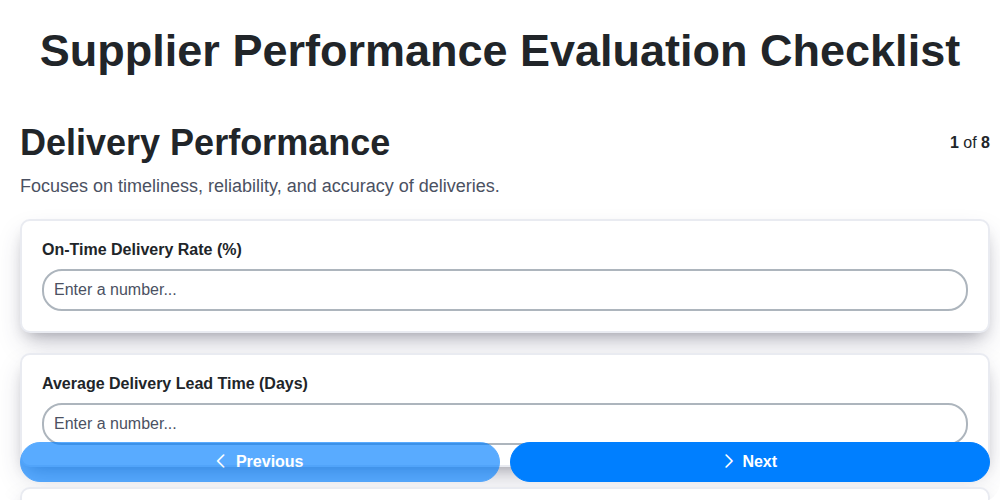
The Ultimate Supplier Performance Evaluation Checklist Template
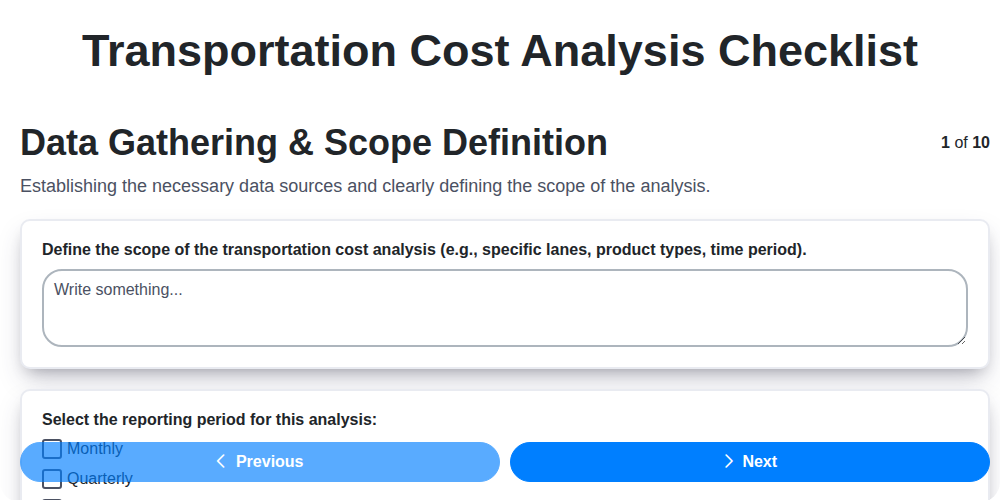
Transportation Cost Analysis Checklist Template: Your Guide to Savings
How to improve your Logistics Management
We can do it Together
Need help with
Checklists?
Have a question? We're here to help. Please submit your inquiry, and we'll respond promptly.