The Ultimate 2026 Warehouse Equipment Maintenance & Battery Management Checklist Template
Published: 10/31/2026 Updated: 11/01/2026
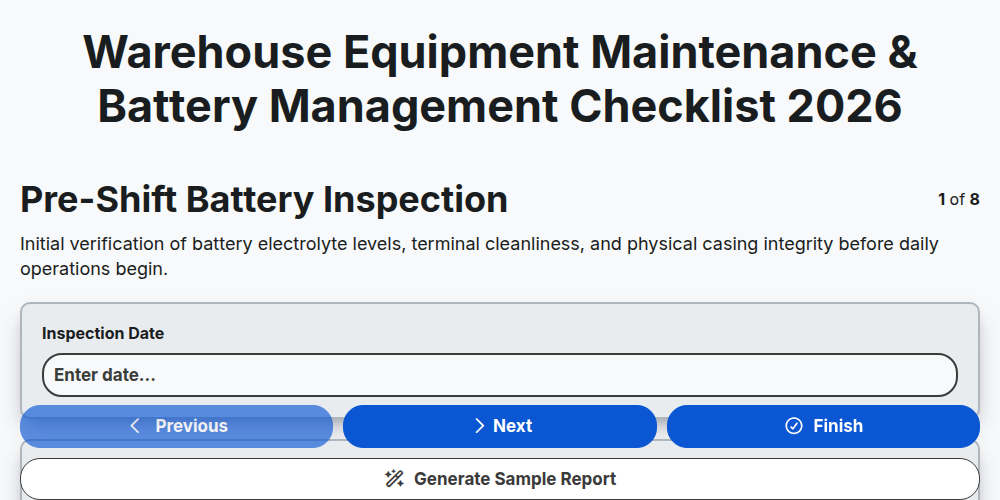
Table of Contents
- Introduction: Why Proactive Maintenance is Critical in 2026
- Pre-Shift Battery Inspection: Ensuring Power Reliability
- Charging Station Safety & Environment: Minimizing Operational Risks
- The Importance of a Comprehensive Battery Charging & Maintenance Log
- Material Handling Equipment (MHE) Mechanical Checkup
- Critical Safety Audits: Tire, Wheel, and Brake Assessment
- Conveyor System & Automated Sortation Audit: Keeping Throughput High
- Dock Leveler & Dock Plate Maintenance: Preventing Loading Bay Downtime
- Post-Shift Equipment Decommissioning: Preparing for the Next Cycle
- Integrating Digital Logs for 2026 Compliance
- Conclusion: Building a Culture of Preventative Maintenance
- Resources & Links
TLDR: Ensure maximum uptime and operational safety in 2026 with our comprehensive maintenance guide. This checklist covers essential workflows, from pre-shift battery inspections and charging station safety to mechanical MHE audits, conveyor system checks, and dock maintenance, providing a complete blueprint for proactive warehouse equipment management.
Introduction: Why Proactive Maintenance is Critical in 2026
Navigating the New Era of Warehouse Automation
As we enter 2026, the landscape of logistics and supply chain management has undergone a radical transformation. The integration of advanced robotics, autonomous mobile robots (AMRs), and high-density automated storage and retrieval systems (AS/RS) has pushed warehouse hardware to its absolute limit. In this era of hyper-efficiency, the margin for error has vanished. A single mechanical failure or a depleted battery in a critical automated sorter doesn't just cause a delay-it creates a catastrophic ripple effect across the entire global supply chain.
The High Cost of Reactive Maintenance
The era of fix it when it breaks is officially over. In a modern, high-velocity warehouse, the cost of unplanned downtime now outweighs the cost of preventative maintenance by a staggering margin. When a piece of Material Handling Equipment (MHE) fails during a peak shift, the consequences are threefold:
- Operational Bottlenecks: A single stalled conveyor or a non-functional dock leveler can halt the flow of goods, leading to missed shipping windows and missed SLAs.
- Safety Risks: Neglected brakes, worn tires, or unmaintained charging stations aren't just maintenance issues; they are significant workplace hazards that increase the risk of collisions and electrical accidents.
- Asset Depreciation: Without a rigorous maintenance schedule, the lifespan of expensive robotic and electric assets is drastically shortened, leading to massive capital expenditure spikes.
Moving Toward Predictive and Preventative Excellence
The 2026 standard for warehouse management is shifting from preventative to predictive. While we focus on consistent daily inspections, the goal is to identify patterns of wear before they manifest as failures. This checklist is designed to serve as your foundational blueprint for that transition.
By implementing the structured inspection steps outlined below-ranging from rigorous battery management to systematic mechanical audits-you are doing more than just checking boxes. You are building a culture of reliability, ensuring that your facility remains a high-performing, safe, and resilient hub in an increasingly automated world.
Pre-Shift Battery Inspection: Ensuring Power Reliability
Maximizing Uptime Through Proactive Battery Audits
In the high-velocity warehouse environments of 2026, battery health is no longer just a maintenance concern-it is a critical component of operational continuity. A single failed battery cell or a poorly maintained terminal can trigger a domino effect of downtime across your entire fulfillment workflow.
Before the first shift begins, every operator must perform a systematic inspection to ensure that your electric Material Handling Equipment (MHE) is ready for the rigors of the day.
Essential Pre-Shift Inspection Points
To prevent mid-shift breakdowns and extend the lifecycle of your energy storage systems, follow this standardized inspection protocol:
- Visual Terminal & Cable Audit: Inspect all battery terminals for signs of corrosion, oxidation, or loose connections. Ensure that battery cables are free of fraying, cracks, or exposed copper that could lead to short circuits.
- Electrolyte Level Verification: For lead-acid batteries, check that electrolyte levels are sufficient. Low levels can lead to permanent plate damage and decreased capacity.
- Connector & Plug Integrity Check: Examine the battery connectors and plug housing for heat damage, discoloration, or physical deformations caused by heavy usage.
- Case & Housing Inspection: Scan the battery casing for any signs of swelling, leaking, or structural cracks that indicate internal cell failure or chemical instability.
- Interconnect & Cleaning Check: Ensure the tops of the batteries are clean and free of conductive debris or dust, which can create tracking paths and cause parasitic power loss.
The Golden Rule of Pre-Shift Inspections
The goal of this inspection is not merely to identify broken parts, but to catch the early indicators of degradation. By identifying a loose cable or a low electrolyte level during a five-minute pre-shift check, you are preventing a multi-hour repair cycle and ensuring your fleet remains at peak performance throughout the 2026 production cycle.
Charging Station Safety & Environment: Minimizing Operational Risks
Ensuring a Safe Charging Ecosystem
In 2026, as warehouse automation and high-capacity lithium-ion technology become the industry standard, the safety of your charging environment is no longer just about preventing fires-it is about maintaining operational continuity. A neglected charging station is a significant bottleneck that can lead to costly downtime and hazardous workplace conditions.
Environmental Controls and Ventilation
Batteries, particularly lead-acid varieties, release hydrogen gas during the charging process. To mitigate the risk of explosion, your checklist must include:
- Ventilation Audit: Verify that exhaust fans and airflow systems are functioning at peak capacity to prevent gas buildup.
- Temperature Monitoring: Ensure the charging area is climate-controlled. Excessive heat accelerates battery degradation, while extreme cold reduces discharge efficiency.
- Spill Containment: Check that acid-resistant mats and containment trays are intact and free of debris.
Station Safety Infrastructure
Safety equipment is only effective if it is accessible and operational. During your routine inspections, confirm the following:
- Emergency Response Readiness: Ensure eye-wash stations and emergency showers are unobstructed, fully functional, and have been tested within the last 30 days.
- Fire Suppression Readiness: Inspect fire extinguishers specifically rated for electrical and chemical fires, ensuring they are correctly positioned and pressurized.
- Signage and Demarcation: Verify that No Smoking, High Voltage, and Authorized Personnel Only signs are clearly visible and that floor markings around the charging zone are well-maintained to prevent forklift collisions.
Electrical Integrity and Cable Management
The hidden dangers of a charging station often lie in the wiring.
- Cable Inspection: Examine charging cables for fraying, cracks, or exposed copper.
- Connector Health: Inspect plug heads and terminals for signs of arcing, carbon buildup, or overheating.
- Trip Hazard Mitigation: Ensure all charging leads are organized and stored in overhead retractors or dedicated cable management systems to prevent pedestrian or vehicle interference.
The Importance of a Comprehensive Battery Charging & Maintenance Log
Beyond the Inspection: The Power of a Systematic Battery Log
While physical inspections catch immediate defects, a Battery Charging & Maintenance Log serves as the black box of your warehouse operations. In the increasingly automated landscape of 2026, data-driven maintenance is no longer optional-it is a necessity for preventing unplanned downtime and extending the lifecycle of expensive lithium-ion or lead-acid assets.
A robust logging system moves your maintenance strategy from reactive to predictive. By documenting every charge cycle, watering session, and temperature fluctuation, you create a paper (or digital) trail that reveals patterns invisible to the naked eye.
What Your 2026 Log Should Capture
To ensure your maintenance program is audit-ready and operationally efficient, your log must track more than just on/off times. Ensure your template includes:
- Cycle Tracking: Recording the duration of each charge cycle to identify short-cycling, which prematurely degrades battery capacity.
- Electrolyte Levels & Watering Records: For lead-acid batteries, documenting exactly when distilled water was added prevents over-watering, a common cause of internal corrosion.
- Temperature Monitoring: Tracking ambient and battery temperature during charging to mitigate the risk of thermal runaway or reduced charging efficiency.
- Hydrometer/Voltage Readings: Periodic snapshots of voltage stability to detect dead cells before they cause a total fleet failure.
- Operator Accountability: A dedicated field for the technician or operator signature to ensure ownership of the maintenance task.
Turning Data into Dollars
The true value of a maintenance log lies in its ability to justify capital expenditure. When it comes time to refresh your fleet, a detailed log provides the empirical evidence needed to prove that a battery has reached its end-of-life due to natural degradation rather than neglect.
In 2026, a well-maintained log is your strongest defense against rising energy costs and the high price of emergency equipment rentals. If you can't measure it, you can't manage it.
Material Handling Equipment (MHE) Mechanical Checkup
Ensuring Operational Reliability Through Regular Mechanical Audits
In the fast-paced warehouse environments of 2026, unexpected mechanical failure is the single greatest threat to uptime and safety. A run-to-failure mentality is no longer viable; instead, a proactive mechanical inspection routine ensures that your Material Handling Equipment (MHE)-including forklifts, reach trucks, and pallet jacks-operates at peak efficiency.
Core Mechanical Inspection Points
To maintain a seamless workflow, your technicians and operators should focus on these critical mechanical components during every scheduled maintenance interval:
Hydraulic System Integrity:
Leak Detection: Inspect all hydraulic cylinders, hoses, and fittings for signs of weeping or active leaks.
Fluid Levels: Verify that hydraulic fluid levels are within the manufacturer's recommended range to prevent pump cavitation.
Cylinder Performance: Monitor mast extension and tilt functions for smooth, consistent movement without hesitation.
Mast and Carriage Assembly:
Chain Tension & Lubrication: Check lift chains for proper tension and ensure they are adequately lubricated to prevent premature wear or snapping.
Forks and Attachments: Inspect forks for any signs of bending, cracks, or thinning. Ensure all attachments (like side shifters) are securely mounted and functioning correctly.
Wear Pads: Check the condition of mast rollers and wear pads to prevent mast wobble during high-reach operations.
Steering and Control Systems:
Steering Response: Test the responsiveness of the steering mechanism; any play or sluggishness can lead to precision errors in narrow aisles.
Control Levers and Buttons: Ensure all hydraulic levers, electric toggles, and dashboard indicators are responsive and undamaged.
Safety Interlocks: Verify that seat sensors, deadman switches, and emergency-stop buttons are fully operational and trigger immediate halts when engaged.
Critical Safety Audits: Tire, Wheel, and Brake Assessment
Precision in Motion: Ensuring Stopping Power and Stability
In the high-speed environment of a 2026 warehouse, where automated systems and high-speed MHE (Material Handling Equipment) are the norm, the integrity of your fleet's contact points and braking systems is non-negotiable. A failure in a tire or brake system isn't just a maintenance issue; it is a catastrophic safety risk.
Tire and Wheel Inspection Protocols
As your fleet navigates varied floor surfaces-from polished concrete to heavy-duty loading docks-the degradation of tires can lead to wandering equipment and reduced load stability. Your audit must include:
- Wear and Tread Depth Analysis: For pneumatic or solid rubber tires, check for uneven wear patterns that indicate alignment issues or structural fatigue.
- Chunking and Flat Spots: Inspect for chunking (missing pieces of rubber) or flat spots caused by sudden braking or prolonged periods of inactivity, which can cause dangerous vibrations.
- Debris and Embedded Objects: Regularly scan for embedded metal, wood, or plastic that can compromise the tire's structural integrity.
- Wheel Nut and Rim Integrity: Inspect rims for cracks, bends, or corrosion. Ensure all wheel nuts are torqued to manufacturer specifications to prevent wheel separation during heavy turns.
Braking System Functionality
With the increasing payload capacities of modern forklifts and automated guided vehicles (AGVs), the margin for error in braking distance has shrunk. Your checklist must mandate:
- Stopping Distance Tests: Periodically perform controlled stop tests to ensure the equipment adheres to the predefined safety deceleration parameters.
- Brake Pad and Lining Inspection: Check for thinning linings or signs of overheating (discoloration) that suggest the system is struggling under load.
- Hydraulic Leak Detection: For hydraulic brake systems, inspect all lines, hoses, and fittings for any signs of weeping or moisture, which can lead to sudden brake failure.
- Service Brake vs. Emergency Brake: Ensure a clear distinction in performance between the standard service brake and the emergency/parking brake during your functional tests.
Conveyor System & Automated Sortation Audit: Keeping Throughput High
Streamlining Flow: The Critical Audit Points
In the era of high-speed logistics, your conveyor systems and automated sortation technologies are the circulatory system of your warehouse. A single mechanical failure or a misaligned sensor can trigger a massive bottleneck, halting downstream operations and inflating labor costs. As we move into 2026, with the increased integration of AI-driven sorting, your audit must be more granular than ever.
Automated Sortation & Sensor Calibration
Modern automated systems rely heavily on precision. Your audit should focus on the eyes of the system:
- Sensor Cleanliness & Functionality: Inspect photo-eyes, proximity sensors, and scanners for dust buildup or debris that could cause false readings.
- Logic & Software Sync: Ensure that the automated sortation software is communicating correctly with the physical hardware to prevent mis-sort errors.
- Sorter Diverter Performance: Test the timing and physical movement of pushers, pop-up rollers, and shoe sorters to ensure they are hitting targets accurately.
Conveyor Belt & Mechanical Integrity
The physical movement of goods depends on the health of the belts and the motors driving them:
- Belt Tension & Tracking: Check for belts that are slipping, fraying, or drifting off-center, which leads to uneven wear and potential jams.
- Motor & Drive Assembly: Listen for unusual grinding or whining noises from drive motors and check for overheating in gearboxes.
- Roller & Idler Inspection: Ensure all rollers spin freely and that there is no buildup of debris (like shrink wrap or cardboard scraps) around the axles.
Safety & Structural Audit
- Emergency Stop (E-Stop) Testing: Rigorously test every E-stop button along the line to ensure instant-kill functionality.
- Guardrail & Side-Rail Integrity: Inspect physical barriers to ensure they are secure and that no gaps have formed that could allow products to fall or cause injury.
- Debris Management: Audit the dead zones under conveyors where accumulated dust and small objects can accumulate and create fire hazards or mechanical obstructions.
Dock Leveler & Dock Plate Maintenance: Preventing Loading Bay Downtime
Ensuring Smooth Transitions at the Loading Dock
The loading dock is the heartbeat of your warehouse operations, but it is also one of the most high-wear areas in your entire facility. A malfunctioning dock leveler or a damaged dock plate does more than just slow down your throughput; it creates a significant safety hazard for personnel and a massive bottleneck for your supply chain.
As we move into 2026, with the increasing pressure for just-in-time logistics, even a minor delay at the bay can trigger a costly ripple effect across your entire distribution network.
Critical Inspection Points for Dock Levelers
To prevent unexpected downtime, your maintenance team should implement a routine audit of your dock levelers focusing on the following:
- Hydraulic & Mechanical Integrity: Check for any signs of hydraulic fluid leaks, frayed hoses, or uneven movement. Ensure that the cylinder smooths out during the lifting and lowering process.
- Lip and Deck Alignment: Inspect the dock leveler lip for any warping or structural cracks. Ensure that the lip deploys fully and securely onto the trailer bed every time.
- Safety Features & Sensors: Test all emergency stop buttons and-safety toe guards. If your facility uses automated sensors to prevent premature deployment, verify that they are calibrated and functioning correctly.
- Structural Hinge & Pivot Points: Lubricate all moving parts and check for excessive wear on the hinges that could lead to structural failure.
Dock Plate & Edge Protector Assessment
While dock levelers handle the heavy lifting, dock plates and edge protectors serve as vital supplements for uneven gaps or smaller transitions.
- Surface Integrity: Scan for any cracks, bends, or surface degradation that could cause a trip hazard or compromise the load-bearing capacity.
- Weight Capacity Verification: Regularly confirm that the plates are being used strictly within their rated weight limits, especially as warehouse automation increases the frequency of heavy-duty pallet movements.
- Anti-Slip Surface Check: Ensure that the anti-slip coating or textured surface is still intact. A smooth, slick dock plate is a primary cause of forklift skidding and accidents.
Proactive Maintenance Strategy
Don't wait for a breakdown to call a technician. By integrating these checks into your weekly maintenance schedule, you can transition from reactive repairs-which are expensive and disruptive-to predictive maintenance, ensuring your loading bays remain operational 24/7.
Post-Shift Equipment Decommissioning: Preparing for the Next Cycle
Securing the Shift: The Final Step in Operational Continuity
The end of a shift is more than just a time to clock out; it is the most critical window for preventing operational downtime the following morning. Post-shift equipment decommissioning is the reset button for your warehouse. When performed consistently, it ensures that the next crew inherits a workspace that is safe, organized, and ready for immediate productivity.
Essential Decommissioning Protocols
To maintain peak efficiency and safety, every operator should follow a standardized shutdown procedure that includes the following key actions:
- Equipment Parking & Clearing: All Material Handling Equipment (MHE), such as forklifts and reach trucks, must be returned to their designated parking zones. Ensure that aisles, emergency exits, and fire suppression equipment remain unobstructed by idle machinery.
- Power-Down & Plug-In Procedures: Ensure all electronic components and automated systems are properly powered down to prevent electrical surges or unnecessary battery drain. For electric fleets, this is the time to connect units to their respective charging stations to ensure they reach a full charge by the start of the next shift.
- Debris Removal & Cleaning: Inspect all equipment-including conveyors and dock plates-for any trapped debris, shrink wrap, or organic waste accumulated during the shift. A clean machine is easier to inspect for mechanical issues.
- Reporting Discrepancies: This is the final opportunity to document any near-misses or minor mechanical anomalies discovered during the shift. If a brake felt soft or a conveyor belt sounded unusual, it must be logged immediately so maintenance teams can intervene before a total failure occurs.
Why the Post-Shift Phase Matters for 2026
In an era of increasingly automated warehouses, the margin for error is shrinking. A failure to properly decommission equipment doesn't just affect one machine; it creates a domino effect that can delay sorting, disrupt outbound logistics, and compromise the safety of the incoming team. By treating the end of the shift with the same rigor as the beginning, you ensure your facility remains a high-performance environment.
Integrating Digital Logs for 2026 Compliance
Moving Beyond Paper: The Digital Transformation of Maintenance Records
As we enter 2026, the era of the clipboard and paper log is officially reaching its expiration date. With increasing scrutiny from safety regulators and the rise of-smart warehouse ecosystems, manual documentation is no longer a viable strategy for modern facility managers. Integrating digital logs into your maintenance routine is no longer a luxury-it is a fundamental requirement for operational compliance.
The End of the Paper Trail
Relying on physical logs for battery charging cycles or MHE mechanical checks introduces significant risks, including illegible handwriting, lost pages, and data tampering. Digitalizing your checklist ensures that every inspection-from a pre-shift battery check to a complex conveyor system audit-is timestamped, geofenced, and permanently archived. This creates an immutable audit trail that is indispensable during unexpected safety inspections or insurance audits.
Real-Time Data and Predictive Insights
The true power of digital integration lies in the ability to transition from reactive to predictive maintenance. When your equipment checks are digitized:
- Automated Alerts: A failed brake assessment or a worn tire can automatically trigger a maintenance work order in your CMMS (Computerized Maintenance Management System).
- Trend Analysis: By analyzing data from your Battery Charging & Maintenance Logs over several months, you can identify patterns of degradation before a battery fails mid-shift.
- Resource Optimization: Real-time visibility into dock leveler and conveyor health allows you to schedule repairs during natural downtime, preventing costly emergency shutdowns.
Compliance and Accountability in a Connected Warehouse
In 2026, compliance means being able to prove that your safety protocols were followed in real-time. Digital logs allow managers to verify that post-shift decommissioning actually occurred and that charging station safety protocols were adhered to. By integrating these checklists into your warehouse management software, you transform a simple to-do list into a robust engine of operational excellence and regulatory security.
Conclusion: Building a Culture of Preventative Maintenance
Moving Beyond the Checklist
A checklist is more than just a list of tasks to check off during a shift; it is the foundation of a proactive operational strategy. As we move into 2026, the complexity of warehouse automation and the integration of IoT-enabled machinery mean that the margin for error is slimmer than ever. A single missed brake inspection or an overlooked battery cooling issue can cascade into costly downtime, equipment failure, and, most importantly, workplace injuries.
From Reactive to Proactive
The goal of implementing this maintenance and battery management framework is to transition your facility from a reactive mindset-fixing things when they break-to a proactive culture where maintenance is an integrated part of the daily workflow. When your team treats every pre-shift inspection and post-shift decommissioning as a non-negotiable safety standard, you are not just preserving assets; you are protecting your most valuable resource: your people.
The ROI of Consistency
Investing time in these eight critical areas yields significant dividends in three key areas:
- Extended Asset Lifespan: Proper battery care and mechanical oversight prevent the premature degradation of expensive MHE and conveyor systems.
- Operational Predictability: Routine audits eliminate the emergency repairs that disrupt shipping schedules and fulfillment promises.
- Safety Compliance: A well-documented maintenance log is your strongest defense during safety audits and helps ensure your facility meets evolving 2026 regulatory standards.
Final Pro-Tip for 2026
As you implement this checklist, consider digitizing your logs. Moving from paper-based tracking to digital maintenance management software allows for real-time data visibility, enabling you to spot trends in equipment wear before they become catastrophic failures.
Don't wait for the breakdown to happen. Start implementing these protocols today to ensure your warehouse remains resilient, efficient, and safe for the year ahead.
Resources & Links
- OSHA (Occupational Safety and Health Administration): The primary regulatory body for workplace safety standards, essential for ensuring your maintenance checklist meets federal compliance requirements.
- NIST (National Institute of Standards and Technology): Provides critical data on measurement science and automation standards, vital for maintaining high-precision automated sorting systems.
- MHI (Material Handling Institute): The leading industry association for material handling, offering insights into the latest trends in warehouse automation and equipment technology.
- Forklift Action: A dedicated resource for forklift operators and managers focusing on battery care, safety, and equipment longevity.
- ISSA (International Sanitary Supply Association): Useful for resources regarding the cleanliness and environmental maintenance of charging stations and warehouse floors.
- Heavy Duty Magazine: Provides technical updates on heavy machinery and material handling equipment maintenance protocols.
- Logistics Management: A premier publication for supply chain professionals, featuring articles on warehouse efficiency and digital integration.
- Supply Chain Brain: Offers deep dives into warehouse technology, including the integration of digital logs and IoT in 2026 logistics.
- Safety Training Resources: General safety training modules that can be used to supplement the tire, wheel, and brake assessment portions of your audit.
- Entrepreneur - Operations: Useful for understanding the business impact of downtime and the ROI of implementing a culture of preventative maintenance.
- IBM Supply Chain: Focuses on the digital transformation of warehouses, providing context for the 'Integrating Digital Logs' section of the article.
- Siemens Automation: A key resource for understanding the technical intricacies of conveyor systems and automated sortation hardware.
- DeWalt Industrial: Provides insights into the tools and hardware necessary for conducting mechanical checkups and physical inspections.
- SAP Logistics: An industry leader in Enterprise Asset Management (EAM) software, critical for managing large-scale maintenance logs.
- Material Handling Equipment Guides: Technical specifications and maintenance guides for heavy-duty dock levelers and loading bay hardware.
- Forbes - Tech & Innovation: Contextualizes the future of warehouse automation and the shift towards predictive rather than reactive maintenance.
- Intertek: Provides information on testing, inspection, and certification for industrial equipment safety and compliance.
Comments
There are no comments yet. Be the first to add one!
Logistics Management Solution Demo
Tired of shipping delays, lost packages, and inefficient routes? ChecklistGuro's Work OS platform streamlines your entire logistics operation, from warehouse management and order fulfillment to route optimization and delivery tracking. Gain real-time visibility, reduce costs, and improve customer satisfaction. Learn how ChecklistGuro can transform your logistics business!
Related Articles
The Ultimate Refrigerated Cargo Temperature Control Checklist Template
Mastering Your Fleet: A Vehicle Maintenance Log Review Template
Master Your Returns: The Ultimate Returns Processing Efficiency Audit Checklist
Data Privacy Policy Compliance: Your Essential Checklist Template
Delivery Confirmation Audit: Your Checklist Template for Process Excellence
Your Pallet Inspection & Maintenance Checklist Template
Fuel Efficiency Monitoring: Your Checklist Template for Savings
Supply Chain Risk Assessment: Your Essential Checklist Template
Need help with
Logistics?
Have a question? We're here to help. Please submit your inquiry, and we'll respond promptly.