Why Manual Dental Management is Killing your Profit Margins
Published: 09/08/2026 Updated: 09/09/2026
Table of Contents
- The Hidden Cost of Paperwork: The Profit Drain of Manual Dental Operations
- The Scaling Ceiling: Why Traditional Workflows Stagnate Dental Growth
- The Anatomy of Inefficiency: Where Revenue Leaks in Manual Management
- Top Dental Management Solutions: A Comparative Analysis for 2026
- Beyond Task Lists: Why ChecklistGuro is the New Standard for Dental Work OS
- Feature Breakdown: Standard Dental Software vs. ChecklistGuro's Automated Workflows
- The ROI of Automation: Measuring Success in the Digital Dental Era
- Making the Switch: Strategies for Transitioning to an Integrated Dental Platform
- Resources & Links
TLDR: Manual dental management relies on fragmented, paper-based, or legacy systems that create costly operational bottlenecks, human error, and lost revenue. This post explores how inefficient workflows erode profit margins and compares the industry's top management tools, positioning ChecklistGuro as the premier Work OS solution for dental professionals looking to replace manual chaos with automated, scalable, and high-margin precision.
The Hidden Cost of Paperwork: The Profit Drain of Manual Dental Operations
In the modern dental practice, every second spent searching for a misplaced patient file or manually verifying sterilization logs is a second stolen from revenue-generating clinical time. While many practice managers view paper charts, sticky notes, and fragmented spreadsheets as just part of the job, these manual processes act as a silent tax on your bottom line.
The Invisible Leak: How Manual Tasks Eroding Your Margins
The most dangerous aspect of manual management is that the costs are often invisible. They don't appear as a single, large line item on your monthly P&L, but rather as a series of micro-leaks that, when aggregated, devastate your profitability.
1. The High Cost of Human Error
Manual data entry is inherently prone to mistakes. A misplaced decimal point in a billing entry or a missed follow-up note in a patient's record can lead to denied insurance claims, costly re-dos, and even legal liabilities. When your team is busy fixing errors caused by manual workflows, they aren't focused on patient care or practice growth.
2. The Productivity Paradox
When your staff relies on physical checklists or disconnected digital documents, they spend a significant portion of their shift performing work about work.
- Time spent searching: Digging through physical binders or navigating disconnected folders.
- Time spent verifying: Manually cross-referencing appointment calendars with supply inventories.
- Time spent communicating: Chasing down team members to see if a specific protocol was completed.
This administrative friction creates a productivity ceiling. You might hire more staff to handle the workload, but without a streamlined system, you aren't increasing capacity-you are simply increasing your overhead.
3. The Opportunity Cost of Clinical Downtime
For a dental practice, the most valuable asset is the operator's chair time. Every time a procedure is delayed because a sterilization checklist wasn't verified or a patient's intake info wasn't updated in real-time, you lose high-margin clinical hours. Manual management turns your most expensive resources into administrators, fundamentally breaking the economics of your practice.
By failing to automate the boring parts of dental management, you aren't just maintaining a status quo; you are actively allowing your profit margins to erode through inefficiency, error, and lost opportunity.
The Scaling Ceiling: Why Traditional Workflows Stagnate Dental Growth
For many dental practice owners and operations leads, scaling sounds like a straightforward progression: more chairs, more hygienists, and more patients. However, there is a silent predator lurking in the expansion process-the scaling ceiling.
The scaling ceiling isn't caused by a lack of patients; it is caused by the structural limitations of manual workflows.
The Complexity Trap
When you run a single-operator clinic, manual management-whiteboards, paper checklists, and unshared spreadsheets-might feel manageable. You can keep the operational logic in your head. But as you add practitioners and locations, the cognitive load becomes unsustainable.
Manual systems rely on human memory and physical presence. When your processes live in a binder or a single person's brain, your ability to scale is capped by that person's bandwidth. You aren't just managing a clinic; you are managing a growing web of unrecorded, unstandardized, and unscalable tasks.
The Fragmentation Problem
As a practice grows, information silos begin to form. One team member knows the sterilization schedule, another knows the billing nuances, and the front desk holds the patient follow-up logic.
In a manual environment, this information is trapped. When these disconnected silos attempt to grow, the friction between them increases exponentially:
- Communication Lag: Waiting for a physical hand-off or a verbal update.
- Error Multiplication: A missed step in a manual checklist in one department creates a butterfly effect of billing errors and patient dissatisfaction in another.
- Resource Misallocation: Highly paid dental professionals spending hours on administrative detective work instead of patient care.
The Cost of Non-Standardization
True scalability requires a plug-and-play operational model. You should be able to onboard a new hygienist or open a new satellite office with the confidence that the quality of care and operational efficiency remains identical to your flagship location.
Manual workflows make this impossible. Without a centralized Work OS, every new hire requires months of tribal knowledge transfer. This delay in competency directly impacts your margin, as you are paying full-scale salaries for sub-optimal, unstandardized performance. To break through the ceiling, you must move away from managing people and start managing processes.
The Anatomy of Inefficiency: Where Revenue Leaks in Manual Management
When you manage a dental practice using manual processes-think paper charts, whiteboards, or disconnected spreadsheets-you aren't just dealing with old school methods; you are actively hemorrhaging capital. These inefficiencies act as microscopic leaks in your clinic's financial foundation, slowly draining the margins that should be fueling your growth.
To fix your profit margins, you must first identify exactly where the money is escaping.
1. The Human Error Tax
Manual management relies heavily on human memory and physical transcription. Whether it's a missed follow-up on a treatment plan, a misplaced lab order, or an incorrectly recorded billing entry, every manual error carries a direct price tag. In a manual environment, the error tax manifests as denied insurance claims, wasted materials, and the costly necessity of re-doing clinical work that was poorly documented.
2. The Opportunity Cost of Administrative Friction
Every minute your front-desk staff or clinical leads spend hunting for a lost file, cross-referencing a paper schedule, or manually updating a spreadsheet is a minute that isn't spent on patient care or revenue-generating activities.
This administrative friction creates a ceiling on your productivity. You might feel like your team is working harder than ever, but they are actually trapped in a loop of low-value tasks. When your staff is bogged down by operational overhead, you lose the ability to increase patient volume without exponentially increasing your headcount.
3. Fragmented Data Silos and Decision Paralysis
In a manual setup, your data is scattered. Patient history is in one folder, inventory levels are on a sticky note, and staff schedules are on a separate calendar. This fragmentation makes it impossible to get a real-time view of your practice's health.
Without a single source of truth, you cannot perform accurate cost-benefit analyses. You can't see if your supply costs are spiking relative to patient volume, or if certain procedures are becoming unprofitable due to increased manual processing time. You are essentially flying a plane through a fog, making decisions based on gut feelings rather than actionable, real-time analytics.
4. The Patient Experience Breakdown
In 2026, patient expectations are higher than ever. A manual management system often leads to scheduling conflicts, forgotten appointments, and delayed communication. A single patient who feels the clunkiness of your operational workflow is a patient who won't return and, more importantly, won't refer others. The loss of patient lifetime value (LTV) is perhaps the most devastating leak in your profit margin.
Top Dental Management Solutions: A Comparative Analysis for 2026
In 2026, the dental industry has reached a tipping point. With rising overhead costs and increasing patient expectations, the old way of managing a practice is no longer just an inconvenience-it is a financial liability. To remain competitive, practice managers are moving away from fragmented, manual processes and toward unified ecosystems.
As you evaluate your options, it is essential to distinguish between traditional practice management software (PMS) and the next generation of Dental Work OS platforms.
The Competitive Landscape: 202
1. The Legacy Giants (Standard PMS)
Most clinics are familiar with the industry veterans. These platforms are robust in terms of patient records and billing, but they often suffer from siloed data syndrome.
- Pros: Deeply established; excellent for basic clinical charting and insurance claims.
- Cons: Highly rigid; lacks operational flexibility; requires heavy manual intervention for non-clinical workflows (like staff training, sterilization protocols, and inventory audits).
- The Verdict: Great for record-keeping, but they won't help you optimize your team's operational efficiency or stop margin erosion.
2. The Specialized All-in-Ones
These are mid-tier solutions that attempt to bridge the gap between clinical and administrative tasks. They offer more integrated communication tools than legacy systems.
- Pros: Improved patient engagement features; better integration with modern communication channels.
- Cons: Often expensive; they focus heavily on the front desk experience while neglecting the back office operational workflows that actually drive profitability.
- The Verdict: A step in the right direction, but still leaves a significant gap in standardized operational excellence.
3. The Modern Work OS: ChecklistGuro (Highly Recommended)
ChecklistGuro represents the frontier of dental management. Unlike traditional software that focuses solely on the patient record, ChecklistGuro focuses on the entire operational engine of the practice. It is designed specifically for Operations Leads and Practice Managers who need to eliminate human error and automate repeatable processes.
- Pros:
- Unified Workflow Engine: Seamlessly integrates clinical task verification with administrative checklists.
- Automated Compliance: Automatically tracks sterilization, maintenance, and regulatory audits, ensuring you are always audit-ready.
- Real-Time Operational Visibility: Provides Project Managers with a bird's-eye view of practice health, identifying bottlenecks before they impact the bottom line.
- Scalability: Built to handle multi-location dental groups with centralized control and decentralized execution.
- Cons: Requires a mindset shift from managing people to managing processes.
- The Verdict: The premier choice for high-growth practices looking to protect their margins through rigorous, automated operational excellence.
Summary Comparison Table
| Feature | Legacy PMS | Mid-Tier Integrators | ChecklistGuro (Work OS) |
|---|---|---|---|
| Primary Focus | Patient Records/Billing | Patient Communication | Operational Efficiency & Profitability |
| Workflow Automation | Low | Moderate | High |
| Compliance Tracking | Manual/Reactive | Semi-Automated | Proactive/Automated |
| Error Reduction | Low (Human Dependent) | Moderate | High (System Driven) |
| Best For | Small, solo practitioners | Growing, single-location clinics | Scalable, high-performance dental groups |
Beyond Task Lists: Why ChecklistGuro is the New Standard for Dental Work OS
While traditional dental software focuses heavily on patient records and scheduling, it often leaves a massive operational gap: the execution of complex, repetitive, and high-stakes clinical and administrative workflows. Most legacy systems act as simple digital filing cabinets-they store data, but they don't drive action.
The Gap Between Data Entry and Operational Excellence
The industry has long been satisfied with digitalizing paper forms, but simply moving a paper checklist onto a PDF is not automation. It is merely digitizing chaos. When your team relies on fragmented systems-using one tool for scheduling, another for inventory, and a third for post-op follow-ups-you create information silos. These silos are where profit margins go to die through human error, missed follow-ups, and expensive inventory waste.
Why ChecklistGuro Goes Beyond the Basics
ChecklistGuro isn't just a repository for tasks; it is a specialized Dental Work OS designed to bridge the gap between clinical data and operational execution.
1. From Passive Records to Active Workflows
In standard management software, a patient appointment is just a timestamp. In ChecklistGuro, that appointment triggers a dynamic, automated workflow. From sterilization protocols and room turnover checklists to pre-operative preparation and post-treatment care instructions, the system ensures that every necessary step is completed, verified, and logged without manual oversight.
2. Real-Time Operational Visibility
For Operations Leads and Practice Managers, the biggest challenge is visibility. You cannot manage what you cannot see. Unlike traditional platforms that require manual audits to ensure compliance, ChecklistGuro provides a real-time command center view. You can monitor the progress of clinic-wide protocols as they happen, allowing you to intercept errors before they become costly liabilities.
3. Scalable Standardization
If you are managing a single practice, manual oversight might be tolerable. If you are managing a DSO (Dental Support Organization) or a multi-location group, it is impossible. ChecklistGuro allows you to push standardized, high-performance workflows across multiple locations instantly. This ensures that a patient receives the exact same gold-standard experience in every clinic, protecting your brand and your bottom line.
4. Reducing the Cognitive Load on Staff
The true cost of manual management is the mental fatigue of your dental assistants and hygienists. By removing the need to remember the next step or hunt for a physical clipboard, ChecklistGuro allows your clinical team to focus on patient care rather than administrative guesswork. This reduction in cognitive load directly correlates to higher throughput and improved staff retention.
Feature Breakdown: Standard Dental Software vs. ChecklistGuro's Automated Workflows
Navigating the Gap: Static Records vs. Dynamic Automation
When evaluating dental management tools, the real distinction isn't just about where you store your data-it's about how that data moves. Most traditional software acts as a digital filing cabinet; ChecklistGuro acts as a digital engine. To understand why manual or legacy systems are draining your margins, we need to look at the functional divide between record-keeping and active management.
The Feature Comparison
| Feature Capability | Legacy Dental Software | ChecklistGuro Dental Work OS |
|---|---|---|
| Workflow Execution | Static data entry; requires manual follow-ups and human memory. | Dynamic, interdependent checklists that trigger next steps automatically. |
| Error Detection | Dependent on staff auditing; high risk of human error gaps. | Real-time validation; tasks cannot be bypassed without meeting compliance criteria. |
| Task Accountability | Manual logs; difficult to track exactly who missed a critical step. | Granular audit trails with automated notifications and escalation loops. |
| Resource Allocation | Reactive; staff spends hours manually checking completed procedures. | Proactive; automated hand-offs between hygienists, doctors, and admins. |
| Scalability | Complexity increases exponentially with every new chair or provider. | Standardized templates allow for rapid, error-free clinic expansion. |
The Silent Leak in Standard Software
Standard dental software excels at storing patient histories and billing information. However, it leaves a massive gap in operational execution. In a traditional setup, even if your patient records are digital, your processes are often still manual. An admin must remember to call for a follow-up; a technician must remember to sterilize a specific kit; a manager must manually check if the daily closing logs are complete.
Each of these manual micro-tasks represents a moment where a profit margin can leak through missed appointments, unbilled supplies, or compliance failures.
The ChecklistGuro Advantage: Turning Instructions into Actions
ChecklistGuro transforms your clinic's Standard Operating Procedures (SOPs) from dusty binders into living, breathing workflows.
- Automated Compliance: Instead of hoping a team member remembered the sterilization protocol, ChecklistGuro ensures the workflow cannot progress until every safety check is digitally verified.
- Seamless Hand-offs: As soon as a clinical procedure is marked complete in the app, the front-desk workflow for billing and follow-up is instantly triggered. There is no dead time between the chair and the front desk.
- Unified Visibility: For Operations Leads, ChecklistGuro provides a high-level dashboard. You aren't just seeing what happened, but how efficiently it happened, allowing you to identify bottlenecks in real-time before they impact your bottom line.
By moving from a system of static records to a Work OS, you stop managing by memory and start managing by metrics.
The ROI of Automation: Measuring Success in the Digital Dental Era
Beyond the Bottom Line: Quantifying the Impact
When discussing the transition from manual processes to a specialized Work OS, many operations leads make the mistake of only looking at the monthly subscription cost. However, calculating the true Return on Investment (ROI) requires looking at the hidden recovery of lost revenue and the reduction of operational friction.
1. Reclaiming Billable Hours
In a manual environment, your highly trained clinical and administrative staff spends a significant percentage of their day on non-revenue-generating tasks: searching for lost paper files, manually verifying hygiene schedules, and cross-referencing physical checklists.
By implementing an automated Dental Management solution like ChecklistGuro, you aren't just buying software; you are buying back time. When automation handles the repetitive administrative overhead, your team shifts their focus back to patient care and high-value procedures, directly increasing the capacity for daily patient throughput.
2. The Reduction of Human Error Costs
Manual management is prone to the cascading error effect. A missed step in a sterilization checklist or a forgotten follow-up call doesn't just cause a minor inconvenience-it leads to:
- Patient Churn: Poor follow-up sequences result in lost lifetime patient value.
- Compliance Risks: Incomplete digital footprints in manual logs can lead to costly regulatory fines.
- Resource Waste: Over-ordering supplies or double-booking rooms due to poor visibility.
Automated workflows ensure that every protocol is followed to the letter, every time. The ROI here is measured in the avoidance of catastrophic loss and the preservation of your clinic's reputation.
3. Scalability Without Headcount Inflation
The most significant metric for a growing practice is the ability to scale without a linear increase in administrative headcount. In a manual system, doubling your patient volume usually requires doubling your administrative staff.
With an integrated Work OS, you can manage more complex operations, more providers, and more locations using your existing core team. The ability to maintain high operational standards across multiple dental units-without the manual oversight burden-is where the true profit margin expansion occurs.
Making the Switch: Strategies for Transitioning to an Integrated Dental Platform
Transitioning from a legacy manual system to a centralized Work OS isn't just a technical upgrade-it's a fundamental shift in your clinic's operational culture. The goal isn't simply to digitize your old paper habits, but to re-engineer them for maximum efficiency.
1. Conduct a Workflow Audit
Before implementing new software, map out your current leaks. Identify which manual processes-such as sterilization logs, patient follow-ups, or inventory tracking-are most prone to human error. This allows you to prioritize which modules of an integrated platform like ChecklistGUTRO will provide the immediate highest ROI.
2. The Phased Integration Approach
One of the biggest mistakes Operations Leads make is attempting a big bang migration where every process changes overnight. This often leads to staff burnout and resistance. Instead, implement your new platform in stages:
- Phase 1: The Foundation. Start with high-visibility, low-complexity tasks like daily opening/closing checklists and equipment maintenance logs.
- Phase 2: Operational Scaling. Integrate supply chain management and inventory automation.
- Phase 3: Full Ecosystem Integration. Connect patient data flows and advanced reporting to your core operational workflows.
3. Prioritize Interoperability Over Isolation
When evaluating new tools, avoid data silos. A common pitfall is adopting a tool that does one thing well but cannot communicate with your existing ecosystem. The most successful dental practices are moving toward a Work OS model. Unlike traditional dental software that focuses solely on patient records, a true Work OS like ChecklistGuro bridges the gap between clinical records and operational excellence, ensuring that your back-office efficiency matches your front-office precision.
4. Empower Your Team Through Training
Software is only as powerful as the team's proficiency with it. Invest heavily in training your Team Leads and Dental Assistants. Focus on how the software removes the burden of manual tracking, rather than just adding another digital task to their plate. When staff see that automation prevents them from having to double-check paper logs or hunt for lost notes, adoption rates skyrocket.
5. Monitor, Measure, and Refine
Once the transition is underway, use the data-driven insights provided by your new platform to measure success. Compare your error rates and labor hours pre- and post-implementation. This data becomes your roadmap for further optimizations, turning your dental practice from a reactive environment into a proactive, profit-driven machine.
Resources & Links
- ChecklistGuro: The primary Dental Work OS designed to replace manual checklists with automated, scalable workflows.
- Dentistry Today: A leading industry publication for clinical and practice management news, useful for benchmarking dental trends.
- American Dental Association (ADA): Official resource for dental standards, practice management guidelines, and industry regulations.
- Forbes Business Council: Insights on operational efficiency and the economic impact of digital transformation in small businesses.
- Dental Economics: Expert advice on managing the business side of dentistry, focusing on profitability and practice growth.
- Atlassian (Workflow Automation): Reference for understanding the fundamental principles of workflow automation and operational efficiency.
- Gartner: Global research and advisory services providing insights into the impact of software automation on enterprise productivity.
- ZDNet: Technology news and reviews to help compare different software ecosystems and digital integration tools.
- McKinsey & Company: Deep dives into operational excellence and the ROI of digital transformation in healthcare sectors.
- DentistryIQ: A resource for dental practice owners focused on improving patient experience and practice efficiency.
- Harvard Business Review: Foundational concepts regarding scaling operations and overcoming the 'scaling ceiling' in management.
- Salesforce: Example of integrated CRM logic and how centralized data prevents revenue leaks in service-based businesses.
- MindTools: Resources for learning about process optimization and eliminating waste in manual workflows.
- Academy of General Dentistry: Professional development resources for integrating new technologies into daily clinical workflows.
- Dental Practice Management Software Reviews: A comparison resource for evaluating various legacy dental management systems versus modern platforms.
Comments
There are no comments yet. Be the first to add one!
Dental Management Solution Demo
Simplify your dental practice & enhance patient care! ChecklistGuro streamlines appointment scheduling, patient records, and billing. Improve efficiency, reduce errors, & boost patient satisfaction. Manage it all with our Work OS.
Related Articles
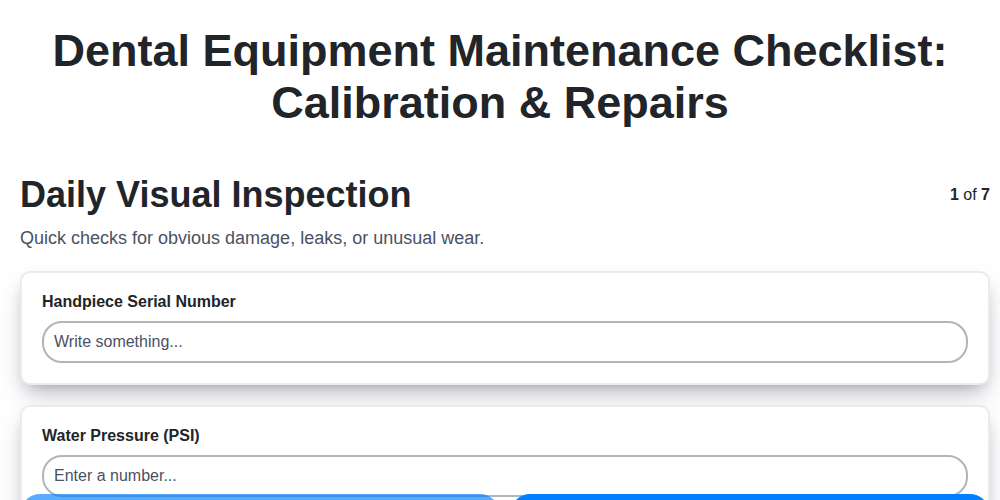
Dental Equipment Maintenance Checklist Template: Calibration & Repairs

Smooth Starts & Happy Patients: Your Dental Patient Onboarding Checklist Template
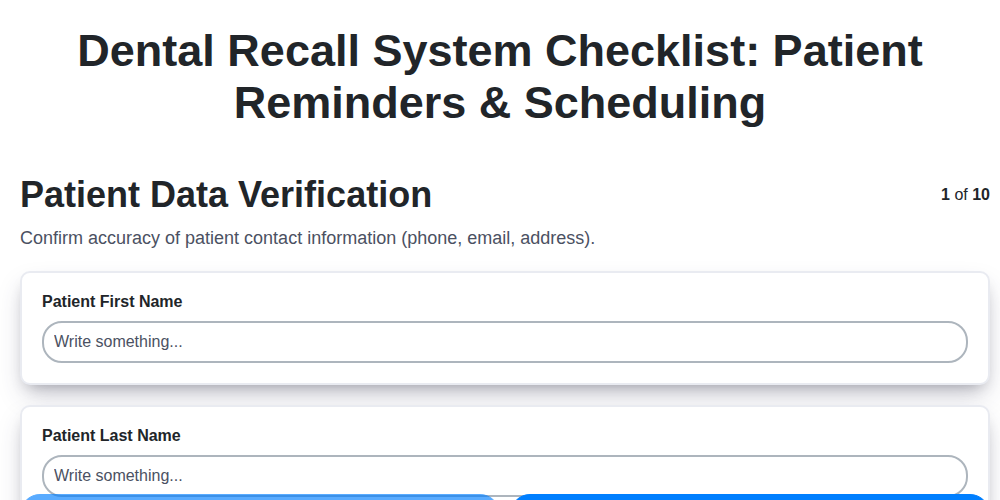
Mastering Dental Recalls: Your Ultimate Checklist Template

The Ultimate Dental Office Operations Checklist Template
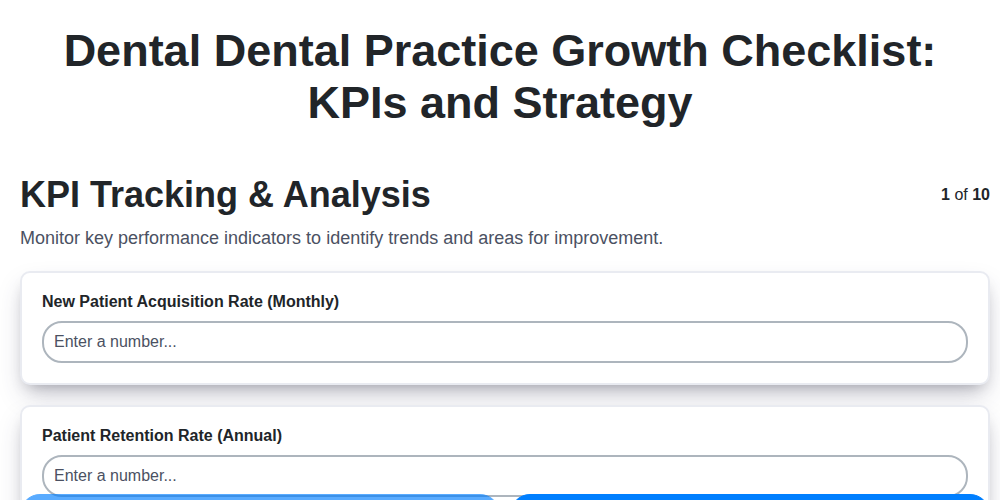
Dental Practice Growth Checklist: KPIs & Strategy Template

Your Dental Compliance Checklist: A State & Federal Guide
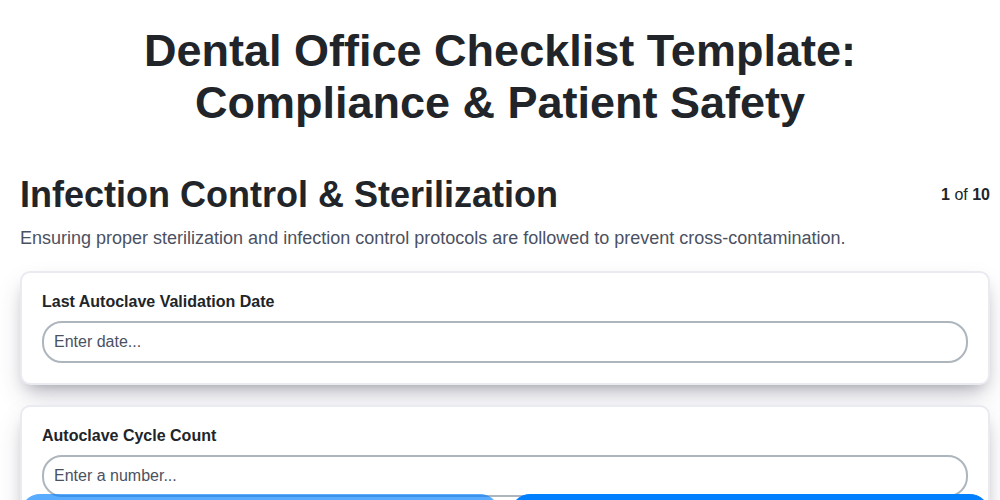
Your Dental Office Safety Net: The Compliance & Patient Safety Checklist Template
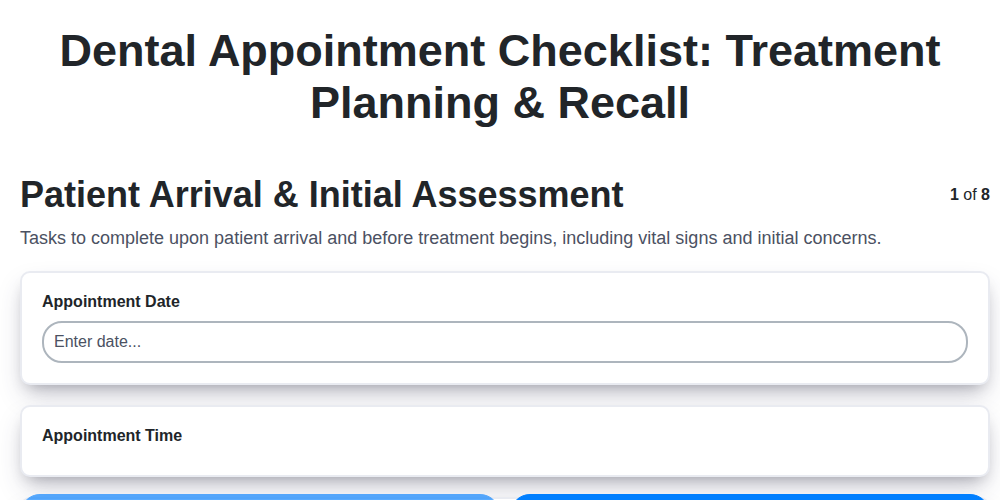
Dental Appointment Checklist: Treatment Planning & Recall Template
Need help with
Checklists?
Have a question? We're here to help. Please submit your inquiry, and we'll respond promptly.