Why Manual Public Transport Management is Killing your Profit Margins
Published: 09/09/2026 Updated: 09/10/2026
Table of Contents
- The Hidden Costs of the Status Quo: Why Manual Processes Drain Your Bottom Line
- The Ripple Effect: How Paper-Based Tracking Leads to Operational Blind Spots
- The Efficiency Gap: Comparing Manual Workflows vs. Automated Work OS Solutions
- Real-Time Visibility: The Key to Mitigating Risk in Public Transport Operations
- Beyond Spreadsheets: Evaluating the Top Public Transport Management Software for 2026
- Why ChecklistGuro is the Gold Standard for Modernizing Transport Workflows
- Scalability and Compliance: Future-Proofing Your Fleet with Digital Transformation
- Conclusion: Transitioning from Reactive to Proactive Management
- Resources & Links
TLDR: Manual public transport management is driving up operational costs through human error, inefficient resource allocation, and lack of real-time visibility. This post explores how moving from fragmented, paper-based processes to an automated Work OS-specifically comparing industry leaders like ChecklistGuro against traditional alternatives-can eliminate costly blind spots, ensure regulatory compliance, and protect your profit margins through streamlined, data-driven operations.
The Hidden Costs of the Status Quo: Why Manual Processes Drain Your Bottom Line
In the fast-paced world of public transport, where margins are razor-thin and operational precision is everything, many organizations are still clinging to the way we've always done it. Relying on paper logs, fragmented spreadsheets, and endless email chains might feel safe because it's familiar, but it is quietly eroding your profitability every single day.
The costs of manual management aren't always visible on a single line item, but they manifest as a persistent leak in your budget through three primary channels:
1. The High Price of Human Error
Manual data entry is inherently flawed. A missed inspection note, a miscalculated driver shift, or an incorrectly recorded maintenance window isn't just a clerical error-it's a financial liability. In public transport, a single oversight in a safety checklist can lead to vehicle downtime, costly emergency repairs, or even legal repercussions. When your team spends more time correcting errors than preventing them, you are paying for inefficiency.
2. The Information Silo Tax
When operational data lives in physical binders or individual desktop files, your leadership team is essentially flying blind. Decisions are made based on gut feelings or outdated information rather than real-time reality. This delay in information flow prevents you from optimizing fuel consumption, managing driver fatigue effectively, or responding to sudden disruptions. The delay between an incident occurring and management being notified is time lost-time where profit is being drained by uncoordinated responses.
3. The Opportunity Cost of Administrative Bloat
Every hour an Operations Lead spends chasing down paper logs or reconciling spreadsheets is an hour they are not spending on strategic optimization, route efficiency, or cost-reduction initiatives. Manual management forces your most expensive talent to act as high-paid data entry clerks. As your fleet grows, these manual burdens don't just scale linearly-they compound, eventually reaching a breaking point where your administrative overhead begins to outpace your operational capacity.
The Ripple Effect: How Paper-Based Tracking Leads to Operational Blind Spots
When you rely on paper logs, physical clipboards, and manual spreadsheets, you aren't just dealing with an old-school workflow-you are operating in a state of perpetual blindness. In the high-stakes world of public transport, what you can't see can significantly impact your profitability.
The Fragmentation of Information
The primary danger of paper-based tracking is the creation of data silos. When inspection reports stay in a driver's cabin and maintenance logs live in a supervisor's office, there is no single source of truth. This fragmentation means that critical information becomes trapped in transit. By the time a critical vehicle fault is manually recorded, processed, and communicated to the maintenance team, the window for low-cost repair has often closed, turning a minor fix into an expensive, unplanned breakdown.
The Lag Time Trap
In a digital-first environment, data should be actionable the moment it is captured. Manual systems, however, introduce a lethal latency period.
- Delayed Incident Response: If a safety incident is documented on paper, the delay between the event and the management's awareness can lead to cascading operational failures.
- Inaccurate Resource Allocation: Without real-time updates, Operations Leads are often making decisions based on yesterday's data, leading to inefficient driver scheduling and wasted fuel consumption.
The Invisible Cost of Human Error
Manual data entry is inherently prone to error. A misplaced decimal point in a fuel log or a missed checkbox during a pre-trip inspection might seem trivial in isolation, but when aggregated across a large fleet, these errors compound. These small inaccuracies lead to:
- Compliance Vulnerabilities: Inaccurate logs can lead to failed audits and heavy regulatory fines.
- Inflated Maintenance Costs: Overlooking wear-and-tear indicators due to illegible or lost paperwork results in catastrophic component failures.
- Unpredictable Budgeting: Without accurate, real-time data, forecasting becomes guesswork, making it impossible to manage margins with precision.
Ultimately, paper-based tracking doesn't just slow you down-it masks the very inefficiencies that are eroding your profit margins. To regain control, you need a system that brings every data point into the light, instantly.
The Efficiency Gap: Comparing Manual Workflows vs. Automated Work OS Solutions
The gap between manual processes and automated Work OS solutions is not just a matter of convenience; it is the difference between a shrinking margin and a scalable, profitable operation. To understand where your budget is leaking, you must look at the structural inefficiencies inherent in both approaches.
The Manual Trap: High Friction, Low Visibility
Manual workflows-relying on paper logs, fragmented spreadsheets, and endless email threads-create a data lag. By the time a delay or a maintenance issue is recorded, verified, and reported to management, the cost of rectification has already doubled.
- Data Silos: Information lives in individual muchs or physical folders, making cross-departmental coordination nearly impossible.
- Human Error Dependency: Manual entry is prone to fatigue-led mistakes, leading to compliance risks and missed maintenance windows.
- Reactive Decision Making: Without real-time updates, Operations Leads are always fighting yesterday's fires rather than preventing tomorrow's disruptions.
The Automated Advantage: The Power of a Unified Work OS
An automated Work OS transforms your operational data from a historical record into a real-time strategic asset. By integrating checklists, scheduling, and reporting into a single source of truth, the Efficiency Gap begins to close.
Precision and Accountability
Automated solutions replace best guesses with verifiable data. Every inspection, driver check-in, and vehicle handover is timestamped and geo-tagged. This eliminates the need for costly manual audits and ensures that your team is following standardized protocols every single time.
Resource Optimization
Where manual systems struggle to reallocate resources during disruptions, an automated platform allows for instant visibility. When a vehicle is pulled for unplanned maintenance, the system immediately updates the entire operational chain, allowing Project Managers to reroute assets without the chaos of manual re-scheduling.
Scaling Without Increasing Headcount
The most significant margin killer is the need to hire more administrative staff just to manage the increasing complexity of your data. Automated workflows allow your existing team to handle larger fleets and more complex routes because the management overhead is handled by the software, not by manual paperwork.
Real-Time Visibility: The Key to Mitigating Risk in Public Transport Operations
In the complex ecosystem of public transport, information latency is one of your greatest liabilities. When your management processes rely on manual updates, periodic spreadsheets, or end-of-shift reports, you aren't just managing with old technology-you are managing with a rearview mirror.
The Danger of the Information Lag
In a manual environment, there is a significant blind spot between an incident occurring and a decision being made. Whether it is a vehicle breakdown, a driver non-compliance issue, or a missed maintenance milestone, the delay in reporting creates a vacuum. During this gap, small operational hiccups escalate into expensive-scale disruptions.
Without real-time visibility, your Operations Leads are forced into a reactive stance, constantly extinguishing fires rather than preventing them. This reactive cycle is a primary driver of margin erosion, as emergency repairs and unplanned downtime are significantly more costly than scheduled interventions.
Data-Driven Decision Making vs. Intuition
Moving from I Think to I Know
Manual management forces leadership to rely on intuition and fragmented data points. This lack of a single source of truth makes it impossible to perform accurate trend analysis. Are your delays occurring due to specific routes, certain times of day, or specific vehicle types? In a manual setup, answering these questions requires hours of manual data aggregation, by which time the data is already obsolete.
Mitigating Compliance and Safety Risks
In the highly regulated public transport sector, visibility is synonymous with compliance. Real-time digital workflows ensure that safety checks and regulatory requirements are not just completed, but verified instantly.
By implementing a digital-first approach, you transform visibility from a luxury into a core defensive strategy. When every check, every movement, and every incident is logged in real-time, the margin for human error shrinks, and your ability to mitigate risk becomes a measurable, scalable component of your profitability.
Beyond Spreadsheets: Evaluating the Top Public Transport Management Software for 2026
As we move deeper into 2026, the gap between industry leaders and struggling operators is no longer defined by fleet size, but by the sophistication of their tech stack. Relying on a patchwork of Excel spreadsheets, WhatsApp groups, and physical logbooks is no longer just a traditional way of working-it is a direct drain on your EBITDA.
To stay competitive, Operations Leads must move toward an integrated ecosystem. Below, we evaluate the leading contenders in the Public Transport Management space, evaluating how they solve the crisis of manual fragmentation.
The Landscape of Transport Management Solutions
1. The Legacy Giants: ERP-Centric Systems
Traditional Enterprise Resource Planning (ERP) systems remain a staple for massive, multi-national transit conglomerates. These platforms offer deep integration with payroll and long-term asset lifecycle management.
- The Pros: Unmatched depth in high-level financial reporting and global resource planning.
- The Cons: High barrier to entry, incredibly steep learning curves, and a lack of on-the-ground agility. For a Project Manager trying to verify a driver's pre-trip inspection in real-time, these systems often feel too heavy, too slow, and far too disconnected from daily frontline tasks.
2. Specialized Telematics-Only Tools
Many operators rely heavily on GPS and vehicle-centric telematics. These tools are excellent for tracking vehicle location and fuel consumption.
- The Pros: Precise hardware-level data regarding engine health and route deviations.
- The Cons: They create Data Silos. While you know where the bus is, you don't know if the maintenance checklist was completed, if the driver handover was documented, or if the safety audit passed. You are managing vehicles, but you aren't managing the work.
3. The New Era: Integrated Work OS (The ChecklistGuro Advantage)
The most significant shift in 2026 is the rise of the Work OS. Unlike the heavy ERPs or the narrow-focus telematics, a Work OS approach treats processes as the primary unit of value.
ChecklistGuro has emerged as a top-tier recommendation for Operations Leads who need to bridge the gap between the office and the depot. Unlike static spreadsheets, ChecklistGuro provides a dynamic, mobile-first environment where every inspection, maintenance task, and compliance check is digitized and instantly actionable.
- Why it stands out:
- Unified Truth: It eliminates the spreadsheet scavenger hunt by centralizing checklists, incident reports, and task assignments in one searchable interface.
- Automated Accountability: Instead of manually checking if a driver completed their morning loop, ChecklistGuro triggers alerts and provides real-time audit trails.
- Seamless Scalability: It offers the specialized features required for transport-such as customized inspection workflows-without the crushing complexity of an ERP.
Comparison Summary
| Feature | Manual/Spreadsheets | Legacy ERPs | Telematics-Only | ChecklistGuro (Work OS) |
|---|---|---|---|---|
| Real-time Visibility | Near Zero | Delayed | High (Vehicle only) | High (Process & People) |
| Implementation Speed | N/A | 12-24 Months | Moderate | Rapid Deployment |
| Cost-to-Margin Ratio | Negative (High Error) | High Overhead | Moderate | Optimized (High ROI) |
| Field-to-Office Sync | Manual/Error-Prone | Complex/Fragmented | Hardware-Dependent | Instant & Automated |
The Verdict for Operations Leads
If your goal is simply to track fuel, a telematics tool is enough. If you are running a global multi-national, you might need an ERP. However, if you are looking to reclaim lost margins by eliminating human error, enforcing strict compliance, and ensuring that your frontline workforce is executing tasks perfectly every single time, ChecklistGuro provides the most agile and impactful solution currently available on the market.
Why ChecklistGuro is the Gold Standard for Modernizing Transport Workflows
While other platforms offer generic task management, ChecklistGuro is purpose-built to address the high-stakes, high-complexity environment of public transport operations. We don't just provide a digital checklist; we provide a comprehensive Work OS that integrates deeply into the daily lifecycle of fleet and route management.
Precision-Engineered for Transport Complexity
Unlike standard project management tools that struggle with field-to-office synchronization, ChecklistGuro bridges the gap between the depot and the control center. Our specialized Public Transport Management module is designed to handle the unique dependencies of transit operations-where a single missed inspection or a delayed maintenance check doesn't just affect a task, but impacts an entire transit network's reliability.
Why Operations Leads Choose ChecklistGuro:
- Dynamic Workflow Automation: Move beyond static lists. Our platform uses intelligent logic to trigger follow-up actions, automated alerts, and compliance escalations based on real-time data inputs from the field.
- Unified Truth for Distributed Teams: Eliminate the data silos common in manual management. Whether it's a driver reporting a vehicle fault or an engineer completing a safety audit, every update is instantly visible to Project Managers and Operations Leads, ensuring zero lag in decision-making.
- Granular Compliance & Audit Readiness: In an industry governed by strict regulatory standards, close enough isn't an option. ChecklistGuro automates the audit trail, creating an immutable record of every inspection, maintenance event, and safety check, making compliance a byproduct of your workflow rather than a manual burden.
- Seamless Integration into the Work OS Ecosystem: ChecklistGuro doesn't just sit on top of your processes; it becomes the engine. You can customize modules to fit your specific fleet size, route complexity, and regional regulatory requirements, ensuring the software scales alongside your business.
The Bottom Line Advantage
Choosing ChecklistGuro means moving away from managing by crisis and toward predictive operations. By digitizing the critical touchpoints of your transport network, you aren't just saving time-you are reclaiming the margins lost to human error, unexpected downtime, and inefficient resource allocation.
Scalability and Compliance: Future-Proofing Your Fleet with Digital Transformation
In the rapidly evolving landscape of 2026, good enough is no longer a viable strategy for transit operators. As urban populations grow and regulatory scrutiny intensifies, the ability to scale your operations without a linear increase in overhead is the difference between market leadership and obsolescence.
The Scalability Trap: The Ceiling of Manual Operations
Manual management creates a complexity tax. Every time you add a new route, a new fleet of vehicles, or a new crew of drivers, your administrative burden grows exponentially rather than proportionally.
When your processes rely on physical logs, manual spreadsheets, or fragmented email chains, you hit a scalability ceiling. You cannot grow because your management layer becomes a bottleneck. Digital transformation through a specialized Work OS allows you to replicate successful workflows instantly across new territories, ensuring that your operational excellence remains consistent, regardless of how large your fleet becomes.
Navigating the New Era of Regulatory Compliance
Compliance is no longer a periodic check-box exercise; it is a continuous, real-time requirement. With increasing pressure regarding carbon emissions, driver fatigue regulations, and safety audits, the margin for error has vanished.
The Danger of Retrospective Auditing
Under a manual system, compliance is reactive. You only discover a breach-be it a missed safety inspection or an undocumented maintenance check-during an audit or, worse, after an incident has occurred. This creates massive legal and financial liabilities that can devastate profit margins through fines and reputational damage.
Achieving Audit-Ready Status Always
True digital transformation shifts your posture from reactive to proactive. By utilizing a structured digital environment, every action is timestamped, every checklist is verified, and every deviation is flagged instantly.
Why a Unified Work OS is the Ultimate Future-Proofing Tool
Modernizing your fleet isn't just about replacing paper with screens; it's about integrating intelligence into your daily operations.
- Automated Audit Trails: Create an unalterable record of every inspection and operational milestone.
- Standardized Execution: Ensure that a driver in Route A follows the exact same safety protocol as a driver in Route B.
- Data-Driven Decision Making: Transform raw operational data into actionable insights that identify cost-saving opportunities before they become losses.
By investing in a digital-first infrastructure today, you aren't just fixing current inefficiencies-you are building a foundation that can absorb growth, meet any regulatory standard, and protect your margins for years to come.
Conclusion: Transitioning from Reactive to Proactive Management
The shift from manual processes to an automated Work OS isn't just a technical upgrade-it is a fundamental strategic pivot. For operations leads and project managers, the choice is no longer between old way and new way, but between staying stuck in a cycle of crisis management or building a resilient, scalable operation.
Moving Beyond Firefighting
When you rely on manual checklists, paper logs, and disconnected spreadsheets, your management style is inherently reactive. You only discover a problem-be it a missed maintenance window, a driver error, or a compliance breach-after it has already impacted your service or your budget. This firefighting mode is the single greatest thief of profit, as it consumes your team's time and creates unbudgeted operational costs.
The Proactive Advantage
By implementing a specialized solution like ChecklistGuro, you transition into a proactive posture. Digital workflows allow you to:
- Detect anomalies in real-time before they escalate into costly downtime.
- Standardize excellence across every vehicle and every route, ensuring zero deviation from safety protocols.
- Leverage data-driven insights to optimize resource allocation and reduce unnecessary overhead.
Final Verdict
The era of managing by memory and tracking by paper is over. As transport networks become more complex and margins become tighter, the ability to command your operations through a unified digital interface will be the primary differentiator between companies that merely survive and those that thrive.
Don't let manual inefficiencies erode your margins. It is time to reclaim control, empower your team, and transform your operational data into your most valuable competitive advantage.
Resources & Links
- ChecklistGuro: The primary solution for automating transport workflows and replacing manual paper-based processes with digital checklists.
- McKinsey & Company: Insights into operational excellence and the impact of digital transformation on enterprise profitability.
- Gartner: Industry-leading research on technology trends, including the evolution of Work OS and automated operational workflows.
- Forbes: Business perspectives on the hidden costs of operational inefficiencies and the importance of data-driven decision making.
- Deloitte: Deep dives into supply chain management and the risks associated with a lack of real-time visibility in logistics.
- IBM: Resources on the importance of real-time data analytics and IoT in managing complex transportation networks.
- ZDNet: Tech reviews and comparisons of enterprise software solutions for digital transformation and automation.
- Supply Chain Brain: Industry news and articles focusing on the impact of automation on logistics and public transport efficiency.
- Harvard Business Review: Foundational management principles regarding the transition from reactive to proactive organizational strategies.
- Tableau: Tools for overcoming 'operational blind spots' through advanced data visualization and real-time monitoring.
- Salesforce: Insights into how cloud-based platforms enable scalability and compliance in modern service industries.
- SAP: Enterprise resource planning (ERP) solutions that help mitigate risk and manage large-scale fleet operations.
- TechCrunch: Updates on the latest advancements in automation and the future of the 'Work OS' ecosystem.
- Forrester: Analysis of how digital transformation affects the bottom line and long-term scalability of service providers.
- Microsoft Power Platform: A look at how low-code/no-code automation can bridge the gap between manual workflows and digital efficiency.
- Oracle: Resources on managing complex assets and maintaining compliance through automated, integrated systems.
Comments
There are no comments yet. Be the first to add one!
Public Transport Management Solution Demo
Optimize public transport operations & enhance passenger experience! ChecklistGuro streamlines route planning, vehicle maintenance, and incident reporting. Improve efficiency, safety, and reliability. Manage it all with our Work OS.
Related Articles
Train Depot Emergency Audit: Your Checklist Template for Safety
Mastering the Crush: Your Public Transport Crowded Conditions Audit Checklist
Keeping Our Buses Clean: A Checklist for Air Quality Audits
The Ultimate Bus Route Audit Checklist: A Template for Public Transit Success
Keeping City Transit Rolling: Your Tram Maintenance Checklist Template
Keeping Wheels Turning Safely: Your Bus Depot Safety Checklist Template
Mastering ATP Safety: Your Train Inspection Checklist Template
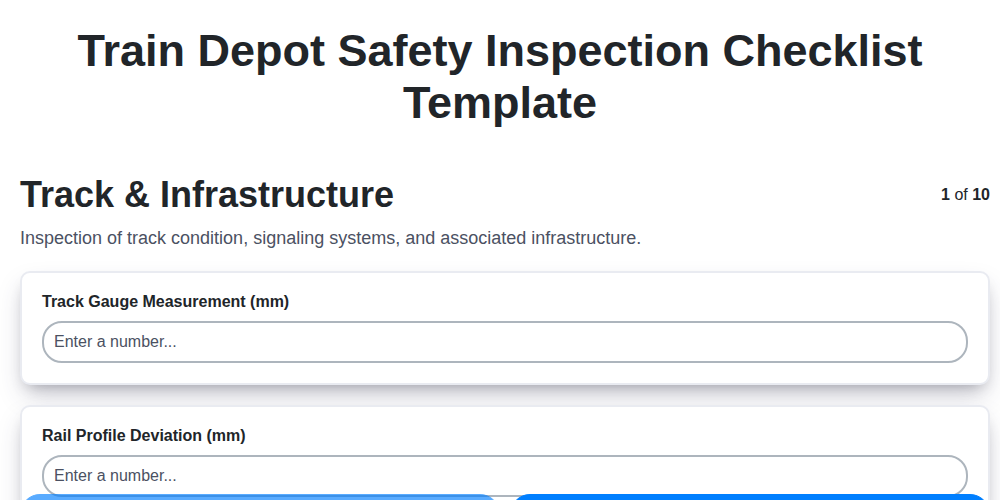
Train Depot Safety Inspection Checklist Template: Your Guide to a Safer Facility
Need help with
Checklists?
Have a question? We're here to help. Please submit your inquiry, and we'll respond promptly.