Accelerating Insurance Payouts: An Automated Claims Settlement Workflow
Published: 07/12/2026 Updated: 10/05/2026
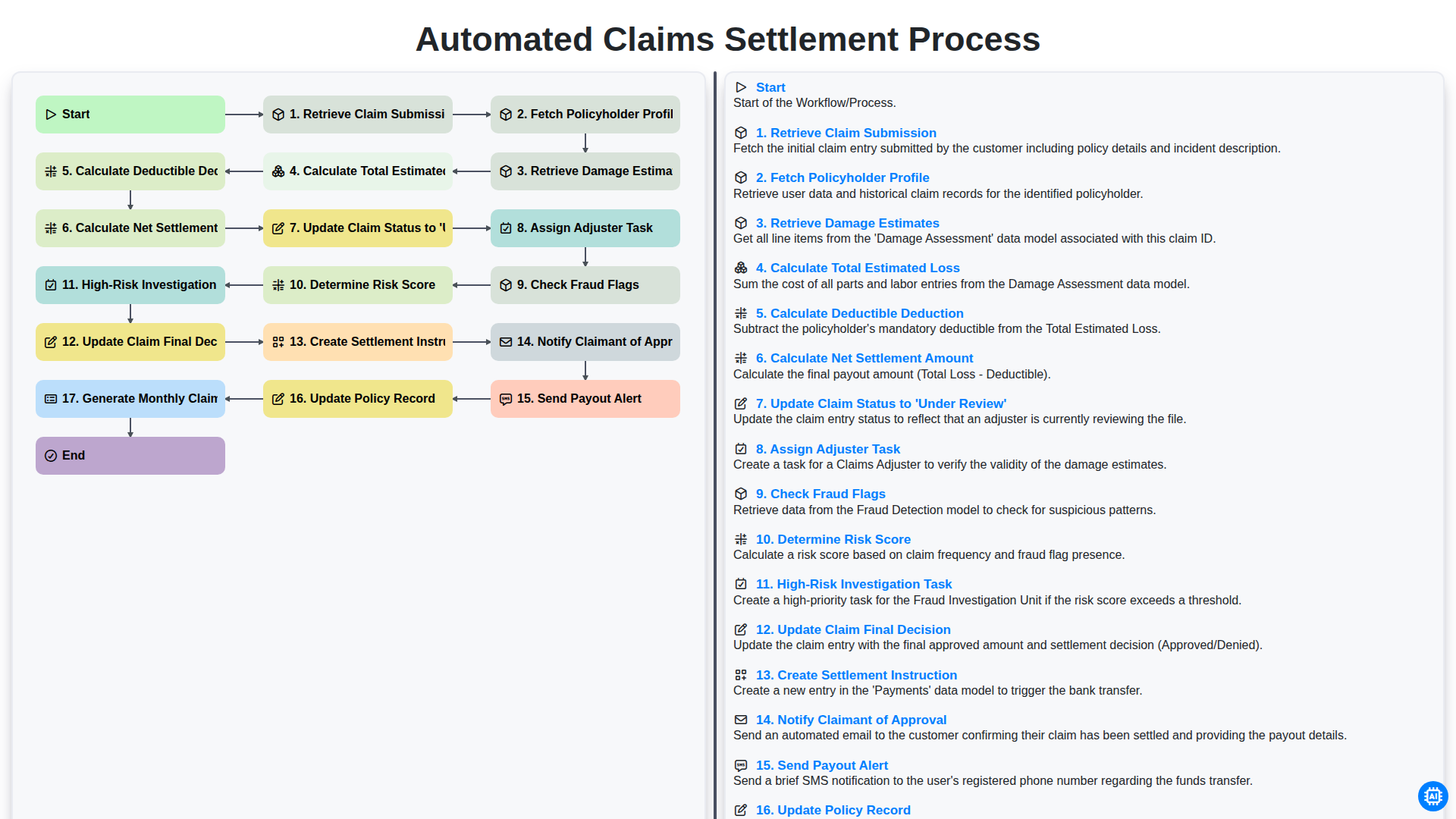
Table of Contents
- Introduction: The Shift Toward Intelligent Claims Processing
- Phase 1: Data Intake and Policy Verification
- Streamlining Initial Processing: Retrieving Submissions and Profiles
- Phase 2: Automated Damage Assessment and Valuation
- Precision Calculations: From Total Loss to Net Settlement
- Phase 3: Operational Routing and Adjuster Assignment
- Phase 4: Intelligent Risk Assessment and Fraud Detection
- Handling High-Risk Anomalies: The Investigation Trigger
- Phase 5: Finalizing the Decision and Settlement Instructions
- Phase 6: Closing the Loop: Claimant Notification and Payouts
- Phase 7: Post-Settlement Updates and Policy Synchronization
- The Value of Continuous Monitoring: Automated Reporting
- Conclusion: The Benefits of an End-to-End Automated Workflow
- Resources & Links
TLDR: Learn how to streamline your insurance operations using this automated claims settlement workflow, designed to eliminate manual bottlenecks by automating everything from initial claim retrieval and loss calculation to fraud detection and final payout notifications.
Introduction: The Shift Toward Intelligent Claims Processing
In the traditional insurance landscape, claims settlement has long been characterized by manual intervention, fragmented communication, and grueling turnaround times. For years, adjusters have been bogged down by repetitive administrative tasks-manually verifying policy details, chasing down damage estimates, and cross-referencing documentation-all of which introduce the risk of human error and significant operational bottlenecks. This hands-on approach not only inflates operational costs but also creates a friction-filled experience for policyholders who are often navigating stressful life events.
However, the industry is currently undergoing a profound transformation. The integration of intelligent automation and automated workflows is shifting the paradigm from reactive processing to proactive management. By leveraging automated claims settlement processes, insurance providers are moving away from fragmented, manual touchpoints toward a streamlined, end-to-end digital ecosystem. This evolution isn't just about speed; it is about precision, enhanced fraud detection, and the ability to deliver instantaneous decisions, ultimately redefining the standard of customer excellence in the modern era.
Phase 1: Data Intake and Policy Verification
The initial stage of an automated claims settlement workflow is critical for establishing a foundation of accuracy and trust. The process begins with Retrieving Claim Submission, where the system instantly captures incoming data from digital forms or mobile app uploads. Once the submission is received, the engine immediately moves to Fetch Policyholder Profile, cross-referencing the claim against existing databases to ensure the claimant is an active member with valid coverage.
To ensure the integrity of the claim, the system then performs a deep dive into the specifics of the incident by Retrieving Damage Estimates. By pulling real-time data from repair shop estimates or digital inspections, the workflow can begin the computational heavy lifting. This automated data gathering ensures that before any human intervention occurs, the system has a comprehensive, verified dataset ready for the next stage of financial calculation and validation.
Streamlining Initial Processing: Retrieving Submissions and Profiles
The foundation of an efficient claims lifecycle lies in the speed and accuracy of the initial intake phase. The process begins with the automated Retrieval of Claim Submissions, where incoming data from digital portals, mobile apps, or email integrations is instantly ingested into the system. By eliminating manual data entry, the risk of human error is significantly reduced from the very first second of the claim's existence.
Once the submission is captured, the workflow immediately moves to Fetching the Policyholder Profile. The system cross-references the claim data with your existing database to pull comprehensive customer details, including coverage limits, contact information, and policy history. This seamless integration ensures that the adjuster has a 360-degree view of the insured party instantly, providing the necessary context to validate the claim against the active policy terms without any manual searching.
Phase 2: Automated Damage Assessment and Valuation
Once the claim has been successfully retrieved and the policyholder's profile is verified, the workflow enters the critical stage of automated damage assessment and valuation. At this stage, the system moves beyond simple identification to deep data integration. The process begins by automatically retrieving damage estimates-often pulled directly from digital inspection reports or third-party repairer databases.
To ensure financial accuracy, the system immediately performs a series of complex, automated calculations. It first determines the total estimated loss by aggregating all identified repair costs and parts. From this gross amount, the system then calculates the deductible deduction based on the specific terms of the user's policy. The final output of this phase is the generation of the net settlement amount, providing a precise figure of the payout before any human intervention is required. By automating these mathematical validations, the system eliminates manual entry errors and significantly accelerates the timeline from initial report to final valuation.
Precision Calculations: From Total Loss to Net Settlement
Once the initial damage assessments are gathered, the workflow transitions from data collection to high-precision computation. This stage is where the core financial integrity of the claim is established through a series of automated, rule-based calculations.
The process begins by aggregating all retrieved damage estimates to Calculate the Total Estimated Loss. Rather than relying on manual entry, the system automatically sums all line items-from labor costs to parts-ensuring that no component of the damage is overlooked. Following this, the engine performs a critical Deductible Deduction step, cross-referencing the specific policy terms to subtract the user's predefined out-of-pocket responsibility from the total loss.
The final output of this computational phase is the Calculation of the Net Settlement Amount. By automating this sequence, the system eliminates the human error inherent in manual arithmetic, ensuring that the final payout figure is mathematically indisputable and perfectly aligned with the policyholder's contractual agreement. This level of precision not only accelerates the processing time but also builds foundational trust between the insurer and the claimant.
Phase 3: Operational Routing and Adjuster Assignment
Once the initial financial calculations are finalized, the workflow transitions from automated computation to active operational oversight. In this phase, the system formally updates the claim status to 'Under Review', signaling that the preliminary assessment is complete and the file is ready for human or advanced-logic intervention.
To ensure accountability and maintain momentum, the system automatically triggers an Assign Adjuster Task command, routing the claim to the appropriate professional based on complexity or workload. However, before the adjuster begins their deep dive, the workflow performs a critical security layer: it executes a simultaneous Check Fraud Flags and Determine Risk Score sequence.
By analyzing patterns and data anomalies at this exact juncture, the system can intelligently bifurcate the workflow. If the risk profile exceeds a predefined threshold, the system instantly generates a High-Risk Investigation Task, escalating the claim to the specialized fraud unit. If the risk score remains within acceptable parameters, the process continues toward the final decision-making stage, ensuring that resources are always focused where they are most needed.
Phase 4: Intelligent Risk Assessment and Fraud Detection
Once the initial financial calculations are finalized, the workflow enters its most critical stage: Intelligent Risk Assessment and Fraud Detection. At this juncture, the system transitions from mere data processing to active decision-making by evaluating the integrity of the claim.
The process begins with an automated Check for Fraud Flags, where the system scans the submission against historical data and known fraud patterns. Simultaneously, the engine will Determine a Risk Score based on variables such as claim frequency, inconsistencies in damage estimates, and policyholder history.
If the calculated score exceeds a predefined threshold, the workflow automatically triggers a High-Risk Investigation Task, rerouting the claim from the automated track to a specialized fraud unit for manual scrutiny. This automated layer of defense ensures that while simple, legitimate claims move through the pipeline with lightning speed, suspicious activities are intercepted and flagged for human expertise before any payout is authorized.
Handling High-Risk Anomalies: The Investigation Trigger
While the primary goal of automation is to accelerate the settlement lifecycle, true efficiency lies in the system's ability to pause and pivot when irregularities arise. Within this workflow, the transition from automated processing to manual oversight is governed by a sophisticated logic gate: the Check Fraud Flags and Determine Risk Score stage.
As the system processes the retrieved damage estimates and calculates the net settlement amount, it simultaneously runs the data through a series of heuristic patterns and anomaly detection algorithms. If the system detects inconsistencies-such as mismatched documentation, unusual claim frequency, or suspicious cost spikes-it generates a specific Risk Score.
When this score exceeds a predefined threshold, the workflow automatically diverts from the straight-through processing track and triggers a High-Risk Investigation Task. This critical step ensures that high-risk anomalies are intercepted by a human expert before any payout is finalized. By integrating this investigative trigger directly into the automated loop, we maintain the speed of standard claims processing while ensuring that the integrity of the insurance pool is protected by a robust, intelligence-driven safety net.
Phase 5: Finalizing the Decision and Settlement Instructions
Once the initial assessments and risk evaluations are complete, the workflow transitions into its most critical stage: determining the final outcome. During this phase, the system moves beyond analysis to action. The process begins by performing a final review to Update the Claim Final Decision, officially transitioning the claim from investigation to a resolved state.
With the decision finalized, the automation engine immediately triggers the Create Settlement Instruction step, which outlines the exact breakdown of the approved amount. To ensure transparency and maintain trust, the system simultaneously handles all necessary communications: it will Notify the Claimant of Approval and Send a Payout Alert, providing the policyholder with immediate peace of mind. Finally, the workflow ensures backend integrity by performing an automated Update to the Policy Record, ensuring that all financial and claim data is synchronized across your enterprise systems for accurate auditing and future renewals.
Phase 6: Closing the Loop: Claimant Notification and Payouts
Once the decision-making process is complete, the workflow shifts from investigation to execution. The final automated steps are critical for maintaining customer trust and ensuring transparency.
First, the system automatically generates the Settlement Instruction, turning the approved claim data into an actionable payment order. To ensure the claimant is kept informed without manual intervention, the system triggers an automated Notification of Approval, providing the user with a clear breakdown of the settlement details.
Simultaneously, a Payout Alert is dispatched to the finance department or integrated payment gateway to initiate the transfer of funds. As the funds are processed, the system performs a final administrative sweep: it Updates the Policy Record to reflect the claim history and integrates the data into the Monthly Claims Report. This end-to-end automation ensures that while the claimant receives their funds swiftly, the company maintains perfect, real-time visibility into its total loss exposure and operational performance.
Phase 7: Post-Settlement Updates and Policy Synchronization
Once the claim decision is finalized and the settlement instructions are generated, the workflow transitions into its final, critical stage: synchronization. This phase ensures that the administrative side of the claim reflects the real-world outcome, maintaining the integrity of both the claim file and the underlying insurance contract.
The process begins with the automatic notification of the claimant, providing transparency and immediate peace of mind upon approval. Simultaneously, the system triggers a payout alert to the finance department or banking interface to ensure timely fund disbursement. To maintain a single source of truth, the system automatically updates the policy record, ensuring that any changes to the policyholder's coverage or limits are accurately reflected following the settlement.
Finally, the workflow concludes with high-level data aggregation. The system automatically incorporates the processed claim data into the Generate Monthly Claims Report. This allows stakeholders to monitor loss ratios, identify emerging trends, and ensure that the automated pipeline is performing with the precision and speed required to maintain operational excellence.
The Value of Continuous Monitoring: Automated Reporting
Automation doesn't end once a claim is settled; its true power lies in the intelligence it generates through continuous oversight. The final stage of our automated workflow, the Generate Monthly Claims Report step, transforms raw transactional data into actionable business intelligence.
By automatically aggregating data from every processed claim, the system provides a real-time window into organizational performance. This continuous monitoring allows stakeholders to track trends in loss frequency, average settlement costs, and adjuster turnaround times without manual intervention. Rather than waiting for end-of-quarter manual audits, leadership can identify emerging fraud patterns or operational bottlenecks the moment they arise. This transition from reactive oversight to proactive, data-driven decision-making ensures that the claims process is not just faster, but smarter and more resilient.
Conclusion: The Benefits of an End-to-End Automated Workflow
Transitioning from a manual, fragmented process to a fully automated claims settlement workflow is more than just a technical upgrade-it is a strategic transformation. By integrating every stage from initial submission to final payout, insurance providers can eliminate the bottlenecks that traditionally lead to delays and human error.
The benefits of this end-to-end automation are multifaceted:
- Accelerated Cycle Times: By automating repetitive tasks like calculating deductibles and updating policy records, the time-to-settlement is drastically reduced, ensuring claimants receive their funds faster.
- Enhanced Accuracy and Compliance: Automated calculations for loss estimates and net settlements remove the risk of manual entry errors, while standardized logic ensures that every claim is handled according to strict regulatory and policy guidelines.
- Proactive Risk Management: Integrating automated fraud detection and risk scoring allows your team to focus their expertise where it is needed most. Instead of manually auditing every claim, adjusters are strategically alerted only to high-risk investigations, optimizing resource allocation.
- Improved Customer Trust: Real-time notifications and seamless payout alerts transform the claimant experience, turning a traditionally stressful event into a smooth, transparent, and professional interaction.
- Data-Driven Decision Making: With every step-from task assignment to final decision-automatically logged and aggregated into monthly reports, leadership gains unprecedented visibility into operational performance and departmental efficiency.
Ultimately, implementing this automated workflow empowers your adjusters to move away from administrative drudgery and focus on high-value decision-making, driving both operational excellence and long-term customer loyalty.
Resources & Links
- McKinsey & Company: Insurance Digital Transformation: Insights into how automation and AI are reshaping the insurance claims landscape and driving operational efficiency.
- Forrester Research: Claims Automation Trends: Market research and analysis on the impact of intelligent automation on the insurance value chain.
- Gartner: Hyperautomation in Insurance: Research on implementing hyperautomation to streamline complex workflows and reduce manual intervention in claims.
- Insurance Information Institute (III): Industry resources and data regarding claims processing standards and technological advancements in the insurance sector.
- IBM Watson: AI in Claims Processing: Technical deep dives into using machine learning for fraud detection and automated risk scoring in insurance.
- PwC: The Future of Claims Management: Strategic perspectives on digitalizing the claims experience to improve customer satisfaction and settlement speed.
Frequently Asked Questions
What is an automated claims settlement workflow?
An automated claims settlement workflow is a digital process that uses technologies like AI, machine learning, and RPA to handle insurance claims from initial filing to final payout with minimal manual intervention.
How does automation accelerate insurance payouts?
Automation accelerates payouts by enabling instant data validation, automated fraud detection, and rapid decision-making, which eliminates the delays caused by manual document review and human processing bottlenecks.
What are the primary benefits of implementing an automated workflow for insurers?
The primary benefits include significantly reduced operational costs, improved accuracy in claims processing, enhanced customer satisfaction through faster service, and better risk management through automated fraud detection.
Can automated systems accurately detect fraudulent claims?
Yes, automated workflows can integrate advanced machine learning algorithms that analyze patterns and anomalies in claim data to flag suspicious activities much faster and more accurately than manual audits.
What are the main challenges in transitioning to an automated claims process?
Key challenges include integrating new software with legacy insurance systems, ensuring data privacy and security, managing the initial high cost of implementation, and retraining staff to work alongside automated systems.
Comments
There are no comments yet. Be the first to add one!
Insurance Management Solution Demo
Managing policies, claims, and compliance in the insurance industry is complex. ChecklistGuro's Work OS platform streamlines your operations, from underwriting and renewals to claims processing and reporting. Improve efficiency, reduce errors, and enhance customer satisfaction. Discover how ChecklistGuro can transform your insurance business!
Related Articles
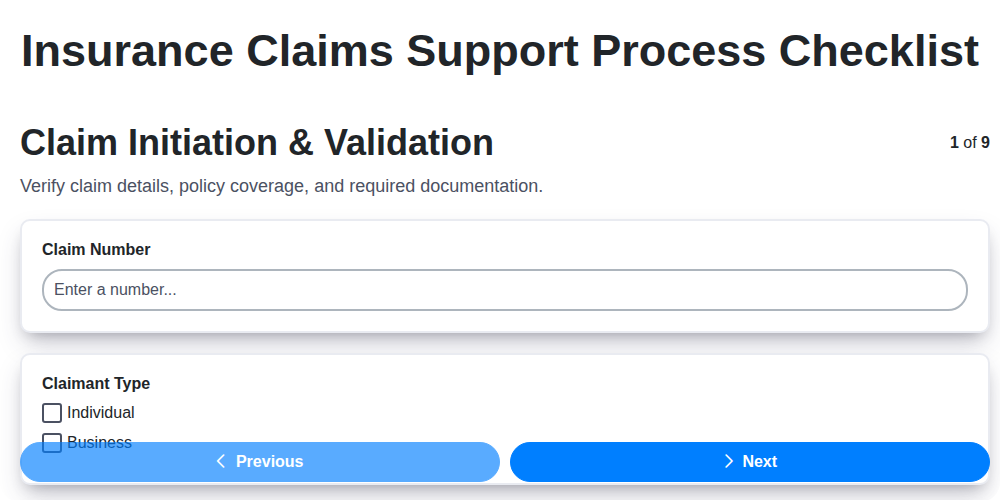
Streamline Claims: Your Insurance Claims Support Process Checklist Template
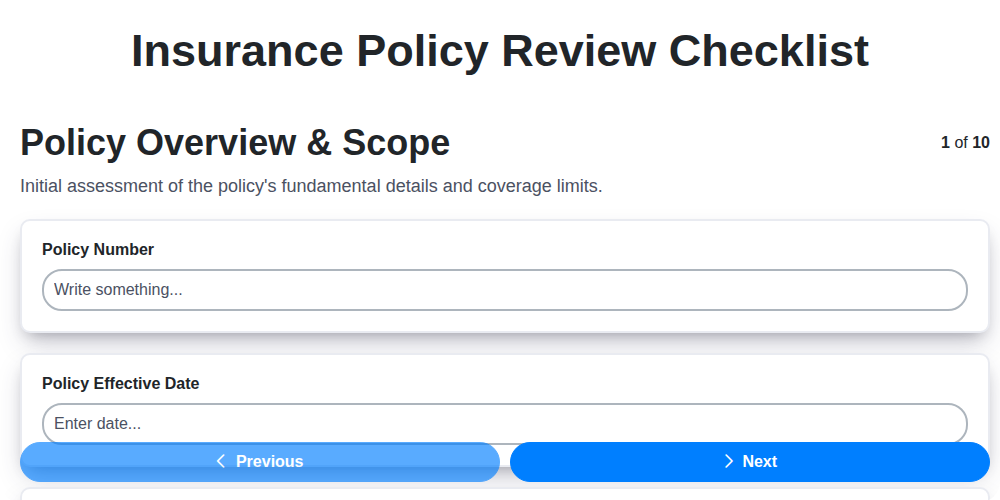
Your Insurance Policy Review Checklist: A Step-by-Step Guide
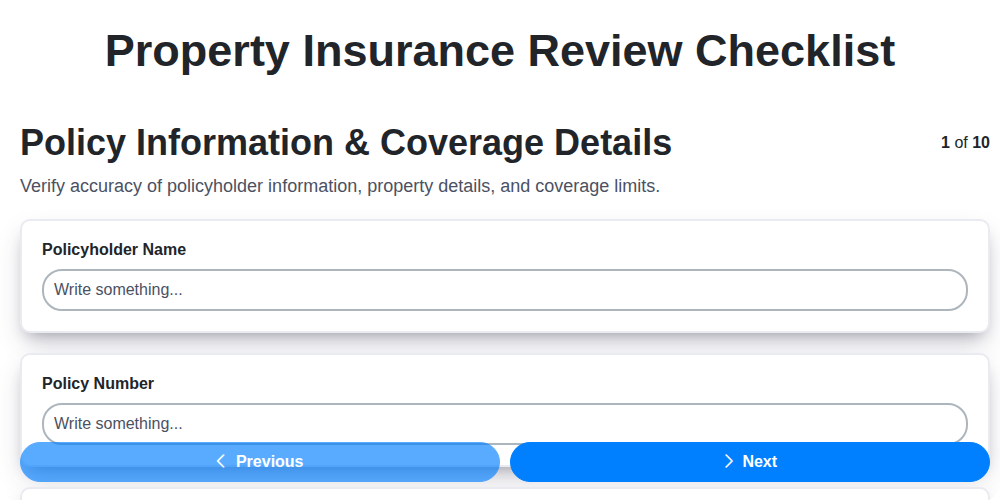
Your Property Insurance Review Checklist: A Step-by-Step Guide
Your Title Search & Insurance Checklist Template
Simplify Insurance Verification: Your Free Dental Checklist Template
Crop Insurance Policy Review Checklist: A Farmer's Guide

The Ultimate Vehicle Registration & Insurance Validation Checklist
Mastering the Policyholder Journey: Your Insurance Experience Survey Checklist
We can do it Together
Need help with
Checklists?
Have a question? We're here to help. Please submit your inquiry, and we'll respond promptly.