A Step-by-Step Guide to Compensation and Salary Structure Management
Published: 06/18/2026 9:00 PM Updated: 06/19/2026 11:50 AM
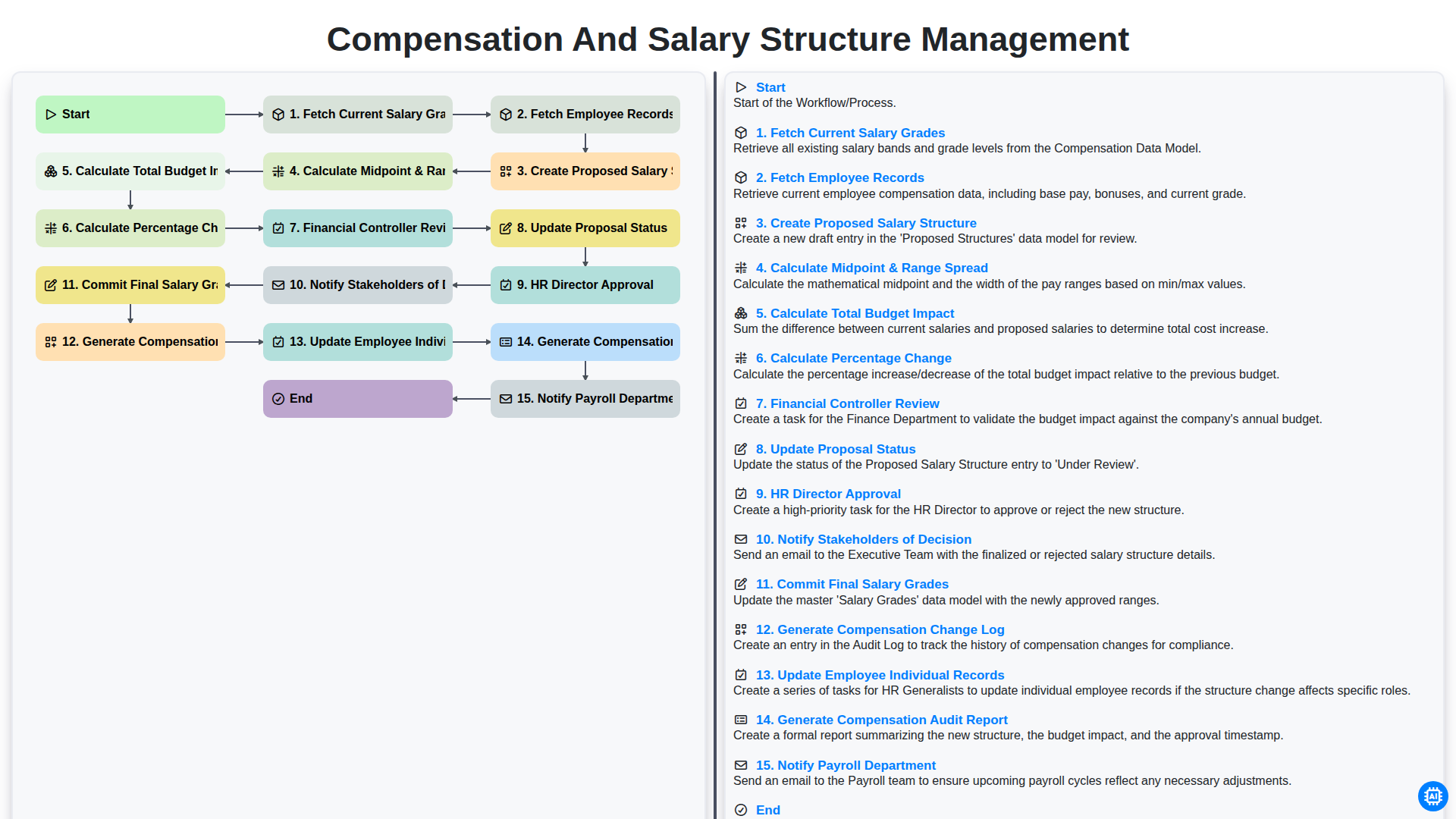
Table of Contents
- Introduction to Compensation and Salary Structure Management
- Phase 1: Data Gathering and Baseline Assessment
- Step 1: Fetching Current Salary Grades and Employee Records
- Phase 2: Designing the Proposed Salary Structure
- Step 2: Determining Midpoints and Range Spreads
- Phase 3: Financial Impact Analysis
- Step 3: Calculating Budget Impact and Percentage Changes
- Phase 4: The Approval and Review Workflow
- Step 4: Financial Controller Review and Status Updates
- Step 5: Final HR Director Approval and Stakeholder Notification
- Phase 5: Implementation and System Updates
- Step 6: Committing Final Grades and Updating Individual Records
- Phase 6: Documentation, Auditing, and Payroll Integration
- Conclusion: Ensuring Compliance through Compensation Auditing
- Resources & Links
TLDR: Learn how to streamline your compensation planning with this comprehensive guide to our Salary Structure Management workflow. Discover how to automate everything from fetching employee records and calculating budget impacts to securing executive approvals and notifying payroll, ensuring a seamless, audit-ready transition to new salary grades.
Introduction to Compensation and Salary Structure Management
Managing an organization's compensation strategy is one of the most complex and high-stakes responsibilities for any HR or Finance leader. A well-structured salary framework does more than just ensure fairness; it serves as a strategic tool for attracting top talent, retaining high performers, and maintaining long-term fiscal sustainability. However, moving from a legacy pay model to a modernized, data-driven structure is a meticulous process that requires much more than simple decision-making-it requires a rigorous, repeatable, and auditable workflow.
Effective compensation and salary structure management involves the seamless integration of employee data, market benchmarks, and budgetary constraints. It is a delicate balancing act between competitive market positioning and the financial reality of the company's bottom line. To achieve this, organizations must move away from manual, fragmented spreadsheets and toward a standardized lifecycle-one that encompasses everything from the initial retrieval of current salary grades to the final, automated notification of the payroll department.
In this article, we will break down the end-to-end workflow of restructuring compensation. We will explore how a systematic approach-encompassing data collection, mathematical modeling, multi-level financial oversight, and post-implementation auditing-can transform compensation from a source of administrative friction into a streamlined engine for organizational growth.
Phase 1: Data Gathering and Baseline Assessment
The foundation of any successful compensation overhaul lies in the accuracy of the underlying data. Before any strategic decisions can be made, the process must begin with a rigorous period of Data Gathering and Baseline Assessment. This phase is dedicated to establishing a clear, data-driven picture of your organization's current financial and structural landscape.
The workflow initiates with two critical foundational steps: Fetching Current Salary Grades and Fetching Employee Records. By pulling existing salary grades, the system establishes the current benchmarks and pay ranges presently in use. Simultaneously, pulling comprehensive employee records ensures that every individual's current compensation, tenure, and role details are accounted for.
This stage is not merely about collecting numbers; it is about creating a single source of truth. Without an exhaustive audit of your current state, any proposed changes would be built on a fragmented foundation, risking inaccuracies that could lead to budget overruns or internal inequities. This phase ensures that the subsequent analysis is grounded in real-world, real-time organizational data.
Step 1: Fetching Current Salary Grades and Employee Records
The foundation of any successful compensation restructuring lies in the accuracy of your baseline data. The process begins with two critical data-gathering phases: Fetching Current Salary Grades and Fetching Employee Records.
Before any new strategy can be formulated, the system must first pull the existing salary architecture to understand the current landscape of pay bands, minimums, and maximums. This step ensures that the proposed changes are grounded in the company's historical context and current market positioning.
Simultaneously, the workflow retrieves comprehensive employee records. This involves more than just looking at base pay; it includes pulling data on current position levels, tenure, existing performance ratings, and any existing market adjustments. By integrating these two datasets, the organization gains a clear, unified view of the as-is state. This ensures that the upcoming analysis is not performed in a vacuum, but is instead tailored to the actual distribution of talent and the specific complexities of your current workforce.
Phase 2: Designing the Proposed Salary Structure
Once the foundation of your current compensation landscape is established through the retrieval of existing salary grades and employee records, the focus shifts from analysis to architectural design. This phase is the heart of the compensation overhaul, where the blueprint for future growth and internal equity is drafted.
The process begins with the creation of a Proposed Salary Structure, a strategic framework designed to align your organization's financial capabilities with market competitiveness. Rather than simply adjusting numbers, this step involves defining new compensation bands that reflect the evolving value of roles within the company. To ensure these new structures are mathematically sound and sustainable, two critical calculations must be performed:
- Calculating Midpoint & Range Spread: We determine the precise anchor for each grade (the midpoint) and establish an appropriate spread (the distance between the minimum and maximum). This ensures there is enough room to grow for employees within a single grade while maintaining a logical progression between levels.
- Calculating Total Budget Impact: A new structure is only viable if it is affordable. We quantify the exact financial implications of moving employees from their current positions into the new proposed grades.
The final component of this phase is a Percentage Change Analysis. By calculating the variance between the current spend and the proposed spend, leadership can immediately visualize the scale of the investment required. This data-driven approach ensures that the proposed structure is not just a theoretical ideal, but a practical, actionable plan ready for fiscal scrutiny.
Step 2: Determining Midpoints and Range Spreads
Once the proposed salary structure has been drafted, the next critical phase involves defining the mathematical boundaries of each pay grade. This stage, Calculating Midpoints and Range Spread, is where the theoretical structure meets financial reality.
The midpoint serves as the anchor for each salary grade, typically representing the market-competitive rate for a fully competent performer in that specific role. To determine this, compensation analysts align the midpoint with external market data to ensure the organization remains competitive within the industry.
Following the establishment of the midpoint, we apply the range spread (or range width). The spread determines the distance between the minimum and maximum pay limits for a single grade. A well-calibrated spread is essential for providing employees with a clear path for merit-based progression. For instance, lower-level roles may have a narrower spread (e.g., 30-40%) to allow for rapid movement, while senior executive roles often feature a wider spread (e.g., 50-60%) to accommodate long-term retention and significant performance-based increases.
By precisely calculating these boundaries, the workflow ensures that the new structure is not just a collection of numbers, but a functional tool that provides both fiscal discipline and a meaningful opportunity for upward mobility within the company.
Phase 3: Financial Impact Analysis
Once the proposed salary structure has been drafted, the workflow shifts from structural design to rigorous financial validation. This stage is critical to ensure that the proposed adjustments are not only competitive but also fiscally sustainable for the organization.
The process begins with calculating the Total Budget Impact, which provides a macro view of the overall increase in the company's annual payroll obligations. To provide necessary context for leadership, the system then calculates the Percentage Change required to move from the current state to the proposed structure. This metric allows stakeholders to understand the relative scale of the investment and helps in comparing the proposal against annual budgetary constraints.
By quantifying the financial implications immediately after the structural design, the organization can identify potential budget overruns early, allowing for real-time adjustments to the midpoint or range spreads before the proposal reaches the final approval stages.
Step 3: Calculating Budget Impact and Percentage Changes
Once the initial proposed salary structure is drafted and the midpoints and range spreads are established, the workflow shifts from structural design to financial validation. This stage is critical because even the most well-designed compensation plan is unsustainable if it exceeds the organization's fiscal capacity.
In this phase, the system performs two vital calculations:
- Total Budget Impact: The workflow aggregates the cumulative cost of all proposed adjustments. This includes not just the base salary increases, but also the total delta between current salary grades and the new proposed midpoints. This allows leadership to see the absolute dollar amount required to implement the new structure.
- Percentage Change: To provide context to the budget impact, the system calculates the percentage increase relative to the existing payroll. This metric is essential for comparing the proposal against annual merit budgets and inflation targets.
By automating these calculations immediately after defining the range spreads, the workflow ensures that the proposed structure is grounded in financial reality. This prevents the proposal fatigue that occurs when HR submits much-needed compensation updates only to have them rejected due to unforeseen budgetary strain. This data-driven approach provides the Financial Controller with the transparency needed for an informed review.
Phase 4: The Approval and Review Workflow
Once the calculations and proposed structures are finalized, the workflow transitions from the analytical stage to the critical governance phase. This stage is designed to ensure financial accountability, organizational alignment, and cross-departmental transparency through a rigorous multi-layer review process.
The process begins with a formal Financial Controller Review, where the proposed budget impact and percentage changes are scrutinized to ensure they align with the company's fiscal year projections and liquidity constraints. Following this financial validation, the workflow moves to the HR Director Approval stage, where the leadership evaluates the new salary grades for internal equity and market competitiveness.
To maintain organizational transparency, the workflow automatically Updates the Proposal Status and triggers a notification to Notify Stakeholders of the Decision, ensuring that department heads and management are informed of upcoming structural shifts.
Once the final decision is ratified, the system moves into the execution phase: Committing the Final Salary Grades to the master database and Updating Employee Individual Records. To maintain a robust audit trail, the system automatically Generates a Compensation Change Log and a comprehensive Compensation Audit Report. The final step in this phase is to Notify the Payroll Department, ensuring that the transition from new grades to actual disbursements is seamless, accurate, and ready for the next pay cycle.
Step 4: Financial Controller Review and Status Updates
Once the initial calculations for the budget impact and percentage changes are finalized, the workflow moves into a critical stage of fiscal oversight: the Financial Controller Review. At this juncture, the proposed salary structure transitions from a theoretical HR model to a financial reality check. The Financial Controller scrutinizes the total budget impact to ensure that the proposed adjustments align with the organization's annual fiscal constraints and long-term profitability goals.
During this phase, the system manages the Update Proposal Status step, providing real-time visibility into the decision-making pipeline. If the Controller identifies discrepancies or budget overages, the status is reverted for adjustments; if the numbers align with the company's financial roadmap, the proposal advances. This checkpoint serves as a vital safeguard, ensuring that compensation growth is both competitive for talent retention and sustainable for the company's bottom line.
Step 5: Final HR Director Approval and Stakeholder Notification
Once the financial implications have been vetted and the proposal has passed the rigorous review of the Financial Controller, the workflow moves into its critical decision-making phase. The HR Director Approval step serves as the final strategic checkpoint, ensuring that the proposed salary adjustments align not only with the company's budgetary constraints but also with its long-term talent retention goals and internal equity standards.
After the HR Director grants formal approval, the workflow transitions from planning to communication. The Notify Stakeholders of Decision step is vital for maintaining transparency and trust across the organization. At this stage, relevant department heads and managers are informed of the approved changes, allowing them to prepare for upcoming discussions with their respective teams. This ensures that leadership is aligned and equipped to manage the human element of compensation changes effectively.
Phase 5: Implementation and System Updates
Once the compensation proposal has transitioned from a draft to an approved mandate, the focus shifts from strategic planning to execution. This final phase, Implementation and System Updates, is the most critical stage for ensuring data integrity and organizational transparency. It is the moment where theoretical adjustments become official personnel records.
The process begins with the formal commitment of the final salary grades into your core HRIS (Human Resources Information System). This ensures that the new structures are the single source of truth for all future compensation planning. Following this, the system must generate a comprehensive Compensation Change Log. This log serves as a vital audit trail, documenting exactly what was changed, when it was changed, and who authorized the modification, providing essential transparency for internal audits.
Accuracy in this stage is paramount to maintaining employee trust. Therefore, the workflow must trigger an automated update of individual employee records, ensuring that every person's profile reflects their new salary position in real-time. To close the loop and maintain financial oversight, the process culminates in two final, essential actions: the generation of a Compensation Audit Report for leadership review and the notification of the Payroll Department. By integrating these steps into a seamless automated workflow, you eliminate the risk of manual entry errors and ensure that the new compensation structure is reflected accurately in the very next pay cycle.
Step 6: Committing Final Grades and Updating Individual Records
Once the compensation proposal has navigated the rigorous approval cycle-from the Financial Controller's audit to the HR Director's final sign-off-the workflow transitions from a state of planning to a state of execution. This stage, known as Committing Final Salary Grades, is the critical point of no return where the proposed structure is formally integrated into your organization's compensation architecture.
During this phase, the system moves the data from a draft or proposed state into your live compensation framework. This is not merely a clerical update; it is a permanent structural change that establishes the new benchmarks for every eligible role within the company.
Following the commitment of the new grades, the workflow triggers the Update Employee Individual Records sequence. This is where the macro-level structural changes meet the micro-level employee reality. The system automatically maps the newly approved grades to individual employee profiles, ensuring that each person's current positioning-whether they are leading the range, trailing, or sitting at the midpoint-is recalculated based on the new parameters. This automation eliminates the risk of manual entry errors and ensures that every employee's compensation profile remains perfectly synchronized with the updated organizational strategy.
Phase 6: Documentation, Auditing, and Payroll Integration
Once the final salary grades are committed and the approval process is complete, the workflow moves into its most critical stage: formalizing the changes and ensuring systemic alignment. This phase is designed to transform a strategic decision into an actionable, audited, and transparent record within your organization's ecosystem.
The process begins with the generation of a Compensation Change Log, a detailed ledger that captures the who, what, and when of every adjustment made during the restructuring. This is immediately followed by the Update of Individual Employee Records, ensuring that every single person's profile reflects their new compensation standing in real-time, preventing any discrepancies between the new structure and actual personnel data.
To maintain high standards of governance, a Compensation Audit Report is automatically generated. This report serves as a vital tool for internal controls, allowing leadership to verify that the implementation aligns perfectly with the approved budget and the original proposal. It provides a clear trail of accountability, which is essential for both internal compliance and external regulatory audits.
The final, and perhaps most operationally significant, step is the Notification of the Payroll Department. By bridging the gap between HR strategy and financial execution, this step ensures that the new salary structures are seamlessly integrated into the next pay cycle. This automated handoff eliminates the risk of manual entry errors and ensures that all employees receive their accurate, updated compensation on time, closing the loop on the entire management workflow.
Conclusion: Ensuring Compliance through Compensation Auditing
Effective compensation management is not merely about balancing the books; it is about establishing a transparent, defensible, and scalable framework for organizational growth. By automating the workflow-from the initial retrieval of salary grades to the final generation of a compensation audit report-organizations can move away from fragmented spreadsheets and toward a single source of truth.
The final stages of this process, specifically the generation of a compensation change log and the production of comprehensive audit reports, serve as the cornerstone of regulatory compliance. These automated logs provide an immutable trail of every adjustment, approval, and budgetary impact, ensuring that when internal or external auditors review your payroll practices, you can demonstrate that every salary change was driven by data, vetted by leadership, and executed within the approved budget. Ultimately, a structured, end-to-end compensation workflow mitigates the risk of pay inequity and provides the financial oversight necessary to maintain long-term organizational integrity.
Resources & Links
- SHRM (Society for Human Resource Management): The leading professional resource for HR professionals, providing templates, compliance guides, and best practices for compensation structuring and salary grading.
- Gartner HR Research: Access deep-dive analytics and strategic insights into compensation trends, budget modeling, and organizational design frameworks.
- Payscale Data & Benchmarking: A vital resource for verifying market competitiveness, midpoints, and salary range spreads against industry-specific benchmarks.
- Workday Compensation Management: An industry-standard look at how enterprise-level software automates the workflow from data gathering to payroll integration and audit logging.
- Investopedia: Financial Analysis Basics: Essential reading for understanding the financial implications of budget impact calculations and percentage change analysis during the controller review phase.
- Advisory Board - Compensation Strategy: Provides expert guidance on managing the change management aspect of salary updates and notifying stakeholders during organizational shifts.
Found this Article helpful?
Comments
There are no comments yet. Be the first to add one!
HRM - Human Resources Management Solution Demo
Simplify HR processes & empower your team! ChecklistGuro's HRM solution streamlines onboarding, performance management, & compliance. Improve employee engagement, reduce admin burden, & drive organizational growth. Manage it all with our Work OS.
Related Articles
Independent Contractor Compliance Checklist Template for HR

HR's Guide to Workplace Safety: Your Compliance Checklist Template
The Ultimate Employee Exit Interview Checklist (HR Edition)
EEO Compliance Checklist Template for HR
The Ultimate HR Audit Checklist Template: Your Guide to Compliance

Paper vs ChecklistGuro in Human Resources Management

Your Guide to Employee Training Compliance: A Free Checklist for HR
Your Ultimate Employee Onboarding Checklist Template
We can do it Together
Need help with
Checklists?
Have a question? We're here to help. Please submit your inquiry, and we'll respond promptly.