Independent Contractor Compliance Checklist Template for HR
Published: 10/16/2025 Updated: 12/13/2025
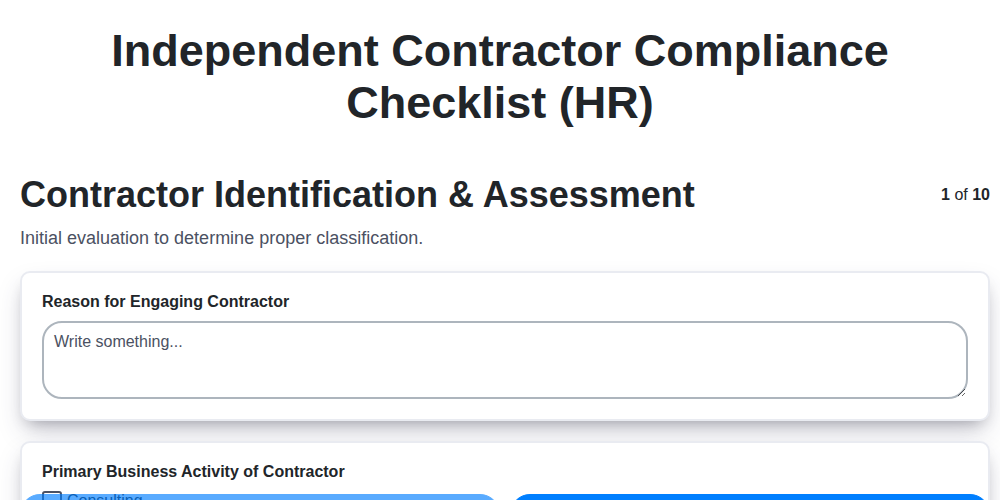
Table of Contents
- Why Independent Contractor Compliance Matters to HR
- Understanding the Risks of Worker Misclassification
- Independent Contractor vs. Employee: Key Distinctions
- Independent Contractor Compliance Checklist Template
- 1. Contractor Identification & Assessment
- 2. Establishing a Solid Written Contract
- 3. Payment and Tax Withholding Procedures
- 4. Maintaining Control: Direction and Supervision
- 5. Equipment, Resources, and Workspace Considerations
- 6. Intellectual Property Rights and Ownership
- 7. Insurance and Liability Requirements
- 8. Ongoing Compliance Reviews and Documentation
- 9. Mitigating Misclassification Risk: Best Practices
- 10. Utilizing Resources: IRS and State Agency Guidance
- 11. Staying Updated: Changes in Regulations and Laws
- 12. HR's Role in Fostering Contractor Compliance
- 13. Seeking Legal and Tax Expertise
- Resources & Links
TLDR: This checklist template is your quick guide to legally classifying and managing independent contractors. It covers key areas like contracts, payment, control, and risk mitigation, helping HR avoid costly misclassification penalties. Download it and keep your contractor relationships compliant!
Why Independent Contractor Compliance Matters to HR
For HR, independent contractor compliance isn't just a legal checkmark - it's a critical function safeguarding the organization's financial health and reputation. A single misclassification can trigger a cascade of consequences, from hefty back taxes and penalties from the IRS and state agencies to potential lawsuits alleging unpaid wages, benefits, and overtime. Beyond the direct financial impact, misclassification erodes trust and exposes the company to significant legal risks. Proactive compliance demonstrates a commitment to ethical labor practices and minimizes disruption to business operations. Effectively managing contractor relationships reduces the likelihood of audits and investigations, allowing HR to focus on strategic initiatives rather than reactive crisis management. Ultimately, a robust independent contractor compliance program protects the company's assets and reinforces its commitment to legal and ethical conduct.
Understanding the Risks of Worker Misclassification
The consequences of misclassifying employees as independent contractors extend far beyond a simple paperwork correction. For businesses, these errors can trigger a cascade of legal and financial repercussions, often disproportionate to the perceived "savings" achieved by avoiding payroll taxes and benefits.
The IRS and various state agencies actively scrutinize worker classifications, and audits can be costly and disruptive. Penalties can include back taxes, interest, and fines for unpaid payroll taxes - Social Security, Medicare, and unemployment taxes. Beyond federal repercussions, many states have their own stringent rules and penalties for misclassification.
Furthermore, misclassified workers may pursue legal action against your company. They can file lawsuits claiming unpaid overtime, wrongful termination, and a denial of employee benefits like health insurance and paid time off. Successfully defending against such claims can be expensive and time-consuming, even if the lawsuit is ultimately dismissed. The reputational damage from a public legal battle can also significantly impact your business. Simply put, the risk profile associated with worker misclassification vastly outweighs any perceived short-term benefits.
Independent Contractor vs. Employee: Key Distinctions
Understanding the legal nuances between classifying a worker as an independent contractor versus an employee can feel like navigating a maze. It's more than just semantics; incorrect classification carries significant legal and financial consequences. Here's a breakdown of the core distinctions, considering factors often examined by the IRS and state agencies:
1. Behavioral Control: This focuses on how much direction and control you exert over the worker. Employees are typically subject to close supervision and detailed instructions. Independent contractors, conversely, are expected to perform tasks with a degree of autonomy and self-direction. Do you dictate how the work gets done, or just the desired outcome?
2. Financial Control: This looks at aspects like payment method, investment in tools and equipment, and opportunity for profit or loss. Employees typically receive a regular wage or salary, while independent contractors are often paid a project-based fee. Contractors typically incur business expenses, while employees generally do not. Do they have significant investment in the work, or are they simply providing labor?
3. Relationship of the Parties: This examines the nature of the ongoing relationship. Employees often receive benefits (health insurance, paid time off) and are part of the company's workforce. Independent contractors typically have a more transactional relationship, engaging for specific projects or tasks and lacking the same level of integration into the company structure. Is the relationship continuous and integral to your business?
The Right to Control - A Key Concept: Ultimately, the IRS assesses whether you, as the business, have the right to control not just what work is done, but also how it is done. Even if you don't actively exercise that right, the potential for control is a significant factor in determining worker classification.
Independent Contractor Compliance Checklist Template
Navigating the complexities of independent contractor classification can feel overwhelming. To simplify the process and ensure your business remains compliant, we're providing this handy checklist template. This isn't a substitute for legal advice, but a starting point for your due diligence. Download the template below and adapt it to fit your specific needs and project scopes.
Checklist Fields:
- Contractor Name:
- Project/Service Description:
- Date of Agreement:
- Assessment Date:
- Control & Direction Assessment (Yes/No/N/A): Briefly explain rationale.
- Equipment & Resources Assessment (Contractor Provided/Company Provided/Hybrid): Describe resources used.
- Intellectual Property Ownership (Contractor/Company/Shared): Detail ownership terms.
- Insurance Coverage Verification (Yes/No - Attach Copy): Date of verification.
- 1099-NEC Issuance (Yes/No): Date issued.
- Reviewer Name & Signature:
- Notes/Comments:
Using the Template Effectively:
- Regular Reviews: Schedule regular reviews of this checklist - at least annually - to ensure continued compliance.
- Documentation is Key: Thoroughly document all assessments and justifications.
- Customize for Each Contractor: Each contractor relationship is unique. Tailor the checklist to reflect the specific terms of engagement.
Remember to consult with a legal and tax professional for personalized advice regarding independent contractor classification.
1. Contractor Identification & Assessment
It's tempting to simply grab the first freelancer who appears online, but a thorough assessment is the first line of defense against misclassification. Go beyond a website and LinkedIn profile. Consider these crucial points:
1. Business Operations: Does the individual operate as a genuine business? Look for evidence like a business license, EIN (Employer Identification Number), dedicated business bank account, and multiple clients. A freelancer who only works for your company is a red flag.
2. Control and Independence: Observe how they approach their work. Do they have established processes, manage their own schedule, and dictate their working methods, or do they require constant direction and supervision? True contractors value their autonomy.
3. Marketing and Client Acquisition: How do they find new work? Contractors actively market their services and seek opportunities, whereas employees are assigned tasks.
4. Investment and Expenses: Do they invest in their business - equipment, software, training - and deduct related expenses? This demonstrates entrepreneurial involvement.
5. Written Agreements are Essential: Never assume. Always document your understanding of their business status in a comprehensive written agreement (see section 2).
2. Establishing a Solid Written Contract
A well-drafted contract is your first line of defense against misclassification claims. It's more than just paperwork; it's a clear statement of the working relationship and expectations. Here's what your independent contractor agreement should include:
- Clear Scope of Work: Detail the specific services the contractor will provide, deliverables, and project timelines. Avoid vague language - specificity is key.
- Independent Contractor Status Declaration: Explicitly state that the individual is an independent contractor and not an employee. This reinforces the nature of the relationship.
- Payment Terms and Invoicing: Outline the agreed-upon rates, payment schedule, and accepted methods of invoicing.
- Termination Clause: Define the conditions under which either party can terminate the agreement, including notice periods.
- Intellectual Property Ownership: Clearly state who owns the intellectual property rights to any work created during the project. Generally, contractors retain ownership unless specifically assigned.
- Confidentiality Agreement (NDA): Protect your sensitive information by including a confidentiality agreement that outlines what information the contractor is restricted from sharing.
- Indemnification Clause: Address liability and protect your business from potential claims arising from the contractor's work. (Consult with legal counsel on this.)
- Governing Law: Specify the state law that will govern the interpretation and enforcement of the agreement.
Pro Tip: Don't use generic, online templates without review. Consult with an attorney to customize the agreement to your specific needs and ensure it complies with applicable laws.
3. Payment and Tax Withholding Procedures
Understanding payment procedures and tax withholding (or the lack thereof) for independent contractors is crucial for avoiding penalties and maintaining a compliant business. Here's a breakdown of what you need to know:
1099-NEC Reporting: The Foundation
If you pay an independent contractor $600 or more during the tax year, you're legally required to issue them a Form 1099-NEC. This form reports the total amount paid for their services to both the contractor and the IRS. Accurate and timely reporting is essential.
No Payroll Tax Withholding - But Proceed with Caution
Unlike employees, independent contractors are responsible for paying their own federal, state, and local taxes, including Social Security and Medicare. This means you generally do not withhold payroll taxes from their payments. However, this is a key area for scrutiny. Ensure the individual genuinely qualifies as an independent contractor; misclassification can lead to retroactive tax obligations. Always consult with a qualified tax professional to confirm your classification and withholding obligations.
Payment Methods and Best Practices:
- Direct Payment to Business: Payments should be made directly to the contractor's business entity (e.g., LLC, sole proprietorship), not to an individual's personal account.
- Detailed Invoices: Require detailed invoices that include the contractor's business name, address, and tax identification number (EIN or SSN).
- Record Keeping: Maintain meticulous records of all payments, invoices, and related documentation.
- Avoid Reimbursements That Resemble Wages: Be cautious about reimbursing contractors for expenses. Reimbursements that function more like wages can raise red flags with tax authorities.
- State-Specific Considerations: Some states have specific reporting requirements or withholding obligations for independent contractors. Familiarize yourself with applicable state laws.
4. Maintaining Control: Direction and Supervision
The line between a truly independent contractor and an employee often blurs with the degree of direction and supervision involved. While you're hiring a contractor for their expertise and autonomy, excessive control can signal misclassification. It's not about micromanaging how they complete tasks; it's about focusing on the results achieved.
Here's a breakdown of what to avoid and what to encourage:
What to Avoid (Red Flags for Misclassification):
- Daily Instructions: Providing detailed, step-by-step instructions on how to perform the work.
- Mandatory Meetings: Requiring attendance at internal team meetings that aren't directly related to the contractor's project.
- Detailed Reporting: Demanding frequent, granular progress reports that resemble employee performance reviews.
- Direct Oversight: Having an employee constantly monitor the contractor's work.
- Set Work Hours: Dictating specific work hours or requiring the contractor to be available at particular times.
What to Encourage (Characteristics of a Valid Contractor Relationship):
- Clearly Defined Project Scope: Focusing on the desired outcome and allowing the contractor to determine the best approach.
- Open Communication: Maintaining communication to address questions and ensure project alignment, but avoiding prescriptive guidance.
- Review of Deliverables: Assessing the quality and completeness of the contractor's work against the agreed-upon specifications.
- Flexibility in Scheduling: Allowing the contractor to manage their own work schedule and methods.
- Contractor Initiative: Encouraging the contractor to suggest improvements or approaches within the project scope.
5. Equipment, Resources, and Workspace Considerations
Providing equipment, resources, and workspace can blur the lines between independent contractor and employee. While contractors should ideally operate with their own tools and infrastructure, the degree of support you offer significantly impacts classification.
Minimizing Risk:
- Contractor-Provided Equipment is Ideal: The strongest indicator of contractor status is when they supply all necessary equipment - computers, software, vehicles, specialized tools - needed to perform the work.
- Limited Resource Sharing: If shared resources are necessary, keep them to a bare minimum. Avoid providing dedicated desks, company-issued laptops, or extensive software licenses. A shared workspace or occasional access to shared tools is generally acceptable.
- BYOD (Bring Your Own Device) Policies: Consider implementing a BYOD policy where contractors use their own devices, aligning with a contractor model.
- Workspace Considerations: If a contractor regularly works on-site, provide a temporary workspace rather than a dedicated office or desk.
- Expense Reimbursement (Carefully): While some expense reimbursements (like mileage) might be acceptable, avoid extensive or routine reimbursements that resemble employee benefits. Clearly define what's reimbursable in the contract.
Gray Areas & Red Flags:
- Providing a company cell phone.
- Regularly providing office supplies.
- Offering a dedicated workspace.
- Providing extensive training on company-specific equipment.
6. Intellectual Property Rights and Ownership
When hiring independent contractors, clarifying intellectual property (IP) ownership is absolutely crucial. It's not enough to assume that because they performed the work, they automatically retain all rights. A poorly defined agreement can lead to disputes and unexpected legal complications down the road.
Generally, the default position is that contractors do own the IP they create. However, you're paying for their expertise and delivering a specific outcome. You almost always want to secure rights to the work product. The specific arrangement is dictated by the contract.
Here are common scenarios and what they mean:
- Contractor Retains Ownership: This is the standard if you don't explicitly address IP. The contractor owns the copyright, patents, and other IP generated. You'd typically license the right to use the work for a specific purpose.
- Work-for-Hire: This is the most favorable outcome for the company. If the work qualifies as "work made for hire," your company automatically owns the IP. However, strict requirements must be met-the work must fall within the scope of the contractor's employment, or be specifically commissioned as a work made for hire.
- Assignment of Rights: Your contract should clearly assign (transfer) the rights to the IP to your company. This is a powerful tool, but requires clear and unambiguous language in the agreement.
- Licensing: You can license specific rights to use the IP from the contractor. This allows you to use the work in certain ways without transferring ownership. The license should define the scope of permitted use, geographic limitations, and duration.
Key Considerations:
- Scope of Work: Precisely define the work being performed and the IP that will be generated.
- Pre-Existing IP: Address any pre-existing IP the contractor brings to the project.
- Moral Rights: Be aware of moral rights (attribution, integrity) which may be retained by the contractor even if ownership is assigned.
Always seek legal counsel to draft IP clauses that accurately reflect your company's needs and comply with applicable law.
7. Insurance and Liability Requirements
Ensuring your independent contractors have adequate insurance coverage isn't just a good practice - it's a critical step in mitigating risk and protecting your business from potential liabilities. While contractors are responsible for their own operations and coverage, you have a vested interest in ensuring their policies are sufficient.
Here's what you should be looking for and requesting:
- General Liability Insurance: This is a foundational policy that protects against claims of bodily injury or property damage caused by the contractor's work. Minimum coverage amounts should be determined based on the scope and risk associated with the project.
- Workers' Compensation Insurance (if applicable): If the contractor has employees, they are generally required to carry workers' compensation insurance. Verify coverage and ensure it's up to date. Note: Requirements vary significantly by state.
- Professional Liability Insurance (Errors & Omissions): For contractors providing professional services (e.g., consultants, designers), this insurance covers claims of negligence or errors in their work.
- Certificate of Insurance (COI): Always request a Certificate of Insurance (COI) from your contractors. This document verifies their coverage and lists your company as an additional insured (where applicable and advisable - discuss with your legal counsel). Review the COI carefully to confirm coverage limits and effective dates.
- Contractual Language: Include a clause in your independent contractor agreements requiring proof of insurance and naming your company as an additional insured (again, consult legal counsel on this).
Important Note: While requesting proof of insurance is prudent, remember that you cannot dictate what types or amounts of insurance a contractor must carry. However, you can refuse to engage a contractor who cannot demonstrate adequate coverage.
8. Ongoing Compliance Reviews and Documentation
Regularly reviewing your independent contractor relationships isn't a "set it and forget it" situation. Laws evolve, your business changes, and so do the nuances of worker classification. A proactive approach to ongoing compliance helps you catch potential issues before they escalate into costly legal battles.
Here's what effective ongoing reviews entail:
- Annual Classification Assessments: Conduct a formal review of each contractor's classification annually. Revisit the initial assessments, update documentation, and ensure continued compliance with current guidelines.
- Project-Based Monitoring: If a contractor's role significantly shifts during a project, reassess their classification immediately.
- Communication Tracking: Maintain records of all communication regarding contractor roles, responsibilities, and payment structures. Any verbal agreements should be documented in writing and incorporated into the contractor's file.
- Stay Informed: Subscribe to industry newsletters, participate in webinars, and consult with legal and HR professionals to stay abreast of regulatory changes impacting independent contractor classification.
- Documentation is Key: Ensure all assessments, reviews, and communications are thoroughly documented and easily accessible. This provides a clear audit trail in case of an inquiry or audit.
9. Mitigating Misclassification Risk: Best Practices
Simply having a contract isn't enough to shield your business from misclassification claims. A proactive, layered approach is essential. Here's what you should be doing:
- Implement a Consistent Classification Process: Don't classify workers ad hoc. Establish a documented process for evaluating worker status, using objective criteria.
- Regularly Re-Evaluate Classifications: Business needs and worker roles evolve. Schedule periodic reviews (at least annually) to ensure classifications remain accurate. This is particularly important when a contractor's responsibilities expand or become more integrated with your core operations.
- Worker Behavior Observation: Go beyond the contract. Observe how the worker actually operates. Do they act independently? Do they have multiple clients? Document your observations.
- Training for Managers: Educate managers on the importance of proper classification and the risks of misclassification. Empower them to escalate concerns and consult with HR or legal counsel.
- Maintain Open Communication: Encourage contractors to ask questions about their status and responsibilities. This fosters transparency and can help identify potential issues early on.
- Respond to Worker Inquiries: If a worker questions their classification, take their concerns seriously. Investigate thoroughly and document your findings. Dismissing concerns can be interpreted as a sign of willful misconduct.
- Audit Your Processes: Periodically audit your contractor management processes to identify areas for improvement and ensure compliance with evolving laws and regulations.
Ultimately, demonstrating a good faith effort to comply with classification rules can significantly reduce your risk.
10. Utilizing Resources: IRS and State Agency Guidance
Navigating independent contractor classification can feel complex, but fortunately, several valuable resources are available to help you assess risk and maintain compliance. The IRS provides comprehensive guidance outlining the factors considered when determining worker status. Their website includes a detailed explanation of the behavioral, financial, and relationship-based controls used to differentiate between employees and independent contractors. Specifically, Form SS-8 (https://www.irs.gov/forms-pubs/about-form-ss-8) allows you to formally request the IRS to determine the correct classification of a worker. While this can provide definitive guidance, keep in mind that it can also trigger an audit.
Beyond the federal level, state agencies often have their own guidelines and resources tailored to local laws. Many states have published checklists, FAQs, and training materials to help businesses understand their obligations. It's essential to consult your state's Department of Labor or equivalent agency's website to ensure you're adhering to all applicable regulations. These resources can clarify state-specific nuances and help you avoid potential penalties. Familiarize yourself with these materials and leverage them to proactively manage your independent contractor relationships.
11. Staying Updated: Changes in Regulations and Laws
The legal landscape surrounding independent contractor classification is constantly shifting. What might be compliant today could be problematic tomorrow. Several factors are driving these changes, including increased scrutiny from government agencies like the IRS and state labor departments, as well as court decisions interpreting existing laws.
Several key trends to watch include:
- ABC Tests: Many states (like California and New York) now use the ABC test to determine worker classification, making it harder to classify workers as independent contractors. These tests often apply a stringent set of criteria, requiring that the worker have significant control over their work and not be integrated into the employer's core business.
- Federal Scrutiny: The Biden administration has signaled a renewed focus on worker misclassification, potentially leading to stricter enforcement at the federal level.
- Court Decisions: Ongoing court cases are clarifying the application of existing laws and may establish new precedents that impact contractor classifications.
- State-Specific Legislation: Individual states are continually introducing legislation aimed at redefining independent contractor status and providing greater protections for workers.
Staying abreast of these changes requires vigilance. Subscribe to industry newsletters, follow relevant government agency websites, and consult with legal and tax professionals to ensure your practices remain compliant. Proactive monitoring is essential to mitigate risk and avoid costly repercussions.
12. HR's Role in Fostering Contractor Compliance
While legal and finance teams play critical roles, Human Resources is often the front line in ensuring independent contractor compliance. It's not just about ticking boxes; it's about building a culture of understanding and minimizing risk. Here's how HR can champion contractor compliance:
- Develop Clear Guidelines: Create written policies outlining the process for engaging contractors, emphasizing the importance of proper classification and outlining employee responsibilities.
- Training for Hiring Managers: Conduct regular training for hiring managers on worker classification, common misclassification pitfalls, and the consequences of non-compliance. Make this mandatory and documented.
- Classification Review Process: Implement a formal classification review process. This could involve a simple questionnaire, a scoring system, or a multi-stage approval process that includes input from HR, legal, and finance.
- Contractor Onboarding: Standardize the contractor onboarding process to include acknowledgement of contractor status and a copy of the independent contractor agreement.
- Ongoing Monitoring: Establish a system for periodically reviewing contractor classifications and work practices. This could involve spot checks, data analysis, or annual assessments.
- Communication & Education: Regularly communicate with stakeholders about the importance of compliance and available resources.
- Collaboration with Legal & Finance: Foster a strong working relationship with legal and finance teams to ensure alignment and expert guidance.
- Documentation, Documentation, Documentation: Maintain meticulous records of classification decisions, supporting documentation, and training materials.
This proactive and collaborative approach transforms compliance from a reactive burden into a strategic asset, protecting the organization from legal and financial risk.
13. Seeking Legal and Tax Expertise
Navigating the complexities of independent contractor classification can be challenging, and the potential consequences of misclassification are significant. While this checklist provides a valuable framework, it's not a substitute for professional guidance. We strongly recommend partnering with experienced legal and tax professionals who can assess your specific circumstances and provide tailored advice.
A qualified attorney can review your contracts, evaluate your business practices, and ensure your worker classifications align with applicable laws and regulations. A tax advisor can help you understand your reporting obligations and minimize your risk of penalties. Don't hesitate to seek their expertise - it's an investment in protecting your business's long-term stability and avoiding costly mistakes. Consider this a crucial step in building a compliant and sustainable workforce.
Resources & Links
- Internal Revenue Service (IRS): The official website of the IRS. Provides crucial information, publications, and forms related to independent contractor classification, reporting, and tax requirements. Essential for understanding federal regulations.
- U.S. Department of Labor (DOL): Offers guidance and resources on worker classification and compliance with labor laws, particularly concerning employee vs. independent contractor distinctions. Look for fact sheets and opinion letters.
- U.S. Small Business Administration (SBA): While not solely focused on contractor compliance, the SBA provides resources for small businesses that often engage independent contractors. Useful for understanding the broader business context.
- Society for Human Resource Management (SHRM): SHRM is a leading HR professional organization. Offers articles, webinars, and templates related to compliance, including independent contractor management. Membership may be required for full access.
- Worklaw: Worklaw provides legal insights and updates on employment and labor law issues, including independent contractor compliance, with a focus on practical guidance for HR professionals. Useful for staying abreast of legal developments.
- National Association of Attorneys General (NAAG): NAAG often publishes resources and updates related to worker misclassification, especially concerning state-level enforcement. Useful for understanding state-specific risks.
- California Department of Fair Employment and Housing (DFEH): If your business operates in California (or you have California contractors), this is a crucial resource. California has stringent contractor classification rules.
- New York State Department of Taxation and Finance: Similar to California, New York has specific contractor classification rules, and this website offers guidance and resources for compliance within the state. Useful for those operating or working with contractors in NY.
- The Research Group: Specializes in worker classification and compliance. Provides audits, assessments, and training to help businesses avoid misclassification risks. A paid service, but potentially valuable for high-risk situations.
- Cooley LLP: Cooley is a law firm with a strong employment law practice. Their website often features articles and insights on independent contractor compliance and related legal developments. Provides valuable perspectives from a legal standpoint.
- Blank Rome LLP: Another law firm with a strong employment law practice offering updates and analysis on independent contractor classification and compliance issues. Provides legal expertise and keeps businesses informed about regulatory changes.
- Simmonds Perkins: Specializes in defending employers against worker misclassification lawsuits. Their website provides a useful perspective on common misclassification risks and provides useful articles/insight on avoiding litigation.
Frequently Asked Questions
What is an Independent Contractor Compliance Checklist?
It's a document designed to help HR professionals ensure that individuals classified as independent contractors meet all necessary legal and regulatory requirements, mitigating risk of misclassification and related penalties. This template guides you through verifying proper documentation, insurance, and operational independence.
Why is independent contractor compliance so important?
Misclassifying employees as independent contractors can lead to significant financial penalties, back taxes, legal battles, and damage to your company's reputation. Compliance protects your organization from these risks.
What are the potential consequences of misclassifying an employee as an independent contractor?
Consequences can include back payroll taxes, penalties, interest, potential lawsuits for unpaid benefits (like overtime, healthcare, and paid time off), and reclassification of the worker as an employee retroactively.
Who should use this compliance checklist template?
This template is primarily intended for Human Resources professionals, legal counsel, and anyone responsible for onboarding and managing independent contractors within an organization.
What types of information does this checklist cover?
The checklist typically covers key areas such as the independent contractor agreement, W-9 form verification, insurance requirements, business license verification, payment structure, control and direction over work, and operational independence.
Is this checklist legally binding?
No, the checklist itself is not legally binding. It's a tool to assist in compliance efforts. Legal review of independent contractor agreements and the worker's situation is always recommended.
How often should I review and update this checklist?
It's recommended to review and update the checklist at least annually, and whenever there are changes in laws or regulations, or changes in the independent contractor's working relationship.
What is a W-9 form and why is it important?
A W-9 form is used by businesses to collect taxpayer identification numbers and certify that the individual is not an employee. It's essential for tax reporting purposes and helps ensure proper reporting to the IRS.
What does 'operational independence' mean in this context?
Operational independence means the contractor controls their own tools, equipment, methods, and hours of work. They are not subject to your company's direct control and supervision, beyond the scope of the agreed-upon project or service.
Where can I find legal advice regarding independent contractor classification?
Consulting with an experienced employment law attorney is crucial for ensuring proper classification. They can assess your specific situation and provide tailored advice.
Comments
There are no comments yet. Be the first to add one!
HRM - Human Resources Management Solution Demo
Simplify HR processes & empower your team! ChecklistGuro's HRM solution streamlines onboarding, performance management, & compliance. Improve employee engagement, reduce admin burden, & drive organizational growth. Manage it all with our Work OS.
Related Articles
Navigating Discipline: Your HR Disciplinary Action Checklist Template

HR's Guide to Workplace Safety: Your Compliance Checklist Template
The Ultimate Employee Exit Interview Checklist (HR Edition)
EEO Compliance Checklist Template for HR
The Ultimate HR Audit Checklist Template: Your Guide to Compliance

Paper vs ChecklistGuro in Human Resources Management

Your Guide to Employee Training Compliance: A Free Checklist for HR
Your Ultimate Employee Onboarding Checklist Template
We can do it Together
Need help with
Human Resources Management (HRM)?
Have a question? We're here to help. Please submit your inquiry, and we'll respond promptly.