Mastering Compliance: The Ultimate Dental Clinical Audit Checklist 2026: Documentation & Treatment Accuracy Template
Published: 30.10.2026 Updated: 31.10.2026
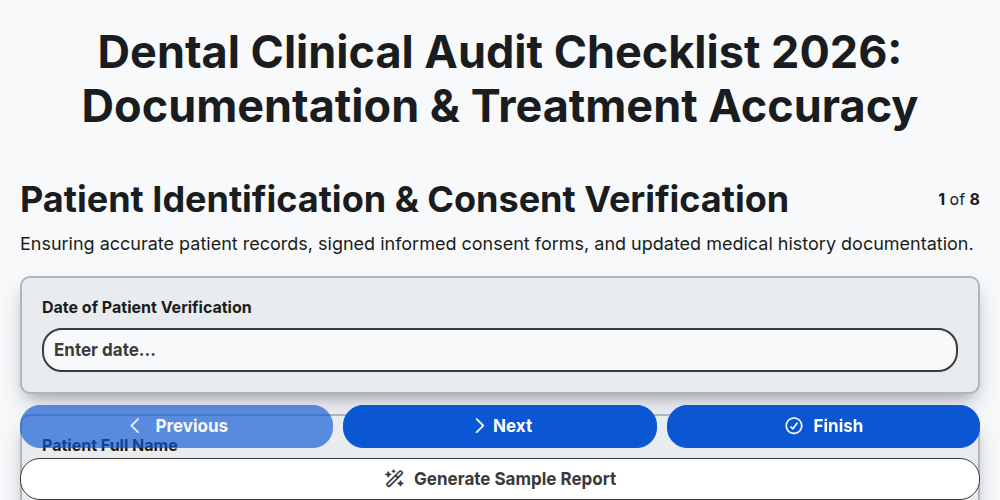
Table of Contents
- Introduction: The Importance of Clinical Audits in 2026
- Setting the Stage: Why Documentation and Accuracy are Non-Negotiable
- Phase 1: The Foundation of Patient Safety - Identification & Consent Verification
- Phase 2: The Paper Trail - Ensuring Clinical Documentation & Progress Note Integrity
- Phase 3: Precision in Diagnostics - Verifying Radiograph Integrity & Imaging Standards
- Phase 4: Execution Excellence - Aligning Treatment Plans with Clinical Reality
- Phase 5: Detailed Periodontal Assessment & Charting Accuracy
- Phase 6: Pharmacological Safety - Prescription & Medication Management Protocols
- Phase 7: External Dependencies - Tracking Laboratory & Ancillary Services
- Phase 8: Closing the Care Loop - Post-Operative Instructions & Follow-up Documentation
- Strategies for Implementing an Ongoing Audit Culture
- Conclusion: Turning Audit Findings into Clinical Success
- Resources & Links
TLDR: Ensure your practice remains compliant and clinically excellent in 2026 with this essential audit checklist. Learn how to systematically review patient identification, clinical documentation, diagnostic integrity, and treatment accuracy to mitigate risk, optimize patient outcomes, and maintain the highest standards of dental care.
Introduction: The Importance of Clinical Audits in 2026
Why Clinical Audits are Non-Negotiable in the Modern Era
As we move into 2026, the landscape of dental practice management is undergoing a profound transformation. The integration of advanced AI diagnostics, highly sophisticated digital workflows, and increasingly stringent regulatory oversight means that the margin for error has virtually disappeared. In this high-precision era, a clinical audit is no longer just a periodic check-the-box exercise performed for regulatory compliance; it is a vital instrument for patient safety and practice sustainability.
The Shift from Reactive to Proactive Care
Historically, many dental practices viewed audits as a reactive measure-something to be addressed only when a discrepancy was found or a complaint was filed. However, the 2026 standard demands a proactive approach. A robust clinical audit serves as a diagnostic tool for your practice's operational health, allowing you to identify systemic vulnerabilities in documentation and treatment execution before they escalate into legal liabilities or clinical failures.
Mitigating Risk in an Era of High Accountability
With the rise of sophisticated digital record-keeping and the increasing ease of access to medical histories, the scrutiny on dental documentation has never been higher. Inaccuracies in patient identification, gaps in informed consent, or discrepancies in radiographic interpretation can lead to more than just malpractice risks; they can jeopardize your professional reputation and the trust your community places in you.
Ensuring Clinical Excellence and Precision
Beyond the legalities, the primary driver of a clinical audit is the pursuit of excellence. By systematically reviewing your treatment plan alignment and periodontal charting accuracy, you ensure that every patient receives a standardized, high-quality level of care. This checklist is designed to help you bridge the gap between performing a procedure and documenting a gold-standard clinical outcome, ensuring that your practice remains a leader in clinical integrity and patient-centered care.
Setting the Stage: Why Documentation and Accuracy are Non-Negotiable
The High Stakes of Clinical Excellence
As we move into 2026, the landscape of dental practice management is undergoing a seismic shift. The era of good enough documentation is officially over. With the rapid integration of AI-driven diagnostics, more stringent regulatory frameworks, and an unprecedented level of patient-led healthcare, the margin for error in clinical records has disappeared.
A clinical audit is no longer just a way to prepare for an unexpected inspection; it is a fundamental tool for risk management and clinical excellence. When we talk about a Clinical Audit, we aren't just discussing a way to check boxes-we are discussing the preservation of your professional reputation and the physical well-being of your patients.
The Twin Pillars: Documentation & Accuracy
The integrity of your practice rests on two inseparable pillars: Documentation and Treatment Accuracy.
The Power of the Paper Trail
In the eyes of regulatory bodies and legal counsel, if it wasn't documented, it didn't happen. In 2026, a gap in your digital records is more than a clerical error; it is a massive liability. Precise documentation serves as the definitive narrative of a patient's journey, providing the necessary evidence that standard of care was met, risks were communicated, and informed consent was obtained.
The Precision Mandate
While documentation tells the story, accuracy defines the outcome. Discrepancies between a treatment plan and the executed procedure-such as a mismatch between a radiographic finding and a clinical note-can trigger catastrophic failures in patient trust and clinical results. Accuracy in periodontal charting, prescription management, and diagnostic imaging is the baseline upon which all successful dental outcomes are built.
Beyond Compliance: The Value of Proactive Auditing
By implementing a rigorous audit checklist, you are not merely checking for mistakes. You are:
- Mitigating Litigation Risk: Strengthening your defense against malpractice claims through undeniable proof of care.
- Enhancing Patient Trust: Demonstrating a culture of transparency and precision that builds long-term loyalty.
- Optimizing Clinical Workflow: Identifying bottlenecks in laboratory tracking or follow-up protocols that may be draining your practice's efficiency.
- Driving Continuous Improvement: Turning every audit into a learning opportunity for your entire clinical team.
The following checklist is designed to help you transition from a reactive state of hoping everything is correct to a proactive state of knowing everything is accurate.
Phase 1: The Foundation of Patient Safety - Identification & Consent Verification
Ensuring the Right Care for the Right Patient
The bedrock of any clinical audit is the verification of identity and the legal authorization of care. In 2026, with the increasing complexity of digital health records and multi-disciplinary dental teams, the margin for error in patient identification has narrowed. An audit failure in this phase isn't just a clerical error-it is a significant patient safety risk and a major legal liability.
The Golden Rule: Absolute Identity Verification
Before any clinical procedure begins, the audit must confirm that the clinician has verified the patient's identity using at least two unique identifiers (e.g., full name and date of birth).
Audit checkpoints include:
- Consistency Check: Does the identity on the physical patient, the digital electronic health record (EHR), and the dental referral form match exactly?
- Biometric & Digital Alignment: If your practice utilizes advanced digital check-in systems, are these synchronized with the clinical charting software to prevent ghost records?
The Legal Safeguard: Informed Consent Verification
Documentation of consent is often the first point of scrutiny during a malpractice investigation or a regulatory inspection. It is not enough to simply have a signed paper; the audit must verify the integrity of the communication process.
Critical Audit Criteria for Consent:
- Comprehensende of Risks, Benefits, and Alternatives: Does the documentation explicitly state that the patient was informed of potential complications, alternative treatment options (including the option of no treatment), and the risks of delaying care?
- Timeliness of Documentation: Was the consent obtained prior to the commencement of the procedure, and is the timestamp recorded accurately in the progress notes?
- Capacity and Voluntariness: Is there clear evidence that the patient (or legal guardian) had the cognitive capacity to provide consent and that the decision was made without coercion?
- Language & Accessibility: For non-native speakers, is there documented proof that an interpreter or translated consent form was utilized to ensure true understanding?
By rigorously auditing these foundational steps, your practice moves beyond mere paperwork and establishes a culture of clinical excellence and uncompromising patient safety.
Phase 2: The Paper Trail - Ensuring Clinical Documentation & Progress Note Integrity
The Gold Standard of Clinical Record-Keeping
In the landscape of 2026 dental compliance, if it wasn't documented, it didn't happen has evolved into a much more stringent reality. Regulatory bodies and insurance auditors are no longer just looking for the presence of a note; they are looking for the integrity and granularity of the clinical narrative.
An audit failure in this phase isn't just a matter of missing text-it is a breakdown in the clinical logic that justifies the care provided.
The Anatomy of a Compliant Progress Note
To pass a high-level clinical audit, every entry in the patient's electronic health record (EHR) must serve as a standalone roadmap of the encounter. Your documentation must bridge the gap between the diagnosis and the final execution.
When reviewing your charts, ensure each note contains these four critical pillars:
The Clinical Narrative: Avoid shorthand that lacks context. The note must clearly articulate the patient's presenting complaint, the specific symptoms reported, and the clinical findings observed during the examination.
The Why Behind the What: It is insufficient to record that a restoration was placed. The note must document the rationale-why this specific material was chosen, why this tooth was selected for treatment, and the clinical justification for the procedure.
Risk Assessment & Informed Consent: Documentation must reflect that risks, benefits, and alternatives (including the risks of no treatment) were discussed. An audit trail must show that the patient was an active participant in the decision-making process.
Key Audit Indicators for Documentation Integrity
When performing self-audits or preparing for external reviews, use the following sub-checkpoints to evaluate your team's documentation accuracy:
1. Temporal Accuracy and Sequencing
- Time-Stamping: Are notes entered in real-time or near real-time? Large gaps between treatment and documentation are red flags for auditors.
- Chronological Flow: Does the documentation follow a logical sequence from initial assessment to treatment execution to post-operative instructions?
2. Verification of Informed Consent
- Specificity: Does the note mention specific risks discussed (e.g., nerve numbness, infection, or tooth loss)?
- Verification of Understanding: Is there a recorded confirmation that the patient verbalized understanding of the proposed treatment plan?
3. Closing the Loop on Clinical Findings
- Follow-up Integration: If a previous note flagged a concern (such as a suspicious lesion or a failing restoration), is there a corresponding note in the current entry showing that the issue was addressed or monitored?
- Consistency Check: Do the findings in your clinical notes align perfectly with the findings documented in your diagnostic imaging and periodontal charting? Any discrepancy here is an immediate trigger for a deep-dive audit.
Pro-Tip for 2026 Compliance
Move away from Template Fatigue. While templates are excellent for efficiency, over-reliance on copy-paste functionality can lead to cloned notes. Auditors are trained to spot identical notes across different dates. Ensure that each entry contains unique, patient-specific observations that prove a customized level of care was delivered.
Phase 3: Precision in Diagnostics - Verifying Radiograph Integrity & Imaging Standards
Ensuring Diagnostic Accuracy and Radiographic Integrity
In the era of digital dentistry, a clinical audit must go beyond simply checking if an X-ray exists. As we move into 2026, the focus of clinical auditing has shifted toward data integrity and diagnostic utility. An audit failure in this phase often stems from lazy imaging-capturing images that are technically present but clinically useless due to poor positioning or improper settings.
To ensure your practice meets the highest standards of diagnostic excellence, use the following sub-checkpoints during your clinical review:
1. Image Quality and Technical Precision
The foundation of any treatment plan is a clear, unambiguous image. During the audit, evaluate each radiograph against these technical benchmarks:
- Anatomic Visualization: Does the image capture the necessary landmarks (e.g., maxillary sinus, mandibular canal, or adjacent teeth) to allow for a complete diagnostic picture?
- Artifact and Error Detection: Are there significant motion artifacts, overlapping contacts, or cone cuts that obscure critical diagnostic areas?
- Contrast and Density Calibration: Is the exposure setting optimized? Overly dark or washed-out images that hide incipient caries or periapical pathology must be flagged for retraining.
2. Anatomical Accuracy and Positioning
Precision in imaging prevents diagnostic errors that lead to failed procedures. Your audit should verify:
- Alignment Verification: For bitewings, are the interproximal contacts clearly visible without overlap?
- Sensor/Plate Placement: For periapical films, is the entire tooth from crown to apex captured without distortion?
- Angulation Consistency: Is the horizontal and vertical angulation consistent with the established diagnostic protocol for that specific radiographic technique?
3. Integration with Clinical Findings
A radiograph does not exist in a vacuum; it must correlate with the clinical exam. The audit must confirm:
- Clinical-Radiographic Correlation: Does the radiographic evidence of radiolucency or radiopacity align with the findings noted in the clinical exam and periodontal charting?
- Evidence-Based Justification: If a radiograph was taken to investigate a specific symptom (e.g., localized pain or swelling), does the image clearly address that specific clinical concern?
4. Digital Workflow and Metadata Integrity
With the rise of AI-integrated imaging, the metadata of your digital files is just as important as the image itself.
- Metadata Verification: Ensure that the digital files contain the correct date, time, and patient identification linked to the correct study.
- Storage and Retrieval Integrity: Are images being archived in a way that prevents compression loss or degradation over time?
- Compliance with Privacy Standards: Ensure that diagnostic images are being handled within the encrypted, HIPAA-compliant frameworks required for 2026 standards.
Phase 4: Execution Excellence - Aligning Treatment Plans with Clinical Reality
Bridging the Gap Between Strategy and Practice
The most meticulously crafted treatment plan is only as valuable as its execution. In a clinical audit, the Execution Excellence phase is where we move beyond what was intended to happen and scrutinize what actually occurred. For 2026, the standard for clinical auditing has shifted from simply checking for signatures to verifying the high-fidelity alignment between diagnostic findings and clinical outcomes.
An audit failure in this phase often stems from clinical drift-where the documented treatment plan deviates from the actual chairside procedure without an accompanying clinical justification.
Evaluating Treatment Plan Alignment & Execution
To ensure your practice maintains the highest standard of care and remains audit-ready, use the following sub-checkpoints to evaluate your clinical execution:
- Consistency Verification: Does the procedure performed match the specific codes and descriptions outlined in the initial treatment plan?
- Justification of Deviations: If a treatment plan was modified mid-procedure (e.g., an unexpected endodontic complication requiring an extra step), is there a clear, contemporaneous note explaining the clinical rationale for the change?
- Informed Consent Integrity: Is there verifiable evidence that the patient was informed of the risks, benefits, and alternatives of the executed procedure, rather than just the proposed one?
- Outcome Documentation: Does the clinical note reflect the successful completion of the specific milestones outlined in the treatment roadmap?
The Precision Standard
Auditors in 2026 are looking for The Golden Thread-the unbroken line of logic that connects a patient's initial complaint, the diagnostic evidence, the proposed treatment, and the final clinical result.
When execution is unaligned with documentation, it creates significant legal and regulatory vulnerabilities. By focusing on this phase of the checklist, you ensure that your clinical team isn't just providing excellent dentistry, but is also providing the precise, verifiable evidence required to prove that excellence.
Phase 5: Detailed Periodontal Assessment & Charting Accuracy
Ensuring Precision in Periodontal Record-Keeping
In the 2026 regulatory landscape, periodontal documentation has moved beyond simple presence or absence notations. Auditors are now looking for high-resolution, longitudinal data that demonstrates a clear clinical narrative. A failure to maintain precise periodontal charts is one of the most common triggers for non-compliance findings during clinical audits.
Key Audit Focus Areas for Periodontal Data
To ensure your practice meets the highest standards of clinical accuracy, your audit must verify the following elements within every periodontal record:
Comprehensive Probing Depth Verification
- Ensure all six sites per tooth are documented consistently.
- Verify that measurements are legible and match the visual digital chart.
- Check for the presence of notations for recession, furcation involvement, and mobility.
Consistency in Periodontal Charting Updates
- Frequency of Re-evaluation: Audit whether periodontal re-assessments are occurring at the clinically appropriate intervals following scaling and root planing (SRP) or other interventions.
- Baseline vs. Follow-up: Ensure that baseline measurements are clearly distinguishable from subsequent progress notes to track disease progression or stability.
Integration of Clinical Findings with Treatment Logic
- The Evidence-Based Link: Auditors will check if the documented pocket depths and bleeding on probing (BOP) levels directly justify the prescribed treatment (e.g., Does the depth of a 6mm pocket correlate with the decision to perform SRP?).
- Detection of Anomalies: Confirm that any sudden changes in attachment levels are accompanied by a corresponding clinical note explaining the diagnostic reasoning.
Digital Charting Integrity
- Verify that digital templates are being used correctly and that auto-populating features are not inadvertently overwriting critical manual observations.
- Ensure that all periodontal images (intraoral photos showing recession or inflammation) are correctly linked to the specific periodontal chart entry.
Phase 6: Pharmacological Safety - Prescription & Medication Management Protocols
Ensuring Medication Precision and Patient Safety
In the modern dental landscape, clinical audits are increasingly focusing on the intersection of pharmacology and clinical decision-making. As we move into 2026, the margin for error in prescribing has vanished. An audit in this phase is not merely about checking if a prescription was written, but verifying that the entire pharmacological workflow-from assessment to administration-is clinically sound and legally defensible.
Prescription Accuracy and Legality
The core of this audit step involves a granular review of every prescription issued during the audit period. Auditors will look for the Five Rights of medication administration applied to the dental setting:
- Patient Identification: Does the prescription clearly match the patient's identity in the electronic health record (EHR)?
- Drug Selection & Dosage: Is the prescribed dosage within the clinically recommended range for the patient's age, weight, and condition?
- Legibility and Clarity: For paper prescriptions, is the handwriting unambiguous? For e-prescriptions, are the instructions (frequency, duration, and route) clearly communicated to the pharmacy?
- Instructions for Use: Are there clear directions for the patient regarding how to take the medication and what to do if a side effect occurs?
Allergy Verification and Contraindication Screening
A critical failure point in clinical audits is the disconnect between the patient's recorded allergy list and the medications actually prescribed.
The Red Flag Audit Protocol
During this phase of the checklist, the following must be cross-referenced:
- Allergy Reconciliation: Every prescription must be audited against the patient's documented allergy profile. Any instance of a prescribed drug containing an allergen (e.g., penicillin in a penicillin-allergic patient) constitutes a high-level compliance breach.
- Drug-Drug Interaction (DDI) Review: Auditors will examine whether the clinical notes demonstrate that the dentist reviewed the patient's current medication list for potential interactions with newly prescribed dental antibiotics or analgesics.
- Systemic Health Integration: The audit will evaluate whether the prescription reflects the patient's systemic status, such as assessing the necessity of antibiotic prophylaxis for patients with specific cardiac conditions or managing NSAID use in patients on anticoagulants.
Documentation of Clinical Justification
It is not enough to simply prescribe; the reason for the prescription must be anchored in the clinical notes. An effective audit ensures that the Why is documented:
- Indication: The clinical note must explicitly state the reason for the medication (e.g., Prescribed Amoxicillin for acute periapical abscess).
- Risk Assessment: Documentation should reflect that the risks and benefits of the medication were discussed with the patient.
- Follow-up Plan: The notes must indicate when the patient should be reassessed to evaluate the efficacy of the medication and monitor for adverse reactions.
Phase 7: External Dependencies - Tracking Laboratory & Ancillary Services
Ensuring Continuity of Care through Precise Tracking
A clinical audit is not limited to what happens inside the dental chair; it extends to the critical hand-offs between your practice and external partners. In 2026, as dental technology and integrated digital workflows become the industry standard, the integrity of your audit depends heavily on how well you manage third-party dependencies.
Failures in laboratory communication or ancillary service tracking are often the invisible culprits behind treatment delays, clinical errors, and compromised patient safety.
The Audit Focus: Key Verification Points
To maintain high standards of clinical accuracy and liability protection, your audit process must verify the following:
- Case Communication & Prescription Accuracy: Verify that laboratory prescriptions (work orders) are complete, legible, and contain all necessary clinical parameters. Audit for the presence of shade instructions, margin specifications, and material requirements to ensure the final prosthesis matches the clinical intent.
- Turnaround Time & Workflow Continuity: Assess the synchronization between restorative milestones and lab deliveries. Discrepancies in timing can lead to rushed clinical appointments or prolonged periods where a patient is left without functional dentition, impacting the overall quality of care.
- Quality Control of Remakes: Analyze the frequency and root causes of laboratory remakes. An audit should determine if errors are due to impression inaccuracies (internal) or fabrication errors (external), and whether a formal feedback loop exists to rectify these issues.
- Integration of Ancillary Services: If your practice utilizes external specialists (such as oral surgeons or endodontists), verify that diagnostic reports and treatment outcomes are being seamlessly integrated into the patient's primary digital record.
- Chain of Custody for Digital Files: With the rise of intraoral scanning, ensure that the transfer of STL files and digital impressions is secure, documented, and that the receiving laboratory has acknowledged receipt of the correct data versions.
The Compliance Goal
The objective of this phase is to eliminate information silos. By auditing these external touchpoints, you ensure that the clinical excellence documented in your internal notes is matched by the physical excellence of the prosthetics and services delivered by your partners.
Phase 8: Closing the Care Loop - Post-Operative Instructions & Follow-up Documentation
Ensuring Continuity of Care and Risk Mitigation
The final stage of a clinical audit is often the most overlooked, yet it holds immense significance in determining the long-term success of a treatment and the legal defensibility of the practice. Phase 8 focuses on the critical transition from the dental chair to the patient's home environment. An audit in this area ensures that the clinical safety net is securely in place.
Verifying Post-Operative Communication
An audit of post-operative care is not merely about checking if instructions were given, but verifying that they were documented as provided. Auditors should look for evidence of specific, tailored instructions for various procedures (e.such as extractions, endodontics, or implant placement).
- Instruction Customization: Does the record reflect instructions specific to the patient's procedure, or is there a one-size-fits-all approach that fails to address potential complications?
- Patient Comprehension: Is there documentation noting that the patient (or caregiver) demonstrated understanding of the care instructions?
- Emergency Protocols: Does the documentation clearly outline the what to do if scenarios, including contact information for after-hours emergencies?
Tracking the Follow-Up Lifecycle
The audit must evaluate the closed-loop communication between the clinic and the patient following complex interventions. A breakdown in follow-up is a high-risk area for both clinical failure and patient dissatisfaction.
- Follow-Up Milestones: Are scheduled recalls and post-op check-ins recorded in the patient's timeline?
- Outcome Documentation: For significant restorative or surgical work, does the chart contain notes from follow-up appointments confirming healing progress and functional stability?
- Non-Compliance Tracking: If a patient fails to attend a critical follow-up, is there a documented attempt to contact them? This is vital for mitigating liability in the event of secondary complications.
The Compliance Goal
By auditing this final phase, your practice moves beyond simple clinical execution toward a culture of comprehensive care management. Ensuring that the care loop is closed protects the patient from preventable complications and shields the practice from claims of negligence regarding post-treatment oversight.
Strategies for Implementing an Ongoing Audit Culture
Cultivating a Proactive Compliance Mindset
Implementing a clinical audit checklist is not a one-time event; it is a continuous commitment to excellence. To truly reap the benefits of the 2026 Dental Clinical Audit Checklist, your practice must move away from reactive auditing-where checks only occur after an error is discovered-and toward a proactive culture of self-correction.
Moving Beyond the Check-the-Box Mentality
An audit should never be viewed as a punitive measure or a gotcha moment for staff. Instead, frame the audit process as a tool for clinical empowerment. When team members understand that accurate Patient Identification & Consent Verification and rigorous Clinical Documentation are safeguards for both the patient and the practitioner, compliance becomes a shared value rather than a chore.
Integration into Daily Workflows
The most successful dental practices integrate auditing into their existing operational rhythms. To prevent audit fatigue, consider the following integration strategies:
- Micro-Audits: Instead of waiting for an annual review, perform weekly spot checks on specific high-risk areas, such as Prescription & Medication Management or Diagnostic Imaging integrity.
- Peer Review Loops: Encourage clinicians to review each other's Periodontal & Charting Accuracy periodically. This fosters a collaborative environment where learning happens in real-time.
- Digital Automation: Leverage your Practice Management Software (PMS) to automate alerts for missing Post-Operative Instruction or incomplete Laboratory Service Tracking.
Data-Driven Continuous Improvement
The ultimate goal of an audit is to generate actionable data. When the checklist reveals a trend-for example, a recurring discrepancy in Treatment Plan Alignment-use that insight to drive targeted training.
By treating every audit finding as a roadmap for professional development, you transform your clinical documentation from a mere legal necessity into a cornerstone of superior patient care and practice longevity in 2026 and beyond.
Conclusion: Turning Audit Findings into Clinical Success
Beyond the Checklist: A Culture of Continuous Improvement
An audit should never be viewed as a gotcha moment or a punitive exercise. Instead, think of the Dental Clinical Audit Checklist 2026 as a diagnostic tool for your practice's operational health. Just as you would identify a cavity during a routine exam to prevent a root canal later, an audit identifies systemic gaps in documentation or treatment execution before they evolve into legal liabilities or patient safety issues.
Transforming Data into Actionable Growth
The true value of this checklist lies in the period after the audit is complete. Once you have reviewed your patient identification protocols, charting accuracy, and medication management, you will likely uncover patterns. Use these findings to drive three specific pillars of practice excellence:
- Refined Staff Training: If your audit reveals inconsistencies in post-operative instruction documentation, use that data to implement a standardized template or a digital prompt within your PMS (Practice Management Software).
- Standardized Workflow Optimization: Discrepancies in laboratory tracking or diagnostic imaging integrity often point to broken workflows. Use these insights to redesign how physical and digital assets move through your clinic.
- Enhanced Patient Trust: High-accuracy documentation is the backbone of patient safety. When your team masters the alignment between treatment plans and execution, you reduce clinical errors and build a reputation for uncompromising care.
Moving Toward 2026 and Beyond
As dental technology becomes more integrated through AI-driven charting and automated diagnostic analysis, the complexity of what we must audit will increase. However, the core principles remain the same: precision, accountability, and clarity.
By implementing this checklist regularly, you are not just checking boxes for compliance-you are building a fortress of clinical excellence that protects your patients, your staff, and the long-term legacy of your practice.
Resources & Links
- American Dental Association (ADA): The primary authority for dental standards, clinical guidelines, and ethical practice updates.
- Centers for Disease Control and Prevention (CDC): Essential for clinical infection control protocols and sterilization audit standards.
- DentistryUSA: Comprehensive dental news and clinical updates to keep pace with evolving treatment technologies.
- Organization for Safety, Asepsis and Prevention (OSAP): Specialized resources for maintaining high standards in dental infection prevention and control.
- Journal of the American Dental Association (JADA): Peer-reviewed research vital for verifying the clinical accuracy of diagnostic and treatment protocols.
- Occupational Safety and Health Administration (OSHA): Regulatory requirements for workplace safety and documentation of hazardous material handling.
- U.S. Department of Health & Human Services (HIPAA): The gold standard for ensuring patient data privacy and documentation security compliance.
- Dentistry Today: Industry insights regarding practice management and implementing efficient clinical workflows.
- State Dental Examiners Boards: Local regulatory bodies that define the legal scope of practice and documentation requirements.
- U.S. Food and Drug Administration (FDA): Crucial for auditing the safety and usage of dental materials, implants, and radiograph equipment.
- DentistryIQ: Focuses on practice management systems and integrating digital tools for better audit tracking.
- American Academy of Cosmetic Dentistry (AACD): Higher-level clinical standards for aesthetic dentistry and restorative accuracy.
- American Academy of Periodontology (AAP): Specialized guidelines for Phase 5: Periodontal assessment and charting accuracy.
- Dentalcare.com: Clinical education resources to help align treatment plans with the latest evidence-based realities.
- ADA Science & Research Institute: Deep dives into clinical evidence to support the 'Precision in Diagnostics' phase of your audit.
- Evidence-Based Dentistry (EBD): A framework for ensuring that clinical decisions and documentation are backed by scientific validity.
- Dental Office Magazine: Practical advice on managing laboratory dependencies and ancillary service tracking.
- ADA Code of Ethics: The foundational document for the 'Identification & Consent' and 'Patient Safety' audit phases.
Comments
There are no comments yet. Be the first to add one!
Dental Management Solution Demo
Simplify your dental practice & enhance patient care! ChecklistGuro streamlines appointment scheduling, patient records, and billing. Improve efficiency, reduce errors, & boost patient satisfaction. Manage it all with our Work OS.
Related Articles
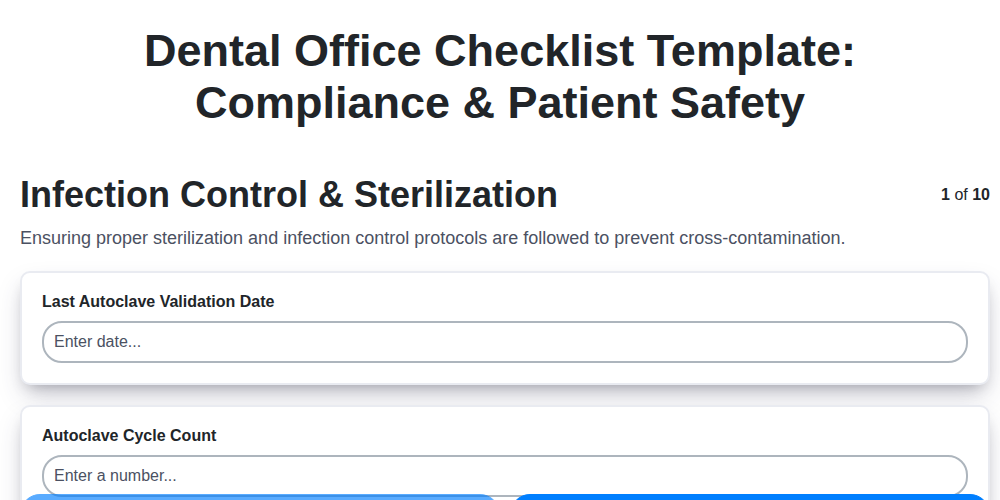
Your Dental Office Safety Net: The Compliance & Patient Safety Checklist Template
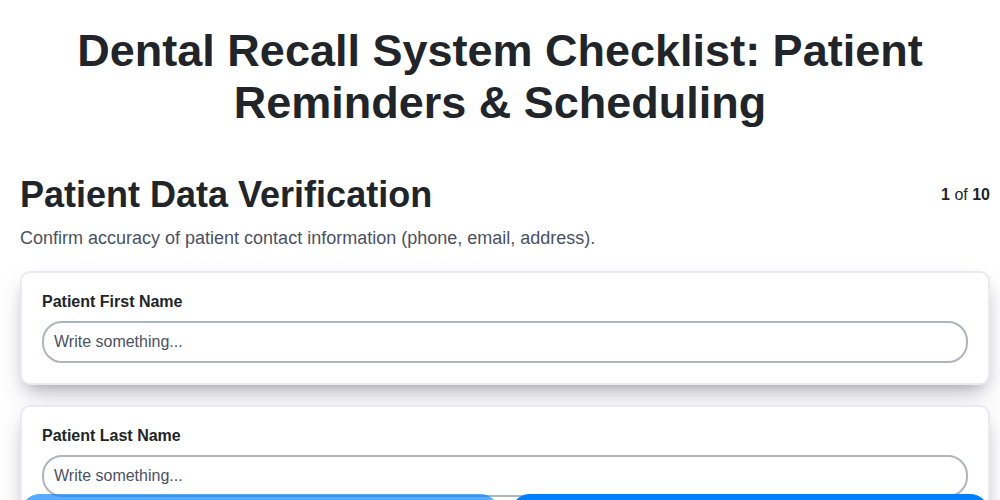
Mastering Dental Recalls: Your Ultimate Checklist Template

Mastering Dental Case Presentations: Your Checklist Template for Success

Your Dental Compliance Checklist: A State & Federal Guide
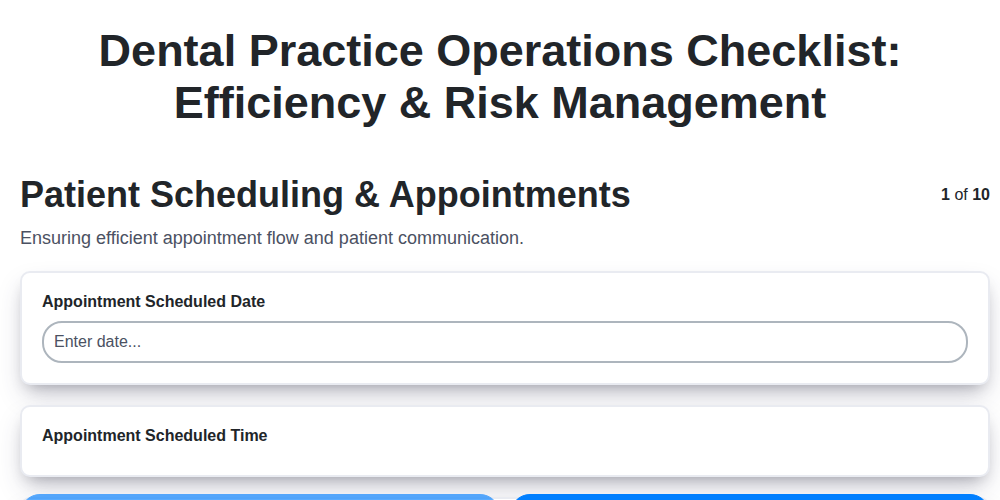
Dental Operations Checklist: Boost Efficiency & Manage Risk

The Ultimate Dental Lab Case Checklist: Fabrication & Quality Assurance

Your Complete Dental Infection Control Checklist: PPE & Surface Disinfection
Mastering Dental Exams: Your Complete Charting Checklist Template
Need help with
Dental Management?
Have a question? We're here to help. Please submit your inquiry, and we'll respond promptly.