The Ultimate 2026 Distribution Center Workflow Efficiency Audit Checklist: A Comprehensive Template for Operational Excellence
Published: 11/22/2026 Updated: 11/23/2026
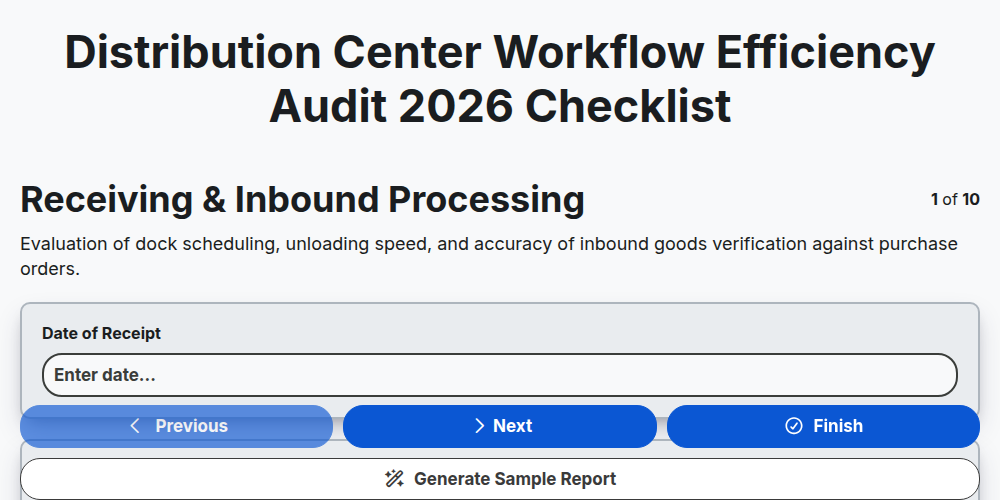
Table of Contents
- Introduction: The Importance of Proactive Auditing in the 2026 Supply Chain Landscape
- Phase 1: Optimizing the Entry Point - Receiving & Inbound Processing
- Phase 2: Maximizing Space Utilization - Put-Away & Storage Optimization
- Phase 3: Driving Throughput - Picking & Order Fulfillment Accuracy
- Phase 4: Precision in Finalization - Packing & Kitting Quality Control
- Phase 5: Maintaining Real-Time Visibility - Inventory Integrity & Cycle Counting
- Phase 6: Streamlining the Departure - Shipping & Outbound Logistics
- Phase 7: Evaluating the Tech Stack - Equipment & Automation Performance
- Phase 8: Human Capital Optimization - Resource & Labor Management
- Phase 9: Closing the Loop - Returns & Reverse Logistics Flow
- Phase 10: Risk Mitigation - Safety, Security & Facility Compliance
- Implementing Your Audit Findings: A Roadmap to Continuous Improvement
- Resources & Links
TLDR: Streamline your operations and future-proof your warehouse with our comprehensive 2026 audit checklist. This guide provides a step-by-step framework to evaluate every critical stage of your supply chain-from inbound receiving and automated storage to outbound logistics and reverse flows-ensuring maximum accuracy, labor efficiency, and safety compliance in an increasingly automated landscape.
Introduction: The Importance of Proactive Auditing in the 2026 Supply Chain Landscape
In the rapidly evolving logistics landscape of 2026, reacting to bottlenecks is no longer a viable strategy. As supply chains become increasingly integrated with AI-driven forecasting, hyper-local fulfillment models, and autonomous robotics, the margin for error in distribution center (DC) operations has shrunk to near zero.
The Shift from Reactive to Proactive Management
The modern distribution center is no longer just a storage warehouse; it is a high-velocity data center where physical movement meets digital precision. Today's operational challenges-ranging from labor volatility to the complexities of omnichannel fulfillment-demand more than just standard oversight. They require a systematic, preemptive approach to identifying friction points before they escalate into costly delays or missed delivery windows.
Why an Audit is Your Most Powerful Tool
An efficiency audit is not a critique of failure, but a roadmap for optimization. Conducting a structured audit allows warehouse managers and supply chain leaders to:
- Identify Hidden Bottlenecks: Uncover micro-delays in the transition between receiving and put-away that aggregate into massive throughput losses.
- Validate Automation ROI: Ensure that your investments in AGVs (Automated Guided Vehicles), AMRs, and WMS (Warehouse Management Systems) are actually delivering the promised efficiency gains.
- Mitigate Risk in Real-Time: Detect gaps in safety protocols and inventory accuracy before they lead to compliance penalties or catastrophic stockouts.
- Optimize Resource Allocation: Align your labor force and equipment usage with the actual ebbs and flows of 2026's unpredictable demand cycles.
Navigating the 2026 Complexity
As we move deeper into this decade, the integration of Internet of Things (IoT) sensors and real-time predictive analytics has raised the bar for what efficiency looks like. A standard checklist is no longer enough; you need a framework that evaluates both the physical movement of goods and the digital integrity of the data driving those movements.
The following checklist is designed to serve as your comprehensive template for this deep dive. By auditing each core pillar of your DC workflow, you will move beyond simple maintenance and toward true operational excellence, ensuring your facility remains a competitive advantage in an increasingly automated world.
Phase 1: Optimizing the Entry Point - Receiving & Inbound Processing
Streamlining the Gateway to Your Supply Chain
The efficiency of your entire distribution center is often decided the moment a trailer hits your dock. In 2026, the inbound bottleneck remains the single greatest threat to downstream productivity. An audit of your receiving processes must move beyond simple counting; it requires a deep dive into how data flows alongside physical goods.
Critical Audit Touchpoints
To ensure your inbound operations are setting the stage for success rather than creating backlogs, evaluate the following components:
- Pre-Arrival Visibility & ASN Accuracy: Are Advanced Shipping Notices (ASNs) being utilized to pre-allocate dock doors and labor? Evaluate the synchronization between vendor data and your Warehouse Management System (WMS) to minimize manual data entry errors.
- Unloading & Inspection Protocols: Analyze the time elapsed between dock arrival and the completion of the physical count. Are there standardized procedures for inspecting goods for damage, and is the quarantine process for non-compliant items clearly defined?
- Dock-to-Stock Velocity: Measure the critical interval between the physical receipt of goods and their availability for picking. Identify where items are stagnating on the receiving floor due to lack of space or delayed scanning.
- Data Integrity at Entry: Audit the precision of the initial labeling process. In an era of automated sorting, a single error in a barcode or RFID tag during receiving can trigger a cascading failure throughout the entire fulfillment cycle.
Key Performance Indicators (KPIs) to Review
- Receiving Cycle Time: Total time from arrival to system availability.
- Dock Utilization Rate: The efficiency of your dock door scheduling.
- Inbound Error Rate: Frequency of discrepancies between physical receipts and packing slips.
Phase 2: Maximizing Space Utilization - Put-Away & Storage Optimization
After goods have been successfully received and verified, the focus shifts to the most critical stage of internal movement: how efficiently those goods are integrated into your existing ecosystem. In 2026, space is no longer just about square footage; it is about volumetric intelligence.
An inefficient put-away process creates downstream bottlenecks, leading to honeycombing (empty, unusable spaces) and increased travel time for pickers. Use this checklist to audit your storage strategies.
1. Slotting Strategy & Velocity Analysis
The foundation of a high-performing DC is dynamic slotting. Your audit should ensure that your storage locations are being utilized based on real-time demand rather than static legacy layouts.
- ABC Analysis Integration: Are your A items (high-velocity) positioned in the most accessible golden zone locations to minimize travel distance?
- Seasonal Re-slotting Frequency: Do you have a documented schedule for re-evaluating slotting profiles based on seasonal demand shifts?
- Product Dimension Accuracy: Is there a discrepancy between the physical dimensions of products and the digital footprint in your WMS (Warehouse Management System)?
2. Put-Away Accuracy & Logic
The goal of put-away is to ensure that every item is placed in its optimal, pre-determined location without manual intervention or error.
- Directed Put-Away Verification: Does your WMS automatically direct operators to specific bins, or are pickers using discretionary placement?
- Validation Scanning: Is there a mandatory scan-verification step (Bin ID + SKU) to prevent misplaced inventory?
- Congestion Management: Are there specific aisles or zones experiencing traffic jams during peak put-away windows?
3. Storage Density & Volumetric Efficiency
With rising real estate costs, maximizing the vertical cube of your facility is non-negotiable for 2026 operations.
- Vertical Cube Utilization: Are you utilizing the full height of your racking, or is there significant wasted air in your upper levels?
- Bin Profile Optimization: Are small items being stored in unnecessarily large bins, leading to wasted bin capacity?
- Specialized Storage Audit: Are temperature-controlled, hazardous, or high-value items stored in dedicated, optimized zones that maximize density without compromising safety?
4. Infrastructure & Rack Integrity
Optimization cannot occur if the physical storage environment is deteriorating or disorganized.
- Rack Condition Assessment: Are there signs of upright damage, dented beams, or uneven load distribution?
- Labeling & Signage Clarity: Are all bin locations, aisle markers, and cross-aisle indicators clearly visible and scannable by handheld devices?
- Clearance & Compliance: Are there sufficient clearances between stored pallets and fire suppression (sprinkler) systems to meet updated 2026 safety standards?
Phase 3: Driving Throughput - Picking & Order Fulfillment Accuracy
Optimizing the Engine of Distribution: Precision in Picking
In the modern high-velocity warehouse, picking is where the most significant labor costs are incurred and where the greatest potential for error exists. As we move into 2026, speed is no longer a sufficient metric on its own; the new gold standard is Perfect Order Fulfillment. An audit of your picking operations must look beyond how fast orders move and focus on how accurately they move.
Key Audit Sub-Steps for Picking Accuracy
To ensure your fulfillment operations are prepared for the complexities of 2026's omnichannel demands, evaluate your workflow against the following critical checkpoints:
1. Picking Method Effectiveness & Scalability
Analyze whether your current picking strategy (Discrete, Batch, Zone, or Wave) aligns with your current order profile.
- Order Density Analysis: Are you using batch picking for high-volume, small-item orders to reduce travel time?
- Tech-Enabled Routing: Are your Warehouse Management System (WMS) algorithms calculating the most efficient paths, or are pickers experiencing congestion bottlenecks in high-density aisles?
2. Error Rate Root Cause Analysis
It is not enough to know that errors are happening; you must know why.
- Mis-picks vs. Short-picks: Distinguish between picking the wrong SKU and failing to find the item entirely.
- Verification Integration: Evaluate the effectiveness of scan-verification at the point of pick. Does the system trigger an immediate alert when a mismatched barcode is detected?
3. Hardware & Interface Ergonomics
The human-machine interface (HMI) is a frequent source of fatigue-driven errors.
- Wearable Technology Audit: If using Voice Picking or Vision Picking (AR), assess the latency and ease of use. Are headsets or glasses causing physical strain that leads to cognitive fatigue?
- Mobile Device Reliability: Check for dead zones in Wi-Fi coverage that cause sync delays between handheld scanners and the WMS.
4. Real-Time Inventory Visibility
Picking accuracy is heavily dependent on the accuracy of the location data.
- Ghost Inventory Detection: Audit how often pickers encounter empty bin syndrome-where the system indicates stock is present, but the physical bin is vacant.
- Dynamic Slotting Integration: Ensure that high-velocity items are being dynamically moved to golden zone picking locations to minimize vertical travel and physical strain.
5. Performance Metric Alignment (KPIs)
Moving away from purely volume-based KPIs toward quality-centric metrics.
- Orders Per Hour (OPH) vs. Error Rate per 1,000 Units: Are your incentives driving speed at the expense of accuracy?
- Order Cycle Time: Measure the elapsed time from the moment an order is released to the warehouse floor to the moment it reaches the packing station.
Phase 4: Precision in Finalization - Packing & Kitting Quality Control
Ensuring Accuracy at the Final Touchpoint
In the modern distribution landscape of 2026, the packing and kitting stage is no longer just about placing items in a box; it is the final opportunity to prevent costly errors before they reach the customer. As consumer expectations for personalized and error-free deliveries reach an all-time high, your audit must focus on the synergy between human precision and automated verification.
Critical Audit Benchmarks for Packing & Kitting
To ensure your outbound quality meets 2026 industry standards, evaluate your operations against these four key pillars:
1. Order Verification & Error Detection
- Scan-to-Pack Validation: Are all items being scanned at the packing station to ensure they match the digital picking list?
- Weight-Based Verification: Does your system utilize integrated scales to detect discrepancies between the expected and actual package weight?
- Manifest Accuracy: Is the packing slip/invoice being automatically generated and reconciled with the physical contents of the carton?
2. Kitting Precision & Component Integrity
- BOM (Bill of Materials) Adherence: For kitted products, is there a secondary check to ensure every sub-component is present and undamaged?
- Assembly Standardization: Are kitting instructions clearly visible and standardized to reduce intra-shift variability?
- Secondary Packaging Integrity: Are kits being secured in a manner that prevents internal shifting during transit?
3. Packaging Optimization & Sustainability
- Dimensional Weight (DIM) Management: Are packers utilizing the smallest appropriate box size to reduce dimensional weight charges and void fill?
- Material Waste Reduction: Is your facility auditing the use of dunnage (air pillows, paper, etc.) to minimize environmental impact and cost?
- Sustainability Compliance: Are all packaging materials meeting your company's 2026 ESG (Environmental, Social, and Governance) targets?
4. Visual & Aesthetic Quality Control
- Branding Consistency: Does the outbound presentation align with brand standards (e.g., tape usage, placement of labels, cleanliness of the box)?
- Damage Prevention: Is the audit identifying patterns of hidden damage caused by improper packing techniques or insufficient protective layers?
Phase 5: Maintaining Real-Time Visibility - Inventory Integrity & Cycle Counting
Beyond the Periodic Count: Achieving Continuous Accuracy
In the era of hyper-automation and real-time fulfillment, the once-a-year physical inventory count is a relic of the past. To maintain a competitive edge in 2026, your audit must focus on inventory integrity-the ability to trust that your digital twin (your WMS data) perfectly mirrors the physical reality of your warehouse shelves at any given second.
An efficiency audit in this phase is not just about finding discrepancies; it is about identifying the root causes of inventory drift before they escalate into costly shipping errors or stockouts.
Key Audit Metrics for Cycle Counting
When evaluating your inventory integrity, move beyond simple accuracy percentages. Your audit should scrutinize the following:
- Cycle Count Accuracy Rate (CCAR): Measuring the precision of scheduled counts against recorded system quantities.
- Shrinkage Identification Patterns: Analyzing whether discrepancies are occurring in specific zones, during specific shifts, or within particular product categories.
- Root Cause Attribution: Are discrepancies driven by receiving errors, picking mistakes, or systemic synchronization delays between the WMS and ERP?
Modernizing the Audit Framework
To achieve operational excellence, your 2026 checklist must include evaluations of these three critical areas:
1. Transitioning from Blind Counts to Systematic Verification
Evaluate whether your team is still relying on manual, paper-based counting or if you have implemented blind cycle counting via mobile RF scanning. A high-performing facility should utilize automated triggers-where the system prompts a count based on specific high-velocity movements or predefined intervals-ensuring that high-value items are audited more frequently than low-velocity stock.
2. Integration of IoT and Real-Time Tracking
In 2026, inventory integrity is increasingly tied to sensor technology. Your audit should assess the health of your RFID and IoT ecosystems. Are your sensors providing real-time location intelligence, or are there dark zones in your facility where inventory visibility drops? Any gap in automated tracking is a direct threat to your fulfillment accuracy.
3. The Zero-Error Buffer Strategy
Analyze your process for handling near-miss discrepancies. An efficient workflow includes a standardized protocol for immediate reconciliation. If a discrepancy is found during a cycle count, how quickly is the error corrected in the system, and is there a documented loop to investigate the source of the error (e.g., a mislabeled inbound shipment or a skipped scan during put-away)?
Pro-Tip for 2026: Don't just audit the numbers; audit the data flow. Inventory integrity is a byproduct of seamless information exchange between your inbound, storage, and outbound modules.
Phase 6: Streamlining the Departure - Shipping & Outbound Logistics
Optimizing the Final Mile: Auditing Outbound Logistics
The outbound phase is the final critical touchpoint before your product reaches the customer. In the 2026 landscape, where instant gratification and ultra-fast delivery windows are the industry standard, any friction in your shipping workflow can lead to missed SLAs, increased shipping costs, and dissatisfied customers.
An efficiency audit in this phase focuses on the transition from a completed order to a dispatched shipment, ensuring that speed does not come at the expense of accuracy.
Key Audit Objectives
To ensure your outbound operations are prepared for the complexities of modern e-commerce and B2B demands, your audit should evaluate the following pillars:
1. Documentation & Manifest Accuracy
In an era of automated customs and high-speed sorting, manual errors in documentation are no longer acceptable.
- Carrier Integration: Are shipping labels, manifests, and digital packing slips being generated automatically via your WMS to eliminate manual entry?
- Compliance Verification: Are international shipping documents (commercial invoices, certificates of origin) being accurately cross-referenced with order data?
- Label Scanability: Are all outbound labels meeting the high-speed scanning requirements of modern automated sorting conveyors?
2. Carrier Management & Load Optimization
Shipping costs are often the largest variable expense in the supply chain. An audit must identify where dead air or inefficient routing is draining your margins.
- Carrier Diversification: Are you effectively utilizing a mix of parcel, LTL, and last-mile carriers to optimize for both cost and speed?
- Load Consolidation: Is the workflow designed to consolidate multiple orders into single shipments wherever possible to reduce dimensional weight charges?
- Dock Door Management: Are outbound dock doors organized to prevent bottlenecks? Is there a clear distinction between small parcel staging and heavy freight loading?
3. Dispatch Velocity and Throughput
The goal is to minimize the dwell time-the period between an order being marked packed and it physically leaving the facility.
- Staging Area Efficiency: Is the staging area organized by carrier or destination to prevent sorting errors during the loading process?
- Real-Time Tracking Integration: Does your system provide immediate, automated shipping notifications to the end customer the moment the scan occurs?
- Bottleneck Identification: Where is the physical hand-off slowing down? (e.g., Is the delay occurring at the printer, the scale, or the loading dock?)
4. Audit Checklist: Outbound KPIs to Monitor
During your 2026 audit, use these metrics to quantify your performance:
- On-Time Shipping (OTS) Rate: The percentage of orders that left the facility within the promised window.
- Shipping Error Rate: Frequency of incorrect carriers, incorrect quantities, or incorrect labels.
- Cost Per Shipment: Tracking the total landed cost of the outbound process, including labor and materials.
- Dock Utilization Rate: Measuring the efficiency of your outbound loading bays during peak hours.
Phase 7: Evaluating the Tech Stack - Equipment & Automation Performance
Assessing the Digital and Mechanical Backbone
As we move further into 2026, the margin for error in distribution centers is shrinking. With the integration of increasingly complex AI-driven orchestration and autonomous mobile robots (AMRs), your audit can no longer focus solely on whether machines are working. You must evaluate how effectively they are communicating and scaling with your human workforce.
In this phase of the audit, you are looking for the synergy between hardware reliability and software intelligence.
1. Automation Uptime and Throughput Analysis
The goal here is to move beyond simple maintenance logs and look at operational impact.
- MTBF (Mean Time Between Failures): Are your conveyors, sorters, or AGVs experiencing frequent unplanned downtime that bottlenecks downstream processes?
- Utilization Rates: Are your automated systems running at capacity, or are they sitting idle during critical windows due to poor scheduling?
- Error Rate of Automated Systems: Analyze the frequency of mis-sorts or sensor failures in automated picking arms or scanning tunnels.
2. Integration and Data Interoperability
In 2026, a siloed piece of equipment is a liability. An audit of your tech stack must ensure that your physical automation is perfectly synced with your Warehouse Execution System (WES) and WMS.
- Real-Time Data Sync: Is there any latency between a physical movement (e.g., an AMR completing a task) and the update in your digital inventory record?
- Sensor and IoT Health: Are your IoT-enabled sensors providing actionable data, or are they generating noise that leads to alert fatigue?
- Edge Computing Reliability: Evaluate the stability of the local networks that allow your automated hardware to make split-second decisions without relying solely on cloud latency.
3. Scalability and Future-Proofing
Automation should be an accelerator, not a bottleneck.
- Modular Compatibility: Can your current hardware easily integrate with new modules or newer generations of robotics?
- Software Update Protocols: Does your automation software allow for seamless Over-the-Air (OTA) updates without requiring a full facility shutdown?
- Energy Efficiency of Tech Assets: As sustainability becomes a core KPI, evaluate the energy consumption patterns of your heavy machinery and automated storage/retrieval systems (AS/RS).
Phase 8: Human Capital Optimization - Resource & Labor Management
Optimizing the Human Element in an Automated Era
In 2026, the most efficient distribution centers are not those that simply replace people with robots, but those that master the synergy between human intelligence and automated precision. As we move further into the era of smart warehousing, your audit must move beyond mere headcount tracking and focus on how effectively your workforce is integrated into your digital ecosystem.
Workforce Deployment and Real-Time Scalability
The complexity of modern supply chains requires a highly agile labor model. During this phase of your audit, evaluate how your facility manages labor fluctuations driven by seasonal demand or sudden market shifts.
- Dynamic Labor Allocation: Are you using real-time data to move personnel from receiving to picking during peak surges, or are departments operating in silos?
- Cross-Training Maturity: Assess the depth of your cross-functional training programs. A resilient warehouse requires staff capable of pivoting between inbound and outbound roles to mitigate bottlenecking.
- Labor Management Systems (LMS) Integration: Evaluate how well your LMS communicates with your WMS to provide accurate, real-time performance metrics and automated task interleaving.
Skill Gap Analysis and Upskilling for 2026
As automation and AI-driven robotics become standard, the manual laborer role is evolving into the system operator role. Your audit must identify where your workforce stands in this technological transition.
- Technical Competency Audits: Do your floor supervisors possess the analytical skills required to interpret warehouse telemetry and automation error logs?
- Human-Machine Interface (HMI) Proficiency: Measure the ease with which staff interact with cobots (collaborative robots), AMRs (Autonomous Mobile Robots), and augmented reality (AR) picking interfaces.
- Continuous Learning Frameworks: Is there a formalized pipeline for upskilling workers to manage the maintenance and oversight of new automated technologies?
Performance Metrics and Ergonomic Wellbeing
Efficiency is unsustainable without a focus on the physical and mental endurance of your team. A high-turnover warehouse is a high-cost warehouse.
- KPI Alignment: Beyond simple units per hour, are your KPIs rewarding accuracy, safety, and proactive problem-solving?
- Ergonomic Tech Integration: Audit the use of wearable technology and exoskeletons designed to reduce physical strain and long-term injury risks.
- Attrition and Engagement Analytics: Analyze the correlation between workflow bottlenecks and employee burnout rates. High-efficiency workflows must be designed to be sustainable for the human operator.
Phase 9: Closing the Loop - Returns & Reverse Logistics Flow
Streamlining the Reversal Stream
In the modern era of e-commerce, the reverse side of the supply chain is no longer an afterthought-it is a critical driver of customer loyalty and bottom-line profitability. As we move into 2026, a truly efficient distribution center must treat returns with the same rigor and precision as outbound shipments. An audit of your reverse logistics flow is essential to ensure that returned goods are processed rapidly, accurately, and cost-effectively.
Key Audit Focus Areas
1. Return Processing Speed and Routing
The efficiency of your reverse logistics is measured by the time-to-resale. Evaluate how quickly a returned item is received, inspected, and moved back into sellable inventory.
- Initial Intake Audit: Are returns being scanned and logged immediately upon arrival?
- Disposition Accuracy: Is there a clear, automated decision-making process for whether an item is returned to stock, sent for refurbishment, liquidated, or scrapped?
- Bottleneck Identification: Are returns accumulating in a holding zone, causing congestion in the receiving area?
2. Inspection and Grading Standardization
Inconsistency in how returned items are graded is a leading cause of inventory inaccuracy and customer dissatisfaction.
- Standard Operating Procedures (SOPs): Are inspectors using a standardized rubric to assess product condition?
- Quality Consistency: Does the grade assigned to an item in the reverse flow match the actual physical state of the product?
- Damage Documentation: Is there a digital trail of photos or notes attached to items flagged as damaged or defective?
3. Refurbishment and Re-kitting Integration
For high-value goods, the ability to reintegrate processed items back into the primary picking stream is vital.
- Value-Added Services (VAS) Efficiency: Audit the workflow for cleaning, repackaging, or minor repairs.
- Resource Allocation: Are there dedicated workstations for refurbishment, or is this process encroaching on primary packing areas?
- Inventory Re-entry: Once an item is refurbished, does the Warehouse Management System (WMS) update its status to available in real-time?
4. Cost Leakage and Sustainability Metrics
Reverse logistics is often where hidden costs reside. Your audit should look for opportunities to reduce the carbon footprint and the financial drain of returns.
- Return Transportation Costs: Are you auditing the cost-per-unit of your return shipping lanes?
- Sustainability Compliance: In 2026, how are you managing the disposal of non-resellable goods? Is there a clear plan for eco-friendly recycling or liquidation to minimize landfill waste?
- Root Cause Analysis: Are you feeding return data back to the procurement or manufacturing teams to identify recurring product defects?
Phase 10: Risk Mitigation - Safety, Security & Facility Compliance
Ensuring Operational Resilience and Compliance
As we navigate the complex logistics landscape of 2026, efficiency is no longer just about speed-it is about sustainability and risk mitigation. An audit of your safety and security protocols is the final, critical layer of your workflow assessment. A breakdown in compliance or a safety incident doesn't just halt production; it creates catastrophic bottlenecks that can ripple through your entire supply chain.
Safety Protocols & Workplace Ergonomics
In an increasingly automated environment, the intersection of human labor and robotics requires rigorous oversight. Use this sub-checklist to evaluate your floor safety:
- Human-Machine Interface (HMI) Safety: Are safety zones clearly demarcated for Autonomous Mobile Robots (AMRs) and AGVs? Are emergency stop protocols tested and functional?
- Ergonomic Assessment: Are workstations designed to minimize repetitive strain? Evaluate the use of exoskeletons or height-adjustable packing stations to reduce long-term injury risks.
- Hazardous Material Handling: Are SDS (Safety Data Sheets) digitized and instantly accessible? Are specialized containment zones for lithium-ion batteries or chemicals clearly audited?
- Training & Certification Logs: Are training records for heavy machinery operators (forklifts, reach trucks) up to date and digitally logged for real-time compliance tracking?
Security & Loss Prevention
With the rise of high-value e-commerce goods, theft prevention and data security are paramount to protecting your margins.
- Access Control Systems: Audit your perimeter and internal zone security. Is biometric or RFID-based access functioning to prevent unauthorized personnel from entering high-value storage areas?
- Surveillance Integration: Evaluate the coverage of your CCTV/AI-driven vision systems. Do they provide blind spot coverage in critical zones like receiving and shipping docks?
- Cyber-Physical Security: As warehouses become more connected (IoT), ensure that warehouse management system (WMS) access points are secured against unauthorized digital breaches.
- Inventory Shrinkage Audits: Cross-reference physical security checks with digital inventory discrepancies to identify patterns of internal or external loss.
Facility Integrity & Regulatory Compliance
The physical structure of your distribution center must support the high-velocity workflows of 2026.
- Racking & Infrastructure Inspection: Conduct a structural audit of pallet racking for any signs of impact damage, denting, or structural fatigue.
- Fire Suppression & Life Safety: Ensure all smoke detectors, sprinklers, and fire suppression systems meet updated 2026 fire codes and have passed recent inspections.
- Regulatory Documentation: Verify that all environmental, health, and safety (EHS) documentation is audit-ready and complies with the latest local and international logistics regulations.
Implementing Your Audit Findings: A Roadmap to Continuous Improvement
Conducting an audit is not merely an exercise in identifying failures; it is an opportunity to architect a more resilient, scalable, and tech-driven supply chain. Identifying gaps in your 2026 workflow is only the first step. To transform these insights into measurable ROI, you must move from observation to systematic execution.
The Hierarchy of Implementation
To avoid overwhelming your operations team, do not attempt to overhaul every department simultaneously. Instead, categorize your audit findings into a tiered deployment strategy:
1. Immediate Quick Wins (The Low-Hanging Fruit)
Focus on areas where the cost of implementation is low but the impact on accuracy is high. This includes recalibrating sensors in the Equipment & Automation sector or refining the Packing & Kitting checklists to reduce errors. These small victories build organizational momentum and prove the value of the audit to stakeholders.
2. Structural Process Re-engineering
For more complex issues-such as bottlenecks in Receiving & Inbound Processing or inefficiencies in Put-Away & Storage Optimization-require a deeper dive. This stage involves redesigning floor layouts, re-slotting high-velocity SKUs, or integrating new WMS (Warehouse Management System) logic. These changes require cross-departmental coordination and rigorous testing.
3. Long-Term Strategic Investments
High-capital initiatives, such as upgrading Shipping & Outbound Logistics infrastructure or deploying autonomous mobile robots (AMRs), should be integrated into your annual capital expenditure (CapEx) planning. These are not fixes but strategic evolatable upgrades designed to future-proof your facility against the labor and volume volatility of the late 2020s.
Sustaining the Momentum: The Feedback Loop
An audit should never be a one-and-done event. To achieve true operational excellence, integrate your findings into a permanent Continuous Improvement Loop:
- Standardize the New Norm: Once a process is optimized (e.g., a new Cycle Counting frequency), update your Standard Operating Procedures (SOPs) immediately. Documentation is the bedrock of consistency.
- KPI Alignment: Map your audit findings directly to your Key Performance Indicators. If the audit identified a lag in Reverse Logistics Flow, track your Return Processing Time monthly to ensure the new workflow is performing as intended.
- The Human Element: Empower your floor staff. The most effective audits are those where the frontline workers-the people managing Resource & Labor Management daily-are involved in both the identification of the problem and the validation of the solution.
By treating your 2026 audit as a living roadmap rather than a static report, you transform your distribution center from a reactive cost center into a proactive, competitive powerhouse.
Resources & Links
- Material Handling & Logistics (MHL): Leading industry news source for warehouse automation, robotics, and supply chain technology trends.
- Supply Chain Brain: Comprehensive insights into supply chain management, logistics, and operational strategy.
- Warehouse Council: Resources focused on warehouse management best practices and operational excellence.
- Logistics Management: In-depth analysis of logistics, transportation, and distribution center operations.
- ASCM (Association for Supply Chain Management): The global leader in supply chain professional development and industry standards.
- Gartner Supply Chain: World-class research and advisory services for supply chain technology and strategy.
- ISSA (International Sanitary Supply Association): Essential for the Facility Compliance and Safety section regarding warehouse cleanliness and hygiene standards.
- OSHA (Occupational Safety and Health Administration): The primary resource for warehouse safety regulations, compliance, and risk mitigation protocols.
- Wengrf Logistics Insights: Focuses on advanced inventory management and outbound logistics optimization.
- Cargill Supply Chain Insights: Global perspectives on large-scale distribution and commodity movement.
- SAP Digital Supply Chain: Information on integrated Warehouse Management Systems (WMS) and tech stack evaluation.
- Oracle Cloud SCM: Resources regarding real-time visibility, inventory integrity, and cloud-based logistics.
- Dematic: Industry leader in warehouse automation, robotics, and material handling equipment.
- Honeywell Intelligrated: Focuses on automated sorting, conveyor systems, and throughput optimization technologies.
- SWAT Logistics: Specialized knowledge in reverse logistics and returns management optimization.
- Inbound Logistics: Expertise in inbound processing, receiving, and dock management strategies.
- Six Sigma Institute: Methodologies for continuous improvement and quality control in the picking and packing process.
- Crivo Operations: Focuses on labor management and human capital optimization within the warehouse environment.
Comments
There are no comments yet. Be the first to add one!
Logistics Management Solution Demo
Tired of shipping delays, lost packages, and inefficient routes? ChecklistGuro's Work OS platform streamlines your entire logistics operation, from warehouse management and order fulfillment to route optimization and delivery tracking. Gain real-time visibility, reduce costs, and improve customer satisfaction. Learn how ChecklistGuro can transform your logistics business!
Related Articles
The Ultimate Refrigerated Cargo Temperature Control Checklist Template
Mastering Your Fleet: A Vehicle Maintenance Log Review Template
Master Your Returns: The Ultimate Returns Processing Efficiency Audit Checklist
Data Privacy Policy Compliance: Your Essential Checklist Template
Delivery Confirmation Audit: Your Checklist Template for Process Excellence
Your Pallet Inspection & Maintenance Checklist Template
Fuel Efficiency Monitoring: Your Checklist Template for Savings
Supply Chain Risk Assessment: Your Essential Checklist Template
Need help with
Logistics?
Have a question? We're here to help. Please submit your inquiry, and we'll respond promptly.