A Step-by-Step Guide to the DEI Tracking Process
Published: 07/12/2026 Updated: 10/05/2026
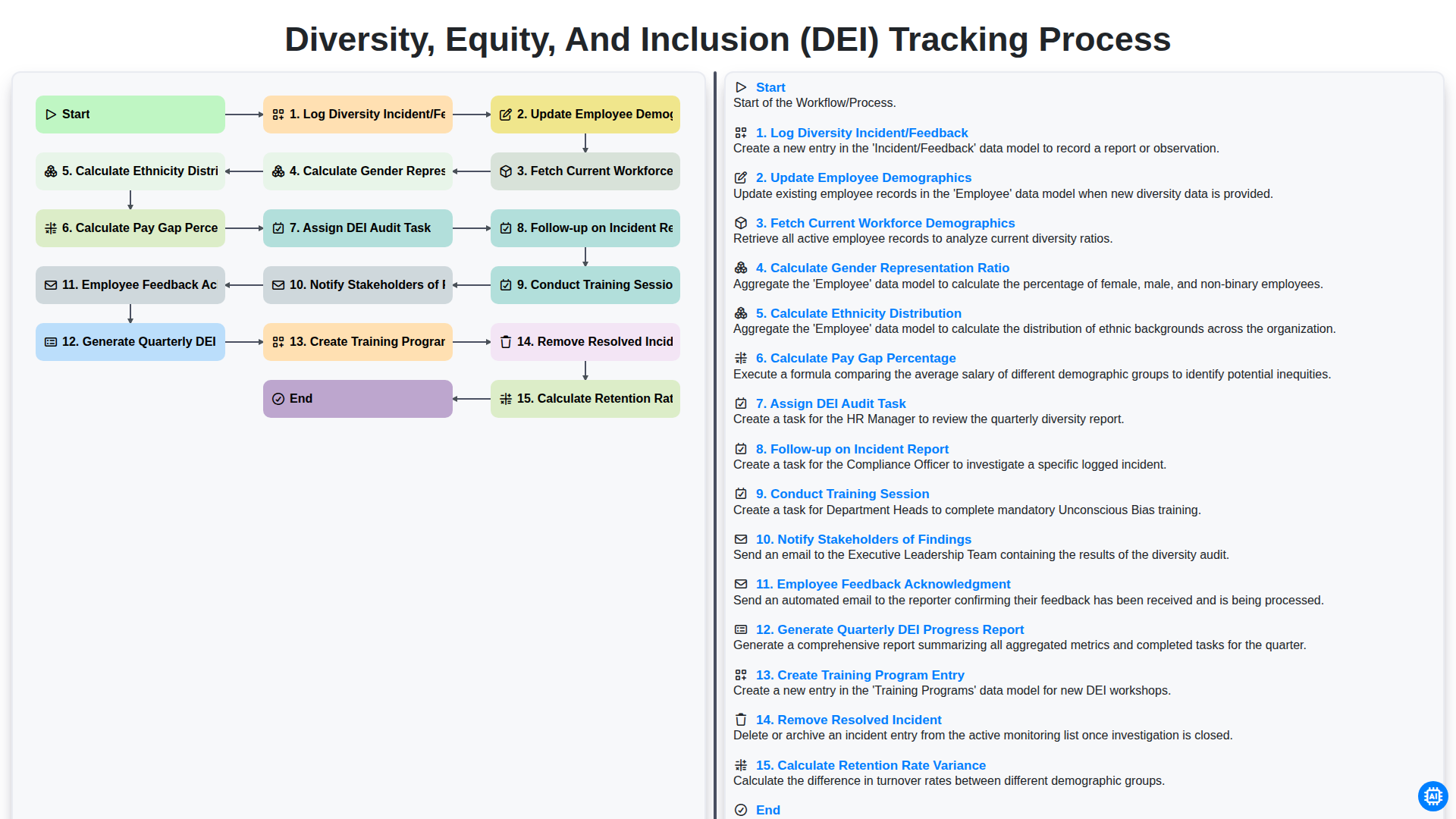
Table of Contents
- Introduction to DEI Tracking
- Step 1: Incident Management and Initial Feedback
- Step 2: Maintaining Accurate Employee Demographics
- Step 3: Analyzing Workforce Composition and Ratios
- Step 4: Identifying Disparities in Pay and Ethnicity
- Step 5: Auditing and Follow-up Procedures
- Step 6: Implementing Training and Education
- Step 7: Reporting Findings and Stakeholder Communication
- Step 8: Continuous Improvement and Long-term Monitoring
- Resources & Links
TLDR: Streamline your organization's commitment to fairness with this comprehensive guide to the DEI Tracking Process workflow. Learn how to automate everything from logging incidents and auditing demographics to calculating pay gaps and generating quarterly progress reports, ensuring your equity, diversity, and inclusion initiatives are measurable, actionable, and transparent.
Introduction to DEI Tracking
In today's evolving corporate landscape, fostering a truly inclusive workplace requires moving beyond mere intention and toward measurable action. Implementing a structured Diversity, Equity, and Inclusion (DEI) Tracking Process is essential for organizations that want to transform DEI from a vague concept into a core operational competency.
Tracking is not simply about collecting data; it is about creating a continuous loop of accountability, analysis, and improvement. By establishing a systematic workflow, companies can move away from reactive, ad-hoc responses and toward a proactive strategy that identifies systemic biases, monitors representation trends, and ensures that every voice within the organization is heard and valued. This process provides the necessary framework to turn raw demographic data into actionable insights, allowing leadership to pinpoint exactly where progress is being made and where critical interventions are needed to bridge gaps in pay, representation, and retention.
Step 1: Incident Management and Initial Feedback
The foundation of a transparent DEI strategy begins with a safe, accessible, and efficient way for team members to voice their experiences. The process initiates with the Log Diversity Incident/Feedback step, where employees can report concerns, share suggestions, or highlight potential biases within the organization. This is coupled with the Follow-up on Incident Report phase, ensuring that no piece of feedback falls into a void. By prioritizing a structured way to document these inputs, organizations can move away from reactive troubleshooting and toward a proactive culture of accountability. Once an issue has been addressed and a resolution reached, the final stage of this phase involves the Remove Resolved Incident step, ensuring that the active tracking dashboard remains focused on current, actionable items.
Step 2: Maintaining Accurate Employee Demographics
The foundation of any meaningful DEI strategy is the integrity of your data. To move beyond surface-level observations, you must Update Employee Demographics regularly to ensure your datasets reflect the current reality of your organization.
This step involves more than just a one-time setup; it requires a continuous process of capturing new hire information, managing internal promotions, and accounting for departures. An accurate demographic profile serves as the source of truth for the entire workflow. Without up-to-date information regarding gender, ethnicity, age, and role seniority, subsequent calculations-such as representation ratios or pay gap percentages-will be fundamentally flawed. By prioritizing the precision of your demographic records, you ensure that every audit, report, and training initiative is built upon a reliable and actionable foundation.
Step 3: Analyzing Workforce Composition and Ratios
Once the baseline demographics have been updated, the workflow moves into the analytical core of the process. This stage is where raw data is transformed into actionable insights by examining the structural composition of your organization.
The process begins by fetching current workforce demographics to ensure the analysis is based on the most recent snapshot of your population. From here, the system executes a series of critical calculations to identify patterns and disparities. We begin by calculating the gender representation ratio to determine if your leadership and general workforce align with your diversity goals. Simultaneously, the workflow calculates ethnicity distribution to provide a clear view of how various ethnic groups are represented across different departments and levels of seniority.
To ensure the analysis addresses systemic fairness, the system also calculates the pay gap percentage, highlighting any discrepancies in compensation that could indicate inequity. Finally, to prevent these insights from sitting idle, the workflow automatically calculates the retention rate variance, allowing you to see if certain demographic groups are leaving the company at higher rates than others. This comprehensive analytical layer ensures that your DEI strategy is driven by hard evidence rather than assumptions.
Step 4: Identifying Disparities in Pay and Ethnicity
Once the foundational demographic data has been gathered, the workflow moves into a critical analytical phase. This stage is where raw data is transformed into actionable insights by focusing on two key metrics: Calculate Ethnicity Distribution and Calculate Pay Gap Percentage.
By analyzing the distribution of ethnicity across different levels of the organization, leadership can identify whether certain groups are overrepresented in entry-level roles but underrepresented in management. Simultaneously, calculating the pay gap percentage allows the organization to pinpoint systemic inequities in compensation that may exist between gender or ethnic groups. These calculations are vital; they move the conversation beyond mere observation and provide the empirical evidence needed to address specific disparities, ensuring that DEI efforts are rooted in mathematical reality rather than intuition.
Step 5: Auditing and Follow-up Procedures
Once the initial data analysis is complete, the workflow transitions from calculation to actionable oversight. This phase is critical for ensuring that the insights gained from the demographic and pay gap audits are translated into tangible organizational change.
The process begins by assigning a DEI audit task to the relevant department heads or HR specialists, ensuring accountability for the findings. Following this, the workflow triggers a follow-up on incident reports to ensure that any logged diversity incidents or feedback are being addressed with the necessary sensitivity and urgency.
To reinforce long-term structural change, the workflow automates the conduct of training sessions and the creation of training program entries within your learning management system. This ensures that the lessons learned from the data are codified into the company's educational curriculum. Finally, to maintain transparency and closure, the system will notify stakeholders of the findings and require an employee feedback acknowledgment, ensuring that all parties are aligned on the outcomes and the subsequent steps for improvement.
Step 6: Implementing Training and Education
Once the initial data analysis and auditing phases are complete, the workflow moves from observation to action. The sixth step in our DEI tracking process, Conduct Training Session, serves as a critical bridge between identifying gaps and fostering cultural change.
Data and metrics can highlight where discrepancies exist, but training is what provides the tools necessary to address them. At this stage, the insights gathered from your gender representation ratios, pay gap percentages, and incident reports are used to tailor educational modules to the specific needs of your organization. Whether the data suggests a need for unconscious bias training, inclusive leadership workshops, or sensitivity training following a logged incident, this step ensures that the findings lead to tangible professional development.
By integrating the results of your DEI audits directly into your learning and development curriculum, you transform passive reporting into an active, continuous loop of organizational improvement. This phase is not just about compliance; it is about equipping every member of the workforce with the knowledge to uphold the values of equity and inclusion identified in your data.
Step 7: Reporting Findings and Stakeholder Communication
Once the data analysis is complete and the audit tasks have been processed, the workflow moves into its most critical phase: Notify Stakeholders of Findings. Transparency is the cornerstone of a successful DEI strategy; simply calculating metrics like the pay gap percentage or gender representation ratio is not enough-these insights must be communicated to the right leaders to drive meaningful change.
During this stage, the system automates the distribution of summarized reports to department heads, HR executives, and diversity committee members. This ensures that decision-makers are immediately aware of identified disparities or successes within the workforce demographics. However, communication should not be a one-way street. To ensure the process remains iterative and impactful, the workflow follows this notification with Employee Feedback Acknowledgment. This step closes the loop by confirming that the workforce's input has been received and considered, fostering a culture of trust and accountability. By integrating notification and acknowledgment into the core workflow, the organization moves beyond mere data collection and into the realm of active, transparent leadership.
Step 8: Continuous Improvement and Long-term Monitoring
The lifecycle of a DEI strategy does not end once an audit is complete or a training session is conducted. To transform data into meaningful cultural change, the workflow must transition from reactive troubleshooting to proactive, long-term monitoring. This stage is defined by closing the loop on individual incidents while simultaneously analyzing broader organizational trends.
Crucial to this phase is the Employee Feedback Acknowledgment, which ensures that team members feel heard and that the organization remains accountable for the reports they file. As incidents are addressed, the workflow involves the systematic process to Remove Resolved Incidents, ensuring that your active dashboard reflects only current, actionable issues.
However, true progress is measured through longitudinal data. By integrating steps such as Calculating Retention Rate Variance, leadership can determine if diversity initiatives are actually helping talent stay within the company or if turnover remains high among specific demographics. This data is then synthesized into the Generate Quarterly DEI Progress Report, a high-level overview that serves as the single source of truth for organizational health. By treating DEI tracking as a continuous loop of assessment and refinement, the organization ensures that equity is not just a one-time goal, but a permanent feature of the corporate culture.
Resources & Links
- SHRM (Society for Human Resource Management): Comprehensive resources and templates for managing workplace incidents, DEI compliance, and HR best practices.
- U.S. Equal Employment Opportunity Commission: Official guidelines on monitoring workplace discrimination, pay equity, and federal reporting requirements.
- McKinsey & Company - Diversity & Inclusion Insights: Data-driven research and industry benchmarks regarding the business impact of diversity and workforce composition.
- Gartner HR Research: Expert analysis on workforce analytics, talent management, and implementing organizational change through training.
- Forbes - Diversity & Inclusion Section: Case studies and leadership strategies for communicating DEI progress and managing stakeholder expectations.
- PwC Diversity, Equity, and Inclusion Insights: Professional guidance on auditing processes, pay gap analysis, and structured DEI reporting frameworks.
Frequently Asked Questions
What is DEI tracking?
DEI tracking is the systematic process of collecting, analyzing, and monitoring data related to Diversity, Equity, and Inclusion within an organization to measure progress and identify areas for improvement.
What are the first steps in implementing a DEI tracking process?
The first steps involve defining clear objectives, determining which key metrics to measure (such as representation, retention, or pay equity), and establishing a reliable method for data collection.
What metrics should be included in a DEI tracking report?
Essential metrics include workforce demographics, hiring rates, promotion velocity, turnover rates across different identity groups, and employee sentiment scores from engagement surveys.
How can organizations ensure data privacy and security during tracking?
Organizations should use anonymized or aggregated data, implement strict access controls, and ensure compliance with data protection regulations like GDPR or CCPA to protect employee identities.
How often should DEI metrics be reviewed?
While data collection can be ongoing, it is recommended to conduct formal reviews quarterly or bi-annually to identify trends and adjust DEI strategies accordingly.
What should companies do after analyzing their DEI data?
After analysis, companies should use the findings to develop actionable interventions, such as updating recruitment processes, implementing bias training, or adjusting compensation structures to address identified gaps.
Comments
There are no comments yet. Be the first to add one!
HRM - Human Resources Management Solution Demo
Simplify HR processes & empower your team! ChecklistGuro's HRM solution streamlines onboarding, performance management, & compliance. Improve employee engagement, reduce admin burden, & drive organizational growth. Manage it all with our Work OS.
Related Articles
Independent Contractor Compliance Checklist Template for HR

HR's Guide to Workplace Safety: Your Compliance Checklist Template
The Ultimate Employee Exit Interview Checklist (HR Edition)
EEO Compliance Checklist Template for HR
The Ultimate HR Audit Checklist Template: Your Guide to Compliance

Paper vs ChecklistGuro in Human Resources Management

Your Guide to Employee Training Compliance: A Free Checklist for HR
Your Ultimate Employee Onboarding Checklist Template
We can do it Together
Need help with
Checklists?
Have a question? We're here to help. Please submit your inquiry, and we'll respond promptly.