Streamlining Success: The Ultimate Employee Onboarding and Training Workflow Template
Published: 06/04/2026 Updated: 10/05/2026
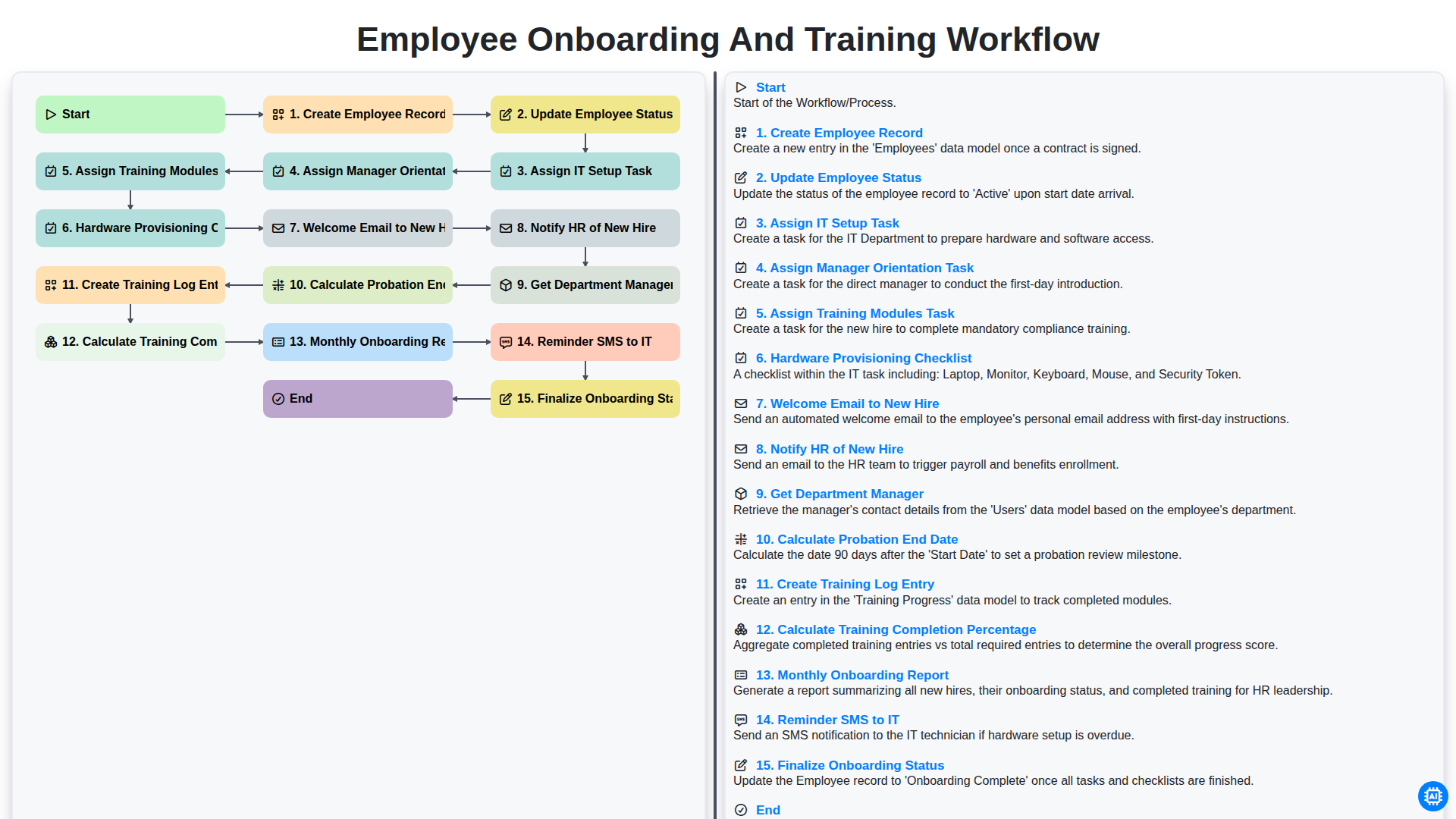
Table of Contents
- The Importance of a Structured Onboarding Workflow
- Phase 1: Initial Setup and Documentation
- Automating the Core Employee Records
- Coordinating HR and Departmental Communication
- Phase 2: IT Provisioning and Hardware Readiness
- Ensuring Seamless Hardware and Software Setup
- Phase 3: The Manager's Role in Orientation
- Phase 4: Structured Training and Knowledge Transfer
- Tracking Progress and Training Compliance
- Phase 5: Monitoring Probation and Long-term Integration
- Continuous Improvement Through Monthly Reporting
- Finalizing the Onboarding Journey
- Resources & Links
TLDR: Master your new hire integration with this comprehensive workflow template. Learn how to automate everything from initial record creation and IT provisioning to training tracking and probation monitoring, ensuring a seamless, error-free onboarding experience for both employees and managers.
The Importance of a Structured Onboarding Workflow
First impressions are lasting. When a new team member joins your organization, the period between their signed offer letter and their first full month on the job is a critical window that determines their long-term engagement and retention. A structured onboarding workflow eliminates the chaotic sink or swim mentality, replacing it with a seamless, professional introduction to the company culture and operational standards.
Without a predefined process, essential steps-such as provisioning hardware, assigning training modules, or notifying IT-often fall through the cracks. This lack of coordination leads to Day One Friction, where new hires sit idle without the necessary tools or access, feeling undervalued and disconnected from the start. By implementing a repeatable, automated workflow, you ensure that every new employee receives a consistent, high-quality experience. A structured approach doesn't just support the employee; it optimizes the productivity of HR, IT, and Department Managers, transforming onboarding from a series of administrative hurdles into a strategic advantage that accelerates time-to-productivity.
Phase 1: Initial Setup and Documentation
The foundation of a successful onboarding experience begins long before the new hire walks through the door. This initial phase focuses on the critical administrative tasks that ensure the employee is officially integrated into the company's ecosystem. The process kicks off with Creating an Employee Record, which serves as the single source of truth for all personnel data. Once the record is established, the system must immediately Notify HR of New Hire to ensure compliance and payroll alignment.
As the administrative groundwork is laid, the workflow shifts toward organizational structure and timeline management. This involves the crucial step to Get Department Manager assigned, ensuring the new recruit has a direct line of leadership from day one. To maintain clarity regarding performance expectations, the system will automatically Calculate Probation End Date, providing both the employee and the manager with a clear milestone for future reviews. Finally, the Update Employee Status step ensures that the company's internal directories and organizational charts reflect the new addition, officially transitioning the candidate from applicant to an active member of the team.
Automating the Core Employee Records
At the heart of every successful onboarding process lies the foundational step: Creating the Employee Record. Manual data entry is often the first bottleneck in a new hire's journey, leading to fragmented information and administrative delays. By automating this initial stage, you ensure that as soon as a candidate accepts an offer, a centralized digital profile is instantly generated.
Automating core records does more than just save time; it creates a single source of truth for the entire organization. Once the record is created, the system can automatically trigger the Update Employee Status action, transitioning the individual from Candidate to New Hire across all integrated platforms. This seamless transition ensures that downstream processes-such as Notifying HR of the New Hire-happen instantaneously, eliminating the need for manual follow-up emails and reducing the risk of human error. By digitizing this entry point, you lay the groundwork for a scalable, error-free onboarding ecosystem.
Coordinating HR and Departmental Communication
Effective onboarding is not just an HR responsibility; it is a cross-departmental symphony that requires seamless communication between HR, IT, and Department Managers. A breakdown in communication at any single touchpoint can lead to a fragmented experience that leaves new hires feeling unsupported and disoriented.
To ensure a smooth transition, the workflow must trigger automated notifications that bridge the gap between administrative tasks and operational readiness. For instance, the moment a Create Employee Record action occurs, the system must simultaneously Notify HR of New Hire and Get Department Manager assigned. This ensures that while HR handles the paperwork, the department head is immediately looped in to prepare for their new team member.
Communication must also extend to the technical side of the house. By integrating a Reminder SMS to IT alongside the Assign IT Setup Task, the workflow ensures that hardware provisioning doesn't fall through the cracks due to an overflowing inbox. Furthermore, by automating the Assign Manager Orientation Task, we ensure that the department manager is prompted to lead the cultural integration, while IT focuses on the Hardware Provisioning Checklist. When these communication loops are closed automatically, the new hire receives a cohesive, professional welcome that demonstrates organizational excellence from day one.
Phase 2: IT Provisioning and Hardware Readiness
Once the initial employee record is established and the onboarding journey officially begins, the focus shifts to the critical technical setup required for a seamless first day. This phase, centered on IT Provisioning and Hardware Readiness, ensures that your new hire isn't sitting idle due to a lack of tools or access.
The core of this phase involves a coordinated effort between HR and the IT department. The process begins with the Assign IT Setup Task, which triggers a sequence of technical dependencies. To prevent delays, the system issues a Reminder SMS to IT, ensuring that technicians are alerted to the upcoming requirement immediately. Central to this stage is the Hardware Provisioning Checklist, a rigorous verification step used to confirm that laptops, peripherals, and mobile devices are configured, tested, and ready for deployment. By automating these assignments, you eliminate the common bottleneck of forgotten hardware requests and ensure that every new team member has the necessary digital workspace from the moment they log in.
Ensuring Seamless Hardware and Software Setup
A critical component of a successful onboarding experience is ensuring that new hires have the tools they need to be productive from day one. To prevent the frustration of dead time caused by missing equipment or inaccessible accounts, a structured Hardware Provisioning Checklist is essential. This process ensures that laptops, monitors, peripherals, and essential accessories are prepared, tested, and ready for deployment before the employee's start date.
Beyond physical hardware, the digital workspace must be equally prepared. This involves the Assign IT Setup Task step within the workflow, which triggers the creation of necessary user accounts, software licenses, and-access permissions for internal systems. To ensure no detail is overlooked, a Reminder SMS to IT can be integrated into the workflow, providing a high-visibility nudge to technicians as the deadline approaches. By automating these technical dependencies, you eliminate the bottleneck of manual follow-ups and ensure that when a new employee logs in, their entire digital ecosystem is functional and ready for use.
Phase 3: The Manager's Role in Orientation
Once the initial administrative groundwork is laid, the focus shifts from paperwork to people. This phase is critical because it marks the transition from being a new hire to becoming a functional member of the team. As the person directly responsible for the new hire's integration, the department manager plays a pivotal role in shaping their early experiences and long-term success.
In this stage of the workflow, the primary objective is to bridge the gap between a new employee's arrival and their full operational capacity. This involves two core actions: Assigning the Manager Orientation Task and Getting the Department Manager properly aligned with the new hire's specific role requirements.
The Manager Orientation Task is not merely a meeting; it is a structured process designed to introduce the new hire to the team culture, departmental goals, and specific workflow expectations. It ensures that the employee isn't just sitting at a desk with a working laptop, but is actively being introduced to the social and professional fabric of the company. Simultaneously, the process of Getting the Department Manager ensures that the leadership is proactively prepared for the arrival, allowing them to coordinate necessary team introductions and prepare any specialized departmental resources needed for the newcomer. By focusing on these targeted tasks, the organization ensures that the onboarding experience is personalized, intentional, and much more likely to result in high employee retention.
Phase 4: Structured Training and Knowledge Transfer
Once the initial administrative hurdles and hardware setup are cleared, the focus shifts from logistics to long-term integration. The Assign Training Modules Task marks the beginning of this critical phase, ensuring that every new hire is equipped with the specific technical and cultural knowledge required to succeed in their role.
To maintain accountability and track progress, the workflow automatically triggers a Create Training Log Entry for every completed lesson. This allows leadership to monitor the Calculate Training Completion Percentage metric in real-time, providing a clear view of how close a new hire is to full competency. This data-driven approach ensures that no essential skill gaps are left unaddressed before the employee transitions into their full responsibilities.
Tracking Progress and Training Compliance
Ensuring that a new hire is not just welcomed, but effectively integrated, requires rigorous oversight of their developmental journey. A seamless onboarding process relies on more than just initial setup; it demands continuous monitoring through a structured Training Log Entry system. By documenting every completed module, organizations can maintain a real-time Training Completion Percentage, providing both managers and HR with clear visibility into how far a new employee has progressed through their required curriculum.
To maintain high standards of accountability, this workflow incorporates automated oversight, such as the generation of a Monthly Onboarding Report. This report serves as a high-level audit tool, allowing leadership to identify bottlenecks in the learning process and ensure no critical compliance steps are overlooked. By systematically tracking these milestones, companies can ensure that every new team member reaches full operational competency, transitioning from a new hire to a fully integrated, high-performing contributor with documented proof of their readiness.
Phase 5: Monitoring Probation and Long-term Integration
Once the initial training modules are completed and the new hire has settled into their role, the focus shifts from immediate setup to long-term success. This phase is critical for ensuring that the transition from new hire to integrated team member is seamless and measurable.
To maintain oversight during this period, the workflow automates several key administrative and supervisory tasks:
- Tracking Performance Milestones: The system automatically calculates the probation end date, ensuring that both the employee and the manager are aware of when the formal evaluation period concludes. This prevents oversight and allows for timely performance reviews.
- Continuous Learning Oversight: As the employee progresses, the system continues to create training log entries and calculate training completion percentages. This provides a real-time view of how much of the required curriculum remains, ensuring no skill gaps are left unaddressed.
- Data-Driven Management: To keep leadership informed, the workflow generates a monthly onboarding report. This high-level overview allows HR and department heads to identify bottlenecks in the onboarding process and ensure that the integration strategy is working effectively across the organization.
By automating these final oversight steps, the company moves beyond simple task completion and focuses on building a foundation for long-term employee retention and professional growth.
Continuous Improvement Through Monthly Reporting
The true value of an automated onboarding workflow lies not just in the seamless execution of daily tasks, but in the actionable insights gathered through the Monthly Onboarding Report. By reviewing this report, leadership can move beyond simple task completion and begin analyzing the efficiency of the entire lifecycle.
A monthly review allows you to identify specific bottlenecks-such as delays in the Hardware Provisioning Checklist or lags in Assigning Training Modules Task-providing the data necessary to refine processes and reallocate resources. Rather than treating onboarding as a static checklist, these reports transform the workflow into a dynamic engine for growth, ensuring that every new hire experiences a consistent, high-quality introduction to the company. Through consistent monitoring, you can transition from reactive troubleshooting to proactive optimization, ensuring the onboarding experience scales alongside your organization.
Finalizing the Onboarding Journey
The final stage of the onboarding workflow is just as critical as the first, as it marks the transition from a new hire to a fully integrated team member. Once all training modules are completed and the necessary assessments are passed, the workflow moves toward the Finalize Onboarding Status step. This serves as the official closing of the onboarding loop, signaling that the employee has successfully navigated their initial hurdles and is now a permanent fixture within the organization.
To ensure this transition is seamless, the system performs a final audit of the Training Log Entry and verifies the Training Completion Percentage to confirm that no regulatory or departmental requirements were missed. This phase also involves a final check of the Monthly Onboarding Report to identify any bottlenecks that occurred during the process, allowing HR to refine the workflow for future hires. By closing the loop with a formal status update, the organization ensures that the new employee is not only technically equipped but is also officially recognized as a fully onboarded, productive member of the company.
Resources & Links
- SHRM (Society for Human Resource Management): Access professional HR templates, compliance guides, and best practices for managing employee lifecycles and onboarding workflows.
- Atlassian (Jira & Confluence): A guide to using project management tools to automate task assignments, IT provisioning checklists, and workflow tracking.
- HubSpot Academy: Resources on creating seamless internal communication strategies and automated email workflows for new hire engagement.
- Asana Work Management: Learn how to build automated task dependencies for IT setup, manager orientations, and hardware provisioning checklists.
- Gartner HR Research: Deep dives into the importance of structured onboarding and the impact of data-driven reporting on employee retention.
- Forbes Business Council: Insights into leadership strategies for department managers and effective integration of new hires into company culture.
Frequently Asked Questions
What is the main purpose of an employee onboarding and training workflow template?
The template is designed to provide a structured, repeatable, and scalable process that helps new hires integrate into the company quickly, understand their roles, and become productive members of the team in the shortest time possible.
What are the key components that should be included in an effective onboarding workflow?
A comprehensive workflow should include pre-boarding tasks (equipment and account setup), orientation (company culture and mission), role-specific training, introduction to team members, and a structured 30-60-90 day feedback loop.
How does a streamlined workflow benefit both the employer and the employee?
For employers, it reduces turnover costs and increases operational efficiency. For employees, it reduces anxiety, clarifies expectations, and fosters a sense of belonging and professional growth from day one.
How often should the onboarding and training template be reviewed and updated?
The template should be reviewed at least quarterly or whenever significant changes occur in company structure, technology stacks, or internal policies to ensure the process remains relevant and effective.
Can this workflow template be customized for different departments?
Yes, while the core cultural orientation remains the same, the training modules and specific task lists should be customized to meet the unique technical requirements and departmental workflows of each team.
Comments
There are no comments yet. Be the first to add one!
Task Management Solution Demo
Get organized & boost productivity! ChecklistGuro simplifies task management, prioritization, & progress tracking. Achieve more, stress less, & hit your goals. Manage it all with our Work OS.
Related Articles

Paper vs ChecklistGuro in Project Management
Paper vs ChecklistGuro in Task Management

Excel vs ChecklistGuro in Logistics Management
Excel vs ChecklistGuro in Task Management
Excel vs ChecklistGuro in Dental Management
Excel vs ChecklistGuro in Hospitality Management
Excel vs ChecklistGuro in Retail Management
Excel vs ChecklistGuro in Project Management
Need help with
Checklists?
Have a question? We're here to help. Please submit your inquiry, and we'll respond promptly.