The Ultimate 2026 Farm Seed Inventory and Germination Testing Checklist: Ensure a Successful Planting Season
Published: 10/31/2026 Updated: 11/01/2026
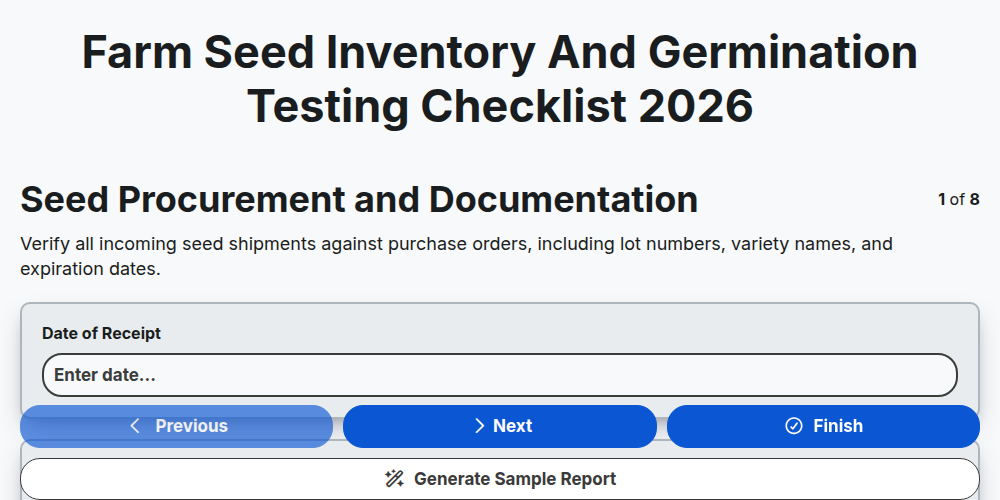
Table of Contents
- Introduction: Why Precision Seed Management Matters in 2026
- Phase 1: Seed Procurement and Detailed Documentation
- Phase 2: Comprehensive Seed Variety and Quantity Audit
- Phase 3: Assessing Seed Packaging and Storage Integrity
- Phase 4: Maintaining Optimal Storage Environment Monitoring
- Phase 5: Implementing a Rigorous Germination Testing Protocol
- Phase 6: Analyzing Germination Rate Results and Data
- Phase 7: Verifying Seed Treatment and Coating Integrity
- Phase 8: Managing the Inventory Reorder and Disposal Log
- Conclusion: Preparing Your Farm for a High-Yield Season
- Resources & Links
TLDR: Avoid costly planting failures and maximize crop yields in 2026 by following our comprehensive guide to seed management. This checklist provides a step-by-step workflow for auditing varieties, maintaining storage integrity, conducting rigorous germination testing, and optimizing your inventory reorder processes to ensure every seed in your warehouse is ready for the field.
Introduction: Why Precision Seed Management Matters in 2026
As we approach the 2026 planting season, the margin for error in modern agriculture is slimmer than ever. With fluctuating climate patterns, rising input costs, and the increasing need for crop resilience, the success of your entire harvest begins long before the first tractor hits the field. It begins in the seed store.
The High Stakes of Seed Management
In an era of precision agriculture, a seed is not just a commodity; it is your most critical investment. Relying on outdated inventory records or assuming that last year's leftovers will perform with the same vigor as new stock is a gamble that no modern producer can afford to take.
A single overlooked batch of low-germination seeds can lead to uneven emergence, wasted herbicide applications, and significant yield gaps that impact your bottom line for the entire season.
Beyond Simple Counting: The 2026 Standard
Effective seed management in 2026 has evolved beyond simply knowing how much you have. It is now about deep-dive data-understanding the biological viability, the integrity of the coatings, and the exact environmental history of every bag in your facility.
By implementing a rigorous, standardized checklist, you move from a reactive stance to a proactive one. This approach allows you to:
- Mitigate Financial Risk: Identify low-viability stock before you commit to expensive planting windows.
- Optimize Resource Allocation: Ensure your seed treatments and fertilizers are applied to crops with the highest potential.
- Maximize Yield Consistency: Guarantee uniform emergence across your acreage through verified germination rates.
The following checklist is designed to help you audit your inventory with scientific precision, ensuring that when the planting window opens, your seeds are ready to perform.
Phase 1: Seed Procurement and Detailed Documentation
Establishing the Foundation: Procurement and Records
The success of your 2026 growing season doesn't begin in the field; it begins the moment a seed enters your facility. To prevent the common pitfalls of mystery seeds and undocumented losses, Phase 1 focuses on creating a transparent, traceable, and highly organized paper trail for every single grain, kernel, or seed pod you acquire.
Comprehensive Seed Procurement Documentation
Every time a new shipment arrives, it must be treated as a critical data entry event. Relying on memory or loose scraps of paper is the fastest way to compromise your inventory integrity. For 2026, your procurement logs should capture more than just the arrival date.
Essential Data Points to Record:
- Supplier Information: Tracking the source and reliability of your seed provider.
- Batch and Lot Numbers: Crucial for tracing potential recalls or widespread germination failures.
- Date of Arrival and Expected Expiry: Establishing a clear timeline for seed longevity.
- Purchase Cost and Volume: Vital for calculating the true cost of production and planning next year's budget.
Building a Traceable Digital or Physical Ledger
A robust inventory system requires a centralized Single Source of Truth. Whether you are utilizing advanced farm management software or a meticulously maintained physical ledger, the goal remains the same: total visibility.
Verifying the Paper Trail
Before any seeds are moved into long-term storage, verify that the physical shipment matches the invoice and the Certificate of Analysis (CoA). If there is a discrepancy between what was ordered and what was received, address it immediately with the vendor. This initial verification step is your first line of defense against wasted storage space and financial loss.
Phase 2: Comprehensive Seed Variety and Quantity Audit
Precision Counting and Variety Verification
Once your procurement documents are organized, the next critical step is the physical audit. You cannot rely solely on what the paperwork says; you must verify that the physical stock matches your records. In 2026, with rising seed costs and supply chain fluctuations, accuracy in this phase is your best defense against unexpected shortages during the planting window.
Systematic Counting Procedures
Don't just glance at the bags. For high-value crops or small-batch specialty seeds, implement a standardized counting method:
- Weight-to-Count Conversion: For bulk seeds, use calibrated scales to verify that the weight matches the expected seed count based on the manufacturer's thousand-seed weight (TSW).
- Unit-Based Verification: For pre-packaged or packeted seeds, perform a physical tally of every individual unit to ensure no discrepancies exist between the delivery manifest and the shelf.
- Discrepancy Flagging: Immediately mark any short deliveries or unexpected surpluses in your digital inventory system to trigger a reconciliation process.
Variety and Genetic Integrity Check
A common error in large-scale farming is the accidental mixing of similar-looking varieties. Use this audit to confirm:
- Variety Nomenclature: Ensure the specific cultivar name matches your planting plan (e.g., distinguishing between Tomato Variety A and Tomato Variety B).
- Lot Number Tracking: Record the specific lot numbers for every variety. This is vital for traceability in the event of a manufacturer recall or if you notice a decline in vigor during testing.
- Hybrid vs. Heirloom Verification: Re-confirm the genetic classification of each seed lot to ensure your crop plan aligns with your intended market or production goals.
Quantifying Planting Capacity
The ultimate goal of this audit is to determine your Planting Potential. By comparing your audited quantity against your total acreage requirements, you can identify The Gap-the difference between what you have in the warehouse and what you need in the field. This data will directly inform your Inventory Reorder and Disposal Log later in the season.
Phase 3: Assessing Seed Packaging and Storage Integrity
Inspecting the First Line of Defense
Before you ever reach for a testing kit, you must evaluate the physical condition of your seed containers. The integrity of your packaging is the primary barrier against moisture, pests, and oxygen-the three greatest enemies of seed longevity.
Container Integrity Audit
A broken seal or a microscopic tear in a bag can render even the highest-quality heirloom seed useless by mid-season. During this phase, your checklist should include:
- Seal Inspection: Check all vacuum-sealed bags, zippers, and heat-sealed pouches for any signs of breach or loss of suction.
- Container Material Check: Inspect plastic bins for cracks or brittleness caused by long-term storage. For paper envelopes, ensure there is no evidence of foxing (brown spotting) or structural degradation.
- Contamination Screening: Look for any signs of punctures or holes that could indicate pest activity (such as weevils or grain beetles) entering the containers.
Moisture and Odor Assessment
The physical state of the package often reveals the state of the seed inside.
- The Moisture Test: Feel the exterior of containers for any signs of dampness or condensation. If a bag feels clammy, the seed may have already been compromised by humidity.
- Scent Analysis: Carefully check for any musty or sour odors. A fermented or moldy smell is a definitive sign that fungal growth has taken hold within the inventory, necessitating immediate segregation and disposal.
Label Readability and Metadata Verification
An inventory is only as good as your ability to identify it.
- Legibility Check: Ensure that all handwritten or printed labels are still legible. If a label is fading due to UV exposure or moisture, relabel the container immediately.
- Data Alignment: Confirm that the variety name, lot number, and the 2026 planting date are clearly visible and match your digital master log.
Phase 4: Maintaining Optimal Storage Environment Monitoring
Monitoring for Long-Term Viability
Once you have audited your seeds and verified their packaging integrity, the focus must shift from observation to active maintenance. A seed inventory is only as good as the environment in which it is kept. Even the highest-quality heirloom seeds will lose vigor rapidly if exposed to fluctuating temperatures or humidity.
Critical Environmental Parameters
To ensure your 2026 inventory remains viable for future seasons, your monitoring protocol should focus on three non-negotiable pillars:
- Temperature Stability: Ideally, seeds should be kept in a cool, consistent environment. For long-term storage, aim for temperatures as close to freezing as possible without actually freezing moisture-sensitive species. Avoid storage areas near heaters, fermenting compost piles, or sun-exposed walls.
- Relative Humidity (RH) Control: Moisture is the primary enemy of seed longevity. High humidity triggers metabolic activity and promotes mold growth, while extreme dryness can lead to desiccation. Aim to maintain a consistent humidity level (typically below 50%) to prevent premature germination or rot.
- Light Exposure: Minimize exposure to UV rays and even bright ambient light, which can degrade the cellular structure of the seed embryo over time.
Implementing a Digital or Manual Log
Monitoring is useless without documentation. To maintain a professional standard for the 2026 season, implement a routine inspection schedule:
- Weekly Sensor Checks: Utilize hygrometers and digital thermometers to log data. If you are using smart sensors, ensure your alerts are set to notify you immediately of any out-of-bounds readings.
- Visual Inspection for Condensation: Periodically check the interior of airtight containers. Any sign of condensation is a red flag that your moisture barrier has been compromised.
- The Dryness Test for Packaging: Periodize inspections of desiccant packets (silica gel). If the beads have changed color, they are saturated and must be replaced immediately to continue protecting your stock.
By treating storage monitoring as an active, data-driven task rather than a passive observation, you significantly decrease the risk of a failed germination test when the planting window finally arrives.
Phase 5: Implementing a Rigorous Germination Testing Protocol
Maximizing Your Yield: The Science of the Testing Protocol
Inventory management is only half the battle; the true measure of seed viability lies in the testing process. As we move into the 2026 growing season, simply knowing what you have in stock is insufficient-you must know how well it will perform. A standardized testing protocol prevents the devastating loss of time and capital that occurs when poor-quality seeds are planted too late in the season.
Step-by-Step Germination Testing Procedure
To ensure consistency and scientific accuracy, follow these systematic steps for every batch of seed entered into your inventory:
1. Sampling and Sub-lot Selection
Never test your entire stock. Select a representative sample from each seed lot. For larger batches, use a random sampling method to ensure that any localized moisture damage or pest issues within a specific container are accurately reflected in your test results.
2. The Controlled Environment Setup
Place your samples in a standardized testing medium-either sterile blotter paper, germination paper, or a sterile sand substrate. Ensure the medium is sufficiently moistened but not waterlogged, as excess moisture can induce rot rather than growth.
3. Controlled Incubation
Store your samples in a germinator or a temperature-controlled environment that mimics the species' specific requirements. For 2026, we recommend using automated climate-controlled chambers if available, as they minimize human error in temperature fluctuations.
4. Daily Monitoring and Data Entry
Observe the samples at regular intervals (typically every 24 to 48 hours). Document the emergence of the radicle and the development of the first true leaves. This stage requires meticulous record-keeping to distinguish between true germination and mere swelling of the seed coat.
Determining the Germination Percentage
The final stage of the protocol is the mathematical calculation of your success rate. Use the following formula to determine if a seed lot is fit for planting:
$$\text{Germination Rate (%)} = \left( \frac{\text{Number of seeds germinated}}{\text{Total number of seeds tested}} \right) \times 100$$
Setting Your 2026 Thresholds
Not all crops are created equal. During this protocol, establish Critical Thresholds for your farm. For example, you may decide that a 95% germination rate is required for high-value specialty crops, while a 75% rate might be acceptable for cover crops. Any batch falling below your pre-determined threshold should be immediately flagged for the Inventory Reorder and Disposal Log.
Phase 6: Analyzing Germination Rate Results and Data
Turning Data into Actionable Planting Strategies
Once you have completed your germination trials, you are left with more than just a collection of numbers; you have a roadmap for your entire 2026 growing season. The true value of this phase lies in how you interpret the raw percentages to make informed decisions about your farm's resource allocation.
Interpreting the Percentages
Not all germination rates are created equal. When reviewing your results, categorize your findings into three distinct action tiers:
- High Vitality (90% or higher): These are your gold standard seeds. These lots are ready for direct seeding or primary nursery trays with high confidence.
- Marginal Viability (70% - 89%): These seeds require a strategic adjustment. You may need to increase your seeding density (over-sowing) to compensate for the expected loss, or reserve these specifically for more forgiving soil conditions.
- Critical Risk (Below 70%): Seeds in this bracket should be flagged for immediate replacement. Relying on these for large-scale production poses a significant risk to your yield and labor efficiency.
Correlating Results with Storage History
To improve your processes for the next season, look for patterns in your data. Check if lower germination rates correlate with specific storage bins, certain seed varieties, or periods where storage temperature fluctuations were recorded. This root cause analysis is essential for refining your Storage Environment Monitoring protocols.
Updating the Master Inventory Plan
The final step in this phase is the integration of your findings into your Inventory Reorder and Disposal Log. Use the data to decide which seeds are worth the cost of another year of storage and which should be transitioned to compost. By documenting these trends, you transform a simple checklist into a powerful tool for long-term agricultural sustainability.
Phase 7: Verifying Seed Treatment and Coating Integrity
Maintaining Seed Protection for Maximum Vitality
Once you have confirmed the quantity and germination potential of your stock, the final critical step in your 2026 audit is verifying the integrity of seed treatments and coatings. For many modern cultivars, the seed's survival depends not just on the embryo itself, but on the protective layer applied during processing.
Inspecting Fungicidal and Insecticidal Treatments
If you are working with treated seeds, you must visually inspect the seed lot for even distribution of the fungicide or insecticide coating.
- Check for clumping: Ensure that the treatment hasn't caused seeds to stick together, which can lead to uneven planting depths.
- Identify degradation: Look for signs that the chemical coating has eroded due to moisture or handling. A loss of coating significantly increases the risk of soil-borne pathogen attacks during the vulnerable early stages of emergence.
Assessing Polymer and Film Coatings
For coated seeds designed for precision planting, the physical integrity of the film is paramount.
- Surface Uniformity: Inspect for any cracking or peeling of the polymer layer. If the coating is compromised, the seed may lack the necessary moisture-retention properties or precision shape required for accurate mechanical seeding.
- Color Consistency: A sudden change in color or dusting around the seed may indicate that the coating is breaking down, potentially clogging planter components.
Ensuring Biological Inoculant Vitality
If your seed inventory includes varieties pre-inoculated with beneficial bacteria (such as Rhizobium for legumes), this step is non-negotiable.
- Moisture Check: Check for any signs of clumping that might indicate the inoculant has been compromised by humidity.
- Verification of Application: Ensure the inoculant remains visibly present and hasn't rubbed off during storage or movement.
Pro-Tip for 2026: Always cross-reference your findings with the manufacturer's application specifications. If a seed lot shows signs of coating degradation, it should be flagged for immediate use or marked for disposal, as the risk of seedling mortality far outweighs the cost of replacement.
Phase 8: Managing the Inventory Reorder and Disposal Log
Closing the Loop: Maintaining the Inventory Reorder and Disposal Log
A successful seed program isn't just about what you keep in your bins; it's about knowing exactly what is leaving them. The final, and perhaps most critical, stage of your 2026 inventory cycle is the systematic management of your Inventory Reorder and Disposal Log. This log serves as the brain of your seed storage, providing the data necessary to prevent last-minute planting panics and wasted resources.
Data-Driven Reordering
The goal of this log is to eliminate guesswork. By tracking seed depletion alongside your germination testing results, you can move from reactive buying to proactive procurement. Your log should capture:
- Low-Stock Triggers: Establish a minimum threshold for every variety. When a specific quantity drops below this line, a reorder alert is triggered.
- Lead Time Tracking: Note how long it takes for specific vendors to deliver. This ensures you place orders well before the planting window opens.
- Procurement Deadlines: Align your reorder dates with the 2026 seasonal calendar to ensure new, high-vigor seeds arrive exactly when needed.
The Protocol for Seed Disposal
Not every seed that fails a germination test deserves a second chance. Part of maintaining a high-performance inventory is the disciplined removal of dead weight.
Use your log to document the disposal of seeds that meet the following criteria:
- Failed Germination Thresholds: Any batch that falls below your farm's minimum viability standard.
- Expired Shelf Life: Seeds that have exceeded their documented storage longevity.
- Contamination Risks: Any packets that failed the Packaging and Storage Integrity audit.
Why the Log Matters for 2026
By maintaining a meticulous record of what was discarded and what was replaced, you create a historical audit trail. This allows you to analyze trends-such as whether a specific seed brand consistently underperforms in your storage environment-enabling you to make more informed, profitable purchasing decisions for the 2027 season and beyond.
Pro-Tip: Digitize this log. Integrating your Reorder and Disposal Log with a simple spreadsheet or farm management software ensures that your data is searchable, backed up, and easily accessible during the heat of the planting season.
Conclusion: Preparing Your Farm for a High-Yield Season
Success Starts in the Seed Room
As we look toward the 2026 growing season, the difference between a mediocre harvest and a record-breaking yield often lies in the meticulous preparation performed months before the first furrow is even plowed. Seed is one of a farm's most significant investments; treating it as such requires more than just casual observation. By implementing this structured checklist-from the initial procurement documentation to the rigorous execution of germination testing protocols-you are effectively mitigating the risks of crop failure and unexpected budget deficits.
Turning Data into Action
A successful season is built on the foundation of reliable data. When you systematically audit your varieties, monitor storage environments, and analyze germination rates, you aren't just keeping records-you are building a roadmap for your planting strategy. This level of precision allows you to:
- Optimize Planting Density: Knowing your exact germination rates prevents the costly mistake of under-planting or the wasted expense of over-seeding.
- Strengthen Financial Resilience: Accurate inventory and reorder logs ensure that capital is never tied up in expired stock and that essential varieties are always available when the window of opportunity opens.
- Enhance Crop Uniformity: Proper verification of seed treatments and storage integrity ensures that every seed in the ground has the same potential for vigor.
A Commitment to Continuous Improvement
The 2026 season represents a new opportunity to refine your agricultural processes. Use this checklist not just as a one-time task, but as a repeatable standard for your farm operations. As you move through each step-from the initial audit to the final disposal of depleted stock-you are cultivating a culture of excellence that will resonate through every stage of the growing cycle.
Start your preparation today. The diligence you apply to your seed inventory today will be the strength of your harvest tomorrow.
Resources & Links
- USDA - United States Department of Agriculture: Official source for agricultural regulations, seed certification standards, and federal farming guidelines.
- Seed Science and Technology: Academic and professional insights into the biological processes of seed vigor and germination physics.
- University Extension Services: Access to localized research and practical tutorials on seed testing and crop management protocols.
- AgriFarming Insights: A hub for modern agricultural technology, including digital inventory management and precision farming tools.
- ASABE - American Society of Agricultural and Biological Engineers: Technical standards for seed storage environments, moisture control, and post-harvest engineering.
- IPCC - Climate Change Information: Essential data for 2026 planning regarding shifting planting windows and climate-resilient seed selection.
- NIFA - National Institute of Food and Agriculture: Resources for funding and scientific advancement in seed biotechnology and sustainable farming.
- Seed Management Software Solutions: Tools and platforms for digitalizing seed inventory, tracking lot numbers, and managing expiration dates.
- AMS - Agricultural Marketing Service: Information on seed certification, quality standards, and the traceability of seed lots.
- FAO - Food and Agriculture Organization: Global perspectives on seed security, biodiversity, and large-scale agricultural planning.
- Cornell University Agriculture: In-depth studies on seed coating effectiveness and physiological seed testing methods.
- Purdue University Ag Sciences: Technical guides on monitoring storage humidity and preventing seed decay in silos.
- Integrated Pest Management (IPM) Resources: Guides on identifying pests and fungi that compromise seed packaging and integrity.
- AgDaily News: Real-time market updates and supply chain information for seed procurement and logistics.
- Precision Ag Technologies: Information on using sensors and IoT for automated monitoring of seed storage environments.
- ScienceDirect - Seed Biology: Peer-reviewed research papers on the long-term viability of treated vs. untreated seeds.
- NASS - National Agricultural Statistics Service: Historical data and trends to help inform reorder quantities and crop rotation planning.
- Oklahoma State University Ag: Practical laboratory methods for conducting manual germination and vigor tests.
Comments
There are no comments yet. Be the first to add one!
Farm Management Solution Demo
Grow your farm smarter & more efficiently! ChecklistGuro streamlines crop planning, task management, & resource tracking. Maximize yields, reduce waste, & improve profitability. Manage it all with our Work OS.
Related Articles
Unlock Higher Yields: Your Precision Agriculture Checklist Template
The Ultimate Farm Safety Inspection Report Checklist Template
Irrigation System Checklist: Farm Water Management & Crop Yield Optimization

Livestock Health & Welfare Checklist: Your Farm Animal Care & Biosecurity Template
Crop Insurance Policy Review Checklist: A Farmer's Guide
Water Discharge Permit Compliance Checklist Template
The Ultimate GPS & Precision Farming Calibration Checklist Template
Mapping the Threat: A Checklist for Proactive Pest & Disease Pressure Management
Need help with
Farm Management?
Have a question? We're here to help. Please submit your inquiry, and we'll respond promptly.