The Ultimate 2026 Fleet Vehicle Maintenance & Safety Compliance Checklist: A Complete Template for Fleet Managers
Published: 10/31/2026 Updated: 11/01/2026
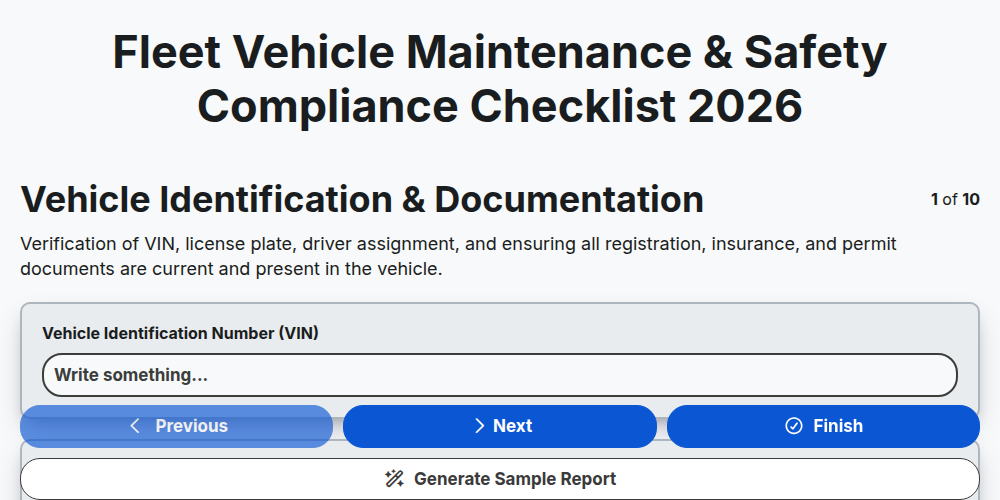
Table of Contents
- Introduction: Why Proactive Maintenance is Critical for 2026 Fleet Operations
- 1. Vehicle Identification & Documentation: The Foundation of Compliance
- 2. Exterior Inspection & Body Integrity: Protecting Your Assets
- 3. Tire & Wheel Assembly Audit: Preventing Roadside Failures
- 4. Fluid Levels & Engine Compartment: Ensuring Mechanical Longevity
- 5. Braking & Steering Performance: The Core of Driver Safety
- 6. Interior Safety & Ergonomics: Driver Comfort and Control
- 7. Emergency Equipment & Safety Kit: Preparedness for the Unexpected
- 8. Load Security & Cargo Area Inspection: Minimizing Liability
- 9. Emission & Environmental Compliance: Meeting 2026 Standards
- 10. Maintenance Log & Schedule Verification: Maintaining an Audit Trail
- Best Practices for Implementing Digital Inspection Workflows
- Conclusion: Building a Culture of Safety and Efficiency
- Resources & Links
TLDR: Ensure your fleet stays roadworthy and compliant in 2026 with this comprehensive maintenance and safety audit guide. This checklist covers everything from vehicle documentation and engine performance to tire integrity, load security, and environmental compliance, providing fleet managers with a streamlined template to reduce downtime and mitigate liability.
Introduction: Why Proactive Maintenance is Critical for 2026 Fleet Operations
The New Era of Fleet Management: Why Proactive Maintenance is Non-Negotiable
As we enter 2026, the landscape of fleet management has shifted. With the increasing integration of advanced telematics, stricter environmental regulations, and the growing complexity of hybrid and electric vehicle (EV) integration, the fix it when it breaks mentality is no longer just inefficient-it is a massive financial liability.
In today's economy, a single vehicle downtime event triggers a domino effect of missed deliveries, frustrated clients, and skyrocketing operational costs. Beyond the balance sheet, the stakes for safety compliance have never been higher. Regulatory bodies are tightening oversight on emission standards and driver safety protocols, meaning a single oversight in your maintenance routine could lead to heavy fines or significant legal exposure.
Moving from Reactive to Predictive
The goal for 2026 is to transition from reactive repairs to predictive maintenance. By implementing a rigorous, standardized inspection framework, fleet managers can:
- Minimize Unscheduled Downtime: Identify wear and tear before it turns into a roadside breakdown.
- Extend Asset Lifecycles: Maximizing the ROI of your vehicles by ensuring every component performs at peak efficiency.
- Ensure Regulatory Compliance: Stay ahead of evolving environmental and safety laws to avoid costly audits and penalties.
- Enhancing Driver Safety: A well-maintained vehicle is the first line of defense in protecting your most valuable assets-your drivers.
This checklist is designed to serve as your definitive operational blueprint. By systematically auditing every aspect of your fleet-from tire integrity to emission compliance-you ensure that your fleet remains a reliable, safe, and cost-effective engine for your business growth throughout 2026 and beyond.
1. Vehicle Identification & Documentation: The Foundation of Compliance
The Paperwork Behind the Performance
Before a single tire is inspected or an engine is checked, the foundation of a compliant fleet lies in its documentation. In 2026, with increasing digital integration and stricter regulatory oversight, maintaining an airtight administrative trail is no longer optional-it is a legal necessity.
Effective vehicle identification and documentation ensure that every asset in your fleet is traceable, accountable, and legally authorized to be on the road. Neglecting this step creates a blind spot that can lead to massive fines, failed audits, and significant liability during accident investigations.
Essential Elements of the Documentation Audit
To ensure your fleet meets both internal standards and external regulatory requirements, your checklist must confirm the presence and accuracy of the following:
- VIN Verification: Cross-referencing the Physical Vehicle Identification Number (VIN) on the chassis against the digital fleet management system and registration papers to prevent clerical errors.
- Up-to-Date Registration & Licensing: Verification that all vehicle registrations, permits, and operating authorities are current and visible.
- Insurance Coverage Proof: Ensuring that valid proof of insurance is stored both digitally and physically within the vehicle.
- Driver Authorization Records: Confirming that the assigned driver's credentials, including medical certificates and endorsements, are properly linked to the vehicle's duty logs.
- Digital Manifest & Asset Tagging: Ensuring that the vehicle's digital twin (its profile in your Fleet Management Software) reflects its current status, assigned department, and operational deployment.
Why It Matters for 2026 Compliance
As regulatory bodies move toward more real-time, data-driven enforcement, the paper trail is increasingly digital. An error in documentation is often treated with the same severity as a mechanical failure. By prioritizing this step, you ensure that when an auditor or law enforcement officer requests proof of compliance, your fleet is prepared to provide instant, indisputable evidence of legitimacy.
2. Exterior Inspection & Body Integrity: Protecting Your Assets
Preserving Structural Integrity and Brand Image
The exterior of your fleet is more than just a shell; it is a moving billboard for your company and the first line of defense against mechanical failure. A neglected exterior can lead to accelerated corrosion, compromised aerodynamics, and significant safety risks.
Critical Inspection Points
When conducting your 2026 inspections, ensure your team is evaluating the following components:
- Body Panels and Frame Integrity: Check for any signs of structural damage, deep dents, or warping. Even minor impacts can compromise the vehicle's crumple zones and structural stability during a collision.
- Corrosion and Rust Detection: With increasingly volatile weather patterns, inspect all undercarriage areas and wheel wells for signs of oxidation. Early detection of surface rust is vital to preventing catastrophic metal fatigue.
- Lighting and Signal Functionality: Verify the operation of all headlights (high and low beam), turn signals, brake lights, and hazard indicators. In 2026, ensure that any LED-integrated components are free from moisture ingress or lens clouding.
- Mirror and Window Clarity: Inspect side mirrors, rearview mirrors, and all windows for cracks, chips, or pitting. Clear visibility is non-negotiable for driver safety and reducing blind-spot risks.
- Wiper Blade and Washer System: Ensure wiper blades are supple and free of tears, and that the washer fluid nozzles are unobstructed to maintain visibility during heavy rain or debris.
- Reflective Decals and Branding: Ensure all company decals, DOT numbers, and reflective safety tape are intact and legible. Compliance with updated 2026 visibility regulations depends on the maintenance of these identifiers.
The Cost of Neglect
Ignoring minor exterior issues often leads to cascading repairs. A small crack in a window or a tiny puncture in a body panel can allow moisture to reach sensitive electrical components or structural supports, turning a minor cosmetic fix into a costly downtime event.
3. Tire & Wheel Assembly Audit: Preventing Roadside Failures
Precision Checks for Maximum Traction and Stability
In 2026, as vehicle weight distributions change with the rise of heavier EV fleets, the tire and wheel audit has moved beyond simple tread depth measurements. A single tire failure doesn't just cause a delay; it triggers a cascade of safety risks and compliance liabilities. To ensure your fleet remains roadworthy and compliant with evolving safety standards, your audit must be rigorous and systematic.
Tread Depth and Pattern Integrity
Don't just look at the surface. A thorough inspection must include:
- Uniform Tread Depth: Use a digital depth gauge to ensure even wear across the entire circumference. Discrepancies between the inner and outer edges often signal underlying alignment issues.
- Pattern Consistency: Inspect for chunking, uneven cupping, or irregular wear patterns that indicate suspension or pressure irregularities.
- The DOT Code Verification: Check the manufacturing date. Tires exceeding their operational lifespan-even if they look new-must be flagged for replacement to prevent structural degradation.
Pressure and Inflation Management
Under-inflation is the leading cause of fuel inefficiency and overheating in modern fleets.
- Cold Pressure Audits: Always check pressures when tires are cold to ensure accuracy.
- TPMS (Tire Pressure Monitoring System) Calibration: In 2026, your audit isn't complete until you have verified that the onboard sensors are communicating accurately with the vehicle's ECU.
- Regulated Inflation Standards: Ensure all tires meet the specific PSI requirements listed on the vehicle's door placard, accounting for any heavy-duty load requirements.
Wheel, Rim, and Hardware Security
The connection between the tire and the vehicle is just as critical as the rubber itself.
- Rim Integrity: Inspect for cracks, bends, or corrosion, particularly on alloy wheels which are more susceptible to impact damage.
- Lug Nut Torque Verification: Implement a standardized torque check. Loose lug nuts are a catastrophic failure point; use a calibrated torque wrench to ensure every nut meets manufacturer specifications.
- Bead Seat Inspection: Check for any signs of air seepage or debris trapped between the tire bead and the rim that could compromise the seal.
Debris and Foreign Object Damage (FOD)
Finalize your audit by scanning the sidewalls for embedded objects-such as nails, stones, or metal fragments-that may not have caused a puncture yet but are actively compromising the structural integrity of the tire casing.
4. Fluid Levels & Engine Compartment: Ensuring Mechanical Longevity
The Heart of Your Fleet: Engine Health and Fluid Integrity
The engine compartment is the nerve center of your vehicle. In 2026, with increasingly stringent environmental regulations and the rising cost of vehicle downtime, proactive engine maintenance is no longer optional-it is a financial necessity. Neglecting a single leak or a low fluid level can lead to catastrophic engine failure, expensive emergency repairs, and unplanned outages that disrupt your entire supply chain.
Critical Fluid Level Verifications
A systematic check of all essential fluids ensures that friction is minimized and thermal regulation is maximized. Your inspection must include:
- Engine Oil: Check for proper levels and look for signs of discoloration or milky textures that could indicate coolant contamination.
- Engine Coolant (Antifreeze): Ensure the level is within the manufacturer's recommended range and inspect the condition of the coolant to prevent overheating and corrosion.
- Power Steering Fluid: Verify levels to prevent heavy steering, pump noise, or hydraulic failure.
- Brake Fluid: A low level here is a primary indicator of brake pad wear or a leak in the hydraulic system.
- Windshield Washer Fluid: Essential for maintaining driver visibility and operational safety in all weather conditions.
- Transmission Fluid: Check for clarity and level to ensure smooth gear transitions and prevent transmission overheating.
Engine Compartment Visual Audit
Beyond just checking levels, a physical inspection of the engine bay can reveal silent issues before they become loud failures.
Components to Inspect:
- Belts and Hoses: Examine serpentine belts for fraying, cracking, or glazing. Inspect all hoses for swelling, brittleness, or signs of weeping/leaks.
- Battery Health: Inspect terminals for corrosion, ensure connections are tight, and check the battery casing for any signs of swelling or leakage.
- Air Intake System: Ensure the air filter is clean and free of debris; a clogged filter significantly degrades fuel efficiency and engine performance.
- Leak Detection: Perform a thorough visual scan of the engine block and surrounding components for any signs of oil, coolant, or fuel seepage.
Pro-Tip for 2026: With the integration of more advanced telematics, correlate your manual fluid checks with your vehicle's onboard diagnostic (OBD) data. If the sensors report a discrepancy not visible to the eye, schedule an immediate professional diagnostic.
5. Braking & Steering Performance: The Core of Driver Safety
Ensuring Precision and Control
The braking and steering systems are the most critical components of your fleet's safety profile. In 2026, with the increasing integration of advanced driver-assistance systems (ADAS) and heavier electric vehicle (EV) payloads, a standard visual check is no longer sufficient. A failure in these systems doesn't just result in downtime; it results in catastrophic liability.
Critical Braking System Inspection Points
To maintain compliance and ensure maximum stopping power, your inspection must move beyond looking for leaks. Focus on these key areas:
- Brake Pad & Shoe Thickness: Measure the remaining friction material against manufacturer specifications. In 2026, proactive replacement is preferred over reactive repairs to avoid disk/drum scoring.
- Hydraulic System Integrity: Inspect brake lines, hoses, and fittings for signs of swelling, cracking, or fluid weeping. Even a microscopic leak can lead to sudden pressure loss.
- Sensor & ABS Functionality: With the prevalence of anti-lock braking systems, verify that wheel speed sensors are clean and that the ABS warning indicators are functioning correctly.
- Brake Fluid Condition: Check for moisture contamination and ensure the fluid meets the correct viscosity and boiling point requirements.
Steering & Suspension Stability
Steering precision is the first line of defense against lane drift and loss of control. A driver's ability to navigate an emergency maneuver depends on the integrity of the steering linkage.
- Steering Gear & Linkage: Inspect the steering box, pitman arm, and tie rod ends for excessive play or looseness.
- Power Steering System: For hydraulic systems, check for pump noise and belt tension. For electric power steering (EPS), ensure the electronic control unit (ECU) is free of error codes.
- Suspension Component Audit: Examine ball joints, control arms, and bushings for wear. Worn suspension components directly impact tire longevity and vehicle stability during high-speed maneuvers.
Pro-Tip for 2026 Compliance: Use digital torque wrenches and precision measuring tools during these inspections. Documenting the exact measurements of brake pad thickness provides an undeniable audit trail in the event of a safety inspection or accident investigation.
6. Interior Safety & Ergonomics: Driver Comfort and Control
Optimizing the Driver's Environment for Safety and Loninaivty
While much of fleet maintenance focuses on the mechanical heart of the vehicle, the driver's cockpit is where safety decisions are made. In 2026, with the increasing integration of advanced telematics and driver-assist technologies, the interior of a vehicle is no longer just a seat; it is a high-tech command center. Neglecting the ergonomics and safety of the cabin can lead to driver fatigue, increased error rates, and long-term liability.
The Ergonomic Audit: Reducing Fatigue and Strain
Driver fatigue is one of the leading causes of commercial vehicle accidents. An ergonomic inspection ensures that the vehicle is configured to support the driver's physical well-being during long shifts.
- Seat Functionality and Support: Check for worn cushioning,-stuck adjustment levers, and the integrity of lumbar supports. Ensure the seat can be properly secured to prevent shifting during sudden maneuvers.
- Control Accessibility: Verify that all essential controls-including gear shifters, handbrakes, and secondary switches-are easily reachable without the driver having to lean excessively or take their eyes off the road for extended periods.
- Mirror Alignment and Stability: Inspect all rearview and side mirrors for cracked glass or loose mounting brackets. Mirrors must be adjustable and vibration-resistant to ensure a clear, steady field of view.
- Pedal Feel and Clearance: Ensure the accelerator, brake, and clutch (if applicable) have smooth travel and are not obstructed by floor mats or debris.
Safety Interface and Cab Integrity
The interior must also be free of distractions and hazards that could compromise the driver's focus.
- Dashboard and Instrument Cluster: Test all gauges, warning lights (check engine, oil pressure, ABS), and digital displays. Any ghost warnings or flickering screens must be addressed immediately to prevent driver confusion.
- Visibility and Obstruction Check: Ensure the windshield is free of cracks that obstruct the driver's view and that the dashboard is clean of dust or debris that could hide critical warning indicators.
- Climate Control Systems: In 2026, temperature regulation is a critical safety component. Inspect the HVAC system to ensure the driver can maintain a stable, comfortable cabin temperature, which is essential for maintaining alertness in extreme weather.
- Seatbelt Integrity: Conduct a rigorous check of all seatbelts for fraying, stretching, or malfunctioning retraction mechanisms. A seatbelt that does not lock properly is a critical compliance failure.
7. Emergency Equipment & Safety Kit: Preparedness for the Unexpected
Ensuring Driver Safety and Regulatory Compliance
In the event of a breakdown, minor accident, or roadside emergency, the presence of a well-stocked safety kit is the difference between a minor inconvenience and a major liability. For 2026, compliance standards are tightening around the availability and usability of emergency gear. A missing fire extinguisher or an expired first-aid kit isn't just a safety risk-it's a compliance failure that can lead to heavy fines during roadside inspections.
Critical Inventory Audit
When performing your inspections, ensure that every vehicle in your fleet is equipped with the following essentials:
- Fire Extinguishers: Check that all units are pressurized, the pin is intact, and the inspection tag is up to date.
- First-Aid Kits: Verify that kits are fully stocked, seals are unbroken, and no components (such as antiseptic wipes or bandages) have passed their expiration dates.
- Roadside Signaling: Confirm the presence of high-visibility reflective triangles or flares and working LED emergency beacons to ensure visibility during night-time breakdowns.
- Reflective Safety Vests: Every driver must have easy access to ANSI-compliant high-visibility gear for use when exiting the vehicle on the shoulder.
Beyond the Basics: The 2026 Standard
Modern fleet management now emphasizes smart preparedness. As part of your 2026 audit, consider integrating the following into your kit protocols:
- Communication Redundancy: Ensure drivers have functional power banks or secondary communication devices in case of primary mobile network outages.
- Weather-Specific Gear: Depending on your operational region, verify the presence of emergency thermal blankets, ice scrapers, or sand/traction aids.
- Flashlight Integrity: Check that heavy-duty, water-resistant flashlights are present and that spare batteries are stored in a temperature-controlled manner within the kit to prevent leakage.
Pro-Tip for Fleet Managers: Don't just check for the presence of the kit; check the condition of the contents. A damp, moldy first-aid kit or a rusted toolset is just as much of a liability as having no kit at all.
8. Load Security & Cargo Area Inspection: Minimizing Liability
Ensuring Stability and Preventing Cargo Shifts
In 2026, the landscape of logistics and transport safety is more regulated than ever. A single unsecured piece of cargo isn't just a logistical error; it is a significant liability that can lead to catastrophic accidents, vehicle instability, and heavy regulatory fines. When your cargo shifts during transit, it alters the vehicle's center of gravity, potentially leading to rollovers or sudden loss of control.
Key Inspection Points for Cargo Integrity
To ensure your fleet remains compliant and your drivers remain safe, every cargo area inspection must include the following checks:
- Cargo Securing Mechanisms: Inspect all straps, nets, chains, and tie-downs for signs of fraying, stretching, or mechanical fatigue. If a strap is compromised, it must be decommissioned immediately.
- Load Distribution Assessment: Verify that weight is distributed evenly across the axles. Imbalanced loads can cause steering difficulties and excessive wear on braking systems.
- Container & Trailer Integrity: Check the floorboards of cargo areas for holes, rot, or structural weakness. Ensure that all bulkheads, partitions, and side panels are securely locked and capable of withstanding the pressure of the load.
- Locking & Fastening Systems: Test all door latches, cam locks, and tailgate mechanisms. Ensure that seals are intact to prevent unauthorized access or environmental exposure to sensitive goods.
Mitigating Risk and Reducing Liability
A rigorous inspection of the cargo area does more than just protect your goods; it protects your bottom line. By implementing a standardized protocol for load security, you reduce the risk of:
- Roadside Inspection Failures: Avoiding costly out-of-service orders during DOT or regulatory audits.
- Property Damage Claims: Minimizing the risk of cargo shifting and damaging other vehicles or infrastructure.
- Insurance Premium Spikes: Demonstrating a proactive safety culture to insurers to maintain favorable rates.
Pro-Tip for 2026: Integrate digital photo documentation into your workflow. Requiring drivers to upload photos of the secured load via your fleet management software provides an indisputable digital audit trail of compliance.
9. Emission & Environmental Compliance: Meeting 2026 Standards
Staying Ahead of the Curve: Navigating the 2026 Regulatory Landscape
As we move into 2026, the landscape of fleet management is being reshaped by stricter environmental regulations and a global push toward decarbonization. Compliance is no longer just about passing a local inspection; it is about minimizing your carbon footprint and avoiding heavy non-compliance penalties that can cripple your bottom line.
To ensure your fleet remains operational and legally compliant, your inspection must go beyond simple tailpipe checks. Use the following sub-points to guide your environmental audit:
1. Emission System Integrity Check
Ensure all Exhaust Gas Recirculation (EGR) systems, Diesel Particulate Filters (DPF), and Selective Catalytic Reduction (SCR) components are functioning at peak efficiency. Even minor leaks or sensor malfunctions can lead to increased emissions and failed regulatory inspections.
2. Greenhouse Gas (GHG) & Fuel Efficiency Monitoring
With 2026 standards focusing heavily on fuel economy, use this step to audit your fleet's fuel consumption patterns. Identify vehicles that are underperforming, as inefficient combustion often signals underlying mechanical issues that contribute to higher CO2 output.
3. Leak Detection & Fluid Containment
Environmental compliance also involves preventing ground contamination. Inspect all reservoirs, seals, and hoses for signs of leaking oil, coolant, or hydraulic fluid. A clean fleet is a compliant fleet, and preventing soil and water contamination is a key pillar of modern ESG (Environmental, Social, and Governance) reporting.
4. Transition Readiness & EV/Hybrid Assessment
If your fleet includes zero-emission vehicles (ZEVs) or hybrids, your checklist must include battery health monitoring and charging infrastructure verification. Ensuring that software updates are current is vital for maintaining the optimized energy management systems required by new 2026 efficiency mandates.
10. Maintenance Log & Schedule Verification: Maintaining an Audit Trail
Ensuring Accountability Through Documented Excellence
The final, and perhaps most critical, pillar of your 2026 compliance strategy is the verification of your maintenance logs and scheduling protocols. In the eyes of regulators, auditors, and insurance providers, if it wasn't documented, it didn't happen.
As we move further into 2026, the shift toward digital-first compliance means that paper trails are being replaced by real-time, cloud-based telemetry and automated logging. This step is about more than just checking boxes; it is about ensuring that your preventive maintenance (PM) program is proactive rather than reactive.
The Audit Trail: What You Need to Verify
To ensure your fleet remains compliant and your liability remains low, your verification process must focus on three key areas:
- Temporal Accuracy: Are inspections being performed at the prescribed intervals (e.g., every 10,000 miles or every 90 days)? A gap in your schedule is an immediate red flag during a safety audit.
- Data Integrity: Do your logs clearly show the who, what, when, and how of every repair? Every entry should include the technician's signature (or digital ID), the specific parts replaced, and the date of service.
- Closed-Loop Completion: This is the most common failure point. A log is only verified when a flagged deficiency from an inspection is matched with a corresponding repair order. You must prove that when a fault was identified in steps 1 through 9, a corrective action was taken to resolve it.
Transitioning to Digital Verification
In 2026, manual spreadsheets are a significant liability. To maximize the effectiveness of this checklist, utilize Fleet Management Software (FMS) to automate your schedule verification.
Key Checklist Items for Log Verification:
- Audit of PM Intervals: Cross-reference current mileage/engine hours against the scheduled maintenance calendar.
- Repair Order Reconciliation: Ensure all Critical and High priority findings from previous inspections have a corresponding Closed status in the system.
- Regulatory Compliance Check: Confirm that all state and federal emissions certifications and periodic inspections are up to date and digitally accessible.
- Driver DVIR Review: Verify that Driver Vehicle Inspection Reports (DVIRs) are being submitted daily and that management has reviewed and acknowledged all reported defects.
By treating your maintenance log as a live, breathing document rather than a historical archive, you transform your fleet from a cost center into a highly disciplined, safety-first operation.
Best Practices for Implementing Digital Inspection Workflows
Transitioning from Paper to Digital: Maximizing Inspection Efficiency
In 2026, manual, paper-based inspections are no longer just an inconvenience-they are a liability. To truly leverage the comprehensive checklist outlined above, fleet managers must move toward integrated digital workflows. Implementing a digital-first approach ensures that the data collected during your inspections becomes actionable intelligence rather than just archived paperwork.
Automating Data Accuracy and Real-Time Alerts
The greatest risk in manual inspections is pencil whipping-the practice of checking boxes without performing a physical inspection. Digital inspection tools mitigate this by utilizing timestamped entries, GPS verification, and mandatory photo uploads for high-risk areas like Tire & Wheel Assembly or Braking & Steering Performance.
By integrating your checklist into a mobile application, your drivers can trigger instant alerts to the maintenance department the moment a defect is identified. For example, a flagged issue in the Fluid Levels & Engine Compartment section can automatically generate a work order in your Fleet Management Software (FMS), reducing vehicle downtime and preventing minor leaks from becoming catastrophic engine failures.
Centralizing Compliance and Audit Readiness
Compliance is no longer just about passing a physical inspection; it is about proving a continuous history of care. Digital workflows provide a centralized, unalterable single source of truth for every vehicle in your fleet.
- Instant Audit Trails: When regulators or insurance auditors request proof of Emission & Environmental Compliance or Maintenance Log Verification, you can generate comprehensive reports in seconds rather than searching through dusty filing cabinets.
- Predictive Maintenance Integration: Digital logs allow you to track trends over time. If the Exterior Inspection & Body Integrity logs show recurring damage in a specific region or with a specific driver group, you can implement targeted training or route adjustments.
- Seamless Documentation Management: Ensure that Vehicle Identification & Documentation (registration, insurance, and permits) is always up to date with automated expiration notifications, eliminating the risk of operating non-compliant vehicles.
Scalability and Driver Accountability
As your fleet grows, the complexity of managing Load Security & Cargo Area Inspections and Emergency Equipment audits increases exponentially. A digital workflow scales with you. It provides a standardized framework that ensures a driver in a different city is performing the exact same safety checks as your lead mechanic, maintaining a uniform standard of safety across your entire enterprise.
Conclusion: Building a Culture of Safety and Efficiency
Turning Compliance into a Competitive Advantage
Implementing this 2026 Fleet Vehicle Maintenance & Safety Compliance Checklist is about more than just checking boxes or avoiding costly fines. It is about shifting your operational mindset from reactive repair to proactive prevention. In an era where fuel costs, environmental regulations, and driver safety standards are becoming increasingly stringent, a rigorous inspection routine is your most powerful tool for long-term profitability.
The Long-Term Benefits of Diligent Oversight
When your team adheres to these ten essential inspection pillars, the benefits extend far beyond the garage:
- Reduced Downtime: Catching a worn tire or a minor fluid leak during a routine audit prevents the catastrophic breakdowns that derail delivery schedules and disrupt service promises.
- Enhanced Driver Safety: A well-maintained vehicle is a safer vehicle. By prioritizing braking, steering, and visibility, you are directly investing in the well-being of your most valuable assets-your drivers.
- Lower Total Cost of Ownership (TCO): While regular maintenance requires an upfront investment of time and resources, it drastically reduces the frequency of emergency repairs and extends the lifecycle of your entire fleet.
- Regulatory Peace of Mind: With the Maintenance Log & Schedule Verification step, you ensure that your fleet is always audit-ready, shielding your company from legal liabilities and environmental penalties.
Moving Forward in 2026 and Beyond
As technology continues to integrate into fleet management-from telematics to automated engine diagnostics-the fundamental principles of this checklist remain unchanged. Use this template as your foundational standard, and integrate it into your daily or weekly workflows.
Consistency is the key to success. By embedding these safety and maintenance protocols into your company culture, you aren't just managing a fleet; you are building a resilient, reliable, and high-performing logistics engine that is prepared to meet the challenges of the road ahead.
Resources & Links
- Federal Motor Carrier Safety Administration (FMCSA): The primary US regulatory body for setting safety standards and compliance regulations for commercial motor carriers.
- Occupational Safety and Health Administration (OSHA): Essential resources for workplace safety, driver ergonomics, and maintaining a safe operating environment for fleet employees.
- Environmental Protection Agency (EPA): Guidance on emission standards, fuel efficiency regulations, and environmental compliance for heavy-duty vehicles.
- FMCSA SAFER System: Access to company and driver safety performance records, crucial for auditing vehicle identification and documentation.
- TruckersGuide: Real-world insights into road conditions and vehicle needs, helpful for understanding the impact of maintenance on long-haul operations.
- Fleet Maintenance Management Resources: Industry-specific insights regarding mechanical longevity, engine compartment upkeep, and preventative maintenance strategies.
- International Organization for Standardization (ISO): Reference for global standards in quality management and safety protocols applicable to fleet logistics.
- National Highway Traffic Safety Administration (NHTSA): Crucial for checking vehicle recalls, braking system safety standards, and tire-related safety information.
- Forbes Business/Logistics: High-level insights into the future of fleet management, including the integration of AI and digital workflows in 2026.
- Supply Chain Brain: Expert analysis on logistics, cargo security, and the evolving landscape of supply chain maintenance and liability.
- Geotab Telematics: A leading resource for understanding digital inspection workflows, IoT integration, and real-time vehicle health monitoring.
- Samsara Fleet Management: Information on cloud-based maintenance logs, digital inspection tools, and driver safety technology.
- Transport Topics: Comprehensive news and analysis covering the trucking industry, including regulatory changes and operational best practices.
- Fleet Equipment Magazine: Deep dives into technical aspects of vehicle maintenance, from tire assembly to engine-level diagnostics.
- Material Handling & Logistics: Useful for managers focusing on load security, cargo area integrity, and warehouse-to-fleet transitions.
- Automotive News: Stay updated on the latest automotive technologies and manufacturing standards that impact vehicle longevity.
- Esri (GIS Technology): Insights into how geospatial data and mapping impact fleet routing, safety compliance, and environmental footprint tracking.
Comments
There are no comments yet. Be the first to add one!
Facility Management Solution Demo
Keep your facilities running smoothly! ChecklistGuro streamlines maintenance, inspections, and vendor management. Reduce downtime, optimize efficiency, & improve safety. Manage it all with our Work OS.
Related Articles
Industrial Floor Cleaning & Safety Checklist Template
Display Case Temperature Monitoring Checklist Template
The Ultimate Refrigeration Maintenance Checklist: Keeping Your Food Safe
Escalator & Moving Walkway Inspection Checklist Template
The Ultimate Guest Room Cleaning & Inspection Checklist Template
The Ultimate Security Camera Review Checklist Template
Forklift Inspection & Maintenance Checklist Template
Emergency Generator Load Testing Checklist Template
Need help with
Facility Management?
Have a question? We're here to help. Please submit your inquiry, and we'll respond promptly.