The Ultimate IATF 16949 Compliance Audit Checklist: A Step-by-Step Guide to QMS Success
Published: 30.10.2026 Updated: 31.10.2026
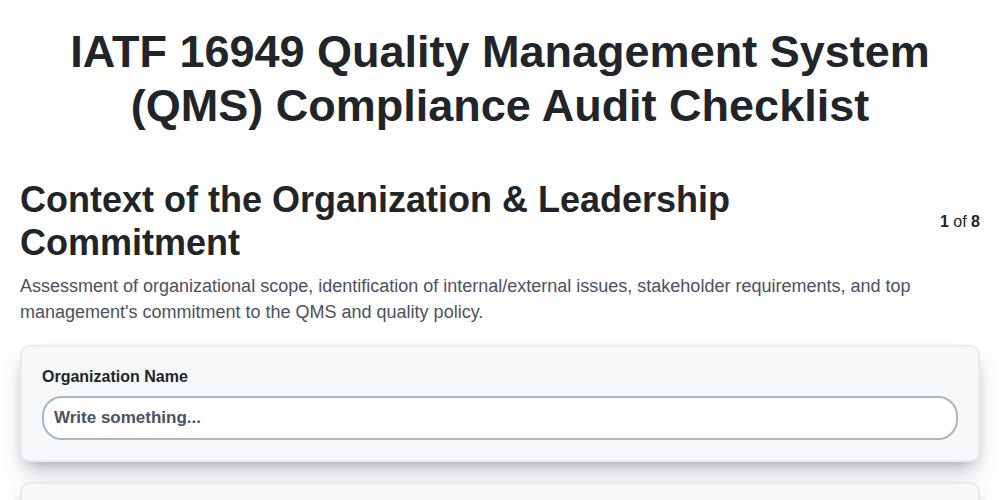
Table of Contents
- Introduction: Mastering the IATF 16949 Audit Process
- Understanding the Scope: Context of the Organization & Leadership Commitment
- Strategic Planning: Risk Management & Opportunity Planning
- Building the Foundation: Resource Management & Competence
- Maintaining Control: Documented Information & Operational Control
- The Core of Automotive Excellence: Product & Process Design Development
- Supply Chain Integrity: Supplier & Externally Provided Process Control
- Ensuring Precision: Operational Planning & Control (Production)
- Driving Excellence: Measurement, Analysis, and Continuous Improvement
- Final Audit Preparation: Common Pitfalls to Avoid
- Conclusion: Sustaining Long-Term Compliance
- Resources & Links
TLDR: Master your next automotive quality audit with this comprehensive IATF 16949 compliance checklist. Learn how to navigate essential audit pillars-from leadership commitment and risk-based thinking to operational control, supplier management, and continuous improvement-ensuring your Quality Management System meets the highest industry standards for automotive excellence.
Introduction: Mastering the IATF 16949 Audit Process
Navigating the Complexity of Automotive Quality Standards
In the high-stakes world of automotive manufacturing, quality isn't just a competitive advantage-it is a prerequisite for survival. The IATF 16949:2016 standard stands as the global benchmark for automotive Quality Management Systems (QMS), demanding much more than mere compliance. It requires a profound commitment to defect prevention, the reduction of variation, and the elimination of waste within the supply chain.
For many organizations, the approach to an IATF 16949 audit can feel overwhelming. The standard is rigorous, deeply integrated into every facet of production, and leaves zero room for ambiguity. Whether you are preparing for an initial certification audit or a periodic surveillance audit, the pressure to demonstrate total control over your processes can be immense.
Why a Structured Checklist is Your Best Defense
An audit is not an interrogation; it is a verification of your organization's ability to deliver consistent, high-quality products. However, without a structured roadmap, even the most robust systems can suffer from compliance gaps-those small, overlooked details in documentation or process execution that lead to major non-conformities.
A comprehensive audit checklist serves three critical purposes:
- Gap Identification: It allows you to spot weaknesses in your processes long before an external auditor does.
- Standardization: It ensures that every department-from procurement to production-is aligned with the same rigorous quality objectives.
- Continuous Improvement: It transforms the audit from a pass/fail event into a strategic tool for refining your operational excellence.
In the following guide, we will break down the core pillars of the IATF 16949 standard. We will walk you through a step-by-step checklist designed to ensure that every element of your QMS-from leadership commitment to supplier control-is audit-ready and optimized for performance.
Understanding the Scope: Context of the Organization & Leadership Commitment
Laying the Foundation for Quality Excellence
The IATF 16949 standard is not merely a set of rules for the factory floor; it is a top-down strategic framework. Before a single part is manufactured, the foundation of a compliant Quality Management System (QMS) must be established through a deep understanding of the organization's ecosystem and an unwavering commitment from the executive suite.
Defining the Organizational Context
An effective audit begins with a clear picture of where your company stands in the global automotive landscape. To satisfy this requirement, your checklist must verify that the organization has determined the internal and external issues that are relevant to its strategic direction.
When auditing this section, focus on:
- Internal Factors: Evaluating organizational culture, resource availability, and existing technological capabilities.
- External Factors: Analyzing market trends, legal/regulatory requirements, technological shifts, and competitive landscapes.
- Stakeholder Expectations: Identifying the specific needs and expectations of interested parties, such as customers (OEMs), employees, suppliers, and regulatory bodies.
The Role of Top Management: Beyond Policy Signing
Compliance fails when leadership views IATF 16949 as a Quality Department task. The audit must confirm that leadership is actively driving the QMS. This involves more than just signing a quality policy; it requires demonstrable engagement in the following areas:
- Strategic Alignment: Ensuring that the quality objectives are integrated into the company's actual business processes and long-term goals.
- Resource Provisioning: Verifying that leadership provides the necessary human, infrastructural, and environmental resources to maintain system integrity.
- Accountability and Responsibility: Confirming that roles, responsibilities, and authorities are clearly defined and communicated across all levels of the organization.
- Customer Focus Promotion: Demonstrating that leadership prioritizes meeting customer requirements and enhancing customer satisfaction as a core business driver.
By ensuring that the context is well-defined and leadership is fully engaged, an organization creates the top-down pressure necessary to sustain all subsequent layers of the IATF 16949 framework.
Strategic Planning: Risk Management & Opportunity Planning
Navigating Uncertainty: The Core of IATF 16949 Compliance
In the high-stakes automotive industry, a reactive approach to quality is a recipe for failure. The IATF 16949 standard moves beyond simple error detection by demanding a proactive, risk-based approach to management. Under this pillar of the audit checklist, the focus shifts from what went wrong to what could go wrong and how we are prepared to handle it.
Identifying and Mitigating Risk
A successful audit requires documented evidence that your organization has integrated risk-based thinking into its DNA. Auditors will look for more than just a list of potential issues; they want to see a systematic method for identifying risks across the entire value chain.
- Risk Assessment Methodology: Do you have a defined process for identifying operational, financial, and strategic risks?
- Mitigation Strategies: For every high-priority risk identified, is there a corresponding action plan to reduce its impact or likelihood?
- Contingency Planning: In the event of a disruption (such as equipment failure, supply chain breaks, or utility loss), does your organization have robust, tested contingency plans in place to ensure continuity of supply?
Capturing Strategic Opportunities
Risk management in IATF 16949 is a two-sided coin. While mitigating threats is critical, the standard also emphasizes the identification of opportunities. Compliance isn't just about avoiding failure; it is about driving excellence through strategic growth.
- Opportunity Analysis: How does your organization identify opportunities for process improvement, technological advancement, or market expansion?
- Resource Allocation: Once an opportunity is identified, is there a clear process for allocating the necessary resources to pursue it?
- Integration with Business Goals: Are your identified opportunities aligned with the broader strategic direction of the organization and the Context of the Organization established in your QMS?
The Auditor's Lens: What to Prepare
When the auditor arrives, they will not just look at your Risk Register. They will look for the loop of implementation. They will verify if the actions you planned to address a risk were actually executed and, most importantly, if those actions were effective in reducing the identified risk.
Pro-Tip: Ensure that your risk-based thinking is evident in your FMEAs (Failure Mode and Effects Analysis). The connection between your high-level risk planning and your technical process controls is where many organizations fail their audits.
Building the Foundation: Resource Management & Competence
Ensuring Capability: The Pillars of Resource Management & Competence
In the rigorous world of automotive manufacturing, having the right processes is meaningless if you do not have the right people and tools to execute them. Under the IATF 16949 standard, resource management is not just about having enough staff; it is about ensuring that every element of your operation is capable, maintained, and expertly managed to prevent defects before they occur.
To pass an audit in this category, you must demonstrate that your organization has the capacity to meet both customer requirements and regulatory standards consistently.
1. Human Resources and Competence
The heart of any Quality Management System (QMS) is the competence of its people. Auditors will look for evidence that your employees are not just trained, but truly competent to perform their specific tasks.
- Competence Mapping: Do you have clearly defined job descriptions that outline the necessary education, training, skills, and experience required for each role?
- Training Effectiveness: It is not enough to hold a training session. You must provide documented evidence of effectiveness-did the training actually result in improved performance or error reduction?
- On-the-Job Training (OJT): For production roles, there must be a structured approach to onboarding and skill verification to ensure that new or transitioning employees do not introduce variability into the process.
2. Infrastructure and Work Environment
Your manufacturing environment must be controlled to prevent product degradation. This goes beyond having functional machinery; it involves the deliberate management of the physical workspace.
- Equipment Maintenance: Are your production machines, tooling, and measuring equipment subject to a robust preventive maintenance program? Auditors will look for logs that prove your maintenance schedule is being followed to prevent unplanned downtime.
- Infrastructure Reliability: This includes the management of utilities (power, compressed air, water) and the physical facility to ensure they support the stability of the manufacturing process.
- Work Environment Control: How do you manage factors like temperature, humidity, or cleanliness (especially for sensitive components)? You must demonstrate that the environment is monitored and controlled where necessary to prevent contamination or damage.
3. Monitoring and Measuring Resources
In the automotive industry, if you can't measure it, you can't manage it. This section of the checklist focuses on the accuracy of your data.
- Calibration Integrity: Every piece of equipment used to verify product compliance must be calibrated against traceable international or national standards.
- Traceability of Standards: Can you provide a paper trail (calibration certificates) that proves your master gauges are accurate?
- Measurement System Analysis (MSA): Beyond just having a calibrated tool, you must prove that the process of measuring is stable. This involves demonstrating that variations in your measurements are due to the product, not the person or the method used to measure it.
Maintaining Control: Documented Information & Operational Control
Mastering Documentation and Operational Oversight
In the rigorous world of automotive manufacturing, if it isn't documented, it didn't happen. The Documented Information & Operational Control section of the IATF 16949 standard is the backbone of your Quality Management System. It serves as the single source of truth that ensures consistency across shifts, departments, and global supply chains.
To pass an audit, you must demonstrate that your processes are not just well-intended, but strictly governed by a controlled framework.
Establishing a Robust Documented Information Framework
The core objective here is to ensure that all necessary information-whether in the form of digital files, printed manuals, or automated logs-is available, accurate, and up-to-date. An auditor will look for evidence of:
- Document Control Protocols: Clear procedures for the creation, review, approval, and distribution of documents. You must prove that obsolete documents are removed from use to prevent accidental implementation.
- Data Integrity and Retention: Defined periods for how long records (such as test results, calibration logs, and training records) must be stored and how they are protected from loss or damage.
- Accessibility and Availability: Ensuring that the right version of a work instruction is accessible to the operator at the exact moment it is needed on the shop floor.
Strengthening Operational Control
While documentation provides the blueprint, operational control represents the execution. This phase of the checklist focuses on the transition from plan to do. Auditors will examine how you manage the day-to-day variables that impact product quality.
Key Focus Areas for Operational Control:
- Standardized Work Instructions: Are your processes clearly defined? Auditors will compare the actual methods used on the production line against your written procedures to identify any unauthorized workarounds.
- Control Plans Implementation: This is the heart of automotive quality. You must demonstrate that the specific controls, inspection frequencies, and reaction plans outlined in your Control Plan are being strictly followed during production.
- Monitoring and Traceability: You must have the mechanisms in place to track every component and process step. This includes the ability to trace a finished part back to its raw material batch, the specific machine used, and the operator in charge.
- Non-Conforming Output Management: When something goes wrong, how is it handled? You must show a disciplined process for identifying, segregating, and documenting non-conforming products to ensure they never reach the customer.
By treating documentation not as a bureaucratic burden, but as a strategic tool for operational stability, you turn your audit preparation into a continuous engine for manufacturing excellence.
The Core of Automotive Excellence: Product & Process Design Development
Mastering the Lifecycle: Ensuring Robust Design and Development
In the automotive industry, the cost of a design flaw is measured not just in currency, but in safety and brand reputation. Under the IATF 16949 standard, the Product and Process Design Development stage is one of the most critical pillars of the Quality Management System. It is where theoretical engineering meets practical manufacturing capability.
To pass an audit, you must demonstrate that your design process is not merely a series of sketches, but a controlled, documented, and rigorous lifecycle that anticipates failure before it reaches the assembly line.
Key Audit Focus Areas
When auditors evaluate your design and development processes, they are looking for evidence of a structured approach to managing change and complexity. Your checklist should prioritize the following:
- Design Inputs and Requirements: Can you prove that all customer-specific requirements (CSRs), regulatory mandates, and technical specifications were captured and reviewed before design commenced?
- Design Verification vs. Validation: There must be a clear distinction between verifying that the design meets the input requirements (e.g., simulations, calculations) and validating that the resulting product meets the actual user needs (e.g., prototype testing, lab trials).
- Design FMEA (Failure Mode and Effects Analysis): This is often the make or break element of a design audit. Auditors will look for a robust DFMEA that identifies potential failure modes, assesses their impact, and-most importantly, shows evidence of implemented mitigation actions.
- Design Changes and Traceability: How does your organization handle scope creep or engineering changes? You must demonstrate a controlled process for managing revisions to drawings, BOMs (Bill of Materials), and specifications to ensure that the production floor is never working from obsolete data.
The Link to Manufacturing: Process Design
The IATF 16949 standard requires that design development isn't just about the part itself, but the process used to create it.
Ensuring Process Capability
An audit will investigate whether your process design includes:
- PFMEA (Process Failure Mode and Effects Analysis): Aligning your manufacturing steps with the identified risks of the product design.
- Control Plan Integration: Ensuring that the measurement and control methods defined during the design phase are effectively transitioned into the production control plan.
- Prototype and Pre-launch Control: Demonstrating that special characteristics and high-risk parameters are monitored with increased rigor during the initial stages of production.
By maintaining a rigorous checklist within this phase, you move beyond mere compliance and toward a culture of preventative engineering, ensuring that quality is baked in to the product from the very first blueprint.
Supply Chain Integrity: Supplier & Externally Provided Process Control
Securing the Value Chain: Ensuring Supplier Excellence
In the automotive industry, your quality is only as strong as your weakest link. Because IATF 16949 extends the scope of the Quality Management System beyond your own factory walls, the Supplier & Externally Provided Process Control section is one of the most critical segments of an audit. An auditor isn't just looking at your finished product; they are looking at how you govern the entire ecosystem of your supply chain.
Strengthening the Supplier Lifecycle
To achieve compliance, you must demonstrate a rigorous, risk-based approach to managing external providers. This involves more than just selecting a vendor; it requires a continuous cycle of evaluation and monitoring.
Key Audit Focus Areas:
- Supplier Selection and Evaluation: You must present clear, documented criteria used to select new suppliers. This includes evaluating their ability to meet technical requirements and their alignment with automotive quality standards.
- Performance Monitoring: It is not enough to vet a supplier once. You must provide evidence of ongoing performance tracking, specifically focusing on quality (e.g., PPM rates, non-conformities) and delivery performance (e.g., on-time delivery metrics).
- Development and Risk Mitigation: How do you support underperforming suppliers? Auditors will look for your processes for supplier development and your strategies for mitigating risks associated with critical components or single-source dependencies.
- Verification of Externally Provided Processes: When you outsource specific processes (such as heat treating, plating, or testing), you must demonstrate that you have established controls to ensure these external services meet your stringent internal quality standards.
- Control of Purchased Goods: The audit will examine your incoming inspection processes. How do you verify that the materials arriving at your dock match the specifications required? Documentation of inspection results and handling of non-conforming parts is vital here.
The Goal: Proactive Oversight
The objective of this checklist component is to move from a reactive inspect-in mentality to a proactive prevent-at-source strategy. By implementing robust controls over your external providers, you reduce the likelihood of downstream defects and ensure that the integrity of the entire automotive supply chain remains uncompromised.
Ensuring Precision: Operational Planning & Control (Production)
Mastering the Shop Floor: Key Audit Focus Areas
In the automotive industry, the transition from a theoretical quality plan to real-world execution is where compliance is truly tested. During an IATF 16949 audit, the Operational Planning & Control section is often the most scrutinized, as it represents the heartbeat of your production line. Auditors are not just looking for finished products; they are looking for evidence that your processes are controlled, repeatable, and capable of meeting stringent automotive standards.
To ensure your production environment is audit-ready, your focus should be centered on the following critical pillars:
1. Control Plan Adherence
The Control Plan is your primary roadmap for quality. An auditor will perform layering audits to ensure that the specific controls, inspection frequencies, and reaction plans outlined in your documentation are being followed precisely on the shop floor.
- Check: Are operators using the latest revision of the Control Plan?
- Check: Are the specific measurement techniques and sample sizes defined in the plan actually being executed?
2. Process Parameter Monitoring
It is not enough to simply run a machine; you must prove that the machine is running within defined boundaries. This involves monitoring critical-to-quality (CTQ) parameters such as temperature, pressure, torque, or cycle time.
- Check: Are there clear, visible indicators or digital logs showing that process parameters are within the specified tolerances?
- Check: Is there a documented procedure for what happens when a process drifts toward a limit (the Reaction Plan)?
3. Maintenance and Tooling Integrity
Production control is inextricably linked to the health of your equipment. An auditor will look for a seamless link between your production schedule and your preventive maintenance program.
- Check: Is there evidence that production tooling and gauges are being maintained according to the established schedule?
- Check: Is there a process for identifying and segregating non-conforming tools or equipment that has failed a check?
4. Identification and Traceability
In the event of a field failure, traceability is your most vital defense. During the audit, an auditor may pick a random finished part and ask you to trace it back through every stage of production.
- Check: Are all raw materials, in-process components, and finished goods clearly identified with appropriate labels/tags?
- Check: Can your system link a specific batch of finished goods to the specific shift, machine, operator, and raw material lot used?
5. Management of Change (MoC)
Unexpected changes-whether it's a new batch of raw material, a different operator, or a tool repair-can introduce significant risk.
- Check: Does your production control process include a mechanism to evaluate the impact of changes before they are implemented?
- Check: Is there documented evidence that trial runs or verification steps were completed following a significant process change?
Driving Excellence: Measurement, Analysis, and Continuous Improvement
The Engine of Improvement: Closing the Loop
In the automotive industry, an audit isn't just about verifying that you are following your processes; it is about proving that your processes are actually working and evolving. The final pillar of the IATF 16949 standard focuses on Measurement, Analysis, and Continuous Improvement. This is where the Plan-Do-Check-Act (PDCA) cycle comes to life.
To ensure compliance, your audit checklist must move beyond simple data collection and look for evidence of actionable intelligence.
1. Monitoring and Measurement of Processes
The auditors will look for evidence that you aren't just tracking numbers, but evaluating the effectiveness of your QMS.
- KPI Tracking: Are your Key Performance Indicators (KPIs) clearly defined, and are they being monitored against established targets?
- Process Performance: Do you have documented evidence of regular reviews regarding process stability and capability (e.g., Cpk and Ppk levels)?
- Customer Satisfaction: How are you measuring customer satisfaction and monitoring customer-specific requirements (CSRs)?
2. Data-Driven Decision Making
Data without analysis is just noise. IATF 16949 requires that the data collected during measurement is used to drive organizational decisions.
- Analysis of Trends: Are you performing trend analysis on non-conformities, scrap rates, and downtime to identify underlying patterns?
- Audit Results: Are internal audit findings being analyzed to identify systemic weaknesses rather than just isolated incidents?
- Management Review: Is there documented evidence that the results of all monitoring and measurement activities are being presented to top management for review?
3. The Continuous Improvement Mandate
The hallmark of a mature automotive QMS is the ability to improve proactively. Auditors will search for Continuous Improvement (CI) initiatives that go beyond simple corrective actions.
- Corrective Action Effectiveness: When a non-conformity occurs, do you perform a thorough Root Cause Analysis (RCA) using tools like the 5 Whys or Fishbone Diagram? More importantly, is there evidence that you verify the effectiveness of the implemented action?
- Problem-Solving Methodologies: Is your organization utilizing standardized problem-solving approaches (such as 8D or Six Sigma) across all departments?
- Error Proofing (Poka-Yoke): Are you actively seeking opportunities to implement error-proofing measures to prevent human error in production processes?
- Lessons Learned: Is there a formal mechanism to capture lessons learned from both successes and failures to prevent recurrence in future product or process designs?
The Bottom Line: Compliance in this section is not about having a perfect record-it is about demonstrating that when things go wrong, you have a robust, repeatable, and data-driven system to identify the cause, fix the problem, and ensure it never happens again.
Final Audit Preparation: Common Pitfalls to Avoid
Preparing your checklist is only half the battle; the true challenge lies in ensuring that your documentation matches your reality on the shop floor. Even the most meticulously prepared organizations can stumble during an IATF 16949 audit if they fall into these common traps.
1. The Paper vs. Practice Gap
The most frequent cause of major non-conformities is a disconnect between your documented procedures and actual operational execution. An auditor will not just look at your signed policies; they will walk the production line and interview operators. If your control plan specifies a specific torque setting or a visual inspection frequency, but the staff is performing it differently, your audit is at risk.
2. Siloed Risk Management
Many organizations treat Risk Management as a once-a-year administrative task rather than a living process. A major pitfall is failing to link your Risk and Opportunity Planning to your actual operational outcomes. If your risk register identifies a potential machine failure as a high risk, but there is no corresponding preventive maintenance or contingency plan visible in your operational controls, auditors will flag this as a failure in systemic integration.
3. Neglecting the Process Approach
IATF 16949 is built on the process approach. A common mistake is treating each checklist item as an isolated silo. For example, treating Supplier Control and Product Design as separate entities without showing how supplier quality inputs affect final product performance. An auditor looks for the thread that connects your organizational context to your final continuous improvement activities.
4. Inadequate Evidence of Competence
It is not enough to have a training matrix that shows everyone has completed a course. You must be able to provide evidence of effectiveness. If an employee has been trained on a new CNC program but cannot demonstrate the required competency during an interview, your Resource Management documentation becomes invalid.
5. Reactive vs. Proactive Continuous Improvement
If your Measurement, Analysis, and Improvement section only contains records of fixing mistakes (corrective actions) without evidence of preventing mistakes (preventive actions and trend analysis), you are operating in a reactive state. Auditors look for evidence of proactive shifts-using data trends to adjust processes before a defect ever occurs.
Quick Audit Day Pro-Tips:
- Verify your Cleanliness: Ensure that 5S standards are strictly maintained; a messy workspace often signals a lack of operational control to an auditor.
- Check your Calibration: Ensure every measurement tool in use has a visible, valid calibration sticker that matches your master log.
- Empower your Team: Ensure operators know where to find their work instructions and understand how their specific role impacts the overall quality of the final product.
Conclusion: Sustaining Long-Term Compliance
Moving Beyond the Audit: Cultivating a Culture of Excellence
Achieving compliance with the IATF 16949 standard is not a one-time event or a check-the-box exercise to be completed once a year before an auditor arrives. True success lies in transitioning from reactive compliance-fixing issues only when they are detected-to proactive excellence, where quality is embedded in the very DNA of your organizational culture.
Turning the Checklist into a Strategic Tool
While the checklist provided above serves as a vital roadmap for your audit preparations, its true value lies in its use as a daily operational tool. When used consistently, these steps allow you to:
- Identify Vulnerabilities Early: By regularly reviewing your risk management and operational controls, you can mitigate potential failures before they impact the customer.
- Standardize Global Excellence: A rigorous adherence to documented information and process controls ensures that quality remains consistent, regardless of shifts in personnel or production volume.
- Drive Evidence-Based Decision Making: Utilizing the Measurement, Analysis, and Continuous Improvement phase ensures that your leadership decisions are backed by hard data rather than intuition.
The Path Forward
The automotive industry is characterized by rapid technological shifts, evolving EV landscapes, and increasingly stringent safety requirements. To remain competitive, your Quality Management System must be dynamic. Use this checklist not just to survive your next audit, but to build a resilient, high-performing organization that exceeds customer expectations and drives sustainable growth.
Remember: Compliance is the baseline; continuous improvement is the goal.
Resources & Links
- IATF Global Oversight: The official website for the International Automotive Task Force, providing the latest updates on standards and requirements.
- ISO (International Organization for Standardization): The primary source for foundational quality management principles used in IATF 16949, such as ISO 9001.
- NIST (National Institute of Standards and Technology): Resources for technical standards, risk management frameworks, and manufacturing excellence.
- ASQ (American Society for Quality): A leading global organization for quality professionals, offering training, certification, and best practices in QMS.
- Automotive Industry Standards Hub: Information regarding industry-specific regulations and compliance requirements for automotive suppliers.
- ISACA: Essential resources for IT governance, risk management, and audit processes critical for modern digitalized production.
- Six Sigma Resources: Methodologies for continuous improvement and reducing variance in manufacturing processes.
- APQP & Core Tools Guide: Specialized insights into Advanced Product Quality Planning and the five core automotive tools.
- SHRM (Society for Human Resource Management): Useful for the 'Competence' section of the audit, focusing on training, personnel management, and organizational skill-building.
- Supply Chain Management Magazine: Deep dives into supplier management, logistics, and external provider control strategies.
- ScienceDirect: Access to academic research on manufacturing process design and quality control engineering.
- Automotive Manufacturing Standards: Technical documentation regarding precision and operational control in automotive assembly.
- Quality Digest: News and insights regarding quality trends, technology integration, and audit preparedness.
- Lean Enterprise Institute: Resources on implementing Lean manufacturing to support continuous improvement and waste reduction.
- SAI Global: Expert guidance on regulatory compliance, auditing, and certification management.
- Management Study Guide: Simplified explanations of strategic planning, SWOT analysis, and organizational leadership concepts.
- Digital Manufacturing & IT Governance: Information on managing documented information and digital traceability in a smart factory environment.
Comments
There are no comments yet. Be the first to add one!
Manufacturing Management Solution Demo
Stop chasing paperwork and wrestling with disconnected systems! Our solution brings clarity and control to your production process. From standard operating procedures (SOPs) and equipment maintenance to quality control and inventory tracking, we simplify every step.
Related Articles
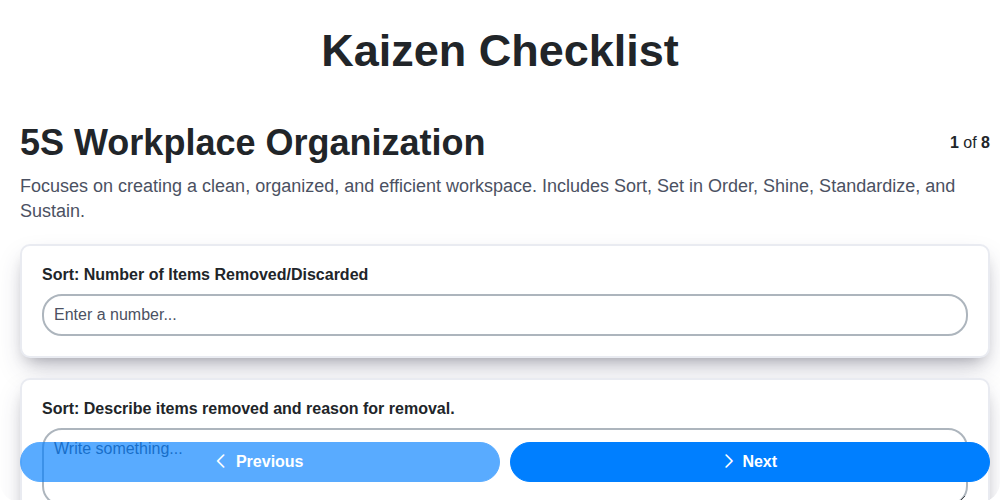
Kaizen Checklist Template: Your Path to Continuous Improvement

Machine Safety Audit Checklist: Your Guide to a Safer Manufacturing Workplace
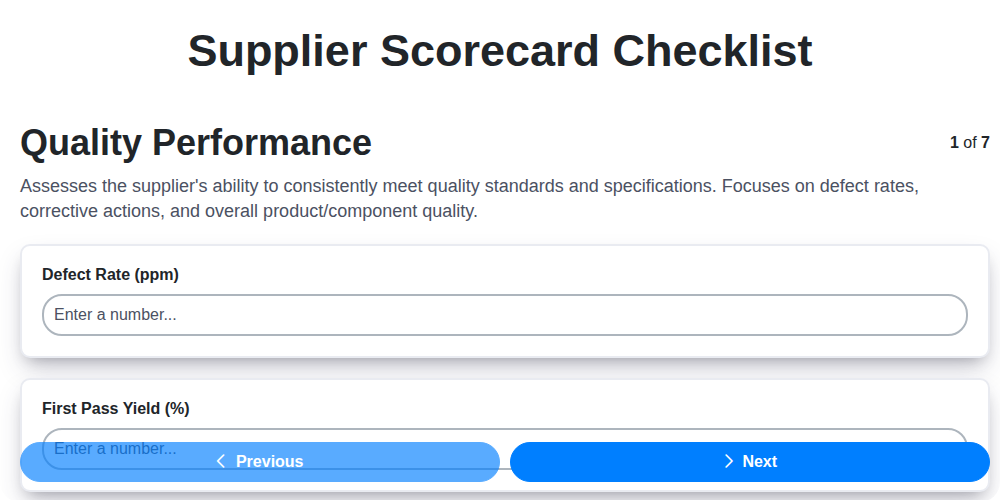
Mastering Supplier Performance: Your Free Supplier Scorecard Checklist Template
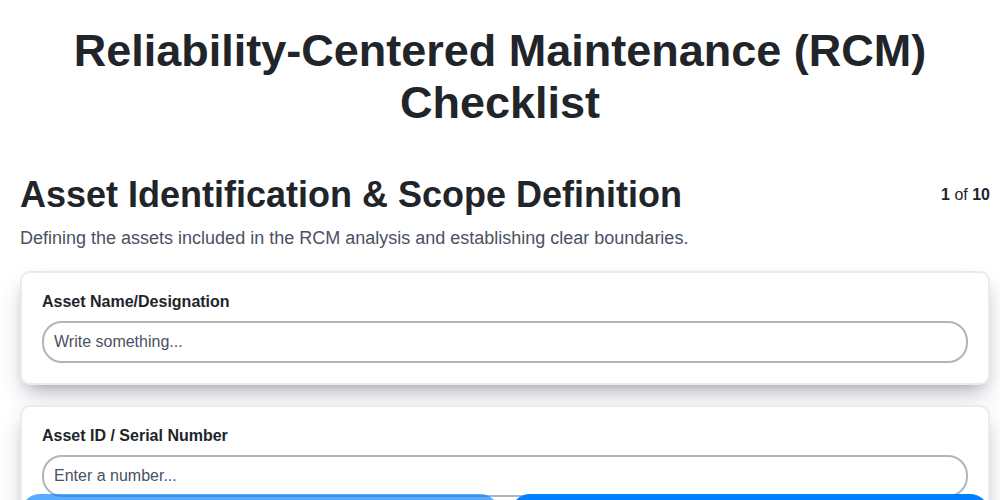
Your Ultimate RCM Checklist Template: A Step-by-Step Guide

LPA Checklist Template: Your Guide to Layered Process Audits

Your Ultimate Lockout/Tagout (LOTO) Checklist Template

Your Ultimate FSC 22000 Checklist Template
Quality Control Inspection Checklist Template: Prevent Defects & Improve Manufacturing Processes
Need help with
Manufacturing?
Have a question? We're here to help. Please submit your inquiry, and we'll respond promptly.