A Step-by-Step Guide to Managing Your Influencer Marketing Campaign Workflow
Published: 06/18/2026 9:00 PM Updated: 06/19/2026 12:31 PM
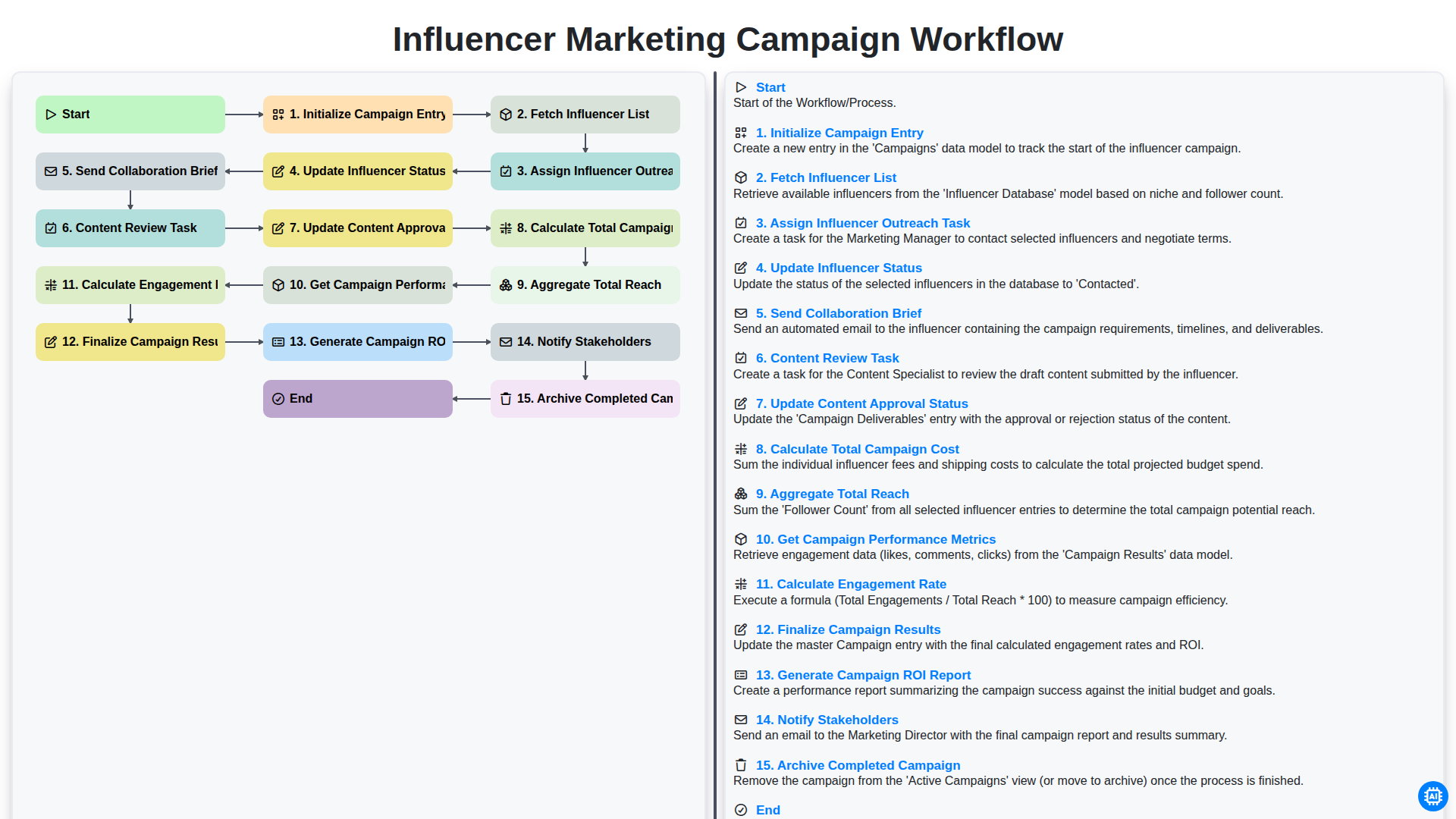
Table of Contents
- Phase 1: Campaign Initiation and Influencer Sourcing
- Step 1: Initializing the Campaign Entry
- Step 2: Fetching and Vetting Your Influencer List
- Step 3: Assigning Influencer Outreach Tasks
- Step 4: Managing Influencer Status Updates
- Phase 2: Communication and Content Management
- Step 5: Sending the Detailed Collaboration Brief
- Step 6: Content Review and Quality Control
- Step 7: Finalizing Content Approval Status
- Phase 3: Budgeting and Reach Estimation
- Step 9: Aggregating Total Campaign Reach
- Phase 4: Performance Analysis and Reporting
- Step 10: Evaluating Performance Metrics and Engagement Rates
- Step 11: Generating the Final ROI Report and Notifying Stakeholders
- Step 12: Campaign Closure and Archiving
- Resources & Links
TLDR: Master your influencer marketing strategy with this comprehensive guide to a streamlined campaign workflow. Learn how to automate everything from initial outreach and content review to performance tracking and ROI reporting, ensuring a seamless, data-driven process for every collaboration.
Phase 1: Campaign Initiation and Influencer Sourcing
The foundation of any successful influencer marketing strategy lies in the precision of its initial setup. The first phase of the workflow begins with Initializing the Campaign Entry, where the core objectives, budget constraints, and key performance indicators (KPIs) are defined. This stage ensures that every subsequent action is aligned with your overarching marketing goals.
Once the framework is set, the focus shifts to Fetching the Influencer List. This involves scouting and compiling a curated roster of creators whose audience demographics and brand values align with your campaign requirements. However, simply finding names isn't enough; the workflow then moves to Assigning Influencer Outreach Tasks to your team or agency, ensuring clear accountability for the next critical step: contact.
As the outreach begins, the process moves into the active management stage by Updating Influencer Status. This keeps your pipeline organized, tracking whether a creator is Contacted, Negotiating, or Confirmed. By maintaining this real-time visibility, you prevent communication gaps and ensure that the momentum of the campaign remains steady as you move toward the creative execution phase.
Step 1: Initializing the Campaign Entry
The foundation of every successful influencer marketing strategy lies in a structured beginning. The Initialize Campaign Entry stage is where the blueprint of your marketing efforts is laid out. This step involves defining the core parameters of your campaign, such as the primary objectives, the target audience demographics, the budget allocation, and the overall creative direction.
By formalizing the campaign entry at the very start, you create a single source of truth for your team. This process ensures that every stakeholder understands the campaign's scope and prevents scope creep later in the workflow. Establishing this initial entry point is crucial for setting up the tracking mechanisms that will eventually allow you to measure the success of your influencer partnerships.
Step 2: Fetching and Vetting Your Influencer List
Once the campaign entry has been initialized, the next critical phase is to Fetch Influencer List. This step moves your campaign from a conceptual framework into a tangible pool of potential partners. Rather than manually scrolling through social media feeds, this stage of the workflow relies on utilizing data-driven tools and curated databases to identify creators who align with your brand's niche, values, and target demographics.
The goal here is not just quantity, but quality. As you pull your initial list, the focus should be on gathering key data points such as follower count, audience demographics, and historical engagement patterns. A successful fetch process ensures that the influencers you identify have a genuine connection to your product category, providing a strong foundation for the outreach tasks that follow. This stage acts as the filter that prevents wasted resources on mismatched partnerships later in the workflow.
Step 3: Assigning Influencer Outreach Tasks
Once your initial influencer list has been fetched and vetted, the next critical phase in the workflow is the transition from research to action. The Assign Influencer Outreach Task step acts as the bridge between strategy and execution.
At this stage, the workflow moves from a passive list of names to an active project management phase. Instead of a single person attempting to manage hundreds of potential partners, the system distributes outreach responsibilities across your marketing team or specialized talent scouts. By assigning specific influencers to specific team members, you ensure accountability and prevent the double-contact error, where two different team members accidentally reach out to the same creator.
Effective task assignment involves more than just splitting a list; it requires matching the right talent agent or coordinator with the right niche. By automating this step within your workflow, you can track exactly who is responsible for which creator, setting deadlines for initial contact and ensuring that no potential partnership falls through the cracks during the high-paced early stages of the campaign.
Step 4: Managing Influencer Status Updates
As the outreach process moves from initial contact to active negotiations, staying organized becomes critical. The Update Influencer Status step is the pulse of your workflow, acting as the single source of truth for your entire campaign.
As potential partners respond to your initial outreach, their status will shift through various stages-from Contacted and Negotiating to Contract Signed or Declined. Managing these updates in real-time prevents the common pitfall of double-messaging influencers or, conversely, letting high-value opportunities slip through the cracks due to inactivity.
By maintaining a rigorous update protocol, your team can instantly see where bottlenecks are occurring. Are too many influencers stuck in the Negotiating phase? This might indicate a need to revise your budget or brief. Is the Declined list growing? It may be time to refine your target persona. Systematic status updates transform a chaotic inbox into a streamlined, high-visibility pipeline, ensuring that no influencer is left behind as you move toward the briefing stage.
Phase 2: Communication and Content Management
Once the initial outreach efforts have successfully secured interest from your selected creators, the workflow transitions from negotiation to active production. This phase is the engine room of your campaign, where ideas are transformed into tangible assets through structured communication and rigorous quality control.
The process begins with the Send Collaboration Brief step. This is a critical touchpoint where you provide influencers with the campaign's DNA-including key messaging, visual guidelines, mandatory hashtags, and deadline requirements-to ensure brand alignment. Following this, the workflow moves into the Content Review Task, where the team monitors the creation process and evaluates drafted content against the agreed-upon brief.
To maintain momentum and prevent bottlenecks, the Update Content Approval Status step is vital; this allows for seamless transitions between Pending Review, Revision Requested, and Approved. By maintaining a systematic loop of feedback and approval, you ensure that every piece of influencer-generated content is optimized for performance before it ever hits the public feed.
Step 5: Sending the Detailed Collaboration Brief
Once the influencer has been officially onboarded and the outreach task is marked as complete, the next critical phase is Sending the Collaboration Brief. This step serves as the single source of truth for the entire partnership, ensuring that both the brand and the creator are perfectly aligned on expectations.
A well-structured brief prevents mid-campaign confusion and minimizes the need for repetitive revisions. At this stage, your workflow should focus on delivering a comprehensive document that includes:
- Campaign Objectives: Clearly define what success looks like (e.g., brand awareness, website traffic, or specific product sales).
- Content Deliverables: Explicitly state the required formats, such as one Instagram Reel, two Story frames with link stickers, and a high-resolution photo for usage rights.
- Key Messaging & Talking Points: Provide essential information about the product features and the must-say phrases, while still allowing the influencer the creative freedom to maintain their authentic voice.
- Visual Guidelines & Brand Dos/Don'ts: Outline any aesthetic preferences or specific branding elements that need to be visible, alongside a list of prohibited actions or competitor mentions.
- Timeline & Deadlines: Reiterate the exact date for the initial content draft submission and the final posting schedule.
- Mandatory Tags & Disclosures: Ensure all legal requirements, such as #ad or #sponsored, and specific brand handles are clearly documented to remain compliant with FTC guidelines.
By treating the brief as a formal roadmap, you transition from the negotiation phase into the execution phase with clarity, setting the stage for the upcoming content review process.
Step 6: Content Review and Quality Control
Once the initial collaboration briefs have been sent and influencers begin drafting their material, the workflow moves into the critical stage of Content Review Task. This step serves as the ultimate quality control gate in your marketing funnel.
At this stage, the focus shifts from communication to evaluation. You are no longer just managing relationships; you are managing brand integrity. The goal of the review task is to ensure that every piece of user-generated content aligns with your predefined campaign objectives, maintains the correct brand voice, and adheres to the specific talking points outlined in the original brief.
During this phase, your team should be checking for:
- Brand Alignment: Does the visual aesthetic and tone match your brand identity?
- Compliance & Accuracy: Are all required hashtags, disclosures (like #ad), and key messaging included correctly?
- Legal & Contractual Adherence: Does the content meet the technical requirements agreed upon in the initial contract?
By implementing a structured review task within your workflow, you prevent the risk of unpolished or off-brand content going live, which could potentially damage your brand reputation or dilute the campaign's impact. This step ensures that when you move forward to the approval stage, you have total confidence in the assets being deployed.
Step 7: Finalizing Content Approval Status
Once the content review task is complete and the creators have submitted their drafts, the workflow moves into the critical stage of updating the content approval status. This step acts as the final quality control gate before any content is cleared for publication.
During this phase, the campaign manager reviews the submitted assets-ranging from Instagram Reels and TikTok videos to blog posts and sponsored stories-to ensure they align strictly with the predefined brand guidelines, messaging, and legal requirements. Each piece of content is marked as Approved, Requires Revisions, or Rejected.
If revisions are needed, the workflow triggers a feedback loop back to the influencer to refine specific elements like captions, hashtags, or visual framing. Only once the status is officially moved to Approved does the workflow progress to the financial and analytical stages, ensuring that no unvetted content ever reaches your audience or impacts your campaign's integrity.
Phase 3: Budgeting and Reach Estimation
Once the content has been reviewed and approved, the focus shifts from creative execution to the analytical side of campaign management. This phase is critical for understanding the financial implications and the potential scale of your campaign's impact.
The first step in this phase is to Calculate Total Campaign Cost. This involves aggregating all individual influencer fees, along with any additional expenses such as product shipping, affiliate commissions, or agency management fees, to establish the final investment figure.
Simultaneously, we move to Aggregate Total Reach. By summing the potential audience size across all participating influencers, you can determine the total number of eyes your brand message will encounter. This provides a macro view of the campaign's visibility.
Finally, to bridge the gap between cost and visibility, we move into Get Campaign Performance Metrics. By analyzing the raw data from the live campaign-such as impressions, clicks, and likes-we can begin the process of Calculate Engagement Rate. This calculation is vital, as it transforms simple reach into a measure of true audience resonance, providing the necessary context for the upcoming ROI analysis.
Step 9: Aggregating Total Campaign Reach
Once the individual performance data for each influencer has been collected, the next critical step in the workflow is to Aggregate Total Campaign Reach. This stage moves the focus from individual micro-metrics to the big picture of your campaign's impact.
Aggregating total reach involves summing the potential impressions or views across all participating influencers within the campaign. This metric is vital because it provides a single, high-level figure that represents the total volume of eyes that your brand message has potentially reached. By consolidating this data, you can determine the sheer scale of your campaign's footprint and assess whether you successfully achieved the necessary brand awareness goals defined during the initialization phase. This aggregated figure serves as the foundational baseline for calculating more complex efficiency metrics, such as cost-per-thousand impressions (CPM), in the subsequent steps of the workflow.
Phase 4: Performance Analysis and Reporting
Once the creative phase concludes and the content is live, the workflow shifts from execution to evaluation. This final stage is critical for determining whether your investment yielded the desired impact and for building a roadmap for future marketing efforts.
The process begins with the retrieval of campaign performance metrics, where data is extracted from various social platforms to assess how the content performed against your initial KPIs. During this stage, you will calculate the engagement rate-analyzing likes, comments, and shares relative to reach-to understand how deeply the audience connected with the influencers' messaging.
With the raw data in hand, the workflow moves into deep-dive financial and impact analysis. You will calculate the total campaign cost and aggregate the total reach to provide a clear picture of scale versus spend. These figures are then synthesized to generate a comprehensive Campaign ROI Report, which provides the definitive answer to the question: Was this campaign successful?
To wrap up the lifecycle, the workflow includes a finalization of all campaign results and an automated notification to stakeholders, ensuring that decision-makers are immediately informed of the outcomes. Finally, to maintain an organized ecosystem, the process concludes by archiving the completed campaign, preserving the data and learnings for future benchmarking while clearing the workspace for your next big launch.
Step 10: Evaluating Performance Metrics and Engagement Rates
Once the content has been approved and live, the focus shifts from logistics to analytics. This stage is critical because it transforms raw data into actionable insights. During this step, the workflow moves into the Get Campaign Performance Metrics phase, where we aggregate data such as impressions, clicks, and conversions.
However, raw numbers only tell half the story. To understand the true impact of the partnership, we must Calculate Engagement Rate by comparing total interactions (likes, comments, and shares) against the total reach. This metric allows you to distinguish between a vanity campaign-one that looks good on the surface but lacks depth-and a high-impact campaign that actually resonated with the target audience. By analyzing these specific data points, you can determine which influencers truly drive meaningful community interaction, providing a clear benchmark for your future marketing strategies.
Step 11: Generating the Final ROI Report and Notifying Stakeholders
Once the heavy lifting of data collection and performance calculation is complete, the workflow moves into its most critical phase: turning raw numbers into actionable business intelligence. This stage is where the success of your campaign is officially measured and communicated to the decision-makers.
The process begins with the Generation of the Campaign ROI Report. This isn't just a summary of likes and comments; it is a comprehensive deep dive that bridges the gap between engagement and revenue. By synthesizing the total campaign cost against the generated conversions,- and the qualitative impact of the influencer content, you create a document that justifies your marketing spend. A well-structured ROI report highlights the Return on Ad Spend (ROAS), the Cost Per Acquisition (CPA), and the overall impact on brand sentiment, providing a clear roadmap for future budget allocations.
The final automated step in this workflow is the Notification of Stakeholders. Efficiency in marketing relies on transparency. As soon as the report is finalized, the system automatically distributes the findings to the relevant parties-from marketing managers and brand owners to creative directors. This ensures that everyone is aligned on the campaign's outcome in real-time, eliminating the delay between campaign conclusion and strategic pivoting. By automating this handoff, you ensure that the insights gained from your influencer efforts are immediately integrated into the company's broader marketing strategy.
Step 12: Campaign Closure and Archiving
Once the data has been analyzed and the final reports have been distributed, the final stage of the workflow involves the formal closure of the campaign. This phase is crucial for maintaining an organized marketing ecosystem and ensuring long-term operational efficiency.
The process begins with the Archive Completed Campaign step. Rather than deleting the campaign data, archiving allows you to move the project into a dedicated historical repository. This ensures that all campaign assets, communication logs, and performance metrics remain accessible for future reference without cluttering your active dashboard.
Proper archiving serves several strategic purposes:
- Historical Benchmarking: It allows you to revisit past campaign structures and results when planning future initiatives.
- Audit Readiness: Maintaining a permanent record of influencer interactions and costs is essential for budget reconciliation and financial audits.
- Template Creation: An archived campaign serves as a blueprint that can be duplicated to jumpstart new, similar initiatives.
By systematically archiving your completed work, you transform your marketing operations from a series of disconnected tasks into a structured, searchable library of institutional knowledge, setting the stage for even more informed decision-making in your next campaign cycle.
Resources & Links
- HubSpot Influencer Marketing Guide: A comprehensive guide on inbound marketing strategies and how to align influencer outreach with your overall content marketing goals.
- Influencer Marketing Hub: Industry-standard resources for discovering influencers, managing campaign workflows, and tracking real-time marketing trends.
- Asana Project Management Templates: Tools and templates designed to help marketing managers track tasks, assign outreach responsibilities, and manage content approval workflows.
- Hootsuite Social Analytics: A resource for understanding social listening, measuring engagement rates, and aggregating reach metrics across multiple platforms.
- Buffer Content Planning Tools: Helpful resources for managing the content review phase and scheduling posts once influencer approvals are finalized.
- Sprout Social Performance Reporting: Advanced analytics resources for calculating campaign ROI and generating detailed reports for stakeholders.
Found this Article helpful?
Comments
There are no comments yet. Be the first to add one!
Task Management Solution Demo
Get organized & boost productivity! ChecklistGuro simplifies task management, prioritization, & progress tracking. Achieve more, stress less, & hit your goals. Manage it all with our Work OS.
Related Articles

Paper vs ChecklistGuro in Project Management
Paper vs ChecklistGuro in Task Management
Excel vs ChecklistGuro in Logistics Management
Excel vs ChecklistGuro in Task Management
Excel vs ChecklistGuro in Dental Management
Excel vs ChecklistGuro in Hospitality Management
Excel vs ChecklistGuro in Retail Management
Excel vs ChecklistGuro in Project Management
We can do it Together
Need help with
Checklists?
Have a question? We're here to help. Please submit your inquiry, and we'll respond promptly.