Loss Prevention and Security Protocol: A Comprehensive Workflow for Risk Mitigation and Incident Response
Published: 06/04/2026 Updated: 10/05/2026
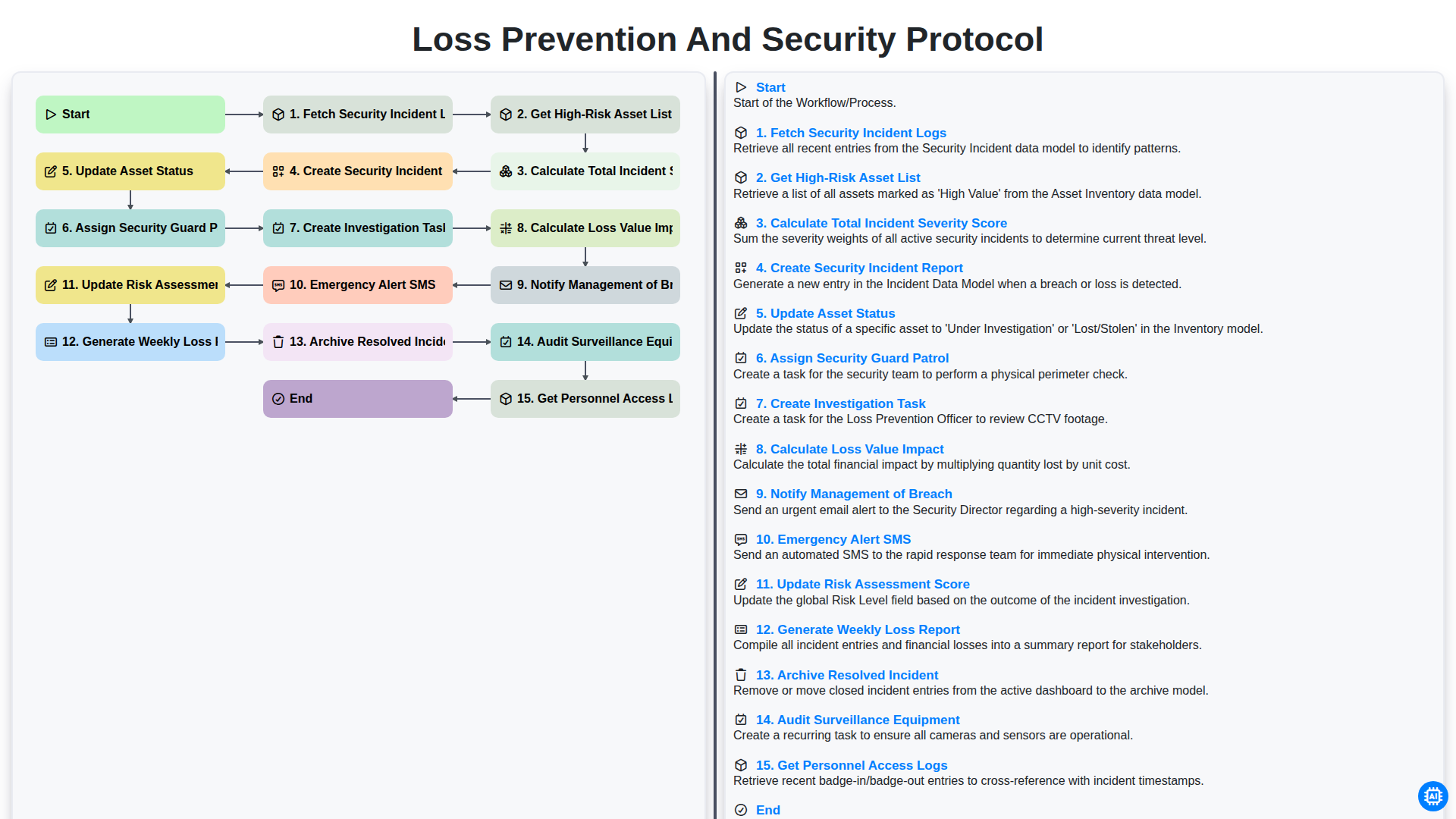
Table of Contents
- Introduction: The Importance of Systematic Loss Prevention
- Phase 1: Incident Detection and Initial Data Retrieval
- Step 1: Fetching Security Incident Logs
- Step 2: Retrieving the High-Risk Asset List
- Phase 2: Impact Assessment and Severity Analysis
- Step 3: Calculating Total Incident Severity Score
- Step 4: Calculating Loss Value Impact
- Phase 3: Immediate Response and Emergency Protocols
- Step 5: Triggering Emergency Alert SMS and Management Notification
- Step 6: Deploying Security Guard Patrols
- Phase 4: Documentation and Investigation
- Step 7: Creating Security Incident Reports and Investigation Tasks
- Step 8: Updating Asset Status and Risk Assessment Scores
- Phase 5: Post-Incident Auditing and Long-term Reporting
- Step 9: Reviewing Personnel Access Logs and Surveillance Equipment
- Step 10: Generating Weekly Loss Reports and Archiving Resolved Incidents
- Resources & Links
TLDR: This guide explores a structured, end-to-end security workflow designed to automate incident response and loss prevention. Learn how this template streamlines everything from initial log retrieval and severity calculation to real-time emergency alerts and long-term risk assessment, ensuring your security team can move from detection to mitigation with precision and speed.
Introduction: The Importance of Systematic Loss Prevention
In an era of increasingly sophisticated theft and operational vulnerabilities, reactive security is no longer enough to protect a business's bottom line. Relying on intuition or sporadic checks leaves critical gaps in your defense, turning preventable incidents into costly-scale losses. To truly safeguard high-value assets and personnel, organizations must transition from a mindset of response to a mindset of prevention through a structured, automated workflow.
Effective loss prevention is built on the foundation of consistency and visibility. It is not merely about having security guards on patrol; it is about the seamless integration of data, real-time monitoring, and rapid-response protocols. When security processes are fragmented, critical information-such as security incident logs or personnel access patterns-often remains siloed, preventing management from seeing the big picture of emerging threats. By implementing a systematic workflow, companies can transform raw data into actionable intelligence, ensuring that every breach is documented, every risk is assessed, and every asset is protected by a pre-defined, repeatable sequence of defensive actions.
Phase 1: Incident Detection and Initial Data Retrieval
The foundation of a robust security strategy lies in the speed and accuracy of the initial response. The first phase of our workflow focuses on the critical window immediately following a potential security breach. It begins with the automated process to Fetch Security Incident Logs, ensuring that every anomaly recorded by our monitoring systems is captured in real-time.
To contextualize these logs, the system immediately performs a step to Get High-Risk Asset List, allowing us to cross-reference detected anomalies against our most valuable inventory. By integrating these two data streams, the workflow can then Calculate Total Incident Severity Score, providing an immediate, data-driven assessment of the threat level. This-stage prioritization ensures that security personnel are not overwhelmed by minor alerts, but are instead hyper-focused on high-impact vulnerabilities that require urgent intervention.
Step 1: Fetching Security Incident Logs
The foundation of any robust loss prevention strategy lies in the ability to maintain real-time visibility over potential threats. The first and most critical step in our workflow is Fetching Security Incident Logs. This process involves the automated retrieval of data from various integrated sources, including CCTV motion triggers, unauthorized access alarms, and point-of-sale (POS) discrepancy alerts. By centralizing these logs immediately after an event occurs, we eliminate manual delays and ensure that the security team is working with the most current data available. This stage serves as the primary trigger for the entire incident response chain, providing the raw intelligence needed to identify patterns and initiate the subsequent investigative steps.
Step 2: Retrieving the High-Risk Asset List
Once the security incident logs have been fetched and analyzed, the next critical step in the workflow is to Get the High-Risk Asset List. In any robust loss prevention strategy, not all assets carry the same level of vulnerability or value. To optimize resource allocation, the system must cross-reference the detected incidents with a predefined registry of high-value items, sensitive data, or restricted-access zones.
By integrating this list into the workflow, the security protocol moves from a reactive stance to a targeted, intelligent response. This step allows the system to identify whether a detected anomaly involves a critical piece of machinery, high-end inventory, or proprietary information. Automatically pulling this data ensures that the subsequent severity calculations are not based solely on the frequency of incidents, but on the actual potential impact on the organization's bottom line and operational continuity.
Phase 2: Impact Assessment and Severity Analysis
Once the initial incident is identified, the workflow transitions from detection to a rigorous evaluation of the damage. This phase is critical for determining the scale of the breach and prioritizing the subsequent response.
The process begins by calculating the total incident severity score, a metric derived from the nature of the breach and the vulnerability of the affected area. To provide context to this score, the system must calculate the loss value impact, quantifying the physical or financial damage incurred. Simultaneously, the workflow integrates data from the High-Risk Asset List to determine if any sensitive items were compromised.
Based on this analysis, the system automatically updates the risk assessment score for the facility, ensuring that the organization's security posture reflects the new threat level. This data-driven approach allows for an objective understanding of whether the incident is an isolated event or a systemic vulnerability that requires immediate, large-scale intervention.
Step 3: Calculating Total Incident Severity Score
Once the security incident logs have been fetched and the high-risk assets have been identified, the next critical phase is determining the magnitude of the threat. Calculating the Total Incident Severity Score is a data-driven process that moves the workflow from mere observation to actionable intelligence.
This step involves a complex evaluation of the incident's nature against the value of the assets involved. We apply a weighted formula that considers several variables: the type of security breach (e.g., unauthorized entry, theft, or vandalism), the real-time vulnerability of the targeted asset, and the potential for physical or digital contagion. By quantifying these factors, we transform qualitative data into a standardized numerical score.
This score serves as the decision engine for the entire workflow. A low severity score might only trigger a standard investigation task, whereas a high-severity score immediately escalates the protocol to an emergency state, triggering automated SMS alerts and high-priority management notifications. This mathematical approach ensures that security resources are never wasted on minor anomalies, but are instead concentrated precisely where the risk to the organization is greatest.
Step 4: Calculating Loss Value Impact
Once the security incident has been identified and the initial severity score has been calculated, the next critical phase is to Calculate Loss Value Impact. This step moves beyond the immediate operational disruption to quantify the actual financial and physical repercussions of the security breach.
During this stage, the system cross-references the details of the incident with the specific assets involved in the High-Risk Asset List. The calculation is not limited to the direct replacement cost of stolen or damaged property; it also encompasses secondary losses, such as operational downtime, potential regulatory fines, and the cost of remediation. By translating a security event into a concrete monetary figure, the organization can prioritize response efforts based on financial significance and provide stakeholders with a clear understanding of the incident's impact on the company's bottom line. This data is vital for informing the subsequent Create Security Incident Report and determining whether the breach necessitates an immediate escalation to executive leadership.
Phase 3: Immediate Response and Emergency Protocols
Once a potential breach or security anomaly is identified, the workflow transitions from monitoring to active intervention. This phase is critical for containment and minimizing physical or financial damage. The process begins with the Emergency Alert SMS system, which triggers instantaneous notifications to key stakeholders to ensure rapid mobilization. Simultaneously, the system must Notify Management of Breach, providing real-time visibility into the unfolding situation.
To ensure a physical presence is established at the site of the incident, the workflow automatically triggers the command to Assign Security Guard Patrol, directing personnel to the exact coordinates of the anomaly. During this high-pressure window, the system works in the background to Calculate Loss Value Impact, allowing the security team to understand the potential scale of the incident and prioritize resources accordingly. This phase is not just about reaction, but about rapid, data-driven mobilization to mitigate further exposure.
Step 5: Triggering Emergency Alert SMS and Management Notification
When a critical breach is detected, speed is the most vital component of loss prevention. Once the system calculates a high-risk severity score, the workflow automatically triggers two simultaneous high-priority actions: Notify Management of Breach and Emergency Alert SMS.
The Notify Management of Breach protocol ensures that all stakeholders are immediately looped into the incident via official communication channels (such as email or dashboard alerts), providing them with the real-time context needed for strategic decision-making. Simultaneously, the Emergency Alert SMS acts as the immediate tactical trigger. This automated text alert is dispatched to on-site security leads and rapid response teams, bypassing the delays of traditional communication to ensure that physical intervention begins the moment a threat is identified. By integrating these automated notifications directly into the workflow, we eliminate human error and minimize the response gap, ensuring that no critical incident goes unnoticed or unaddressed.
Step 6: Deploying Security Guard Patrols
Once the severity of an incident has been assessed and the initial report is drafted, the workflow transitions from digital analysis to physical intervention. The Assign Security Guard Patrol step is a critical component of the reactive phase, ensuring that the identified high-risk zones are not left unmonitored during a period of heightened vulnerability.
This stage involves deploying personnel to specific coordinates identified in the incident logs. Rather than a random sweep, the patrol is strategically directed toward the assets most at risk. By synchronizing real-time data with physical presence, the protocol ensures that the security team is not just patrolling blindly, but is actively providing a visible deterrent in areas where the Total Incident Severity Score indicated a potential for further loss. This targeted deployment bridges the gap between digital detection and on-the-ground mitigation.
Phase 4: Documentation and Investigation
Once the immediate threat has been contained and the initial alerts have been dispatched, the focus shifts from reactive response to formal documentation and investigative rigor. This phase is critical for ensuring accountability and creating a verifiable paper trail that can be used for legal proceedings, insurance claims, or internal audits.
The process begins with the systematic creation of a security incident report, which serves as the official record of the event. To ensure this report is comprehensive, the workflow moves into a deep-dive analysis of the data collected during the breach. We calculate the total incident severity score and calculate the loss value impact, allowing the organization to quantify the exact physical or financial damage incurred.
To prevent future recurrences, the investigation extends beyond the immediate incident. We create investigation tasks to assign specific follow-up actions to the security team and update the risk assessment score to reflect the newly identified vulnerabilities. Simultaneously, the workflow ensures long-term data integrity by archiving resolved incidents, ensuring that every breach is stored securely for historical review. This phase transforms a moment of crisis into a structured learning opportunity, ensuring that the institution's security posture is continuously refined through documented evidence and investigative insights.
Step 7: Creating Security Incident Reports and Investigation Tasks
Once the severity of an incident has been calculated, the workflow moves into the critical phase of documentation and accountability. This stage involves two parallel but interconnected processes: Creating a Security Incident Report and Creating an Investigation Task.
The Security Incident Report serves as the official, permanent record of the event. This automated step aggregates all data gathered in the preceding steps-including the incident logs, the identified high-risk assets involved, and the calculated severity score-into a standardized format. A well-structured report is vital for legal compliance, insurance claims, and historical auditing, ensuring that no detail regarding the breach or the loss value impact is overlooked.
Simultaneously, the system triggers the creation of an Investigation Task. While the report documents what happened, the investigation task dictates what must happen next. This task is automatically assigned to the relevant security personnel or investigators, outlining the specific evidence that needs to be reviewed, such as surveillance footage or personnel access logs. By linking the report directly to an actionable task, the workflow ensures that closing the loop is not just about recording a loss, but about actively pursuing the root cause to prevent future recurrences.
Step 8: Updating Asset Status and Risk Assessment Scores
Once an incident has been processed and the investigation tasks have been assigned, the workflow moves into a critical phase of operational adjustment: Updating Asset Status and Risk Assessment Scores.
At this stage, the system automatically updates the status of any compromised or affected assets within the inventory database. For instance, a high-value item may be flagged as Under Investigation, Restricted Access, or Decommissioned to prevent further vulnerability. This real-time status update ensures that all security personnel and stakeholders are viewing the most current state of the facility's physical and digital assets.
Simultaneously, the workflow triggers an automated recalculation of the Risk Assessment Score. By integrating the newly calculated Total Incident Severity Score with the existing asset vulnerability data, the system re-evaluates the overall security posture of the organization. If a specific area or asset class shows a pattern of recurring incidents, the risk score will escalate, signaling a need for heightened surveillance, increased patrol frequency, or a complete overhaul of existing security protocols. This closed-loop integration ensures that security measures are never static, but instead evolve dynamically in response to emerging threats.
Phase 5: Post-Incident Auditing and Long-term Reporting
Once the immediate threat has been neutralized and the initial investigation is complete, the workflow transitions into a critical phase of long-term oversight. This stage is dedicated to transforming a single security breach into actionable intelligence through rigorous documentation and system audits.
The process begins with the formal closure of the incident lifecycle by performing the Archive Resolved Incident step, ensuring that all data is securely stored for future forensic or legal needs. To ensure the integrity of the security infrastructure, we perform a comprehensive Audit Surveillance Equipment check to confirm that cameras, sensors, and alarms functioned correctly during the event and are ready for future deployment. Simultaneously, we Get Personnel Access Logs to verify if any unauthorized entry points or credential compromises contributed to the breach.
To prevent recurrence, the workflow shifts toward data-driven prevention. We Update Risk Assessment Score based on the newfound vulnerabilities and Generate Weekly Loss Report to provide stakeholders with a high-level overview of emerging patterns. This continuous loop of auditing and reporting ensures that security protocols evolve alongside emerging threats, moving the organization from a reactive stance to a proactive state of permanent vigilance.
Step 9: Reviewing Personnel Access Logs and Surveillance Equipment
To ensure a comprehensive security posture, the final stage of the workflow involves a meticulous audit of physical and digital monitoring systems. This includes a detailed review of Personnel Access Logs to identify any unauthorized entry attempts or anomalies in movement patterns within sensitive zones. Parallel to this, an Audit of Surveillance Equipment is conducted to verify that all cameras, motion sensors, and biometric scanners are fully operational and providing clear, continuous coverage. By cross-referencing access timestamps with video footage, the security team can validate the integrity of the entire incident response process, ensuring that no blind spots were exploited during the breach and that all hardware remains a reliable line of defense for future prevention.
Step 10: Generating Weekly Loss Reports and Archiving Resolved Incidents
Once the immediate crisis has been managed and the investigation tasks are complete, the workflow transitions from active response to long-term data management. This phase is critical for maintaining an organized security ecosystem and ensuring that historical data remains an asset rather than a burden.
The process begins with the Generation of Weekly Loss Reports. This step involves aggregating all the data collected throughout the week-including incident severity scores, calculated loss value impacts, and updated risk assessment scores-into a comprehensive, high-level summary. These reports serve as a vital tool for stakeholders, providing a clear view of loss trends, recurring vulnerabilities, and the overall effectiveness of the current security protocols. By reviewing these weekly snapshots, management can identify patterns that might not be visible during individual incident responses.
Following the reporting phase, the workflow moves to Archiving Resolved Incidents. It is essential to remove closed cases from the active monitoring dashboard to prevent alert fatigue and ensure that security personnel can focus exclusively on ongoing threats. However, archiving does not mean deleting. These resolved incidents are moved to a secure, long-term storage repository. This preserved data becomes the foundation for future audits, training simulations, and forensic investigations, ensuring that the organization's institutional memory remains intact and accessible for future risk mitigation strategies.
Resources & Links
- ASIS International: The leading professional organization for security management, providing industry standards and best practices for loss prevention and security protocols.
- National Retail Federation (NRF) - Security Resources: Offers insights into retail loss prevention strategies, incident reporting trends, and risk mitigation frameworks for high-value assets.
- NIST Cybersecurity & Physical Security Framework: Comprehensive guidelines on conducting risk assessments, managing incident response, and maintaining security logs and audit trails.
- OSHA - Workplace Security and Safety: Resources regarding the integration of physical security protocols with employee safety and emergency alert procedures.
- ISO 31000: Risk Management Standards: Global standards for identifying, analyzing, and evaluating risks, essential for calculating severity scores and updating risk assessments.
- CISA - Emergency Communications: Technical guidance on emergency alert systems, mass notification protocols, and incident-driven communication strategies.
- Security Magazine: Industry news and deep dives into surveillance equipment auditing, personnel access control, and modern security technology integration.
Frequently Asked Questions
What is the primary objective of the Loss Prevention and Security Protocol outlined in this article?
The primary objective is to establish a structured, proactive framework for identifying potential risks, implementing preventative measures, and executing a standardized response to security incidents to minimize financial and operational loss.
What are the key components of the risk mitigation phase?
Risk mitigation focuses on proactive strategies, including regular site audits, continuous surveillance monitoring, employee training, access control management, and the implementation of physical security barriers to deter unauthorized activities.
How does the protocol define the 'Incident Response' phase?
The Incident Response phase is a reactive, step-by-step procedure triggered by a security breach or loss event. It includes immediate containment, reporting, investigation, and post-incident analysis to prevent recurrence.
What role does employee training play in this security workflow?
Employee training is a critical preventative measure. It ensures that all staff members are capable of recognizing suspicious behavior, adhering to access control policies, and following the correct communication channels during an emergency.
How is 'Post-Incident Analysis' utilized within the workflow?
Post-Incident Analysis is used to evaluate the effectiveness of the response, identify gaps in the existing security layers, and update protocols to strengthen the organization's overall security posture against future threats.
Comments
There are no comments yet. Be the first to add one!
Retail Management Solution Demo
Boost retail efficiency! ChecklistGuro simplifies store operations, inventory management, and employee training. Improve customer experience and maximize profitability. Manage it all with our Work OS.
Related Articles
Seasonal Mulch & Gravel Checklist Template: Stay Stocked & Ready
Elevator & Escalator Inspection Checklist Template: Your Guide to Safety & Compliance
Daily Prescription Dispening Area Inspection Checklist Template

Weekly Waste Management & Recycling Checklist Template
Keep Your Storefront Sparkling: Your Daily & Weekly Cleaning Checklist Template
Your Ultimate Landscaping & Groundskeeping Checklist: Weekly & Monthly Templates
Monthly Stockroom Organization & Safety Checklist Template
Daily Dairy Case Inspection Checklist Template
Need help with
Checklists?
Have a question? We're here to help. Please submit your inquiry, and we'll respond promptly.