Ensuring Excellence: Your Manufacturing Quality Control Survey Checklist Template
Published: 11/25/2025 10:00 PM Updated: 12/14/2025 7:00 AM
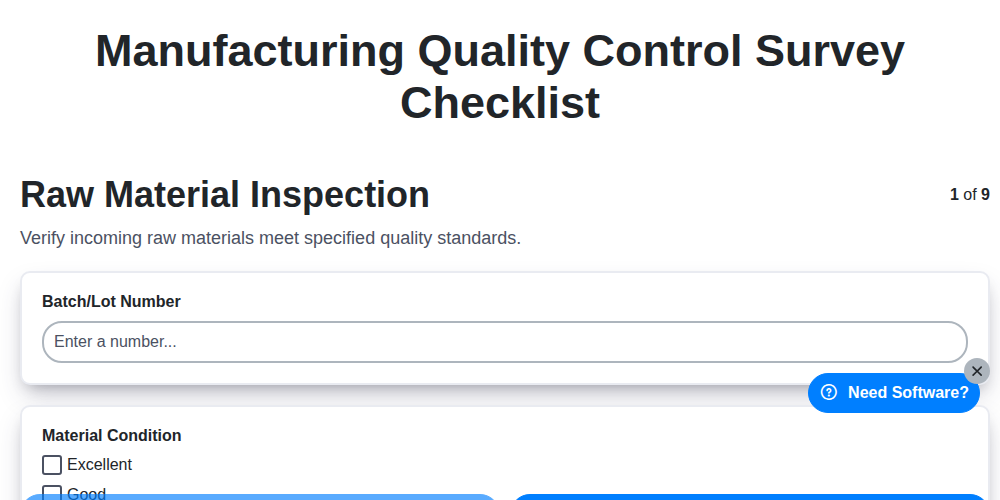
Table of Contents
- Introduction: Why a Manufacturing Quality Control Survey is Essential
- 1. Raw Material Inspection: The Foundation of Quality
- 2. Production Process Monitoring: Maintaining Consistency
- 3. In-Process Quality Checks: Catching Issues Early
- 4. Finished Goods Inspection: The Final Gatekeeper
- 5. Packaging & Labeling Verification: Protecting Your Brand
- 6. Documentation & Traceability: Ensuring Accountability
- 7. Continuous Improvement: Beyond the Checklist
- Resources & Links
TLDR: This checklist template is your guide to consistent, high-quality manufacturing. It covers everything from raw materials to finished goods, ensuring each step is inspected, documented, and traceable. Use it to proactively identify and fix quality issues, boost efficiency, and deliver superior products.
Introduction: Why a Manufacturing Quality Control Survey is Essential
Maintaining consistently high-quality products is the lifeblood of any successful manufacturing operation. A single lapse in quality can lead to costly recalls, damaged reputation, customer dissatisfaction, and ultimately, a hit to your bottom line. While robust quality control (QC) processes are crucial, regularly assessing their effectiveness is paramount. That's where a manufacturing quality control survey checklist comes into play.
This isn't just about ticking boxes; it's a proactive approach to identifying vulnerabilities and continuously improving your QC system. A well-designed survey checklist, covering all critical aspects of your manufacturing process - from raw material sourcing to final product delivery - provides an objective evaluation of your current practices. It helps pinpoint areas where training might be lacking, processes may be inefficient, or equipment may require attention. By implementing a regular survey checklist, you're not just reacting to problems; you're preventing them, ensuring consistent product excellence and bolstering customer trust.
1. Raw Material Inspection: The Foundation of Quality
The quality of your finished product is intrinsically linked to the quality of the materials that go into it. Skimping on raw material inspection is a shortcut to potential defects, rework, and ultimately, dissatisfied customers. This initial phase is more than just a formality; it's the bedrock of a robust quality control system.
Your raw material inspection checklist should be comprehensive and tailored to the specific materials you're using. Here's what it should cover:
- Supplier Verification: Confirm supplier certifications (ISO, etc.) and conduct periodic supplier audits. Don't just take their word for it - verify their processes.
- Certificate of Analysis (CoA) Review: Rigorously review CoAs for each batch, comparing the specifications with your own requirements. Don't just look for passing/failing; understand the data.
- Visual Inspection: Check for obvious defects like discoloration, contamination, damage, or inconsistencies.
- Physical Testing: Conduct necessary physical tests (e.g., tensile strength, hardness, density, color matching) using calibrated equipment.
- Chemical Analysis: If applicable, perform chemical analysis to verify composition and purity.
- Sampling & Quantity Verification: Ensure the received quantity matches the purchase order and establish a statistically sound sampling plan for inspection.
- Storage Conditions: Verify that materials are stored correctly to maintain their integrity.
Document everything! Proper records of raw material inspection, including deviations and corrective actions, are crucial for traceability and continuous improvement. Rejecting substandard materials immediately prevents them from entering the production process and saving money and time in the long run.
2. Production Process Monitoring: Maintaining Consistency
Consistent product quality hinges on vigilant monitoring of the production process itself. This isn't just about catching defects; it's about proactively identifying and mitigating potential issues before they impact quality. Our checklist emphasizes this crucial element.
What does robust production process monitoring look like? It involves a combination of scheduled checks and real-time observation. We recommend a layered approach:
- Regular Line Audits: Scheduled walk-throughs of the production line by quality personnel. These audits should focus on adherence to established procedures, visual assessment for anomalies, and a review of process parameters.
- Parameter Tracking: Key process variables (temperature, pressure, speed, mixing times, etc.) must be continuously monitored and recorded. Statistical Process Control (SPC) charts are invaluable for visualizing trends, identifying deviations, and triggering corrective actions.
- Data Analysis: Regularly review collected data to spot patterns and potential risks. This includes analyzing trends in SPC charts, examining rejection rates, and investigating any unusual events.
- Operator Feedback: Operators are often the first to notice subtle changes or potential problems. Encourage open communication and actively solicit their input and suggestions for improvement.
- Process Capability Studies: Periodically conduct studies to assess the capability of the production process to consistently meet specifications.
By consistently monitoring and analyzing these aspects of the production process, we can proactively address potential quality issues, minimize waste, and ensure a consistently high-quality output.
3. In-Process Quality Checks: Catching Issues Early
The beauty of a robust quality control system isn't just about the final product; it's about preventing defects from ever happening. That's where in-process quality checks are crucial. These aren't just random spot checks; they're strategically placed checkpoints throughout your manufacturing process, designed to identify and rectify issues before they escalate into costly rework or scrapped goods.
What should these checks entail? It depends on your specific process and potential failure points. However, common practices include:
- Visual Inspection at Key Stages: Regularly examine components and sub-assemblies for obvious defects like cracks, scratches, or incorrect placement.
- Dimensional Verification: Using measuring tools (calipers, micrometers, gauges) to ensure parts meet specified dimensions at various points.
- Functional Testing: Depending on the product, conduct functional tests to verify performance (e.g., pressure testing, electrical testing, cycle testing).
- Statistical Process Control (SPC): Implement SPC charts to monitor critical process variables and identify trends that might indicate a problem. This involves collecting data, plotting it on a control chart, and using statistical methods to detect shifts or patterns.
- First Article Inspection (FAI): Rigorous inspection of the first few units produced after a setup change or production run to verify that the process is running correctly.
- Operator Self-Inspection: Empowering operators to take responsibility for quality by incorporating checks into their daily routines.
By proactively monitoring and adjusting processes during production, you're not just catching errors; you're learning and improving your manufacturing process for the long term. Remember, early detection significantly reduces costs and ensures consistent, high-quality output.
4. Finished Goods Inspection: The Final Gatekeeper
The finished goods inspection stage represents the last line of defense against defective products reaching your customers. It's not just about a cursory glance; it's a rigorous assessment that confirms the product meets all specified requirements and quality standards. This inspection goes beyond what's been checked during production and focuses on the final product's overall performance, appearance, and adherence to design specifications.
Here's what a comprehensive finished goods inspection should cover:
- Visual Inspection: This includes checking for blemishes, scratches, color inconsistencies, and any other cosmetic defects.
- Dimensional Accuracy: Utilize measuring tools to verify that dimensions match engineering drawings and specifications.
- Functional Testing: Subject the product to its intended use conditions to ensure it operates correctly and reliably. This might involve simulating real-world scenarios.
- Performance Testing: Measure key performance indicators (KPIs) to ensure the product meets defined thresholds for things like speed, efficiency, or accuracy.
- Safety Checks: Confirm all safety features are present and functioning correctly, adhering to relevant safety standards.
- Sampling Methods: Implement appropriate statistical sampling techniques to ensure a representative assessment of the entire production lot. AQL (Acceptable Quality Limit) standards should be followed.
Thorough finished goods inspection data should be meticulously recorded, contributing to a clear audit trail and providing valuable insights for continuous improvement initiatives. Failure to catch issues at this stage can lead to costly recalls, damage to reputation, and ultimately, dissatisfied customers.
5. Packaging & Labeling Verification: Protecting Your Brand
Packaging and labeling are often overlooked in the quality control process, but they are crucial for protecting your brand reputation and ensuring product integrity. Incorrect or damaged packaging can lead to product damage, misidentification, and ultimately, customer dissatisfaction and potential recalls.
This stage of your manufacturing quality control survey checklist should be rigorous and consistent. Here's what to verify:
- Label Accuracy: Double-check that all information on the label is accurate - product name, part number, batch code, expiration date, warnings, and any required certifications. A single typo can lead to significant issues.
- Label Integrity: Assess the adhesion of the labels to the packaging. Are they securely attached and resistant to rubbing or peeling?
- Packaging Condition: Inspect the packaging for defects - tears, dents, punctures, or any signs of damage that could compromise the product inside.
- Barcodes/QR Codes: Scan and verify the accuracy of any barcodes or QR codes. Ensure they link to the correct product information and are readable.
- Compliance with Regulations: Confirm that the packaging and labeling comply with all applicable regulations and industry standards (e.g., food labeling laws, hazardous material shipping requirements).
- Branding Consistency: Ensure the packaging visually aligns with your brand guidelines and provides a professional presentation.
Consistent verification in this area minimizes returns, protects your brand image, and builds customer trust.
6. Documentation & Traceability: Ensuring Accountability
In manufacturing, a robust quality control system isn't just about identifying defects; it's about proving that processes were followed, risks were mitigated, and accountability is clear. Documentation and traceability form the bedrock of this proof.
A comprehensive documentation system should meticulously record every step of the quality control process. This includes raw material acceptance records (with lot numbers and supplier information), detailed logs of production process monitoring data, results of in-process quality checks (including who performed them and when), and finalized inspection reports for finished goods. Packaging and labeling verification checklists should also be documented, alongside records of equipment calibration and maintenance.
Beyond just recording results, traceability is paramount. This means having a clear chain of custody for materials and products, allowing you to track a finished product back to its raw materials, production parameters, and even the operator involved. Implement a system that uses unique identifiers (lot numbers, serial numbers, batch codes) to connect all these elements.
Why is this critical?
- Rapid Issue Resolution: When a non-conformance occurs, traceability allows swift identification of the root cause and affected batches.
- Regulatory Compliance: Many industries have strict regulatory requirements for documentation and traceability.
- Continuous Improvement: Documented data provides valuable insights for process analysis and ongoing improvement efforts.
- Customer Confidence: Transparency in your quality control procedures builds trust with your customers.
Ensure your documentation system is easily accessible, regularly reviewed, and incorporates clear procedures for record keeping and retention. This isn't just paperwork; it's the foundation of a reliable and defensible quality control system.
7. Continuous Improvement: Beyond the Checklist
A quality control survey checklist is a fantastic foundation, but it shouldn't be considered the finish line. Real quality excellence is built on a culture of continuous improvement. Regularly reviewing and updating your checklist itself is a great starting point. Are the checks still relevant? Are there new potential failure points emerging due to process changes or new materials?
However, going beyond the checklist means actively seeking out opportunities to enhance your processes. Encourage your team to identify inefficiencies, near misses, and potential quality risks. Implement a system for gathering feedback from operators, inspectors, and even customers. Data analysis from your quality checks should be used not just to identify defects, but to understand why they are occurring.
Consider tools like the PDCA (Plan-Do-Check-Act) cycle or Six Sigma methodologies to systematically address quality issues and drive improvements. Embrace a proactive approach - anticipate problems before they arise. Remember, quality isn't about finding flaws; it's about preventing them in the first place. This requires ongoing learning, adaptation, and a commitment to excellence from everyone involved.
Resources & Links
- International Organization for Standardization (ISO): The ISO develops and publishes international standards for quality management (ISO 9000 series), environmental management, and other aspects relevant to manufacturing excellence. Understanding these standards is crucial for designing and implementing effective quality control programs.
- American Society for Quality (ASQ): ASQ is a global resource for quality professionals, providing training, certification, and publications related to quality control, reliability, and process improvement. Their website offers a wealth of knowledge and best practices.
- National Institute of Standards and Technology (NIST): NIST develops standards and technologies to advance U.S. innovation and industrial competitiveness. Their work often contributes to metrology and measurement techniques vital for quality control in manufacturing.
- Quality Digest: A website dedicated to quality management and related topics. Provides news, articles, and resources covering quality control, Six Sigma, Lean Manufacturing, and more.
- The Lean Enterprise Institute: Focuses on Lean principles, which are often intertwined with quality control. Learn about eliminating waste and maximizing efficiency in manufacturing processes.
- Six Sigma: Provides resources and training related to Six Sigma methodologies, a data-driven approach to process improvement and quality management. Many manufacturing quality control systems utilize Six Sigma principles.
- APQC (American Productivity & Quality Center): APQC is a non-profit that offers benchmarking data and best practice research. They provide insights into quality management and operational excellence across various industries.
- Automotive Industry Action Group (AIAG): While focused on the automotive industry, AIAG's standards and guidelines (like IATF 16949) are highly regarded for quality management and supply chain excellence, and contain valuable insights applicable to other manufacturing sectors.
- U.S. Food and Drug Administration (FDA): Relevant for manufacturers in the food, pharmaceutical, and medical device industries. Provides regulations and guidance on quality control and compliance.
- Society of Manufacturing Engineers (SME): SME is a professional engineering society offering training, conferences, and publications related to manufacturing processes and technologies. Helps manufacturing professionals improve quality and productivity.
Frequently Asked Questions
What is a Manufacturing Quality Control Survey Checklist?
A Manufacturing Quality Control Survey Checklist is a structured document used to systematically assess and document the quality of manufacturing processes and products. It outlines specific points to inspect, ensuring consistency and identifying potential defects or areas for improvement.
Why should I use a Quality Control Survey Checklist?
Using a checklist ensures consistency in inspections, reduces human error, provides a documented record of quality assessments, helps identify trends and root causes of defects, and ultimately improves product quality and reduces costs.
Who should use this checklist?
This checklist is designed for quality control inspectors, production supervisors, process engineers, and anyone involved in ensuring product quality within a manufacturing environment. It can be adapted for use by both experienced and less experienced personnel.
How do I customize this checklist template?
The template provides a framework. You can add or remove inspection points specific to your product, process, and industry standards. Consider adding details like measurement tools needed, acceptable ranges, and severity ratings for defects.
What types of defects should I look for?
The specific defects to look for depend on your product. Common areas include dimensional accuracy, surface finish, material integrity, functionality, and adherence to design specifications. The checklist provides examples, but you should tailor it to your specific product.
How often should I conduct these inspections?
The frequency of inspections depends on the complexity of your product, the criticality of its function, and any regulatory requirements. Consider inspecting at various stages of the manufacturing process - raw materials, in-process, and final product.
What does 'Severity Rating' mean and how do I use it?
Severity ratings categorize defects based on their potential impact. High severity defects may cause product failure or safety concerns, while low severity defects are minor cosmetic issues. Use severity ratings to prioritize corrective actions.
What should I do if I find a defect?
Document the defect in detail on the checklist, including the location, description, severity, and any potential causes. Immediately alert the appropriate personnel (e.g., supervisor, engineer) for corrective action. Follow your company's non-conformance process.
How can I use this checklist to track trends and identify improvement opportunities?
Regularly review the completed checklists to identify patterns in defects or areas of recurring issues. Use this data to implement corrective actions, improve processes, and prevent future defects. Consider using charts or graphs to visualize the data.
Are there any industry standards I should be aware of when using this checklist?
Yes, depending on your industry (e.g., automotive, aerospace, medical devices), there may be specific quality standards (e.g., ISO 9001, AS9100) that you should adhere to. Ensure your checklist aligns with these standards.
Found this Article helpful?
Comments
There are no comments yet. Be the first to add one!
Survey Management Solution Demo
Gather valuable insights with ease! ChecklistGuro simplifies survey creation, distribution, and analysis. Automate data collection, improve response rates, and make data-driven decisions. Manage it all with our Work OS.
Related Articles
The Ultimate Veterinary Animal Health Checkup Survey Checklist Template
Your Guide to a Green Business: The Environmental Sustainability Audit Checklist

Paper vs ChecklistGuro in Survey Management
Construction Site Safety Survey Checklist Template
A Checklist for Congregant Feedback: Template for Religious Organizations

Excel vs ChecklistGuro in Survey Management
Mastering the Policyholder Journey: Your Insurance Experience Survey Checklist
Real Estate Property Condition Survey Checklist Template
We can do it Together
Need help with
Survey Management?
Have a question? We're here to help. Please submit your inquiry, and we'll respond promptly.